• 검색 결과가 없습니다.

Simulation of SI-HCCI Transition in a Two-Stroke Free Piston Engine Fuelled with Hydrogen

N/A
N/A
Protected

Academic year: 2021

Share "Simulation of SI-HCCI Transition in a Two-Stroke Free Piston Engine Fuelled with Hydrogen"

Copied!
8
0
0

로드 중.... (전체 텍스트 보기)

전체 글

(1)

DOI: http://dx.doi.org/10.7316/KHNES.2013.24.6.472 eISSN 2288-7407

수소 2행정 프리피스톤엔진의 SI-HCCI 변화에 관한 수치해석적 연구

왼바흥1ㆍ박규열2ㆍ임옥택2†

1

울산대학교 기계자동차공학과 대학원 ,

2

울산대학교 기계자동차공학부

Simulation of SI-HCCI Transition in a Two-Stroke Free Piston Engine Fuelled with Hydrogen

NGUYEN BA HUNG

1

, KYUEL PARK

2

, OCKTAECK LIM

2†

1

Grad. School of Mechanical and Automotive Engineering, University of Ulsan, Ulsan, Korea

2

Department of Mechanical and Automotive Engineering, University of Ulsan, Ulsan, Korea

Abstract >> A free piston linear engine could be operated under HCCI combustion due to its variable compression ratios. To obtain HCCI combustion, the free piston linear engine needs a high compression ratio to achieve auto-ignition of the fuel/air mixture. In this study, an idea for obtaining a high compression ratio using the transition from SI combustion to HCCI combustion was proposed. The fuel used in this study is hydrogen, which is considered to be an environmentally friendly fuel. Besides, the effects of key parameters such as equivalence ratio (ϕ), load resistance (R

L

) and intake temperature (T

in

) on the SI-HCCI transition were numerically investigated. The simulation results show that the SI-HCCI transition is successful without any significant reduction of in-cylinder pressure as the intake temperature is increased from T

in

=300K (SI mode) to T

in

=450K (HCCI mode), while the load resistance and equivalence ratio are retained respectively at R

L

=120Ω and ϕ=0.6 in both SI mode and HCCI mode.

Key words : Linear engine, Linear alternator, Equivalence ratio, Load resistance, Intake temperature

Corresponding author : [email protected]

[ 접수일 : 2013.10.23 수정일 : 2013.12.18 게재확정일 : 2013.12.31 ] Copyright ⓒ 2013 KHNES

Nomenclature

A

B

: area of piston crown P

in

:

inta

ke pressure

P

l

: pressure in left cylinder P

r

: pressure in right cylinder F

f

: friction force

F

e

: electric force

F

sl

: spring force in the left F

sr

: spring force in the right m : mass

x : displacement of translator x

0

: initial coordinate of translator a : acceleration of translator t : time

x

m

: the maximum stroke of piston p : instantaneous pressure in cylinder γ : specific heat ratio

V : instantaneous volume in cylinder

(2)

h : heat transfer coefficient A

t

: heat transfer area

T : instantaneous temperature in cylinder T

w

: wall temperature

M

F

: mean magneto motive force τ : pole pitch

τ

p

: width of permanent magnet

x

m

: coordinate of survey point in translator axis x

s

: coordinate of survey point in stator axis μ

0

: permeability

g : air gap length

B : magnetic induction density Φ : flux contained in the coil N

coil

: number of turn in the coil λ : total flux contained in the coil H : length of coil cutting magnetic line i : current in the equivalent circuit ε : voltage generating operation R

I

: internal resistance of coil R

L

: load resistance

L : induction

W : average cylinder gas velocity V

d

: displaced volume

V

r

: volume at reference state P

r

: pressure at reference state T

r

: temperature at reference state P

m

: motored cylinder pressure

Subscripts

l : left r : right

A free piston linear engine (FPLE) is considered to be a crankless internal combustion engine with free motion of a piston in a cylinder. Unlike the conven- tional engines with crankshaft mechanism, the FPLE can optimize the combustion process through the variable compression ratios

1-3)

. Besides, the variation of compression ratio in FPLE also allows the engine to operate with various kinds of fuels

4)

. Goldsborough

5)

presented a numerical study of a free piston linear engine with dual piston type. The simulation results indicated that the operating compression ratio of engine was variable, and it particularly depended on the operating conditions of the engine such as equivalence ratio, scavenging efficiency, intake temperature, etc. In addition, the authors showed that the NO

x

emission levels of the engine were significantly reduced over conventional internal combustion engine since very low equivalence ratio homogeneous-charge combustion was possible. Li

6)

submitted a simulation study of a two-stroke free piston engine for electrical power generation. Therein, the authors also investigated the performance of a free piston linear engine under HCCI combustion, and compared it with conventional engine. The simulation results showed that the piston acceleration in the free piston engine was better than that of traditional engine with a crankshaft mechanism.

Particularly, the authors indicated that by changing

external loads, the tops dead center of the engine

could be changed easily. Besides, using a lean mixture

to acquire a higher compression ratio could improve

the indicated thermal efficiency effectively in the

(3)

Fig. 1 Operating model of FPLE Fig. 2 Free body diagram of FPLE

engine.

A FPLE needs a high compression ratio to achieve auto-ignition of the fuel/air mixture as well as HCCI combustion. Therefore, an idea for obtaining a high compression ratio using the transition from SI to HCCI combustion is proposed. Further, the parameters such as equivalence ratio, load resistance, and intake temperature have a significant influence on the auto- ignition of fuel/air mixture as well as HCCI combustion.

Therefore, it is reasonable that these parameters have an effect on the transition from SI combustion to HCCI combustion. In this paper, the effects of the above parameters on the SI-HCCI transition using hydrogen fuel are investigated.

2. Operation of the FPLE

The FPLE is a combination of two main components including a free piston engine and a linear alternator, as shown in Fig. 1. To start engine, the linear alternator will operate as a beginning device to drive the free piston engine through a connecting rod system. After certain frequencies, spark plugs are activated, and the compression process will occur alternatively at each

cylinder, forcing the connecting rod to move back and forth. The movement of connecting rod will generate the current in the windings due to the magnetic flux linked with winding in stator is changed.

3. Simulation Model

3.1 Dynamic model

The forces applied on the linear engine are expressed through a free body diagram as Fig. 2.

The dynamic model is described by equation that obeys Newton’s second law:

(1)

3.2 Linear alternator model

The model of a single phase linear alternator with

permanent magnet is built as shown in Fig. 3. Therein,

the permanent magnet creates a magneto motive force

(MMF) in the air gap length.

(4)

The flux density in the air gap is calculated by equation:

(2) Where

(3)

The flux contained in the differential element dx

s

is calculated by equation:

(4)

Combine the equation (2) with the Fig. 3, the equation (4) is rewritten as follow:

(5)

Because the permanent magnet linear alternator operates on the same basic physical principles as conventional rotary alternators, so the voltage generating operation of the alternator is Faraday’s Law expressed as:

(6)

The voltage generating operation is also calculated by the equivalent circuit of the linear alternator as follow:

(8)

From the equation (8), the induced current can be easily found:

(9)

The electromagnetic force which contained in equation (1) is determined by equation:

(10)

Combine the equations (6), (7), (8) and (9), the electromagnetic force can be derived:

(11)

3.3 Thermodynamic model

The compression and expansion process are assumed

(5)

to obey an isentropic process

7)

.

The combustion process in SI mode is assumed to occur immediately after the spark occurs, which means that the ignition delay is ignored. On the other hand, in HCCI mode, auto-ignition occurs when the cylinder charge is hightly compressed after closing the exhaust port. In this study, the HCCI auto-ignition delay model is described by an Arrhenius equation

4)

The pressure in the combustion process is calculated as follow:

(12)

(13)

The heat release rate dQ

in

/dt is calculated when the mass fraction burned is known. The mass fraction burned can be found through the Wiebe function. The Wiebe function is usually used to calculate the mass fraction burned versus crank angle for crankshaft engine.

Because the FPLE has no crankshaft, the mass fraction burned is calculated as a function of time

(14)

Where, a and m are adjustable parameter (according to Heywood

7)

, a=5, m=2), t0 is the start of com- bustion, Δt is the total combustion duration.

By differential two sides of the equation (14), the mass fraction burned rate is given

(15)

From equation (15), the heat release rate can be calculated as follow:

(16)

The heat transfer rate is calculated by:

(17)

In the equation (16), the heat transfer coefficient is calculated by

7)

:

(18) Where

(19)

4. Results and discussion

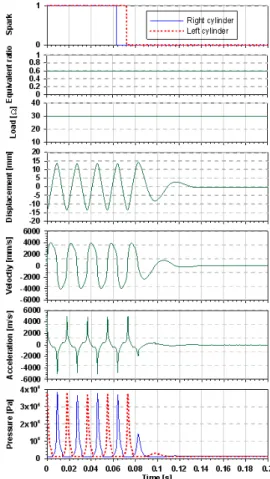
The simulation parameters are shown in Table 1, which was selected based on the operating conditions and specifications of a real FPLE. The transition from SI combustion to HCCI combustion is investigated under the variation of key parameters, as shown in Tables 2, 3 and 4, corresponding to case 1, case 2 and case 3.

In the first case (Table 2), the FPLE is directly adjusted from SI mode (spark=1) to HCCI mode (spark=0) without any change of the key parameters.

Namely, the intake temperature, equivalence ratio,

and load resistance are retained at T

in

=300K, ϕ=0.6,

and R

L

=30Ω respectively. The results of the first case

(6)

Equivalence ratio 0.6

Width of magnet 10mm

Number of turns 240

Load resistance 30Ω

The natural spring length 50mm Spring stiffness 2.9N/mm

LHV of Hydrogen 120MJ/kg

Table 2 Case 1

Parameters SI mode HCCI mode

ϕ 0.6 0.6

T

in

300K 300K

R

L

30Ω 30Ω

Table 3 Case 2

Parameters SI mode HCCI mode

ϕ 0.6 0.6

T

in

300K 450K

R

L

120Ω 120Ω

Table 4 Case 3

Parameters SI mode HCCI mode

ϕ 0.6 0.55

T

in

300K 650K

R

L

120Ω 150Ω

Fig. 4 Motion profiles of the piston and in-cylinder pressure in the transition from SI combustion to HCCI combustion (Case 1). SI mode (Spark=1), HCCI mode (Spark=0)

are shown in Fig. 4. It can be seen that the pressure in the right cylinder is dropped immediately after HCCI mode is activated. The decreased right cylinder pressure results in an extremely low left cylinder pressure, as can be seen in Fig. 4. The high imbalance in pressure between the left and right cylinders leads to decreased piston displacement, velocity, and

acceleration. To solve this problem, some parameters are adjusted as shown in Table 3 (the second case).

Therein, equivalence ratio is still retained at ϕ=0.6 in both SI mode and HCCI mode to ensure that the FPLE can be operated with a lean air/fuel mixture, while load resistance is adjusted to R

L

=120Ω in both two modes to increase piston stroke and the intake temperature is increased from T

in

=300K (SI mode) to T

in

=450K (HCCI mode) to provide a suitable auto- ignition timing of the air/fuel mixture in HCCI mode.

The results of these changes are shown in Fig. 5. It

can be seen that the transition from SI mode to HCCI

mode is successful.

(7)

Fig. 5 Motion profiles of the piston and in-cylinder pressure in the transition from SI combustion to HCCI combustion (Case 2). SI mode (Spark=1), HCCI mode (Spark=0)

Fig. 6 Motion profiles of the piston and in-cylinder pressure in the transition from SI combustion to HCCI combustion (Case 3). SI mode (Spark=1), HCCI mode (Spark=0)

As can be seen in Fig. 5, the transition from SI mode to HCCI mode takes place successfully as the FPLE is operated with an equivalence ratio ϕ=0.6 and the other parameters as shown in Table 3. In order to examine the operating behavior of the FPLE at a smaller equivalence ratio in HCCI mode, the engine is operated by changing the key parameters as shown in Table 4 (the third case).

In the third case, equivalence ratio is adjusted from ϕ=0.6 (SI mode) to ϕ=0.55 (HCCI mode). The smaller equivalence ratio in HCCI mode results in reduced pressure in the left and right cylinders as well as reduced piston stroke. Therefore, to ensure that the piston stroke is not so much reduced, the load resistance should be increased to a suitable

value. Here, the load resistance is adjusted from R

L

=120Ω (SI mode) to R

L

=150Ω (HCCI mode).

Besides, the intake temperature is increased from T

in

=300K (SI mode) to T

in

=650K (HCCI mode) for controlling the appropriate auto-ignition timing of the air/fuel mixture in HCCI mode. The results of these change are shown in Fig. 6.

As can be seen in Fig. 6, the transition from SI mode to HCCI mode is successful. However, the peak pressure in the left and right cylinders is much reduced in HCCI mode, compared with SI mode.

This is because the air density is reduced as the intake temperature is increased, as shown in Table 4.

As a result, the piston acceleration and velocity are

decreased.

(8)

and load resistance on the transition from SI combustion to HCCI combustion has been investigated. The simulation results indicated that the SI-HCCI transition was successful if the key parameters were adjusted appropriately. In order to ensure that the FPLE could be operated in the successful transition without any significant decrease of the in-cylinder pressure, the engine should be operated using the second case.

Acknowledgements

This research was financially supported by the “R&D Infrastructure for Green Electric Vehicle (RE-EV)”

through the Ministry of Trade Industry & Energy(MOTIE) and Korea Institute for Advancement of Technology (KIAT) and the Ministry of Education (MOE) and National Research Foundation of Korea (NRF) through the Human Resource Training Project for Regional Innovation.

Direct Injection Linear Engine”, SAE Technical Paper, 2002-01-1739, 2002.

3. A.P. Kleemann, J.C. Dabadie, S. Henriot, “Comput- ational Design Studies for a High-Efficiency and Low-Emissions Free Piston Engine Prototype”, SAE Technical Paper, 2004-01-2928, 2004.

4. J. Fredriksson and I. Denbratt, “Simulation of a Two-Stroke Free Piston Engine”, SAE Technical Paper, 2004-01-1871, 2004.

5. S.S. Goldsborough and P.V. Blarigan, “A numerical study of a free piston IC engine operating on homogeneous charge compression ignition combus- tion”, SAE Technical Paper, 1999-01-0619, 1999.

6. Q.F. Li, J. Xiao, Z. Huang, “Simulation of a two-stroke free piston engine for electrical power generation”, Energy & Fuel, vol. 22, pp. 3443- 3449, 2008.

7. J. Heywood, “Internal combustion engine fundam-

entals”, McGraw-Hill Book Company, New

York, USA, 1998.

수치

Fig. 1 Operating model of FPLE Fig. 2 Free body diagram of FPLE
Table 2 Case 1
Fig. 5 Motion profiles of the piston and in-cylinder pressure  in the transition from SI combustion to HCCI combustion  (Case 2)

참조

관련 문서

The metal biopsy test of both specimens did not show any microscopic cracks in the heat affected zone and the base metal, and both samples were free from

Using selected engine performance simulation results as input to the intake faces of the nozzles and ejector CFD simulation to determine pressure loss, temperature levels and

using the fiber and Matrix properties obtained from previous study.(Simulation specimen is same experiment specimen.) Compare the simulation results

(a) is without vibration condition, (b) is with vibration casting condition... Figure 4.24 Measured proportional constant a as a function of Si content in Al-Si binary

“Simplifying Simulation Modeling through Integration with 3D CAD.” Journal of Construction Engineering and Management, Volume 126, Issue 6, pp.

Example 16.5: Small-Signal Gain Variation of NMOS Inverter..  the small-signal gain is the largest in

→ The simulation of turbulence in heat and mass transport models is always important because the scalar transport equation does not contain any pressure gradient

: In this type of problem, overall composition (z i ), pressure (P), and temperature (T) are given, and the composition of the liquid and vapor phases is required.. •