• 검색 결과가 없습니다.

Sintering Behavior of Ag-Ni Electrode Powder with Core-shell Structure

N/A
N/A
Protected

Academic year: 2021

Share "Sintering Behavior of Ag-Ni Electrode Powder with Core-shell Structure"

Copied!
6
0
0

로드 중.... (전체 텍스트 보기)

전체 글

(1)

한국표면공학회지 J. Korean Inst. Surf. Eng.

Vol. 49, No. 6, 2016.

https://doi.org/10.5695/JKISE.2016.49.6.507

<연구논문>

ISSN 1225-8024(Print) ISSN 2288-8403(Online)

Sintering Behavior of Ag-Ni Electrode Powder with Core-shell Structure

Kyung Ho Kim

a

, Jun-Mo Koo

a

, Sung-Soo Ryu

a

, Sang Hun Yoon

b

, Yoon Soo Han

a,*

a

Engineering Ceramic Center, Korea Institute of Ceramic Engineering and Technology , Icheon, 17303, Korea

b
Munmoo CO., LTD., Hwaseng 18623, Korea

(Received November 26, 2016 ; revised December 20, 2016 ; accepted December 21, 2016)

Abstract

Expensive silver powder is used to form electrodes in most IT equipment, and recently, many attempts have been made to lower manufacturing costs by developing powders with Ag-Ni or Ag-Cu core-shell struc- tures. This study examined the sintering behavior of Ag-Ni electrode powder with a core-shell structure for silicon solar cell with high energy efficiency. The electrode powder was found to have a surface similar to pure Ag powder, and cross-sectional analysis revealed that Ag was uniformly coated on Ni powder. Each electrode was formed by sintering in the range of 500

o

C to 800

o

C, and the specimen sintered at 600

o

C had the lowest sheet resistance of 5.5 mΩ/□, which is about two times greater than that of pure Ag. The micro- structures of electrodes formed at varying sintering temperatures were examined to determine why sheet resis- tance showed a minimum value at 600

o

C. The electrode formed at 600

o

C had the best Ag connectivity, and thus provided a better path for the flow of electrons.

Keywords : Core-shell, Silver, Nickel, Electrode, Sintering

1. Introduction

With the depletion of energy sources such as petroleum and coal, and the worsening problem of global warming, advanced countries have turned their eyes on renewable energy as a solution. Among the various types of renewable energy, solar cells serve as an unlimited energy source as they convert the sun’s energy into electricity. Unlike other power- generating devices, they are quiet, safe and environ- mentally-friendly. Depending on the raw material, solar cells can be divided into silicon solar cells, compound semiconductor solar cells and dye- sensitive solar cells [1-9]. In the current solar cell market, silicon solar cells are the most widespread [10].

Configured as a p-n junction, silicon solar cells

consist of an anti-reflective coating for better absorption of light, a front electrode to draw out electron-electron hole pairs, and a back electrode.

When exposed to sunlight, electrons and electron holes are generated at the silicon semiconductor doped with impurities due to the photovoltaic effect.

The electrons and electron holes generated by the photovoltaic effect are pulled to the n-type silicon semiconductor and p-type semiconductor and move to the front electrode and back electrode, which are attached to the lower end of the substrate and the upper emitter layer, respectively. Current flows when these electrodes are connected. In general, the electrodes of solar cells are formed by screen printing. The front electrode is made of silver, while the back is made of aluminum or silver. Sintering is used as a heat treatment for electrodes to come into contact with the silicon substrate. The front electrode is formed by coating silver paste followed by sintering. Expensive silver powder is used to achieve high resistance to oxidation under high-temperature

* Corresponding Author :Yoon Soo Han

Engineering Ceramic Center, Korea Institute of Ceramic Engineering and Technology

Tel : +82-31-645-1457 ; Fax: +82-31-645-1485

E-mail : [email protected]

(2)

form electrodes of the Ag-Ni powder, sintering was carried out at temperatures greater than 500

o

C. The optimal temperature for electrode formation was derived by measuring the sheet resistance of the electrodes. The temperature dependency of electrode sheet resistance was explained through microstructural and compositional analysis.

2. Experimental Method

To prepare the paste composition for printing, this study mixed Ag-Ni powder(Munmoo CO., LTD., Korea) with glass frit(Dongjin SemiChem. CO., LTD., Korea). A mini mill was used for the dry mixing process as only a small number of specimens were involved. The powder was placed in a mortar and mixed with ethyl cellulose (Ethocel STD 100, Dow Chemical, USA) as a binder, BYK-103 (Altana Group, Germany) as a dispersing agent, and toluene and ethanol as a solvent. After attaching a 250 mesh screen mask on a manual screen printer, a squeegee was used to print the electrode paste on the silicon substrate. The silicon substrate was made up of solar cells with an SiN anti-reflective coating. Instead of a general electric furnace, sintering was performed in an rapid thermal annealing (RTA) furnace to raise the rate of temperature increase. The sintering profiles were maintained for 10 minutes at 350

o

C for binder burnout, and heated at a rate of 40

o

C/min until the final sintering temperature was reached. The profiles were maintained for two minutes at the maximum temperature before cooling, and the sheet resistance of the sintered specimens was measured using a 4 point probe. Before using the 4 point probe, zero point calibration was performed with a standard Si sample. FE-SEM was employed to observe the microstructure of the specimens. For cross-sectional observations, specimens were prepared by mixing Ag powder with EpoFix resin and polishing them to 1 µm.

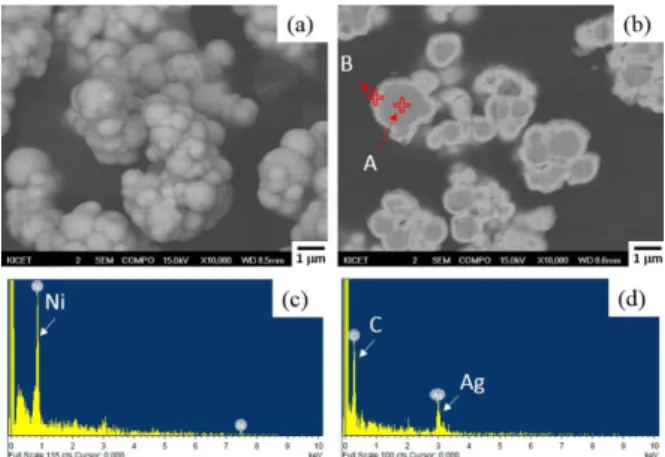
area marked with a cross and labeled A is the inside of the Ni particle, and the bright gray area marked with a cross and labeled B is the Ag coating layer.

Compositional analysis was performed, and the results are presented in Fig. 1(c) and 1(d). In Fig. 1(c), which gives the composition of point A in Fig. 1(b), only pure Ni elements were detected. In Fig. 1(d), which gives the composition of point B in Fig. 1(b), both Ag and C elements were detected. The C element is presumed to have originated from the resin, and the results demonstrate that the Ag-Ni powder has a distinct core-shell structure.

Figure 2 was obtained from Raman analysis of the surface of the Ag-Ni powder. The Raman spectrum of Ag-Ni powder is presented together with that of pure Ag. The two specimens have the same Raman peak, and both surfaces were found to have highly similar chemical properties.

Figure 3 shows the microstructure of fracture surfaces after forming electrodes from Ag-Ni powder sintered at temperatures of 500, 600, 700 and 800

o

C.

In the micrograph of Fig. 3(a), the surface roughness is similar to that of the raw powder. In Fig. 3(b), the Ag shell gradually disappears, and we can start to observe the surface of Ni particles. However, the

Fig. 1. Micrographs of Ag-coated Ni powder (a) as-

received, (b) cross-section; and its composition by

EDS (c) A point (d) B point. Note that A point shows

Ni element and B point shows Ag and C elements.

(3)

surface of the exposed Ni particles has a low roughness. In Fig. 3(c), the Ag shell is still partially present, but significantly less compared to the specimen sintered at 600

o

C. More of the Ni powder is exposed, and the rougher, bumpier surface is different from that of the Ni surface observed at 600

o

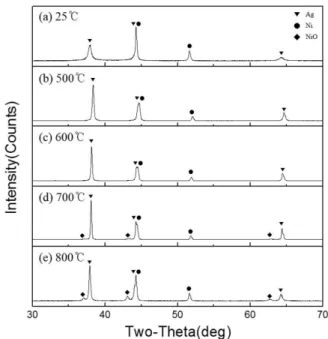
C. This tendency grows more prominent at higher sintering temperatures. In Fig. 3(d), the Ag particles are not connected, and the exposed Ni powder has a rough surface. To determine the cause behind such differences in microstructure, XRD analysis was performed on heat-treated Ag-Ni powders, and the results are shown in Fig. 4. The raw powder has both Ag and Ni peaks, but the Ag-Ni powder heat-treated at 800

o

C has an intense peak corresponding to NiO. The changes on the surface of the Ni powder can be traced to the NiO oxide layer formed when Ni is oxidized.

Additionally, compositional analysis was conducted on the sample sintered at 700

o

C to prove the existence of NiO. As shown in Fig. 5, we can distinguish the silver surface from the nickel oxide surface clearly.

Figure 6 shows the sheet resistance of electrodes formed from the sintering of Ag-Ni powder at varying temperatures of 500, 600, 700 and 800

o

C.

The lowest sheet resistance was observed for the specimen sintered at 600

o

C, and sheet resistance values increased with sintering temperature. The minimum sheet resistance of the Ag-Ni electrode was approximately 5.5 mΩ/□. This is two times greater than that of the electrode made from pure Ag powder, which has a sheet resistance of 2 - 3 mΩ/□.

To analyze the phenomenon of the minimum sheet resistance being achieved at a sintering temperature Fig. 2. Raman spectrum of surface of Ag-coated Ni

powder and pure Ag powder.

Fig. 3. Micrographs of Ag-coated Ni powders sintered at (a) 500

o

C, (b) 600

o

C, (c) 700

o

C, and (d) 800

o

C.

Fig. 4. X-ray diffraction patterns of (a) as-received and heat-treated Ag-coated Ni powders at (b) 500, (c) 600, (d) 700, and (e) 800

o

C. Note that NiO peak is shown at 700

o

C.

Fig. 5. Micrographs of Ag-coated Ni powders sintered

at 700

o

C and its EDS mapping images for silver,

nickel, and oxygen elements.

(4)

of 600

o

C, the cross-sections of electrodes sintered at different temperatures were polished and observed as shown in Fig. 7. As explained for Fig. 1(b), the black area is filled with resin, the dark gray is the inside of the Ni particle, and the light gray area is the Ag coating. In Fig. 7(a), which shows the electrode sintered at 500

o

C, the surface of the Ni powder is wrapped by the Ag coating. The low sintering temperature prevents the mass transport of Ag atoms, and the formation of incomplete necks between powders resulted in poor Ag connectivity. The areas disconnected due to the formation of incomplete necks on the powder surface are marked with white arrows in Fig. 7(a). This restricts the flow of electrons, and thus raises the electrical resistance of electrodes. Fig. 7(b) shows the cross-sectional micro- structure of the electrode sintered at 600

o

C. The Ag coatings on powder surfaces are in contact with one another. This superior connectivity is advantageous in lowering the resistance of electrodes. Fig. 7(c) and 7(d) show the cross-sectional images of electrodes sintered at 700

o

C and 800

o

C respectively. As can be seen in Fig. 3, the surface of the Ni powder begins to be exposed, and the exposed surface turns into NiO.

Silver, which facilitates the flow of electrons, becomes only partially clustered and exhibits an isolated structure. The formation of an oxide layer

and the structural isolation of Ag contribute to lowering the electrical conductivity of electrodes, which is consistent with the decrease in electrical conductivity with increasing sintering temperature shown in Fig. 6.

For Ag-Ni electrodes sintered at high temperatures above 600

o

C, the inter-solubility of Ag and Ni elements can be considered a factor contributing to the increase in sheet resistance, in addition to the aforementioned isolated structure. As shown in Fig. 8, the solubility of each element can be derived from the phase diagram of the Ag-Ni alloy system [14]. The Ag-Ni inter-solubility is insignificant at heat treatment below 700

o

C, but the solubility of Ag in Ni grows more substantial above 700

o

C. On the other hand, the solubility of Ni in Ag at temperatures greater than 700

o

C is highly limited. In other words, there is a small possibility of Ag lowering the Fig. 6. Sheet resistance of electrodes with Ag-coated

Ni powders depending on sintering temperature. Note that the sheet resistance shows a minimum value at 600

o

C, but increases as sintering temperature increases.

The minimum value of sheet resistance of Ag-Ni powder is still higher than that of pure Ag powder.

Fig. 7. Cross sectional micrographs of Ag-coated Ni powders sintered at (a) 500

o

C, (b) 600

o

C, (c) 700

o

C, and (d) 800

o

C.

Fig. 8. Phase diagram of Ag-Ni alloy system [14].

(5)

electrical conductivity with the dissolution of Ni.

Figure 9 shows the EDS line scanning profiles of powders in the sintered electrodes. Fig. 9(a) is the result for the electrode powder sintered at 600

o

C, and Fig. 9(b) is for the electrode powder sintered at 800

o

C. For the electrode powder sintered at 600

o

C, the Ag element is strongly detected in the area corresponding to the coating, and the Ni element in the area corresponding to the inside of the powder.

Meanwhile, an interdiffusion layer exists at the interface of Ag and Ni. In this area, a concentration gradient is observed from the Ag element to the inside of the Ni powder, and from the Ni element to the Ag coating. However, the concentration gradient in the interdiffusion layer is limited due to the low sintering temperature and short period of maintenance, and we can presume that the electrical properties of electrode powders are largely unaffected. For the electrode powder sintered at 800

o

C, EDS line scans of the Ni particle did not show a strong presence of Ag inside the powder or on the surface. The Ni particle observed in the microstructure is thus unlikely to have a significant influence on electrical conductivity. In case of metal electrode formation from the Ag-Ni core-shell powder, a factor contributing to changes in the electrical conductivity of electrodes in relation to sintering temperature was not the Ag-Ni alloying, but both of the connectivity of Ag and the surface oxidation of Ni particles.

4. Conclusion

This study examined the sintering behavior of Ag- Ni electrode powder with a core-shell structure. The electrode powder was found to have a surface similar to pure Ag powder, and cross-sectional analysis revealed that Ag was uniformly coated on Ni powder. Each electrode was formed by sintering in the range of 500

o

C to 800

o

C, and the specimen sintered at 600

o

C had the lowest sheet resistance of 5.5 mΩ/□, which is about two times greater than that of pure Ag. The electrode formed at 600

o

C had the best Ag connectivity, and thus provided a better path for the flow of electrons.

Acknowledgments

This research was supported by a grant from the R&D Program for Technology Innovation Development (Grant#S2225724), funded by the Small and Medium Business Administration, Republic of Korea.

References

[1] J. Zhao, A. Wang, P. P. Altermatt, S. R. Wenham.

M. A. Green, 22% efficient perl silicon solar cell:

Recent improvements in high efficiency silicon cell research, Sol. Energ. Mat. Sol. C., 41 (1996) 87-99.

[2] J. Zhao, A. Wang, M. A. Green, 24.5% efficiency PERT silicon solar cells on SEH MCZ substrates and cell performance on other SEH CZ and FZ substrates, Sol. Energ. Mat. Sol. C., 66 (2001) 27-36.

[3] M. A. Green, J. Zhao, A. Wang, S. R. Wenham, Progress and outlook for high-efficiency crystalline silicon solar cels, Sol. Energ. Mat. Sol. C., 65 (2001) 9-16.

[4] J. Zhao, Recent advances of high-efficiency single crystalline silicon solar cells in progressing technologies and substrate materials, Sol. Energ.

Mat. Sol. C., 82 (2004) 53-64.

[5] I. Repins, M. A. Contreras, B. Egaas, C. Dehart, J. Scharf, C. L. Perkins, B. To, R. Noufi, 19.9%- efficient ZnO/CdS/CuInGaSe

2

solar cell with 81.2%

fill factor, Prog. Photovoltaics, 16 (2008) 235-239.

[6] P. Jackson, D. Hariskos, E. Lotter, S. Paetel, R.

Wuerz, R. Menner, W. Wischmann, M. Powalla, New world record efficiency for Cu(In,Ga)Se

2

thin- film solar cells beyond 20%, Prog. Photovoltaics, 19 (2011) 894-897.

[7] A. Hagfeldt, G. Boschloo, L. Sun, L. Kloo, H.

Fig. 9. EDS line scanning profiles of Ag-coated Ni

powders (a) 600

o

C and (b) 800

o

C.

(6)

Ni-Ag core-shell nanoparticles with magnetic, optical and anti-oxidation porperties, Nanotechnology,

[14] M. Singleton, P. Nash, The Ag-Ni (silver-Nickel)

system, J. Phase Equilib., 8 (1987) 119-121.

수치

Figure 2 was obtained from Raman analysis of the surface of the Ag-Ni powder. The Raman spectrum of Ag-Ni powder is presented together with that of pure Ag
Figure 6 shows the sheet resistance of electrodes formed from the sintering of Ag-Ni powder at varying temperatures of 500, 600, 700 and 800 o C.
Fig. 8. Phase diagram of Ag-Ni alloy system [14].
Figure 9 shows the EDS line scanning profiles of powders in the sintered electrodes. Fig

참조

관련 문서

또한 생물학적 방법으로 lemongrass 잎 추출물을 이용한 삼각형 형태의 Au core-Ag shell 나노입자 합성이 Rai 등에 의해 보고되었다[4].. 본 연구진은 최근 감잎,

“Effects of core/shell volumetric ratio on the dielectric- temperature behavior of BaTiO 3 ”, J.. Lin, “TEM microstructures of X7R type base-metal electroded BaTiO 3