This is an Open Access article distributed under the terms of the Creative Commons Attribution Non-Commercial License (http: //creativecommons.org/licenses/by- nc/4.0/) which permits unrestricted non-commercial use, distribution, and reproduction in any medium, provided the original work is properly cited.
Copyright: © 2019 Korean Journal of Agrcultural Science
https://doi.org/10.7744/kjoas.20180089
PLANT & FOREST
Antioxidant activity and phenolic acid
content of Gynostemma pentaphyllum leaves according to extraction conditions
Hyun Min Ko
1, Tae Kil Eom
2, Ju-Sung Kim
1,*1
Major in Plant Resource and Environment, SARI, Jeju National University, Jeju 63243, Korea
2
Subtropical/Tropical Organism Gene Bank, SARI, Jeju National University, Jeju 63243, Korea
*
Corresponding author: [email protected]
Abstract
This study was intended to provide basic data for a health functional food study by exploring antioxidant activity of reflux extract according to the concentration of ethanol and the extract of ultrasonic waves extracted and reflux extracted under the same solvent conditions. In the same solvent condition, the reflux extract (75.10 ± 1.99 mg) showed a higher total phenol content than the ultrasonic wave extract (51.74 ± 2.28 mg). Flavonoids also had a higher reflux extract (25.05 ± 1.53 mg) than did ultrasonic extracts (16.23 ± 1.95 mg). Reflux extract according to ethanol concentration was found to have a higher phenol content than the 70%
ethanol extract (40.60 ± 1.49 mg) in 60% ethanol extract. Flavonoid content was also similar to phenol content in reflux extract as determined by ethanol concentration from 60% ethanol (25.05 ± 1.53 mg) to 70% ethanol extract (6.60 ± 0.46 mg). In addition, the antioxidant activity (DPPH, TEAC, FRAP, ORAC) of the reflux extract in the same solvent conditions tended to be higher than that of ultrasonic extracts. Also, 60% ethanol extract had better antioxidant activity than 70% ethanol extract. However, an analysis of phenolic acid content through HPLC showed that the ultrasonic extract had a higher content in the same solvent condition than did the reflux extract. Not only the presence of phenolic acid, but also those of other compounds are believed to be attributed to the activity of antioxidants. Therefore, further studies are needed to clarify this phenomenon.
Keywords: antioxidant, benzoic acid, cinnamic acid, extract condition, phenolic acid
Introduction
활성산소에는
hydroxyl radical
(OH
·),superoxide radical
(O
2-),hydrogen peroxide
(H
2O
2) 등이 있으며 체내에서 생성되어 세포 신호 전단 및 각종 감염으로부터 세포를 보호하는 작용을 하지만 과량의 활성산소는 생체를 구성하는 분자인 단백질, 지질 및 핵산 등과 반응하여 손상을 유발하여 다양한 질환의 원인으로 알려지고 있다(Bajpai et al
.,2017
). 이러한 활성산소를 억제하기 위한 물질에는 항 산화 효소인catalase
,superoxide dismutase
(SOD
),glutathione peroxidase
등과 합성 산화방지제인OPEN ACCESS
Accepted: November 30, 2018 Revised: November 26, 2018 Received: July 2, 2018 DOI:
Citation: Ko HM, Eom TK, Kim JS. 2019.
Antioxidant activity and phenolic acid content of Gynostemma pentaphyllum leaves according to extraction conditions.
Korean Journal of Agricultural Science.
https://doi.org/10.7744/kjoas.20180089
butylated hydroxy anisole
(BHA
)와butylated hydroxytoluene
(BHT
) 등이 있다. 식품과 화장품 등의 산화 방지 목적으로 주로 합성 산화방지제를 사용했으나 독성을 가지고 있는 것이 문제가 되어 최근에는 안전한 항산화제를 탐색하고자 천연물의 기능성 연구가 활발히 진행되고 있다(Lee et al
.,2003
).돌외(
Gynostemma pentaphyllum
)는 박과에 속하는 다년생 덩굴 식물로 주로 산이나 숲 속에서 자라며 국내에는 제주 등 남쪽 지방의 섬에 분포한다. 잎은 길이4
-8 cm
, 폭2
-3 cm
로5
개의 작은 잎으로 구성되어 있다. 잎의 주성분은gypenoside
,chlorogenic acid
,flavonoids
등으로 항산화, 항염증 및 심혈관계 질환에 효과가 있으며 예로부터 차의 원료로 사용되어 왔다 (Jeong et al
.,2011
;amec et al
.,2016
). 선행연구 결과로는 항당뇨효과(Huyen et al
.,2012
), 돌외 잎70
% 에탄올 추출물은 콜 라겐 형성 촉진에 의한 주름개선 효능(Yim et al
.,2014
), 열처리된 돌외 잎의 에탄올 추출물의 암세포 억제 효과가 보고되 었다(Piao et al
.,2014
). 또한 돌외 에탄올 추출물 및 분획물의 항산화능과 세포보호효과가 보고되어 있다(Kim et al
.,2017
).하지만 추출방법을 달리하여 항산화능을 연구한 결과는 보고되어 있지 않다. 이에 본 연구에서는 돌외 잎의
60
,70
% 에탄 올 환류냉각 추출물,60
% 에탄올 초음파 추출물을 가지고 실험을 진행하여 각 추출조건에서 나타나는 항산화 활성을 탐 색함으로써 건강 기능성 식품 연구의 기초자료로 제공하고자 하였다.Materials and Methods
실험재료
본 실험에 사용한 돌외 잎은 (주)한라산소주(
Hallasan Soju
,Jeju
,Korea
)에서 제공받아 추출물을 제조하였다. 돌외 잎을0
.5 mm
크기 미만으로 분쇄하였으며, 환류냉각 추출물은 각각60
,70
% 에탄올을 시료 중량의30
배를 첨가하여80
℃ 온도 에서90
분간 추출한 후 여과하였으며 동일 과정을3
회 반복하였다. 초음파 추출물은60
% 에탄올을 시료 중량의30
배를 첨 가하였으며 초음파 추출기(Power sonic 520
,Hwashin Technology Co
.,Seoul
,Korea
)를 사용하여90
분간 추출 후 여과하였고 다음의 과정을3
회 반복하였다. 여과된 추출물은 감압농축기(Hel
-VAP Precision
,Heidolph
,Germany
)를 사용하여 농축하였 고 이후 동결건조하여 실험을 진행하였다.총 페놀 및 플라보노이드 함량 측정
돌외 잎 추출물의 폴리페놀 함량은
Ko et al
. (2017
)의 방법을 사용하여 측정하였다. 추출물20 μL
에 증류수700 μL
를 첨 가한 후Folin
-Ciocalteu
시약100 μL
를 넣어 섞어준 뒤 상온에서2
시간동안 방치하고20
%sodium carbonate
를100 μL
씩 혼합 하여1
시간동안 반응시켰다. 흡광도는i
-Mark microplate reader
(168
-1135
,Bio
-Rad
,Hercules
,USA
)로750 nm
에서 측정하였 다. 추출물의 흡광도는gallic acid
로 작성된standard curve
를 이용하여GAE
(gallic acid equivalent
)로 나타내었다.플라보노이드 함량은
Kim et al
. (2012
)의 방법을 참고하여 측정하였다. 추출물100 μL
에ethanol 300 μL
,10
%aluminum nitrate 20 μL
,1 M potassium acetate 20 μL
와 증류수560 μL
를 가하여 혼합한 후1
시간동안 반응시켰다. 이후microplate reader
를 사용하여415 nm
에서 흡광도를 측정하였다. 추출물의 흡광도는quercetin
을 이용하여 작성된standard curve
를 이용하여QE
(quercetin equivalent
)로 나타내었다.1,1-diphenyl-2-picrylhydrazyl (DPPH) radical 소거능 측정
돌외 잎 추출물의
DPPH radical
소거능은Blois
(1958
)의 방법을 변형하여 측정하였다. 추출물40 μL
에0
.15 mM DPPH
160 μL
를 더하여 혼합한 뒤 암실에서30
분간 방치하였다. 추출물의 흡광도는microplate reader
를 사용해490 nm
에서 측정 하였다.DPPH radical scavenging activity
(%) = [1
- (Abs of the sample
-Abs of the blank
) /Abs of the control
] ×100
으로 나타내었다.
Trolox equivalent antioxidant capacity (TEAC) 측정
2
,2
'-Azino
-bis
(3
-ethylbenzothiazoline
-6
-sulfonic acid
) (ABTS
)radical
소거능 측정은Zulueta et al
. (2009
)의 방법을 변형해서 측 정하였다.7 mM ABTS
와2
.45 mM potassium persulfate
를 혼합시킨 후 암실에서 하루 동안 방치시켜 생성된ABTS radical
은 실험하기 전734 nm
파장에서optical density
값이0
.70
±0
.02
가 되도록 한 후 본 실험에 사용하였다.ABTS 1 mL
에 추출물50 μL
를 가하여5
분간 반응시키고UV
-spectrometer
(UV
-1800
,Shimadzu
,Japan
)를 이용해734 nm
에서 흡광도를 측정하였다.Trolox
를 사용해standard curve
를 작성하고 추출물1 g
당trolox
농도(mM trolox equivalent
[TE
]/g
)로 나타내었다.Ferric reducing antioxidant power (FRAP) 측정
FRAP
은Benzie and Strain
(1996
)법을 참고하여 측정하였다.FRAP working solution
은0
.3 M sodium acetate buffer
(pH 3
.6
),20 mM FeCl
3,10 mM 2
,4
,6
-tripyridyls
-triazine
(TPTZ
)를10
:1
:1
의 비율로 혼합한 후37
℃에서30
분간 반응시켜 사용하였다.추출물
50 μL
에FRAP working solution 150 μL
를 가하며37
℃에서15
분간 반응시켰다. 이후microplate reader
를 사용해595 nm
에서 흡광도를 측정하였다.FeSO
4를 사용해standard curve
를 작성하고 추출물1 g
당FeSO
4 환원력(mM FeSO
4/g
)으로 나 타내었다.Oxygen radical absorbance capacity (ORAC) 측정
돌외 잎 추출물의
ORAC
지수 분석은Hwang et al
. (2013
)의 방법을 변형하여 측정하였다.Black 96
-well plate
에 추출물50 μL
와78 nM fluorescein
용액150 μL
를 첨가 후37
℃에서10
분간 반응하였다. 이후 반응액에221 mM 2
,2
'-azobis
(2
-aminopropane
)dihydrochloride
(AAPH
)를 첨가하였으며fluorescence microplate reader
를 이용하여excitation 485 nm emission 535 nm
에서1
분 간격으로1
시간동안 형광도를 측정하였다.Trolox
를 표준시약으로 사용하였으며 각 추출물과 표준시약 의area under the curve
(AUC
) 값을 작성하였다.ORAC
지수는trolox
로 작성된 표준검량곡선에 따라1 g
당trolox
농도(mM TE
/g
)로 나타내었다.Phenolic acid 정량 분석
돌외 잎 추출물의
phenolic acid
정량은high
-performance liquid chromatography
(HPLC
-DAD
,Shimadzu
,Japan
)를 사용하여 분 석하였다.Column
은YMC
-Triart C18 column
(250
×4
.6 mm I
.D
.5 μM Hybrid silica
-based ODS
,YMC
,Korea
)를 사용하였고 이동상은 용매A
와B
로A
상은trifluoroacetic acid
가0
.1
% 함유된 증류수,B
상은trifluoroacetic acid
가0
.1
% 함유된 메탄올을 사용하였다. 용매조건은A
:90
%,B
:10
%로 시작하여10 min
에A
:80
%,B
:20
%,20 min
에A
:75
%,B
:25
%,30 min
에A
:72
.5
%,B
:27
.5
%,45 min
에A
:60
%,B
:40
%,50 min
에A
:40
%,B
:60
%,55 min
에A
:0
%,B
:100
%,62 min
에A
:90
%,B
:10
% 로 하여 분석하였다. 유속은1 mL
/min
으로 하였고column
의 온도는40
℃로 고정하여 분석하였으며 검출파장은260 nm
를 사용하였다. 각standard
는methanol
에 녹여6
.25
,12
.5
,25
,50
,100
,200 μg
/mL
로 만들어 검량선을 작성하여 정량하였다.통계분석
본 연구는
3
회 반복 실험하였고 실험 결과는average
±standard deviation
으로 나타내었고, 각 실험군의 통계처리는SPSS
(Statistical Package for the Social Sciences
,ver 18
.0
,SPSS Inc
.,Chicago
,USA
)를 사용하여 분산분석을 실시하였다. 유의적 차 이가 있는 항목에는Tukey
의 다중범위검정(Tukey Multiple Range Test
,TMRT
)을 사용하여 통계학적 유의성을 분석하였다 (p
<0
.05
).Results and Discussion
총 페놀 및 플라보노이드 함량
돌외 잎 추출물의 총 페놀 및 플라보노이드 함량은
Table 1
과 같다. 동일 용매조건에서 환류냉각 추출물(75
.10
±1
.99 mg
)은 초음파 추출물(51
.74
±2
.28 mg
)보다 더 높은 페놀 함량을 나타내었다. 플라보노이드 함량 또한 총 페놀 함량과 유 사한 경향으로 환류냉각 추출물(25
.05
±1
.53 mg
)이 초음파 추출물(16
.23
±1
.95 mg
)보다 높았다. 이는Kang and Lee
(2013
) 가 보고한 바와 같이 고온에서 용질이 추출됨에 따라poly phenol
의 구조가 고분자에서 저분자로 전환되었기 때문에 고온 에서 추출하는 환류냉각 추출물의 폴리페놀 함량이 더 높게 나타난 것으로 생각된다. 또한 환류냉각 추출물 간 비교에서 는60
% 에탄올 추출물에서70
% 에탄올 추출물(40
.60
±1
.49 mg
)보다 더 높은 페놀 함량이 측정되었다. 플라보노이드 함 량도60
% 에탄올(25
.05
±1
.53 mg
)에서70
% 에탄올 추출물(6
.60
±0
.46 mg
)보다 더 높은 경향을 보였다. 이는Cho et al
. (2005
)의 연구결과인 복분자60
% 에탄올 추출물은70
% 에탄올 추출물보다 페놀함량이 더 높게 측정되었다는 부분과 비슷한 결과를 보였다.항산화 능력 측정
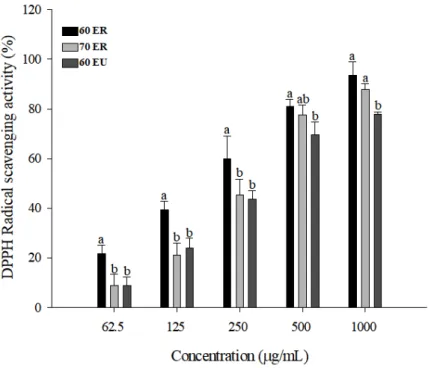
돌외 잎 추출물의
DPPH radical
소거활성은Fig
.1
에 나타내었다. 각 추출물은 농도가 높아짐에 따라DPPH radical
소거 활성이 증가하였다. 동일 용매조건에서 환류냉각 추출물은 초음파 추출물과 비교하여 모든 실험농도에서 더 높은DPPH radical
소거활성을 보였다. 환류냉각 추출물의DPPH
소거활성은60
% 에탄올 추출물에서70
% 에탄올 추출물보다 더 높 게 측정되었다. 이는60
% 에탄올 추출물의 페놀 또는 플라보노이드 함량이70
% 에탄올 추출물보다 높은 결과로부터 기 인된 것으로 생각된다.돌외 잎 추출물의
TEAC
,FRAP
,ORAC
값의 결과는Table 2
와 같다. 동일 용매조건에서 환류냉각 추출물과 초음파 추출 물의TEAC
값은 각각121
.22
±4
.33
,90
.71
±2
.19 mM TE
/g
으로 환류냉각 추출물의ABTS
라디칼 소거능이 더 우수한 결 과를 보였다. 환류냉각 추출물 간TEAC
값은 유의적인 차이를 보이지는 않았으나60
% 에탄올 추출물(121
.22
±4
.33 mM TE
/g
)에서70
% 에탄올 추출물(113
.36
±2
.10 mM TE
/g
)보다 다소 높은 값을 보였다.동일 용매조건에서 환류냉각 추출물의
FRAP
값은116
.80
±4
.21 mM FeSO
4/g
으로 초음파 추출물의58
.60
±4
.20 mM FeSO
4/g
값보다 약2
배 더 높게 나타났다. 환류냉각 추출물의FRAP
값은60
,70
% 에탄올 추출물에서 각각116
.80
±4
.21
,67
.57
±1
.56 mM FeSO
4/g
으로60
% 에탄올 추출물에서FRAP
값은 더 높았다.동일 용매 조건에서 환류냉각 추출물과 초음파 추출물의
ORAC
지수는 각각979
.32
±144
.65
,757
.18
±50
.85 mM TE
/g
으로 환류냉각 추출물의ORAC
지수가 더 높게 측정되었다. 환류 냉각 추출물의ORAC
지수는60
% 에탄올 추출물 (979
.32
±144
.65 mM TE
/g
)이70
% 에탄올 추출물(241
.80
±55
.16 mM TE
/g
)보다 약3
배 이상 더 높은 경향을 보였다.Table
Table 1. Total contents of phenol and flavonoid of
Gynostemma pentaphyllum Makino leaf extracts.Extracts Total phenol (mg GAE/g)
yTotal flavonoid (mg QE/g)
z60 ER 75.10 ± 1.99a 25.05 ± 1.53a
70 ER 40.60 ± 1.49c 6.60 ± 0.46c
60 EU 51.74 ± 2.28b 16.23 ± 1.95b
60 ER, 60% ethanol reflux extract; 70 ER, 70% ethanol reflux extract; 60 EU, 60% ethanol ultrasonic extract.
y
mg GAE/g : mg gallic acid equivalent per sample 1 g.
z
mg QE/g : mg quercetin equivalent per sample 1 g.
a - c: Means with different letters in the same column are significantly different at Tukey multiple range test (p <
0.05).
2
에서 보고한 모든 실험결과는60
% 환류냉각 에탄올 추출물에서 항산화능이 더 우수한 결과를 보였다.TEAC
및FRAP
값은 항산화제의 전자 전달 능력을 비교 측정하는 실험방법이며ORAC
는 항산화제의 수소 공여 능력을 측정하여 항산화 능력을 비교하는 실험 방법으로 이들 모두 총 페놀성 화합물 및 플라보노이드 함량이 높을수록 증가하는 경향을 나타낸 다(Wojdyło et al
.,2007
).Table 2
에서 보고한 모든 실험결과는60
% 환류냉각 에탄올 추출물에서 항산화능이 더 우수한 결과를 보였다. 이는 다 양한 식물 추출물에서의 총 페놀 함량과 항산화 활성은 서로 비례관계가 성립한다는Katalinic et al
. (2006
)의 연구결과처럼 페놀 및 플라보노이드 함량이 가장 높게 측정된60
% 에탄올 환류냉각 추출물이70
% 에탄올 초음파 추출물보다 더 높은 항산화 활성(TEAC
,FRAP
)을 보였다. 이는 돌외 잎 성분 중 함유되어 있는 폴리 페놀 성분 및 플라보노이드 성분이 항산화 작용을 나타내는 활성 물질로 예상할 수 있다.
Table 2. TEAC, FRAP and ORAC of Gynostemma pentaphyllum Makino leaf extracts.
Extracts TEAC (mM TE/g)
yORAC (mM TE/g) FRAP (mM FeSO
4/g)
z60 ER 121.22 ± 4.33a 979.32 ± 144.65a 116.80 ± 4.21a
70 ER 113.36 ± 2.10b 241.80 ± 55.16c 67.57 ± 1.56b
60 EU 90.71 ± 2.19c 757.18 ± 50.85b 58.60 ± 4.20c
60 ER, 60% ethanol reflux extract; 70 ER, 70% ethanol reflux extract; 60 EU, 60% ethanol ultrasonic extract.
y
mM TE: mM trolox equivalent per sample 1 g.
z
mM FeSO
4/g: mM iron sulfate (Ⅱ) equivalent per sample 1 g.
a - c: Means with different superscript in the same column are significantly different at p < 0.05 by Tukey’s
Fig. 1. DPPH (1,1-diphenyl-2-picrylhydrazyl) radical scavenging activity of Gynostemma pentaphyllum
Makino leaf extracts. 60 ER, 60% ethanol reflux extract; 70 ER, 70% ethanol reflux extract; 60 EU, 60% ethanol ultrasonic extract. a, b: Means with different superscript are significantly different at p < 0.05 by Tukey’s multiple range tests.Phenolic acid 정량 분석
Phenlolic acid
류는 기본 구조가benzoic acid
로 이루어진benzoic
, p-hydroxybenzoic
,protcatecuic acid
및cinnamic acid
로 이루어진cinnamic
,coumaric
,caffeic acid
등이 있으며 이들 화합물을HPLC
를 사용하여 정량 분석한 결과는Table 3
과 같다. 모든 추출물에서benzoic acid
류는protocatechuic acid
가 가장 높은 함량을 보였으며cinnamic acid
류는 p-coumaric acid
가 가장 높은 함량을 보였다. 동일 용매조건에서 환류냉각 추출물과 초음파 추출물의benzoic acid
류의 함량은 각각1
.03
,0
.98 mg
/g
이 확인되었으며 특히benzoic acid
는 환류냉각 추출물에서 초음파 추출물보다0
.06 mg
/g
더 높은 함량이 분석되 었다. 환류냉각 추출물에서는60
,70
% 에탄올 추출물 각각1
.03
,1
.08 mg
/g
으로 나타났다. 동일용매 조건에서 초음파 추출 물과 환류냉각 추출물의cinnamic acid
류의 함량은2
.89
,2
.72 mg
/g
이 검출되었으며 초음파 추출물에서cinnamic acid
,p-
coumaric acid
,caffeic acid
,sinnapanic acid
가 더 높은 함량을 보였다. 이는 환류냉각 추출시 고온으로 인하여 페놀성 히드 록시 그룹의 불안정성에 의한 함량감소가 나타난 것으로 사료된다(Song et al
.,2012
). 환류냉각 추출물에서는60
% 에탄올 추출물이70
% 에탄올 추출물보다 더 많은 함량을 보였다.Conclusion
돌외 잎 추출조건별 항산화 활성을 비교한 결과 에탄올 농도를 다르게 한 환류냉각 추출물에서는
60
% 에탄올 추출물 이70
% 에탄올 추출물보다 더 높은 페놀 및 플라보노이드 함량이 나타났으며 항산화 활성 또한 더 높은 결과를 보였다. 동 일 용매조건인60
% 에탄올 추출물에서 추출방법을 다르게 하였을 때 환류냉각 추출물이 초음파 추출물보다 총 페놀 및 플라보노이드 함량이 더 높게 나타났으며TEAC
,ORAC
및FRAP
측정결과 더 우수한 항산화 활성을 보였다. 하지만HPLC
를 통한phenolic acid
류 분석결과 동일 용매조건에서 초음파 추출물이 환류냉각 추출물보다 더 높은 함량이 검출되 어 비색법을 사용한 총 페놀함량 분석과는 다른 경향을 보였다. 이는phenolic acid
류 뿐만 아니라 플라보노이드 성분들도 항산화 작용에 기인한 것으로 보여 정확한 규명을 위해서는 추가적인 연구가 진행될 필요가 있을 것으로 생각된다.Acknowledgements
본 연구는 중소벤처기업부와 한국산업기술진흥원이 지원하는 지역특화산업 육성사업(
R0003895
)으로 수행된 연구결Table 3. Individual phenolic acid contents of Gynostemma pentaphyllum Makino leaf extracts (Unit: mg/g
extracts).Phenolic acid 60 ER 70 ER 60 EU
Benzoic acid derivatives
Benzoic acid 0.14 0.19 0.08
p-Hydroxybenzoic acid 0.16 0.16 0.17
Protocatechuic acid 0.73 0.73 0.73
Total 1.03 1.08 0.98
Cinnamic acid derivatives
Cinnamic acid 0.01 0.01 0.02
p-Coumaric acid 2.05 1.93 2.17
Caffeic acid 0.36 0.32 0.41
Ferullic acid 0.25 0.27 0.21
Sinnapanic acid 0.05 0.04 0.08
Total 2.72 2.57 2.89
60 ER, 60% ethanol reflux extract; 70 ER, 70% ethanol reflux extract; 60 EU, 60% ethanol ultrasonic extract.
과입니다.
Authors Information
Hyun Min Ko
,https
://orcid
.org
/0000
-0001
-6184
-7748 Tae Kil Eom
,https
://orcid
.org
/0000
-0001
-8203
-6549 Ju
-Sung Kim
,https
://orcid
.org
/0000
-0002
-7227
-3345
References
Bajpai VK, Baek KH, Kang SC. 2017. Antioxidant and free radical scavenging activities of taxoquinone, a diterpenoid isolated from Metasequoia glyptostroboides. South African Journal of Botany 111:93-98.
Benzie IFF, Strain JJ. 1996. The ferric reducing ability of plasma (FRAP) as a measure of “antioxidant power”: The FRAP assay. Analytical Biochemistry 39:70-76.
Blois MS. 1958. Antioxidant determinations by use of a stable free radical. Nature 181:1199-1200.
Cho YJ, Chun SS, Kwon HJ, Kim JH, Yoon SJ, Lee KH. 2005. Comparison of physiological activities between hot-water and ethanol extracts of Bokbunja (Rubus coreanum F.). Journal of the Korean Society of Food Science and Nutrition 34:790-796. [in Korean]
Huyen VTT, Phan DV, Thang P, Ky PT, Hoa NK, Ostenson CG. 2012. Antidiabetic effects of add-on Gynostemma pentaphyllum extract therapy with sulfonylureas in type 2 diabetic patients. Evidence- Based Complementary and Alternative Medicine 2012. doi:10.1155/2012/452313
Hwang JH, Park KY, Oh YS, Lim SB. 2013. Phenolic compound content and antioxidant activity of citrus peels. Journal of the Korean Society of Food Science and Nutrition 42:153-160. [in Korean]
Jeong SH, Lee MK, Park MS, Kim JM. 2011. Randomized, double-blind study of efficacy and safety of Gynostemma pentaphyllum ethanol extract in a normal population. Korean Journal of Clinical Pharmacy 21:131-137. [in Korean]
Kang KM, Lee SH. 2013. Effects of extraction methods on the antioxidative activity of Artemisia sp. Journal of the Korean Society of Food Science and Nutrition 42:1249-1254. [in Korean]
Katalinic V, Milos M, Kulisic T, Jukic M. 2006. Screening of 70 medicinal plant extracts for antioxidant capacity and total phenols. Food Chemistry 94:550-557.
Kim EJ, Choi JY, Yu M, Kim MY, Lee S, Lee BH. 2012. Total polyphenols, total flavonoid contents, and antioxidant activity of Korean natural and medicinal plants. Korean Journal of Food Science and Technology 44:337-342. [in Korean]
Kim KM, Kim AR, Kim AY, Ha JH, Xuan SH, Jeong YJ, Park YM, Jeong HJ, Hong IG, Park SN. 2017.
Antioxidative and cellular protective effects of Dolwoe (Gynostemma pentaphyllum Makino) extracts against oxidative stress. Korean Journal of Pharmacognosy 48:125-133. [in Korean]
Ko HM, Eom TK, Song SK, Jo GY, Kim JS. 2017. Tyrosinase and α-glucosidase inhibitory activities and antioxidant effects of extracts from different parts of Hypochaeris radicata. Korean Journal of
Medicinal Crop Science 25:139-145. [in Korean]
Lee SE, Seong NS, Bang JK, Park CG, Sung JS, Song J. 2003. Antioxidative activities of Korean medicinal plants. Korean Journal of Medicinal Crop Science 11:127-134. [in Korean]
Piao XL, Xing SF, Lou CX, Chen DJ. 2014. Novel dammarane saponins from Gynostemma pentaphyllum and their cytotoxic activities against HepG2 cells. Bioorganic & Medicinal Chemistry Letters 24:4831- 4833.
amec D, Valek- ulj L, Martinez S, Grúz J, Piljac A, Piljac- egarac J. 2016. Phenolic acids significantly contribute to antioxidant potency of Gynostemma pentaphyllum aqueous and methanol extracts.
Industrial Crops and Products 84:104-107.
Song CH, Seo YC, Choi WY, Lee CG, Kim DU, Chung JY, Chung HC, Park DS, Ma CJ, Lee HY. 2012.
Enhancement of antioxidative activity of Codonopsis lanceolata by stepwise steaming process. Korean Journal of Medicinal Crop Science 20:238-244. [in Korean]
Wojdyło A, Oszmian´ski J, Czemerys R. 2007. Antioxidant activity and phenolic compounds in 32 selected herbs. Food Chemistry 105:940-949.
Yim JH, Jang MS, Jung US, Moon MY, Lee HY, Kim YH, Lee GY, Lee NH. 2014. Constituents of collagen synthesis activation from the extracts of Gynostemma pentaphyllum leaves. Journal of the Society of Cosmetic Scientists of Korea 43:289-295. [in Korean]
Zulueta A, Esteve MJ, Frigola A. 2009. ORAC and TEAC assays comparison to measure the antioxidant capacity of food products. Food Chemistry 114:310-316.