http://dx.doi.org/10.12925/jkocs.2017.34.1.163
치자(
Gardenia jasminoides
Ellis fructus) 껍질 추출물의 항산화 활성진동혁․오다영․김한수
✝ 부산대학교 식품공학과(2017년 2월 7일 접수: 2017년 3월 27일 수정: 2017년 3월 30일 채택)
Antioxidant Activity of Peel from Gardenia jasminoides Ellis Fructus Extracted by Various Solvents
Dong-Hyeok Jin․Da-Young Oh․Han-Soo Kim✝
Department of Food Science and Technology, Pusan National University, Miryang 50463, Korea (Received February 7, 2017; Revised March 28, 2017; Accepted March 30, 2017)
요 약 : 치자 껍질의 항산화 활성을 측정하기 위하여 70% methanol, distilled water (DW) 및 ethyl acetate (EA)의 3가지 용매를 사용한 추출물의 용매 별 flavonoid 함량 및 항산화 활성, 금속 chelating 능력 측정을 통하여 치자 껍질의 기능성 식품 재료로서의 가치를 검토한 결과, 치자 껍질의 proanthocyanidin 함량은 48.165±0.811 mg CE/g DW로 나타났으며, 추출 수율은 70% methanol (36.26%), DW (39.87%), EA (2.88%) 로 나타났다. 추출 용매 별 항산화 활성은 농도(0.2, 0.4, 0.6 mg/mL)가 증가할수록 유의적으로 증가하였으며, control로 사용된 ascorbic acid, BHA, EDTA 보다는 낮은 활성이 관찰되었다. Flavonoid 함량(mg QE/g)은 70% methanol (0.416), DW (0.225), EA (0.212) 순으로 확인되었으며 다른 항산화 분석 및 금속 chelating 능력 실험에서도 이와 유사하게 관찰 되어 모든 분석에서 70% methanol 추출물이 가장 활성이 강한 것으로 나타났다. 이상의 결과를 미루어 볼 때 치자 껍질의 용매 별 flavonoid 함량에 따라 항산화능, 금속 chelating 능력이 증가하는 것으로 사 료되며, EA 추출물을 제외한 다른 추출물에서의 수율과 항산화 활성은 높은 수준으로 관찰되었다. 따라 서 치자의 껍질은 proanthocyanidin과 flavonoid 화합물을 다량 함유하고 있으며 그로 인한 높은 항산 화 활성과 생리활성을 가지고 있어 기능성 식품 및 천연항산화제로서의 가치가 매우 기대된다.
주제어 : 치자 껍질, 항산화 활성, 프로안토시아니딘, 플라보노이드
Abstract : The purpose of this study was to measure the bioactivity and antioxidant activity of peel from
Gardenia jasminoides
Ellis fructus (GJE). GJE have been known to contain functional materials such as crocin, crocetin, geniposide, gardenosid, geniposidic acid, iridoid glycosides etc.We were separated into GJE peel. After that, we determined proanthocyanidin. GJE peel were extracted by 70% methanol, ethyl acetate (EA) and distilled water (DW) of three solvents. To
✝
Corresponding author
(E-mail: [email protected])
investigate by the solvent extract of flavonoid content and value as a functional food ingredient of GJE peel through antioxidant activities (DPPH radical scavenging activity, ABTS radical scavenging activity, superoxide dismutase like ability, hydroxyl radical scavenging activity, ferrous ion-chelating capacity) were performed. Solvent extract antioxidant activity of increasing concentrations (0.2, 0.4, 0.6 mg/mL) were significantly increased (
p
<0.05). GJE peel extracts showed lower activity than positive control (ascorbic acid, BHA, EDTA). These results, by a solvent of peel were found that the relationship with the increase of flavonoid content increased physiological activity. The antioxidant activity of the extract from the other except for the EA extract on peel was observed at a high level. The results suggest that GJE peel can be used as nutraceutical foods and natural antioxidant.Keywords : peel of Gardenia jasminoides Ellis fructus, antioxidant activity, proanthocyanidin, flavonoid
1. 서 론
지난 50년 동안 농업의 발달로 생산성이 증가 하여, 식품의 다양성과 계절의존성 감소를 통한 공급량 증가와 그로 인한 가격 안정화의 결과 식 품 소비에 상당한 변화를 가져왔다[1]. 서구화된 식생활과 스트레스, 환경, 신체 활동 감소 등으로 인한 이상지질혈증(dyslipidemia), 고혈압과 같은 심혈관계 질환과 비만, 당뇨 등 생활습관병 발병 이 사회적 문제가 되고 있으며[2-3], 건강의 중 요성에 따라 식품은 단순한 영양원이 아닌 기능 성을 고려한 건강기능식품에 대한 관심과 소비가 증가하는 추세이다[4]. 여러 질병의 주된 원인으 로 인체 내의 호흡과정 중 발생하는 산화 생성물 의 free radical은 superoxide radical (O2-), singlet oxygen (1O2), hydroxyl radical (OH-), hydrogen peroxide (H2O2) 등의 reactive oxygen species (ROS)로 다양하게 존재하며, 불안정하고 홑 전자를 가지므로 그 안정성을 확보하기 위해 반응성이 매우 높은 것으로 알려져 있다[5]. 또한 세포막 파괴, DNA 손상 등과 함께 여러 산화에 의한 생성물들을 생성하여 암을 유발하고 노화와 관련해 생리적 장애를 일으킨다고 알려져 있다 [6]. 경남 남해군의 삼자 중 하나인 치자는 꼭두 서니과(
Rubiaceae
)에 속하는 치자나무(Gardenia jasminoides
Ellis)의 열매로 국내를 비롯한 중국, 일본, 대만 등의 기온이 따뜻한 지방에 자생하고 있다. 한방에서는 소변을 잘 나오게 하여 열을 제거하고 화를 가라 앉혀 피를 맑게 하며, 지혈, 진정, 염증 완화 등의 작용이 있다고 한다. 또한geniposide, β-carotene, crocin, quercetin, shanzhiside 등 여러 생리활성물질을 함유하고 있 어 이러한 천연화합물들은 체내에서 ROS 및 free radical을 제거 할 수 있는 능력과 이에 대 한 상호 작용을 통해 생활습관병을 예방하는 것 으로 알려져 있다[7-8]. 그 중 항산화 기능에 대 한 flavonoid 연구는 1980년대 초부터 많은 관심 을 받아왔으며[9], Steinmetz & Potter (1991)의 연구[10]에서 많은 flavonoid를 함유하고 있는 야 채를 섭취 시 만성 질환을 감소시키는 것으로 보 고하였다. 식물체에서 5,000개 이상의 다양한 flavonoid가 존재하는 것으로 알려져 있으며, 국 내외에서 flavonoid가 건강에 미치는 영향에 대 한 연구가 진행되고 있다[11-13].
본 연구에서는 치자의 껍질의
proanthocyanidin 함량을 측정하여 70%
methanol, distilled water (DW) 및 ethyl acetate (EA)의 용매 별로 추출한 뒤, flavonoid 함량을 측정하고, 항산화 능력(DPPH radical scavenging activity, ABTS radical scavenging activity, superoxide dismutase like ability, hydroxyl radical scavenging activity), 금속 킬레이팅 능력 (ferrous chelating activity)을 측정하여 치자 껍 질의 추출 용매에 따른 항산화능력을 비교하여 생활습관병 예방과 건강기능 식품 개발의 목적으 로 이들의 소비 효율성을 높이고 이에 대한 기초 자료를 제시함으로써 고부가 가치의 천연 항산화 제의 이용 가능성을 검토하고자 하였다.
2. 재료 및 방법
2.1. 실험 재료
본 실험에 사용된 시료인 치자(
Gardenia jasminoides
Ellis)는 경상남도 남해군에서 2014 년 11월에 수확하여 반 건조 상태로 되어있는 시 료를 남해 소재 약재상에서 2015년 1월에 구입 하였다. 구입한 치자의 껍질을 분리한 뒤 자연 건조시켜 분쇄기(HMF-3250S, Han-Il Co., Seoul, Korea)에 각각 분쇄하여 분말로 만든 다 음 deep freezer (DF-8514, Il-Shin BioBase Co., Daegu, Korea)에 –80℃로 저장하여 실험에 사용하였다.2.2. Proanthocyanidin 함량 측정
치자 껍질의 proanthocynidin 함량은 vanillin 측정법을 변형하여 측정하였다[14]. 시료 분말 0.03 g에 methanol 2.0 mL를 넣어 혼합한 후 여과(filter paper, Advantec, No.2, Tokyo, Japan)한 뒤 1% vanillin/methanol (w/v) 2.0 mL를 넣고 25% sulfuric acid/methanol 2.0 mL 를 가하여 섞은 후 30℃ water bath에서 15분간 방치한 뒤 methanol 1.0 mL를 넣고 4,000 rpm 에서 10분간 원심분리한 후 상등액을 취하여 500 nm에서 흡광도를 측정하였다. 표준물질로는 (+)-catechin (Sigma-Aldrich, St. Louis, USA)을 사용하였으며 검량선을 작성하여 치자 껍질에서 의 proanthocyanidin 함량을 산출하였고 시료 g 당 mg CAE (mg of catechin equivalents)로 나 타내었다.
2.3. 시료의 추출
시료의 추출은 동결 저장된 치자 분말 100 g 씩 취하여 70% methanol, ethyl acetate (EA) 용매를 각 10배 가하여(1:10, w/v) 24시간씩 2 회 추출한 뒤 여과(filter paper, Advantec, No.2, Tokyo, Japan)하였고, distilled water (DW) 추 출물은 70℃에서 2시간씩 2회 추출하여 여과 (filter paper, Advantec, No.1, Tokyo, Japan)하 였다. 각 추출물은 rotary vacuum evaporator (Hei-VAP Advantage, Heidolph Co., Germany) 를 이용하여 40℃에서 감압 농축하여 용매를 제 거한 후, 실험에 사용하였으며, 시료의 수율은 추 출 전 시료 중량에 대한 추출 후 건조 중량 백분 율(%)로 나타내었다.
2.4. Flavonoid 함량 측정
Flavonoid 함량 측정은 two complementary colorimetric method를 변형하여 사용하였으며 [15], 시료 추출액 0.5 mL에 10% aluminium nitrate 0.5 mL와 1 M potassium acetate 0.5 mL를 넣은 뒤, 80% ethanol 2.0 mL를 첨가하여 잘 혼합한 후 40분간 실온에 방치하여 반응시킨 후 415 nm에서 흡광도 값을 측정하였다. 이 때 표준물질인 quercetin (Sigma-Aldrich, St. Louis, USA)을 사용해 검량선을 작성하여 시료 g 당 mg QE (mg of quercetin equivalents)로 계산하 였다.
2.5. DPPH radical scavenging activity 측정 DPPH (1,1'-diphenyl-2-picrylhydrazyl) radical 소거 활성은 각 용매 별 시료 추출물 0.2 mL와 0.2 mM DPPH in 80% methanol 2.8 mL를 혼 합하고 암실에서 30분간 반응시킨 후 517 nm에 서 흡광도를 측정하여 백분율로 나타내었으며, 그 에 따른 IC50 계산하여 표시하였다[16]. 이 때 활 성 비교를 위하여 control로 합성항산화제인 BHA (butylated hydroxyanisole, Sigma-Aldrich, St. Louis, USA)를 사용하여 같은 방법으로 흡광 도를 측정하였다.
2.6. ABTS radical scavenging activity 측정 ABTS cation decolorization assay에 의한 방 법[17]을 변형하여 ABTS (2,2-azino-bis-3- ethylbenzothiazoline-6-sulfonic acid) radical을 이용한 항산화력 측정을 시행하였다. 7 mM ABTS와 2.45 mM potassium persulfate를 1:1 (v/v)의 비율로 섞어 16시간 동안 암소에 방치하 여 ABTS radical을 형성시킨 후, 735 nm에서 흡 광도 값이 0.70(±0.02)이 되도록 ethanol로 희석 하였다. 희석된 용액 3.9 mL에 시료 추출액 0.1 mL를 넣은 후 10분 뒤 734 nm에서 흡광도를 측정하였다. Control은 BHA를 사용하였으며 ABTS radical 소거 활성은 백분율로 나타내었다.
2.7. Superoxide dismutase (SOD) like ability 측정
SOD 유사활성으로 McCord & Fridovich (1969)의 방법[18]을 변형하여 시료 0.1 mL에 Tris-HCl buffer (50 mM tris (hydroxymethyl) aminomethane buffer + 10 mM EDTA (ethylenediaminetetraacetic acid disodium salt
dihydrate (pH 8.5)) 3.0 mL와 7.2 mM pyrogallol 0.2 mL를 넣어 25℃ water bath에서 10분 동안 반응 시킨 뒤, 1.0 N HCl 1.0 mL로 반응을 정지시켜 420 nm에서 흡광도를 측정하였 다. SOD 유사활성은 나타내어 계산하였으며 이 를 통해 IC50을 구하였다 control로 BHA를 사용 하여 나타내었다
2.8. Hydroxyl radical (OH-) scavenging activity 측정
Hydroxyl radical 소거능 측정은 deoxyribose degradation assay [19]와 1,10-phenanthroline/
ferrous iron (II) oxidation assay [20]를 변형하 여 사용하였다. 각 농도의 시료 1.0 mL를 0.75 mM 1,10-phenanthroline 용액과 ethanol 1.0 mL 및 0.75 M PBS (phosphate buffer saline, pH 7.4) 2.0 mL, distilled water 1.0 mL, 0.75 mM ferrous sulfate 1.0 mL, 0.032% hydrogen peroxide 1.0 mL를 순차적으로 가하여 37℃
water bath에 60분간 반응시켰다. Control로 BHA를 사용하여 표시하였고, 흡광도는 536 nm 에서 측정하여 백분율로 나타내었다.
2.9. Ferrous ion-chelating capacity 측정 치자 껍질의 각 농도별 추출물에서 ferrous ion chelating activity는 Robu et al.(2012)의 방법 [21]을 변형하여 시료 1.0 mL에 2 mM iron (II) chloride tetrahydrate 0.1 mL과 5 mM ferrozine (3-(2-pyridyl)-5,6-diphenyl-1,2,4-triazine-4`,4
``-disulfonic acid sodium salt) 0.2 mL, ethanol 3.0 mL을 가하여 잘 섞은 후 실온에 10분간 반 응시켜 Fe2+-ferrozine complex를 형성시킨 뒤 562 nm에서 흡광도를 측정하였다. Control로 EDTA (ethylenediaminetetraacetic acid disodium salt dihydrate, Sigma-Aldrich, St.
Louis, USA)를 사용하였고 치자 껍질에서의 ferrous ion-chelating activity는 백분율로 환산하 여 나타내었다.
2.10. 통계 처리
실험 데이터는 3회 반복 측정하였으며, mean±SD (
n
=3)으로 표현하였다. 또한 실험 결 과 값 간의 유의적인 차이는 one-way ANOVA (analysis of variance)로 분석 한 뒤p
<0.05 수준 에서 Duncan`s multiple range test에 의하여 각 농도 간의 유의성을 검증하였다. 통계처리에 대한프로그램은 IBM SPSS statistic ver. 22를 사용하 였다.
3. 결과 및 고찰
3.1. Proanthocyanidin 함량
치자 껍질의 proanthocyanidin 함량은 Table 1 에 나타내었으며 48.165±0.811 mg CE (catechin equivalent)/g DW (dry weight)로 관 찰 되었다. Proanthocyanidin은 식물에 자연적으 로 존재하는 flavonoid polymer complex로서 식 물의 씨앗, 포도와 같은 베리류를 포함한 일부 과일과 껍질에 풍부하며 구조적인 특징으로 polyphenol을 가지고 있어 인체 내에서 금속 이 온 및 단백질과 복합체를 형성하며[22-23], 안정 적인 환원제로 작용하여 강력한 항산화 작용을 가지고 있는 것으로 알려져 있다[24]. Carpenter et al.(2014)는 슈퍼푸드로 알려진 크랜베리의 proanthocyanidin 함량이 재배지 마다 다르지만 Mullica Queen과 Early Black 품종에서 48~82 mg/g의 proanthocyanidin이 함유되어 있다고 보 고하였다[25], 이에 본 실험에서의 치자 껍질은 proanthocyanidin의 함량이 많다고 알려진 크랜 베리와 비교하였을 때 proanthocyanidin 함량이 비슷한 수준으로 판단되어 이로 인한 생활습관병 예방 및 노화방지 등의 효과가 기대된다.
3.2. 수 율
치자 껍질의 70% methanol, distilled water (DW) 및 ethyl acetate (EA)에서의 추출 수율은 Table 1에 나타내었다. 각 용매 별 추출 수율은 70% methanol에서 36.26%, DW 39.87%, EA 2.88%로 DW에서 추출 수율이 가장 높게 나타 났다.
3.3. Flavonoid 함량
치자 껍질의 용매 별 추출물에서의 flavonoid 함량은 Table 1에 나타내었으며, 추출물 중 70%
methanol 추출물에서 0.416±0.002 mg QE/g으 로 유의적으로 가장 높게 나타났으며, DW 추출 물 0.225±0.002 mg QE/g, EA 추출물 0.212±0.002 mg QE/g 순으로 EA 추출물에서 가장 낮은 값이 관찰되어 각 추출물에서 유의적 인 차이가 나타났다. Chu et al.(2000)의 연구에 서는 양배추, 시금치, 양파를 포함한 여러 가지
Assays1) Values Proanthocyanidin content (mg CE2)/g DW3)) 48.165±0.811
EA DW 70% methanol
Extraction yields (%) 2.88 39.87 36.26
Flavonoid content (mg QE4)/g) 0.212±0.002a5) 0.225±0.002b 0.416±0.002c DPPH (IC50, mg/mL) 3.585±0.011c 0.940±0.001b 0.610±0.001a ABTS (IC50, mg/mL) 1.929±0.027c 1.640±0.005b 1.208±0.004a SOD (IC50, mg/mL) 2.013±0.026b 2.122±0.006c 1.554±0.006a OH- (IC50, mg/mL) 3.698±0.037c 0.949±0.001b 0.636±0.001a FIC (IC50, mg/mL) 1.763±0.018c 0.405±0.004b 0.209±0.002a
1) DPPH radical scavenging activity (DPPH), ABTS radical scavenging activity (ABTS), superoxide dismutase like ability (SOD), hydroxyl radical scavenging activity (OH-), ferrous ion-chelating capacity (FIC). 2) CE: catechin equivalents. 3) DW: dry weight. 4) QE: quercetin equivalents. 5) The values are means±SD (
n
=3). Values with the different letters in the same row are significantly different (p
<0.05) by Duncan`s multiple range tests.Table 1. Contents of proanthocyanidin, flavonoid and IC50 values in the antioxidant activity evaluation assays of peel from
Gardenia jasminoides
Ellis fructus채소류에서의 flavonoid 함량은 185.01~426.82 mg/kg로 나타났다고 보고하였으며, 국화 52.19 mg/100 g (Andarwulan et al., 2010), 양파 486 mg QE/kg, 케일 110 mg QE/kg, 브로콜리 30 mg QE/kg으로 보고하였다[26]. 이에 치자 껍질 의 flavonoid 함량은 높은 수준으로 판단되며 그 에 따른 생리활성 효과가 기대된다.
3.4. DPPH radical scavenging activity 치자 껍질의 각 용매 별 추출물과 control인 BHA (butylated hydroxyanisole)의 DPPH radical 소거능을 각 농도 별로 비교한 결과는 Fig. 1에 나타내었고, IC50값을 구하여 Table 1에 나타내었다. 치자 껍질의 각 용매 별 추출물 0.2, 0.4, 0.6 mg/mL의 농도에서 측정한 결과, 농도 가 증가함에 따라 유의적으로 DPPH radical 소 거능이 증가하는 경향을 보였다. 70% methanol 추출물에서 농도 별로 각각 18.85±0.26%, 33.51±0.07%, 49.42±0.33%, IC50 0.610±0.001 mg/mL로 추출 용매 중 유의적인 차이를 보이며 가장 강한 소거능이 관찰되었으며, DW 추출물에 서 12.71±0.07%, 23.13±0.33%, 32.81±0.36%, IC50 0.940±0.001 mg/mL, EA 추출물 5.69±0.12%, 8.47±0.07%, 10.92±0.25%, IC50
3.585±0.011 mg/mL 순으로 추출물 중에서는 EA 용매 추출물에서 가장 낮은 활성과 높은 IC50
결과치가 관찰되었다.
Fig. 1. DPPH radical scavenging activity of various solvent extracts from peel of
Gardenia jasminoides
fructus.1) The values are means±standard deviation (
n
=3). Bars with the different letters are significantly different (p
<0.05) by Duncan’s multiple range tests. 2) EA: ethyl acetate. 3) DW:distilled water. 4) BHA: butylated hydroxyanisole.
DPPH는 안정된 free radical을 가지며 수소 공 여를 통해 산화되어 소거되며 이 과정에서 진한 보라색에서 황색으로 정색 반응하는 것으로 알려 져 있다[27]. 치자 용매 별 추출물의 항산화능은
positive control인 BHA보다 낮았으나 70%
methanol 추출물에서 비교적으로 높은 활성이 관 찰되었으며, 용매 별로 DPPH 소거능의 명확한 차이를 보여 사용된 추출용매의 극성에 의해 생 리활성물질이 용해되는 정도가 달라 항산화능의 차이가 나타난다는 보고와 유사한 것으로 나타났 다[28].
3.5. ABTS radical scavenging activity 치자 껍질의 각 용매 별 추출물과 positive control인 BHA의 ABTS radical 소거능을 각 농 도 별로 비교한 결과를 Fig. 2에 표시하였으며, IC50값을 구하여 Table 1에 나타내었다. 각 시료 는 농도가 증가함에 따라 ABTS radical 소거능이 유의적으로 증가하는 것으로 관찰되었다. 70%
methanol 추출물에서 24.20±0.01%, 29.66±
0.17%, 34.39±0.47%, IC50 1.208±0.004 mg/mL로 추출 용매 중 유의적인 차이를 보이며 가장 강한 소거능이 관찰되었으며, DW 추출물에 서 23.76±0.15%, 27.17±0.22%, 31.07±0.15%, IC50 1.640±0.005 mg/mL, EA 추출물 15.61±0.08%, 19.02±0.08%, 23.61±0.25%, IC50 1.929±0.027 mg/mL 순으로 EA 용매 추출 물에서 가장 낮은 ABTS 소거활성과 높은 IC50
결과치가 관찰되었다.
Fig. 2. ABTS radical scavenging activity of various solvent extracts from peel of
Gardenia jasminoides
fructus.1) The values are means±standard deviation (
n
=3). Bars with the different letters are significantly different (p
<0.05) by Duncan’s multiple range tests. 2) EA: ethyl acetate. 3) DW:distilled water. 4) BHA: butylated hydroxyanisole.
3.6. Superoxide dismutase (SOD) like ability
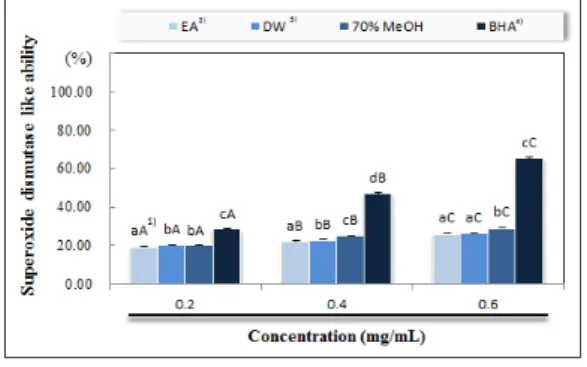
치자 껍질 추출물의 superoxide dismutase (SOD) 유사활성은 Fig. 3에 표시하였으며, IC50
을 구하여 Table 1에 나타내었다. 껍질의 70%
methanol 추출물 20.51±0.01%, 25.17±0.14%, 29.19±0.40%, IC50 1.554±0.006 mg/mL, DW 추출물 20.14±0.12%, 23.05±0.19%, 26.37±
0.12%, IC50 2.122±0.006 mg/mL, EA 추출물 19.44±0.07%, 22.34±0.07%, 26.20±0.07%, IC50 2.018±0.026 mg/mL 순으로 EA 용매 추출 물에서 가장 낮은 SOD 유사활성이 나타났으나, DW 추출물에서 유의적으로 가장 높은 IC50 결과 치가 관찰되었다. 이는 농도가 증가함에 따라 SOD 유사활성 증가 폭이 EA 추출물에서 DW 추출물보다 크기 때문에 이러한 결과가 나타난 것으로 사료된다. 또한 EA 추출물과 DW 추출물 은 0.6 mg/mL 농도에서 유의적인 차이가 없는 것으로 관찰되었다. Positive control인 BHA는 각 농도에서 28.78±0.72%, 47.34±0.26%, 65.57±0.19%로 농도가 증가함에 따라 SOD 유 사활성이 큰 폭으로 증가하는 것을 관찰할 수 있 었다.
Fig. 3. Superoxide dismutase like ability of various solvent extracts from peel of
Gardenia jasminoides
fructus.1) The values are means±standard deviation (
n
=3). Bars with the different letters are significantly different (p
<0.05) by Duncan’s multiple range tests. 2) EA: ethyl acetate. 3) DW:distilled water. 4) BHA: butylated hydroxyanisole.
3.7. Hydroxyl radical (OH-) scavenging activity
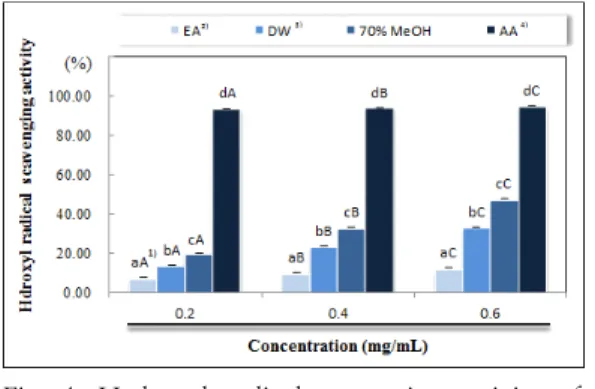
치자 껍질의 각 용매 별 추출물과 control인 ascorbic acid의 hydroxyl radical (OH-) 소거능 을 각 농도 별로 비교한 결과는 Fig. 4에 나타내 었고, IC50을 구하여 Table 1에 나타내었다. 70%
methanol 추출물에서 농도 별로 20.02±0.53%, 33.12±0.07%, 47.75±0.30%, IC50 0.636±
0.001 mg/mL로 추출물 중 가장 높은 활성이 관 찰되었으며, DW 추출물에서 13.98±0.07%, 23.57±0.30%, 33.23±0.33%, IC50 0.949±
0.001 mg/mL, EA 추출물 7.56±0.13%, 10.08±0.07%, 12.41±0.13%, IC50 3.698±
0.037 mg/mL 순으로 EA 용매 추출물에서 가장 낮은 활성과 높은 IC50 결과치가 관찰되었다.
Control인 ascorbic acid는 각 농도에서 93.58±
0.01%, 93.93±0.20%, 95.03±0.18%로 강한 hydroxyl radical 소거능이 관찰되었다. 본 실험 에서의 용매 별 추출물의 DPPH 소거능을 포함 한 다른 항산화능 분석 실험의 결과를 비교하였 을 때, 같은 시료에서의 항산화 활성 결과의 정 도의 차이는 있지만 그 결과는 매우 유사하다는 Elfalleh et al.(2009)의 보고[29]와 동일하게 각 실험에서 70% methanol, DW, EA 추출물 순으 로 항산화능이 관찰되었다.
Fig. 4. Hydroxyl radical scavenging activity of various solvent extracts from peel of
Gardenia jasminoides
fructus.1) The values are means±standard deviation (
n
=3). Bars with the different letters are significantly different (p
<0.05) by Duncan’s multiple range tests. 2) EA: ethyl acetate. 3) DW:distilled water. 4) AA: ascorbic acid.
3.8. Ferrous ion-chelating capacity 치자 껍질의 각 용매 별 추출물과 control인 EDTA (ethylenediaminetetraacetic acid)의 각 농 도 별로 비교한 ferrous ion-chelating capacity 결과는 Fig. 5에 나타내었으며, IC50을 구하여 Table 1에 나타내었다. 70% methanol 추출물 48.37±0.19%, 64.79±0.06%, 75.04±0.15%, IC50 0.209±0.002 mg/mL로 유의적인 차이를 보이며 강한 chelating 능력이 관찰되었으며, DW 추출물에서 40.10±0.23%, 48.45±0.10%, 60.69±0.06%, IC50 0.405±0.004 mg/mL, EA 추출물 30.17±0.09%, 33.87±0.18%, 35.14±
2.24%, IC50 1.763±0.018 mg/mL 순으로 관찰 되었다. 본 실험에서 control로 사용된 EDTA는 6자리의 리간드 구조를 가지고 있기 때문에 각 농도에서 99% 이상의 매우 강한 ferrous ion-chelating 능력을 나타낸 것으로 사료된다.
Flavonoid 화합물의 화학구조는 각종 산화 작용 의 촉매 역할을 하는 금속이온과 결합하여 산화 반응을 상당히 줄일 수 있다는 것으로 알려져 있 다[30]. 뿐만 아니라 Kostyuk et al.(2004)과 Mira et al.(2002)의 연구는 lutein, taxifolin, (-)-epicatechin 등 flavonoid 화합물과 금속이온 이 결합한 복합체가 비 복합체 flavonoid보다 더
Fig. 5. Ferrous ion-chelating capacity of various solvent extracts from peel of
Gardenia jasminoides
fructus.1) The values are means±standard deviation (
n
=3). Bars with the different letters are significantly different (p
<0.05) by Duncan’s multiple range tests. 2) EA: ethyl acetate. 3) DW:distilled water. 4) EDTA: ethylene- diaminetetraacetic acid.
뛰어난 radical 소거능을 가진다고 보고하였다 [31-32]. 이에 70% methanol 추출물 0.6 mg/mL 농도의 시료는 70% 이상의 높은 ferrous chelating 능력을 가지는 것으로 관찰되어, 치자 껍질 추출물의 금속이온 결합 및 그에 따른 항산 화 작용에 대한 시너지 효과가 기대된다.
4. 결 론
치자 껍질의 proanthocyanidin 함량을 알아보 고 70% methanol, distilled water (DW) 및 ethyl acetate (EA)의 3가지 용매를 사용한 추출 물의 용매 별 flavonoid 함량 및 항산화 활성, 금 속 chelating 능력 측정을 통하여 치자 껍질의 기 능성 식품 재료로서의 가치를 검토하기 위하여
본 실험을 수행하였다. 치자 껍질의
proanthocyanidin 함량은 48.165±0.811 mg CE/g DW로 나타났으며 추출 수율은 70%
methanol (36.26%), DW (39.87%), EA (2.88%) 로 나타났다. 추출 용매 별 항산화 활성은 농도 (0.2, 0.4, 0.6 mg/mL)가 증가할수록 유의적으로 증가하였으며, control로 사용된 ascorbic acid, BHA, EDTA 보다는 낮은 활성이 관찰되었다.
Flavonoid 함량(mg QE/g)은 70% methanol (0.416), DW (0.225), EA (0.212) 순으로 관찰 되었으며 다른 항산화 분석 및 금속 chelating 능 력 실험에서도 이와 마찬가지로 관찰되어 모든 분석에서 70% methanol 추출물이 가장 활성이 강한 것으로 나타났다. 이상의 결과를 미루어 볼 때 치자 껍질의 용매 별 flavonoid 함량에 따라 항산화능, 금속 chelating 능력이 증가하는 것으 로 사료되며, EA 추출물을 제외한 다른 추출물에 서의 수율과 항산화 활성은 높은 수준으로 관찰
되었다. 본 실험 결과 치자의 껍질은
proanthocyanidin과 flavonoid 화합물을 다량 함 유하고 있으며 그로 인한 높은 항산화 활성과 생 리활성을 가지고 있어 기능성 식품 및 천연항산 화제로서의 가치가 매우 기대된다.
References
1. J. Kearney, Food consumption trends and drivers,
Philosoph. Transact. Royal Soc. B:
Biol. Sci.
, 365, 2793 (2010).2. S. Klein, D. B. Allison, S. B. Heymsfield, D. E. Kelley, R. L. Leibel, C. Nonas and R. Kahn, Waist circumference and cardiometabolic risk: a consensus statement from shaping America's health:
Association for Weight Management and Obesity Prevention; NAASO, the Obesity Society; the American Society for Nutrition; and the American Diabetes Association,
Obesity
, 15, 1061 (2007).3. T. A. Pearson, G. A. Mensah, R. W.
Alexander, J. L. Anderson, R. O. Cannon, M. Criqui, Y. Y. Fadl, S. P. Fortmann, Y.
Hong, G. L. Myers, S. C. Smith, K.
Taubert, R. P. Tracy, F. Vinicor and N.
Rifai, Markers of inflammation and cardiovascular disease application to clinical and public health practice: a statement for healthcare professionals from the centers for disease control and prevention and the American Heart Association,
Circulation
, 107, 499 (2003).4. K. Menrad, Market and marketing of functional food in Europe,
J. Food Eng.
, 56, 181 (2003).5. B. Halliwell, J. M. Gutteridge and C. E.
Cross, Free radicals, antioxidants, and human disease: where are we now?,
J.
Lab. Clinic. Med.
, 119, 598 (1992).6. J. S. Hwang, B. H. Lee, X. An, H. R.
Jeong, Y. E. Kim, I. Lee, H. Lee and D.
O. Kim, Total phenolics, total flavonoids, and antioxidant capacity in the leaves, bulbs, and roots of
Allium hookeri
,Korean J. Food Sci. Technol.
, 47, 261 (2015).7. H. J. Koo, K. H. Lim, H. J. Jung, and E.
H. Park, Anti-inflammatory evaluation of gardenia extract, geniposide and genipin,
J.
Ethnopharmacol.
, 103, 496 (2006).8. M. Yamauchi, K. Tsuruma, S. Imai, T., Nakanishi, N. Umigai, M. Shimazawa, and H. Hara, Crocetin prevents retinal degeneration induced by oxidative and endoplasmic reticulum stresses via
inhibition of caspase activity,
European J.
Pharmacol.
, 650, 110 (2011).9. W. Bors, and M. Saran, Radical scavenging by flavonoid antioxidants,
Free Radical Res. Commun.
, 2, 289 (1987).10. K. A. Steinmetz and J. D. Potter, Vegetables, fruit, and cancer. I.
Epidemiology,
Cancer Causes Control
, 2, 325 (1991).11. J. M. Harnly, R. F. Doherty, G. R.
Beecher, J. M. Holden, D. B. Haytowitz, S. Bhagwat and S. Gebhardt, Flavonoid content of US fruits, vegetables, and nuts,
J. Agric. Food Chem.
, 54, 9966 (2006).12. Y. D. Kim, W. J. Ko, K. S. Koh, Y. J.
Jeon and S. H. Kim, Composition of flavonoids and antioxidative activity from juice of Jeju native citrus fruits during maturation,
Korean J. Nutr.
, 42, 278 (2009).13. L. Sampson, E. Rimm, P. C. Hollman, J.
H. de VRIES and M. B. Katan, Flavonol and flavone intakes in US health professionals,
J. American Diet. Assoc.
, 102, 1414 (2002).14. B. Sun, J. M. Ricardo-da-Silva and I.
Spranger, Critical factors of vanillin assay for catechins and proanthocyanidins,
J.
Agric. Food Chem.
, 46, 4267 (1998).15. A. Meda, C. E. Lamien, M. Romito, J.
Millogo and O. G. Nacoulma, Determination of the total phenolic, flavonoid and proline contents in Burkina Fasan honey, as well as their radical scavenging activity,
Food Chemistry
, 91, 571 (2005).16. M. S. Blois, Antioxidant determinations by the use of a stable free radical,
Nature
, 181, 1199 (1958).17. A. Floegel, D. O. Kim, S. J. Chung, S. I.
Koo and O. K. Chun, Comparison of ABTS/DPPH assays to measure antioxidant capacity in popular antioxidant-rich US foods,
J. Food Compos. Anal.
, 24, 1043 (2011).18. J. M. McCord and I. Fridovich, Superoxide dismutase an enzymic function for erythrocuprein (hemocuprein),
J. Biol.
Chem.
, 244, 6049 (1969).19. X. Li, Solvent effects and improvements in the deoxyribose degradation assay for hydroxyl radical-scavenging,
Food Chem.
, 141, 2083 (2013).20. J. Ming, C. Yaxin, L. Jinrong and Z. Hui, 1, 10–Phenanthroline–Fe2+ oxidative assay of hydroxyl radical produced by H2O2/Fe2+,
Prog. Biochem. Biophys.
, 6, (1996).21. S. Robu, A. Aprotosoaie, A. Miron, O.
Cioancă, U. Stănescu and M. Hăncianu,
In vitro
antioxidant activity of ethanolic extracts from someLavandula
species cultivated in Romania,Farmacia
, 60, 394 (2012).22. D. Bagchi, M. Bagchi, S. J. Stohs, D. K.
Das, S. D. Ray, C. A. Kuszynski, S. S.
Joshi and H. G. Pruess, Free radicals and grape seed proanthocyanidin extract:
importance in human health and disease prevention,
Toxicol.
, 148, 187 (2000).23. A. E. Hagerman and L. G. Butler, The specificity of proanthocyanidin-protein interactions,
J. Biol. Chem.
, 256, 4494 (1981).24. C. Santos-Buelga and A. Scalbert, Proanthocyanidins and tannin‐like compounds–nature, occurrence, dietary intake and effects on nutrition and health,
J. Sci. Food Agric.
, 80, 1094 (2000).25. J. L. Carpenter, F. L. Caruso, A. Tata, N.
Vorsa and C. C. Neto, Variation in proanthocyanidin content and composition among commonly grown North American cranberry cultivars (
Vaccinium macrocarpon
),J. Sci. Food Agric.
, 94, 2738 (2014).26. Y. H. Chu, C. L. Chang and H. F. Hsu, Flavonoid content of several vegetables and their antioxidant activity, J. Sci. Food Agric., 80, 561 (2000).
27. V. Bondet, W. Brand-Williams and C.
Berset, Kinetics and mechanisms of antioxidant activity using the DPPH free radical method,
LWT-Food Sci. Technol.
, 30, 609 (1997).28. V. Vaithiyanathan and S. Mirunalini, Assessment of anticancer activity: A comparison of dose–response effect of ethyl acetate and methanolic extracts of Pergularia daemia (Forsk),
Oral Sci. Int.
, 13, 24 (2016).29. W. Elfalleh, N. Nasri, N. Marzougui, I.
Thabti, A. M'rabet, Y. Yahya, B.
Lachiheb, F. Guasmi and A. Ferchichi, Physico-chemical properties and DPPH-ABTS scavenging activity of some local pomegranate (
Punica granatum
) ecotypes,Int. J. Food Sci. Nutr.
, 60, 197 (2009).30. J. H. Medina, H. Viola, C. Wolfman, M.
Marder, C. Wasowski, D. Calvo and A.
C. Paladini, Overview—flavonoids: a new family of benzodiazepine receptor ligands,
Neurochem. Res.
, 22, 419 (1997).31. V. A. Kostyuk, A. I. Potapovich, E. N.
Strigunova, T. V. Kostyuk and I. B.
Afanas'ev, Experimental evidence that flavonoid metal complexes may act as mimics of superoxide dismutase,
Arch.
Biochem. Biophys.
, 428, 204 (2004).32. L. Mira, M. Tereza Fernandez, M. Santos, R. Rocha, M. Helena Florêncio and K. R.
Jennings, Interactions of flavonoids with iron and copper ions: a mechanism for their antioxidant activity,