Kor. J. Pharmacogn.
48(2) : 113∼ 118 (2017)
113
Gardenia sootepensis의 끝눈으로부터 생리활성 성분
윤의중1*·장영기2
1극지연구소 극지생명과학 연구부, 2하와이 주립대학교 약학대학 약학과
Chemical Constituents from the Apical Bud of Gardenia sootepensis and Their Bioactivity
Ui Joung Youn1* and Leng Chee Chang2
1Division of Life Sciences, Korea Polar Research Institute, KIOST, Incheon, 21990, Republic of Korea
2 Department of Pharmaceutical Sciences, Daniel K. Inouye College of Pharmacy, University of Hawai’i at Hilo, Hilo, HI, 96720, United States
Abstract − Bioassay guided fractionation and isolation of the CH2Cl2 extract from the apical bud of Gardenia sootepensis (Rubiaceae) led to the isolation of five known flavonoids (1-5). The structures of the compounds were determined by 1D and 2D NMR, and MS experiments, as well as by comparison of their data with published values. Compounds 1-5 were isolated for the first time from this plant source. The isolated compounds were evaluated for their cancer chemopreventive potential based on their ability to inhibit nitric oxide (NO) production. Among the isolates, compound 4 exhibited considerable NO inhib- itory activity with an IC50 value of 13.8µM.
Keywords − Gardenia sootepensis, Nitric oxide, Flavonoid, Rubiaceae
Gardenia(Rubiaceae) 속 식물은 현재 80여 종이 보고되었 고, 전세계 열대 지역에 분포 되어있다. 동남아에서는 G.
sootepensis을 포함하여 15 종이 알려져 있다.1) Gardenia 종 들의 추출물은 항균,2) 항궤양,3) 진통,4) 이뇨,4) 고혈압,4) 유 충 제거 등의 활성들을 가지고 있으며,5)이 식물에서는 cycloartane triterpenoid들이 주 성분들로 알려져 있다. 이들 화합물들은 암세포에 대한 독성 및 항 HIV-1 바이러스 활 성을 갖는 것으로 알려져 있으며,6-10) 최근에 들어 이들의 항염증 관련 연구가 진행되어 추가로 알려져 있다.11) 그러 나, 이 식물에서 cycloartane triterpenoid 화합물들을 제외한 다른 이차 대사산물들 및 이들의 활성 관련 연구는 아직까 지 보고되지 않고 있다.
약용으로 사용되고 있는 식물들에 대한 이차 대사산물 및 항 염증에 관한 연구에서 G. sootepensis 끝눈의 CH2Cl2 분 획이 LPS 처리에 의해 유도되는 RAW 264.7 세포에서 NO 생성을 억제하는 활성을 보였다. 본 연구에서 G. sootepensis 의 끝눈 부위에 대한 이화학적 연구를 통하여 5 종의
flavonoid 화합물들을 처음 분리하여 구조를 동정하였으며, 이들의 항 염증 활성을 측정 하였다.
재료 및 방법
실험재료 − 연구에 사용된 G. sootepensis는 2012년 6월 태국 북부의 치앙라이(Chiang Rai) 지역에서 채집되었으며, Mae Fah Luang 대학교의 Surat Laphookhieo 교수에 의하 여 동정되었다. 시료들은 음건하여 세절 하였으며, 표본 (GS001)은 하와이 주립대학교 약학대학 장영기(Leng Chee Chang) 교수의 표본실에 보관하였다.
기기 및 시약 − UV 및 IR은 각각 Shimadzu PharmaSpec- 1700 UV-visible spectrophotometer 와 Bruker Tensor-27 spectrophotometer 모델을 사용하였다. 1D 및 2D NMR은 Bruker AVANCE(400 MHz) spectrometer를 사용하였다.
Mass spectra는 BioTOF II ESI mass spectrometer를 이용하 였다. TLC는 Merck precoated silica gel F254 plates를 사 용하였으며, RP TLC로는 RP-C18 F254s plates가 이용되었 다. UV light를 이용하여 254 nm와 365 nm 파장에서 1차적 으로 확인하고 10% sulfuric acid를 이용하여 발색 확인하
*교신저자(E-mail):[email protected] (Tel): +82-32-760-5562
였다. Column chromatography에 이용된 충진제는 silica gel 60(Merk Co., 70-230 mesh), RP-C18 silica gel(YMC GEL ODS-A, 12 nm, S-75 µm)과 Sephadex LH-20(Pharmacia Co.)가 이용되었다. Semi-preparative HPLC는 Beckman Coulter Gold-168 system을 이용하였고, column으로는 Alltech reversed-phase Econosil C-18 column(10 µm, 10×
250 mm)을 사용하였다.
추출 및 분리 − G. sootepensis(15.8 g)의 건조한 끝 눈 부 위를 CH2Cl2 용매로 2 L씩 3 회에 걸쳐 추출 및 여과하였 다. 추출 여과 액은 감압 농축기를 이용하여 농축액 10 g을 얻었다. CH2Cl2 추출물(9 g)은 silica gel column(230-400 mesh, 360 g), hexane-ethyl acetate(50:1~0:100)의 조건으로 분리를 진행하였고, 10개의 분획물(Fc1-Fc10)들을 얻었다.
분획물 Fc4(2 g)는 sephadex LH-20 gel column과 이동상으 로 H2O-MeOH(30:70~0:100) 용매를 사용하여 6개의 소분 획(Fc4L1-Fc4L6)들을 얻었다. 화합물 4(35 mg)와 5(82 mg) 는 CHCl3 용매를 이용하여 각각의 소분획 Fc4L2와 Fc4L3 로부터 재결정에 의하여 얻어졌다. 화합물 2(275 mg)는 소 분획 Fc4L6로부터 silica gel column과 hexane-ethyl acetate (50:1 to 1:1) 용매를 사용하여 정제하였다. 분획물 Fc6(1.5 g) 은 silica gel column(φ 7 cm; 230-400 mesh, 250 g)과 이동 상 용매, hexane-ethyl acetate(99:1~1:1)를 이용하여 8개의 소분획(Fc6s1-Fc6s8)들을 얻었다. 소분획 Fc6s3은 다시 sephadex LH-20 gel column과 이동상 용매, H2O-MeOH (50:50~0:100)를 사용하여 5개의 소분획(Fc6s3.1-Fc6s3.5)들 을 얻었고, 소분획 Fc6s3.4는 semi-prep. HPLC를 이용하여 Econosil C-18 column(10 µm, 10×250 mm) 및 MeOH-H2O/
0.1% acetic acid = 90:10~100:0의 용매 조건에서 화합물 1(3 mg, tR 78 min)과 3(2.5 mg, tR 81 min)을 분리하였다.
Demethoxycentaureidin (1) − Yellow amorphous powder, UV (MeOH) λmax (log ε) 278 (4.0), 331 (3.7) nm; IR νmax (KBr) 3323, 1656 cm-1; LCMS m/z 331 [M + H]+;
1H-NMR (400 MHz, DMSO-d6) δH 13.03 (1H, s, 5-OH), 7.54 (1H, dd, J=8.8, 2.4 Hz, H-6′), 7.42 (1H, d, J=2.4 Hz, H-5′), 7.09 (1H, d, J=8.8 Hz, H-2′), 6.75 (1H, s, H- 8), 6.58 (1H, s, H-3), 3.86 (3H, s, 4′-OCH3), 3.75 (3H, s, 6-OCH3); 13C-NMR (100 MHz, DMSO-d6) δC 182.2 (C- 4), 163.9 (C-2), 157.9 (C-7), 152.8 (C-8a), 152.6 (C-5), 151.3 (C-4′), 147.1 (C-3′), 131.7 (C-6), 123.1 (C-1′), 118.8 (C-6′), 113.1 (C-2′), 104.5 (C-4a), 104.1 (C-3), 103.1 (C- 5′), 94.4 (C-8), 60.4 (4′-OCH3), 56.1 (6-OCH3).
5,7,2′,5′-Tetrahydroxy-6,3′,4′-trimethoxyflavone (2) − Yellow amorphous powder, UV (MeOH) λmax (log ε) 268 (4.1), 320 (3.8) nm; IR νmax (KBr) 3323, 1656 cm-1; LCMS m/z 377 [M + H]+; 1H-NMR (400 MHz, DMSO- d6) δH 13.03 (1H, s, 5-OH), 10.77 (1H, s, 7-OH), 9.55
(1H, s, 2′-OH), 9.22 (1H, s, 5′-OH), 7.12 (1H, s, H-6′), 7.04 (1H, s, H-3), 6.51 (1H, s, H-8), 3.87 (3H, s, 4′- OCH3), 3.78 (3H, s, 3′-OCH3), 3.76 (3H, s, 6-OCH3); 13C- NMR (100 MHz, DMSO-d6) δC 182.6 (C-4), 161.5 (C-2), 157.8 (C-7), 153.1 (C-5), 152.9 (C-8a), 145.1 (C-4′), 144.0 (C-5′), 143.7 (C-2′), 142.2 (C-3′), 131.7 (C-6), 112.5 (C-1′), 109.3 (C-6′), 108.5 (C-3), 104.5 (C-4a), 94.4 (C-8), 61.4 (3′-OCH3), 60.7 (4′-OCH3), 60.4 (6-OCH3).
5,7,3′-Trihydroxy-6,4′,5′-trimethoxyflavone (3) − Yellow amorphous powder, UV (MeOH) λmax (log ε) 279 (4.1), 330 (3.6) nm; IR νmax (KBr) 3229, 2934, 1651 cm-1; LCMS m/z 361 [M + H]+; 1H-NMR (400 MHz, DMSO- d6) δH 12.97 (1H, s, 5-OH), 7.14 (1H, d, J=2.1 Hz, H-2′), 7.12 (1H, d, J=2.1 Hz, H-6′), 6.86 (1H, s, H-3), 6.57 (1H, s, H-8), 3.88 (3H, s, 5′-OCH3), 3.76 (3H, s, 6-OCH3), 3.75 (3H, s, 4′-OCH3); 13C-NMR (100 MHz, DMSO-d6) δC 182.6 (C-4), 163.6 (C-2), 157.8 (C-7), 153.9 (C-5′), 153.2 (C-5), 152.8 (C-8a), 151.3 (C-3′), 140.0 (C-4′), 131.8 (C-6), 126.3 (C-1′), 108.1 (C-2′), 104.6 (C-3), 104.6 (C-4a), 102.5 (C-6′), 94.7 (C-8), 60.5 (4′-OCH3), 60.3 (6- OCH3), 56.5 (5′-OCH3).
Umuhengerin (4) − Yellow amorphous powder, UV (MeOH) λmax (log ε) 278 (4.0), 331 (3.7) nm; IR νmax (KBr) 3323, 2291, 1656, 1591 cm-1; LCMS m/z 389 [M + H]+; 1H-NMR (400 MHz, DMSO-d6) δH 12.83 (1H, s, 5-OH), 7.39 (2H, s, H-2′/H-6′), 7.16 (1H, s, H-3), 7.03 (1H, s, H-8), 3.96 (3H, s, 7-OCH3), 3.92 (6H, s, 3′-OCH3/ 5′-OCH3), 3.76 (3H, s, 4-OCH3), 3.75 (3H, s, 6-OCH3);
13C-NMR (100 MHz, DMSO-d6) δC 182.8 (C-4), 163.7 (C-2), 159.2 (C-7), 153.7 (C-3′/C-5′), 153.2 (C-8a), 152.4 (C-5), 141.3 (C-4′), 132.4 (C-6), 126.3 (C-1′), 105.7 (C- 4a), 105.2 (C-3), 104.6 (C-2′/C-6′), 92.3 (C-8), 60.7 (4′- OCH3), 60.5 (6-OCH3), 57.0 (7-OCH3), 56.8 (3′-OCH3/5′- OCH3).
5,7,2′,5′-Tetrahydroxy-6,3′,4′-trimethoxyflavone (5) − Yellow amorphous powder, UV (MeOH) λmax (log ε) 279 (4.0), 329 (3.5) nm; IR νmax (KBr) 3325, 2289, 1654, 1591 cm-1; LCMS m/z 391 [M + H]+; 1H-NMR (400 MHz, DMSO-d6) δH 12.89 (1H, s, 5-OH), 7.20 (1H, s, H- 6′), 7.11 (1H, s, H-3), 6.82 (1H, s, H-8), 3.93 (3H, s, 7- OCH3), 3.87 (3H, s, 4′-OCH3), 3.79 (3H, s, 3′-OCH3), 3.74 (3H, s, 6-OCH3); 13C-NMR (100 MHz, DMSO-d6) δC 182.0 (C-4), 161.9 (C-2), 159.3 (C-7), 153.2 (C-5), 152.4 (C-8a), 145.3 (C-4′), 144.8 (C-5′), 144.2 (C-2′), 142.2 (C-3′), 132.0 (C-6), 112.5 (C-1′), 109.6 (C-6′), 108.8 (C-3), 105.5 (C-4a), 91.7 (C-8), 61.4 (3′-OCH3), 60.8 (4′-
OCH3), 60.5 (6-OCH3), 56.9 (7-OCH3).
Nitric Oxide(NO)생성 억제 활성 측정12)− LPS 처리에 의해 유도되는 RAW 264.7 세포에서 NO 생성이 각 시료에 의해 억제되는 것을 측정하기 위해 배양된 세포를 4×10⁵ cells/well 수준으로 24 well plate에 1 ml씩 배양한 다음 24 시간 동안 배양하고, 24시간 후 medium을 제거한 후 RPMI1640으로 희석된 각 농도 별 시료 처리 후 LPS(1 µg/
ml)를 처리하여 24시간 후 세포에서 medium으로 분비되어 나온 NO의 양을 Griess 시약[0.1%(w/v) N-(1-naphathyl)- ethylenediamine and 1%(w/v) sulfanilamide in 5%(v/v) phosphoric acid]을 사용하여 반응하였다. 반응 후 ELISA microplate reader(Bio Rad Laboratories Inc., California, USA)를 사용하여 540 nm에서 측정하였다. L-NG-monomethyl arginine citrate(L-NMMA)는 비교 대조군으로 사용되었다 (IC50 25.1 μM).
결과 및 고찰
G. sootepensis의 CH2Cl2 추출물을 실리카 및 C-18 젤 칼 럼 크로마토그래피로 분획한 후 재결정법 및 분취용 HPLC 를 실시하여 총 5 종의 대사산물들을 분리하였다(Fig. 1).
화합물 1은 밝은 노랑색의 가루 형태로 얻어졌으며, LC- MS spectrum에서 m/z 331 [M + H]+의 ion peak를 확인하 였다. UV spectrum은 331과 278 nm에서 각각 double bond 과 carbonyl group에 해당하는 흡수 밴드를 보였다. IR spectrum은 1656 cm-1에서 conjugated C=O group과 3323 cm-1에서 hydroxyl group의 특징적인 흡수 피크를 나타내었 다. 화합물 1의 13C NMR spectrum은 두 개의 methoxy carbon들을 포함하여 17개의 carbon signal들을 나타내었다.
UV 및 1H과 13C NMR spectra를 토대로 화합물 1은 flavone 의 구조로 확인하였다.13) 화합물 1의 1H NMR spectrum은
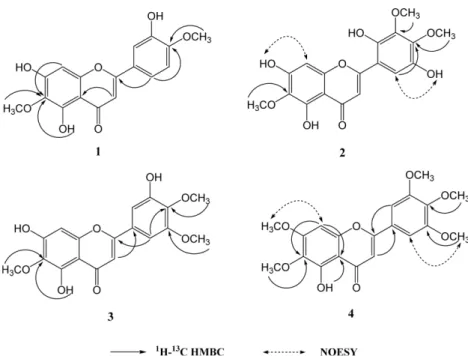
δH 13.03에서 C=O group과의 수소결합으로 인하여 저 자 장 영역으로 이동된 hydroxyl group proton과 δH 6.75 (H- 8)와 6.58 (H-3)에서 두 개의 aromatic singlet proton들을 나 타내었으며, 이들의 상관관계는 HMBC 실험에서 확인되었 다(Fig. 2). 추가적으로 δH 7.42 (1H, d, J=2.4 Hz, H-2′), 7.09 (1H, d, J=8.8 Hz, H-5′), 7.54 (1H, dd, J=8.8, 2.4 Hz, H-6′)에서 화학적 이동값들은 ABX-type의 aromatic system proton들을 의미하였다. HMBC 실험은 hydroxy proton (δH 13.03)과 C-5 (δC 151.4)/C-6 (δC 131.7)/C-4a (δC 104.4)의 correlation들과 methoxy proton (δH 3.75)과 C-6의 correlation을 확인 함으로써 A-ring의 C-6에 methoxy group이 치환되어 있다는 것을 알 수 있었으며, H-6′ (δH 7.54)/OCH3 (δH 3.86) 와 C-4′과의 HMBC correlation을 확 인함으로써 나머지 하나의 methoxy group (δH 3.86)이 B- ring의 C-4′ 위치에 치환되어 있음을 확인하였다. 따라서, 화 합물 1번은 위의 물리 화학적 실험 및 문헌 값과의 비교에 의하여 demethoxycentaureidin 구조로 동정하였다.14)
화합물 2번은 밝은 노랑색 가루로 얻어졌다. LC-MS spectrum은 m/z 377 [M + H]+에서 ion peak를 보였다. 화 합물 2번의 1H NMR spectrum은 δH 3.75 (3H, s, 6-OMe), 3.78 (3H, s, 3′-OMe)와 3.87 (3H, s, 4′-OMe)에서 3개의 methoxy signal들과 저 자장 영역의 δH 13.03 (5-OH), 10.77 (7-OH), 9.55 (2′-OH), 9.22 (5′-OH)에서 4개의 hydroxy proton signal들을 보였으며, δH 7.04 (1H, s, H-3), 6.50 (1H, s, H-8), 7.12 (1H, s, H-6′)에서 각각 singlet으로 나타 나는 aromatic signal들을 확인하였다. 13C 및 DEPT NMR 실험은 δC 60.3 (6-OMe), 61.4 (3′-OMe), 60.7 (4′-OMe)에 서 3 개의 methoxy signal들과 δC 108.5 (C-3), 94.4 (C-8), 109.3 (C-6′)에서 3 개의 protonated aromatic carbon들, [δC 161.5 (C-2), 157.8 (C-7), 153.1 (C-5), 152.9 (C-8a), 145.1 (C-4′), 144.0 (C-5′), 143.7 (C-2′), 142.2 (C-3′), 131.7 (C- 6)]에서 9개의 oxygenated quaternary aromatic carbon들, 이 들보다 비교적 고자장의 방향족 영역 δC 112.5 (C-1′) 와 104.5 (C-4a)에서 나타나는 2개의 4차 aromatic carbon들, 그 리고 δC 182.6 (C-4)에서 한 개의 carbonyl carbon을 보였 다. HMBC 실험에서 5-OH/6-OCH3 proton들과 C-6, 2′- OH/3′-OMe proton들과 C-3′ 그리고 H-6′/5′-OH/4′-OMe 과 C-4′ 사이의 correlation들은 Fig. 2에 보여지는 것처럼 -OH 와 -OCH3 group들의 치환된 위치를 제시하였다. 추가적인 HMBC 와 NOESY 실험들은 Fig. 2에 나타내었다. 따라서, 화합물 2의 구조는 G. carinata 식물로부터 분리된 5,7,2′,5′- tetrahydroxy-6,3′,4′-trimethoxyflavone과 일치하였다.15)
화합물 3의 UV, IR, and NMR spectra는 2번의 data들과 유사한 값들을 보였으나, 3은 B-ring의 δH 7.14 (1H, d, J=2.1 Hz, H-2′)와 7.12 (1H, d, J=2.1 Hz, H-6′)에서 2개의 aromatic doublet proton들과 δH 6.57 (1H, s, H-8)에서 하나 Fig. 1. Structures of compounds 1-5 isolated from Gardenia
sootepensis.
의 singlet aromatic proton 그리고 δH 3.88 (3H, s, H-5′)에 서 하나의 methoxy proton과 같이 2와는 다른 pattern의 signal들을 보였다. HMBC NMR 실험에서 H-8 (δH 6.57) 와 C-4/C-4a/C-6/C-7/C-8a; H-2′ (δH 7.14)/H-6′ (δH 7.12) 와 C-1′/C-4′/C-2들 사이의 correlation들은 화합물 3의 구조 가 Artemisia reptans16)식물에서 분리된 5,7,3′-trihydroxy- 6,4′,5′-trimethoxyflavone라는 것을 의미하였다.
화합물 4의 구조는 LC-MS의 m/z 389 [M + H]+에서 molecular ion peak를 보였다. 4번의 NMR spectrum은 3번 의 그것들과 매우 유사 하였지만 C-7와 C-3′ 위치에 2개의 methoxy group들이 추가적으로 치환된 형태를 보였다. 1H NMR spectrum의 화학적 이동값 δH 7.39 (2H, s, H-2′/H-6′) 와 δH 3.92 (6H, s, H-3′&H-5′)에서 각각 두 개의 동등한 aromatic proton들과 methoxy proton들이 발견된 것으로 보 아 B-ring은 대칭적인 구조를 가지고 있음을 알 수 있었다.
이는 Fig. 2에서 보여지는 것처럼 HMBC 와 NOESY NMR 실험에서 확인 되었다. 따라서, 화합물 4의 구조는 Lantana trifolia 식물에서 분리된 umuhengerin의 구조로 동정 되었 다.17)
화합물 5은 분광학적 분석 및 문헌 값과의 비교에 의하여 5,7,2′,5′-tetrahydroxy-6,3′,4′-trimethoxyflavone으로 확인되었 다.15)
항 염증 관련 활성 screening 연구에서 G. sootepensis의 끝눈 부분의 CH2Cl2 추출물이 LPS 처리에 의해 유도되는 RAW 264.7 세포에서 NO 생성을 98%로 저해하는 것으로 나타났다. 또한, 이로부터 분리된 이차 대사산물들의 NO 생 성 억제 활성을 측정한 결과 Table I에서 보여지는 것처럼
화합물 2번은 IC50 39.3μM로 중간 정도의 활성을 보인 반 면 화합물 4번은 IC50 13.8μM로 양성 대조군으로 사용된 L-NG-monomethyl arginine citrate(L-NMMA)(IC50 25.1 μM) 에 비하여 더 강한 활성을 보이는 것으로 나타났다. 나머지 화합물들은 활성이 없는 것으로 나타났다. 분리된 flavonoid 유도체들의 항 염증 활성은 본 연구에서 처음으로 밝혀졌다.
결 론
G. sootepensis 식물의 끝눈 부위에 대한 CH2Cl2 추출물로 부터 이차 대사산물들의 분리 연구를 실시한 결과 5개의 Fig. 2. Important 1H-13C HMBC and NOESY correlations for 1-4.
Table I. Inhibition effect of compounds 1-5 against the NO production in LPS-stimulated RAW 264.7 cells
Compounds Nitrite assay
%inhib.a %surv.b IC50 (μM) CH2Cl2 extract 98.0±1.6 62.5±2.4
1 10.2±1.1 99.8±0.6 ndd
2 61.0±2.0 78.5±1.3 39.3±3.0
3 38.1±3.1 95.9±1.2 ndd
4 79.6±0.7 61.4±0.5 13.8±0.4
5 25.1±2.2 98.6±1.7 ndd
L-NMMAc 25.1±2.3
a
% inhibition of NO production at 50 µM.
b
% survival at concentration of 50 µM.
c
positive control for NO.
d
nd, not determined.
flavonoid 화합물들을 얻었다. 이들 화합물들은 각각 demethoxycentaureidin(1) 5,7,2′,5′-tetrahydroxy-6,3′,4′-trimet- hoxyflavone(2), 5,7,3′-trihydroxy-6,4′,5′-trimethoxyflavone(3), umuhengerin(4) 및 5,7,2′,5′-tetrahydroxy-6,3′,4′-trimethoxy- flavone(5)로 동정 되었으며, 분리된 화합물들 모두 G.
sootepensis에서 처음 보고되었다. 특히, 화합물 4번은 화합 물 2번과 함께 G. sootepensis 식물의 끝눈 부위의 주성분들 로 분리되었으며, 50 μM의 처리 농도에서 약간의 세포 독 성을 보였으나, 양성의 항 염증 활성을 나타내었다. 그러나, 나머지 주성분으로 분리된 화합물 5번은 활성을 보이지 않 았다. 자연에는 수많은 종류의 flavonoid 유도체들이 존재하 는데, 특히, flavonoid 화합물들의 항 염증 연구와 관련하여 kaempferol 및 glycosylated kaempferol 유도체들,18,19) quercetin 및 이 화합물의 glycosylated 유도체들과20) Helmin- thostachys zeylanica로부터 분리된 neougonin21)과 같이 일 부 prenylated flavonoid 구조들은 강한 항 염증 효과를 갖 는 것으로 알려져 있다. 한편, flavonoid 구조에 methoxy group이 치환된 유도체들에서는 비교적 약한 nitric oxide 활 성이 알려져 있으나,22) 본 연구의 결과에서는 OCH3 작용기 가 다수 치환 되어 있는 화합물 4의 구조에서 NO 생성 억 제 활성이 비교적 강하게 나타나는 것을 알 수 있었다. 따 라서 추가적으로 flavonoid 화합물들에 대한 다양한 유도체 및 세밀한 활성 연구들이 필요할 것으로 생각되며, 앞으로 항 염증과 관련된 화학 및 생물학적 연구 분야에 기여할 것 으로 사료된다.
사 사
본 연구는 극지연구소, KOPRI(PE17100)의 지원을 받아 수행되었다. 서울대학교 기초과학 공동 기기 원의 질량 분 석 실, 신혜숙 연구원님의 도움을 받았으며, 이에 감사 드 립니다.
인용문헌
1. Smitinand, T. Thai plant names (2001) Revised edition by the Forest Herbarium, Royal Forest Department. Bangkok: Pra Cha Chon Co., Ltd; p. 248.
2. Laurens, A., Mboup, S., Tignokpa, M., Sylla, O. and Masque- lier, J. (1985) Antimicrobial activity of some medicinal spe- cies from the Dakar markets. Pharmazie 40: 482-484.
3. Takase, H., Imanishi, K., Miura, O., Yumioka, E. and Wata- nabe, H. (1989) Features of the anti-ulcer effects of Oren- gedoku-to (a traditional Chinese medicine) and its component herb drugs. Jpn. J. Pharmacol. 49: 301-308.
4. Hussain, M. M. Sokomba, E. N. and Shok, M. (1991) Phar- macological effects of Gardenia erubescens in mice, rats and
cats. Int. J. Pharmacognosy 29: 94-100.
5. Manson, D. J. (1939) The action of certain Assamese plants as larvicides. Malaria Inst. India 2: 85-93.
6. Silva, G. L., Gil, R. R., Cui, B., Chai, H., Suntisuk, T., Sri- sook, E., Reutrakul, V., Tuchinda, P., Sophasan, S., Sujarit, S., Upathum, S. E., Lynn, S. M., Farthing, J. E., Yang, S. L., Lewis, J. A., O’Neill, M. J., Farnsworth, N. R., Cordell, G.
A., Pezzuto, J. M. and Kinghorn, A. D. (1997) Novel cyto- toxic ring-A seco-cycloartane triterpenes from Gardenia cor- onaria and G. sootepensis. Tetrahedron 53: 529-538.
7. Tuchinda, P., Pompimon, W., Reutrakul, V., Pohmakotr, M., Jaipetch, T.,Yoosook, C., Kongyai, N., Sophasan, S., Sujarit, K., Upathum, S. E. and Suntisuk, T. (2002) Cytotoxic and anti-HIV-1 constituents of Gardenia obtusifolia and their modified compounds. Tetrahedron 58: 8073-8086.
8. Nuanyai, T., Chokpaiboon, S., Vilaivan, T. and Pudhom, K.
(2010) Cytotoxic 3,4-seco-cycloartane triterpenes from the exudate of Gardenia tubifera. J. Nat. Prod. 73: 51-54.
9. Nuanyai, T., Sappapan, R., Vilaivan, T. and Pudhom, K.
(2011) Cycloartane triterpenes from the exudate of Gardenia thailandica. Phytochem. Lett. 4: 26-29.
10. Nuanyai, T., Sappapan, R., Vilaivan, T. and Pudhom, K.
(2011) Gardenoins E-H, cycloartane triterpenes from the api- cal buds of Gardenia obtusifolia. Chem. Pharm. Bull. 59:
385-387.
11. Youn, U. J., Park, E.-J., Kondratyuk, T. P., Sripisut, T., Laphookhieo, S., Pezzuto, J. M. and Chang, L. C. (2016) Anti-inflammatory triterpenes from the apical bud of Gar- denia sootepensis. Fitoterapia 114: 92-97.
12. Park, E.-J., Kondratyuk, T. P., Morrell, A., Kiselev, E., Conda-Sheridan, M., Cushman, M., Ahn, S., Choi, Y., White, J. J., van Breemen, R. B. and Pezzuto, J. M. (2011) Induction of retinoid X receptor activity and consequent upregulation of p21WAF1/CIP1 by indenoisoquinolines in MCF7 cells. Can- cer Prev. Res. (Phila) 4: 592-607.
13. Agrawal, P. K., Thakur, R. S. and Bansal, M. C. (1989) Fla- vonoids. In: Agrawal, P. K. (ed.), Carbon-13 NMR of Fla- vonoids. Amsterdam, Elsevier, pp. 95-100.
14. Voirin, B. (1983) UV spectral differentiation of 5-hydroxy- and 5-hydroxy-3-methoxyflavones with mono-(4'), di-(3',4'), or tri-(3',4',5')-substituted B rings. Phytochemistry 22: 2107- 2145.
15. Kongkum, N., Tuchinda, P., Pohmakotr, M., Reutrakul, V., Piyachaturawat, P., Jariyawat, S., Suksen, K., Yoosook, C., Kasisit, J. and Napswad, C. (2012) DNA topoisomerase IIα inhibitory and anti-HIV-1 flavones from leaves and twigs of Gardenia carinata. Fitoterapia 83: 368-372.
16. Marco, J. A., Barbera, O., Rodriguez, S., Domingo, C. and Adell, J. (1988) Flavonoids and other phenolics from Arte- misia hispanica. Phytochemistry 27: 3155-3159.
17. Claeys, M., Pieters, L., Corthout, J., Vanden Berghe, D. A.
and Vlietinck, A. J. (1988) Umuhengerin, a new antimi-
crobially active flavonoid from Lantana trifolia. J. Nat. Prod.
51: 966-968.
18. Song, H.-K., Khiev, P., Chai, H.-S., Lee, H.-K., Oh, S.-R., Choi, Y. H., and Chin, Y.-W. (2012) Flavonoids from thyr- santhera suborbicularis and their NO inhibitory activity. Nat.
Prod. Sci. 18: 273-278.
19. Kim, C. S., Bae, M., Oh, J., Subedi, L., Suh, W. S., Choi, S.
Z., Son, M. W., Kim, S. Y., Choi, S. U., Oh, D.-C., and Lee, K. R. (2017) Anti-neurodegenerative biflavonoid glycosides from Impatiens balsamina. J. Nat. Prod. 80: 471-478.
20. Huang, Y.-L., Shen, C.-C., Shen, Y.-C., Chiou, W.-F., and Chen, C.-C. (2017) Anti-inflammatory and antiosteoporosis
flavonoids from the rhizomes of Helminthostachys zeylanica.
J. Nat. Prod. 80: 246-253.
21. Su, L.-H., Li, Y.-P., Li, H.-M., Dai, W.-F., Liu, D., Cao, L., and Li, R.-T. (2016) Anti-inflammatory prenylated flavonoids from Helminthostachys zeylanica. Chem. Pharm. Bull. 64:
497-501.
22. Li, D., Han, X. H., Hong, S. S., Lee, C., Lee, M. S., Lee, D., Lee, M. K., Hwang, B. Y. (2010) Inhibitors of nitric oxide production from Artemisia princeps. Nat. Prod. Sci. 16: 143- 147.
(2017. 5. 24 접수; 2017. 6. 13 심사; 2017. 6. 15 게재확정)