45(3) : 240∼ 248 (2014)
240
LC-MS/MS 를 이용한 桂枝茯 丸의 동시분석 및 항산화 효능 연구
서창섭·김온순·신현규* 한국한의학연구원 한약방제연구그룹
Quantitative Analysis and Antioxidant Effects of Gyejibokryeong-hwan
Chang-Seob Seo, Ohn Soon Kim, and Hyeun-Kyoo Shin*
Herbal Medicine Formulation Research Group, Korea Institute of Oriental Medicine, 1672 Yuseong-daero, Yuseong-gu, Daejeon 305-811, Korea
Abstract − Gyejibokryeong-hwan (GJBRH) has been used for treatment of patients with climacteric syndrome. In this study, an ultra-performance liquid chromatography-electrospray ionization-mass spectrometer (UPLC-ESI-MS) method was estab- lished for the simultaneous quantification of seven marker compounds in GJBRH extract. In addition, we assessed the anti- oxidant effects of GJBRH. All analytes were separated by gradient elution using two mobile phases on a UPLC BEH C18 column and maintained at 45oC. The antioxidant activities of GJBRH were evaluated by measuring free radical scavenging activities on 2,2'-azinobis-3-ethyl-benzothiazoline-6-sulfonic acid (ABTS) and 1-1-diphenyl-2-picrylhydrazyl (DPPH). The inhibitory effects on low-density lipoprotein (LDL) oxidation were evaluated by the formation of thiobarbituric acid relative substances (TBARS) and relative electrophoretic mobility (REM). Regression equations of the seven compounds were acquired with r2 values ≥ 0.9988. The amounts of the seven compounds, amygdalin, albiflorin, paeoniflorin, coumarin, cinnamic acid, cinnamaldehyde, and paeonol in GJBRH water extract were 21.71, 2.16, 17.17, 1.97, 0.40, 0.78, and 3.42 mg/g, respectively.
The GJBRH showed the radical scavenging activity in a dose-dependent manner. The concentration required for 50% reduction (RC50) against ABTS and DPPH radicals were 54.18µg/mL and 79.53 µg/mL. Furthermore, GJBRH reduced the oxidation properties of LDL induced by CuSO4.
Key words − Gyejibokryeong-hwan, Quantitative analysis, Antioxidant effects, LC-MS/MS
桂枝茯 丸은 張仲景의『金 要略』에 최초로 수록된 처 방으로 桂枝(Cinnamomi Ramulus), 茯笭(Poria Sclerotium), 牧丹皮(Moutan Radicis Cortex), 芍藥(Paeoniae Radix) 및 桃仁(Persicae Semen)의 5종 한약재로 구성되어 있으며, 하 복부의 瘀血로 인한 痛症을 치료하는 기본 방제로 알려져 있다.1) 본 처방은 항암,2-4) 진통, 항염, 항경련 및 근이완,5,6) 항혈전,7)항동맥경화,8,9)항혈소판10)및 신장보호11)효과 등 과 같은 다양한 실험적 생리활성 연구가 진행 및 보고되었 으며, 교통사고 등 외상으로 유발된 瘀血 변증에 대한 효 과,12)원발성 생리통에 대한 치료 효과1,13)및 여성의 폐경 후 삶의 질 개선 효과14,15) 등의 증례보고와 임상연구도 보 고되었다.
본 연구에서는 골반 혈관의 염증, 월경 및 하혈 등과 같 은 鬱血로 인한 下服桶, 月經不順 및 月經痛 등의 부인과 질
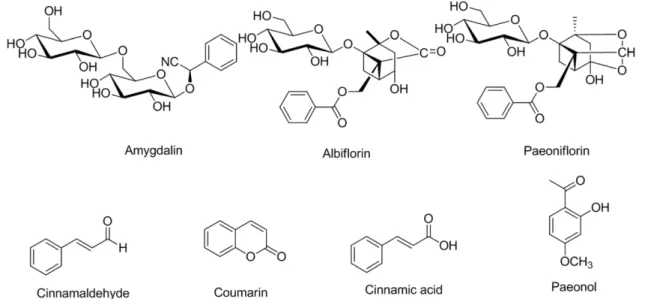
환에 널리 사용되는 대표 처방인 桂枝茯 丸을 선정하여 이 에 대한 효율적인 품질관리에 대한 기초 자료를 제공하고 자 주요 성분에 대한 함량분석을 실시하였다. 본 처방의 구 성 생약의 성분에 관한 연구는 桂枝의 coumarin, cinnamic acid 및 cinnamaldehyde 등과 같은 coumarin 계열16,17)과 茯 笭의 pachymic acid와 dehydropachymic acid 등과 같은 triterpenoid 계열18,19)이 분리 보고되었다. 또한 牧丹皮는 phenol 성분인 paeonol, 芍藥은 monoterpenoid 성분인 albiflorin과 paeoniflorin 및 桃仁은 cyanoglucoside 계열의 amygdalin 등이 대한약전 10개정20)에 지표물질로 수록되어 있다. 이와 같이 처방을 구성하는 각각의 생약 성분에 대하 여 고성능액체크로마토그래피를 이용한 분석법21-26)은 많이 보고가 되어 있으나 복합제제인 처방의 분석에 대한 연구 는 미비한 실정이다. 따라서 본 연구에서는 구성 생약의 주 요 성분들, 즉 桂枝의 coumarin, cinnamic acid 및 cinnamaldehyde, 牧丹皮의 paeonol, 芍藥의 albiflorin과
*교신저자(E-mail):[email protected] (Tel): +82-42-868-9464
paeoniflorin 및 桃仁의 amygdalin 등 7종의 성분을 대상으 로 질량분석기가 결합된 초고성능 액체크로마토그래피(ultra- performance liquid chromatography-electrospray ionization- mass spectrometer; UPLC-ESI-MS)를 이용하여 함량분석을 실시하고 본 처방에 대한 항산화 효과와 LDL 산화 억제 효 과를 통한 동맥경화질환의 예방 및 치료의 적용 가능성을 검토하였다.
재료 및 방법
실험재료 − Table I과 같이 본 실험에 사용된 桂枝茯 丸 을 구성하는 5종의 한약재는 모두 광명당제약(Ulsan, Korea) 에서 규격품을 구입하여 동국대학교 한의과대학 이제현 교 수(Gyeongju, Korea)와 대전대학교 한의과대학 서영배 교수 (Daejeon, Korea) 등 2인의 전문가로부터 감정 후 사용하였 다. 본 처방을 이루는 구성 한약재들의 표본(2012-KE31- 1~2012-KE31-5)은 한국한의학연구원 한약방제연구그룹에 보관하였다.
시약 및 기기 − Amygdalin, coumarin, dimethyl sulfoxide (DMSO), 2,2'-azinobis-3-ethyl-benzothiazoline-6-sulfonic acid (ABTS) 및 2,2-diphenyl-2-picrylhydrazyl(DPPH)는 Sigma- Aldrich(St. Louis, MO, USA)에서 구입하였으며, albiflorin, paeoniflorin, cinnamic acid, cinnamaldehyde 및 paeonol은 Wako Pure Chemical Industries, Ltd.(Osaka, Japan)로부터 구입하였다. 이들 표준물질의 순도는 모두 98.0% 이상이었 다. LC-MS/MS 분석을 위한 메탄올, 아세토나이트릴 및 물 은 J.T. Baker(Phillipsburg, NJ, USA)에서 구입하였으며, 개 미산은 Sigma-Aldrich(St. Louis, MO, USA)에서 구입하여 사용하였다.
7종의 성분 분리를 위해 pump, digasser, column oven 및 autosampler로 구성된 Waters의 ACQUITY UPLC(Milford, MA, USA)를 사용하였으며, 질량분석기는 ESI source가 장 착된 탠덤 사중극자 질량분석기(ACQUITY TQD LC-MS/
MS, Waters, Milford, MA, USA)를 사용하여 분석하였다.
데이터는 Waters MassLynx software(version 4.1, Milford, MA, USA)를 사용하여 수집 및 처리하였다.
桂枝茯 丸 물 추출물 조제 − 桂枝茯 丸을 구성하는 한 약재를 Table I과 같이 같은 비율로 배합한 후 총 시료 양 을 5.0 kg으로 맞춘 후 초고속진공저온추출기(Cosmos 660, Kyungseo Machine Co., Incheon, Korea)에 넣고, 물을 시료 의 10배(50 L)로 첨가하여 100oC에서 2시간 전탕 한 후 표 준체(No. 270, 53 µm, Chung Gye Sang Gong Sa, Seoul, Korea)를 이용하여 여과하였다. 여과액은 동결건조기 (PVTFD100R, IlShinBioBase, Dongduchun, Korea)를 사용 하여 동결건조하여 11.8%의 수율인 약 591 g의 추출물을 얻었다.
표준액의 조제 − Amygdalin, albiflorin, paeoniflorin, coumarin, cinnamic acid, cinnamaldehyde 및 paeonol 7종 의 표준품에 대한 표준용액은 무게를 정확하게 측정한 후 메탄올로 녹여 모두 0.1 mg/mL의 농도로 조제한 후 4oC에 보관하면서 사용 전에 희석하여 사용하였다.
검액의 조제 − LC-MS/MS 정량분석을 위하여 동결건조 된 추출물 100 mg을 정확히 취한 후 물을 넣어 5 mL로 맞 춘 후 5분간 초음파 추출하였다. 추출액에 대하여 1000배 희석 후 0.22 µm 멤브레인 여과하여 검액으로 하였다.
UPLC 및 LC-MS/MS 분석 조건 − 桂枝茯 丸 내 주요 성분인 amygdalin, albiflorin, paeoniflorin, coumarin, cinnamic acid, cinnamaldehyde 및 paeonol의 함량분석을 위 해 Waters(Milford, MA, USA)사의 질량분석기가 결합된 UPLC를 사용하여 분석 하였다. 각 성분의 분리를 위한 칼 럼은 UPLC BEH C18(2.1×100 mm, 1.7µm, Waters, Milford, MA, USA) 칼럼을 이용하였으며, 칼럼 온도는 45oC를 유지 하였다. 이동상은 0.1% 개미산이 함유된 물(A)과 아세토나 이트릴(B)를 이용하여 기울기 용매 조건으로 흘려주었으며, 유속은 0.3 mL/분, 주입량은 2.0 µL였다(Table II). 또한 각 성분의 MS분석을 위해 ESI가 결합된 탠덤 사중극자 질량 분석기(ACQUITY TQD, Waters, Milford, MA, USA)를 사 용하여 양이온 모드와 음이온 모드에서 검출하였다. 최적의 MS 검출을 위해 capillary voltage(3.3 kV), extract voltage (3 V), source temperature(120oC), RF lens(0.3 V), desolvation temperature(300oC), desolvation gas(600 L/h), cone gas(50 L/h) 및 collision gas(0.14 mL/min) 등에 대한 조건을 설정 Table I. Composition of Gyejibokryeong-hwan
Herb Scientific name Herbal medicine Original region Amount(g)
桂枝 Cinnamomum cassia Cinnamomi Ramulus Vietnam 3.75
茯笭 Poria cocos Poria Sclerotium Pyeongchang, Korea 3.75
牧丹皮 Paeonia suffruticosa Moutan Radicis Cortex Jecheon, Korea 3.75
芍藥 Paeonia lactiflora Paeoniae Radix Uiseong, Korea 3.75
桃仁 Prunus persica Persicae Semen South Africa 3.75
Total amount(g) 18.75
하여 multiple reaction monitoring(MRM) 모드를 적용하여 정량을 실시하였다(Table II).
검량선 작성 − Amygdalin, albiflorin, paeoniflorin, coumarin, cinnamic acid, cinnamaldehyde 및 paeonol 등 7 종의 표준품에 대한 검량선은 5, 10, 50, 100 및 500 ng/mL 의 농도로 희석하여 피크 면적과 농도에 대해서 작성하였 다. 작성된 검량선은 상관계수(r2)를 구하여 직선성을 판단 하였다.
항산화능 측정
ABTS 라디칼 소거능 측정 − ABTS 라디칼을 이용한 항 산화능 측정은 ABTS+· cation decol orization assay 방법을 96 well plate에 맞게 수정하여 실시하였다. 7 mM ABTS와 2.45 mM potassium perulfate를 최종농도로 혼합하여 실온 인 암소에서 24시간 동안 방치하여 ABTS+·를 형성 시킨 후 743 nm에서 0.7의 흡광도 값을 갖도록 phosphate buffer saline(PBS, pH 7.4)로 희석하였다. 96 well plate에 ABTS+·
용액과 시료를 혼합하여 실온에서 5분간 반응시킨 후, microplate reader(Benchmark Plus, Bio-Rad. USA)를 사용 하여 734 nm에서 흡광도를 측정하였다. 시료의 항산화능은 시료를 녹인 용매인 PBS를 대조군으로 하여 대조군에 대한 라디칼 소거능을 백분율로 나타내었다. 활성비교를 위하여 vitamin C를 사용하였다.
ABTS radical scavenging activity = (1−Asample/Acontrol)×100 DPPH 라디칼 소거능 측정 − DPPH 라디칼을 이용한 항 산화능 측정은 96 well plate을 이용하여 실시하였다. 96 well plate에 0.15 mM의 DPPH 용액과 시료를 혼합하여 실 온에서 30분간 반응시킨 후, 517 nm에서 흡광도를 측정하 였다. 시료의 항산화능은 시료를 녹인 용매인 DMSO를 대 조군으로 하여 대조군에 대한 라디칼 소거능을 백분율로 나 타내었다. 활성비교를 위하여 vitamin C를 사용하였다.
DPPH radical scavenging activity=(1−Asample/Acontrol)×100 LDL 산화 억제 활성 측정
Cu2+에 의한 LDL의 산화 − 반응은 LDL(Biomedical Technologies, Stoughton, MA, USA) 100µg과 시료를 혼합 한 후 25 µM CuSO4를 첨가함으로써 시작하였고, 37oC에서 6시간 동안 반응시켰다. 반응 후 thiobarbituric acid reacting substance(TBARS)의 형성과 relative electrophoretic mobility (REM)을 측정하였다.
TBARS 측정 − 산화 반응이 끝난 LDL 50 µg을 취하여 TBARS Assay Kit(BioAssay Systems, Hayward, CA, USA)를 이용하여 제조사의 protocol에 따라 측정하였다. 측 정된 흡광도 값을 malondialdehyde(MDA) 표준곡선에 대입 시켜 MDA 양으로 환산하였다.
REM 측정 − 산화 반응이 끝난 LDL 10 µg을 0.8%
agarose gel에 loading하여 TAE buffer(40 mM Tris, 40 mM acetic acid 및 1 mM EDTA)에서 100 V로 30분 동안 전기 영동 한 후, Coomassie brilliant blue R-250로 염색하여 이 동 거리를 측정하였다.
통계처리
실험값은 mean±S.E.M.으로 표시하였다. 실험결과에 대한 통계학적 유의성 검정은 ANOVA검정을 적용하였으며, Dunnet’s multiple comparison test를 이용하여 p-value가 0.05 미만일 경우 유의한 것으로 판정하였다.
결과 및 고찰 LC-MS/MS 분석조건 확립
桂枝茯 丸의 구성 약재 중 桂枝의 coumarin, cinnamic acid 및 cinnamaldehyde, 牧丹皮의 paeonol, 芍藥의 Table II. Conditions for LC-MS/MS analysis of Gyejibokryeong-
hwan
HPLC condition
Column ACQUITY UPLC BEH
C18(100×2.1 mm, 1.7µm) Flow rate 0.3 mL/min
Injection volume 2.0µL Column temperature 45oC Sample temperature 5oC Mobile phase
MS condition
Capillary voltage(kV) 3.3 Extract voltage(V) 3.0 Source temperature(°C) 120
RF lens(V) 0.3
Desolvation temperature(°C)
300 Desolvation gas(L/h) 600 Cone gas(L/h) 50 Collision gas(mL/min) 0.14
10.1%(v/v) formic acid in water
2Acetonitrile
Time(min) A(%)1 B(%)2
0 80 20
0.1 80 20
3.0 5 95
4.0 5 95
4.1 80 20
6.0 80 20
albiflorin과 paeoniflorin 및 桃仁의 amygdalin 등 7종의 성 분을 LC-MS/MS를 이용하여 동시 정량을 실시하였다. 역 상 UPLC 조건에서 UPLC BEH C18 칼럼을 이용하여 모든 성분의 분리를 위해 물과 아세토나이트릴의 조건을 이용하 여 ESI 방법의 양이온 모드와 음이온 모드에서 Table II와 III의 조건을 이용하여 검출하였다. 또한 피크 꼬리 끌림 현 상을 줄이고 각 성분의 이온에 대한 검출 감도를 향상시키 기 위하여 0.1% 개미산을 첨가하였다. 최적의 이동상을 이 용하여 기울기 용매로 분리를 실시하였으며, 칼럼온도는 45oC, 유속은 분당 0.3 mL로 하여 모든 성분을 6분 이내로 분리하였다.
검량선 작성
LC-MS/MS를 이용하여 농도에 따른 ESI 방법의 MRM 모드에서 amygdalin, albiflorin, paeoniflorin, coumarin, cinnamic acid, cinnamaldehyde 및 paeonol 7종의 성분에 대 한 피크면적과 농도에 따른 검량선 작성 결과 상관 계수(r2) 값이 0.99이상으로 양호한 직선성을 각각 나타내었다(Table III).
桂枝茯 丸 추출물 중 주요성분의 함량분석
桂枝茯 丸을 설정된 LC-MS/MS 분석법으로 7종 성분 에 대한 함량을 분석하였다. MS를 이용한 각 성분의 확인 은 albiflorin, coumarin, cinnamic acid, cinnamaldehyde 및 paeonol 5종은 양이온 모드에서 m/z 480.9, 146.8, 148.9, 132.8 및 166.9의 [M+H]+ 형태의 분자이온 피크를 각각 확 인하였으며, amygdalin과 paeoniflorin은 음이온 모드에서 m/
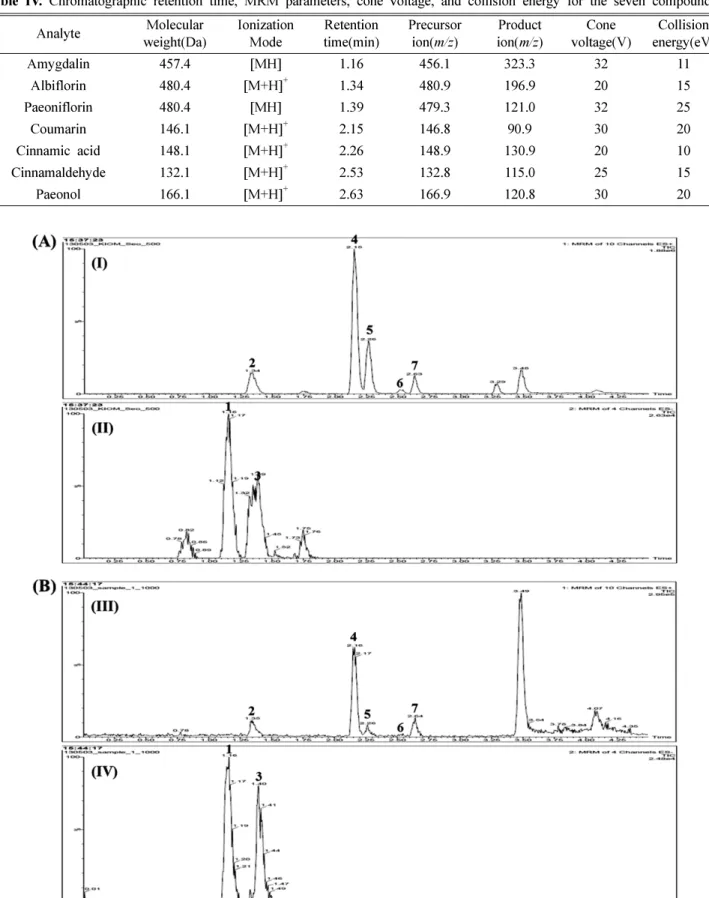
z 456.1과 m/z 479.3의 [M-H]- 형태의 분자이온 피크를 확 인하였다(Fig. 2). LC-MS/MS에서 정량분석을 위한 amygdalin의 MRM 조건은 m/z 456.1(precursor ion) → 323.3(product ion), albiflorin은 m/z 480.9 → 196.9, paeoniflorin은 m/z 479.3 → 121.0, coumarin은 m/z 146.8
→ 90.9, cinnamic acid는 m/z 148.9 → 130.9, cinnamaldehyde는 m/z 132.8 → 115.0 및 paeonol은 m/z 166.9 → 120.8로 설정한 후 정량을 실시하였다. 이상과 같 이 설정된 桂枝茯 丸의 LC-MS/MS MRM 분석법에 의해 분석한 결과 amygdalin, albiflorin, paeoniflorin, coumarin, cinnamic acid, cinnamaldehyde 및 paeonol은 1.16분, 1.34 분, 1.39분, 2.15분, 2.26분, 2.53분 및 2.63분에서 각각 검출 Fig. 1. Chemical structures of 7 marker compounds of Gyejibokryeong-hwan.
Table III. Linearities, regression equation, and correlation coefficients for 7 marker compounds
Compound Linear range(ng/mL) Regression equation Correlation coefficient
Amygdalin 5−500 y = 2.88x – 23.52 0.9988
Albiflorin 5−500 y = 18.94x – 63.08 0.9995
Paeoniflorin 5−500 y = 2.64x – 26.62 0.9990
Coumarin 5−500 y = 93.41x + 535.23 0.9994
Cinnamic acid 5−500 y = 41.14x + 105.39 0.9997
Cinnamaldehyde 5−500 y = 3.57x + 4.79 0.9991
Paeonol 5−500 y = 9.30x + 10.49 0.9998
되었다(Table IV 및 Fig. 3). 함량 분석 결과 桂枝茯 丸 추 출물 중 桂枝의 coumarin, cinnamic acid 및 cinnamaldehyde
의 함량이 1.97±0.09, 0.40±0.03 및 0.78±0.05 mg/g으로 각 각 검출되었으며, 牧丹皮의 paeonol과 桃仁의 amygdalin이 Fig. 2. Mass spectra of seven standard compounds. Amygdalin(A), albiflorin(B), paeoniflorin(C), coumarin(D), cinnamic acid(E), cinnamaldehyde(F), and paeonol(G).
Table IV. Chromatographic retention time, MRM parameters, cone voltage, and collision energy for the seven compounds Analyte Molecular
weight(Da)
Ionization Mode
Retention time(min)
Precursor ion(m/z)
Product ion(m/z)
Cone voltage(V)
Collision energy(eV)
Amygdalin 457.4 [MH] 1.16 456.1 323.3 32 11
Albiflorin 480.4 [M+H]+ 1.34 480.9 196.9 20 15
Paeoniflorin 480.4 [MH] 1.39 479.3 121.0 32 25
Coumarin 146.1 [M+H]+ 2.15 146.8 90.9 30 20
Cinnamic acid 148.1 [M+H]+ 2.26 148.9 130.9 20 10
Cinnamaldehyde 132.1 [M+H]+ 2.53 132.8 115.0 25 15
Paeonol 166.1 [M+H]+ 2.63 166.9 120.8 30 20
Fig. 3. Total ion chromatogram of seven marker compounds(A) and Gyejibokryeong-hwan sample(B) in positive ion(I and III) and negative ion(II and IV) modes by LC-MS/MS MRM mode. Amygdalin(1), albiflorin(2), paeoniflorin(3), coumarin(4), cinnamic acid(5), cinnamaldehyde(6), and paeonol(7).
3.42±0.29 및 21.76±0.67 mg/g으로 각각 나타났다. 또한 芍 藥의 albiflorin과 paeoniflorin은 2.16±0.05 및 17.17±0.40 mg/g으로 검출되었다(Table V).
桂枝茯 丸 추출물의 항산화 활성
桂枝茯 丸의 항산화 활성을 평가하고자 추출물을 농도
별로 조제한 후 ABTS와 DPPH 라디칼 소거활성을 측정하 였다. ABTS 라디칼의 소거활성을 비교한 결과 추출물의 농 도가 증가함에 따라 ABTS 라디칼 소거활성이 증가하는 경 향을 보였다. 桂枝茯 丸 추출물 25, 50, 100 및 200 µg/mL 농도에서 각각 28.13, 52.29, 87.17 및 99.72%의 라디칼 소 거활성을 나타냈으며, 시료를 첨가하지 않은 대조구의 흡광 도를 1/2로 감소시키는데 필요한 시료의 양(RC50)은 54.18 µg/
mL로 관찰되었다. 양성대조군인 vitamin C의 RC50값은 3.66µg/mL로 관찰되었다(Fig. 4A). DPPH 라디칼의 소거활 성 또한 ABTS 라디칼의 소거활성과 유사하게 농도의존적 인 증가를 나타냈다. 추출물 25, 50, 100 및 200 µg/mL 농 도에서 각각 18.94, 37.63, 59.34 및 82.24%의 라디칼 소거 활성을 나타냈으며, RC50는 79.53 µg/mL로 관찰되었다. 양 성대조군인 vitamin C의 DPPH 라디칼에 대한 RC50값은 12.93 µg/mL로 관찰되었다(Fig. 4B).
桂枝茯 丸 추출물의 LDL 산화 억제 활성
LDL 산화 억제 활성을 검색하고자 Cu2+에 의해 LDL 산 Table V. Amount of the 7 marker compounds in Gyejibokryeong-hwan
Compound Amount(mg/g)
Source
Mean SD RSD(%)
Amygdalin 21.71 0.67 3.07 Persicae Semen
Albiflorin 2.16 0.05 2.20 Paeoniae Radix
Paeoniflorin 17.17 0.40 2.31 Paeoniae Radix
Coumarin 1.97 0.09 4.67 Cinnamomi Ramulus
Cinnamic acid 0.40 0.03 8.25 Cinnamomi Ramulus
Cinnamaldehyde 0.78 0.05 6.70 Cinnamomi Ramulus
Paeonol 3.42 0.29 8.38 Moutan Radicis Cortex
Fig. 4. Effects of Gyejibokryeong-hwan on ABTS and DPPH free radical scavenging activity. ABTS(A) or DPPH(B) radical solution was added to a 96-well plate containing of indicated concentrations of GJBRH or vitamin C. After 30 min of incu- bation, the absorbance(ABTS; 734 nm, DPPH; 517 nm) was measured using a microplate reader. The quantitative data were presented as mean±S.E.M. of triplicate experiments.
Fig. 5. Effects of Gyejibokryeong-hwan on Cu2+-induced lipid peroxidation in LDLs. Indicated concentrations of GJBRH or vitamin C(50µg/mL) and LDLs were incubated with CuSO4 for 6 h at 37°C. The quantitative data were presented as mean±S.E.M. of triplicate experiments. **p<0.01 vs. OxLDL group.
화를 유도하고, 추출물을 처리하여 LDL 산화 정도를 비교 분석하였다. TBARS assay 결과 桂枝茯 丸 추출물의 처리 에 의해 농도 의존적으로 저해효과를 나타냈으며, IC50 값이 75.81µg/mL으로 계산되었다(Fig. 5). Fig. 6은 Cu2+에 의해 유도된 산화 LDL의 전기적 이동차(REM)에 대한 桂枝茯 丸의 효과를 나타내고 있다. 桂枝茯 丸을 37.5, 75 및 150µg/mL 농도로 처리하였을 때 산화 LDL의 REM이 각 각 19.73, 63.34 및 73.73% 감소되었다. 양성대조군인 vitamin C를 처리한 경우 산화된 LDL의 이동을 77.21% 억 제하였다.
결 론
桂枝茯 丸을 구성하는 桂枝, 茯笭, 牧丹皮, 芍藥 및 桃仁 의 5가지 구성 생약 중 桂枝의 coumarin, cinnamic acid 및 cinnamaldehyde, 牧丹皮의 paeonol, 芍藥의 albiflorin과 paeoniflorin 및 桃仁의 amygdalin 등 7종의 성분에 대하여
LC-MS/MS를 이용한 함량분석을 실시하였다. 분석 결과 桃 仁과 芍藥의 주요 성분인 amygdalin과 paeoniflorin이 21.71 mg/g과 17.17 mg/g으로 다른 성분에 비해 많이 함유 되어 있음을 확인하였다. 또한 桂枝茯 丸의 ABTS와 DPPH 라디칼 제거를 통한 항산화 활성은 용량이 높을수록 높은 활성을 나타내었으며, LDL 산화 억제 활성 역시 고농도로 처리할 경우 LDL의 산화정도를 나타내는 지표인 TBARS 와 REM이 더 감소됨을 알 수 있었다. 이러한 결과는 桂枝 茯 丸이나 이와 관련된 한약제제의 품질관리를 위한 기초 자료로 활용될 수 있을 것으로 사료되며, 桂枝茯 丸의 우 수한 항산화 활성과 LDL의 산화 억제활성을 통해 산화적 스트레스에 의한 동맥 경화질환의 초기단계를 예방하는데 활용할 수 있을 것으로 기대 된다.
사 사
본 연구는 한국한의학연구원에서 지원하는 ‘한약 처방의 과학적 근거 기반 구축사업(K14030)’에 의해 수행되었으며 이에 감사 드린다.
인용문헌
1. Nam, E. J., Lee, Y. K., Lee, D. N. and Kim, H. J. (2006) Clin- ical study on the effect of Gyebongnyeong capsule in the treatment of primary dysmenorrhea. Korean J. Physiol.
Pathol. 20: 1364-1368.
2. Lee, S. K., Kim, H. G., Ahan, J. C., Chung, T. W., Moon, J.
Y., Park, S. D., Kim, J. K., Choi, D. Y., Kim, C. H. and Park, W. H. (2003) Effect of the Geijibokryunghwan on human hepatocarcinoma cells. Korena J. Oriental Physiol. Pathol.
17: 568-573.
3. Hwang, D. S., Cho, J. H., Jang, J. B. and Lee, K. S. (2006) Inhibitory effects of Gaejibokryunghwan on cell proliferation in HeLa cells. J. Korean Oriental Med. 27: 23-35.
4. Yao, Z, and Shulan, Z. (2008) Inhibition effect of Guizhi-Ful- ing-decoction on the invasion of human cervical cancer. J.
Ethnopharmacol. 120: 25-35.
5. Ha, D. J., Jeong, K. J. and Lee, K. N. (1995) Effect of Kae- jibokryungwhan on analgesic, anti-inflammation, anti-con- vulsion, muscle relaxation and changes of body temperature through experimental animal. J. Korean Oriental Med. 16:
339-350.
6. Park, W. H., Joo, S. T., Park, K. K., Chang, Y. C. and Kim, C. H. (2004) Effects of the Geiji-Bokryung-Hwan on car- rageenan-induced inflammation in mice and cyclooxygenase- 2 in hepatoma cells of HeG2 and Hep3B. Immunopharmacol.
Immunotoxicol. 26: 103-112.
7. Yi, I. h., Lee, K. S. and Song, B. K. (2000) Effect of Guiz- ibokryungwhan aqua-acupuncture on the intravascular coag- Fig. 6. Effects of Gyejibokryeong-hwan on electrophoretic
mobility of Cu2+-induced oxidized LDLs. Indicated concentra- tions of GJBRH or vitamin C(50µg/mL) and LDLs were incubated with CuSO4 for 6 h at 37oC. The electrophoretic mobility of LDLs was detected by agarose gel electrophoresis.
(A) The stained gel is representative of three independent experiments. (B) Relative electrophoretic mobility (REM) indi- cated the distances moved from the origin were calculated and presented. **p<0.01 vs. OxLDL group.
ulation induced by endotoxin in rats. J. Oriental Gynecol. 13:
1-17.
8. Choi, M. H. and Park, W. H. (2006) Effect of the Geiji- bokryunghwan water extracts on stimulus-induced superox- ide generation and tyrosyl phosphorylation in human neutrophils. Korean J. Oriental Physiol. Pathol. 20: 477-481.
9. Kim, B. J., Kim, Y. K., Park, W. H., Ko, J. H., Lee, Y. C. and Kim, C. H. (2003) A water-extract of the Korean traditional formulation Geiji-Bokryung-Hwan reduces atherosclerosis and hypercholesteremia in cholesterol-fed rabbits. Int. Immu- nopharmacol. 3: 723-734.
10. Park, W. H., Kim, K. S., Kim, K. H., Kim, D. S. and Kim, C.
H. (2003) The antiplatelet activity of Geiji-Bokryung-Hwan, Korean traditional formulation, is mediated through inhibi- tion of phospholipase C and inhibition of TxB2 synthetase activity. Int. Immunopharmacol. 3: 971-978.
11. Nakagawa, T., Goto, H., Hikiami, H., Yokozawa, T., Shiba- hara, N. and Shimada, Y. (2007) Protective effects of keish- ibukuryogan on the kidney of spontaneously diabetic WBN/
Kob rats. J. Ethnopharmacol. 110: 311-7.
12. Jo, H. G., Park, A. R., Kee, Y. B., Kang, D. H., Choi, J. B. and Sil, J. U. (2011) A clinical trial on the blood stasis and effi- cacy of Kyejibokryong-whan (Guizhifuling-wan) in the patients with motor vehicle accident. J. Oriental Rehab Med.
21: 45-55.
13. Cho, J. H. (2007) A pilot study of the difference between Gyejibongnyeong-hwan and Gyejibongnyeong-hwan com- bined acupuncture therapy on the primary dysmenorrhea. J.
Oriental Obstetrics & Gynecol. 20: 161-168.
14. Park, J. M., Yang, J. M. and Kim, D. I. (2007) A clinical trial to verity the quality of life imporvement efficacy of Dang- guijakyak-san and Gyejibongnyeong-hwan granulation in postmenopausal women. J. Oriental Obstetrics & Gynecol.
20: 213-228.
15. Cho, K. O., Kim, Y. S., Jung, W. S. and Kim, T. H. (2011) Effect of Gui-zhi-fu-ling-wan on hot flashes in young patients: A retrospective case series. J. Acupunct Meridian Stud. 4: 129-133.
16. Liang, K., Cui, S., Zhang, Q., Bi, K., Qian, Z. and Jia, Y.
(2011) UPLC simultaneous determination of five active com- ponents in Cinnamomi Ramulus. Zhongguo Zhong Yao Za
Zhi 36: 3298-3320.
17. Wen, K. C., Huang, C. Y. and Liu, F. S. (1992) Determination of cinnamic acid and paeoniflorin in traditional Chinese medicinal preparations by high-performance liquid chroma- tography. J. Chromatogr. 593: 191-199.
18. Li, G., Xu, M. L., Lee, C. S., Woo, M. H., Chang, H. W. and Son, J. K. (2004) Cytotoxicity and DNA topoisomerases inhibitory of constituents from the sclerotium of Poria cocos.
Arch. Pharm. Res. 27: 829-833.
19. Hoang, L., Kwon, S. H., Kim, K. A., Hur, J. M., Kang, Y. H.
and Song, K. S. (2005) Chemical standardization of Poria cocos. Kor. J. Pjarmacogn. 36: 177-185.
20. Korean Pharmacopoeia Committee (2013) The Korean Phar- macopoeia, 10th ed, 1129-1192. Shinilbooks, Seoul.
21. Xu, X. Y., Yi, Z. H., Zheng, Y. M. and Fu, S. Q. (2008) Study on quality standard of Poria cocos. Zhong Yao Cai 31: 597- 599.
22. Che, S., Li, Q., Huo, Y. S., Chen, X. H. and Bi, K. S. (2010) RP-HPLC simultaneous determination of five triterpenoid acids in different parts of Poria cocos by UV wavelengths switch. Yao Xue Xue Bao 45: 494-497.
23. Jeong, S. Y., Zhao, B. T., Moon, D. C., Kang, J. S., Lee, J. H., Min, B. S., Son, J. K. and Woo, M. H. (2013) Quantitative analysis of bioactive marker compounds form Cinnamomi Ramulus and Cinnamomi Cortex by HPLC-UV. Nat. Prod.
Sci. 19: 28-35.
24. Ding, Y., Wu, E., Chen, J., Nguyen, H. T., Do, T. H., Park, K.
L., Bae, K. H., Kim, Y. H. and Kang, J. S. (2009) Quality evaluation of Moutan Cortex Radicis using multiple com- ponent analysis by high performance liquid chromatography.
Bull. Korean. Chem. Soc. 30: 2240-2244.
25. Yang, L., Xu, S. J., Tian, R. T., Xie, P. S. and Wang, Z. T.
(2007) HPLC fingerprinting of Radix Paeoniae Alba. Yao Xue Xue Bao 42: 71-74.
26. Koo, J. Y., Hwang, E. Y., Cho, S., Lee, J. H., Lee, Y. M. and Hong, S. P. (2005) Quantitative determination of amygdalin epimers from Armeniacae Semen by liquid chromatography.
J. Chromatogr. B Analyt. Technol. Biomed. Life Sci. 814: 69- 73.
(2014. 7. 11 접수; 2014. 8. 20 심사; 2014. 8. 27 게재확정)