Open Access
Role of Chemotherapy in Stage II Nasopharyngeal Carcinoma Treated with Curative Radiotherapy
Original Article
Purpose
To define the role of neoadjuvant and concurrent chemotherapy in stage II nasopharyngeal carcinoma, we compared the treatment outcomes of patients treated with curative radio- therapy with or without chemotherapy.
Materials and Methods
From 2004 to 2011, 138 patients with American Joint Committee on Cancer (AJCC) 2002 stage II nasopharyngeal carcinoma were treated with curative radiotherapy in 12 hospitals in South Korea. Treatment methods included radiotherapy alone in 34 patients, neoadjuvant chemotherapy followed by radiotherapy alone in seven, concurrent chemoradiotherapy in 80, and neoadjuvant chemotherapy followed by concurrent chemoradiotherapy in 17.
Adjuvant chemotherapy was used in 42 patients. Total radiation dose ranged from 64 Gy to 74.2 Gy (median, 70 Gy).
Results
Median follow-up was 48 months (range, 7 to 97 months) for all patients. At the last follow- up, 13 patients had died and 32 had experienced treatment failure; locoregional failure occurred in 14, distant failure in 16, and both in two. Five-year locoregional relapse-free survival, distant metastasis-free survival, progression-free survival, and overall survival were 86.2%, 85.5%, 74.4%, and 88.2%, respectively. Multivariate analyses showed that the significant prognostic factors were concurrent chemotherapy and N stage for locoregional relapse-free survival, concurrent chemotherapy for progression-free survival, and age and N stage for overall survival. Neither neoadjuvant nor concurrent chemotherapy improved distant metastasis-free survival.
Conclusion
Concurrent chemotherapy significantly improved 5-year locoregional relapse-free survival and progression-free survival in stage II nasopharyngeal carcinoma. However, neoadjuvant chemotherapy failed to improve either.
Key words
Nasopharyngeal carcinoma, Radiotherapy, Chemotherapy, Chemoradiotherapy + + + + + + + + + + + + + + + + + + + +
+ + + + + + + + + + + + + + + + + + + + + + + + + + + + + + + + + + + + + + + + + + + + + + + + + + + + + + + + + + + + + + + + + + + + + + + + + + + + + + + + + + + + + + + + + + + + + + + + + + + + + + + + + + + + + + + + + + + + + + + + + + + + + + + + + + + + + + + + + + + + + + + + + + + + + + + + + + + + + + + + + + + + + + + + + + + + + + + + + + + + + + + + + + + + + + + + + + + + + + + + + + + + + + + + + + + + + + + + + + + + + + + + + + + + + + + + + + + + + + + + + + + + + + + + + + + + + + + + + + + +
Correspondence: Chang Geol Lee, MD, PhD Department of Radiation Oncology, Yonsei Cancer Center, Severance Hospital, Yonsei University College of Medicine, 50-1 Yonsei-ro, Seodaemun-gu, Seoul 03722, Korea
Tel: 82-2-2228-8114 Fax: 82-2-2227-7823 E-mail: [email protected]
Received June 8, 2014 Accepted September 1, 2014 Published online February 13, 2015
*Min Kyu Kang and Dongryul Oh contributed equally to this work.
Min Kyu Kang, MD1 Dongryul Oh, MD2 Kwan Ho Cho, MD3 Sung Ho Moon, MD3 Hong-Gyun Wu, MD4 Dae-Seog Heo, MD5 Yong Chan Ahn, MD2 Keunchil Park, MD6 Hyo Jung Park, MD2 Jun Su Park, MD2 Ki Chang Keum, MD7 Jihye Cha, MD7 Jun Won Kim, MD7 Yeon-Sil Kim, MD8 Jin Hyoung Kang, MD9 Young-Taek Oh, MD10 Ji-Yoon Kim, MD11 Sung Hwan Kim, MD12 Jin-Hee Kim, MD13 Chang Geol Lee, MD, PhD7
1Department of Radiation Oncology, Yeungnam University College of Medicine, Daegu, 2Department of Radiation Oncology, Samsung Medical Center, Sungkyunkwan University School of Medicine, Seoul, 3Proton Therapy Center,
Research Institute and Hospital, National Cancer Center, Goyang, Departments of 4Radiation Oncology and 5Internal Medicine, Seoul National University College of Medicine, Seoul,
6Division of Hematology-Oncology, Department of Medicine, Samsung Medical Center, Sungkyunkwan University School of Medicine, Seoul, 7Department of Radiation Oncology, Yonsei University College of Medicine, Seoul,
Departments of 8Radiation Oncology and 9Medical Oncology, Seoul St. Mary’s Hospital, College of Medicine, The Catholic University of Korea, Seoul,
10Department of Radiation Oncology, Ajou University School of Medicine, Suwon, 11Departments of Radiation Oncology, Yeouido St. Mary’s Hospital, College of Medicine,
The Catholic University of Korea, Seoul,
12Department of Radiation Oncology, St. Vincent's Hospital, College of Medicine, The Catholic University of Korea, Suwon,
13Department of Radiation Oncology, Dongsan Medical Center, Keimyung University School of Medicine, Daegu, Korea
Introduction
Early-stage nasopharyngeal carcinoma (NPC) is tradition- ally treated with radiotherapy (RT) alone which achieves high overall survival (OS) rates. However, treatment outcome after RT alone in early-stage NPC is not always satisfactory in terms of locoregional control and distant metastasis. Chua et al. [1] reported results of 141 early-stage NPC patients treated with RT alone and found that stage II patients showed significantly poorer outcomes. The 10-year disease-specific survival, recurrence-free survival, local control, regional control, and distant control rates of stage I patients were 98%, 94%, 96%, 98%, and 98%, respectively, and the corresponding 10-year survival rates of stage II patients were 60%, 51%, 78%, 93%, and 64%, respectively. In addition, parapharyngeal extension [2,3], N1 [1,4] or T2N1 (1992 Fuzhou, China staging system) [5] increased the inci- dence of distant metastasis or were associated with poorer survival in early-stage NPC.
Chemotherapy (CTx) has been used before, during, or after RT in selected early stage NPC at the physician’s discretion.
Concurrent CTx is considered to improve locoregional control, and Xu et al. [6] retrospectively found that the locoregional control rate in T2N1 NPC was significantly higher for concurrent CTx than RT alone (91.5% vs. 77.3%, p=0.008). On the other hand, neoadjuvant CTx has been used to reduce distant metastasis, but results of two studies about the role of neoadjuvant CTx in early-stage NPC were contra- dictory. Neoadjuvant CTx decreased distant metastasis and improved OS in a subgroup analysis of two randomized trials [7], but not in a retrospective study [8]. Hence, the role of CTx in early-stage NPC is ill-defined.
To define the roles of neoadjuvant and concurrent CTx on patterns of failure and survival in stage II NPC patients, we retrieved and analyzed the data of stage II NPC patients collected in a database for the patterns of care study conducted by Head and Neck Study Group of the Korean Society for Radiation Oncology (KROG 11-09).
Materials and Methods
The Institutional Review Boards of all participating hospi- tals approved this retrospective study and waived the requirement for informed patient consent.
1. Patients
From 2004 to 2011, 804 patients with nasopharyngeal
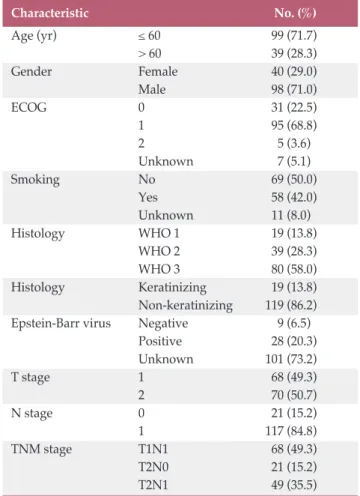
cancer were treated at 15 hospitals in South Korea, and of these, 138 patients from 12 hospitals met the following study eligibility criteria: biopsy-proven NPC, American Joint Com- mittee on Cancer (AJCC) 2002 stage II (T2N0, T1N1, or T2N1), completion of curative RT, and available information on patterns of failure and survival. Patient and tumor char- acteristics are listed in Table 1. Patients with a follow-up period of less than 12 months without any event were excluded.
2. Pretreatment workup
All patients underwent computed tomography (CT, n=129) and/or magnetic resonance imaging (MRI, n=104) of the head and neck. For the systemic work-up, bone scan (n=23) and abdominal ultrasonography or CT (n=13) were used. Positron emission tomography-computed tomography (PET-CT) was used in 79.0% of the patients (109/138). After
Table 1. Patients and tumor characteristics
Characteristic No. (%)
Age (yr) ! 60 99 (71.7)
> 60 39 (28.3)
Gender Female 40 (29.0)
Male 98 (71.0)
ECOG 0 31 (22.5)
1 95 (68.8)
2 5 (3.6)
Unknown 7 (5.1)
Smoking No 69 (50.0)
Yes 58 (42.0)
Unknown 11 (8.0)
Histology WHO 1 19 (13.8)
WHO 2 39 (28.3)
WHO 3 80 (58.0)
Histology Keratinizing 19 (13.8)
Non-keratinizing 119 (86.2) Epstein-Barr virus Negative 9 (6.5)
Positive 28 (20.3)
Unknown 101 (73.2)
T stage 1 68 (49.3)
2 70 (50.7)
N stage 0 21 (15.2)
1 117 (84.8)
TNM stage T1N1 68 (49.3)
T2N0 21 (15.2)
T2N1 49 (35.5)
ECOG, Eastern Cooperative Oncology Group; WHO, World Health Organization.
PET-CT became reimbursable by Korean National Health Insurance System in June 2006, it became routine.
3. Treatment
RT techniques included 2-dimensional RT alone (2D-RT) in three patients, 2D-RT followed by 3-dimensional confor- mal RT (3D-CRT) or intensity-modulated radiation therapy (IMRT) in six, 3D-CRT alone in 50, 3D-CRT followed by stereotactic body RT (SBRT) in one, and IMRT alone in 78.
Total dose ranged from 64 to 74.2 Gy (median, 70 Gy), after excluding one patient given 100.2 Gy by 3D-CRT and SBRT.
RT was given once daily at a median fraction size of 2.12 Gy (1.8 Gy in 32, 2.0 Gy in 35, 2.12 Gy in 24, 2.20 Gy in 15, 2.25 Gy in 15, and 2.4 Gy in 17).
CTx was used in neoadjuvant, concurrent, and adjuvant settings. Neoadjuvant CTx was used in 17.4% of patients (24/138) and concurrent CTx in 70.3% (97/138). Accordingly, there were four treatment groups: RT alone in 34 patients, neoadjuvant CTx followed by RT alone in seven patients, concurrent chemoradiotherapy (CCRT) in 80 patients, and neoadjuvant CTx followed by CCRT (neo-CCRT) in 17
patients. During RT, most patients were given cisplatin weekly or every 3 to 4 weeks. Cisplatin-based combination regimens were used for neoadjuvant CTx. Neoadjuvant CTx regimens used 5-fluorouracil and cisplatin in 11 patients, docetaxel and cisplatin in six, 5-fluorouracil, docetaxel and cisplatin in four, and other taxane-containing regimens in three. Concurrent CTx regimens were cisplatin every 3 to 4 weeks in 45 patients, weekly cisplatin in 40, 5-fluorouracil and cisplatin in five, and other regimens in seven. Adjuvant CTx was used in 30.4% of the patients (42/138): 39 patients in CCRT group, two in neo-CCRT group, and one in RT alone group. Adjuvant CTx regimens were 5-fluorouracil and cisplatin in 38 patients and taxane-containing regimens in three.
Planned neck dissection was not performed in all patients.
Instead, three patients with partial response underwent neck dissection at 37, 48, and 101 days after completing RT. These patients were not considered to have regional recurrence.
4. Statistical analysis
The chi-square test or Fisher exact test and the Student Table 2. Comparison of patient and tumor characteristics
Characteristic Neoadjuvant CTx Concurrent CTx
No Yes p-value No Yes p-value
Age (yr) ! 60 80 19 0.374 27 72 0.318
> 60 34 5 14 25
Gender Male 79 19 0.333 31 67 0.439
Female 35 5 10 30
Histology Keratinizing 18 1 0.196 4 15 0.374
Non-keratinizing 96 23 37 82
T stage 1 56 12 0.938 18 50 0.412
2 58 12 23 47
N stage 0 21 0 0.025 12 9 0.003
1 93 24 29 88
TNM stage T1N1 56 12 0.030 18 50 0.010
T2N0 21 0 12 9
T2N1 37 12 11 38
Neoadjuvant CTx No - - - 34 80 0.949
Yes - - 7 17
Concurrent CTx No 34 7 0.949 - - -
yes 80 17 - -
Adjuvant CTx No 74 22 0.010 40 56 < 0.001
yes 40 2 1 41
RT technique 2D-RT 6 3 0.190 4 5 0.450
3D-CRT or IMRT 108 21 37 92
CTx, chemotherapy; RT, radiotherapy; 2D-RT, 2-dimensional radiotherapy; 3D-CRT, 3-dimensional conformal radiotherapy;
IMRT, intensity-modulated radiation therapy.
t test or one-way ANOVA were used to evaluate group differences among categorical or continuous variables as appropriate. The duration of locoregional relapse-free survival (LRRFS), distant metastasis-free survival (DMFS), progression-free survival (PFS), and OS rates was calculated from treatment start to the date of the first event or the date of last follow-up. Survival curves were calculated using the Kaplan-Meier method. Log-rank tests and the Cox propor- tional hazard model using backward stepwise elimination procedure to remove variables with a p-value of " 0.10 were used to determine the prognostic significance of variables.
IBM SPSS ver. 22 (IBM Co., Armonk, NY) was used for analy- sis, and p-values of < 0.05 were considered significant.
Results
1. Patient and tumor characteristics
Patient and tumor characteristics, except N stage and the use of adjuvant CTx, were not significantly different between neoadjuvant CTx and concurrent CTx groups (Table 2).
Neoadjuvant CTx was used only in patients with N1 disease (20.5% vs. 0%, p=0.025). Concurrent CTx was used more frequently in patients with N1 disease (75.2% vs. 42.9%, p=0.003). Adjuvant CTx was predominantly used in concur- rent CTx group (42.3% vs. 2.4%, p < 0.001).
2. Patterns of failure and survival
Median follow-up in the 138 patients was 48 months (range, 7 to 97 months). Thirty-two patients experienced treatment failure; locoregional failure in 14 (9 local, 4 regional, and 1 locoregional), distant failure in 16, and both in two.
Of the 14 patients with locoregional relapse only, salvage surgery (n=3), RT (n=6), or both (n=1) were applied, and four received additional CTx. One patient was treated with CTx alone. Four patients died at 16, 22, 35, and 45 months after diagnosis of recurrence and eight patients remained alive at 12 to 84 months after recurrence (median, 30 months). OS rate after diagnosis of locoregional recurrence was 63.0% at 3 years. Of the 18 patients with distant metastasis, palliative CTx was administered in 15 patients. The OS rate after diag- nosis of distant metastasis was 57.6% at 3 years. At the last follow-up, 13 of the 138 patients had died: nine of distant metastasis, two of local recurrence, one of a non-nasopharyn- geal cause, and one of unknown cause.
Survival
1.0 0.8 0.6 0.4 0.2
0.0 0
Time (mo)
12 24 36 48 60
Distant metastasis-free survival Locoregional relapse-free survival Overall survival
Progression-free survival
Fig. 1. Locoregional relapse-free, distant metastasis-free, progression-free, and overall survival curves for all patients.
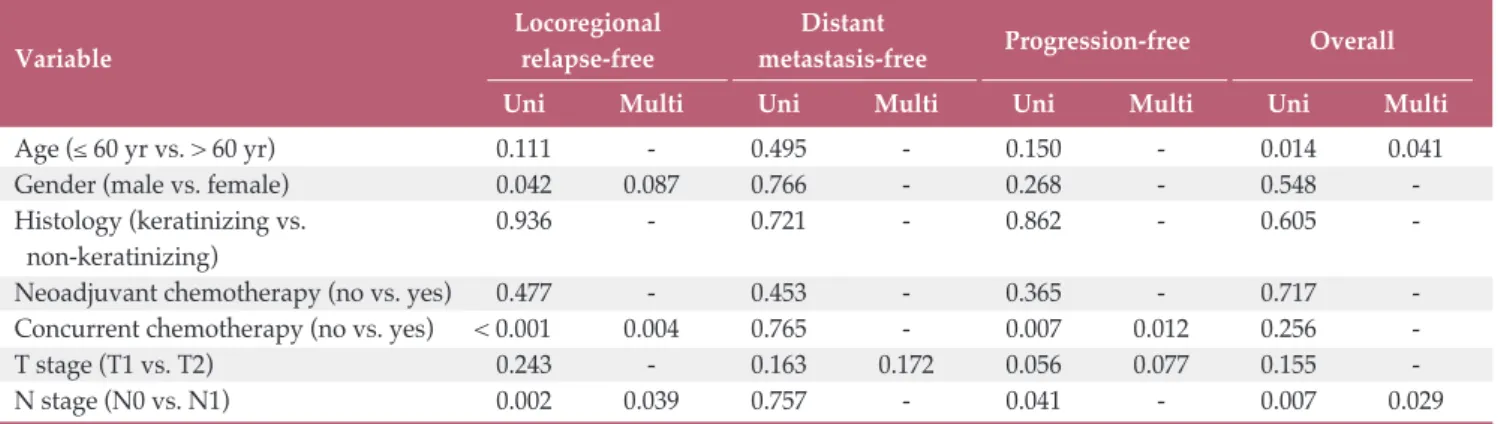
Table 3. Univariate and multivariate analyses of prognostic factors for survival endpoints Locoregional Distant
Progression-free Overall
Variable relapse-free metastasis-free
Uni Multi Uni Multi Uni Multi Uni Multi
Age (! 60 yr vs. > 60 yr) 0.111 - 0.495 - 0.150 - 0.014 0.041
Gender (male vs. female) 0.042 0.087 0.766 - 0.268 - 0.548 -
Histology (keratinizing vs. 0.936 - 0.721 - 0.862 - 0.605 -
non-keratinizing)
Neoadjuvant chemotherapy (no vs. yes) 0.477 - 0.453 - 0.365 - 0.717 -
Concurrent chemotherapy (no vs. yes) < 0.001 0.004 0.765 - 0.007 0.012 0.256 -
T stage (T1 vs. T2) 0.243 - 0.163 0.172 0.056 0.077 0.155 -
N stage (N0 vs. N1) 0.002 0.039 0.757 - 0.041 - 0.007 0.029
3. Prognostic factors
Fig. 1 shows survival curves and Table 3 shows the results of univariate and multivariate analyses of prognostic factors.
OS rates were 93.7% at 3 years and 88.2% at 5 years. Age and N stage were significant prognostic factors in both univariate and multivariate analysis. However, neither concurrent CTx nor neoadjuvant CTx improved OS.
PFS rates were 77.0% at 3 years and 74.4% at 5 years.
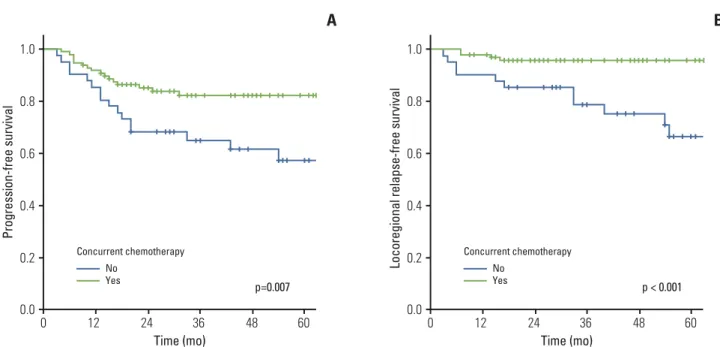
Concurrent CTx and N stage were significantly associated with PFS by univariate analysis, but only concurrent CTx was significant in multivariate analysis. Fig. 2A shows the PFS curves according to the use of concurrent CTx.
LRRFS rates were 90.5% at 3 years and 86.2% at 5 years.
Significant variables were gender, concurrent CTx, and N stage in univariate analysis. Concurrent CTx and N stage were significantly associated with LRRFS in multivariate analysis. Neoadjuvant CTx did not improve locoregional control. Fig. 2B shows LRRFS curves according to the use of concurrent CTx: 3- and 5-year LRRFS of each group were 78.8% vs. 95.7% and 66.6% vs. 95.7%, respectively. DMFS rates were 86.8% at 3 years and 85.5% at 5 years. No signifi- cant prognostic factor was identified in univariate or univari- ate analysis.
Discussion
In this study, concurrent CTx significantly improved LRRFS and PFS in stage II stage NPC, whereas neoadjuvant CTx did not. However, neither neoadjuvant nor concurrent CTx reduced distant metastasis or increased OS.
CCRT is a standard treatment for stage III/IV locally advanced NPC due to both locoregional control and survival benefit compared to RT alone. Intergroup Study 0099, in which concurrent (cisplatin) and adjuvant CTx (5-fluo- rouracil and cisplatin) were used, showed improved PFS and OS [9], and randomized clinical trials in endemic areas produced similar results [10-12].
Based on these findings, concurrent CTx could be expected to improve locoregional control and survival rates in selected early-stage NPC patients. Cheng et al. [13] reported that concurrent CTx (5-fluorouracil and cisplatin) achieved a locoregional control rate of 100% at 3 years in 32 patients with AJCC 1997 stage II NPC, whereas RT alone achieved a locoregional control rate of 91.7% in 12 patients with stage I or II NPC. Xu et al. [6] retrospectively compared RT alone with CCRT (cisplatin) in patients with AJCC 2002 T2N1 NPC, and found concurrent CTx significantly improved locore- gional control (91.5% vs. 77.3% at 5 years, p=0.008), but not DMFS or OS. In the present study, concurrent CTx signifi- cantly improved locoregional control in stage II NPC patients (Table 3), but this was not reflected by an OS improvement.
Progression-free survival
1.0 0.8 0.6 0.4 0.2
0.00 12 24 36 48 60
Time (mo)
p=0.007
A
NoYes
Concurrent chemotherapy
Locoregional relapse-free survival
B
1.0 0.8 0.6 0.4 0.2
0.0 0 12 24 36 48 60
Time (mo)
p < 0.001 NoYes
Concurrent chemotherapy
Fig. 2. Progression-free survival (A) and locoregional relapse-free survival (B) curves according to the use of concurrent chemotherapy.
This discrepancy may have been caused by the effectiveness of salvage treatment, as the majority of patients with locore- gional relapse alone were treated with salvage surgery or RT, and 5-year OS of patients with locoregional relapse alone was 42%. However, although a lack of an OS increase miti- gates against the use of concurrent CTx, its use seems warranted based on improved locoregional control, since the toxicities related to salvage treatments for locoregional recurrence after RT alone may be greater than the toxicities associated with concurrent CTx. A recent phase III trial show- ed the benefit of CCRT in NPC patients with Chinese 1992 stage II [14], equivalent to AJCC 2010 stage II-III, but only 13% of the study's patients were AJCC stage III. Concurrent cisplatin given weekly during RT significantly improved OS (94.5% vs. 85.8% at 5 years, p=0.007) by reducing distant metastasis rather than locoregional failure. However, as the current study showed no difference in DMFS by use of concurrent CTx (85.6% vs. 85.4% at 5 years), and there has not been enough evidence that concurrent CTx can reduce distant metastasis, follow-up data in a large cohort of early stage NPC may be needed to assess the effect of concurrent CTx on distant metastasis.
Conversely, IMRT without any kind of CTx achieves high locoregional control and OS rates. Su et al. [2] in a Chinese study reported disease-specific survival, local recurrence-free survival and DMFS rates were 97.3%, 97.7%, and 97.8%, respectively, at 5 years in 198 patients with AJCC 2002 stage I-IIb NPC treated with IMRT without CTx (141 of these patients had stage IIb). Local relapse only occurred in patients with T2b disease and their local recurrence-free survival rate was 94.2% at 5 years. Tham et al. [15] reported a 3-year OS of 96.2% in 107 patients, only nine of whom received concurrent CTx, with stage IIb NPC treated with IMRT with or without CTx. However, since most studies favoring IMRT alone were reported from single institutional retrospective experiences in endemic areas, it is unclear whether IMRT alone is sufficient to treat the stage II NPC, especially in non-endemic areas.
Neoadjuvant CTx has been used to reduce distant metas- tasis in locally advanced NPC. Of five randomized controlled studies using neoadjuvant CTx followed by RT alone, DFS was increased by neoadjuvant CTx only in one study, and OS was not improved in any of the studies [16-20]. A meta- analysis also concluded that neoadjuvant CTx does not improve OS [21]. Although neoadjuvant CTx is also used in early stage NPC, its effect remains unclear. A pooled analysis of two randomized controlled trials conducted by Chua et al. [7] in AJCC 1997 stage I and II NPC revealed that induc- tion CTx (cisplatin, epirubicin, and 5-fluorouracil) improved OS by 12% (79% vs. 67% at 5 years, p=0.048) by reducing distant metastasis (86% vs. 71% at 5 years, p=0.005) in early- stage NPC (T1-2N0-1). However, Song et al. [8] reported that
induction CTx (cisplatin and 5-fluorouracil) did not improve clinical outcomes including distant metastasis and OS in AJCC 1997 stage I and II NPC. In the current study, 24 patients with AJCC 2002 stage II NPC were treated with neoadjuvant CTx (mainly cisplatin and 5-fluorouracil) followed by RT alone (n=7) or RT combined with concurrent CTx (n=17). Although the number of patients enrolled in the current study was small, neoadjuvant CTx did not improve DMFS or PFS. Tham et al. [15] also found that neoadjuvant CTx did not improve DMFS in stage IIB NPC.
In addition, delayed definitive RT and toxicities associated with neoadjuvant CTx could be harmful. Song et al. [8]
reported that RT delay due to neoadjuvant CTx resulted in poorer locoregional control in stage IIB disease than RT alone (p=0.044). In another trial, in which combination of bleomycin, epirubicin and cisplatin were used, treatment- related death was found to be greater for induction CTx than RT alone (8% vs. 1%) [17]. However, when considering that distant metastasis is still problematic in early stage NPC, and earlier studies used old chemotherapeutic regimens, neoad- juvant CTx with novel agents deserves investigation.
Unlikely concurrent and neoadjuvant CTx, the effect of adjuvant CTx on early stage NPC has not been investigated.
In locally advanced NPC, adjuvant CTx after RT alone did not improve DFS or OS in three randomized trials [22-24].
Instead, adjuvant CTx has been used with CCRT based on the results of randomized trials, which showed that CCRT followed by adjuvant CTx significantly improved OS compared to RT alone [9-11]. Cheng et al. [13] also used adjuvant CTx following CCRT in 32 stage II NPC patients, but could not investigate the effects of adjuvant CTx due to the low incidence of distant metastasis. In the present study, adjuvant CTx was used mainly in the CCRT group, but although it was used in 47.6% of patients in this group, it did not appear to improve PFS or OS (data not shown). Hence, the efficacy of adjuvant CTx in early stage NPC remains unclear.
This study is inherently limited by its retrospective nature.
Another limitation is the change of the staging system: stage II in the AJCC 2002 staging system consists of IIa (T2aN0) and IIb (T1N1, T2bN0, T2a/bN1), but T2aN0 was moved to stage I in AJCC 2010 staging system [25]. T2a and T2b disease could not be analyzed separately because of the lack of information. Epstein-Barr virus infection was tested in only 37 of 138 patients (26.8%), in whom the positive rate was 75.7% (28/37). A variety of CTx regimens and RT techniques were used.
However, this study also has some strengths. Because it was a multi-institutional study, retrospective bias was prob- ably reduced. In addition, because the quality of oncologic management, including imaging techniques, CTx, and RT, has improved significantly, we included only patients
treated during the last decade. MRI was used in 75.4% of patients for staging, which can discriminate T stage more than CT. PET-CT was used in 79.0% of patients as an initial systemic work-up tool, which means that the risk of includ- ing patients with asymptomatic distant metastasis was lower than other studies. In addition, since PET-CT was reim- bursed by national health insurance beginning June 2006 and used for routine workups thereafter, locoregional or distant failures were probably detected and treated earlier, which might have influenced PFS and OS.
Conclusion
In summary, concurrent CTx significantly improved LRRFS and PFS in stage II NPC, whereas neoadjuvant CTx did not. These findings need to be confirmed by a random-
ized clinical trial. Furthermore, since distant metastasis occurred in 13% of patients and was not reduced by adding CTx, more effective novel agents are required.
Conflicts of Interest
Conflict of interest relevant to this article was not reported.
Acknowledgments
This study was supported by Yeungnam University research grants in 2012.
1. Chua DT, Sham JS, Kwong DL, Au GK. Treatment outcome after radiotherapy alone for patients with Stage I-II nasopha- ryngeal carcinoma. Cancer. 2003;98:74-80.
2. Su SF, Han F, Zhao C, Chen CY, Xiao WW, Li JX, et al. Long- term outcomes of early-stage nasopharyngeal carcinoma patients treated with intensity-modulated radiotherapy alone.
Int J Radiat Oncol Biol Phys. 2012;82:327-33.
3. Teo P, Yu P, Lee WY, Leung SF, Kwan WH, Yu KH, et al.
Significant prognosticators after primary radiotherapy in 903 nondisseminated nasopharyngeal carcinoma evaluated by computer tomography. Int J Radiat Oncol Biol Phys. 1996;36:
291-304.
4. He X, Ye M, Guo X, Pan Z, Zhang Z, He S, et al. Treatment outcome of patients with stages I-II nasopharyngeal carcinoma after late course accelerated hyperfractionation radiotherapy alone. Oral Oncol. 2012;48:1058-63.
5. Xiao WW, Han F, Lu TX, Chen CY, Huang Y, Zhao C. Treat- ment outcomes after radiotherapy alone for patients with early-stage nasopharyngeal carcinoma. Int J Radiat Oncol Biol Phys. 2009;74:1070-6.
6. Xu T, Hu C, Wang X, Shen C. Role of chemoradiotherapy in intermediate prognosis nasopharyngeal carcinoma. Oral Oncol. 2011;47:408-13.
7. Chua DT, Ma J, Sham JS, Mai HQ, Choy DT, Hong MH, et al.
Improvement of survival after addition of induction chemotherapy to radiotherapy in patients with early-stage nasopharyngeal carcinoma: subgroup analysis of two phase III trials. Int J Radiat Oncol Biol Phys. 2006;65:1300-6.
8. Song CH, Wu HG, Heo DS, Kim KH, Sung MW, Park CI.
Treatment outcomes for radiotherapy alone are comparable with neoadjuvant chemotherapy followed by radiotherapy in early-stage nasopharyngeal carcinoma. Laryngoscope.
2008;118:663-70.
9. Al-Sarraf M, LeBlanc M, Giri PG, Fu KK, Cooper J, Vuong T, et al. Chemoradiotherapy versus radiotherapy in patients with advanced nasopharyngeal cancer: phase III randomized Inter- group study 0099. J Clin Oncol. 1998;16:1310-7.
10. Lee AW, Lau WH, Tung SY, Chua DT, Chappell R, Xu L, et al.
Preliminary results of a randomized study on therapeutic gain by concurrent chemotherapy for regionally-advanced nasop- haryngeal carcinoma: NPC-9901 Trial by the Hong Kong Nasopharyngeal Cancer Study Group. J Clin Oncol. 2005;23:
6966-75.
11. Wee J, Tan EH, Tai BC, Wong HB, Leong SS, Tan T, et al. Ran- domized trial of radiotherapy versus concurrent chemoradio- therapy followed by adjuvant chemotherapy in patients with American Joint Committee on Cancer/International Union against cancer stage III and IV nasopharyngeal cancer of the endemic variety. J Clin Oncol. 2005;23:6730-8.
12. Chen Y, Liu MZ, Liang SB, Zong JF, Mao YP, Tang LL, et al.
Preliminary results of a prospective randomized trial compar- ing concurrent chemoradiotherapy plus adjuvant chemother- apy with radiotherapy alone in patients with locoregionally advanced nasopharyngeal carcinoma in endemic regions of china. Int J Radiat Oncol Biol Phys. 2008;71:1356-64.
13. Cheng SH, Tsai SY, Yen KL, Jian JJ, Chu NM, Chan KY, et al.
Concomitant radiotherapy and chemotherapy for early-stage nasopharyngeal carcinoma. J Clin Oncol. 2000;18:2040-5.
References
14. Chen QY, Wen YF, Guo L, Liu H, Huang PY, Mo HY, et al.
Concurrent chemoradiotherapy vs radiotherapy alone in stage II nasopharyngeal carcinoma: phase III randomized trial. J Natl Cancer Inst. 2011;103:1761-70.
15. Tham IW, Lin S, Pan J, Han L, Lu JJ, Wee J. Intensity-modu- lated radiation therapy without concurrent chemotherapy for stage IIb nasopharyngeal cancer. Am J Clin Oncol. 2010;33:
294-9.
16. Chan AT, Teo PM, Leung TW, Leung SF, Lee WY, Yeo W, et al. A prospective randomized study of chemotherapy adjunc- tive to definitive radiotherapy in advanced nasopharyngeal carcinoma. Int J Radiat Oncol Biol Phys. 1995;33:569-77.
17. International Nasopharynx Cancer Study Group; VUMCA I Trial. Preliminary results of a randomized trial comparing neoadjuvant chemotherapy (cisplatin, epirubicin, bleomycin) plus radiotherapy vs. radiotherapy alone in stage IV(> or = N2, M0) undifferentiated nasopharyngeal carcinoma: a posi- tive effect on progression-free survival. Int J Radiat Oncol Biol Phys. 1996;35:463-9.
18. Chua DT, Sham JS, Choy D, Lorvidhaya V, Sumitsawan Y, Thongprasert S, et al. Preliminary report of the Asian-Ocean- ian Clinical Oncology Association randomized trial comparing cisplatin and epirubicin followed by radiotherapy versus radiotherapy alone in the treatment of patients with locore- gionally advanced nasopharyngeal carcinoma. Asian-Ocean- ian Clinical Oncology Association Nasopharynx Cancer Study Group. Cancer. 1998;83:2270-83.
19. Ma J, Mai HQ, Hong MH, Min HQ, Mao ZD, Cui NJ, et al.
Results of a prospective randomized trial comparing neoad-
juvant chemotherapy plus radiotherapy with radiotherapy alone in patients with locoregionally advanced nasopharyn- geal carcinoma. J Clin Oncol. 2001;19:1350-7.
20. Hareyama M, Sakata K, Shirato H, Nishioka T, Nishio M, Suzuki K, et al. A prospective, randomized trial comparing neoadjuvant chemotherapy with radiotherapy alone in patients with advanced nasopharyngeal carcinoma. Cancer.
2002;94:2217-23.
21. Baujat B, Audry H, Bourhis J, Chan AT, Onat H, Chua DT, et al. Chemotherapy in locally advanced nasopharyngeal carci- noma: an individual patient data meta-analysis of eight randomized trials and 1753 patients. Int J Radiat Oncol Biol Phys. 2006;64:47-56.
22. Rossi A, Molinari R, Boracchi P, Del Vecchio M, Marubini E, Nava M, et al. Adjuvant chemotherapy with vincristine, cyclophosphamide, and doxorubicin after radiotherapy in local-regional nasopharyngeal cancer: results of a 4-year multicenter randomized study. J Clin Oncol. 1988;6:1401-10.
23. Chi KH, Chang YC, Guo WY, Leung MJ, Shiau CY, Chen SY, et al. A phase III study of adjuvant chemotherapy in advanced nasopharyngeal carcinoma patients. Int J Radiat Oncol Biol Phys. 2002;52:1238-44.
24. Kwong DL, Sham JS, Au GK, Chua DT, Kwong PW, Cheng AC, et al. Concurrent and adjuvant chemotherapy for nasop- haryngeal carcinoma: a factorial study. J Clin Oncol. 2004;22:
2643-53.
25. Edge SB, Byrd DR, Compton CC, Fritz AG, Greene FL, Trotti A. AJCC cancer staging manual. 7th ed. New York: Springer;
2010.