http://dx.doi.org/10.4236/ojn.2015.58077
Difference in the Contents of Music Intervention to Control Agitation by Music Providers
Heeok Park
College of Nursing, Keimyung University, Daegu, South Korea Email: [email protected]
Received 16 July 2015; accepted 25 August 2015; published 28 August 2015 Copyright © 2015 by author and Scientific Research Publishing Inc.
This work is licensed under the Creative Commons Attribution International License (CC BY).
http://creativecommons.org/licenses/by/4.0/
Abstract
Purpose: The purpose of this study was to compare the contents of music intervention studies between the music therapists and non-music therapists who endeavored to control agitation in patients with dementia, and to provide meaningful ideas to improve the music interventions by music providers. Method: This study is a review study by searching CINAHL, MEDLINE, and Psy- chINFO for the keywords, “agitation” and “music,” which are used in the searches. Results: A total of 30 studies of music intervention (7 studies about music therapists and 23 studies about non- music therapists) were included for the review. The studies about music therapists had a more reasonable sample size, variety of music activities, and comparison groups. The studies of non- music therapists were provided by nurses, researchers, recreational therapists, and trained nurs- ing assistants and they provided music using background music at a scheduled time for care, such as mealtimes and bathing times. Conclusions: Studies on music interventions need to have a more rigorous research design, such as randomized controlled trials for the future studies. Furthermore, there is a need for multi-disciplinary music intervention studies by music providers who have dif- ferent types of educational backgrounds and clinical experiences.
Keywords
Music, Agitation, Dementia
1. Introduction
Persons with dementia have health problems that include cognitive decline, language deterioration, poor judg- ment, restlessness, confusion, and changes in social-behavioral problems [1]. Among these problems, agitation
has become a major issue because it increases nursing-home placement, health maintenance costs, and the bur- dens of caregivers [2]-[4]. Pharmacological interventions are often necessary to control agitation in persons with dementia, but they bring about undesirable effects such as a high risk of fall, declined cognition levels, and monetary burdens [5] [6]. To reduce the undesirable effects of pharmacological interventions, music interven- tion is currently being provided to control agitation because it is relatively convenient, non-pervasive, and cost- effective. Music therapy is defined as “an established allied health profession using music and music activities to address physical, psychological, cognitive and social needs of individuals with disabilities” [7].
Many studies have reported the positive effects of music intervention on diverse health problems in persons with dementia, including cognitive decline, less-alert responses, lack of engagement between caregiver and care- receiver, disruptive behaviors, impaired language function, inattention, lack of food intake, and poor social rela- tionships [8]-[13]. Many studies have also reported the positive effects of music intervention on agitation in persons with dementia [14]-[18]. Music intervention consists of music group activities, listening to music, sing- ing, or playing instruments [9] [16] [17]. Most music-intervention studies have been performed in nursing facili- ties, with only one study that was conducted at the client’s residence [17].
Music intervention to control agitation in persons with dementia has been performed by diverse healthcare providers. The providers can be categorized into two groups: music therapists and non-music therapists (the lat- ter includes nurses, certified nursing assistants, recreation specialists, and family members; [15] [19] [20]. Music therapists are inclined to use different methods of music intervention compared with non-music therapists, re- flecting their different educational backgrounds and clinical experiences. Even though music intervention pro- viders tend to use different types of music intervention to control agitation, there has been no description re- garding how the interventions are different depending on the different educational backgrounds of the music in- tervention providers. A few studies reviewed the effects of music intervention on agitation, and a review focused on the findings of music interventions, but not on music contents and music providers [21]-[23].
The present study was undertaken to fill the knowledge gap by examining how the content of music interven- tion is different between music therapists and non-music therapists based on a review of published research ar- ticles. The findings reveal more of the strengths and weaknesses of music intervention by each group, and also how music interventions might be improved. Specifically, the present review focused on how the contents of music intervention used to control agitation in persons with dementia differed between music therapists and non- music therapists. This new knowledge should aid in developing more practical guidelines of music intervention for each group of music providers.
2. Method
2.1. DesignThis study is a review study to investigate the contents of music intervention to control agitation in patients with dementia and to compare the contents of music intervention by the intervention providers.
2.2. Sample Selection
A review of the research literature was undertaken by searching computerized databases (CINAHL, MEDLINE, and PsychINFO) from 1990-2015 June. Some of the keywords used in the literature search included music and agitated. By the first search, a total of 119 articles were listed. The criteria for article selection were those ar- ticles published in English, reported an intervention study using music, and studied controlling agitation in per- sons with dementia or Alzheimer’s disease. Based on the findings of the inclusion criteria, a total of 30 articles were selected. The others were excluded because they were no intervention studies, not performed for patients with dementia, not mainly performed using music intervention, or not mainly provided to control agitation. Thus, the remaining 30 articles were included for the review.
3. Results
3.1. Subjects’ Characteristics
A total of 30 research-based studies were included for the review and the studies were divided into two groups according to the purpose of the proposed study of music therapists and non-music therapists. Among the 30 stu-
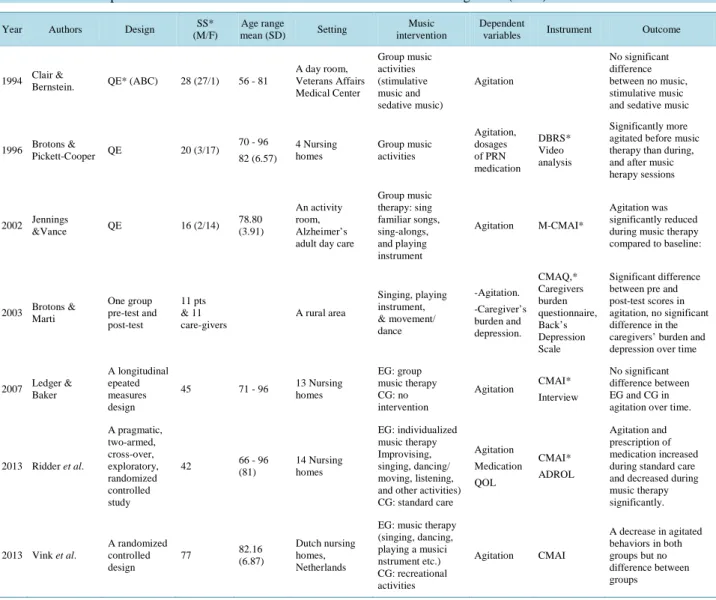
dies, 7 studies were performed by music therapists and the other 23 studies were provided by non-music therap- ists, including nurses, certified nurse assistants, recreational specialists, and family caregivers. The overall find- ings of the music-intervention studies were reviewed, including research design, sample size, setting, music in- terventions, instruments, and outcomes. The overall findings about the music therapists are shown in Table 1 and concerning the non-music therapists in Table 2. The contents of music interventions were reviewed and they included conceptual framework or theoretical framework, music-intervention providers and agitation raters, music-intervention tools, and music-intervention time schedules (timing, duration, frequency, and total sessions).
The contents of music interventions by music therapists are presented in Table 3 and non-music therapists in Table 4.
3.2. The Characteristics of Music Interventions Studies 3.2.1. Sample Size and Setting
In the 30 music-intervention studies to control agitation in persons with dementia that were identified, the sam- ple sizes were diverse and varied from 1 - 100. In the music therapists’ studies, the sample size varied from 11 - 77, with 86% of the studies having a sample size exceeding 15 (Table 1). In the non-music therapists’ studies,
Table 1. Music therapists: the characteristics of music intervention studies to control agitation (N = 7).
Year Authors Design SS*
(M/F)
Age range
mean (SD) Setting Music
intervention
Dependent
variables Instrument Outcome
1994 Clair &
Bernstein. QE* (ABC) 28 (27/1) 56 - 81
A day room, Veterans Affairs Medical Center
Group music activities (stimulative music and sedative music)
Agitation
No significant difference between no music, stimulative music and sedative music
1996 Brotons &
Pickett-Cooper QE 20 (3/17) 70 - 96 82 (6.57)
4 Nursing homes
Group music activities
Agitation, dosages of PRN medication
DBRS*
Video analysis
Significantly more agitated before music therapy than during, and after music herapy sessions
2002 Jennings
&Vance QE 16 (2/14) 78.80
(3.91)
An activity room, Alzheimer’s adult day care
Group music therapy: sing familiar songs, sing-alongs, and playing instrument
Agitation M-CMAI*
Agitation was significantly reduced during music therapy compared to baseline:
2003 Brotons &
Marti
One group pre-test and post-test
11 pts
& 11 care-givers
A rural area
Singing, playing instrument,
& movement/
dance
-Agitation.
-Caregiver’s burden and depression.
CMAQ,*
Caregivers burden questionnaire, Back’s Depression Scale
Significant difference between pre and post-test scores in agitation, no significant difference in the caregivers’ burden and depression over time
2007 Ledger &
Baker
A longitudinal epeated measures design
45 71 - 96 13 Nursing
homes
EG: group music therapy CG: no intervention
Agitation CMAI*
Interview
No significant difference between EG and CG in agitation over time.
2013 Ridder et al.
A pragmatic, two-armed, cross-over, exploratory, randomized controlled study
42 66 - 96
(81)
14 Nursing homes
EG: individualized music therapy Improvising, singing, dancing/
moving, listening, and other activities) CG: standard care
Agitation Medication QOL
CMAI*
ADROL
Agitation and prescription of medication increased during standard care and decreased during music therapy significantly.
2013 Vink et al.
A randomized controlled design
77 82.16
(6.87)
Dutch nursing homes, Netherlands
EG: music therapy (singing, dancing, playing a musici nstrument etc.) CG: recreational activities
Agitation CMAI
A decrease in agitated behaviors in both groups but no difference between groups
*CMAI = Cohen-Mansfield Agitation Inventory; CMAQ = Cohen Mansfield Agitation Questionnaire; DBRS = Disruptive Behavior Rating Scales; M-CMAI = Modified Cohen-Mansfield Agitation Inventory; NPI = Neuropsychiatry Inventory; PGC-IADL = Philadelphia Geriatric Centre Instrumental Activities of Daily Living; SS = sample size.
Table 2. Non-music therapists: the characteristics of music intervention studies to control agitation (N = 23).
Year Authors Design SS* (M/F)
Age Range
Mean (SD) Setting Music
Intervention
Dependent
Variables Instrument Outcome
1993 Gerdner &
Swanson A case
study 5 70 - 99 A health
center Individualized music Agitation,
# of medication M-CMAI* Agitation decreased during music intervention in 4 out of 5 clients.
1994 Goddaer &
Abraham ABAB 29
(6/23) 69 - 93 81.3 (6.9)
2 nursing homes,
A: no music B: Group music (Relaxing music)
Agitation M-CMAI.
Agitation significantly decreased 54% with music compared to baseline and increased 38.4%
when withdrawal period
1995 Tabloski
et al. QE* 20
(3/17) 64 - 84 2 Long term
care facilities Group (Calming music) Agitation
Agitation Behavior Scale
A significant reduction in agitated both during and after music intervention compared to baseline
1996 Ragneskog
et al. 5 69 - 85 A nursing
home
Group (Soft, Swedish,
Pop/rock music Agitation Video
analysis.
Two of the five patients didn’t show restless during soothing music condition.
1997 Denney QE 9
(3/6) 65 - 84 74.8 (6.4)
A nursing
home Quiet music Agitation. M-CMAI Agitation decreased with
music from baseline
1997 Gerdner A case
study 1 77
Classical-relaxation
& Preferred music (spiritual or religious music)
Agitation M-CMAI
Agitation decreased during preferred music condition than classical music
1997 Thomas, Heitman, &
Alexander.
QE 14
(4/10) 69 - 86 A nursing facility
Individualized and Preferred music
Aggressive
behaviors M-CMAI
There were significant differences on physically aggressive behaviors between pre-music and post-music and music and post-music
1998 Clark, Lipe,
& Bilbrey QE 18 (4/14)
55 - 95 82 (10)
A nursing
facility Preferred music Aggressive
behaviors. Observation
The total number of aggressive ehaviors significantly decreased with music compared to no music
2000 Gerdner
A pre and posttest crossover design
39
(9/30) 82.6 6 long-term care facilities
Individualized M Vs. Classical-Relaxation music
Agitation M-CMAI
Significant reduction in agitation with individualized music and even after withdrawal compared to classical music
2001 Ragneskog
et al. QE 4 - 4 nursing
homes
Individualized
M Classical M Agitation Video
analysis.
Two patients became calmer during some of the individualized music sessions
2004 Richeson
& Neill QE 27 (6/21)
87 (67 - 94)
Nursing
facility Quiet music Agitation,
Food intake
M-CMAI, Percentage of food eaten
Overall agitation decreased compared to baseline to intervention and food eaten increased from baseline
2005 Gerdner QE 8
(0/8) 83.3 A skilled care facility
Preferred music
individualized Agitation
M-CMAI VAS* Interviews
A significant reduction in agitation during the presentation of music from baseline and daytime
2005 Hicks-
Moore QE 30
(9/21) 82.4 (70 - 101)
A nursing
home Relaxing music Agitation M-CMAI Mean of agitated behaviors decreased with music
2006 Sung
et al. QE 57 - A residential
care facility
EG*: Preferred music
CG*: No music Agitation CMAI*
A significant reduction in overall CMAI. Physically non-aggressive behaviors in music group decreased compared to the no music group
2006 Sung
et al. RCT* 36 77.61
(8.43)
A residential care facility
EG: Familiar music
CG: No music Agitation M-CMAI
Agitation of the EG decreased significantly compared to CG and baseline
2008 Hicks- Moore &
Robinson 3 * 3 repeated measures design
41 84.5 (6.0) 67 - 92
Three nursing homes
EG1: Favorite music (FM) EG2: Hand massage (HM) EG3: FM & HM CG: no treatment
Agitation M-CMAI
Agitation significantly decreased in EG1, EG2, and EG3 immediately following the intervention but no significant difference in agitation over the groups
2009 Park &
Specht
ABAB A: music B: no music
15
83.40 (10.26) 60 - 98
Home
Individualized and preferred music
Agitation M-CMAI
Agitation significantly decreased while listening to music compared to baseline. No difference in agitation between music and no music weeks
Continued
2010 Cooke et al.
A randomized crossover design
47 (14/33)
74 - 94 (87.2%)
2 LTC facilities
EG: Music group CG: reading group
Agitation Anxiety
CMAI-SF* RAID*
Significant increase in the frequency of verbal aggression over time, but no overall effect of the music on agitation and anxiety
2011 Ho et al.
A single group pre and post design
A
hospital-based nursing home
Researcher-
composed music Agitation CMAI Significant decline in mean agitation scores
2011 Lin et al.
A pre and posttest control group design
100 65 - 97, 82 (6.80)
3 nursing home facilities Taiwan
EG: music intervention CG: normal daily activities
Agitation
Chinese version of CMAI
Agitation reduced significantly in the experimental group
2011 Sung
et al. QE 55 81.37
(9.14)
A residential care facility Taiwan, Australia
EG: music intervention CG: usual care
Agitation Anxiety
CMAI RAID
The reduction of agitation between two groups was not significantly different
2013 Dunn &
Riley-Doucet
A within-subjects, repeated-measures design
5(2/3) 77 - 88 (83)
An adult day care center
Non-religious music group and religious music group
Neuropsychiatric symptoms (agitation etc)
The Agitated Behavior Scale
There was no significant differences between the non-religious music and religious music on NPS
2013 Park One group pre and
posttest design 26 82.19 Own home Individualized
preferred music Agitation M-CMAI
Agitation decreased while listening to the music compared to the baseline
*ADROL = Alzheimer’s Disease-Related Quality of Life; CG = Control group; CMAI = Cohen-Mansfield Agitation Inventory; CMAI-SF = Cohen-Mansfield Agitation Inventory-Short Form; EG = Experimental group; M-CMAI = Modified Cohen-Mansfield Agitation Inventory; RAID = Rating Anxiety in Dementia Scale; RCT = Randomized Controlled Trial; SS = Sample Size; QE = Quasi-Experimental Design; VAS = Visual Analog Scale.
Table 3. Music therapists: the contents of music interventions (N = 7).
Year Authors CF*/TF* Music providers/
agitation raters Using tool Timing Duration Frequency Total-
week Total- sessions
1994 Clair
& Bernstein - PI* (MT*)/Pairs
of observer Stereo system
10:30 am - 11 am Noon (meal time) 3:00 pm - 3:30 pm
90 min (30 min
for each condition) 5 days/week 8 wks -
1996 Brotons &
Pickett-Cooper -
Two MTs /MT &
Caregivers (nurses, nurses aids, activity directors)
A variety
music activities Afternoon 30 min 2/week - 5
2002 Jennings
& Vance - MTs/
nursing assistants - - 30 min 1/week 4 wks -
2003 Brotons
& Marti - MTs/
Neuropsychologist
Group activities
Morning (7 sessions):
patients and caregivers Afternoon (4 sessions):
caregivers
- - -
2007 Ledger
& Baker - MTs/MTs Group activity
3 Groups in the morning & 2 in the mid afternoon
30 - 45 min 1 - 3/week At least 42 wks -
2013 Ridder et al. - MTs/MTs - - 2/week 6 wks 12
2013 Vink et al. -
Music therapy-MTs, recreational activities-occupational therapist/nurses
Group activity - 40 min 2/week 2 months 34
*CF = Conceptual Framework; MT = Music Therapist; PI = Principle Investigator; TF = Theoretical Framework.
the sample size varied from 1 - 100, with 39% of the studies having a sample size exceeding 15 (Table 2). In music therapists’ studies, all studies were conducted in long-term care facilities including nursing homes, an Alzheimer’s adult day care, and a Veterans Medical Center. In the non-music therapists’ studies, all studies were conducted in long-term care facilities such as nursing homes, a health center, and a residential care facility, ex- cept one, and that one study was at the patient’s own home.
3.2.2. Music Interventions
In the music therapists’ studies, all studies except one provided using group activities for music interventions to
Table 4. Non-music therapists: the contents of music interventions (N = 23).
Year Authors *CF/*TF Music Providers/
Agitation Raters Using tool Timing Duration Frequency Total-Week Total
Session
1993 Gerdner &
Swanson *PLST *PI (Nurse)/PI An audio cassette player
3:30 pm - 4:00 pm (Prior to peak level of agitation)
30 min 5 days 2 wks (*W1: baseline,
W2: Music) -
1994 Goddaer &
Abraham PLST PI (Nurse)/A trained
independent rater A tape player Meal time - - 4 wks (W1, 3: no music
W2, 4: music) -
1995 Tabloski
et al. PLST Researchers/
Researchers A CD player When agitation occurs 15 min 1/week 2 wks 2
1996 Ragneskog
et al. - Staff/authors A tape recorder Meal time (Dinner) 30 - 45 min -
11 wks (W1: baseline W2, 3, 5 - 6, 8 - 9: music;
W4, 7, 10 - 11: no music)
40
1997 Denney PLST - A tape player Meal time:
11:45 am - 1:15 pm 90 min Daily 4 wks (W1, 3: No music
W2, 4: Music) 14
1997 Gerdner *IMIA - Peak agitation time 30 min 2/week
6 wks (classical music), 2 wks (no music), 6 wks (religious music)
1997 Thomas
et al. - *CNA/CNA A tape recorder Bathing time - - - 3
1998 Clark
et al. - *RAs/RAs A CD radio
cassette recorder Bathing time - - 2 wks: no music
2 wks: music 10
2000 Gerdner IMIA RAs/RAs A portable audio
cassette player Peak agitation time 30 min 2/week
W2 - 4: baseline
W5 - 10: Individualized music, W11 - 12: wash-out, W13 - 18: Classical music
2001 Ragneskog
et al. - Staff/Researchers A prerecorded
cassette recorder Most agitated time 30 min
Control period: no music, 2 periods: individualized music, 1 period: classical music
4 - 5
2004 Richeson
& Neill *NDB
Therapeutic recreation specialist, nursing staff, & researchers/
researchers
A CD player Meal time:
5 pm - 6 pm. 60 min 4/week W1: baseline
W2: Music -
2005 Gerdner PLST,
IMIA CNA/CNA A portable
CD player Peak agitation time 30 min Daily Month 1: baseline,
month 2 - 3: music -
2005 Hicks-
Moore - -/researchers - Meal time - Daily W1, 3: no music,
W2, 4: music -
2006 Sung
et al. - Trained nurses/- - Mid-afternoon 30 min 2/week 6 wks -
2006 Sung
et al. - A nursing researcher
& RAs/nursing staff A CD player 3:00 - 3:30 pm 30 min 2/week 4 wks 8
2008 Hicks- Moore &
Robinson
- RNs or Faculty/RA A portable CD player
when agitation
occurred 10 min - 1
2009 Park &
Specht PLST
Family caregivers/family caregivers
A portable
CD player Peak agitation time 30 min 2/week W1 - 2, 5 - 6: music
W3 - 4, 7 - 8: no music 8
2010 Cooke
et al. - Musicians/RAs
Guitar, pre-recorded instrumental music
Morning 40 min 3/week
W1 - 8: music, W9 - 13: wash out, W14 - 21: reading
16
2011 Ho et al. - Researchers A CD player Meal time 60 min daily 4 wks 28
2011 Lin
et al. - Researcher Group
activities - 30 min 2/week 6 wks 12
2011 Sung
et al. - RAs Percussion
instruments Mid afternoon 30 min 2/week 6 wks 12
2013 Dunn &
Riley- Doucet
- Formal
caregivers A CD player Any time in a
private corner - M
W1 - 2: non-religious music W3 - 4: religious music (or the other way)
34
2013 Park - PI A CD player Peak
agitation time 30 min 2/week 2 wks 4
*CAN = Certified Nurse Assistants; IMIA = Individualized Music Intervention on Agitation; NDB = Need-Driven Dementia-Compromised Behavior; PI = Principle Investigator; PLST = Progressively Lowered Stress Threshold Model; RAs = Research Assistants; W = Week.
control agitation and one study provided individualized music therapy (Table 1). The music interventions in- cluded diverse music activities such as singing songs, music listening, playing rudimentary instruments, dance/movement, composition/improvisation, music games, and music relaxation exercises. These diverse mu- sic activities allowed clients to enjoy the music depending on their functional status. In the non-music therapists’
studies, 39% of the studies provided individualized music to meet the patients’ music preferences and the pa- tients’ music favorites were assessed before offering music intervention (Table 3). The music interventions in- cluded playing the recorded music, such as relaxing/quiet music, classical music, rock music or religious music as background music. The genre of recorded music was determined based on the researchers’ own plans or the clients’ music preferences.
3.2.3. Instruments
In the music therapists’ studies, the agitation level was measured using diverse measurements, including, most commonly, the Cohen-Mansfield Agitation Inventory, the Disruptive Behavior Rating Scales, the Neuropsy- chiatry Inventory, video analysis, and interviews. In the non-music therapists’ studies, the agitation level was also measured using diverse instruments: the Cohen-Mansfield Agitation Inventory (CMAI) was the most com- monly used assessment, followed by an agitation behavior scale, video analysis, and observation. In both groups, the CMAI was most commonly used after being modified in several studies [16] [18] [20].
3.2.4. Outcomes
In the music therapists’ studies, 4 out of 7 studies showed significant decreases in agitation during the presence of music compared with the baseline and the other group, and the other 3 studies reported no significant differ- ence between the groups. The authors assumed that the absence of an effect from background music on agitation was because the music was selected without guidance as to the clients’ musical tastes. Also, the lack of signifi- cant difference in agitation between the groups over time may indicate that music intervention has only a short-term effect on agitation. In the non-music therapists’ studies, most studies showed a decrease in agitation with music compared with the baseline but only 5 studies showed a significantly reduced agitation with a music group, compared with the other group (preferred music other than classical music or no music).
3.3. The Contents of Music Intervention
In the music therapists’ studies, no study explained a conceptual framework or theoretical framework, but in the non-music therapists’ studies, 9 studies presented a theoretical framework, such as the progressively lowered stress threshold model, a mid-range theory of individualized music intervention for agitation, and the need-dri- ven dementia-compromised behavior model. In the non-music therapists’ studies, music interventions were pro- vided by nurses, certified nursing assistants, musicians, therapeutic recreation specialists, research assistants, staff, and family caregivers.
In the music therapists’ studies, the timing of providing music interventions were morning, noon (meal time), or afternoon. In the non-music therapists’ studies, the timing of providing music interventions were diverse, such as peak agitation time, meal time, bathing time, morning, afternoon, and any time. In the music therapists’
studies, the duration of music intervention was 30 to 45 minutes for a session. In the non-music therapists’ stu- dies, the duration of music intervention was more diverse from 15 to 90 minutes, but the most common duration of music interventions was 30 minutes (14 studies in both groups). The rationale of offering music intervention for 30 minutes was in the recognition of the limited attention span in patients with dementia. Finally, the fre- quency of offering the music intervention was diverse in the music therapists’ and non-music therapists’ studies and they offered the intervention most commonly two times a week (11 studies).
4. Discussion
The present study was undertaken to review the differences of music interventions to control agitation in pa- tients with dementia between music therapists and non-music therapists, with the aim of providing practical ideas to improve the interventions for each group. Music-intervention studies by music therapists were inclined to have more subjects compared with non-music therapists. A more reasonable sample size needs to be included using calculation of the sample size, and furthermore the rationale for determining the sample size needs to be presented in the studies. All studies except two studies took place in nursing homes, health center, nursing facil-
ity, long-term care facility, skilled care facility, and so on and only two studies were performed in the patients’
own homes [17]. Thus, more music intervention studies need to be conducted on different communities includ- ing patients’ own home for the future studies.
In terms of the findings about music interventions, 4 out of the 7 music therapists’ studies reported significant effects of music interventions compared with the other group. In non-music therapists’ studies, most studies showed significant decreases in agitation compared with the baseline, but only 5 out of 27 studies showed sig- nificant effects of music interventions to the comparison groups. For future studies, a comparison about the ef- fects of music on agitation with different types of music needs to be conducted using a more sophisticated level of research design, such as randomized controlled trials.
The Cohen-Mansfield Agitation Inventory (CMAI) is not only the most commonly used instrument to meas- ure agitation in the music therapists’ studies but also for the non-music therapists. To increase the validity of the study findings, another measurement, such as video analysis, observation or interviews with caregivers, might be added to measure agitation for both types of music providers. In addition, while music therapists provided music interventions any time, such as morning, noon, or afternoon, the non-music therapists performed music interventions mostly at peak agitation time, mealtime, or bathing time [17] [24] [25]. The reasons for performing the intervention at those times are assumed to be that meal time and bathing time are important moments to care for patients with dementia for the usual care and is also the time when it is likely for agitation to often occur, so that the care providers want to control agitation during the meal time and bathing time with music.
For the contents of music interventions, the music therapists’ studies provided music interventions including diverse methods with group activities, such as singing, playing instruments, improvising, or dancing. On the other hand, the non-music therapists’ studies usually provided music interventions using recorded music for background music and they were likely to perform the intervention for individual patients with dementia. The differences of offering music intervention methods between the studies are based on their educational back- grounds and clinical experiences. For future studies, to consider the pros and cons of each music provider’s education background and clinical experiences, multi-disciplinary music intervention studies need to be carried with music therapists, nurses, or recreational therapists.
5. Conclusion
The current study reviewed the differences in the contents of music intervention studies to control agitation be- tween the music therapists and non-music therapists, with the goal of providing practical guidelines for music providers. The music therapists’ studies had a more reasonable sample size, various music activities, and the comparison groups. Whereas, the non-music therapists’ studies had a more theoretical framework of music in- terventions, used the recorded music for the background music, provided music at more diverse times such as peak agitation time, meal time, or bathing time. For future studies, multi-disciplinary music intervention studies including music therapists, nurses, recreational therapists, occupational therapists and so on are recommended to improve the effects of music intervention on agitation
Funding
This research was supported by Basic Science Research Program through the National Research Foundation of Korea (NRF) funded by the South Korean Ministry of Education (2015R1D1A3A01017843).
References
[1] Imperio, K. and Pusey-Reid, E. (2006) Cognitive and Neurological Function. In: Meiner, S. and Lueckenotte, A., Eds., Gerontological Nursing, Mosby, St. Louis, 653-692.
[2] Rodney, V. (2000) Nurse Stress Associated with Aggression in People with Dementia: Its Relationship to Hardiness, Cognitive Appraisal and Coping. Journal of Advanced Nursing, 31, 172-180.
[3] Sourial, R., McCusker, J., Cole, M. and Abrahamowicz, M. (2001) Agitation in Demented Patients in an Acute Care Hospital: Prevalence, Disruptiveness, and Staff Burden. International Psychogeriatrics, 13, 183-197.
http://dx.doi.org/10.1017/S1041610201007578
[4] Yaffe, K., Fox, P., Newcomer, R., Sands, L., Lindquist, K., Dane, K. and Covinsky, K.E. (2002) Patient and Caregiver Characteristics and Nursing Home Placement in Patients with Dementia. JAMA: Journal of the American Medical As- sociation, 287, 2090-2097. http://dx.doi.org/10.1001/jama.287.16.2090
[5] Buchalter, E. and Lantz, M. (2001) Treatment of Impulsivity and Aggression in a Patient with Vascular Dementia. Ge- riatrics, 56, 53-54.
[6] Kyomen, H.H. and Gottlieb, G.L. (2005) The Cost of Psychotropic Drug Use for Elderly. In: Salzman, C., Ed., Clinical Geriatric Psychopharmacology, 4th Edition, Lippincott Williams & Wilkins, Philadelphia, 49-60.
[7] Association, A.M.T., in Membership Brochure, 1997.
[8] Brotons, M. and Koger, S.M. (2000) The Impact of Music Therapy on Language Functioning in Dementia. Journal of Music Therapy, 37, 183-195. http://dx.doi.org/10.1093/jmt/37.3.183
[9] Brotons, M. and Marti, P. (2003) Music Therapy with Alzheimer’s Patients and Their Family Caregivers: A Pilot Project. Journal of Music Therapy, 40, 138-150. http://dx.doi.org/10.1093/jmt/40.2.138
[10] Clair, A.A. (2002) The Effects of Music Therapy on Engagement in Family Caregiver and Care Receiver Couples with Dementia. American Journal of Alzheimer’s Disease & Other Dementias, 17, 286-290.
http://dx.doi.org/10.1177/153331750201700505
[11] Ragneskog, H., Kihlgren, M., Karlsson, I. and Norberg, A. (1996) Dinner Music for Demented Patients: Analysis of Video-Recorded Observations. Clinical Nursing Research, 5, 262-282.
http://dx.doi.org/10.1177/105477389600500302
[12] Sherratt, K., Thornton, A. and Hatton, C. (2004) Emotional and Behavioural Responses to Music in People with De- mentia: An Observational Study. Aging & Mental Health, 8, 233-241.
http://dx.doi.org/10.1080/13607860410001669769
[13] Suzuki, M.,Kanamori, M., Watanabe, M., Nagasawa, S., Kojima, E., Ooshiro, H. and Nakahara, D. (2004) Behavioral and Endocrinological Evaluation of Music Therapy for Elderly Patients with Dementia. Nursing & Health Sciences, 6, 11-18. http://dx.doi.org/10.1111/j.1442-2018.2003.00168.x
[14] Gerdner, L.A. (2000) Effects of Individualized versus Classical “Relaxation” Music on the Frequency of Agitation in Elderly Persons with Alzheimer’s Disease and Related Disorders. International Psychogeriatrics, 12, 49-65.
http://dx.doi.org/10.1017/S1041610200006190
[15] Gerdner, L.A. (2005) Use of Individualized Music by Trained Staff and Family: Translating Research into Practice.
Journal of Gerontological Nursing, 31, 22-30. http://dx.doi.org/10.3928/0098-9134-20050601-08
[16] Jennings, B. and Vance, D. (2002) The Short-Term Effects of Music Therapy on Different Types of Agitation in Adults with Alzheimer’s. Activities, Adaptation & Aging, 26, 27-33. http://dx.doi.org/10.1300/J016v26n04_03
[17] Park, H. and Pringle Specht, J.K. (2009) Effect of Individualized Music on Agitation in Individuals with Dementia Who Live at Home. Journal of Gerontological Nursing, 35, 47-55. http://dx.doi.org/10.3928/00989134-20090706-01 [18] Sung, H., Chang, A.M. and Abbey, J. (2006) The Effects of Preferred Music on Agitation of Older People with De-
mentia in Taiwan. International Journal of Geriatric Psychiatry, 21, 999-1000. http://dx.doi.org/10.1002/gps.1585 [19] Richeson, N.E. and Neill, D.J. (2004) Therapeutic Recreation Music Intervention to Decrease Mealtime Agitation and
Increase Food Intake in Older Adults with Dementia. American Journal of Recreation Therapy, 3, 37-41.
[20] Thomas, D.W., Heitman, R. and Alexander, T. (1997) The Effects of Music on Bathing Cooperation for Residents with Dementia. Journal of Music Therapy, 34, 246-259. http://dx.doi.org/10.1093/jmt/34.4.246
[21] Goodall, D. and Etters, L. (2005) The Therapeutic Use of Music on Agitated Behavior in Those with Dementia. Holis- tic Nursing Practice, 19, 258-262. http://dx.doi.org/10.1097/00004650-200511000-00005
[22] Lou, M. (2001) The Use of Music to Decrease Agitated Behaviour of the Demented Elderly: The State of the Science.
Scandinavian Journal of Caring Sciences, 15, 165-173. http://dx.doi.org/10.1046/j.1471-6712.2001.00021.x
[23] Sung, H. and Chang, A.M. (2005) Use of Preferred Music to Decrease Agitated Behaviours in Older People with De- mentia: A Review of the Literature. Journal of Clinical Nursing, 14, 1133-1140.
http://dx.doi.org/10.1111/j.1365-2702.2005.01218.x
[24] Lin, Y.,Chu, H., Yang, C.-Y., Chen, C.-H., Chen, S.-G., Chang, H.-J., et al. (2011) Effectiveness of Group Music In- tervention against Agitated Behavior in Elderly Persons with Dementia. International Journal of Geriatric Psychiatry, 26, 670-678. http://dx.doi.org/10.1002/gps.2580
[25] Hicks-Moore, S.L. (2005) Relaxing Music at Mealtime in Nursing Homes: Effect on Agitated Patients with Dementia.
Journal of Gerontological Nursing, 31, 26-32. http://dx.doi.org/10.3928/0098-9134-20051201-07