Coat Color Patterns and Genotypes of Extension and Agouti in Hanwoo and Jeju Black Cattle
Sang-Hyun Han
1,2, In-Cheol Cho
1, Jae-Hwan Kim
1, Moon-Suck Ko
1, Young-Hoon Kim
3, Eun-Young Kim
2, Se-Pill Park
2,4and Sung-Soo Lee
5*
1
Subtropical Animal Experiment Station, National Institute of Animal Science, RDA, Jeju 690-150, Korea
2
Mirae Biotechnology/Jeju National University Stem Cell Research Center, Seoul 227-217, Korea
3
Institute for Livestock Promotion, Jeju Special Self-governing Province, Jeju 690-802, Korea
4
Faculty of Biotechnology, Jeju National University, Jeju 690-756, Korea
5
National Institute of Animal Science, RDA, Suwon 441-350, Korea
Received February 17, 2011 /Accepted April 26, 2011To understand the relationship between coat color inheritance patterns and genotypes of Extension (E) and Agouti (A) loci in cattle, the genotypes for melanocortin-1 receptor (MC1R) and agouti signaling protein (ASIP) were analyzed in Hanwoo, Jeju black cattle (JBC), and their crossbred progeny. Three MC1R alleles (E
D, E
+, and e) were found in the black-colored JBC population. JBC had no recessive homo- zygotes (e/e), but this genotype was predominant in the Hanwoo breed. However, MC1R E
+/e Hanwoo did not produce a black coat color as they appeared either as brown or solid red. For ASIP, three genotypes (A/A, A/A
Br, and A
Br/A
Br) were determined by insertion/deletion of an L1-BT element in Hanwoo. The ASIP A
Brallele was rarely observed, and no ASIP A
Br/A
Brhomozygotes were detected in the JBC population. Cattle carrying ASIP A
Brdid not show any agouti-like brindle pigmentation patterns in either breed or their progeny. The coat colors of the crossbred progeny were discriminated by two colors, yellowish-brown versus dark-brown or black, and their coat colors were directly related to the genotypes of the Extension locus, yellowish-brown (e/e) and dark-brown or black (E
+/e), but not to the Agouti locus. ASIP genotypes probably did not affect coat color development in the Hanwoo or crossbred progeny. Our results suggest that the ASIP genotypes do not play key roles in coat color variation, but the MC1R genotypes do direct the phenotypes of Hanwoo, JBC, and their progeny.
Key words : Coat color, melanocortin-1 receptor (MC1R), agouti signaling protein (ASIP), Hanwoo, Jeju black cattle
*Corresponding author
*Tel:+82-31-290-1753, Fax:+82-31-290-1598
*E-mail : [email protected]
Introduction
In Korea, there are 4 indigenous cattle breeds dis- tinguished by 3 coat color patterns: a brown or red cattle breed (Hanwoo), a black-striped brown cattle breed (Korean brindle cattle, also called Chik-so) and 2 black cattle breeds.
The 2 indigenous black cattle breeds can be separated by their localities: mainland (Korean black cattle) and Jeju Island (Jeju black cattle, JBC). The popular cattle breed Hanwoo has the largest population estimated at about 1.8 million-head, while the other 3 breeds have small pop- ulations (total number animals of each breed are fewer than 500 head). In particular, Jeju black cattle (JBC) that are reared only on Jeju Island are regarded as an endangered breed, which fostered the JBC Conservation Program in the early
1990s. After its political protection for maintenance and pro- motion, the JBC population has increased to about 300 head at present. JBC cattle are typically characterized as black cat- tle with/without abdominal white spots. Some other ani- mals show partially diluted, light-yellow or colorless.
In mammals, coat color inheritance is regulated by more than 120 genes, and is mainly determined by the combinations of genotypes from several distinct loci, e.g.
agouti (A), extension (E), spotting (S), dilution (D) and dun and
albino (C) [9,20,23]. The melanocortin-1 receptor (MC1R)
expressed by the E locus plays a primary role in signal
transduction for the melanocyte-stimulating hormone α
(MSHα) in melanocytes, and was recently studied at the
molecular level for black, brown and red coat colors in
various cattle breeds [10,16,24,27]. At the E locus, 3 major
alleles, E
Dfor dominant black, E
+for intermediate/wild type
and e for recessive red/yellowish-brown, were previously
described. The dominant E
Dallele produces a completely
Table 1. Primers for genotyping used in this study
Gene Primer name Nucleotide sequence Reference
MC1R
MC1RmisF 5'-TGGTGAGCGTCAGCAACGTGCTGGAGACGGCAGTCAAG-3' Han et al. (2008) MC1RmisR 5'-TGGATCCGCACATGAGCACGTCGATGACATTGTCCAAC-3' Han et al. (2008)ASIP
ASIP_II4s 5'-ATAACTTGCTCCCTATTTTTCA-3' Girardot et al. (2006)ASIP_III4as 5'-CTGTTTCAAATAAGGACCAGAT-3' Girardot et al. (2006)
ASIP_L1-BT1as 5'-GATGCTGCAAACAAATAACA-3' Girardot et al. (2006)
The underlined nucleotide sequences of MC1RmisF and MC1RmisR were modified to replace the
Aci
Ⅰ recognition site atMC1R
g.296T>C with that ofAlu
Ⅰ for genotyping because components of the PCR reaction buffer usually inhibit the digestion activity of theAci
Ⅰ restriction enzyme [27].black color in cattle breeds, such as Holstein, Angus and others, whereas the recessive e allele has a frameshift mutation that causes a prematurely terminated protein in homozygous e/e individuals corresponding to yellow or red colors. Animals with the intermediate wild type E
+/- chiefly show black color, but their coat color can be modified to a brown coat color by the allelic presence of A
+at the A locus [1,19,22]. Wild-type agouti hair found in rodents is characterized by a sub-terminal or terminal yellow band with the hair containing black or brown eumelanin pigment.
Recently, a bovine agouti allele for brindle coat color was described in the Normande cattle breed by an L1-BT insertion between the skin-specific promoter and the first coding exon for the ASIP gene [6,7]. Previous MC1R studies for 2 indigenous Korean cattle breeds, Hanwoo and JBC, documented interesting genetic aspects for the relationship between their genotypes and coat color phenotypes. In Hanwoo, 2 MC1R alleles (predominant e and rare E
+) were identified and their coat colors ranged from yellowish- to reddish-brown [2,3,14,17,18,27]. In contrast, the predominant MC1R E
+was responsible for black coat color in the JBC population. However, there is currently no information on the genetic relationship for coat-color dilution and agouti-like pigmentation in either breed.
In this study, the genotypes of both major coat-color controlling genes, MC1R and ASIP, were investigated to determine the relationship between phenotypic traits, including coat color, and the genetic details for 2 indigenous Korean cattle breeds, Hanwoo and JBC, and their progeny.
Materials and Methods Animals and DNA extraction
A total of 618 animals representing 2 native Korean breeds (JBC and Hanwoo), 4 foreign breeds (Black Holstein, Red Holstein, Angus and Hereford) and JBC×Hanwoo
crossbred calves were analyzed. Blood samples from JBC were collected at the Subtropical Animal Experiment Station (SAES), National Institute of Animal Science, RDA, Institute for Livestock Promotion (ILP) of Cheju-special Self-governing Province, and at licensed JBC-rearing farms on Jeju Island, South Korea. Samples from Hanwoo cattle were collected at 10 different farms on the Korean mainland and Jeju Island. JBC×Hanwoo crossbred calves were collected by SAES. Foreign cattle breeds were sampled on farms. Genomic DNA was extracted from blood samples using standard methods [26] with slight modifications.
Genotyping of MC1R gene
Bovine MC1R genotypes were determined using a polymerase chain reaction mediated restriction fragment length polymorphisms (PCR-RFLP) technique. Partial fragments of bovine MC1R genes containing the E
Ddetermining substitution, g.296T>C (p.99Leu>Pro), and a recessive e allele determining deletion G (delG) mutation at g.310
thposition were amplified using bMC1RmisF and bMC1RmisR primers (Table 1) designed by Han et al. [8].
Amplified products were enzymatically digested with 2 restriction enzymes (AluI for g.296T>C; MspI for g.310delG).
Digests were separated on 3% agarose gels and the genotypes were determined using combinations of the enzyme digestion patterns for each animal.
Genotyping of ASIP gene
To analyze ASIP genotypes for the presence/absence of an1.2 kb L1-BT retroposon, the ASIP gene was amplified using specific primers (Table 1) designed by Girardot et al.
[6]. The presence of an L1-BT element in ASIP was detected on 1.5% agarose gels.
Pedigree analysis and microsatellite genotyping
To elucidate phenotypic inheritance patterns for coat
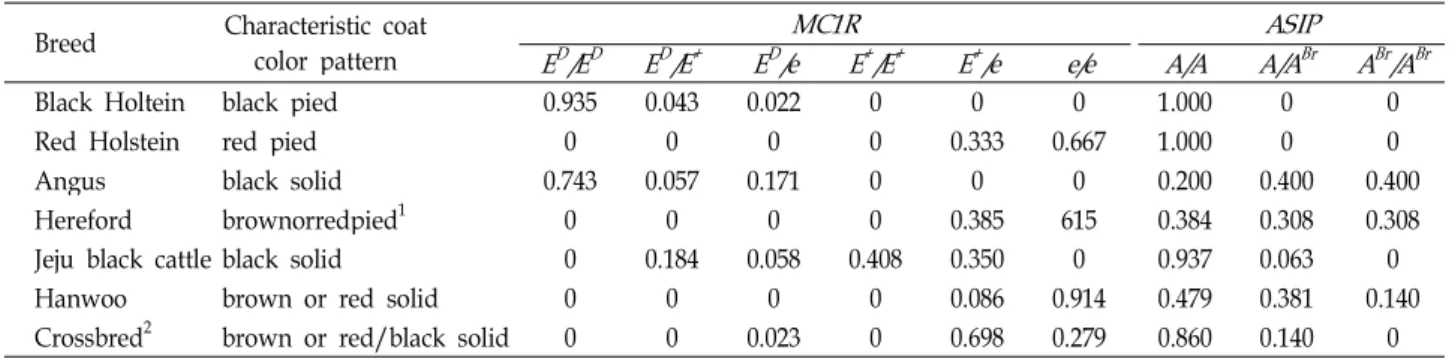
Table 2. Coat color patterns and genotypes of
MC1R
andASIP
genes in cattle breeds Breed Characteristic coatcolor pattern
MC1R ASIP
E
D/E
DE
D/E
+E
D/e E
+/E
+E
+/e e/e A/A A/A
BrA
Br/A
BrBlack Holtein black pied 0.935 0.043 0.022 0 0 0 1.000 0 0
Red Holstein red pied 0 0 0 0 0.333 0.667 1.000 0 0
Angus black solid 0.743 0.057 0.171 0 0 0 0.200 0.400 0.400
Hereford brownorredpied1 0 0 0 0 0.385 615 0.384 0.308 0.308
Jeju black cattle black solid 0 0.184 0.058 0.408 0.350 0 0.937 0.063 0
Hanwoo brown or red solid 0 0 0 0 0.086 0.914 0.479 0.381 0.140
Crossbred2 brown or red/black solid 0 0 0.023 0 0.698 0.279 0.860 0.140 0
1pied region mainly appeared on the head.
2produced between Hanwoo and Jeju black cattle.
color in JBC×Hanwoo crossbred calves, 3 pedigrees were constructed based on information from breeding records and our previous parentage analysis using microsatellite (MS) genotyping with two MS marker sets: International Society of Animal Genetics (ISAG) marker set and SAES marker set. The ISAG marker set comprised 11 MS markers fluorescently labeled with 5’-FAM, HEX, and NED (BM1824, BM2113, ETH3, ETH10, ETH225, INRA23, SPS115, TGLA53, TGLA122, TGLA126 and TGLA127), which were recommended for cattle population diversity studies by the MoDAD program of US FAO for Management of Farm Animal Genetic Resources. The SAES marker set also comprised 11 MS markers (BL1134, BMS1580, BMS1907, BMS2060, BMS4028, DIK3027, DIK4224, DIK4591, DIK4460, IDVGA-37 and MNS-2), and was selected based upon the authors’ preliminary study on parentage tests for the JBC population. References and primer sequences for the MS used are available in the Cattle Diversity Database. PCR for MS genotyping was performed using a multiplex PCR procedure described by Yoon et al. [28] with slight modifications. Amplified PCR products were separated on a MegaBACE1000 DNA Sequencer (Amersham Biotechnologies, USA) and allele data were collected using Genetic Analyzer 2.0 and Fragment Analyzer 3.3.3 (Amersham Biotechnologies, USA). Combining the data for genotypes of the MC1R and ASIP analyses and those from MS analysis, parentage tests for JBC×Hanwoo crossbred claves were carried out using the CERVUS 3.0.3 program [11].
Results and Discussion
To determine the relationship between coat colors and the genotypes of the Extension and Agouti loci for the Korean
cattle breeds, we investigated the genotypes of both genes in Hanwoo, JBC and their F
1calves, as well as in other non-domestic cattle breeds (Table 2). To analyze the MC1R genotypes, g.T296C (p.99Leu>Pro) and a recessive e allele caused by a g.310delG frame-shift mutation for MC1R gene expression were tested. PCR-RFLP patterns using AluI and MspI restriction enzymes showed polymorphisms in the MC1R gene for JBC and Hanwoo, respectively (Fig. 2A).
Combining each fragment pattern, 3 alleles (E
D, E
+, and e) were detected in JBC, but only 2 alleles (E
+and e) were observed in Hanwoo. JBC showed a higher E
+allele frequency than those of E
Dand e, but Hanwoo did not demonstrate the E
Dallele. The black coat-colored JBC derived from 3 genotypes (E
D/E
+, E
+/E
+, and E
+/e), except for 2 homozygotes, E
D/ E
Dand e/e. This is similar to results for genotype distributions of Hanwoo and JBC previously reported [4,14,18,27].
The Hanwoo were either brown or red coat color cattle, and they had only 2 MC1R genotypes (e/e and E
+/e). Of these, the recessive MC1R gene homozygote e/e was predominant (91.4%) in this population, but E
+/e was rare. Other reports have also described that the MC1R E
+allele frequency was rare in the Hanwoo population [2,14,18,27]. Scientists have argued if the MC1R functions in coat color development of Hanwoo, as the coat color of MC1R E
+/e Hanwoo cattle is not clearly discriminated from that of e/e Hanwoo cattle.
However, the MC1R E
+allele was also found in other red
or yellowish-brown cattle breeds, including Japanese Brown
[14,18,19,27] and Chinese brown cattle [5]. The MC1R E
+al-
lele is also found in the Hereford and Red Holstein red or
yellowish-brown cattle breeds. There are no E
+/E
+homo-
zygote cattle found in Hereford, Red Holstein or Hanwoo
(Table 2). Thus, additional molecular studies will be needed
in order to determine why the red cattle’s MC1R
Fig. 1. Coat color patterns and combining haplotypes for
MC1R
andASIP
genes of JBC sires (A-B), Hanwoo dams (C-F) and their crossbred progenies (G-J).E
+does not produce the black coat color in several cattle breeds.
ASIP genotypes were also investigated. PCR genotyping
Fig. 2. Genotyping for
MC1R
(A) andASIP
(B) in cattle.MC1R
genotypes (A) were determined by combining the RFLP patterns obtained from digests usingAluⅠ
forE
D and others andMsp
Ⅰ fore
and others.ASIP
genotypes (B) were determined by the presence/absence of a 1.2-kb L1-BT retroposon;lower and upper bands indicate the absence of L1-BT (allele
A
) and the presence of L1-BT (A
Br), respectively.based on the presence or absence of an L1-BT retroposon in the ASIP gene also showed polymorphisms in the tested cattle breeds (Fig. 2B). However, the ASIP brindle allele (A
Br) was not found, and there was no A
Br/A
Brhomozygote among JBC cattle. In contrast, Hanwoo had all three genotypes (A/A, A/A
Br, and A
Br/A
Br), but their coat colors were not discriminated according to these genotypes (Table 2). In the analysis of Hanwoo×JBC progeny, 2 MC1R genotypes (E
+/e and e/e) were found, and both MC1R genotypes produced black (E
+/e) and yellowish-brown (e/e).
However, two ASIP genotypes (A/A and A/A
Br) were also found, but both ASIP genotypes did not produce different coat colors (non-brindle and brindle).
Pedigrees constructed from mating records and genotype
data from MS analyses of crossbred families between
Hanwoo and JBC (Fig. 3) provided important information
on coat color inheritance patterns and the relationship be-
tween coat color phenotypes and genotypes for the extension
and agouti loci. All F
1calves produced from a JBC E
+/E
+sire
(an arrow in Fig. 3) and Hanwoo e/e dams showed black
coat colors and had MC1R E
+/e. That is, the coat colors of
F
1calves with MC1R E
+/e did not become red or brown.
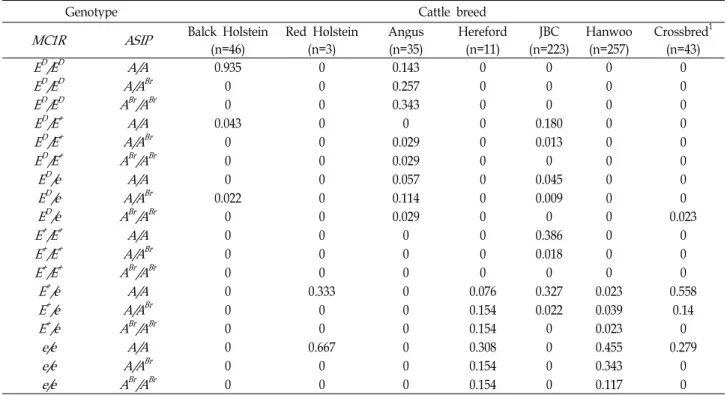
Table 3. Combining haplotypes for
MC
1R andASIP
genes in cattle breedsGenotype Cattle breed
MC1R ASIP
Balck Holstein Red Holstein Angus Hereford JBC Hanwoo Crossbred1(n=46) (n=3) (n=35) (n=11) (n=223) (n=257) (n=43)
E
D/E
DA/A
0.935 0 0.143 0 0 0 0E
D/E
DA/A
Br 0 0 0.257 0 0 0 0E
D/E
DA
Br/A
Br 0 0 0.343 0 0 0 0E
D/E
+A/A
0.043 0 0 0 0.180 0 0E
D/E
+A/A
Br 0 0 0.029 0 0.013 0 0E
D/E
+A
Br/A
Br 0 0 0.029 0 0 0 0E
D/e A/A
0 0 0.057 0 0.045 0 0E
D/e A/A
Br 0.022 0 0.114 0 0.009 0 0E
D/e A
Br/A
Br 0 0 0.029 0 0 0 0.023E
+/E
+A/A
0 0 0 0 0.386 0 0E
+/E
+A/A
Br 0 0 0 0 0.018 0 0E
+/E
+A
Br/A
Br 0 0 0 0 0 0 0E
+/e A/A
0 0.333 0 0.076 0.327 0.023 0.558E
+/e A/A
Br 0 0 0 0.154 0.022 0.039 0.14E
+/e A
Br/A
Br 0 0 0 0.154 0 0.023 0e/e A/A
0 0.667 0 0.308 0 0.455 0.279e/e A/A
Br 0 0 0 0.154 0 0.343 0e/e A
Br/A
Br 0 0 0 0.154 0 0.117 01produced between Hanwoo and Jeju black cattle.
Fig. 3. Pedigrees showing the relation of coat color inheritance patterns to
MC1R
genotypes in two family groups constructed by crossbreeding between Hanwoo and JBC. Black squares and circles represent black coloredE
+/E
+ males and females, respectively. Gray squares and circles represent black coloredE
+/e
males and females, respectively. Open squares and circles represent reddish-brown colorede/e
males and females, respectively. An arrow indicates a JBCE
+/E
+ sire.This indicates that the wild type E
+allele of JBC is dominant to the recessive e allele. However, after mating a JBC E
+/e sire with Hanwoo e/e dams, calves appeared with 2 distinct coat colors: brown/red (e/e) or black (E
+/e). Coat color phenotypes of crossbred calves between the 2 breeds showed Mendelian dominance and segregation of genes.
However, the ASIP genotypes did not directly affect the coat color phenotypes of the progeny. For example, brown or red colored Hanwoo with the ASIP A
Brallele did not show brindle- or agouti-like pigmentation patterns (Fig. 1D~F).
Among crossbred calves, an E
+/e-A/A
Brhaplotype was also detected in 6 animals, although a brindle-like pigment was not found.
These results suggest that the coat color patterns of offspring may be directed by their MC1R genotypes rather than their ASIP genotypes. Royo et al. [25] suggested that the ASIP coding region does not play a central role in coat color variation in cattle, as there was no mutation found in the coding region of the ASIP gene in 9 Spanish and French cattle breeds. Do et al. [4] described two SNPs in the intronic region of ASIP, but not in coding sequences, and suggested that the ASIP intron 2 g.-157A>T showed polymorphisms in Hanwoo and Hereford, although there was no relationship to coat color development in either breed.
However, Girardot et al. [6,7] found that the bovine Agouti allele for brindle coat color (A
Br) was described in Normande cattle breed and other breeds by an L1-BT insertion between the skin-specific promoter and the first coding exon of the ASIP gene, and suggested that the A
Brallele is responsible for the brindle phenotype in the presence of a functional E allele. Yet, brindle-like pigmentation patterns were not found in JBC, Hanwoo and their crossbred calves suggesting that the ASIP L1-BT polymorphism may not related to coat color variation in both Korean cattle breeds.
In Korea, the yellowish-brown Hanwoo is the most abundant cattle breed. The black JBC, considered as an endangered breed until the early 1990s, are totally isolated either in two separate institutions (SAES and ILP) or several restricted JBC-rearing farms on Jeju Island under the political control of a pure breeding program. Indeed, the Hanwoo population is abundant and widespread over the mainland (>2.2 million head) and Jeju Island (>1.8 thousand head), South Korea. Before political protection for maintenance and promotion, the JBC population was not distinguished from other cattle and were reared together with Hanwoo and other breeds, and regarded as a mixed breed. Even after the
start of the JBC pure breeding program, some progeny born with brown-red coat color (MC1R e/e) were actually excluded from the JBC pure breeding population.
The MC1R genotype is broadly used as one of the molecular markers for breed-discriminating in the cattle industry of Korea, for example for the identification of Hanwoo versus imported beef cattle breeds. In addition, the F
1calves produced by crossbreeding between Hanwoo×Holstein or Hanwoo×Angus show solid black coat colors (data not shown), and they are not completely distinguishable from the JBC in coat color patterns. Because these F
1calves sometimes engendered social problems regarding breed identification in Korea, previous studies were carried out to develop a precise, simple method for distinguishing exotic cattle breeds with MC1R E
D/- and MC1R e/e Hanwoo in Korea [2,3,13,15,21].
Historically, the dominant black cattle breeds with the MC1R E
Dallele, including Holstein and Angus, and other coat colored cattle breeds have been imported since the 1960s for improving milk and beef productivity and for developing a new mixed breed by intercrosses among these and Korean cattle. The MC1R genotypes of the Black Holstein and Angus predominantly showed the E
Dallele in this study, as well as other reports [2,3,14,18]. No JBC cattle showed the E
D/E
Dhomozygous MC1R genotype, and no Hanwoo cattle had the E
Dallele, supporting that the dominant black allele E
Dfound in the JBC population was introduced from foreign cattle breeds, probably Holstein or Angus. During JBC breeding, the candidate sires collected from farms with E
D/- had been excluded, because the Korean cattle breeds did not possess this MC1R allele. However, because MC1R E
D/- cattle are present in the JBC population, JBC breeding researchers plan to remove them in the immediate future. From this view, we suggest that this study will not only contribute to the breeding of the endangered cattle breed, JBC, by providing critical information on a genetic marker for breed-identification to prohibit the introduction of gene pools of foreign black-colored cattle breeds for rearing on Jeju Island, but also to understand coat-color inheritance patterns in cattle.
Acknowledgement
This study was supported by Korea Rural Development
Administration Fund No. 2009OFT072149135 and a grant
(308008-5) of Technology Development Program for
Agriculture and Forestry, Ministry for Food, Agriculture, Forestry and Fisheries, Republic of Korea.
References
1. Adalsteinsson, S., S. Bjarnadottir, D. I. Vage, and J. V.
Jonmundsson. 1995. Brown coat color in Icelandic cattle produced by the loci
Extension
andAgouti
.J. Hered
. 86, 395-398.2. Chung, E. R., W. T. Kim, Y. S. Kim, and S. K. Han. 2000.
Identification of Hanwoo meat using PCR-RFLP of
MC1R
gene associated with bovine coat color.J. Anim. Sci. Technol
. 42, 379-390.3. Chung, E. R., W. T. Kim, Y. S. Kim, and S. K. Han. 2001.
Identification of Hanwoo meat and analysis of polymorphism of bovine
MC1R
gene using PCR-SSCP technique.J. Anim. Sci. Technol.
43, 45-52.4. Do, K. T., H. Y. Shin, J. H. Lee, N. S. Kim, E. W. Park, D. H. Yoon, and K. S. Kim. 2007. Investigation of coat color candidate gens in Korean cattle.
J. Anim. Sci. Technol.
49, 711-718.5. Gan, H., J. Li, H. Wang, Y. Gao, W. Liu, J. Li, and J. Zhong.
2007. Allele frequencies of
TYR
andMC1R
in Chinese native cattle.Anim. Sci. J.
78, 484-488.6. Girardot, M., S. Guibert, M. P. Laforet, Y. Gallard, H.
Larroque, and A. Oulmouden. 2006. The insertion of a full-length
Bos taurus
LINE element is responsible for a transcriptional deregulation of the NormandeAgouti
gene.Pigment Cell Res.
19, 346-355.7. Girardot, M., J. Martin, S. Guibert, H. Leveziel, R. Julien, and A. Oulmouden. 2005. Widespread expression of the bovine
Agouti
gene results from at least three alternative promoters. Pigment Cell Res.
18, 34-41.8. Han, S. H., Y. H. Kim, I. C. Cho, B. G. Jang, M. S. Ko, H.
Y. Jung, and S. S. Lee. 2008. Analysis of the genotype distribution in cattle breeds using a double mismatched primer set that discriminates the
MC1R
dominant black allele.J. Anim. Sci. Technol.
50, 633-640.9. Hearing, V. J. and K. Tsukamoto. 1991. Enzymatic control of pigmentation in mammals.
FASEB J.
5, 2902-2909.10. Joerg, H., H. R. Fries, E. Meijerink, and G. F. Stranzinger.
1996. Red coat color in Holstein cattle is associated with a deletion in the
MSHR
gene.Mamm. Genome
7, 317-318.11. Kalinowski, S. T., M. L. Taper, and T. C. Marshall. 2007.
Revising how the computer program CERVUS accommodates genotyping error increases success in paternity assignment.
Mol. Ecol.
16, 1099-1106.12. Kantanen, J., I. Olsaker, K. Brusgaard, E. Eythorsdottir, L.
E. Holm, S. Lien, B. Danell, and S. Adalsteinsson. 2000.
Frequencies of genes for coat colour and horns in Nordic cattle breeds.
Genet. Sel. Evol.
32, 561-576.13. Kim, T. J. and J. I. Lee. 2005. Discrimination of Hanwoo from Holstein/black Angus meat by PCR-RFLP of MC1R gene.
Korean J. Vet. Res.
45, 335-339.14. Kim, T. H., D. H. Yoon, E. W. Park, H. Y. Lee, S. J. Oh,
I. C. Cheong, T. Y. Thak, K. N. Kim, and J. Y. Han. 2000.
A study on genotype frequencies of the bovine melanocortin receptor 1 (
MC1R
) in cattle breeds.J. Anim. Sci. Technol.
42, 735-744.15. Koh, D. B. R. 2005. Rapid differentiation of Hanwoo and Holstein meat using multiplex allele specific polymerase chain reaction protocols.
Korean J. Vet. Res.
45, 351-357.16. Klungland, H., D. I. Vage, L. Gomez-Raya, S. Adalsteinsson, and S. Lien. 1995. The role of melanocyte-stimulating hormone (MSH) receptor in bovine coat color determination.
Mamm. Genome
6, 636-639.17. Lee, S. S., B. S. Yang, Y. H. Yang, S. Y. Kang, S. B. Ko, J. K. Jung, W. Y. Oh, S. J. Oh, and K. I. Kim. 2002. Analysis of
melanocortin receptor 1
(MC1R
) genotype in Korean brindle cattle and Korean cattle with dark muzzle.J. Anim. Sci.
Technol.
44, 23-30.18. Lee, S. S., Y. H. Yang, S. Y. Kang, W. Y. Oh, B. S. Yang, S. B. Ko, S. J. Oh, and K. I. Kim. 2000. Comparison of the genotypes and frequencies of MSH receptor (
MC1R
) gene in Korean cattle, Cheju native black cattle, Japanese black and Japanese brown cattle.J. Anim. Sci. Technol.
42, 253-260.19. Lu, D., D. Willard, I. R. Patel, S. Kadwell, L. Overton, T.
Kost, M. Luther, W. Chen, R. P. Woychik, W. O. Wilkison, and R. D. Cone. 1994. Agouti protein is an antagonist of the melanocyte-stimulating-horomone receptor.
Nature
371, 799-802.20. Olson, T. A. 1999. The Genetics of Cattle. Wallingford, Oxon, CAB International.
21. Park, S. D., T. J. Kim, and J. I. Lee. 2005. Identification of Hanwoo and Holstein meat using MGB probe based real-time PCR associated with singe nucleotide polymorphism (SNP) in Melanocortin 1 receptor (MC1R) gene.
Korean J. Vet. Res.
45, 25-28.22. Rieder, S., S. Taourit, D. Mariat, B. Langlois, and G. Guerin.
2001. Mutations in the agouti (
ASIP
), the extension (MC1R
), and the brown (TYRP1
) loci and their association to coat color phenotypes in horses (Equus caballus
).Mamm. Genome
12, 450-455.23. Rouzaud, F. and V. J. Hearing. 2005. Regulatory elements of the melanocortin 1 receptor.
Peptides
26, 1858-1870.24. Rouzaud, F., J. Martin, P. F. Gallet, D. Delourme, V.
Goulemot-Leger, Y. Amigues, F. Ménissier, H. Levéziel, R.
Julien, and A. Oulmouden. 2000. A first genotyping assay of French cattle breeds based on a new allele of the
extension
gene encoding the melanocortin-1 receptor (Mc1r).Genet.
Sel. Evol.
32, 511-520.25. Royo, L. J., I. Alvarez, I. Fernandez, J. J. Arranz, E. Gomez, and F. Goyache. 2005. The coding sequence of the
ASIP
gene is identical in nine wild-type coloured cattle breeds.J. Anim.
Breed. Genet.
122, 357-360.26. Sambrook, J., E. F. Fritsch, and T. Manniatis. 1989. Molecular cloning: a laboratory mannual. 2nd Eds., Cold Spring Harbor Laboratory
27. Sasazaki, S., M. Usui, H. Mannen, C. Hiura, and S. Tsuji.
2005. Allele frequencies of the extension locus encoding the melanocortin-1 receptor in Japanese and Korean cattle.
초록:제주흑우와 한우에서 Extension, Agouti 유전자형과 모색 출현 양상 한상현
1,2․조인철
1․김재환
1․고문석
1․김영훈
3․김은영
2․박세필
2,4․이성수
5*
(
1농촌진흥청 국립축산과학원 난지축산시험장,
2제주대학교 줄기세포연구센터 미래생명공학연구소,
3제주
특별자치도 축산진흥원,
4제주대학교 생명공학부,
5농촌진흥청 국립축산과학원)
소의 Extension (E), Agouti (A) 유전자형과 모색유전양상의 연관관계를 이해하기 위해, 한우와 제주흑우(JBC), 이들 사이에서 생산된 교배후손에서 melanocortin-1 receptor (MC1R)과 agouti signaling protein (ASIP)의 유전자형 을 분석하였다. 흑모색의 JBC에서는 세 가지 MC1R 대립인자들(E
D, E
+, e)이 모두 발견되었다. JBC 집단은 한우에 서 우점적으로 나타나는 열성동형접합자(e/e)가 발견되지 않았다. 반면, MC1R E
+/e 한우는 흑모색이 아닌 갈색이
나 적색의 모색을 나타내었다. ASIP 유전자에서, 한우에서는 L1-BT 전위인자의 삽입/결실에 의해 세 가지 유전
자형(A/A, A/A
Br, A
Br/A
Br)이 모두 관찰되었다. JBC 집단에서는 ASIP A
Br대립인자가 드물게 관찰되고, ASIP A
Br/A
Br동형접합인 개체들은 발견되지 않았다. ASIP A
Br대립인자를 보유하더라도 한우와 JBC, 이들의 교배후손
에서도 agouti-유사 얼룩무늬 모색은 발견되지 않았다. 교배후손의 모색은 Agouti 유전자형과는 무관하고,
Extension 유전자형과 직접적으로 연관되어 황-갈색(e/e)과 암-갈/흑색(E
+/e)으로만 구분되었다. ASIP 유전자형은 아마도 한우 또는 교배 후손에서 모색의 발달에 영향이 없는 것으로 추정된다. 본 연구 결과는 한우, 제주흑우,
이들의 교배후손에서 MC1R 유전자형이 모색 표현형을 결정하며, ASIP 유전자형은 모색의 변이에는 핵심적인
역할을 수행하지 않는다는 것을 시사한다.
Anim. Sci. J.
76, 129-132.28. Yoon, D. H., E. W. Park, S. H. Lee, H. K. Lee, S. J. Oh, I. C. Cheong, and K. C. Hong. 2005. Assessment of genetic
diversity and relationship between Korean cattle and other cattle breeds by microsatellite loci.