• 검색 결과가 없습니다.

Expression of Coat Color Associated Genes in Korean Brindle Cattle by Microarray Analysis

N/A
N/A
Protected

Academic year: 2021

Share "Expression of Coat Color Associated Genes in Korean Brindle Cattle by Microarray Analysis"

Copied!
9
0
0

로드 중.... (전체 텍스트 보기)

전체 글

(1)

Expression of Coat Color Associated Genes in Korean Brindle Cattle by Microarray Analysis

Hae-Lee Lee

1

, Jae-Hee Park

1,2

and Jong Gug Kim

2†

1

Livestock Experiment Station, Jeollabuk-do Institute of Livestock and Veterinary Research, Jinan-gun 567-891, Korea

2

Department of Animal Sciences, College of Agriculture and Life Science, Institute of Molecular Biology and Genetics, Chonbuk National University, Jeonju 561-756, Korea

ABSTRACT

The aim of the present study was to identify coat color associated genes that are differentially expressed in mature Korean brindle cattle (KBC) with different coat colors and in Hanwoo cows. KBC calves, before and after coat color appearance, were included. Total cellular RNA was isolated from the tail hair cells and used for microarray. The number of expressed coat color associated genes/probes was 5813 in mature KBC and Hanwoo cows. Among the expressed coat color associated genes/probes, 167 genes were the coat color associated genes listed in the Gene card database and 125 genes were the pigment and melanocyte genes listed in the Gene ontology_bovine database. There were 23 genes/probes commonly listed in both databases and their expressions were further studied. Out of the 23 genes/probes, MLPH, PMEL, TYR and TYRP1 genes were expressed at least two fold higher (p<0.01) levels in KBC with brindle color than either Hanwoo or KBC with brown color. TYRP1 expression was 22.96 or 19.89 fold higher (p<0.01) in KBC with brindle color than either Hanwoo or KBC with brown color, respectively, which was the biggest fold difference.

The hierarchical clustering analysis indicated that MLPH, PMEL, TYR and TYRP1 were the highly expressed genes in mature cattle. There were only a few genes differentially expressed after coat color appearance in KBC calves.

Studies on the regulation and mechanism of gene expression of highly expressed genes would be next steps to better understand coat color determination and to improve brindle coat color appearance in KBC.

(Key words : Korean brindle cattle (Chikso), coat color, gene expression, microarray)

Correspondence : [email protected]

INTRODUCTION

Genetics of coat color in animals (Barsh, 2001) and in cattle (Olson, 1999) has been reviewed. Synthesis of eumelanin and phaeomelanin are important in coat colors of cattle. Tyrosinase related protein 1 (TYRP1) affects coat colors with eumelanin synthesis (Berryers et al., 2003). Melanocortin 1 Receptor (MC1R) influences eumelanin and phaeomelanin synthesis, and MC1R genotypes are responsible for most variation of cattle coat color in many breeds including Hanwoo and KBC (Klung- land et al., 1995; Chung et al., 2000; Berryers et al., 2003; Do et al., 2007; Lee et al., 2008; Park et al., 2012). Agouti sig- naling protein (ASIP) is the natural antagonist of MC1R (Barsh, 1996). Investigators have identified other genes that affect coat colors of cattle including tyrosinase (TYR) (Schmutz et al., 2004), KIT (Reinsch et al., 1999) and KIT ligand (KITLG) (Charlier et al., 1996; Seitz et al., 1999). Schmutz et al. (2013) reported an interaction between the MC1R and premelanosomal

protein (PMEL). Brenig et al. (2013) investigated the genetic background of mismarked coat color in White Galloway cattle, where mating of individuals with the preferred well or strongly marked phenotype also resulted in offspring with the undesired mismarked and/or even fully black coat color in White Gallo- way cattle. The results of this study indicated that the white coat color variation was caused by the ploidy of aberrant inser- tions and inheritance of the KIT gene on chromosome 29 in White Galloway and White Park cattle. Data suggests that numerous genes are involved in the coat color appearance in cattle, and expression of specific coat color associated genes may be important in certain breeds of cattle. The objective of this study was to determine the gene expression patterns by microarray 1) in mature KBC with different coat colors and in Hanwoo cows, and 2) in KBC calves before and after the brindle coat color appearance.

MATERIALS AND METHODS

(2)

1. Experimental Animals and RNA Extraction

Total number of experimental animals used in this study were 20, including 4 Hanwoo cows and 16 Koran brindle cattle (KBC). KBC included 12 mature cattle with 3 different coat colors, and 4 calves between 1 to 2 months of age. Hanwoo had brown coat color, while mature KBC had either whole brindle, brown or black coat color. Whole brindle was defined as having brindle coat more than 50% of body, brown as ha- ving similar coat color as Hanwoo, and black as having black coat all of the body (Park et al. 2012). Four KBC calves were included to determine the changes of gene expression before and after the brindle coat color appearance.

For microarray analysis, RNA was extracted from tail hair cells of brindle, brown or black coat color of KBC and from tail hair cells of brown coat color of Hanwoo. For KBC with brindle coat color, hair cells from brindle area with mainly dark brown and black hairs were used. Less than 5 mg of material was inserted into the 1.5 ml microcentrifuge tube and total cellular RNA was extracted using RNeasy Micro Kit (Qiagen, Germany). Quality of RNA was determined by measuring ab- sorbance at 260 nm/280 nm and 260 nm/230 nm, and 28s/18s RNA ratio using a 2100 Bioanalyzer (Agilent Technologies, USA). RNA integrity number (RIN) was calculated for each sample using Agilent 2100 Expert software, and RNA was stored frozen at —70℃ until analysis.

2. Microarray Analysis

To compare the gene expression pattern between the expe- rimental groups, the procedure of amplification, labeling and hybridization was conducted using Agilent’s Low Input Quick Amp Labeling kits (Agilent Technology, USA) and Agilent bovine 4×44K chip, following the manufacture’s protocol. One μg of total cellular RNA was mixed with T7 promoter primer and was incubated at 65 ℃ for 10 min. Then, cDNA master mix (5X First strand buffer, 0.1 M DTT, 10 mM dNTP mix, RNase-Out, and MMLV-RT) was prepared and added into the microcentrifuge tube. Samples were incubated at 40 ℃ for 2 hr.

Following reverse transcription and dsDNA synthesis, trans- cription master mix (4X Transcription buffer, 0.1 M DTT, dNTP mix, 50% PEG, RNase-Out, inorganic pyrophosphatase, T7- RNA polymerase, and cyanine 3-CTP) was prepared, added to dsDNA tubes, and incubated at 40 ℃ for 2 hr. Labeled cRNA was purified and quantified with ND-1000 spectrophotometer (NanoDrop Technologies, Inc., Wilmington, DE). Labeled cRNA

was then fragmented, mixed with hybridization buffer, and placed on the microarray slide. The microarrays were then in- cubated at 65 ℃ for 17 hr in a hybridization oven (Agilent Technology, USA) and washed. Dried microarray slides were scanned using Agilent DNA microarray Scanner (Agilent Tech- nology, USA). The images obtained after scanning were analyzed with Agilent Feature Extraction software (Agilent Technology, USA). Fluorescent intensity from each spot was calculated after background subtraction. All data normalization and selection of fold-changed genes were performed using GeneSpringGX 7.3.1 program (Agilent Technology, USA).

RESULTS

1. Gene Expression in Korean Brindle Cattle with Different Coat Colors and in Hanwoo

Microarray analysis was performed with the Agilent bovine 4×44K chip to compare the coat color gene expression in mature Korean brindle cattle (KBC) with different coat colors and in Hanwoo cows. We identified 5813 expressed genes/probes that were related to coat color, pigmentation, melanocyte, and mela- nogenesis in the hair cells of mature cattle. One hundred sixty seven genes expressed in the microarray were coat color asso- ciated genes listed in the Gene card database and 125 genes expressed in the microarray were bovine pigment and melano- cyte genes listed in the Gene ontology_bovine database. There were 23 genes/probes expressed in the microarray, which were listed both in Gene card database and Gene ontology_bovine database (Table 1).

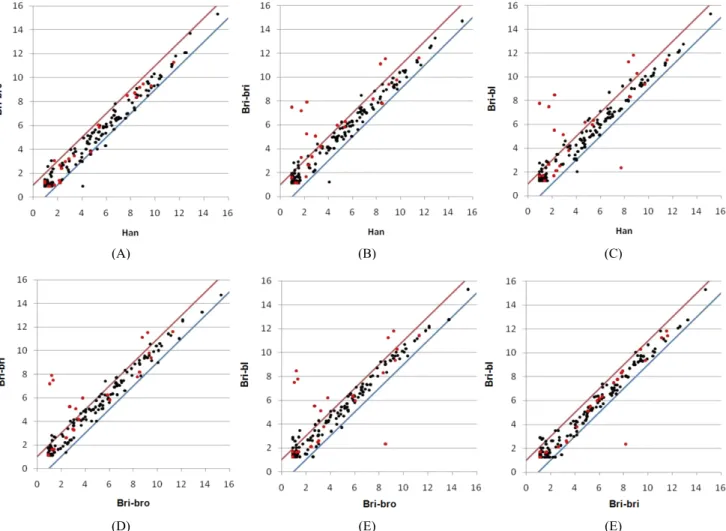
Expressions of 167 coat color associated genes from diffe- rent experimental groups were compared by scatter plots (Fig.

1) and the expression levels of the 23 selected genes/probes in Table 1 were further investigated. When Hanwoo and KBC with brown coat color was compared, the expressions of ASIP, DCT, LEF1 (LYMPHOID ENHANCER-BINDING FACTOR 1), and SLC45A2 genes were at least two fold higher (p<0.01) in KBC with brown coat color than in Hanwoo (Fig. 1A).

LEF1 was not listed in Table 1. The difference was the most

in DCT expression with 6.28 fold higher (p<0.01) in KBC

with brown coat color than in Hanwoo. The expressions of

ASIP, EDA, MLPH, PMEL, SLC45A2, TYR, and TYRP1

genes were at least two fold higher (p<0.01) in KBC with

brindle coat color than in Hanwoo (Fig. 1B). EDA (ECTODY-

SPLASIN A) and SLC45A2 (SOLUTE CARRIER FAMILY

(3)

Table 1. List of 23 bovine coat color associated genes and pigment/melanocyte genes or probes

Gene symbol Gene name GenBank accession Probe ID

KIT v-kit Hardy-Zuckerman 4 feline sarcoma viral oncogene homolog NM_001166484 A_73_P087626

MLPH Melanophilin NM_001081597 A_73_P317496

KIT v-kit Hardy-Zuckerman 4 feline sarcoma viral oncogene homolog NM_001166484 A_73_113522

PMEL Premelanosome protein NM_001080215 A_73_P036316

TYR Tyrosinase (oculocutaneous albinism IA) NM_181001 A_73_P251106

MC1R Melanocortin 1 receptor (alpha melanocyte stimulating hormone receptor) NM_174108 A_73_P036956

TYR Tyrosinase (oculocutaneous albinism IA) NM_181001 A_73_P037571

ASIP Agouti signaling protein NM_206843 A_73_P437651

ASIP Agouti signaling protein NM_206843 A_73_107408

DCT Dopachrome tautomerase NM_001012666 A_73_P040651

TYRP1 Tyrosinase-related protein 1 NM_174480 A_73_P041341

EDNRB Endothelin receptor type B NM_174309 A_73_P377566

EDNRB Endothelin receptor type B AB099006 A_73_P099906

EDNRB Endothelin receptor type B NM_174309 A_73_P038281

ARCN1 Archain 1 NM_001195013 A_73_P075116

KITLG KIT ligand NM_174375 A_73_110108

TYRP1 Tyrosinase-related protein 1 NM_174480 A_73_105798

MLPH Melanophilin NM_001081597 A_73_107222

TYRP1 Tyrosinase-related protein 1 NM_174480 A_73_P411006

PMEL Premelanosome protein M81193 A_73_107037

KITLG KIT ligand NM_174375 A_73_P051146

MREG Melanoregulin NM_001192953 A_73_P057721

DCT Dopachrome tautomerase NM_001012666 A_73_102308

45, MEMBER 2) were not listed in Table 1. The difference was the most in TYRP1 expression with 22.96 fold higher, followed by PMEL expression with 5.80 fold higher, in KBC with brindle coat color (p<0.01) than in Hanwoo. The expre- ssions of DCT, EDA, MLPH, PMEL, SLC45A2, SOX10, and TYR genes were at least two fold higher (p<0.01) in KBC with black coat color than in Hanwoo (Fig. 1C). EDA, SLC45A2, and SOX10 (SRY-BOX 10) were not listed in Table 1. The difference was the most in TYRP1 expression with 28.97 fold higher, followed by PMEL and TYR expressions with 7.29 and 7.42 fold higher, respectively, in KBC with black coat color (p<0.01) than in Hanwoo.

When KBC with brindle coat color and KBC with brown coat color was compared, the expressions of CITED1, MLPH, NF1, PMEL, TYR, and TYRP1 genes were at least two fold higher (p<0.01) in KBC with brindle coat color than in KBC with brown coat color (Fig. 1D). CITED1 (CBP/p300-INTERAC- TING TRANSACTIVATOR WITH GLU/ASP-RICH C-TER- MINAL DOMAIN, 1) and NF1 (NEUROFIBROMATOSIS, TYPE I) genes were not listed in Table 1. The difference was the most in TYRP1 expression with 19.89 fold higher, followed by MLPH expression with 4.13 fold higher, in KBC with brindle coat color (p<0.01) than in KBC with brown coat color.

The expressions of MLPH, PMEL, SOX10, TYR, and TYRP1

(4)

(A) (B) (C)

(D) (E) (E)

Fig. 1. Scatter plot of selected coat color associated genes in Korean brindle cattle and Hanwoo cows. Scatter plots displaying the ex- pression patterns of selected genes by fold differences between the experimental groups among Korean brindle cattle with 3 different coat colors and Hanwoo are shown. Black spots represents 167 expressed genes that are listed as coat color related genes in Gene card database and red spots represents 23 expressed genes/probes that are listed as pigment and melanocyte related genes in database of Gene ontology_bovine as well as coat color related genes in Gene card database, respectively.

Spots located outside the two diagonal red and blue lines indicate more than 2-fold gene expression differences. Some spots were placed on top of each other depicting less than the total number. Han : Hanwoo with brown coat color, Bri-bro : Korean brindle cattle with brown coat color, Bri-bri : Korean brindle cattle with whole brindle (≧50%) coat color, Bri-bl : Korean brindle cattle with black coat color.

genes were at least two fold higher (p<0.01) in KBC with black coat color than in KBC with brown coat color (Fig. 1E). SOX10 was not listed in Table 1. The difference was the most in TYRP1 expression with 25.09 fold higher, followed by TYR and MLPH expressions with 5.20 and 5.03 fold higher, respec- tively, in KBC with black coat color (p<0.01) than in KBC with brown coat color. The expression of only LOC785371 was at least two fold higher (p<0.01) in KBC with black coat color than in KBC with brindle coat color (Fig. 1F). LOC- 785371 (Uncharacterized protein, related to GLI-KRUPPEL

FAMILY MEMBER 3; GLI3) was not listed in Table 1.

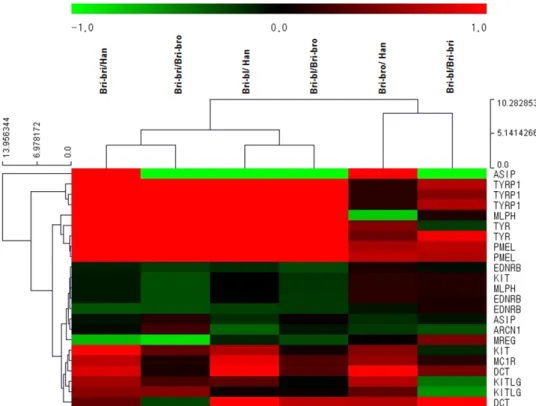
In the hierarchical clustering analysis of the contrasts between two experimental groups, there were three clusters (Fig. 2).

The first cluster included Bri-bri/Han and Bri-bri/Br-bro con-

trasts, the second cluster Bri-bl/Han and Bri-bl/Bri-bro contrasts,

and third cluster Bri-bro/Han and Bri-bl/Bri-bri contrasts. The

first and the second clusters were linked first, and then with

the third cluster. In the hierarchical clustering analysis of coat

color genes, there were four clusters. TYRP1 gene was in the

first cluster, while MLPH, TYR, and PMEL genes were in the

(5)

Fig. 2. Hierarchical clustering analysis of experimental group contrasts and 23 selected genes/probes. Hierarchical clustering analysis dis- play clusters among contrasts between two experimental groups and also the expression patterns of the 23 selected genes/probes in Korean brindle cattle with 3 different coat colors and in Hanwoo. The red color indicates the up-regulated genes and green color indicates the down-regulated genes. Han : Hanwoo with brown coat color, Bri-bri : Korean brindle cattle with whole brindle (≧50%) coat color, Bri-bro : Korean brindle cattle with brown coat color, Bri-bl : Korean brindle cattle with black coat color.

second cluster. Gene expression in these two clusters was high.

EDNRB, KIT, MLPH, ASIP, ARCN1 and MREG genes were in the third cluster, and their expression was low. KIT, MC1R, DCT and KITLG genes were in the fourth cluster, and their expression was relatively high. The last two clusters were linked first, followed by the second cluster, and the first cluster. ASIP was not in the cluster with other genes and linked last with the rest of the clusters.

2. Gene Expression in Korean Brindle Cattle Calves before and after Coat Color Expression

Four Korean brindle cattle (KBC) calves were included to determine the gene expression patterns before and after the coat color appearance. The coat colors of two KBC calves started to change from brown to brindle between 27 to 48 days of age, while the other two calves maintained the same brown coat color. Expressions of 167 coat color associated genes were compared before and after the color changes by scatter plots (Fig. 3) and the expression levels of the 23 selected genes/

probes in Table 1 were further investigated. No genes from Table 1 were expressed more than 2 fold after coat color deter- mination in KBC calves with brown coat color (Fig. 3A). Though not listed in Table 1, expression of ZIC2 (ZINC FINGER PRO- TEIN OF CEREBELLUM 2) gene was 17.0 fold higher (p<0.01) after coat color determination than before. In KBC with brindle coat color, the expression of TYRP1 gene was 2.18 fold higher (p=0.02) after brindle coat color appearance than before (Fig.

3B). Expression of ZIC2 gene was 14.9 fold higher (p=0.01) after brindle coat color appearance than before.

In the hierarchical clustering analysis, there were no clusters between the KBC calves with brown or brindle coat color (Fig.

4). In principle, gene expression was higher in KBC calves

with brindle coat color than in KBC calves with brown coat

color. For coat color gene expressions, clustering was more

complicated in the KBC calves than the experimental group

contrasts of mature cattle. In the first cluster, there were KIT,

KITLG, ASIP, and MREG genes in a sequential manner. Their

expression was low in both KBC calves with brown coat color

(6)

(A)

(B)

Fig. 3. Scatter plot of selected coat color associated genes/probes in KBC calves before and after the coat color change. Scatter plots displaying the expression patterns of selected genes by fold differences before and after the coat color change in Korean brindle cattle (KBC) with brown coat color (A) and in KBC with brindle coat color (B) are shown. Black spots represents 167 expressed genes that are listed as coat color related genes in Gene card database and red spots represents 23 expressed genes/probes that are listed as pigment and melanocyte related genes in database of Gene ontology_bovine as well as coat color related genes in Gene card database. Spots located outside the two diago- nal red and blue lines indicate more than 2-fold gene expre- ssion differences. Some spots were placed on top of each other depicting less than the total number.

Fig. 4. Hierarchical clustering analysis of experimental groups and 23 selected genes/probes. Hierarchical clustering analysis display the expression pattern of 23 selected genes/probes before and after coat color appearance between Korean brindle cattle (KBC) with brown coat color (Bri-bro) and KBC with brindle coat color (Bri-bri). The red color indicates the up-regulated genes and green color indicates the down- regulated genes.

and brindle color. In the second cluster, there were PMEL, MLPH, EDNRB and TYR genes in a sequential manner. Their gene expression was low in KBC calves with brown coat color and relatively high in KBC calves with brindle coat color. In the third cluster, there were DCT and TYRP1 genes. Their gene expression was relatively high in KBC calves with brown coat color and high in KBC calves with brindle coat color. In the fourth cluster with smaller nested clusters, there were ARCN1, MLPH, DCT, MC1R, EDNRB, TYRP1, and ASIP genes. Their gene expression was relatively high in both KBC calves with brown and brindle coat color (Fig. 4).

DISCUSSION

In this study, the gene expression patterns of mature Korean

brindle cattle (KBC) with different coat colors and Hanwoo

cows were investigated by microarray and hierarchical cluste-

ring analysis. Gene expression patterns of KBC calves before

(7)

and after coat color appearance were also studied. Analysis of microarray data revealed that there were 5813 expressed genes/

probes that were related to coat color, pigmentation, melanocyte, and melanogenesis. Among them, 23 genes/probes were listed both 1) as coat color associated genes in Gene card database and 2) as bovine pigment and melanocyte genes in Gene on- tology_bovine database. Their expressions were further analyzed in detail.

KBC with brindle coat color expressed significantly higher (p<0.01) levels of ASIP, EDA, MLPH, PMEL, SLC45A2, TYR and TYRP1 genes than Hanwoo, while KBC with brindle coat color expressed significantly higher levels of CITED1, MLPH, NF1, PMEL, TYR and TYRP1 genes than KBC with brown coat color (Fig. 1). Thus, MLPH, PMEL, TYR and TYRP1 genes were commonly expressed in KBC with brindle coat color, whether they were compared with Hanwoo or KBC with brown coat color. Expression of these genes may be required for brindle coat color appearance in KBC. TYRP1 expression was 22.96 or 19.89 fold higher (p<0.01) in KBC with brindle color than either Hanwoo or KBC with brown color, respec- tively (Fig. 1). The data suggest that TYRP1 may be one of the genes contributing to brindle coat color in KBC, as TYRP1 synthesizes eumelanin (Berryers et al., 2003). KBC with brindle coat color expressed higher levels of ASIP, EDA and SLC- 45A2 than Hanwoo, in addition to the MLPH, PMEL, TYR and TYRP1 genes. KBC with brown coat color expressed higher levels of ASIP, DCT, LEF1 and SLC45A2 genes than Hanwoo.

Whether KBC has brindle or brown color, they expressed higher levels of ASIP and SLC45A2 genes than Hanwoo. This indicates that certain coat color associated genes, including ASIP and SLC45A2 are expressed higher in KBC with either brindle or brown coat color than in Hanwoo. Higher level of ASIP ex- pression in KBC with brindle or brown color than in Hanwoo was unpredicted. Since ASIP is the natural antagonist of MC1R (Barsh, 1996), lower expression of ASIP in KBC than in Hanwoo would have been expected. SLC45A2 is solute carrier family 45, member 2, also known as melanoma antigen AIM1 (Fuka- machi et al., 2001). It may be involved in the melanogenesis of cattle hair cells. The function of SLC45A2 needs to be in- vestigated further in the coat color appearance of KBC. Since KBC with brown coat color have capacity to express certain coat color associated genes at higher level than Hanwoo, KBC with brown coat color may have genetic potential to express brindle coat color in their offspring when they are bred with

appropriate KBC cattle.

Microarray analysis revealed that MC1R was one of the 23 selected genes/probes (Table 1) that were expressed and its expression was relatively high (Fig. 2). However, level of MC1R expression did not change more than 2 fold among experimen- tal groups with different coat colors. The expression levels of MC1R in KBC with brown, brindle and black colors were 1.50, 1.65, and 1.87 fold higher (p<0.01) than Hanwoo, respectively.

The results may be comparable to the previous study showing variation of MC1R expression in KBC with different coat colors (Lee et al., 2014). Though the gene is known for most variation in coat color, the genotype of MC1R may be more critical (Park et al., 2012) than the level of expression in the coat color appearance of KBC. PMEL was reported to interact with MC1R (Schmutz et al., 2013) and its expression was relatively high (Fig. 2). Therefore, PMEL interaction with MC1R may require further investigation in the future.

Only a few genes expressed more than 2 fold in KBC cal-

ves with brindle coat color after brindle coat color appearance

than before (Fig. 3B). Expression of TYRP1 gene was 2.18 fold

higher (p=0.02) in KBC calves with brindle coat color after

brindle coat color appearance than before. TYRP1 could be

one of the genes that are expressed from the early stage of

growth in KBC. The pattern of differential gene expression

shown in the mature cattle with different coat colors may take

place later as the calves grow. Changes of hormone levels,

including steroid hormones, in KBC calves may also influence

the coat color appearance during their growth and maturation

(Lee et al., 2015). Though it was not listed as one of the 23

selected genes/probes in Table 1, ZIC2 gene expression was

17.0 or 14.9 fold higher in KBC calves with brown color 1or

brindle color, after brindle coat color appearance in KBC calves

with brindle color than before. ZIC2 is zinc finger protein of

cerebellum 2 and it is known to be expressed in the fetal brain

and retina (Nagai et al., 1997). The expression of ZIC2 needs

to be confirmed in the hair cells of KBC calves by other me-

thods. Since its expression was elevated similarly in both the

KBC calves with brown and brindle color, it may not affect

the coat color significantly. While EDNRB expression was

relatively low in mature experimental animal group contrasts

(Fig. 2), it was relatively high in KBC calves, with higher

expression in KBC calves with brindle color than brown color

(Fig. 4). EDNRB has been implicated in the black color trait

in a Chinese pig breed (Wang et al., 2015) and may have a

(8)

potential to influence coat color in KBC.

In conclusion, differential gene expression pattern was de- termined in mature KBC with different coat colors and in Hanwoo cows. Out of many expressed genes, 23 selected genes/

probes were 1) coat color associated genes listed in the Gene card database and 2) pigment and melanocyte genes listed in the Gene ontology_bovine database. Among the 23 genes/probes, MLPH, PMEL, TYR and TYRP1 genes were expressed at least two fold higher (p<0.01) levels in KBC with brindle color than either Hanwoo or KBC with brown color. TYRP1 gene expression showed the biggest fold difference. There were a few novel genes that were expressed, including SLC45A2 and ZIC2. Results of the differential gene expression among KBC with different coat colors and in Hanwoo may be used to com- plement the current breeding scheme, which is mainly based on the MC1R genotypes and coat color, to improve coat color appearance in KBC. Expression pattern of coat color associated genes that were determined from this study may be considered in the breeding scheme of KBC. Confirmation of novel or un- predicted gene expression, including LEF1, EDA, SLC45A2, SOX10, CITED1, NF1, LOC785371 and ZIC2 by additional methods may be needed. Studies on the regulation and mecha- nism of gene expression of highly expressed genes would be next steps to better understand coat color determination and to improve brindle coat color appearance in KBC.

REFERENCES

Barsh GS. 1996. The genetics of pigmentation : From fancy genes to complex traits. Trends Genet. 12(8):299-305.

Barsh GS. 2001. Coat Colour Mutations, Animals. New York : Academic Press.

Berryers TG, Schmutz SM, Schimpf RJ, Cowan CM and Potter J. 2003. TYRP1 is associated with dun coat colour in Dexter Cattle or how now brown cow? Anim. Genet. 34:169-175.

Brenig B, Beck J, Floren C, Bornemann-Kolatzki K, Wiede- mann I, Hennecke S, Swalve H and Schütz E. 2013. Mole- cular genetics of coat colour variations in White Galloway and White Park cattle. Anim. Genet. 44(4):450-453.

Charlier C, Denys B, Belanche JI, Coppieters W, Grobet L, Mni M, Womack J, Hanset R and Georges M. 1996. Microsatel- lite mapping of the bovine roan locus - a major determinant of White Heifer disease. Mamm. Genome 7(2):138-142.

Chung ER, Kim WT, Kim YS and Han SK. 2000. Identification

of Hanwoo meat using PCR-RFLP marker of MC1R gene associated with bovine coat color. J. Anim. Sci. & Technol.

42(4):379-390.

Do KT, Shin HY, Lee JH, Kim NS, Park EW, Yoon DH and Kim KS. 2007. Investigation of coat color candidate genes in Korean cattle (Hanwoo). J. Anim. Sci. & Technol.

49(6):711-718.

Fukamachi S, Shimada A and Shima A. 2001. Mutations in the gene encoding B, a novel transporter protein, reduce mela- nin content in medaka. Nature Genet. 28:381-385.

Hirobe T, Kiuchi M, Wakamatsu K and Ito S. 2010. Estrogen increases hair pigmentation in female recessive yellow mice.

Zoolog Sci. 27(6):470-6.

Klungland H, Vage DI, Gomez-Raya L, Adalsteinsson S and Lien S. 1995. The role of melanocyte-stimulating hormone (MSH) receptor in bovine coat color determination. Mamm.

Genome 6:636-639.

Lee HL, Park JH and Kim JG. 2014. Coat color of Korean brindle cattle and melanocortin 1 receptor (MC1R) mRNA:

Variation of 3’-untranslated region and expression. J. Emb.

Trans. 29(3):297-303.

Lee HL, Park JH, Kim YS and Kim JG. 2015. Analysis of coat color changes and hormone levels in Korean brindle cattle.

J. Emb. Trans. 30(1):65-71.

Lee SM, Lee WW, Lee GR and Lee DS. 2008. Differentiation of Hanwoo and other breeds of cattle using PCR-RFLP and allele-specific PCR. The annual report of Busan Metropo- litan City Institute of Health & Environment 19(1):88-93.

Nagai T, Aruga J, Takada S, Gunther T, Sporle R, Schughart K and Mikoshiba K. 1997. The expression of the mouse Zic1, Zic2, and Zic3 gene suggests an essential role for Zic genes in body pattern formation. Dev. Biol. 182:299-313.

Olson TA. 1999. Genetics of color variation. In : Fries R, Ru- vinsky A, eds. The Genetics of Cattle. Wallingford, UK:

CABI, 33-53.

Park JH, Lee HL, Kim YS and Kim JG. 2012. MC1R genotypes, coat color, and muzzle phenotype variation in Korean na- tive brindle cattle. J. Anim. Sci. & Technol. 54(4):255-265.

Reinsch N, Thomsen H, Xu N, Brink M, Looft C, Kalm E,

Brockmann GA, Grupe S, Kühn C, Schwerin M, Leyhe B,

Hiendleder S, Erhardt G, Medjuqorac, I, Russ I, Förster M,

Reents R and Averdunk G. 1999. A QTL for the degree of

spotting in cattle shows synteny with the KIT locus on ch-

romosome 6. J. Hered. 90(6):629-634.

(9)

Schmutz SM, Berryere TG, Ciobanu DC, Mileham AJ, Schmi- dtz BH and Fredholm M. 2004. A form of albinism in cattle is caused by a tyrosinase frameshift mutation. Mamm. Ge- nome 15(1):62-67.

Schmutz SM and Dreger DL. 2013. Interaction of MC1R and PMEL alleles on solid coat colors in Highland cattle. Anim Genet. 44(1):9-13.

Seitz JJ, Schmutz SM, Thue TD and Buchanan FC. 1999. A missense mutation in the bovine MGF gene is associated

with the roan phenotype in Belgian Blue and Shorthorn cattle. Mamm. Genome 10(7):710-712.

Wang C, Wang H, Zhang Y, Tang Z, Li K and Liu B. 2015. Ge- nome-wide analysis reveals artificial selection on coat colour and reproductive traits in Chinese domestic pigs. Mol. Ecol.

Resour. 15(2):414-24.

Received May 6, 2015, Revised June 12, 2015, Accepted

June 14, 2015

수치

Table  1.  List  of  23  bovine  coat  color  associated  genes  and  pigment/melanocyte  genes  or  probes
Fig.  1.  Scatter  plot  of  selected  coat  color  associated  genes  in  Korean  brindle  cattle  and  Hanwoo  cows
Fig.  2.  Hierarchical  clustering  analysis  of  experimental  group  contrasts  and  23  selected  genes/probes
Fig.  3.  Scatter  plot  of  selected  coat  color  associated  genes/probes  in  KBC  calves  before  and  after  the  coat  color  change

참조

관련 문서