Genotypes of Lysophospholipase I (LYPLA1) Gene Associate with Carcass Traits of the Jeju Crossbred Cattle (Hanwoo × Jeju Black cattle) and Hanwoo Populations
Sang-Hyun Han1,2, Pil-Nam Seong1* and In-Cheol Cho1*
1Subtropical Livestock Research Institute, National Institute of Animal Science, RDA, Jeju 63242, Korea
2Educational Science Research Institute, Jeju National University, Jeju 63243, Korea Received April 26, 2017 /Revised June 28, 2017 /Accepted June 28, 2017
Genotypes of the nucleotide substitution g.23655332G>C of SNP marker rs385360448 at Lysophospholipase I (LYPLA1) gene intron 7, were tested for their effect on the carcass traits of Hanwoo and Jeju Crossbred cattle (F1 progeny produced between Hanwoo × Jeju Black cattle) populations on Jeju Island. In the Hanwoo steer population, the meats containing LYPLA1 rs385360448 G/- genotypes showed significantly higher marbling scores and greater texture indices, compared to those of rs385360448 C/C homozygous animals (p<0.05). However, the LYPLA1 genotypes were not associated with the levels of carcass weight, backfat thickness, eye muscle area (EMA), meat color, and fat color (p>0.05). On the other hand, in the JCC steer population, the LYPLA1 G/- harboring meats showed significantly greater EMA levels, compared to those of C/C homozygotes (p<0.05). The results of the present study indicate that the LYPLA1 genotypes could alter the levels of intramuscular fat deposi- tion, texture index, and eye muscle area via phospholipid metabolism in the Longissimus dorsi muscle of the cattle. These findings suggested that LYPLA1 genotypes may effect molecular genetic markers in the improvement of carcass traits of Hanwoo and Jeju Black industrial cattle populations on Jeju Island.
Key words : Association, carcass traits, Hanwoo, Jeju Black cattle, LYPLA1
*Corresponding authors
*Tel : +82-64-754-5716, Fax : +82-64-754-5713
*E-mail : [email protected] (Pil-Nam Seong)
*Tel : +82-64-754-5710, Fax : +82-64-754-5713
*E-mail : [email protected] (In-Cheol Cho)
This is an Open-Access article distributed under the terms of the Creative Commons Attribution Non-Commercial License (http://creativecommons.org/licenses/by-nc/3.0) which permits unrestricted non-commercial use, distribution, and reproduction in any medium, provided the original work is properly cited.
Journal of Life Science 2017 Vol. 27. No. 7. 760~766 DOI : https://doi.org/10.5352/JLS.2017.27.7.760
서 론
제주흑우는 예로부터 제주도에서 사육되어온 전신 흑모색 의 소 품종으로 제향이나 진상품으로 공출됨에 따라 국가적으 로 엄격히 관리되었으나, 20세기 말 절멸위기에 직면하였다.
이후 혈통복원과 증식사업이 진행 중이며, 2013년 천연기념물 546호로 지정되어 관리되고 있다. 또한 제주흑우와 한우 간 인공수정을 통해 제주흑한우 축군(Jeju Crossbred cattle, JCC) 을 생산하여 산업화를 시도하고 있다[6, 33]. 제주흑우 집단에 대한 유전적 특성 연구는 계통유전학 연구, 흑모색과 관련된 melanocortin 1 receptor (MC1R), agouti-signaling protein 유전자 형의 상관[4, 18, 19], 복원과 증식 중인 축군의 혈통관리, 친자 확인 체계의 구축을 위한 microsatellite (MS) 등 핵 DNA 다형 성과 대립유전자의 분포 등이 보고되었다[3, 5, 33].
소의 경제형질에 대한 연구를 통해 소 염색체(Bos taurus:
BTA) 14번에서 임신기간, 생시체중, 등지방두께, 일당증체량 과 사료효율 등과 높은 상관을 보이는 양적형질좌위(quantita- tive trait loci, QTL)들이 보고되었다[13, 23-26]. 특히, 한우에 서는 BTA14의 단일염기변이(single nucleotide polymor- phism, SNP) 마커들이 도체중과 고도의 상관을 나타내는 것 으로 보고되었다[7, 15-17, 22, 32]. BTA14 lysophospholipase 1 (LYPLA1)는 lysophospholipid-특이적인 lysophospholipase 의 활성을 나타내며, 식욕을 조절하는 호르몬인 ghrelin의 탈 아세틸화에 관여하는 억제자이며[31, 35], Kell blood group com- plex subunit-related family, member 4 (XKR4), transmembrane protein 68 (TMEM68)와 함께 사료효율과 성장형질, 체중 증가 에 기여하는 것으로 제안되었다[23, 24]. 제주흑우와 한우의 교배를 통해 조성된 JCC 집단에 대해서는 adipocyte determi- nation and differentiation factor-1 (ADD1) 유전자의 다형성이 도체형질과의 상관를 보고한 연구결과가 있으나[6], 아직까지 JCC 축군의 경제형질을 개선에 적용할 수 있는 체계적인 연구 성과는 거의 없다.
이에 본 연구에서는 제주도 내에서 사육되어 도축된 한우와 JCC 집단의 도체형질과 BTA14 LYPLA1 유전자 다형성의 상 관관계를 조사하여 제주흑우 유래의 산업용 축군의 능력 개선 을 위한 DNA 마커로써의 효과를 시험하고자 하였다.
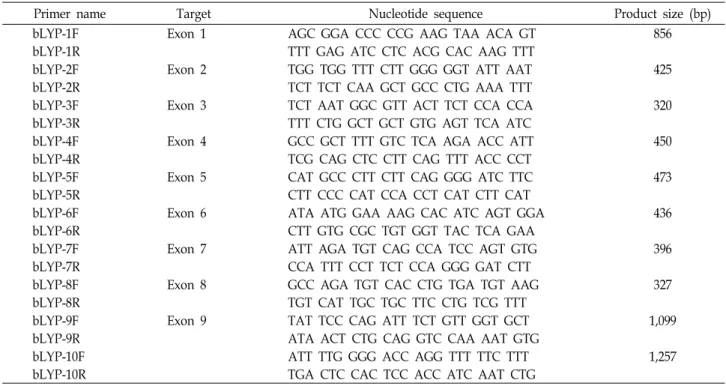
Table 1. Primers designed for amplification and DNA sequencing of LYPLA1 gene
Primer name Target Nucleotide sequence Product size (bp)
bLYP-1F Exon 1 AGC GGA CCC CCG AAG TAA ACA GT 856
bLYP-1R TTT GAG ATC CTC ACG CAC AAG TTT
bLYP-2F Exon 2 TGG TGG TTT CTT GGG GGT ATT AAT 425
bLYP-2R TCT TCT CAA GCT GCC CTG AAA TTT
bLYP-3F Exon 3 TCT AAT GGC GTT ACT TCT CCA CCA 320
bLYP-3R TTT CTG GCT GCT GTG AGT TCA ATC
bLYP-4F Exon 4 GCC GCT TTT GTC TCA AGA ACC ATT 450
bLYP-4R TCG CAG CTC CTT CAG TTT ACC CCT
bLYP-5F Exon 5 CAT GCC CTT CTT CAG GGG ATC TTC 473
bLYP-5R CTT CCC CAT CCA CCT CAT CTT CAT
bLYP-6F Exon 6 ATA ATG GAA AAG CAC ATC AGT GGA 436
bLYP-6R CTT GTG CGC TGT GGT TAC TCA GAA
bLYP-7F Exon 7 ATT AGA TGT CAG CCA TCC AGT GTG 396
bLYP-7R CCA TTT CCT TCT CCA GGG GAT CTT
bLYP-8F Exon 8 GCC AGA TGT CAC CTG TGA TGT AAG 327
bLYP-8R TGT CAT TGC TGC TTC CTG TCG TTT
bLYP-9F Exon 9 TAT TCC CAG ATT TCT GTT GGT GCT 1,099
bLYP-9R ATA ACT CTG CAG GTC CAA AAT GTG
bLYP-10F ATT TTG GGG ACC AGG TTT TTC TTT 1,257
bLYP-10R TGA CTC CAC TCC ACC ATC AAT CTG
재료 및 방법 공시동물과 DNA 분리
연구에 이용된 JCC 집단은 제주특별자치도 축산진흥원과 국립축산과학원 난지축산연구소에 사육중인 제주흑우 종모 우의 동결정액을 공급받아, 한우를 종빈우로 인공수정을 통 해 생산한 교배 1세대이며, 생산 이후 MS 마커와 MC1R 유전 자에 대한 검사를 통과한 흑모색 개체들을 대상으로 하였다.
유전자 친자확인과 MC1R 유전자형 판독은 제주특별자치도 축산진흥원에서 수행하였다. 연구에 이용된 한우 도축우는 JCC와 유사한 시기에 출하된, 출하월령 30-36개월 개체 중 축 산물품질평가원에서 제시한 품종판정 결과에서 한우로 인정 되고, MC1R 유전자형 e/e인 개체들을 선정하였다. 한우와 JCC 모두 거세우만 분석에 이용하였고 유전자형 판독과 통계 분석에 이용하였다. 제주흑우 종모우는 제주특별자치도 축산 진흥원과 국립축산과학원 난지축산연구소에서 보유중인 ge- nomic DNA를 분양 받았으며, JCC는 제주도 축산진흥원에서 genomic DNA를 분양 받아 사용하였다. 한우는 2012년 7월 부터 2014년 5월까지 도축된 시료에서 근육을 수집한 후, Sambrook 등[28]의 방법을 변형하여 DNA를 분리하였다. 분 리한 DNA 용액은 NanoDrop ND-1000 spectrophotometer (Nano Drop Technologies, USA)로 흡광도를 측정한 후 A260/A280 1.8 이상인 DNA 용액들을 50 ng/μl로 희석하여 중 합효소연쇄반응(polymerase chain reaction, PCR)의 주형으 로 이용하였다.
중합효소연쇄반응(polymerase chain reaction, PCR) LYPLA1 유전자 서열은 Ensembl database (http://asia.
ensembl.org/index.html)에 보고된 서열(BTA14: 23,651,477- 23,668,800)를 확보하였고, 전체 9개의 exon을 각각 포함하는 PCR primer를 Primer3 (http://biotools.umassmed.edu/bio- apps/primer3_www.cgi) web program을 이용하여 고안하였 다(Table 1). 각각의 절편에 대한 PCR 증폭조건은 Mastercy- cler Gradient (Eppendorf, Germany)를 이용하여 gradient PCR로 최적화하였다. PCR 반응은 10× 반응완충액, 20 mM dNTP, 각각 200 mM primer, 2 units Taq DNA polymerase (GenetBio, Daejeon, South Korea)와 50 ng genomic DNA 용 액에 멸균한 탈이온수를 첨가하여 반응하였다. 주형 DNA의 변성은 초기에 94℃에서 5분을 수행한 후, 94℃ 40초-프라이머 결합온도 40초-72℃ 60초로 구성된 cycle을 35 회 반복하였다.
PCR 증폭 산물은 agarose gel 상에서 전기영동으로 확인한 후 DNA 염기서열 분석이나 유전자형 결정에 이용하였다.
염기서열 분석과 LYPLA1 유전자형 결정
증폭한 PCR 산물을 주형으로 DYEnamic ET-Dye Termina- tor Kit (GE Healthcare, USA)로 dye-termination 반응을 수행 한 후, MegaBace1000 (Amersham Pharmacia, USA)을 이용하 여 염기서열을 결정하였다. 이에 따라 LYPLA1 유전자형은 g.23655332G>C 다형성(SNPdb ID, rs385360448)을 HaeⅢ 제 한효소 인지서열의 유무에 따른 제한절단 양상으로 판단하였 다. 10× 반응완충액 1 ul, PCR 산물 2.5 ul, 5 units HaeⅢ (Enzynomics, Daejeon, South Korea)와 증류수를 혼합한 후
A
B
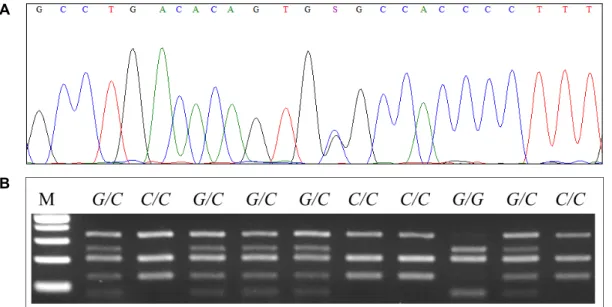
Fig. 1. The nucleotide substitution polymorphism of LYPLA1 rs385360448 g.23655332G>C. A, DNA sequencing result for G/C hetero- zygous animal. An ambiguous code S in the sequence means G/C heterozygous at g.23655332 nucleotide position; B, PCR-RFLP detection for PCR products of rs385360448 g.23655332G>C variants using the digestion patterns by HaeⅢ restriction enzyme.
M is 100-bp DNA ladder.
37℃에서 overnight 반응시킨 후, 2% agarose gel 상에서 전기 영동하여 판독하였다. 유전자형의 분포와 빈도, 유전적 다양 성에 대한 평가는 CERVUS 3.0.7 program [9]을 이용하여 산 출하였다.
LYPLA1 rs385360448 g.23655332G>C 유전자형과 도체형질의 상관 분석
한우와 JCC 집단의 도체성적은 축산물평가원 제주지원의 전문 등급판정사에 의해 측정된 결과를 확보하여 이용하였다.
조사형질은 도체중(carcass weight, CW), 등지방두께(backfat thickness, BF), 등심단면적(eye muscle area, EMA), 근내지방 도(marbling score, MARB), 육색(meat color, MC), 지방색(fat color, FC), 조직감지수(texture index, TI) 등으로 구분하였다.
근내지방도는 9 단계(최저 1-최고 9)로 구분하여 통계분석에 이용하였다. 조사된 성장형질 측정치에 대한 유전자 다형성의 효과는 SAS ver 8.01 program package/PC [29]의 General linear model (GLM) procedure를 이용하여 추정하였다. 통계 모델은 Y = μ + SNP + ε (여기서, Y = 표현형, μ = 전체평균, SNP = SNP marker의 효과, ε = 임의 잔차값)를 이용하였고, 거세우만 분석하였기 때문에 성별효과는 고려하지 않았다. 평 균값의 차이는 Duncan's multiple range test로 유전자형별 유의차 검정을 실시하였다.
결과 및 고찰
제주흑한우와 한우 집단에서 LYPLA1 유전자의 다형성 제주도에서 생산되어 도축된 한우와 JCC 집단에서 LYPLA1
유전자의 다형성을 제주흑우 종모우에서 확인하였다. 염기서 열 분석 결과 아미노산 암호화 영역에서의 염기치환이나 삽입 /결실 등은 관찰되지 않았다. 반면, intron 7에서 g.23655332G
>C와 3’-비해독부위(untranslated region)에서 신규 SNP g.
23653150A>G가 검출되었다. 검출된 두 SNP의 유전자형은 분 석한 모든 종모우에서 서로 연관된 형태를 나타내었으며(자료 미기재), 이에 LYPLA1 유전자형의 판독은 rs385360448 g.
23655332G>C에 대한 유전자형으로 분석하였다. 두 집단에서 LYPLA1 유전자의 세 가지 유전자형 G/G, G/C, C/C가 모두 발견되었다. LYPLA1 intron 7의 rs385360448 g.23655332G>C 변이(Fig. 1)에 대하여 한우 집단은 G 대립유전자의 빈도가 0.188로 C 대립유전자의 빈도(0.812)보다 낮았으나, JCC 집단 은 G 대립유전자의 빈도가 0.687로 C 대립유전자의 빈도 (0.313)보다 높았다(Table 2).
LYPLA1 rs385360448 유전자형과 도체형질의 상관 제주도 한우 집단의 도체성적과 LYPLA1 rs385360448 유전 자형의 상관관계를 분석한 결과는 Table 3에 나타내었다. 유전 자형에 따라 근내지방도(MARB)와 조직감지수(TI)에 대한 유 의적인 차이를 보였다(p<0.05). 근내지방도에 대하여 유전자 형 C/C는 5.82±2.054, C/A는 5.59±2.066로 G/G의 5.03±2.135 에 비해 더 높은 성적을 나타내었다. TI는 C/C에서 2.45±1.008, C/G는 2.56±0.994, G/G는 2.94±0.968를 나타내었다. 반면, 한 우 집단에서 LYPLA1 rs385360448 유전자형은 도체중, 등지방 두께, 등심단면적, 육색, 지방색 등과는 유의적인 차이를 나타 내지 않았다(p>0.05).
Table 4에서는 JCC 집단의 LYPLA1 유전자형과 도체형질의
Table 2. Genotype frequency and genetic diversity parameters at the LYPLA1 gene in Hanwoo an JCC populations
Breed1 Genotype No. of
animals
Allele p
(HWE)2
Diversity parameter3
G/G G/C C/C G C Ho He PIC
JCC 0.628 0.119 0.253 430 0.687 0.313 p<0.05 0.118 0.430 0.337
(n=270) (n=51) (n=109)
Hanwoo 0.034 0.306 0.659 1,016 0.188 0.812 N.S. 0.306 0.305 0.258
(n=35) (n=311) (n=670)
1, JCC stands for the Jeju Crossbred cattle produced between Hanwoo and Jeju Black cattle by artificial insemination using semen of Jeju Black cattle.
2, Hardy-Weinberg equilibrium. p<0.05 indicates significant difference and N.S. indicates not significant.
3, Ho, observed heterozygosity; He, expected heterozygosity; PIC, polymorphic information content.
Table 3. Association between different genotypes of the LYPLA1 gene and carcass traits in the Hanwoo steer population
Trait1 Overall (n=1,016) C/C (n=670) G/C (n=311) G/G (n=35) P-value Significance2
CW BF EMA MARB
MC FC TI
402.77±43.888 13.00±4.351 83.43±9.357 5.72±2.065 4.86±0.393 2.98±0.165 2.50±1.006
405±44.264 12.86±4.200 83.77±9.541 5.82±2.054a 4.86±0.403 2.98±0.176 2.45±1.008a
398.18±43.141 13.25±4.394 82.82±9.037 5.59±2.066a 4.85±0.371 2.99±0.139 2.56±0.994a
401.06±41.074 13.54±6.386 82.29±8.418 5.03±2.135b 4.89±0.404 2.97±0.169 2.94±0.968b
0.075 0.319 0.255 0.036 0.728 0.783 0.009
n.s.
n.s.
n.s.
* n.s.
n.s.
**
1, all abbreviations of each trait are given in the Materials and Methods section.
2, LS Mean ± SE values in the same row with different letters are significantly different at 5% (*) and 1% (**) significance thresholds.
n.s., not significant.
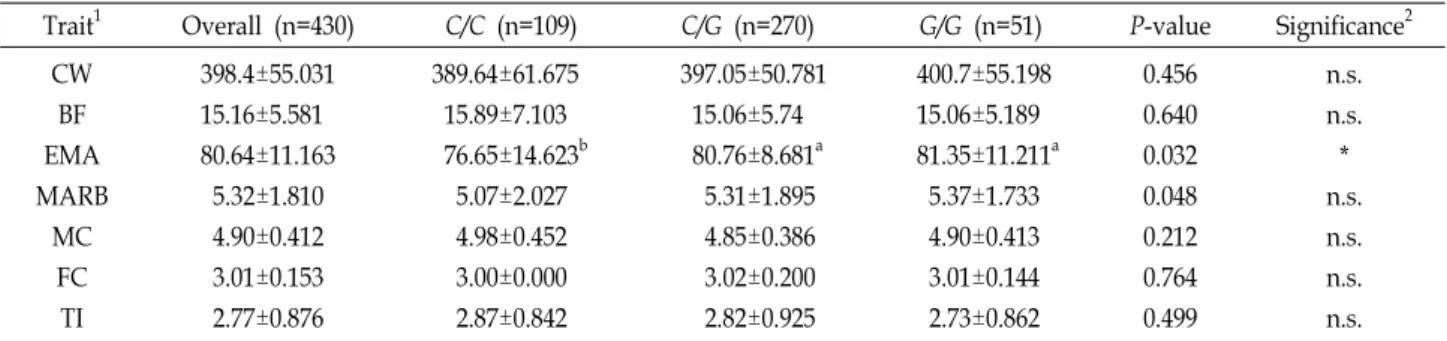
Table 4. Association between different genotypes of the LYPLA1 gene and carcass traits in the JCC steer population
Trait1 Overall (n=430) C/C (n=109) C/G (n=270) G/G (n=51) P-value Significance2
CW BF EMA MARB
MC FC
TI
398.4±55.031 15.16±5.581 80.64±11.163 5.32±1.810 4.90±0.412 3.01±0.153 2.77±0.876
389.64±61.675 15.89±7.103 76.65±14.623b 5.07±2.027 4.98±0.452 3.00±0.000 2.87±0.842
397.05±50.781 15.06±5.74 80.76±8.681a 5.31±1.895 4.85±0.386 3.02±0.200 2.82±0.925
400.7±55.198 15.06±5.189 81.35±11.211a 5.37±1.733 4.90±0.413 3.01±0.144 2.73±0.862
0.456 0.640 0.032 0.048 0.212 0.764 0.499
n.s.
n.s.
* n.s.
n.s.
n.s.
n.s.
1, all abbreviations of each trait are given in the Materials and Methods section.
2, LS Mean ± SE values in the same row with different letters are significantly different at 5% (*) significance thresholds. n.s., not significant.
상관을 나타낸 것으로, 유전자형에 따라 등심단면적(EMA)의 수준에 유의적인 차이를 나타내었다(p<0.05). EMA의 성적에 서 LYPLA1 C/C 동형접합인 개체들에서는 76.65±14.623 cm2 로, C/G (80.76±8.68 cm2)와 G/G (81.35±11.211 cm2)인 개체들 에 비해 약 4-5 cm2 정도 적은 면적을 나타내었다. 반면, JCC에 서 조사된 형질 중에서 도체중, 등지방두께, 근내지방도, 육색, 지방색, 조직감지수에 대한 LYPLA1 rs385360448의 유전자형 효과는 검출되지 않았다(p>0.05).
소 BTA14의 23-25 Mb 위치한 유전자의 SNP 마커들은 소의
경제형질 중 임신기간, 체중, 일당증체량과 사료효율 등과 높 은 상관을 보였다[23-25]. 한우 집단에서도 유전체 수준의 연 관분석(genome-wide association study)에서 BTA14의 SNP 들이 도체중, 등심단면적과 유의적인 상관을 나타내는 것으로 알려져 있다[15, 16, 21, 22, 32]. 특히, BTA14 25 Mb 인근의 SNP들은 도체중과 매우 높은 유의적 상관을 보인다. 이 영역 내에서 pleomorphic adenoma gene 1의 SNP가 소의 도체중에 영향을 주는 강력한 유전자 변이로 제안되었으나[10], 한우 집 단에 대한 연구에서는 유의성이 없다고 보고되었다[33].
본 연구 결과에서 제주도산 한우와 JCC 집단들이 LYPLA1 유전자의 SNP 마커인 rs385360448 g.23655332G>C에 대하여 다형성을 나타내었고, 한우의 근내지방도와 조직감지수에서 유의적인 차이를 나타내었고, JCC 집단에서는 등심단면적 수 준에 유의적인 차이를 보였다(p<0.05). 한우에서 근내지방도 는 고기의 육질을 결정하는 가장 중요한 형질로[11, 28], 근내 지방도와 관련된 QTL은 BTA3, 5, 7, 9, 10, 13, 16, 17, 18, 19, 20, 25, 28 등 다수의 염색체 상에서 보고되었다[15, 16, 21, 22, 32]. 이 중 BTA14에서는 암호화되어 있는 fatty acid binding protein 4 (FABP4), FABP5 promoter의 SNP들이 근내지방도에 유의적인 상관을 제안하였고[7, 17], 이 외에도 adipose most abundant gene transcript 1, adiponectin, proopiomelanocortin (POMC)의 SNP들도 근내지방도와 유의적인 상관을 나타낸다 고 하였다[2, 14, 30]. Fatty acid synthase의 g.17924A>G 유전자 형은 도체중과 육량지수, 등지방두께, 체지방함량에 유의적인 상관을 보였고[8, 12, 20], acetyl CoA carboxylase-α, cortico- trophin-releasing hormone, POMC 유전자의 변이는 등심단면적 과 유의적인 상관을 나타내었다[8, 30]. 한편, 유전적인 배경뿐 만 아니라 무기물이나 지질, 당의 공급 등 사양관리에 의해서 도 근내지방도, 성장형질이나 산육량 등 경제형질의 수준이 변화될 수 있는 것으로 보고되었다[1, 34]. LYPLA1는 lyso- phospholipid-특이적인 가수분해 효소로[35], 식욕을 조절하 는 호르몬인 ghrelin 대사를 조절한다고 알려져 있지만[23, 24, 31], 본 연구에서 분석된 rs385360448 마커가 LYPLA1 유전자 의 intron에 위치하기 때문에 표현형에 대한 유전자형의 효과 를 직접적으로 설명할 수 있는 자료는 없다. 이에 향후 im- munoblotting 등 단백질 수준의 발현 분석과 인지질 생합성 대사에서 유전자형에 따른 LYPLA1의 기능에 대한 연구와 환 경요인과의 상관관계 등에 대한 연구들이 수반되어야 할 것이 다.
본 연구를 통해서 LYPLA1 유전자형이 한우의 근내지방도 와 조직감, JCC 집단의 등심단면적에 영향을 줄 수 있다는 점은 마커도움선발(marker-assisted selection)을 통해 한우와 JCC의 육질과 산육량 증대에 기여할 수 있음을 보여주었다.
특히, 인공수정을 위한 제주흑우 종모우 선발과정에서 LYPLA1 rs385360448를 DNA 마커로 활용한다면, JCC 집단의 등심단 면적 수준을 향상시킬 있을 것으로 기대된다. 또한 대부분의 비육우 경제형질들이 양적 형질이며, 이들의 유전자 발현이 환경적 요소의 영향을 많이 받는다는 점, 육지부에 비해 상대 적으로 온화한 제주도의 기후와 초지 방목 등을 고려해 볼 때, 외부 한우의 연구자료를 그대로 적용하는 것이 아니라, 제주도 한우에 대한 연구자료를 토대로 우수한 종빈우를 선발 할 수 있는 유전자 마커 탐색이 지속적으로 이루어져야 할 것이다. 이와 함께 인공수정용 정액 생산에 활용되고 있는 제 주흑우 종모우의 유전 정보 수집과 평가를 통해 DNA 마커들 이 개발되면, 제주흑우의 유전능력 개량과 JCC 축군의 산업화
에 크게 기여할 것이다.
감사의 글
본 논문은 농촌진흥청 연구사업(세부과제명: 제주흑한우 (제주흑우×한우) 성장단계별 적정 영양수준 및 비육기간 설정 연구, 세부과제번호 PJ01095801)의 지원에 의해 수행되었으 며, 이에 감사드립니다.
References
1. Adams, D. C., Galyean, M. L., Kiesling, H. E., Wallace, J.
D. and Finkner, M. D. 1981. Influence of viable yeast culture, sodium bicarbonate and monensin on liquid dilution rate, rumen fermentation and feedlot performance of growing steers and digestibility in lambs. J. Anim. Sci. 53, 780-789.
2. Choi, Y., Davis, M. E. and Chung, H. 2015. Effects of genetic variants in the promoter region of the bovine adiponectin (ADIPOQ) gene on marbling of Hanwoo brrf cattle. Meat Sci. 105, 57-62.
3. Han, S. H., Cho, S. R., Cho, I. C., Cho, W. M., Kim, S. G., Yang, S. N., Kang, Y. J., Park, Y. S., Kim, Y. H., Park, S.
P., Kim, E. Y., Lee, S. S. and Ko, M. S. 2013. A parentage test using indel, microsatellite markers and genotypes of MC1R in the Jeju Black cattle population. J. Embryo Transf.
28, 207-213.
4. Han, S. H., Kim, Y. H., Cho, I. C., Jang, B. G., Ko, M. S., Jung, H. Y. and Lee, S. S. 2008. Analysis of the genotype distribution in cattle breeds using a double mismatched pri- mer set that discriminates the MC1R dominant black allele.
Kor. J. Anim. Sci. Technol. 50, 633-640.
5. Han, S. H., Ko, J. C., Kim, Y. H., Kim, N. Y., Kim, J. H., Ko, M. S., Jeong, H. Y., Cho, I. C., Yang, Y. H. and Lee, S. S. 2010. Verification of ET and AI derived offspring using on the genetic polymorphsims of microsatellite and coat col- or genes in Jeju Black cattle. J. Life Sci. 20, 381-387.
6. Han, S. H., Oh, H. S., Lee, J. B., Jwa, E. S., Kang, Y. J., Kim, S. G., Yang, S. N., Kim, Y. K., Cho, I. C., Cho, W. M., Ko, M. S. and Baek, K. S. 2015. Effects of genetic polymorphisms of ADD1 gene on economic traits in Hanwoo and Jeju Black cattle-derived commercial populations in Jeju-do. J. Life Sci.
25, 21-28.
7. Heo, K. N., Kim, N. K., Lee, S. H., Kim, N. Y., Jeon, J. T., Park, E. W., Oh, S. J., Kim, T. H., Seong, H. H. and Yoon, D. 2011. Association between the polymorphism of the fatty acid binding protein 5 (FABP5) gene within the BTA 14 QTL region and carcass/meat quality traits in Hanwoo. Kor. J.
Anim. Sci. Technol. 53, 311-317.
8. Jeon E. K., Kim, S. W., Choi, Y. J., Kim, N. S., Cho, M. W., Lee, M. I., Jeong, Y. H., Lee, J. S., Kim, K. T., Koh, K. C.
and Kim, K. S. 2011. Effect of the fatty acid synthase and acetyl CoA carboxylase genes on carcass quality in commercial Hanwoo population. Kor. J. Anim. Sci. Technol. 53, 389-395.
9. Kalinowski, S. T., Taper, M. L. and Marshall, T. C. 2007.
Revising how the computer program CERVUS accom- modates genotyping error increases success in paternity assignment. Mol. Ecol. 16, 1099-1106.
10. Karim, L., Takeda, H., Lin, L., Druet, T., Arias, J. A., Baurain, D., Cambisano, N., Davis, S. R., Farnir, F., Grisart, B., Harris, B. L., Keehan, M. D., Littlejohn, M. D., Spelman, R. J., Georges, M. and Coppieters, W. 2011. Variants modulating the expression of a chromosome domain encompassing PLAG1 influence bovine stature. Nat. Genet. 43, 405-413.
11. Kim, C. J. and Lee, E. S. 2003. Effects of quality grade on the chemical, physical and sensory characteristics of Han- woo (Korean native cattle) beef. Meat Sci. 63, 397-405.
12. Kim, S. W., Lee, J. H., Kim, J. H., Won, Y. S., Kim, N. S.
and Kim, K. S. 2010. Effect of the fatty acid synthase gene for beef quantity traits in Hanwoo breeding stock. Kor. J.
Anim. Sci. Technol. 52, 9-16.
13. Kneeland, J., Li, C., Basarab, J., Snelling, W. M., Benkel, B., Murdoch, B., Hansen, C. and Moore, S. S. 2004. Identifica- tion and fine mapping of quantitative trait loci for growth traits on bovine chromosomes 2, 6, 14, 19, 21, and 23 within one commercial line of Bos taurus. J. Anim. Sci. 82, 3405-314.
14. Kwon, A., Srikanth, K., Lee, E., Kim, S. and Chung, H. 2016.
Confirmation of genotypic effects for the bovine AMP1 gene on marbling in Hanwoo cattle. Kor. J. Anim. Sci. Technol.
58, 15.
15. Lee, S. H., Choi, B. H., Lim, D., Gondro, C., Cho, Y. M., Dang, C. G., Sharma, A., Jang, G. W., Lee, K. T., Yoon, D., Lee, H. K., Yeon, S. H., Yang, B. S., Kang, H. S. and Hong, S. K. 2013. Genome-wide association study identifies major loci for carcass weight on BTA14 in Hanwoo (Korean cattle).
PLoS One 8, e74677.
16. Lee, S. H., van der Werf, J. H., Kim, N. K., Lee, S. H., Gondro, C., Park, E. W., Oh, S. J., Gibson, J. P. and Thomp- son, J. M. 2011. QTL and gene expression analyses identify genes affecting carcass weight and marbling on BTA14 in Hanwoo (Korean Cattle). Mamm. Genome 22, 589-601.
17. Lee, S. H., van der Werf, J. H., Lee, S. H., Park, E. W., Oh, S. J., Gibson, J. P. and Thompson, J. M. 2010. Genetic poly- morphisms of the bovine fatty acid binding protein 4 gene are significantly associated with marbling and carcass weight in Hanwoo (Korean Cattle). Anim. Genet. 41, 442-444.
18. Lee, S. S., Yang, B. S., Yang, Y. H., Kang, S. Y., Ko, S. B., Jung, J. K., Oh, W. Y., Oh, S. J. and Kim, K. I. 2002. Analysis of melanocortin receptor 1 (MC1R) genotype in Korean brindle cattle and Korean cattle with dark muzzle. Kor. J. Anim. Sci.
Technol. 44, 23-30.
19. Lee, S. S., Yang, Y. H., Kang, S. Y., Oh, W. Y., Yang, B.
S., Ko, S. B., Oh, S. J. and Kim, K. I. 2000. Comparison of the genotypes and frequencies of MSH receptor (MC1R) gene in Korean cattle, Cheju native black cattle, Japanese black and Japanese brown cattle. Kor. J. Anim. Sci. Technol. 42, 253- 260.
20. Li, S. Kim, S. W., Lee, J. J., Lee, J. H., Yoon, D., Kim, J.
J., Jeong, Y. C., Jeon, S. H., Choi, J. W., Kim, N. S. and Kim, K. S. 2009. Characterization of the bovine FASN gene varia- tion for carcass and beef quality traits in Hanwoo. Kor. J.
Anim. Sci. Technol. 51, 185-192.
21. Li, Y. and Kim, J. J. 2015. Multiple linkage disequilibrium mapping methods to validate additive quantitative trait loci in Korean Native cattle (Hanwoo). Asian-Australas. J. Anim.
Sci. 28, 926-935.
22. Li, Y., Gao, Y., Kim, Y. S., Iqbal, A. and Kim, J. J. 2017.
A whole genome association study to detect additive and dominant single nucleotide polymorphisms for growth and carcass traits in Korean native cattle, Hanwoo. Asian- Australas. J. Anim. Sci. 30, 8-19.
23. Lindholm-Perry, A. K., Kuehn, L. A., Smith, T. P., Ferrell, C. L., Jenkins, T. G., Freetly, H. C. and Snelling, W. M. 2012a.
A region on BTA14 that includes the positional candidate genes LYPLA1, XKR4 and TMEM68 is associated with feed intake and growth phenotypes in cattle. Anim. Genet. 43, 216-219.
24. Lindholm-Perry, A. K., Kuehn, L. A., Snelling, W. M., Smith, T. P., Ferrell, C. L., Jenkins, T. G., King, D. A., Shackelford, S. D., Wheeler, T. L. and Freetly, H. C. 2012b. Genetic mark- ers on BTA14 predictive for residual feed intake in beef steers and their effects on carcass and meat quality traits.
Anim. Genet. 43, 599-603.
25. Maltecca, C., Weigel, K. A., Khatib, H., Cowan, M. and Bagnato, A. 2009. Whole-genome scan for quantitative trait loci associated with birth weight, gestation length and pas- sive immune transfer in a Holstein x Jersey crossbred population. Anim. Genet. 40, 27-34.
26. Moore, S. S., Li, C., Basarab, J., Snelling, W. M., Kneeland, J., Murdoch, B., Hansen, C. and Benkel, B. 2003. Fine map- ping of quantitative trait loci and assessment of positional candidate genes for backfat on bovine chromosome 14 in a commercial line of Bos taurus. J. Anim. Sci. 81, 1919-1925.
27. Park, G. B., Moon, S. S., Ko, Y. D., Ha, J. K., Chang, H.
H. and Joo, S. T. 2002. Influence of slaughter weight and sex on yield and quality grades of Hanwoo (Korean native cattle) carcasses. J. Anim. Sci. 80, 129-136.
28. Sambrook, J., Fritsch, E. F. and Manniatis, T. 1989. Molecular cloning: a laboratory manual. 2nd Ed. Cold Spring Harbor Laboratory.
29. SAS. 1999. SAS/STAT software for PC. Release 8.01. SAS Institute Inc., Cary, NC, USA.
30. Seong, J. and Kong, H. S. 2015. Association between poly- morphisms of the CRH and POMC genes with economic traits in Korean cattle (Hanwoo). Genet. Mol. Res. 14, 10415- 10421.
31. Shanado, Y., Kometani, M., Uchiyama, H., Koizumi, S. and Teno, N. 2004. Lysophospholipase I identified as a ghrelin deacylation enzyme in rat stomach. Biochem. Biophys. Res.
Commun. 325, 1487-1494.
32. Sharma, A., Dang, C. G., Kim, K. S., Kim, J. J., Lee, H. K., Kim, H. C., Yeon, S. H., Kang, H. S. and Lee, S. H. 2014.
Validation of genetic polymorphisms on BTA14 associated with carcass trait in a commercial Hanwoo population.
Anim. Genet. 45, 863-867.
33. Suh, S., Cho, C. Y., Kim, Y. S., Byun, M. J., Choi, S. B., Cho, Y. M., Bae, K. H. and Kim, J. H. 2015. Molecular genetic
초록:제주도산 한우와 제주흑한우 집단의 도체형질에 대한 Lysophospholipase I (LYPLA1) 유전자 형의 효과
한상현1,2․성필남1*․조인철1*
(1농촌진흥청 국립축산과학원 난지축산연구소, 2제주대학교 교육과학연구소)
본 연구는 Lysophospholipase I (LYPLA1) 유전자의 SNP 마커인 rs385360448 g.23655332G>C의 유전자형이 제주 도 한우와 제주흑한우(한우×제주흑우, JCC) 집단의 도체형질에 미치는 영향을 시험하였다. 한우 거세우 집단에서 LYPLA1 rs385360448 G/-를 보유한 도체는 C/C 동형접합에 비해 유의적으로 높은 수준의 근내지방도(MARB)와 조직감지수(TI)를 나타내었다(p<0.05). 반면, LYPLA1 유전자형은 도체중, 등지방두께, 등심단면적, 육색, 지방색에 서는 유의적인 차이를 보이지 않았다(p>0.05). JCC 거세우에서는 LYPLA1 G/- 도체에서 C/C 동형접합에 비해 등 심단면적(EMA)의 수준이 유의적으로 더 높았다(p<0.05). 이번 연구의 결과들은 LYPLA1 유전자형이 소의 등심에 서 인지질 대사를 통해 근내지방도와 조직감의 수준과 등심단면적의 수준을 변화시킬 수 있음을 보여주고 있다.
이러한 결과들은 LYPLA1 유전자형이 한우와 제주흑우-유래의 산업화축군에서 도체형질을 개선할 수 있는 유전 자 마커로써의 기능을 수행할 수 있을 것으로 기대된다.
considerations of Jeju Black cattle using microsatellite markers. J. Agr. Life Sci. 49, 57-65.
34. Volpi-Lagreca, G. and Duckett, S. K. 2016. Supplementation of glycerol or fructose via drinking water to enhance mar- bling deposition and meat quality of finishing cattle. J. Anim.
Sci. 94, 858-868.
35. Wang, A., Yang, H. C., Friedman, P., Johnson, C. A. and Dennis, E. A. 1999. A specific human lysophospholipase cDNA cloning, tissue distribution and kinetic character- ization. Biochim. Biophys. Acta 1437, 157-169.