• 검색 결과가 없습니다.

Changes in Forest Disturbance Patterns from 1976 to 2005 in South Korea

N/A
N/A
Protected

Academic year: 2021

Share "Changes in Forest Disturbance Patterns from 1976 to 2005 in South Korea"

Copied!
9
0
0

로드 중.... (전체 텍스트 보기)

전체 글

(1)

593

F OREST S OCIETY

Changes in Forest Disturbance Patterns from 1976 to 2005 in South Korea

Pil Sun Park*, Kyu Hwa Lee, Mun Ho Jung, Hanna Shin, Woongsoon Jang, Kikang Bae, Jongkoo Lee and Don Koo Lee

Department of Forest Sciences, Seoul National University, Seoul 151-921, Korea (S)

Abstract : Forest disturbances including forest fire, insect pests and diseases, landslides, and forest conversion from 1976 to 2005 were investigated to trace the changes of major forest disturbance agents and their characteristics over time in accordance with changes in natural and social environment in South Korea.

While the damaged area by insect pests and diseases continuously decreased for the past 30 years, damaged areas by forest fire and landslide were fluctuating through years. The interval of large forest fires has become shorter with increased tree volume. The precipitation between January and April were significantly correlated with large fire occurrences as Pearson’s correlation coefficient -0.400 ( P =0.029). The composition of major insect pests and diseases damaging Korean forests has been changed continuously, and become more diversified. While damages by pine caterpillar ( Dendrolimus spectabilis ) and pine needle gall midge ( Thecodiplosis japonensis ) decreased, damage by introduced pests has been more serious recently. The change of precipitation pattern that brought more localized heavy rain or powerful typhoon resulted in the recent increase in landslide areas. The major land uses to induce forest conversion have been changed, reflecting the changes in industrial structure in South Korea as agriculture and mining in 1970s, mining and golf ranges classified in pasture in 1980s, and road and housing construction in 1990s and 2000s. Changes in forest disturbance patterns in South Korea show that a country’s industrial development is jointly working with global warming on forest stand dynamics. Altering energy structure and land use pattern induced by industrial development accumulates forest volume and reforms microenvironments on forest floor, interacting with climate change, inducing shorter interval of large forest fire and changes in major species composition of forest insect pests and diseases.

Key words : species composition, forest fire, insect pests and diseases, landslide, forest conversion, forest change

Introduction

Disturbance, whether it is natural or anthropogenic, causes landscape heterogeneity and changes the structure and function of ecosystem. While natural disturbance occurs depending on the area’s environmental condition, the occurrence of anthropogenic disturbance depends on socio-economic environments of the area (Kamada and Nakagoshi, 1996). In the history of Korean forest, illegal logging and fuelwood collection from the early to mid 20

th

century, and the reforestation activities initiated by the Korean government and industrialization were major events that resulted in the current feature of Korean for- ests as well as natural disturbance patterns.

Although many parts of Korean forests had remained as old-growth forests until the 19th century, the forest

exploitation in the Japanese colonial period (1910-1945) and the Korean War (1950-1953) destroyed most of Korean forests. The forest firing to suppress communist partisans hiding in forests, and over-utilization for fuel- wood and construction material after the Korean War made forests more degraded, resulting that the average volume per hectare of Korean forest was merely 10.6 m

3

in 1960s. Korean forest has changed tremendously with the industrial development and the strong reforestation policies by the Korean government from late 1960s to late 70s (Korea Forest Service, 2007a; Bae, 2007).

The industrialization that changed major fuel sources from fuelwood to charcoal, oil and gas, and strong forest rehabilitation and protection policies of Korean govern- ment were major contributors for successful forest refor- estation in Korea (Bae and Lee, 2006). Drastic changes of Korean forest during the past half century in the accu- mulation of timber volume and organics on forest floor have accompanied changes in forest disturbance patterns

*Corresponding author

E-mail: [email protected]

(2)

including forest fire, landslide, and insect pests and dis- eases (Korea Forest Research Institute, 1976-2007;

Korea Forest Service, 1992-2006).

Natural disturbances have been closely linked to forest dynamics in Korea. The Annals of the Choson Dynasty, the national archives of Korea between 1392 and 1863, often reported forest damages by Dendrolimus spectabi- lis (pine caterpillar). When the caterpillar damage was serious such as in 1403 and in 1685, the government mobilized people to exterminate the pine caterpillar (National Institute of Korean History, 2005). From the early 20

th

century, the new exotic insect pests and dis- eases were reported including Thecodiplosis japonensis (pine needle gall midge) in 1929, Cronartium ribicola (white pine blister rust) in 1936, and Hyphantria cunea (fall webworm) in 1961 (Ministry of Agriculture and Forestry, 1961; Korea Forest Research Institute, 1986;

Ministry of Agriculture and Forestry, 2000b). Recent forest damages by insect pests and diseases have been ascertained with the monitoring of the hazard agents for forest by the Korea Forest Research Institute since 1960s (Shin, 2007a).

Forest Fire has always been among the most disturb- ing factors in forest ecosystem (Whelan, 1995; Telesca et al. , 2007). The increase of human population and human activities has resulted in an increase in the num- ber of forest fires (Whelan, 1995; Lee et al. , 2006). Most forest fires in Korea are known to be caused by human activities, and no natural fires have been reported over the past 30 years (Korea Forest Service, 1992-2006;

Choung et al. , 2004; Lee et al. , 2006). Landslides are also one of major factors of natural and sediment disas- ters in Korea (Lee, 2005). Most of landslides occur in the summer due to the precipitation characteristics as more than half of the annual precipitation concentrated in the summer in Korea.

None of disturbance factors have affected forests more than the land conversion in South Korea. The forest area in Korea has gradually decreased with rising industrial- ization and urbanization while industrial, residential and non-forested public land areas have increased. In the 1970s and early 1980s, 1.3 percent of South Korea’s for- est was converted to agricultural, industrial and residen- tial uses. The forest conversion continued in the 21

st

century although the rate was decreased. Land use-changes have brought public concern over issues of timber scar- city and losses of unique ecosystems, however, contin- ued conversion seems inevitable, in light of rapid urban and industrial development (Choi and Klemperer, 2000).

This study was aimed to synthesize changes of major forest disturbance agents in Korea and to investigate fac- tors influencing changes in each disturbance agent to provide information to establish forest conservation pol-

icies and for sustainable forest management. Our study focused on disturbance patterns for the past 30 years fol- lowing reforestation policies implemented.

Methods

1. Disturbance database

The forest disturbance factors considered in this study were insect pests and diseases, forest fire, landslide, and forest conversion. The data on forest damaged areas, cli- mate, and relevant environmental factors were collected within the temporal scale from 1976 to 2005.

Annual damaged forest areas by insect pests and dis- eases were obtained from Forest Statistics (Korea Forest Administration, 1976-1991) and Statistical Yearbook of Forestry (Korea Forest Service, 1992-2006). Annual Report of Monitoring for Forest Insect Pests and Dis- eases in South Korea, and various research reports and syntheses on specific insect pests and diseases were used for the distribution and characteristics of specific insect pests and diseases (Ministry of Agriculture and Forestry, 1961; Korea Forest Research Institute, 1985, 1986; Min- istry of Agriculture and Forestry, 2000a, b).

The data on the forest fire occurrence from 1976 to 2005 were obtained through the Korean Forest Fire Information System (Korea Forest Service, 2007b).

The Disaster White Paper 2002 and Lee (2005)’s study were used for the data on landslide occurrence area from 1976 to 2005 (National Institute for Disaster Prevention, 2003; Lee, 2005).

The data on forest land use change were obtained through Forest Statistics and Statistical Yearbook of For- estry (Korea Forest Administration, 1976-1991; Korea Forest Service, 1992-2006).

The climate data from 1976 to 2005 were obtained from the Annual Climatological Report of Korea Mete- orological Administration (Korea Meteorological Adminis- tration, 2008). The climate data included monthly maximum, minimum and mean temperature, precipitation, and wind data. Monthly mean temperature and monthly mean pre- cipitation were calculated from the climate data for 1976-2005.

2. Data analysis

The damaged forest areas by major disturbances were summed by year and chronologically arranged. The tem- poral change of damaged areas by each major distur- bance was analyzed with environmental factors. The damaged areas by pest insects and diseases, forest fire, and landslide were analyzed with meteorological data or forest volume data.

The damaged forest area by major insect pests and

diseases were chronologically arranged by year to inves-

(3)

tigate the temporal distribution of the major insect pests and diseases outbreaks. Damaged forest areas were cal- culated by plotting the infected area on the map on a scale of 1 to 25,000.

The means of monthly fire occurrences and burned areas for 1976-2005 were calculated and compared using Duncan’s multi-range test (Zar, 1996). After the monthly status of forest fire was examined, the rela- tionship between the intensive time of forest fire and the precipitation at the time was analyzed. Because more than 80% of forest fires occur between January and April (Lee et al. , 2006; Korea Forest Service, 2007c), the burned area and precipitation from January to April were used to analyze the correlation between forest burned area and precipitation. The annual forest burned area was transformed into logarithmic form and SPSS 12.0 was used for the statistical analysis (SPSS, 2004).

The monthly landslide occurrence area was compared with the monthly precipitation.

The change of forest land area by major forest con- version causes was annually arranged to examine the temporal transition of major factors. The major causes for forest conversion were classified as mine, housing and factory site, pasture, agriculture area, golf and rec- reation, and others. The classified causes were from the largest to the fifth changed area. Golf and recreation was included from 2001. The annual change of forest con- version was examined with the proportion of economic production by each industrial sector in the Korean econ- omy.

Results

1. Overall forest disturbance patterns in South Korea from 1976 to 2005

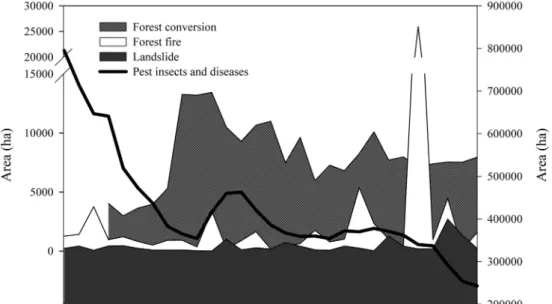
The overall forest damaged area has decreased in accordance with the decrease of insect pests and diseases damages that account for the overwhelming majority of the disturbance causes (Figure 1). The only exception was year 2000 when unprecedented forest fires broke out in the east coast of the Korean peninsula. While the damaged area by insect pests and diseases continuously decreased, damaged areas by forest fire and landslide were fluctuating through years. Forest conversion increased till mid 1980s, and slightly decreased since then.

2. Insect pests and diseases

Major insect pests and diseases damaging Korean for- ests were changed through year. In 1970s, most of the forest damages were caused by Dendrolimus spectabilis (pine caterpillar) and Thecodiplosis japonensis (pine needle gall midge). Hyphantria cunea (fall webworm) and Age- lastica coerulea (Japanese alder leaf beetle) were emerg- ing damaging agents. D. spectabilis damage kept decreased and little damage was detected after mid 1980s. The occurrence of A. coerulea and Cronartium ribicola (white pine blister rust) was also negligible recently. T.

japonensis damage has slightly decreased, but is still one of the most important insect pests with the cyclic pattern of occurrence. The damage by H. cunea were constant since 1976 (Figure 2).

While damages by pine caterpillar and pine needle

Figure 1. Forest disturbance patterns in South Korea from 1976 to 2005. Left axis is the damaged area by forest

conversion, forest fire, and landslide, and right axis is the damaged area by insect pests and diseases (ha).

(4)

gall midge decreased, damages by introduced pests have been more serious recently. Matsucoccus thunbergianae

(black pine bast scale) which were first observed in 1963 became a severe damaging agent on Pinus thunbergii

stands in the southwest region for the past several years.

Bursaphelenchus xylophilus (pine wood nematode) caus- ing pine wilt disease, first found in 1988, has caused critical damages to Pinus densiflora and Pinus koraien- sis and been fast spreading across the country (Han et

al ., 2008). Oak wilt disease caused by Raffaelea spp., was first reported in 2004, and has been fatal to oak stands since then (korea Forest Research Institute, 2006).

3. Forest fire

Mean annual burned area and mean forest fire occur- rence were 397 times and 2247.8 ha from 1976 to 2005, respectively. Forest fire occurrences decreased in 1980s and then increased (Figure 3). The pattern of fire occur- rences were similar among 1970s, 1990s, and present, however, the interval of annual burned area larger than 3000 ha became more frequent in recent years.

The monthly fire occurrences and burned areas indi- cated that April was the month with the most fire occur- rences and burned area (Table 1). Fire burned areas in April were very significantly different from areas burned in other months, even areas burned in April were more Figure 2. The change of the ratio of damaged areas by major pest insects and diseases in South Korea between 1976 and 2005.

Figure 3. Annual forest fire occurrences and burned areas (ha) in South Korea from 1976 to 2005.

(5)

then the sum of burned areas of the other months ( P <

0.001). The period from February to April had 76% of the forest fire occurrences and 88% of burned forest areas in a year ( P =0.020).

The forest fire burned area and the precipitation between January and April were significantly correlated as Pear- son’s correlation coefficient -0.400 ( P =0.029) (Figure 4). In 2000, the precipitation between January and April was less than 10 cm, the least precipitation record for

the past 30 years, while the largest forest area, 25953 ha was burned.

4. Landslide

The total landslide area in Korea between 1976 to 2005, was 12060 ha, and the mean annual landslide area was 430 ha yr

−1

(Figure 5). The landslide area from 2001 to 2005 was 4992 ha with 1267 ha yr

−1

, and the largest landslide occurrence year was 2002 with 2705 ha.

Year 1987, 1998, and 2003 also experienced large land- slide areas, indicating that landslide area was recently increased. The annual precipitation varied in South Korea ranging from 882 mm in 1988 to 1850 mm in 2003 with the mean annual precipitation was 1326 mm for the past 30 years.

5. Forest land use change

Until mid 1980s, mining and agriculture were the main causes to encroach on Korean forests (Figure 6).

Forest conversion for mining rapidly dropped since then, as 2629 ha in 1976-1985, 1373 ha in 1986-1995, and 143 ha in 1996-2005. Housing and factory site, and road replaced mining and agriculture for the main factors for forest conversion from late 1980s. Golf and recreation were emerging factors to take forest land from late 1990s, and golf and recreation were added to the cate- gory from 2001. The forest area converted for the golf and recreation was fast increased from 515 ha (7% of total forest conversion) in 2001 to 1100 ha (12.2% of Table 1. Monthly mean forest fire occurrences and burned area in South Korea from 1991 to 2005.

Mean Jan Feb Mar Apr May Jun Jul Aug Sep Oct Nov Dec

No. forest fires 22.2

a

65.4

b

112.2

c

158.3

d

25.2

a

10.5

a

1.6

a

0.6

a

5.3

a

10.4

a

13.5

a

18.8

a

Burned area (ha) 37.4

a

139.1

a

296.9

a

2,461.4

b

37.3

a

7.2

a

2.3

a

0.6

a

4.3

a

264.0

a

18.1

a

23.9

a

The same letters are not significantly different at the 0.05 level according to Duncan’s multi-range test.

Figure 4. The scatter plot between the forest burned area and the precipitation between January and April in 1965- 2005 in South Korea.

Figure 5. The landslide areas and June-September mean precipitations by year between 1976 and 2005 in South Korea.

(6)

total forest conversion) in 2005. In the category, others included burial, marsh, playground, military installation, and rest area.

Discussion

Among factors to lead to changes in forest disturbance patterns in South Korea, industrial development, forest development, global warming, and the introduction of exotic insect pests and diseases are worth to pay atten- tion to.

The composition of major insect pests and diseases damaging Korean forests has been changed continu- ously, and become more diversified. Change of species composition and density of major insect pests and dis- eases in Korean forests coincides with changing pattern of forest type. Korean forests are getting through devel- opmental changes in terms of species composition and stand structure. The proportion of coniferous forests which mostly composed of pioneer species of P . densi- flora or P. rigida , decreased from 53% in 1976 to 43%

in 2005, while that of mixed and non-coniferous forests increased (Korea Forest Research Institute, 1976-2007), indicating the outbreak potential of insect pests and dis- eases damaging non-coniferous forests such as oak wilt disease become greater the future. With successional development of Korean forests, the importance of insect pests and diseases damaging pioneer species decreased.

The damage by A. coerulea declined sharply from early 1980s as alders planted for reforestation in 1960s and 1970s decreased and replaced by oak forests (Korea For- est Service, 1992-2006).

The rapid decline of D. spectabilis , the predominant insect agent in mid 1970s, and the increase of T. japon- ensis from mid 1970s to early 1980s could be partly explained by the changing environmental condition on

forest floor and by the competition for food between two insects . D. spectabilis is known to be more competitive in dry site (Kamata, 2002), while accumulated litter layer and forest growth in 1970s and 1980s increased moisture condition on forest floor. Both D. spectabilis and T. japonensis use P. densiflora as the main host.

However, the fact that D. spectabilis abhors the needle of P. densiflora attacked by T. japonensis led D. spect- abilis to lose the competition against T. japonensis . Some population of D. spectabilis even changed its host from P. densiflora to Pinus rigida which T. japonensis dislike (Ministry of Agriculture and Forestry, 2000a).

To trace the origin of the forest damage by insect pests and diseases is not easy because multiple biotic and abi- otic factors are involved in most syndromes. Among fac- tors that predispose trees to insect pests and diseases, temperature is identified as a dominant abiotic factor directly affecting herbivorous insects, pathogens, and trees, with the major effects on winter survival, summer growth, and reproduction by controlling the available thermal budget during growing season in the temperate regions (Bale et al. , 2002). The change of temperature often puts trees under stress to be more susceptible to insect pests and diseases, while temperature rise encour- ages pests to migrate, that are expected to respond more quickly to climate change than plants (Cannon, 1998).

Repeated forest damages by subtropical disease and insect of

Fusarium circinatum (pitch canker) and Phraortes elonga-

tus (walkingstick) is suspected to be related to the cli-

mate change trend. Intergovernmental Panel on Climate

Change (IPCC) reported that the global mean surface

temperature increased by 0.6 ± 0.2

o

C over the 20

th

cen-

tury, and projected an increase of 1.4 to 5.8

o

C over the

period 1990 to 2100 (Houghton et al. , 2001). In Korea,

the temperature increased by 1.5

o

C during the 20

th

cen-

tury, which was much higher than the global increase,

Figure 6. Forest conversion by landuse from 1976 to 2005 in South Korea.

(7)

but it was reasonable considering the fact that the most of global warming and the effect of urbanization have mainly occurred over mid- and high-latitudes where Korea is belonged to (Youn et al. , 2004). Many pine trees exposed to the stress caused by higher temperature are suffering from the pathogen with low pathogenicity like Cenangium ferruginosum (Cenangium twig blight) (Korea Forest Research Institute, 1976~2007).

The damage by exotic organisms has become more extending. Pine wood nematode has rapidly spread, especially after 2000, to 53 districts since it was first reported in 1988, and even infected Pinus koraiensis . The infection of P. koraiensis by pine wood nematode was the first case in the world (Shin, 2007b). Oak wilt disease by Raffaelea sp., first found in 2004 in Korea, has mainly infected Quercus mongolica which is the most common oak species in Korea. The mortality of oak wilt disease reached to 20.1% (Korea Forest Research Institute, 1976~2007). Obolodiplosis robiniae (locust gall midge) reported in 2003 is also threatening Robinia pseudoacacia stands. Damaged area by C. ribicola and H. cunea among introduced insect pests and diseases has been remained at the certain level. Considering a general agreement that environmental change will continue, insect pests and diseases damaging Korean forests will be more diversified in the future. The more important point we should focus on is that the damage severity can be higher if the new and exotic insect pests and diseases attack forests weakened by warmer climate, and having no resistance to them.

Although most forest fires are caused by human activ- ities in Korea, forest fire occurrences were inverse to precipitation (Lee et al. , 2006; Korea Forest Service, 2007c). Annual precipitation in Korea is concentrated in the summer (Korea Meteorological Administration, 2008), and the period from October to April next year is regarded as dry season as well as an intensive fire sea- son as most of burned area is created during this period.

The interval of large forest fires has become shorter for the past 30 years. The years that experienced forest fire more than 3,000 ha were 1978, 1988, 1996, 2000, and 2002. Increased tree volume might have contributed to the shorter cycle of large fires by providing more fuel (Korea Forest Service, 1992~2006; Choi et al ., 2006).

The tree volume of Korean forest has increased from 16.35 m

3

ha

−1

in 1976 to 79.20 m

3

ha

−1

in 2005. As Korean forest is still growing to mature forests, the potential to have larger forest fire is still increasing (Lee et al ., 2008).

The change of precipitation pattern that brought more localized heavy rain or powerful typhoon in Korea explained the recent increase in landslide areas (Lee, 2005). The years with large landslide areas usually coin-

cided with years with high precipitation caused by large typhoon hits or long rainy season. The years 1987, 1998, 2003 and 2006 experienced more powerful and stronger typhoon, and landslide occurrence areas in those years were larger than average annual landslide occurrence areas. According to the equation for the relationship between maximum landslide occurrence area and annual precipitation (Im, 2002), the precipitation could be a use- ful indicator to landslide damage when typhoon or local- ized heavy rain occurs.

The converted forest area was largest in mid 1980s, decreased from late 1980s to early mid 1990s, and main- tained similar area for the past 10 years. The landuse and area created by forest conversion coincided with the development of Korean economy. The sharp decrease and increase in forest conversion areas in 1979-1984 seemed to be related to the Korea’s economic crisis in 1980 and quick economic recovery in early 1980s (Col- lins, 1990). The major land uses to induce forest con- version have been changed, reflecting the changes in industrial structure in South Korea. The Korea’s major industry shifted from primary industries in 1970’s to ter- tiary industries in 2000s, resulting that major landuses from forest conversion were agriculture and mining in 1970s, mining and golf ranges classified in pasture in 1980s, and road and housing construction in 1990s and 2000s. Forest conversion for agriculture and mining was 4,407 ha in 1976, but was only 551 ha in 2005. The increase of fallow ground derived from the decrease of agriculture is providing the opportunity to regain forest area with the rising demand of Korean people for rec- reation areas and nature conservation.

Conclusion

Korean forest has experienced diverse disturbance events both natural and artificial as drastic as its history.

Industrialization, forest development, and climate change were important factors to alter major disturbance agents in Korean forest.

Damages by exotic insect pests and diseases are

increasing, and the hazard species are diversified due to

global warming, active international exchange, and the

change of forest structures and types in Korea. Most of

forest fire ignitions in South Korea are induced by

human activities, however, fire patterns and burned area

are related to weather condition especially precipitation

from January to April. As stand volume and human

activities are increasing in South Korea, the potential of

large forest fire outbreak is also growing. The intensity

of landslide is also increasing in South Korea in spite of

increasing stock volume in forests. The change of pre-

cipitation pattern with more localized heavy rain or pow-

(8)

erful typhoon results in the increase of landslide areas.

Industrialization converted Korean forest mainly into agricultural field in 1970s, and housing, factory, and road in 1980s, 1990s and 2000s. The increase of aban- doned agricultural fields derived from the decrease of agricultural industry and the rising demand of Korean people for recreation areas and nature conservation due to upgraded Korean economy leave the challenge and opportunity for Korean forests for the next level.

Acknowledgments

We thank all the faculty members in the Department of Forest Sciences, Seoul National University, for sup- port and advice. This work was carried out with the sup- port of Forest Science & Technology Projects (Project No. S210707L1010) funded by Korea Forest Service.

Literature Cited

1. Bale, J.S., Masters, G.J., Hodkinson, I.D., Awmack, C., Bezemer, T.M., Brown, V.K., Butterfield, J., Buse, A., Coulson, J., Farrar, J., Good, J.E.G., Harrington, R., Hartley, S., Jones, T.H., Lindroth, R.L., Press, M.C., Symrnioudis, I., Watt, A.D. and Whittaker, J.B. 2002.

Herbivory in global climate change research: direct effects of rising temperature on insect herbivores. Glo- bal Change Biology 8: 1-16.

2. Bae, J-S. 2007. Establishing process of the 1st 10-year National Greening Project: at the turning point between the management-oriented approach and administration- oriented approach. Journal of Korean Forest Society 96(3): 269-282.

3. Bae, J-S. and Lee, K-B. 2006. Impacts of the substi- tution of firewood for home use on the forest greening after the 1945 liberation of Korea. Journal of Korean Forest Society 95(1): 60-72.

4. Cannon, R.J.C. 1998. The implications of predicted cli- mate change for insect pests in the UK, with emphasis on non-indigenous species. Global Change Biology 4:

785-796.

5. Choi, J.C. and Klemperer, W.D. 2000. Forest Land Use Policy in South Korea. Korean Journal of Agricultural Management and Policy 27: 91-109.

6. Choi, S-D., Chang, Y-S. and Park, B-K. 2006. Increase in carbon emissions from forest fires after intensive reforestation and forest management programs. Science of the Total Environment 372: 225-235.

7. Choung, Y., Lee, B.C., Cho, J.H., Lee, K.S., Jang, I.S., Kim, S.H., Hong, S.K., Jung, H.C. and Choung, H.L.

2004. Forest responses to the large-scale east coast fires in Korea. Ecological Research 19: 43-54.

8. Collins, S.M. 1990. Lessons from Korean Economic Growth. The American Economic Review 80: 104-

9. Han, H., Chung, Y.J. and Shin, S.C. 2008. First Report 107.

of Pine Wilt Disease on Pinus koraiensis in Korea.

Plant disease 92(8): 1251.

10. Houghton, J.T., Ding, Y., Griggs, D.J., Noguer, M., Meehl, G., Linden, P.J.V.d., Dai, X., Maskell, K. and Johnson, C.A. 2001. Climate Change 2001: The Sci- entific Basis. Cambridge University Press, Cambridge, United Kingdom. pp. 881.

11. Im, J.H. 2002. Occurrence and Effect on Forest Ecol- ogy by Rusa. In, Proceedings of The Korean Society of Agricultural and Forest Meteorology 4th Conference, November 1, 2002, Seoul, Korea(S), pp. 35-44.

12. Kamada, M. and Nakagoshi, N. 1996. Landscape struc- ture and the disturbance regime at three rural regions in Hiroshima Prefecture, Japan. Landscape Ecology 11: 15- 13. Kamata, N. 2002. Outbreaks of forest defoliating insects in 25.

Japan, 1950-2000. Bulletin of Entomological Research 92: 109-118.

14. Korea Forest Administration. 1976-1991. Forestry Sta- tistics. Korea Forest Administration, Seoul.

15. Korea Forest Research Institute. 1976-2007. Annual Report of Monitoring for Forest Insect Pests and Dis- eases in Korea. Korea Forest Research Institute, Seoul.

16. Korea Forest Research Institute. 1985. A Synthesis on the Pine needle gall midge. Korea Forest Research Institute, Seoul. pp. 278.

17. Korea Forest Research Institute. 1986. A Synthesis on the Pine Blister Rust. Korea Forest Research Institute, Seoul. pp. 116.

18. Korea Forest Service. 1992~2006. Statistical Yearbook of Forestry. Korea Forest Service, Daejeon.

19. Korea Forest Service. 2007a. The Foresty of Korea.

Korea Forest Service, Daejeon. Available from http://

www.foa.go.kr (2007. 6. 3).

20. Korea Forest Service. 2007b. Korean Forest Fire Infor- mation. Korea Forest Service, Daejeon. Available from http://sanfire.foa.go.kr/ (2007. 6. 3).

21. Korea Forest Service. 2007c. Status of Forest Fire Occurrence. Korea Forest Service, Daejeon. http://san- fire.foa.go.kr/(accessed June 2007).

22. Korea Meteorological Administration. 2008. Annual Cli- matological Report. http://www.kma.go.kr/sfc/sfc_03_07.jsp (2009. 3. 30).

23. Lee, B., Park, P.S. and Chung, J. 2006. Temporal and spatial characteristics of forest fires in South Korea between 1970 and 2003. International journal of wild- land fire 15: 389-396.

24. Lee, B., Song, J. Lee, M. and Chung, J. 2008. The rela- tionship between characteristics of forest fires and spa- tial patterns of forest types by the ecoregions of South Korea. Journal of Korean Forest Society 97(1): 1-9.

25. Lee, C.W. 2005. Trends and Missings Caused by Nat-

(9)

ural and Sediment Disaster in Korea. Journal of Korean Forest Society 94: 252-257.

26. Ministry of Agriculture and Forestry. 1961. Ecological Studies and Control of Hyphantria cunea Drury (Fall Webworm). Ministry of Agriculture and Forestry, Seoul.

pp. 38.

27. Ministry of Agriculture and Forestry. 2000a. Control of pine moth, Dendrolimus spectabilis with beneficial nat- ural enemy insects. Ministry of Agriculture and For- estry, Gwacheon. pp. 149.

28. Ministry of Agriculture and Forestry. 2000b. Develop- ment of intergrated management system for pine needle gall midge. Ministry of Agriculture and Forestry, Gwacheon.

pp. 200.

29. National Institute for Disaster Prevention. 2003. Disas- ter White Paper 2002. National Institute for Disaster Pre- vention, Seoul. pp. 1162.

30. National Institute of Korean History. 2005. The Annals of the Choson Dynasty. National Institute of Korean His- tory, Gwanchon. http://sillok.history.go.kr/main/main.jsp (2009. 3. 30).

31. Shin, J.H. 2007a. Forest Damage History and Future

Directions for Forest Landscape Resporation in Korea.

In, IUFRO Conference on Forest Landscape Restora- tion, May 14-19, 2007, Seoul, Korea, pp. 18-25.

32. Shin, S.C. 2007b. Current Status on Research and Management of Pine Wilt Disease in Korea. In, Inter- national Symposium on Pine Wilt Disease in Asia.

Kyoto University, Kyoto, Japan, pp. 7-8.

33. Telesca, L. Amatucci, G., Lasaponara, R., Lovallo, M.

and Rodrigues, M.J. 2007. Space-time fractal proper- ties of the forest-fire series in central Italy. Communi- cations in Nonlinear Science and Numerical Simulation 12: 1326-1333.

34. Whelan, R.J. 1995. The ecology of fire. Cambridge University Press, Cambridge.

35. Youn, Y.H., Oh, I.S., Park, Y.H. and Ahn, J.B. 2004.

Long-term Variabilities of Air Temperature in the Korean Peninsula. Journal of the Korea Meteorological Society 40: 361-368.

36. Zar, J.H. 1999. Biostatistical Analysis, 3rd Edition.

Prentice Hall, Upper Saddle River, New Jersey. pp. 662.

(Received August 12, 2009; Accepted September 23, 2009)

수치

Figure 1. Forest disturbance patterns in South Korea from 1976 to 2005. Left axis is the damaged area by forest conversion, forest fire, and landslide, and right axis is the damaged area by insect pests and diseases (ha).
Figure 3. Annual forest fire occurrences and burned areas (ha) in South Korea from 1976 to 2005.
Figure 5. The landslide areas and June-September mean precipitations by year between 1976 and 2005 in South Korea.

참조

관련 문서

Incheon Metropolitan City's green projects took first place in the 2016 Green Fund Support Program organized by the Korea Forest Welfare Institute. The ‘Eco Garden’ plan

In the broad approach, a country would define a system of forest management practices (without the requirement that a specified forest management practice

It is to trace the period of their appearances and changes and also to illuminate coinage characteristics and method of architectural terminology used

agricultural land range land deciduous forest coniferous forest mixed forest.. water, both salt and fresh barren land, mostly desert

Ha(2020), “The Effect of Forest Healing Program Experience on Psychological and Physiological Changes of Office Workers Exposed to Task Stress.” Chonnam

□ The least-upper-bound property (sometimes called completeness or supremum property) is a fundamental property of the real number system. The least-upper-bound

□ The least-upper-bound property (sometimes called completeness or supremum property) is a fundamental property of the real number system. The least-upper-bound

이것은 가 위로 유계가 아니라는 문제의 가정에 모순이다... 유리수의