GHS 체계에 대응한 MSDS DB 구축 및 정보 제공 프로그램 개발
한국산업안전보건공단 연구
접수일 : 2009년 6월 17일, 채택일 : 2009년 11월 9일
‡ 교신저자 : 임철홍( 305-380 대전광역시 유성구 문지동 104-8 산업안전보건연구원 ,
Tel : 042-869-0315, Fax : 042-863-8361, E-mail : [email protected])
Development of MSDS DB management system corresponding to the Globally Harmonized System of Classification and Labelling of Chemicals (GHS)
The United Nation agreed to adopt the Globally Harmonized System of Classification and Labelling of Chemicals (GHS) until 2008 to solve the significant differences enough to result in different labels or MSDS for the same chemical in different jurisdictions. Though the GHS is an ideal solution in the respect of pursuing only one format of a MSDS throughout the world, it may cause confusion at the beginning due to lack of information. So the Korean Ministry of Labor (MOL) revised the Industrial Safety and Health Act (ISHA) and related public notice on the classification & labelling of chemicals according to the GHS in 2006. The transition period for the implementation of the GHS for substances was set until Jun 30, 2010, and for mixtures until Jun 30, 2013. To promote the implementation of the GHS in Korea, we developed an application program for constructing MSDS database and a management program for providing MSDS contents on the web in accordance with the GHS. We analyzed the sixteen sections of MSDS by the GHS guideline, and the result showed the necessity to construct logically connected DB for chemical identifier, hazard classification, label, standard phrases and
regulatory information. Each section of a MSDS was divided into sub-databases to update the database efficiently. According to Relational Database Management System (RDBMS), the sub-databases were automatically assembled and subsequently a full MSDS is produced. At present, MSDS database for 6,314 substances has been built and provided through internet as the MSDS Editing program.
During the service period from January 1 to March 31, 13,666 users have searched MSDSs for 33,401 substances.
During program review, some comments about the classification results and other MSDS element sources were reported but no technical bug reported.
We expect that the MSDS DB management system in accordance with GHS will accelerate the implementation of the GHS in Korea.
GHS, RDBMS, MSDS, program Key Words :
Cheol-Hong Lim
‡·Hyun-Ock Kim·Hye-Jin Lee·Sun-Chan Ahn
1·Hyun-Hwa Shin·Jeong-Sun Yang
Korea Occupational Safety & Health Agency, Occupational Safety & Health Research Institute, To21 Co., Ltd.
1 임철홍‡·김현옥·이혜진·안선찬1)·신현화·양정선한국산업안전보건공단 산업안전보건연구원, TO211)
Ⅰ. 서 론
화학 산업이 발전함에 따라 화학물질의 사용은 비약적으 로 증가하여, 현재 4천 만종 이상의 화학물질이 알려져 있으 며(American Chemical Society, 2009), 이중 상업적으로 유통되 는 화학물질도 14만종 이상으로(ECHA, 2009), 매년 2,000여 종의 신규화학물질이 새롭게 국제시장에 도입되고 있다(환 경부, 2008). 화학물질 정보전달 체계는 화학물질 관리를 위 한 기초 정보를 제공하기 위한 것으로, 화학물질의 유해·위 험성에 대한 정보를 제공함으로써, 화학물질 취급자의 건강 및 생명 보호수준을 향상시키자는 차원에서 도입되었다
(Jennifer, 1997).
물질안전보건자료(Material Safety Data Sheet, 이하 MSDS) 는 1970년대 미국의 일부 화학제품 제조자에 의해 자율적으 로 제공하기 시작하였으며(Kaplan, 1986), 1985년 미국의
OSHA(Occupational Safety and Health Administration)에서 HCS(Hazard Communication Standard)를 도입하면서 유해·위
험성 화학제품에 대한 MSDS 작성을 의무화함에 따라 제도 화 되었다(OSHA, 1983). 캐나다에서는 1988년 WHMIS(Workplace Hazardous Materials Information System)에 의해 MSDS 제도가 도입되었고(Health Canada, 2009), 1990년 ILO(International Labour Organization)에서 MSDS의 작성 및 제
공을 규정한 협약 170호가 채택됨으로써 MSDS 제도가 전 세 계적으로 확대되었다(ILO, 1990). 이후 유럽연합(EuropeanUnion, 1991), 일본(후생노동성, 1992)에서 물질안전보건제도
를 도입하였으며, 우리나라에서는 1996년부터 시행해오고 있다(노동부, 1996).MSDS는 미국국립의학도서관(NLM, National Library of Medicine)에서 제공하는 MEDLINE과 같은 서지정보를 이용
하거나 TOXNET를 통하여 제공하는 2차 정보 즉, HSDB(hazardous Substances Data Bank), CCRIS(Chemical Carcinogenesis Research Information System), GENE-TOX, IRIS(Integrated Risk Information System), TRI(Toxics Release Inventory), RTECS(Registry of Toxic Effects of Chemical Substances) 등 유해·위험성 기초 정보원을 이용하여 작성할
수 있지만(Philip, 2004; Gary, 2002; Larry, 2001), MSDS는 유 해·위험성 기초 정보뿐 아니라 유해·위험성 평가 결과 및 그에 따른 대책 정보와 규제정보 등 화학물질의 건전한 관리 를 위한 종합적인 정보를 요구하기 때문에 고도의 전문성이 필요하다.최근 유엔에서 GHS(Globally Harmonized System of
Classification and Labelling of Chemicals)가 추진됨에 따라 화학
물질 정보전달체계는 전 세계적으로 통합되고 있다. 2006년 뉴질랜드, 일본, 한국을 시작으로 2008년 유럽연합에서 시행됨에 따라 GHS의 국제적 이행이 가시화되고 있으며
(UNECE, 2009), 이에 따라 국제적인 컨설팅기관을 중심으로
이미 MSDS 데이터베이스(Database, 이하 DB)를 GHS 체계로 전환하고 전 세계적 서비스를 위한 작업을 서두르고 있다(The wercs Ltd, 1984; Chemadvisor, 1986; 3E Company, 1988;
Atrion, 1989).
우리나라에서는 2006년 산업안전보건법 시행규칙을 개정 하여 GHS 제도 도입 근거를 마련하였으며, 2006년 12월 12일 에는 관련 고시를 발표하여 GHS를 시행하고 있다(노동부,
2006a). 2008년 6월 27일 개정된 고시에 의하여(노동부, 2008a)
단일물질은 2010년 6월 30일까지, 혼합물질은 2013년 6월 30 일까지 이전의 고시(노동부, 1997)에 따라 유해·위험성을 분류하고 경고표지 및 물질안전보건자료를 작성할 수 있도 록 허용하고 있다. 따라서 화학산업계에서 GHS에 대응하기 위한 준비기간이 있지만, 단일물질, 혼합물질 각각에 대하 여, 차질 없이 준비하기 위해서는 공공적인 차원에서의 유 해·위험성 분류 정보, 경고표지 및 MSDS 작성 기반 조성이 필요하다. 따라서 본 연구에서는 먼저 2010년 6월 30일까지 완료되어야 하는 단일물질의 유해·위험성 분류, 경고표지 및 MSDS 작성 지원을 위한 기본화학물질의 DB를 구축하고, 시스템을 이용한 MSDS 및 경고표지 작성 도구를 개발하고 자 하였다.Ⅱ. 연구방법
프로그램 개발은 GHS체계에서의 MSDS 특성 분석, 프로 그램 개발방향 설정, DB 시스템 설계 및 구축, 웹 프로그램 구현의 단계로 수행되었다.
MSDS 각 구성항목에서 요구하는 자료의 특성을 분석하여
각각의 항목에 적합한 자료 관리 방법을 결정하였으며,MSDS 특성 분석을 통하여 결정된 자료관리 방법을 구현하
기 위해 화학물질 확인정보, 유해·위험성 분류정보, 경고표 지 요소, 표준문구, 규제 대상 물질에 대하여 별도의 DB를 구 축하였다.화학물질 확인정보 DB는 공단에서 제공하는 MSDS 정보 와 기존화학물질 목록정보(노동부, 환경부 1996)를 활용하였 고, 유해·위험성 분류정보 DB는 화학물질의 유해·위험성 에 대한 기초 자료를 평가하여 결정된 분류결과를 활용하였 다(박종태 등, 2006; 권경옥 등, 2007; 노영만 등, 2007; 노영만 등, 2008; 최재욱 등 2008). 경고표지 요소 DB는 노동부 고시 를 기본으로 구축하였고(노동부, 2008a), 표준문구 DB는 긴 급대응지침(ERG, Emergency Respone Guidebook) 등을 참조하여 1개 문장 단위로 만들었다(ERG, 2008). 규제대
상 물질 DB는 국내 규제정보, 국제협약물질, 외국 규제정보 로 나누어 구축하였고, 국내 규제정보는 노동부(노동부,
2003; 노동부 2006b, c, d; 2008b, c, d), 환경부(환경부, 2008; 환
경부, 2007a, b), 국립환경과학원(2008) 관련법 규정과 소방방 재청(2009)에서 제공하는 규제정보를 이용하여 구축하였다.국제협약 물질은 몬트리올 의정서(UNEP, 2000), 로테르담 협 약(UNEP, 2009b), 스톡홀름 협약(UNEP, 2009a), 유엔 위험물 운송권고 모델 규칙(UN, 2007) 자료를 이용하였다. 외국의 규 제정보는 유럽연합(EU, 2008)과 미국(OSHA, 1992; EPA,
2006))의 규제 정보, 발암성 물질 DB는 IARC(2009), NTP(2009), ACGIH(2008)의 자료를 조사하여 구축하였다.
구축된 DB는 관계형 DB(오라클 10g)를 이용하여 1:n 등 논 리적으로 연결하였다. 프로그램 구현은 JSP로 하였으며, 검 색엔진은 Dycast, 출력은 AI Report를 이용하였다.
개발된 프로그램은 내부의 테스트 서버에서 안정성을 검 토하였다. MSDS Editing 프로그램에 DB가 구축된 화학물질
6,314종 중 무작위로 50종을 선택하여 구축된 DB와 동일한
결과가 테스트 서버에서 구현되고, 테스트 서버에서 구현된 정보가 AI Report를 통하여 pdf, 한글 등의 문서로 구현되는지 검토하였다. 테스트 서버에서 안정이 끝난 MSDS Editing 프 로그램은 URL:http://www.kosha.net에서 정식으로 서비스를 실시하였다. MSDS 정보가 제공된 2009년 1월 1일부터 2009 년 5월 31일 기간 중 접속자수 및 물질별 검색이용현황을 확 인하였으며, 인터넷 또는 유선으로 문의된 내용을 바탕으로2차 프로그램 안정성을 확인하였다.
Ⅲ. 연구결과
1
1.. M MS SD DS S 특 특성 성 분 분석 석
MSDS DB 구축을 위하여 MSDS 16개 항목에서 요구하는
각각의 자료 특성을 분석하여 DB 구축 방법을 결정하였다(Table 1). 분석결과 화학제품의 일반적인 특성, 제조자 등의
정보를 제공하는“1항 화학제품과 회사에 관한 정보”와 화 학물질의 반응가능성을 제공하는“10항. 안정성 및 반응성”은 MSDS 작성자가 직접 입력하여야 하는 정보로 분석되었 으며, 경고표지 정보를 주로 제공하는“2항. 유해·위험성”
은 별도의 유해·위험성 분류정보 DB를 구축하였고, “3항.
구성성분의 명칭 및 함유량”은 기본화학물질 DB 정보를 이 용할 수 있는 것으로 나타났다. 사고 시 긴급 대응 요원 등에 제공되는“4항. 응급조치요령”, “5항. 폭발·화재시 대처방 법”, “6항. 누출 사고 시 대처방법”정보는 표준문구를 이용 한 정보제공이 가능하였으며, 작업장에서의 일반적인 취급
정보를 제공하는“7항. 취급 및 저장방법”및“8항. 노출방지 및 개인보호구”정보도 표준문구를 이용한 정보제공이 가능 한 것으로 확인되었다. 화학물질의 특성, 유해·위험성 기초 정보가 제공되는“9항. 물리화학적 특성”, “11항. 독성에 관 한 정보”, “12항. 환경에 미치는 영향”은 참고문헌 정보를 함 께 입력함으로써“16항. 기타 참고사항”의 자료의 출처정보 를 자동적으로 제공할 수 있도록 설계하였다. 수치화 정보는 적절한 단위를 제공하여 유해·위험성 자동 분류 논리 개발 시 이용하였다. 법적 규제정보를 제공하는“14항. 운송에 필 요한 정보”와“15항. 법적 규제현황”은 별도의 규제정보 DB 를 구축하여 자동으로 입력되고 수정하도록 하는 것이 효율 적으로 나타났다.
2
2.. 프 프로 로그 그램 램 개 개발 발방 방향 향 설 설정 정
MSDS 특성 및 기능 분석 결과, MSDS DB는 화학물질 확
인, 유해·위험성 분류 및 규제정보의 DB가 필요하며, 분류 결과에 따라 자동으로 할당되는 경고표지 요소, 유해·위험 성에 따른 조치사항을 제공하는 표준문구 DB를 구축하여 논 리적으로 연계된 MSDS 작성 시스템 구축이 필요한 것으로 확인되었다(Figure 1, Table 2).3
3.. D DB B 구 구축 축 및 및 논 논리 리적 적 관 관계 계 설 설정 정 (1) DB 구축
(가) 화학물질 확인정보 DB
공단에서 제공하던 MSDS 및 국내 기존화학물질에 등재된 물질 44,988종에 대한 확인 정보 DB를 구축하였다. 화학물질 관리를 위한 DB 검색조건으로 CAS 번호, KE 번호(국내 기존 화학물질 번호), EU 번호(유럽연합 기존화학물질 번호)와
UN 번호(유엔 운송 위험물질 번호)를 포함시켰다.
(나) 유해·위험성 분류정보 DB
노동부 고시(노동부, 2008a)에서 제공하는 유해·위험성 분류기준에 따라 DB를 설계하고 구축하도록 하였다. 유해·
위험성 분류정보 DB는 전문가가 수동으로 입력하는 것을 원 칙으로 하였다.
(다) 경고표지 요소
유해·위험성 분류결과에 따라 자동으로 할당되는 경고표 지 요소는 유엔 지침서 및 노동부 고시에 따라 11개의 그림문 자, 2개의 신호어, 71개의 유해·위험문구, 134개의 예방조치 문구 DB를 구축하였다. 경고표지 요소 DB는 유해·위험성 분류결과에 연계되어 자동으로 할당되도록 설계되었으며, 경고표지 작성 시 개별로 선택할 수 있도록 설계하였다(Table
4).
MSDS Contents Data characterization
Input method Form Reference
1. Product and Company Identification
2. Hazard Identification
3. Composition/
Information on Ingredients
4. First-aid Measures
5. Fire-fighting measures
6. Accidental Release measures
7. Handling and Storage
8. Exposure Controls
& Personal Protection
9. Physical and Chemical Properties
a) Product name
b) Recommended use of the chemical and restrictions on use
c) Manufacturer/Supplier/Distributor Information a) Classification
b) Label elements, including precautionary statements - Symbol, Signal word, Hazard statement,
Precautionary statement
c) Other hazards which do not result in classification (e.g.
dust explosion hazard)
Chemical identity of the substances Other name
CAS number or other identification number Content (%)
a) Eye contact b) Skin contact c) Inhalation d) Ingestion
e) Acute and delayed symptoms/effects
f) Indication of immediate medical attention and notes for physician
a) Suitable (and unsuitable) extinguishing media
b) Specific hazards arising from the chemical (e.g. nature of any hazardous combustion products)
c) Specific protective equipment and precautions for fire- fighters
a) Personal precautions, protective equipment and emergency procedures
b) Environmental precautions and protective procedures c) Methods and materials for containment and cleaning up a) Precautions for safe handling
b) Conditions for safe storage a) Control parameters
b) Appropriate protective equipment c) Personal protective equipment
- Respiratory protection, Eye protection, Hands protection, Body protection a) Appearance (physical state, color etc.) b) Odour
c) Odour threshold d) pH
e) Melting point/freezing point f) Initial boiling point and boiling range g) Flashing point
h) Evaporation rate
i) Flammability or explosive limits
j) Upper/lower flammability or explosive limit k) Vapor pressure
Textual Textual Textual nominal nominal Textual/numerical
Textual Textual Textual Numerical
Textual Textual Textual Textual Textual Textual Textual Textual Textual Textual Textual Textual Textual Textual Textual Textual Textual Textual Textual Numerical
Textual Numerical Numerical Numerical Textual Textual Numerical Numerical
no no no no no no no no no no no no no no no no no no no no no no no no yes no no yes yes yes yes yes yes yes yes yes yes yes
DB data Manual User DB data Logic allocation
Manual DB data DB data DB data Default Std. Phrase Std. Phrase Std. Phrase Std. Phrase Manual Std. Phrase Std. Phrase Manual Manual Std. Phrase Std. Phrase Std. Phrase Std. Phrase Std. Phrase DB data Std. Phrase Std. Phrase Manual Manual Manual, Unit
Manual Manual, Unit Manual, Unit Manual, Unit
Manual Manual Manual, Unit Manual, Unit
Table 1. Data characterization and data input strategy for constructing MSDS databaseMSDS Contents
10. Stability and Reactivity
11. Toxicological Information
12. Ecological Information
13. Disposal Consideration
14. Transport Information
15. Regulatory Information
16. Other Information
l) Solubility m) Vapor density n) Relative density
o) Partition coefficient: n-octanol/water p) Auto-ignition temperature
q) Decomposition temperature r) Viscosity
s) Formula mass a) Chemical stability
b) Possibility of hazardous reactions c) Conditions to avoid
d) Incompatible materials
e) Hazardous decomposition products a) Information on the likely routes of exposure
- by respiratory, mouth, skin and contacts
b) Delayed and immediate effects as well as chronic effects from short- and long-term exposure
- Acute toxicity - Skin corrosion/irritation - Serious eye damage/eye irritation - Respiratory sensitization - Skin sensitization - Carcinogenicity - Germ cell mutagenicity - Reproductive toxicity
- Specific target organ toxicity - Single exposure - Specific target organ toxicity - Repeated exposure - Aspiration hazard
c) Numerical measures of toxicity a) Aquatic and terrestrial ecotoxicity b) Persistence and degradability c) Bioaccumulative potential d) Mobility in soil
e) Other adverse effects a) Disposal method b) Disposal precaution a) UN number
b) UN proper shipping name c) Transport hazard class d) Packing group (if applicable) e) Marine pollution (yes/no)
f) Special precaution which a user to be aware of or needs to comply with in connection with transport or convey either within or outside their premises
a) Industrial Safety and Health Act b) Toxic Chemical Control Act
c) Dangerous Material Safety Control Act d) Wastes management Act
e) Other requirements in domestic and other countries a) Information source and references
b) Issuing date
c) Revision number and date d) others
Numerical Textual Textual Textual Numerical Numerical Numerical Textual Textual Textual Textual Textual Textual Textual
Numerical Textual Textual Textual Textual Textual Textual Textual Textual Textual Textual Textual Textual Numerical/ Textual
Textual Textual Textual Nominal
Textual Numerical
Textual Textual Textual Nominal Nominal Nominal Nominal Nominal Nominal Nominal Textual Numerical Numerical Textual
yes yes yes yes yes yes yes yes no no no no no yes
yes yes yes yes yes - yes yes yes yes yes yes yes yes yes yes yes no no no no no no no no no no no no no no no no
Manual, Unit Manual Manual Manual Manual, Unit Manual, Unit Manual, Unit
Manual Manual Manual Manual Manual Manual Manual
Manual, Unit Manual Manual Manual Manual DB data Manual Manual Manual Manual Manual Manual Manual, Unit Manual, Unit
Manual Manual Manual Auto allocation
Manual
DB data
DB data
DB data
DB data
DB data
DB data
DB data
DB data
DB data
DB data
DB data
Program
Auto input
Auto input
manual
Figure 1. Configuration of MSDS DB system
Independent DB Chemical Identifier Hazard Classification
Label Elements
Standard Phrases
Regulatory Chemicals
Details Substance Name, Cas No., KE No., EU No., UN No Hazard class and category
Pictogram, Signal word, Hazard statement
Precautionary statement (Prevention, Response, Storage, Disposal)
First aid measures, Fire-Fighting measures, Accidental release measures, Handling and storage, Exposure controls & personal protection
Domestic regulation, International convention, Foreign regulation
Table 2. Independent DB and details constructed in the MSDS editing program(라) 표준문구
MSDS의 작성 시 각 항목별 조치사항에 대한 정보를 선택
적으로 입력할 수 있도록 604개의 응급조치요령, 149개의 폭 발·화재 시 대처방법, 165개의 누출 사고 시 대처방법, 335 개의 취급 및 저장방법, 104개의 노출방지 및 개인보호구에 대한 표준문구 DB를 구축하였다(Table 5).(마) 규제 대상물질
국내외 화학물질 관련 법규를 조사하여 산업안전보건법 의 작업환경측정물질, 관리대상물질, 제조금지물질, 제조허 가물질, 특수건강진단물질, 노출기준설정물질, 유해화학물 질관리법의 유독물, 금지물질, 허가물질, 관찰물질, 사고대 비물질, 위험물안전관리법 및 잔류성유기오염물질 관리법 등의 국내 규제물질, 몬트리올의정서, 로테르담협약, 스톡홀 름협약, 운송위험물질 등의 국제협약 물질, 미국 및 유럽연 합의 외국 규제물질 DB를 구축하여 MSDS 작성 시 자동으로 입력될 수 있도록 구축하였다(Table 6).
(2) 논리적 관계 설정
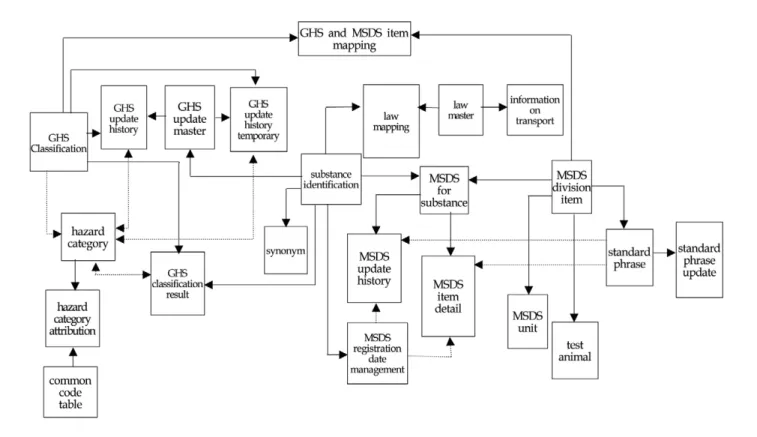
구축된 DB는 MSDS 작성이 가능하도록 오라클 DB(10g)를 이용하여 논리적으로 연결하였다(Figure 2, Table 7).
4
4.. 프 프로 로그 그램 램 구 구현 현
프로그램은 화학물질 각각에 대한 MSDS DB 구축을 위한 관리자시스템과 이를 이용하여 MSDS 정보를 검색할 수 있 는 사용자시스템으로 구성하였으며, 관리자시스템에서는
MSDS DB 구축을 위한 기능, 사용자시스템에서는 MSDS DB
검색, MSDS 정보를 이용한 MSDS 편집 및 경고표지 자동생 성 기능을 포함시켰다(Figure 3).관리자시스템은 기본화학물질관리, 기초데이터관리,
MSDS 개정관리 기능 메뉴로 구성하였으며, 기본화학물질
관리에서는 유해위험성 분류 및 MSDS DB를 관리하고, 기초 데이터관리에서는 경고표지 요소, 표준문구, 규제정보 및 단위관리에 대한 별도의 DB를 관리할 수 있도록 구축하였다
(Figure 3A). 구축된 DB는 웹상의 별도 일반 사용자시스템에
서 기본화학물질 MSDS 검색을 통하여 화학물질 자료를 검 색할 수 있도록 하였으며(Figure 3B), MSDS 정보를 이용하여 경고표지를 작성할 수 있도록 하였다(Figure 4).5
5.. M MS SD DS S D DB B 구 구축 축에 에대 대한 한안 안정 정화 화및 및서 서비 비스 스실 실태 태파 파악 악 MSDS DB 구축은 2단계로 이루어졌다. 1단계에서는 화학
물질명, 유해성 분류결과, 경고표지 요소, 표준문구, 규제정 보 등의 MSDS 구성요소 중 주요 항목에 대하여 독립 DB를 구축하였으며, 2단계에서는 1단계에서 구축한 독립 DB 이외Hazard Class Hazard Category
Physical Hazards
Health Hazards
Environment Hazards Hazardous to the aquatic environment Hazard Class
Explosives Flammable gases Flammable aerosols Oxidizing gases Gases under pressure Flammable liquids Flammable solids
Self-reactive substances and mixtures Pyrophoric liquids
Pyrophoric solids
Self-heating substances and mixtures
Substances and mixtures which, in contact with water, emit flammable gases
Oxidizing liquids Oxidizing solids Organic peroxides Corrosive to metals Acute toxicity Skin corrosion/irritation
Serious eye damage/eye irritation Respiratory sensitization Skin sensitization Germ cell mutagenicity Carcinogenicity Reproductive toxicity
Specific target organ toxicity - Single exposure Specific target organ toxicity - Repeated exposure Aspiratory hazard
Hazard Category
Unstable explosives, Division 1.1 ~ 1.6 Category 1
Category 1, 2 Category 1
Compressed gas, Liquified gas, Refrigerated liquified gas, Dissolved gas
Category 1 ~ 3 Category 1, 2
Type A, B, C and D, E and F, G Category 1
Category 1 Category 1, 2 Category 1 ~ 3 Category 1 ~ 3 Category 1 ~ 3
Type A, B, C and D, E and F, G Category 1
Category 1 ~ 4 Category 1, 2 Category 1, 2A Category 1 Category 1 Category 1A, 1B, 2 Category 1A, 1B, 2
Category 1A, 1B, 2, Effect on or via lactation Category 1 ~ 3
Category 1 ~ 2
Category 1 ~ 2
Acute Category 1
Chronic Category 1 ~ 4
Table 3. Hazard classification and category in DB structureItems of label elements Number
Pictogram 11
Signal Word
Hazard statement
Precautionary statement
Physical hazard Health Hazard Environmental Hazard
Prevention Response
Storage Disposal
29 35 7 38 76 19 1 2
Table 4. Composition of GHS label elementsItems Number of standard
phrases
First aid measures
Fire-Fighting measures
Accidential release measures
Handling and storage
Exposure controls & Personal protection
Eye contact Skin contact Inhalation Ingestion
Indication of immediate medical attention and notes for physician Suitable extinguishing media
Unsuitable extinguishing media, Large fire
Fire and Explosion hazard
Personal precautions, protective equipment and emergency procedure Air
Soil Water Small leakage Large leakage
Precautions for safe handling Conditions for safe storage Appropriate engineering controls Respiratory protection
Eye protection Hands protection Body protection
82 108 119 243 52 29 20 34 66 64 5 10 16 46 24 74 261
15
50
13
12
14
Table 5. Composition of standard phrases used in the MSDS Editing programLaws Number of chemicals controlled‡
First aid measures
International Convention
Foreign Regulation
Work environment monitoring : 1,308 Management : 1,115
Prohibition of Manufacturing : 62 Permission of Manufacturing : 92 Special health screening : 638 Exposure Threshold Limit : 1,537 Industrial Safety and health Act
Poisonous substances : 1468 Restricted substances : 18 Prohibited substances : 75 Substances under observation : 19
Substances requiring preparation for accidents : 56 Toxic Chemicals Control Act
Dangerous Goods : 1,496 POP substances : 12
Ozone depletion chemicals : 36 PIC chemicals : 51
POPs : 12
Dangerous Goods : 2,232 OSHA 1910 :118 CERCLA : 750 EPCRA 302 : 353 EPCRA 304 : 353 EPCRA 313 : 755
Regulation 1907/2006 (REACH) Hazardous chemicals : 3,402
American
European Union
Table 6. Current status of chemical-related laws constructed in the MSDS Editing program
‡ Number of chemicals controlled were counted in accordance with CAS registration number.
Dangerous Goods Safety Management Act Persistent Organic Pollutants (POPs) Control Act Montreal Protocol
Rotterdam Convention Stockholm convention UN Transport Model regulation
의 MSDS의 모든 구성요소에 대하여 물질별로 DB를 구축하 였다. 개발된 MSDS Editing 프로그램을 이용하여 2008년 12 월 30일까지 6,314종의 화학물질 MSDS DB를 구축하였다. 인 터넷을 통한 서비스를 실시하기 전에 50종의 화학물질을 무 작위로 선정하여 프로그램의 안정성 평가를 실시한 결과,
MSDS 작성 환경에서의 MSDS 정보내용이 테스트 서버에서
동일하게 적용되었으며, AI Report를 통하여 pdf, 한글 등의 문서화 프로그램에 동일하게 반영되었다. 또한 MSDSEditing 프로그램을 이용한 경고표지도 노동부 고시(노동부, 2008a)에서 요구하는 형식으로 출력되었다(Figure 4B). 2009
년 1월 1일부터 5월 31일까지의 서비스 기간 중 13,667명이방문하여 33,401건의 MSDS를 검색하였으며, 물질별로는 톨 루엔, 벤젠, 폼알데하이드, 수산화나트륨 순으로 많이 검색 된 것으로 나타났다(Table 8).
Ⅳ. 고 찰
MSDS 제도가 도입된 이후, 미국 등의 전문 컨설팅 기관에
서는 MSDS 작성지원과 함께 효율적인 MSDS 작성 및 관리 를 위한 시스템을 개발하여 운용하고 있다. 화학제품 MSDS 작성을 위해 단일물질로 구성된 기본화학물질의 유해?위험Table name Items contained in each tables MSDS item code
‡, GHS common class
‡GHS item code
‡, GHS classification code, GHS item name in Korean, GHS item name in English, order sequence index, deletion(Yes/No), register, registration date, update person, update date
GHS update history identification
‡, substance identification
‡, GHS classification code
‡, registration sequence number
‡, hazard classification category code, registration date, register, update person, update date
GHS update history identification
‡, substance identification
‡, update(Yes/No), requester, request date, confirmer, confirming date
GHS update history identification
‡, substance identification
‡, GHS classification code‡, registration sequence number
‡, requester, request date, confirmer, confirming date, hazard class code
hazard class code
‡, GHS classification code, substance name in Korean, substance name in English, order sequence index, deletion(Yes/No), register, registration date, update person, update date
hazard class code
‡, GHS common class
‡, hazard class code
‡, order index
GHS common class
‡, hazard class code
‡, GHS item code in Korean, GHS item code in English, GHS image file name, deletion(Yes/No), register, registration date, update person, update date
substance identification
‡, GHS classification code
‡, registration sequence number
‡, hazard classification category code, registration date, register, update date, update person
substance identification
‡, substance name in Korean, substance name in English, CAS No, UN No, EU No, KE No, RTECS No, GHS registration(Yes/No), MSDS registration(Yes/No), GHS registration date, GHS register, MSDS registration date, MSDS register
substance identification
‡, synonym code
‡, synonym name
substance identification
‡, MSDS item code
‡, update(Yes/No), registration date, register, update date, update person
MSDS update history identification
‡, substance identification
‡, MSDS item code
‡, item no
‡, standard phrase code, item detail, registration date, register, insert No, move date, mover, item details
substance identification
‡, MSDS item code
‡, item no, standard phrase code, item detail, registration date, register, insert No, item details
substance identification
‡, insert No
‡, registration date, register, MSDS revision content, update(Yes/No)
law code
‡, substance identification
‡, deletion(Yes/No), register, registration date, update person, update date, dates
GHS and MSDS item mapping
GHS Classification
GHS update history
GHS update master
GHS update history temporary
Hazard category
Hazard category attribution
Common code table
GHS classification result
Substance identification
Synonym MSDS for substance
MSDS update history
MSDS item detail
MSDS registration date management
Law mapping
Table 7. List of tables items contained in each tables used in the Entity-relationship diagram(ERD) DB
Law master
Information on transport
MSDS division item
MSDS unit Test animal
Standard phrase
Standard phrase update
law code
‡, upper law code, law name, column name, MSDS item code, update(Yes/No), deletion(Yes/No), register, registration date, update person, update date
law code
‡, UN No
‡, shipping name in Korean, shipping name in English, transport hazard level, packing level, fire emergency code, leak emergency code, update(Yes/No), registration date, register, update date, update person
MSDS item code
‡, upper MSDS item code, MSDS item No, MSDS item name in Korean, MSDS item name in English, standard phrase(Yes/No), order index
MSDS item code
‡, unit code
‡, unit name, time code, unit use(Yes/No), register, registration date, update person, update date, default(Yes/No)
MSDS item code
‡, test animal code
‡, test period, source, default(Yes/No)
MSDS item code
‡, standard phrase code
‡, Standard phrase name in Korean, standard phrase name in English, order index, registration date, register, update date, update person,
deletion(Yes/No), update(Yes/No)
MSDS update history identification
‡, MSDS item code
‡, standard phrase code
‡, standard phrase name in Korean, standard phrase name in English, revised standard phrase name in Korean, revised standard phrase name in English, update(Yes/No), register, request date, confirmer, confirming date
‡means identifier for each tables.
성 정보 DB를 개발하였으며, 인터넷 등 정보전달 매체가 발 전함에 따라 MSDS 작성 기초정보 제공을 위한 DB 뿐만 아 니라 산업현장에서 실질적으로 필요한 MSDS 관리 프로그 램을 개발하였으며, 최근에는 MSDS 기초자료를 이용하여 화학제품의 MSDS를 자동으로 작성하는 프로그램을 개발하 는 등으로 서비스 영역을 발전시키고 있다(The wercs Ltd,
1984; Chemadvisor 1986; 3E Company, 1988; Atrion, 1989).
우리나라에서는 MSDS 제도가 도입된 1996년부터 한국산 업안전보건공단(이하, 공단)에서 MSDS 정보를 제공하였는 데, 이와 같은 서비스는 캐나다의 CCOHS(Canada's National
Occupational Health & Safety Resource)와 유사한 형태이다 (CCOHS, 2008).
MSDS 정보 서비스 체계는 위에서 언급한 것과 같이 인터
넷과 컴퓨터 프로그램의 발달에 영향을 받아 비약적으로 발 전하였지만, 공단에서는 초기 천리안에서 제공되던 MSDS 를 1997년 WWW(World Wide Web)에 기반을 둔 KOSHANET 으로 전환한 이후 추가적인 서비스 개발 등의 발전은 미진하 였다.서비스 체계와 대응하여, MSDS 제도 체계는 GHS에 의해 큰 변화가 일어나고 있다. 1992년 UNCED(유엔환경정상회 의)에서 화학물질의 분류 및 표지에 관한 세계조화시스템인
GHS가 합의되고, 2003년 GHS 지침서가 발표되었으며(UN, 2003), 2006년 뉴질랜드, 일본, 한국, 2008년 유럽연합 등에서
GHS가 시행됨에 따라 GHS에 의해 MSDS 제도는 이미 단위
국가에서의 시행여부와 관계없이 전 세계적으로 통합되고 있다. 미국의 경우 OSHA에서 2006년 9월 GHS 시행을 위한 입법예고 격인 ANPR(Advanced Notice of Proposed Ruling) 이 후 2009년 9월 30일 NPRM(Notice of Proposed RuleMaking)을 발표하여 GHS를 추진하고 있으며 (OSHA, 2009). 미국의 전 문 컨설팅 기관에서는 MSDS DB를 전환하여 각 국의 GHS 이행에 대응할 수 있도록 서비스를 실시하고 있다(The wercsLtd, 1984; Chemadvisor 1986; 3E Company, 1988; Atrion, 1989).
GHS에 대하여 공단은 전 세계적으로 가장 적극적이고 빠
른 대응을 보여주는 조직 중 하나이다. 공단은 GHS 지침서의 한글판 번역(정부합동 GHS 추진위원회, 2005, 2006) 및 노동 부 관련 고시 작성을 지원하고(노동부, 2006), 관련 KOSHACODE를 발표하였으며(한국산업안전보건공단, 2008a, b, c), 2007년부터 GHS에 대응한 유해·위험성 분류결과를 제공
하고 있다(한국산업안전보건공단, 2009). 2009년 9월 현재 유 엔에서는 GHS 지침서에 대한 3차 개정판을 발표하였으나, 국문 GHS 지침서는 1차 개정판까지만 제공되고 있는 실정 으로(정부합동 GHS 추진위원회, 2006), 공단에서 2차 및 3차 개정판에 대한 번역작업을 진행 중이다.본 연구에서는 이러한 공단의 GHS 이행지원과 연계하여, 화학물질의 유해·위험성 분류결과, 경고표지 및 MSDS 작 성을 위한 체계적인 DB를 개발하고자 시도하였다. GHS에
Figure 2. Logical Entity-relationship Diagram(ERD) of DB structure in MSDS Editing program
Figure 3. MSDS Editing program on the web
A : MSDS DB constructing system in MSDS Editing program
B : MSDS DB providing system in MSDS Editing program
Figure 4. Preparation of labels through MSDS Editing program
A : Layout for selecting labelling elements
B : The GHS label prepared by MSDS Editing program
대응한 DB 개발을 위해 이전의 DB 체계를 분석한 결과, 이전 의 DB 체계는 화학물질 또는 제품 하나에 하나의 파일을 제 공하는 문서형 DB로 구축되어 법적 규제정보의 변경, 혼합 제품에 대한 MSDS 수정 등의 최신화 작업과 같은 관리적 차 원에서는 비효율적이었으며, GHS 시행초기의 규제정보 등 각종 정보의 변경과 유해·위험성 분류결과 제공, 유해·위 험성 분류정보를 이용한 경고표지 작성 기능 등의 추가 서비 스를 제공하고, GHS 제도에 대응한 혼합물질의 MSDS를 자 동으로 작성하는 기능 등 새롭게 요구되는 서비스에 효율적
으로 대응하기 위해서는 관계형 DB 체계로 전환해야 하는 것으로 확인되었다.
본 연구에서는 GHS MSDS 데이터 체계 분석(Table 1) 및 각 종 하위 DB의 기능 분석을 통하여(Table 2, Figure 1), DB 관계 도를 구축하였으며(Table 7, Figure 2), GHS 분류 체계 조사
(Table 3), 경고표지 요소 검토(Table 4), 각종 예방조치에 대한
표준문구 개발(Table 5), 규제정보 데이터 구축(Table 6) 등의 작업을 통하여 관계형 MSDS DB 시스템을 개발하였다. 이와 같이 개발된 DB 시스템은 DB 관리프로그램을 통해 유해·NO Name of substances CAS_NO Number of retrieval 1
2 3 4 5 6 7 8 9 10 11 12 13 14 15 16 17 18 19 20 21 22 23 24 25 26 27 28 29 30 31 32 33 34 35 36 37 38 39 40 41 42 43 44 45 46 47 48 49 50
Toluene Benzene Formaldehyde Sodium hydroxide Methanol Sulfuric acid Ethanol Acetone
Hydrogen chloride 2-Propanol Oxygen Xylene Ammonia Nitric acid Methyl ethyl ketone tert-Butylaclohol Ochratocin A Carbon black Acetic acid Nitrogen
Propylene glycol methyl - Distillates (petroleum), - Vinylbenzene
Cyclohexanone Titanium dioxide Talc (Mg3H2(SiO3)4) Lead
N,N-Dimethylformamide Potassium hydroxide Nickel
Ethylene trichloride 1-Methyl-2-pyrrolidinone Methylene chloride orthophosphoric acid n-Hexane
Carbon dioxide Calcium carbonate Acetic acid ethyl ester n-butyl acetate Glass, oxide Phenol Silicon dioxide Ethanolamine Hydrogen peroxide 1,1,1-Trichloroethane Sodium bicarbonate Glycerol
Distillates (petroleum), - LPG, SWEETENED Aluminium
108-88-3 71-43-2 50-00-0 1310-73-2
67-56-1 7664-93-9
64-17-5 67-64-1 7647-01-0
67-63-0 7782-44-7 1330-20-7 7664-41-7 7697-37-2 78-93-3 75-64-9 303-47-9 1333-86-4 64-19-7 7727-37-9
108-65-6 64742-54-7
100-42-5 108-94-1 13463-67-7 14807-96-6 7439-92-1
68-12-2 1310-58-3 7440-02-0 79-01-6 872-50-4
75-09-2 7664-38-2
110-54-3 124-38-9 471-34-1 141-78-6 123-86-4 65997-17-3
108-95-2 7631-86-9 141-43-5 7722-84-1 71-55-6 144-55-8
56-81-5 64742-47-8 68476-86-8 7429-90-5
476 344 332 311 230 228 212 204 201 200 183 167 119 115 111 108 97 93 93 93 91 90 86 81 80 80 73 73 72 70 69 68 65 64 62 61 60 60 59 59 57 56 56 55 53 53 52 52 52 52
NO Name of substances CAS_NO Number of
retrieval 51
52 53 54 55 56 57 58 59 60 61 62 63 64 65 66 67 68 69 70 71 72 73 74 75 76 77 78 79 80 81 82 83 84 85 86 87 88 89 90 91 92 93 94 95 96 97 98 99 100
Sodium nitrite Ammonium hydroxide Propylene glycol methyl - Quartz (SiO2)
Distillates (petroleum), - Trichloromethane Hydrogen 1,2-Ethanediol Methyl isobutylketone Sodium chloride Boric acid, crude natural Sodium hypochlorite Sodium carbonate
4,4'-(1-Methylethylidene)bis Argon
Hydrogen fluoride Siloxanes and Silicones,- Tetramethylammonium - Tetracosanoic Acid) 1-(2-Aminophenyl)ethanone 1-Butanol
Triethanolamine Diethylene glycol - 1,1-dichloro-1-fluoroethane Sulfur, precipitated, - Sodium sulfate Hexahydrobenzene Light gasoline
1-Chloro-2,3-epoxypropane Acetonitrile
Dichloropropylene Acetic anhydride Zinc oxide
Guanidine hydrochloride Propylene glycol Acetylene
N,N-Dimethylacetamide Magnesium oxide Copper
Aluminium sulfate Naphtha (petroleum), - Naphthalene
2-Butoxyethanol 2,6-di-tert-butyl-p-cresol acitivated carbon Potassium nitrate Ethyl ether Formic acid Glutaraldehyde Copper, phthalocyanine
7632-00-0 1336-21-6 107-98-2 14808-60-7 64742-65-0 67-66-3 1333-74-0
107-21-1 108-10-1 7647-14-5 10043-35-3
7681-52-9 497-19-8 25068-38-6
7440-37-1 7664-39-3 63148-62-9
75-59-2 557-59-5 551-93-9 71-36-3 102-71-6 112-34-5 1717-00-6 7704-34-9 7757-82-6 110-82-7 8006-61-9 64742-55-8
75-05-8 78-87-5 108-24-7 1314-13-2
50-01-1 57-55-6 74-86-2 127-19-5 1309-48-4 7440-50-8 10043-01-3 64742-48-9 91-20-3 111-76-2 128-37-0 7440-44-0 7757-79-1 60-29-7 64-18-6 111-30-8 147-14-8
52
51
50
49
48
47
47
46
46
46
46
45
44
44
43
42
42
41
40
39
39
39
39
39
39
39
38
38
38
37
37
37
37
36
36
36
36
36
36
36
36
35
35
35
35
35
34
34
34
34
Table 8. Priority of substances retrieved in the MSDS editing program from January 1st to May 31st, 2009위험성 분류정보, 법규정보, 기타 MSDS 정보로 구분하여 구 축하였으며(Figure 3A), 구축된 MSDS DB는 인터넷(URL:
:http://www.kosha.net)을 통해 서비스하여(Figure 3B) 사업장에
서 GHS에 대응할 수 있도록 하였다.화학물질 정보, 유해위험성 분류정보, 법규정보 등 주요 구 성요소별로 별도의 독립된 DB 운영은 DB로 구축된 정보를 이용하여 경고표지 작성, MSDS 요약정보 등의 부가서비스 개발을 쉽게 하고, 관련 법 규정, 표준문구 변경 등에 대하여 효과적으로 개정할 수 있도록 할 수 있지만 독립된 DB로 연 결된 관계형 DB 시스템의 운영은 프로그램의 안정성 확보가 중요하다. 본 연구에서는 MSDS DB가 구축된 50종의 화학물 질을 무작위로 선택하여 독립된 DB로 구축된 정보들이
MSDS, 경고표지 등으로 오류없이 만들어지고 문서화로 전
환되는 지 확인함으로서 프로그램의 안정성을 평가하였다.자체 안정성 평가 결과 MSDS 및 경고표지의 각 요소가 인터 넷상에서 오류 없이 반영되었으며(Figure 4), 문서화 전환 프 로그램에 의해서도 pdf, 한글 등으로에 오류 없이 전환되는 것으로 확인되었다. 안정화 작업 완료 후 인터넷 서비스를 실시한 결과, 2009년 1월 1일부터 2009년 5월 31일까지 총
33,401건의 MSDS가 검색되었으며, 이 기간 동안 유해·위험
성 분류결과 등 MSDS 정보내용에 대한 이견은 다수 제시되 었으나, 프로그램 오류에 대한 문의는 없는 것을 통하여 프 로그램의 안정성을 간접적으로 확인하였다. 이 기간 중 DB 가 구축되어 제공되는 MSDS는 모두 1회 이상 검색이 된 것 으로 나타났으며, 톨루엔, 벤젠, 폼알데하이드, 수산화나트 륨, 메탄올 등의 물질에 대한 MSDS 검색비율이 높게 나타났 다. 현재 GHS MSDS 서비스는 시작단계로 인용건수가33,401건에 불과하며, GHS MSDS 제공 서비스 초기에 따른
관심, GHS 교육 등을 위한 검색 등 화학물질 사용과 직접적 으로 관련성이 적은 간접요인이 많았으며, 인터넷 사용에 따 른 개인정보 보호차원에서 동일인 또는 동일 사업장에서의 중복 검색 등을 확인할 수 없었기 때문에 특정 화학물질의 인용건수가 과도하게 평가될 가능성을 배제할 수는 없으나, 상위 검색건수 10위 안에 포함된 화학물질은 200회 이상 검 색되었으며, 100위 안에 포함된 화학물질도 30회 이상 검색 되어 화학물질 취급 실태에 대한 보조 자료로서의 활용성에 대한 가능성은 확인되었다. 화학물질 사용에 관한 신뢰할 수 있는 통계가 부족한 우리나라 여건상 화학물질 사용실태 파 악을 위한 보조적인 정보로 활용될 수 있으리라 판단되며, 특히 GHS 이행이 본격화되고 사업장에서 본 프로그램을 이 용한 화학물질 검색이 증가하여 다양한 간섭요인을 줄일 수 있다면, 환경부의 화학물질 유통량 조사, 노동부의 작업환경 실태조사 결과에 대한 해석의 보조정보로 이용될 수 있을 것 으로 기대된다. 그러나 기본화학물질에 대한 MSDS 검색정보는 어떠한 물질이 MSDS 작성에 많이 사용되는 지에 대한 정보는 제공할 수 있으나, 사업장에서의 화학물질 취급실태 를 보다 효과적으로 파악하기 위해서는 화학제품의 MSDS 제공 등 보다 다양한 서비스가 개발되어야 할 것으로 판단된 다. 다만, 이러한 검색 건수는 시기별로 MSDS 작성 또는 사 용되는 화학물질의 실태를 확인하게 함으로써, 화학 산업계 에서 필요로 하는 화학물질에 대하여 보다 신속히 최신화가 가능하게 되었다. 따라서 본 프로그램은 GHS 이행 촉진 뿐 아니라 근로자의 안전보건 향상에 기여할 것으로 기대된다.
REFERENCES
국립환경과학원, 고시집 유독물·관찰물질 지정 385-448
2008 [cited 2009 April 1]: Available from;
http://www.nier.go.kr/
권경옥, 사공성호, 권성필, 김형권, 이봉우 등. GHS에 대응한 하학물질 분류 및 표시정보의 제공(II). 한국산업안전공 단 산업안전보건연구원 연구보고서; 2007.
노동부. 고시 제2006-36호 화학물질의 분류·표시 및 물질안 전보건자료에 관한 기준; 2006a.
노동부. 고시 제2008-26호 화학물질 및 물리적인자의 노출기 준; 2008b.
노동부. 고시 제2008-29호 화학물질의 분류·표시 및 물질안 전보건자료에 관한 기준; 2008a.
노동부. 고시 제97-27호. 물질안전보건자료 작성·비치 등에 관한 기준; 1997.
노동부. 산업보건기준에 관한 규칙 별표 7 관리대상물질의 종류; 2003.
노동부. 산업안전보건법 시행규칙 별표 11의4 작업환경측정 대상 유해인자; 2008c.
노동부. 산업안전보건법 시행규칙 별표 12의 2 특수건강진 단 대상유해인자; 2006b.
노동부. 산업안전보건법 시행규칙 제29조 제조 등의 금지 유 해물질; 2006c.
노동부. 산업안전보건법 시행규칙 제30조 허가대상 유해물 질; 2006d.
노동부. 산업안전보건법 시행규칙 제31조 허용기준 이하 유 지 대상 유해인자; 2008d.
노동부, 환경부. 기존화학물질목록; 1996.
노영만, 임영욱, 김치년, 심상효, 홍승국 등. GHS에 대응한 하 학물질 분류 및 표시정보의 제공(I). 한국산업안전공단 산업안전보건연구원 연구보고서; 2007.
노영만, 임영욱, 김치년, 정진윤, 윤지혜 등. GHS 화학물질 유
해위험성 분류 및 MSDS 신규작성(II). 한국산업안전공 단 산업안전보건연구원 연구보고서; 2008.
박종태, 김영환, 김병권, 워정일, 김종선, 김승남 등. 화학물질 관리 국제동향 및 대응방안 마련을 위한 정책 연구. 한국 산업안전공단 산업안전보건연구원 연구보고서; 2006.
소방방재청. 위험물 정보관리시스템 2009 [cited 2009 April 1]
Available from: URL: http://hazmat.nema.go.kr/index.jsp
최재욱, 김영수, 조삼래, 배희경, 최승현 등. GHS 화학물질 유해위험성 분류 및 MSDS 신규작성(II). 한국산업안전공 단 산업안전보건연구원 연구보고서; 2008.
한국산업안전보건공단. 경고표지 작성 지침; 2008a.
한국산업안전보건공단. 물질안전보건자료 작성 지침;
2008b.
한국산업안전보건공단. 화학물질의 유해·위험성 분류 지 침; 2008c.
한국산업안전보건공단 1997 [cited 2009 April 1] Available from:
URL:http://www.kosha.net/shdb/ghs/materialSearchResult.jsp
환경부. 고시 제2008-74호 취급제한·금지물질에 관한 규정;2008.
환경부. 유해화학물질 관리법 시행규칙 별표 2 사고대비물 질; 2007a.
환경부. 잔류성유기오염물질관리법 시행규칙 별표 1 잔류성 유기오염물; 2007b.
환경부. 환경백서; 2008.(605쪽.)