국가공간정보정책 추진체계의 바람직한 모형구축에 대한 연구
A Study on The Construction of Desirable Model of the National Spatial Data Infrastructure Policy Promotion System
김 태 진*
Tae Jin Kim
요 약 국가공간정보 전략의 비전을 효율적으로 추진하기 위해서는 국가공간정보정책 추진체계를 합 리적으로 정립하는 것이 중요하다. 특히, 국가공간정보정책 추진체계에 있어서 관련된 조직들 간의 협조 및 정책의 일관성은 매우 중요한 요소이다. 이러한 관점에서 본 연구의 목적은 바람직한 국가공간정보정 책 추진체계 모형을 개발하고, 이를 통해 우리나라 국가공간정보 정책 추진체계의 문제점과 개선방안을 제시하는데 있다. 본 연구의 목적을 달성하기 위한 주요 연구방법은 문헌고찰과 내용분석이 사용되었다.
주요 분석결과는 다음과 같다. 첫째, 바람직한 국가공간정보정책 추진체계는 상위체계(기획수준)와 하위 체계(집행수준)로 구성되어야 한다. 둘째, 국가공간정보정책 추진체계의 상위 체계와 하위체계는 수직적 및 수평적으로 연계되어야 한다. 셋째, 상위체계는 국가공간정보정책 추진위원회, 민간자문위원회, 그리고 분과위원회로 구성되어야 한다. 넷째, 국가공간정보사업의 집행을 위한 하위체계는 국가공간정보 최고관 리자, 각 중앙 및 지방정부, 그리고 전문지원기관 등으로 구성되어야 한다.
키워드:국가공간정보정책, 추진체계, 상위체계(기획수준), 하위체계(집행수준)
Abstract
In order to efficiently promote a nation's National Spatial Data Infrastructure (NSDI) vision, it is important that a rational NSDI promotion system should be established. For such a NSDI promotion system, cooperation among the related organizations and the consistency of policies are crucial. In these regards, the main purpose of this research is to suggest a desirable model for the NSDI promotion system. Also, this study attempts to demonstrate problems and provide solutions in Korea NSDI promotion system. To accomplish this purpose, the literature reviews and content analysis were used. Following are the major findings of this research. First, a desirable NSDI promotion system should be consisted of the upper system (at the planning level) and the lower system (at the executive or implementing level). Second, the upper and lower system in NSDI promotion system should both be vertically connected and be horizontally connected. Third, the upper system should consist of the NSDI promotion committee, civil advisory committee, and sub-committee. Fourth, the lower system for the execution purposes of NSDI projects should consist of the NSDI top manager, in each central/local government, and professional support institute.Keywords:NSDI Policy, Promotion System, Upper System, Lower System
The research was supported by a grant from the Academic Research Program of Korea National University of Transportation in 2012.
*Tae Jin Kim, Professor, Public Administration, Korea National University of Transportation. [email protected]
1. Introduction
In the contemporary society, the way of life of citizens and industrial development could be in- fluenced by how to plan its National Spatial
Data Infrastructure(NSDI) strategies. In order to
efficiently promote a nation's NSDI vision, it is
important that a rational NSDI promotion system
should be established. For such a NSDI promo-
tion system, cooperation among the related or-
ganizations and the consistency of policies are crucial[15, 20, 21, 23, 26].
In these regards, this research tries to analyze the changing process of ROK's NSDI promotion system, to address its problems and provide sol- utions, to explain the factors to be considered when promoting NSDI policies.
The main purpose of this study is to analyze the historical change in the NSDI policy promo- tion system in Korea from the 1st NSDI Master Plan(1995~2000) to the 8th NSDI Master Plan(2011~2015), in order to set the proper NSDI governance promotion system[13, 18, 23, 24].
2. Desirable Features of NSDI Promotion System
2.1 Basic Mechanism of the NSDI Promotion System
According to the goals of the NSDI policy, the organization principles of the promotional system can be flexible[21]. Generally, the following three crucial principles need to be considered, when establishing the NSDI Promotion system in a na- tion:
First, NSDI requires a high-level of technical expertise in the establishment. So, people in a department responsible for the NSDI should have an exceptional level of understandings on the in- formation technology[15].
Second, since the NSDI technology quickly changes, the department that is accountable for such policies should not be hierarchical, but be changeable in its operating structure[1, 20].
Third, in that the NSDI promotional policy in- volves various actors such as several central government agencies, local governments, and pri- vate enterprises, a multi-organizational im- plementation structure should be made[25].
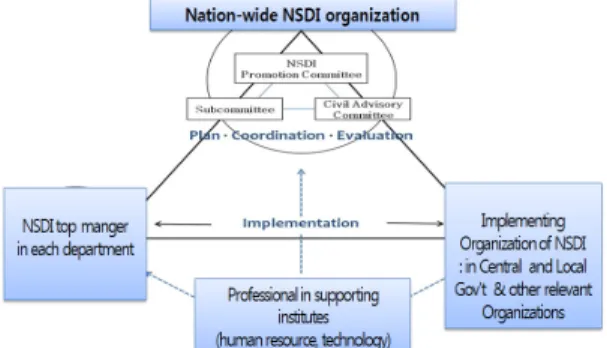
2.2 A model of the NSDI Promotion System The NSDI promotional system consists of the upper system at the planning level and the lower
system at the executive level. The upper and lower system should both be vertically connected and be horizontally connected[3].
Figure 1. A model of NSDI Promotion System
A desirable upper system is a nation-wide governmental NSDI organization. The system should carry out the role of planning, coordinat- ing, and evaluating for the NSDI policies.
A desirable lower system is a NSDI execution organization. It consist of NSDI Top Manager in each governmental department, Implementing Organizations of NSDI, and Professional Supporting Institutes.
2.2.1 Upper Promotion System(planning level) The upper system consists of nation-wide enti- ties such as the NSDI Promotion Committee, Civil Advisor Committee, and Sub Committee, in order to plan, coordinate, to evaluate the NSDI.
Figure 2. Upper system on NSDI
The Chair of the NSDI Promotion Committee
should be either a person under the President, a
committee member under the Prime Minister's
Office, or a Minister from a central government body, in line with the political will of the NSDI policy.
Civil Advisor Committee: As the channel that receives opinions regarding NSDI policy coordi- nation and planning, it generally execute func- tions that strengthens the transparency and fair- ness of NSDI policies.
Sub-Committees: Given the responsibility and authority in each department regarding NSDI, it works as a body for integration and coordination among different projects in each central govern- ments[26].
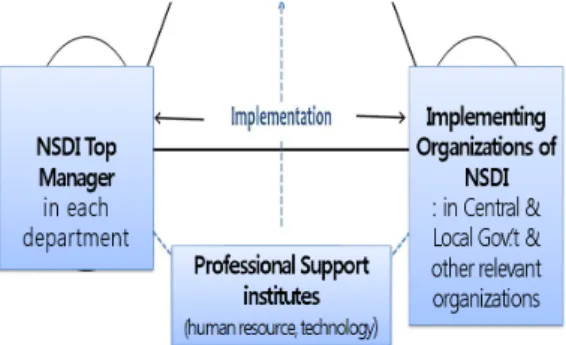
2.2.2 Lower Promotion System(executive level) For the execution purposes of the NSDI proj- ects, there are managers in charge of NSDI at each department in the central government, or executive government department (central & lo- cal government, and the relevant institutes).
Figure 3. Lower System in NSDI
2.2.2.1 NSDI Top managers of NSDI in each central government department
NSDI policies and projects are executed in a multi-organizational structure. Each NSDI Top Manager in each department should serve as a node that connects itself to the upper system.
The higher the NSDI manager's position in the government is, the more effective project coordi- nation will be[21].
2.2.2.2 NSDI executing institute
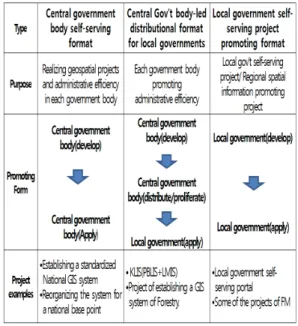
There are 3 kinds of projects: 1) NSDI project
carried out by each department in the central government, 2) one led by the central government which is distributed to local governments, and 3) one that local governments independently develop and push for.
2.2.3 NSDI Professional in Supporting Institute A professional support institutes(PSI) help NSDI by providing the relevant geospatial in- formation technology and human resources[15].
When promoting multi-organizational and mul- ti-departmental project such as NSDI, pro- fessional support institutes consisting of the rele- vant specialists are crucial.
PSI's roles are as follows:
- First, assisting the establishment and evalua- tion of the basic plan for NSDI.
- Second, monitoring the progress of promoting NSDI.
- Third, publishing an annual reports of NSDI.
- Fourth, assisting research related to NSDI.
It is necessary that the supporting mechanism of PSI are stipulated by law.
3. Current Status of the NSDI Promotion System in Korea
3.1 Current status of the upper system 3.1.1 NSDI Promotion Committee
The name of the government-wide NSDI pro- motion committee is changed from NGIS Promotion Committee to NSDI Promotion Committee in the 8th NSDI master plan.
In the 2nd NSDI Basic Master Plan, the Chair of the Committee was promoted from Vice Minister of the Ministry of Construction and Transport(the current Ministry of Land, Transport and Maritime Affairs) to Minister of the same organization.
3.1.2 Civil Advisory Committee(CAC)
The CAC is organized to provide ongoing ad-
vice on planning and Subcommittee plans in the
NSDI policy. Legally, this Committee is a na-
tion-wide NSDI promoting organization[18, 23, 24].
Since the 8th NSDI Basic Master Plan (2011~
2015) the Civil Advisory Committee has been abolished[13].
3.1.3 Current status of the Sub-Committees Sub-Committee has been changed 8 times flex- ibly according to the changes in the objectives and contents of the NSDI Master Plan[13, 18, 23, 24].
Now, the Ministry of Land, Transport and Maritime Affairs (MLTM) is primarily respon- sible for the core NSDI.
There were 5 Subcommittees in total according to the 1st NSDI Basic Master Plan: General (overall management), Geographic Information, Technology Development, Standardization, and Land Information Subcommittee[24].
In the 2nd NSDI Basic Master Plan, the fol- lowing 7 Sub-Committees are listed: Geographic Information, Cadastral Information, Technology, Utilization & Distribution, Expert Fostering, Industry Support, Standardization[18].
The 3rd NSDI Basic Master Plan included 6 Subcommittees as follows:
NGIS Promotion Administrative, Fundamental Geographic Information, Standardization, Technology Development, Utilization & Distribution, Policy System Subcommittee[23].
The 8th NSDI Basic Master Plan includes the 7 Subcommittees: General Coordination, Standardi- zation & Technology Standard, Industry Promo- tion, Survey and Water Channel Investigation, and Subcommittees created by Presidential Decree (Fundamental Spatial Data, Spatial Data Referring System, Spatial Convergence Service)[13].
3.2 Current status of the Lower-system 3.2.1 NSDI Top Managers of each department At the NSDI Promotion System in Korea, there is no official NSDI manager.
However, there are public officials in gov- ernmental departments or in each local govern-
ments, supporting the NSDI projects at the ex- ecutive level.
3.2.2 NSDI project executing organizations The NSDI project executing organizations were separated in each level of government such as central government, local government, and the re- lated institutes[15].
So, the execution of projects were separately promoted by numerous central government agen- cies and local governments.
Each central government department was in charge of the overall management of NSDI ex- ecution plans and evaluation.
Table 1. Execution types of NSDI projects
3.3 Professional Supporting Institutes Since the 1st NSDI Basic Master Plan (1995), Korea Research Institute for Human Settlements (KRIHS) had been a role of a major NSDI pro- fessional support institute(PSI). According to the 2nd NSDI Basic Master Plan(2001), the role was abolished[18, 24].
A law of the 2nd and 3rd NSDI Basic Master
Plan stipulated that such support institutes "can
be designated". In reality, no institute had not
been designated[18, 24].
However, in the 8th NSDI Basic Master Plan allows R& D contracting-out to one of institutes such as the National Information Society Agency, Korea Cadastral Survey Corporation, Korea Communications Agency, and others[13].
8. Problems of NSDI Promotion System & Solutions in Korea
8.1 Problems of the Upper system : At the
nation-wide Level
8.1.1 Problems of NSDI Promotion Committee Although the NSDI upper system has the au- thority to integrate and coordinate the functions of NSDI policies by law, it still has the following limitations:
First, coordinating both among different spatial information industries and among various projects were difficult.
Second, opportunities of cooperating between Subcommittees and NSDI promoting committees were scare.
Third, the operation of the Subcommittees be- came a formality.
Fourth, Advisory Committee was managed per- functorily and was later abolished. There was no substantive budget for functional coordination.
Originally, the Planning and budgeting body and each central government body were prepared for the role of collaboration on the budget allotment for NSDI; However, the NSDI Promotion Committee had no power in making a decision on the budget.
Legally, while the Promotion Committee had the function of integration and coordination, its 'coordination' role was so weak.
8.1.2 The problems of the civil advisory committee
While Civil Advisory Committee(CAC) has a role of providing advice on the NSDI policy plan- ning and the plans of the Subcommittees, it had
no substantive role in reality.
A law of the CAC in the NSDI Promoting Committee requires active role. However, CAC held meetings only 1 or 2 times : it became a perfunctory organization[23].
Thus, the 8th NSDI Basic Master Plan (2011~
2015) abolished the Civil Advisory Committee[13].
8.1.3 The problems of the Sub-Committee The roles and functions given to each Subcommittee under the NSDI law are considered appropriate, in that there is a clear division of work among the related central government de- partments[15].
In consideration of the capability of information technology among central government depart- ments, Sub-committees are properly dispersed.
The substantial function of the Sub Committee is coordination among various entities, while each government department carries out its projects independently.
However, due to the weak coordination function of the Sub-Committee, there has been no sub- stantive policy integration or collaboration.
8.2 The problems of the Lower-system : At the executive level
8.2.1 Problems of each department's NSDI Top Manager
There has been no legally-designated NSDI top Manager in Korea. At the executive level, there were public officials supporting NSDI in each government department and local government.
Also, the sense of obligation of the public offi- cials was low due to high turn-over rate and frequent job rotation. Therefore, collaboration and cooperation both among departments at the na- tional level and among local governments for the NSDI promoting system had been rarely seen.
8.2.2 The problem of the NSDI project executing institution
When executing NSDI projects, the central
government bodies and local governments need to
continuously negotiate and coordinate together from the beginning to the end of the project.
Thus, there should be a permanent coordination system that promotes spatial informational proj- ects among central government and local governments.
However, there were only piecemeal cooperation either within the central government departments or within the local government divisions. There was rarely collaborative or coordinating organ- ization for a comprehensive spatial information project execution.
8.2.3 Problems of the PSI
KRIHS was the first PSI as designated in the 1st NSDI Basic Master Plan (1995), until the 2nd NGIS Basic Master Plan(2001) took place[24].
The 8th NSDI Basic Master Plan allowed R&
D to one of other institutes such as the National Information Society Agency, Korea Cadastral Survey Corporation, Korea Communications Agency, and so fourth.
PSIs should be a designated institute, so that the human resource management of full-time and part-time workers who are experts in each field enables NSDI to raises functional effectiveness.
A summary of the historical change in the NSDI policy promotion system in Korea shown in Table 2.
Table 2. Compare to the NSDI promotion system: 1st-8th NSDI master plan
NSDIContents 1st 2nd 3rd 8th
Upper system
NSDI Promotion
Committee ○ ○ ○ ○ Civil Advisory Committee ○ ○ ○ × Number of Subcommittee 5 7 6 7 Lower
system
NSDI Top Manager × × × × Professional Supprot
Institute ○ × × △ O : exist / x : Not exist
5. Conclusions and Recommendations
5.1 Conclusions
In the era of digital technology, the importance of spatial information is continuously rising. Data acquisition, application, and maintenance are per- tinent factors where government support is crucial.
Following are the major findings of this research. First, a desirable NSDI promotion sys- tem should be consisted of the upper system (at the planning level) and the lower system (at the executive or implementing level). Second, the up- per and lower system in NSDI promotion system should both be vertically connected and be hori- zontally connected. Third, the upper system should consist of the NSDI promotion committee, civil advisory committee, and sub -committee.
Fourth, the lower system for the execution pur- poses of NSDI projects should consist of the NSDI top manager, in each central/local govern- ment, and professional support institute.
5.2 Recommendations
As the results of this study, we suggest the following recommendations.
First, when establishing a NSDI Promotion System, hierarchical characteristics of each coun- try must be primarily considered. For countries with an active inter-departmental cooperation, a general department-centric promoting organization is advantageous. However, for countries with lit- tle inter-departmental cooperation, NSDI promot- ing organizations should be directly under the top decision-maker in the organization[6, 24].
Second, according to the goals of NSDI, the organization of the NSDI Promotion Committee (or Council) should be also changed. If the goal is only to adopt and to operate an efficient spatial information system, a Department-Centric Promotion System is preferred[26].
On the other hand, if the goal is to reinforce
inter-departmental collaboration, there should be a
Nation-Wide Promotion System for coordination and discussion.
Third, given the maturity of the industry or the private sector (maturity and demand of the citizens' need for NSDI), the role of the govern- ment should be changed[6, 26]. In other words, depending on the level of social information, the promotion system should also flexibly reflect such change. Technological development may bring both the discoveries in new types of services and the work behaviors and exchanges among various organizations through cooperation among govern- ment services. At the same time, depending on the maturity level of industry and/ or private sector's informatization, the range of gov- ernmental cooperation and private-public coopera- tion should be expanded.
Fourth, both the maintenance of strong leader- ship in IT and the responsiveness of each de- partmental needs in IT are very crucial to imple- ment the NSDI policy. Decentralizing functions in each department, whereby raising the efficiency of each units, and eventually establishing a de- velopment system that reflects individual characteristics. However, securing the power of coordination through a centralized decision mak- ing and strengthening the role of management are all important. To do these, the inter institutional promoting system and the intra institutional pro- moting system should both be reasonably organized.
Fifth, to overcome department-centered egoism and to efficiently promote multi-departmental spatial information projects, the redistribution of authority and responsibility regarding integration and coordination among different sectors is im- portant[26].
Sixth, it is also essential to closely look over the phenomenon that strengthening one de- partment's of force weakens another department's one. Thus, when establishing a promoting system for NSDI, it is important to review both how the distribution of authority regarding policy coordi-
nation and budget allocation is made, and how the application of information technology hap- pen[26].
Seventh, depending on the executive organ- ization's form (whether it is a collegiate system, or department-based system), the process of ex- ecution differs. In other words, in hierarchical or- ganizations, there should be division of work be- tween a permanent organization for execution and a non permanent Committee. Especially, it must be evaluated that whether the Committee is sim- ply a figure head, issuing rubber stamps on proj- ects[26]. Also, the relationship between the colle- giate Committee and the executive organization is also crucial[14].
Eighth, currently subcommittees in Korea are composed in a department-centric way, yet adopting United States' method of having an in- dependent institute(FGDC) which has small sub- committees that collaborates with working groups all under the FGDC. The U.S. method is compre- hensively including all executive groups from production, application, and distribution into one department (institute)[8, 18, 24, 26]. For example, if basic databases are categorized as topography, cadastre, underground infrastructure, soil, vegeta- tion, and water resource, this method enables one department (institute) to completely execute the foundation creation(standard, technology develop- ment), information production, application, and distribution for each database[19].
References
[ 1 ] C. Jones, W. S. Hesterly, and S. P. Borgatti, 1997, A General Theory of Network Governance : Exchange Conditions and Social Mechanism, The Academy of Management Review, 22(4).
[ 2 ] Eun Hyung Kim, 2010, NATIONAL SPATIAL DATA INFRASTRUCTURE: The Case of the Republic Korea, The World Bank.
[ 3 ] Ernest R. Alexander, 1985, From Idea to Action:
Notes for a Contingency Theory of Policy
Implementation Process, Administration and Society, 16(4):403-426.
[ 4 ] FGDC, 1994, Executive Order 12906.
[ 5 ] I. Masser, 1998, 제1세대 국가공간정보기반에 관 한 보고서, INT. J. GEOGRAPHICAL INFOR- AMATION SCIENCE. 13(1):67-84.
[ 6 ] J. Kooiman, 2007, “Societal Governance: Levels, Modes, and Orders of Social Political Interac- tion,” in Mark Bevir(ed.), Public Governance, SAGE Library of Political Science, 1:310-332.
[ 7 ] K. Carley, 1999, Organizational Change and the Digital Economy: A Computational Organization Science Perspective, Paper presented for Understanding the Digital Economy: Data, Tools and Research. U.S. DOC.
[ 8 ] K. Q. Hill, & K. R. Mladenka, 1996, Democratic Governance in American States and Cities, Wadsworth Publishing Company.
[ 9 ] M. Considine and J. M. Lewis, 2003, Bureaucracy, Network, or Enterprise? Com- paring Models of Governance in Australia, Britain, the Netherlands, and New Zealand, Public Administration Review, 63(2):132-140.
[10] Ministry of Construction and Transport, 1995, The 1st Master Plan for NGIS.
[11] Ministry of Construction and Transport, 2000, The 2nd Master Plan for NGIS.
[12] Ministry of Construction and Transport, 2005, The 3rd Master Plan for NGIS.
[13] Ministry of Land, Transport and Maritime Affairs, 2011, The 4th Basic Plan for National Spatial Data Polices.
[14] M. Bovens and S. Zouridis, 2002, From Street Level to System Level Bureaucracies : How Information and Communication Technology is Transforming Administrative Discretion and Constitutional Control. Public Administration Review, 62(2):174-184.
[15] National Spatial Data Infrastructure Act (2009).
[16] OMB, 1996, CIRCULAR No. A-130.
[17] OMB, 1990, CIRCULAR No. A-16.
[18] OMB, 1984, CIRCULAR No. A-89 Revised.
[19] P. Christopher, 2003, Jointed-up Government : a
Survey, Political Studies Review, 1:34-49.
[20] Tae Jin Kim & Jong Taek Park, 2006, A Study on the Revision Direction of National Geographic Information System Law and Institution, The Journal of GIS Assoiciation of Korea, 14(2):191-209.
[21] Tae Jin Kim, 2005, A Study on Improvement of the Naitonal GIS Policy in Korea, The Korea Spatial Planning Review, 47:255-270.
[22] Tae Jin Kim, 2010, The Government’s Role Model for the Effective Adoption of the UIT, Journal of Korea Spatial Information Society, 18(4):55-64.
[23] P. H. Specht, 2000, The Impact of IT of Organization Performance in the Public Sector, Handbook of Public Information Systems, New York: Marcel Dekker, Inc.
[24] S. Bretschneider, 2003, Information Technology, E-government, and Institutional Change, Public Administration Review, 63(6):738-741.
[25] S. M. Oster, 1995, Strategic Management for Nonprofit Organizations: Theory and Cases, New York: Oxford University Press.
[26] W. Richard Scott, 2001, Institutions and Organization, California: Sage Publications, Inc.
논문접수:2012.07.20
수 정 일:1차 2012.11.16. 2차 2012.11.20 심사완료:2012.12.14.
Tae Jin Kim