Journal of the Korean Society of Surveying, Geodesy, Photogrammetry and Cartography Vol. 33, No. 6, 579-587, 2015
http://dx.doi.org/10.7848/ksgpc.2015.33.6.579
A Comparative Analysis of Landslide Susceptibility Assessment by Using Global and Spatial Regression Methods in Inje Area, Korea
Park, Soyoung
1)ㆍKim, Jinsoo
2)Abstract
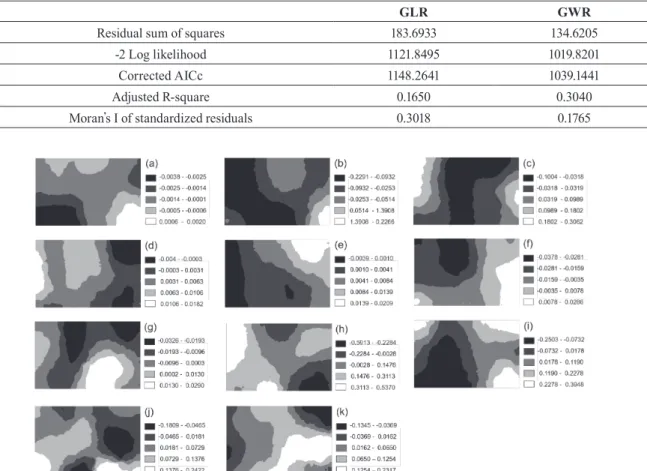
Landslides are major natural geological hazards that result in a large amount of property damage each year, with both direct and indirect costs. Many researchers have produced landslide susceptibility maps using various techniques over the last few decades. This paper presents the landslide susceptibility results from the geographically weighted regression model using remote sensing and geographic information system data for landslide susceptibility in the Inje area of South Korea. Landslide locations were identified from aerial photographs. The eleven landslide-related factors were calculated and extracted from the spatial database and used to analyze landslide susceptibility. Compared with the global logistic regression model, the Akaike Information Criteria was improved by 109.12, the adjusted R-squared was improved from 0.165 to 0.304, and the Moran’s I index of this analysis was improved from 0.4258 to 0.0553. The comparisons of susceptibility obtained from the models show that geographically weighted regression has higher predictive performance.
Keywords : Landslide, Landslide Susceptibility Map, Geographically Weighted Regression, Logistic Regression Model
579 ISSN 1598-4850(Print) ISSN 2288-260X(Online) Original article
Received 2015. 12. 01, Revised 2015. 12. 22, Accepted 2015. 12. 26
1) Member, Dept. of Spatial Information Engineering, Pukyong National University (E-mail: [email protected])
2) Corresponding Author, Member, Dept. of Spatial Information Engineering, Pukyong National University (E-mail: [email protected])
This is an Open Access article distributed under the terms of the Creative Commons Attribution Non-Commercial License (http://
creativecommons.org/licenses/by-nc/3.0) which permits unrestricted non-commercial use, distribution, and reproduction in any medium, provided the original work is properly cited.
1. Introduction
Over the last decade, natural disasters such as hurricanes, earthquakes, extreme erosion, tsunamis, and landslides have increased sharply. Because of increasing threats from these phenomena, national and local government agencies have expressed concern for human injuries and economic loss (Yilmaz, 2009). Landslides, which account for 4.4% of natural disasters around the world, have increased rapidly in frequency and cause significant damage (1990-2009) (Akgun et al., 2008; Vos et al., 2010; Park et al., 2013). This trend will continue in the coming decades, as regional precipitation, deforestation, urbanization, and development increase (Schuster, 1996).
Under these circumstances, interest in landslide assessment
has grown significantly among experts in various fields, such as engineers, geologists, planners, local administrators, and decision makers (Ercanoglu and Gokceoglu, 2004).
Assessment and management of landslide damage can be aided by thematic mapping, with the following steps: 1.
Landslide inventory maps; 2. Landslide susceptibility maps;
3. Landslide hazard maps; and 4. Landslide risk maps (Kamp et al., 2008). Among these maps, the production of a landslide susceptibility map in the early stage of the assessment process is of crucial importance.
Landslide susceptibility maps have been drawn using various methods across numerous research studies. The methods are divided into qualitative and quantitative.
Currently, quantitative techniques are widely used, aided
by the technological development of GIS (Geographical
580
Information Systems), which provide a powerful tool for managing and manipulating spatial data. Quantitative techniques are based on numerical expressions of the relationships between controlling factors and landslides (Aleotti and Chowdhury, 1999). Quantitative techniques are divided into deterministic and statistical methods (either bivariate or multivariate), and the majority of researchers prefer the GLR (Global Logistic Regression) model, a statistical method (Ayalew and Yamagishi, 2005; Bai et al., 2010; Bui et al., 2011; Chauhan et al., 2010; Chen and Wang, 2007; Falaschi et al., 2009; Xu et al., 2013).
However, the GLR model cannot take into account the spatial dependence or autocorrelation characteristics of observational data (Erener and Düzgün, 2010). This reduces the efficiency of estimated parameters when evaluating landslide susceptibility. Therefore, the GWR (Geographically Weighted Regression) has been introduced as a method that incorporates spatial variation (Feuillet et al., 2014). Because the GWR model uses a regression model, the advantages of existing models can be applied, and different factors can be estimated for respective regions. This makes it possible to confirm a spatially heterogeneous pattern that is difficult to grasp with existing models. Additionally, it enables the visualization of spatial interactions among data by mapping the results of the GWR analysis using GIS (Ercanoglu and Gokceoglu, 2004).
The goal of our study is to analyze and quantify improvements in the accuracy and explanatory power of landslide susceptibility compared with a previously used the GLR model when analyzing landslide susceptibility using the GWR. To accomplish this, the Inje region was selected as the research area, as it was subjected to severe landslide damage in 2006. A spatial database of landslide-related factors was compiled using the DEM (Digital Elevation Model) and various thematic maps. The GWR model was analyzed and compared with the GLR model analysis results using conformity-measured values and various diagnostic indices.
2. Study Area
Approximately 81% of the total area of Gangwon-do in the
central eastern region of Korea is composed of mountains.
Most of these mountains have steep and rough terrain with 2 m or less of effective soil depth: suitable conditions for landslides (Im, 2009).Three instances of localized heavy rainfalls occurred in the Gangwon-do area in 2006 (July 11–
13, July 14–20, July 25–29), including Ewiniar, a category 3 typhoon. These rains were regionally concentrated in the Inje, Yangyang, and Pyeongchang areas, with the heaviest rainfall in about 500 years lasting for about 1–6 hours (Lee and Talib, 2005). This caused approximately 160 billion won in property damage and resulted in 40 or more human deaths. According to Kim et al. (2012), landslides occurred in about 400 locations around Inje-eup, Girin-myun, and Nam- myun, Inje-gun. Among these, a survey revealed that Inje- eup experienced the most landslides and the most damage.
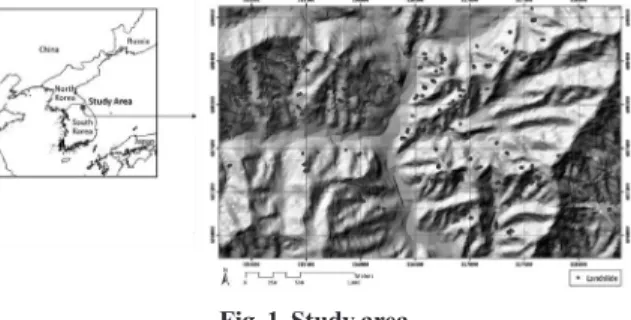
Therefore, the entire area of Inje-eup was selected as the study area for this analysis of landslide susceptibility (Fig. 1).
3. Data set and methodology
3.1. Landslide identification
Accurate identification of landslide locations is critical to analyses of landslide hazards. Field surveys are the most accurate way to identify landslide locations, but terrain and environmental conditions may make it difficult and costly to access these areas as an initial landslide identification method. Remote sensing methods using data such as aerial photos and satellite imagery are more effective due to their lower cost, and are widely used to identify landslide locations (Liangjie et al., 2012).
Landslide locations for this study were identified using aerial photos taken soon after landslide occurrences. Aerial photos taken on 2 August 2006 using the PKNU (Pukyong
Fig. 1. Study area
A Comparative Analysis of Landslide Susceptibility Assessment by Using Global and Spatial Regression Methods in Inje Area, Korea
581 National University) IV system were used to identify the
locations of landslides that had occurred in the Inje area in July 2006. The collected aerial photos were geometrically corrected using a 1:5,000 digital topographic map and then used to produce orthophotos by creating a mosaic using a DTM (Digital Terrain Model). Landslide locations were digitized by visual interpretation using orthorectified aerial photos.
3.2 Spatial dataset
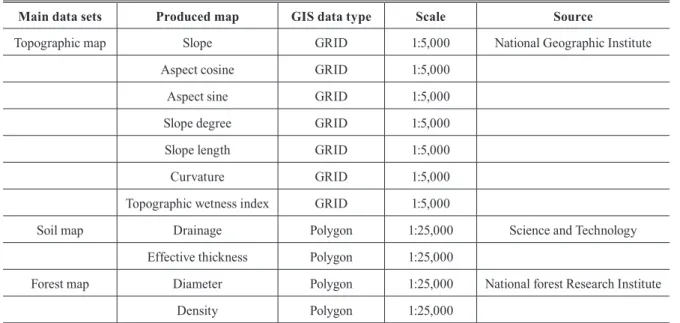
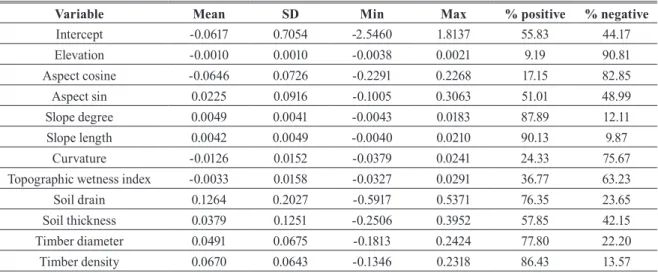
Because landslides result from a combination of various factors such as topology, soil, and forest, these landslide- related factors need to be built into a spatial database for landslide susceptibility analysis. The relevant thematic maps acquired from government were used to construct a spatial database (Table 1). A total of eleven landslide-related factors were compiled into a spatial database with 10×10-m cells relative to the research area using ArcGIS 10.2 software.
The dataset consisted of 232 rows×370 columns, for a total of 85,840 cells, with landslides represented in 446 of the cells.
A total of 446 cells were divided randomly into two groups, training and validation set. 624 cells, accounting for 70%
of the total positive events (landslide affected areas), were randomly selected as the training set. In addition, cells of the
negative events (landslide non-affected areas) were collected with same number of the positive events. The remaining portion of the training set was used as validation set.
3.3. GLR
Regression approaches including linear regression, log- linear regression and logistic regression can be considered a process to extract the coefficients of empirical relationships from observations (Ozdemir and Altural, 2013). The goal of GLR is to find the best-fitting model to describe the relationship between a dichotomous depend variable (the presence or absence of landslides) and several explanatory variables.The explanatory variables may be continuous or discrete (with dummy variables) and do not need a normal frequency distribution (Ayalew and Yamagishi, 2005; Van Den Eeckhaut et al., 2006). Quantitatively, the relationship between depend variable and explanatory variables can be expressed in Eq. (1).
(1)
where, P is the probability of landslide occurrence, ranging between 0 and 1 on an s-shaped curve, and z represents a linear combination of the variables through Eq. (2).
Main data sets Produced map GIS data type Scale Source
Topographic map Slope GRID 1:5,000 National Geographic Institute
Aspect cosine GRID 1:5,000
Aspect sine GRID 1:5,000
Slope degree GRID 1:5,000
Slope length GRID 1:5,000
Curvature GRID 1:5,000
Topographic wetness index GRID 1:5,000
Soil map Drainage Polygon 1:25,000 Science and Technology
Effective thickness Polygon 1:25,000
Forest map Diameter Polygon 1:25,000 National forest Research Institute
Density Polygon 1:25,000
Table 1. Data type and scale of data used in the study
Journal of the Korean Society of Surveying, Geodesy, Photogrammetry and Cartography, Vol. 33, No. 6, 579-587, 2015
582
(2)
where,
is the intercept of the model,
are the regression coefficients, and
are the explanatory variables (Youssef et al., 2015). The value z varies from
to
.
A positive sign of the probability represents that the explanatory variables has increased the probability of change, and a negative sign indicates the opposite effect. In addition, maximizing likelihood function is used to obtain the regression coefficients. A coefficient is significant if the tested null hypothesis that the estimated coefficient was zero could be rejected at a 0.05 significance level(Hosmer and Lemeshow, 2000; Kleinbaum and Klein, 2002; Van Den Eeckhaut et al., 2006).
In addition, multicollinearity among the independent variables is tested using the TOL (tolerance) and the VIF (Variance Inflation Factor) to improve the model fitting.
The variables with VIF > 10 and TOL < 0.1 are represented serious multicollinearity between explanatory variables and excluded from the logistic analysis (Hosmer and Lemeshow, 2000; Menard, 2002; Zhu and Huang, 2006).
3.4. GWR
GWR, which is a local modeling technique, aims to capture spatial non-stationarity in the influence of factors on the occurrence of a landslide (Feuillet et al., 2014). The spatial non-stationarity is identified by generating a set of local-specific coefficients, including local R square, local model residuals, local parameter estimates as well as the corresponding t-test values (Fotheringham et al., 2002). The GWR model extends the OLS (Ordinary Regression Squares) regression by allowing regression coefficients to be estimated locally (Feuillet et al., 2014).
The GWR model can be expressed as:
(3)
where
and
are the spatial position of location j,
acts as intercept, and
is the local estimated coefficient for explanatory variables (Su et al., 2012).
The GWR uses kernel bandwidth to determine the spatial
scope of spatialdependence, and then employs distance decay function to weight all the observations within the spatial scope. Because it is assumed that observations near point i have more influence on the estimation of
than observations located farther from i (Feuillet et al., 2014;
Tu and Xia, 2008). The distance decay functions can be calculated by Gaussian and bi-square (Brunsdon et al., 1998;
Fotheringham et al., 2002). In this research, the Gaussian distance decay is used to express the weight function:
(4)
where
is the weight for observation
within the neighborhood of observation
,
represents the distance between observations
and