https://doi.org/10.7848/ksgpc.2016.34.6.597
A Comparative Study of the Frequency Ratio and Evidential Belief Function Models for Landslide Susceptibility
Mapping
Yoo, Youngwoo
1)· Baek, Taekyung
2)· Kim, Jinsoo
3)· Park, Soyoung
4)Abstract
The goal of this study was to analyze landslide susceptibility using two different models and compare the results. For this purpose, a landslide inventory map was produced from a field survey, and the inventory was divided into two groups for training and validation, respectively. Sixteen landslide conditioning factors were considered. The relationships between landslide occurrence and landslide conditioning factors were analyzed using the FR (Frequency Ratio) and EBF (Evidential Belief Function) models. The LSI (Landslide Susceptibility Index) maps that were produced were validated using the ROC (Relative Operating Characteristics) curve and the SCAI (Seed Cell Area Index). The AUC (Area under the ROC Curve) values of the FR and EBF LSI maps were 80.6% and 79.5%, with prediction accuracies of 72.7% and 71.8%, respectively. Additionally, in the low and very low susceptibility zones, the FR LSI map had higher SCAI values compared to the EBF LSI map, as high as 0.47%p. These results indicate that both models were reasonably accurate, however that the FR LSI map had a slightly higher accuracy for landslide susceptibility mapping in the study area.
Keywords : Evidential Belief Function, Frequency Ratio, Landslide Susceptibility, Landslide Susceptibility Index, Landslide Susceptibility Mapping
Original article
Received 2016. 11. 25, Revised 2016. 12. 19, Accepted 2016. 12. 28
1) Dept. of Urban Engineering, Dongeui University (E-mail: [email protected]) 2) Dept. of Urban Engineering, Dongeui University (E-mail: [email protected])
3) Member, Dep. of Spatial Information Engineering, Pukyong National University (E-mail: [email protected])
4) Corresponding Author, Member, Graduate School of Earth Environmental Hazard System, Pukyong National University (E-mail: [email protected]) This is an Open Access article distributed under the terms of the Creative Commons Attribution Non-Commercial License (http://
creativecommons.org/licenses/by-nc/3.0) which permits unrestricted non-commercial use, distribution, and reproduction in any medium,
1. Introduction
Landslides, defined as the movement of a mass of rock or debris, are significant natural hazards. They are caused by various causes, including rainfall, bedrock conditions, vegetation surcharge, groundwater, and human activities (Cruden, 1991; Gerath et al., 1997). Each year, landslides cause casualties and economic losses amounting to more than 100,000 deaths and injuries and more than one billion USD (Schuster, 1996). In Korea, approximately 70% of the
land is mountainous, consisting mainly of granite gneiss. It rains frequently in the region, and typhoons also bring strong winds and heavy rains during the rainy season. Under these circumstances, landslide occurrences have recently become larger and more frequent (KOSIS, 2016).
Landslide susceptibility mapping has become an essential
part of the strategies applied to mitigate and manage
landslide hazards efficiently and effectively. To illustrate
for planners which sites (either rural or urban) are suitable
for development, maps of susceptibility to landslides divide
areas of land into sections, differentiated by the degree (potential or actual) to which they constitute a landslide hazard (Pourghasemi et al., 2013). In recent years, various models incorporating GIS (Geographic Information System) and remote sensing data have been used to assess landslide susceptibility. GIS models yield advantages in multisource data analysis, particularly when heterogenic or uncertain data is involved (Bui et al., 2012).
Among such models, the FR (Frequency Ratio) model has been used widely to simplify assessment (Lee and Sambath, 2006; Mohammedy et al., 2012). In addition, LR (Logistic Regression), a statistical model, has also been used (Akgun, 2012; Süzen and Doyuran, 2004; Yalcin et al., 2011). Data mining models such as ANN (Artificial Neural Network) (Ermini et al., 2005; Yilmaz, 2009), decision trees (Pradhan, 2013; Saito et al., 2009), and fuzzy logic (Bui et al., 2012) models have similarly been used to assess landslide susceptibility. More recently, the EBF (Evidential Belief Function) (Lee et al., 2013; Pourghasemi and Kerle, 2016), the index of entropy (Hong et al., 2016), and support vector machine (Su et al., 2015) models have been applied.
A number of models have been suggested and implemented, but there is still no agreement on the best model and technique for mapping landslide susceptibility (Wang and Sassa, 2005). Therefore, various models should be applied in a study area and the results should be compared. In Korea, the FR, LR, and ANN have been used widely to analyze landslide susceptibility (Jang et al., 2004; Lee et al., 2012;
Oh, 2010; Yeon, 2011). However, few studies have compared the results from the various models. Additionally, the EBF model has occasionally been used for landslide susceptibility mapping. The efficacy and applicability of the EBF model can be assessed through comparison with the FR model, which is also a bivariate statistical model and its accuracy has been confirmed by many studies. This study assessed and compared the results of LSMs (Landslide Susceptibility Maps) derived using the FR and EBF models and GIS data for spatial prediction of landslide hazards.
2. Study Area
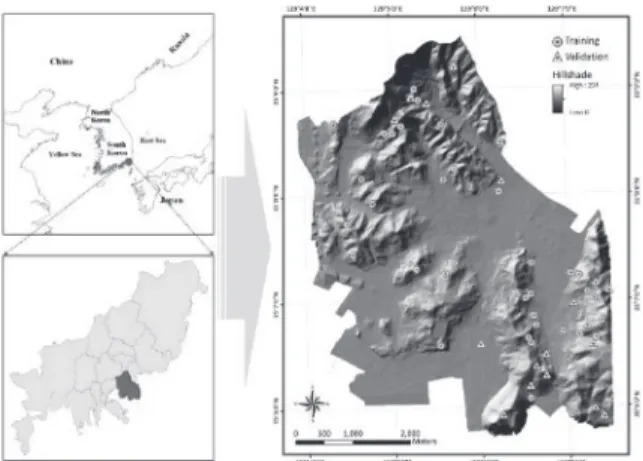
The study area is located at Nam-gu, in the southern part
of Busan Metropolitan City, South Korea. The area covers approximately 25 km
2, excluding some areas where spatial data could not be collected. It lies between the latitudes of 35°6′ to 35°9′ N and the longitudes of 129°4′ to 129°7′ E (Fig. 1). The annual average temperature is 14.8°C and the annual average precipitation is 1535 mm (from 2000 to 2009;
BMCN, 2016). Heavy rain was concentrated in Busan in July 2009. The heaviest precipitation (average: 260 mm, rate: 86 mm/h) was recorded on July 16, 2009. According to the Busan Metropolitan City Hall, many roads, homes, and stores were flooded and destroyed by the heavy rain. Additionally, 142 landslides occurred throughout Busan Metropolitan City; of these, 27.9% occurred within the study area. This study was based on the landslides that occurred in Nam-gu in July 2009.
3. Data and Methodology
3.1 Landslide inventory map
A landslide inventory map, which is essential for analyzing landslide susceptibility, can be produced by various methods, such as aerial photographs, satellite imagery, airborne LiDAR, and field surveying. In this study, a landslide inventory map was produced using the results of a comprehensive field survey performed by the Busan Metropolitan City Hall. From the 99 landslides identified, 69 (70%) locations were chosen randomly for model training and the remaining 30 (30%) locations were used for model validation (Fig. 1).
Fig. 1. Study area location map with hillshading and
landslide inventory
3.2 Landslide conditioning factors
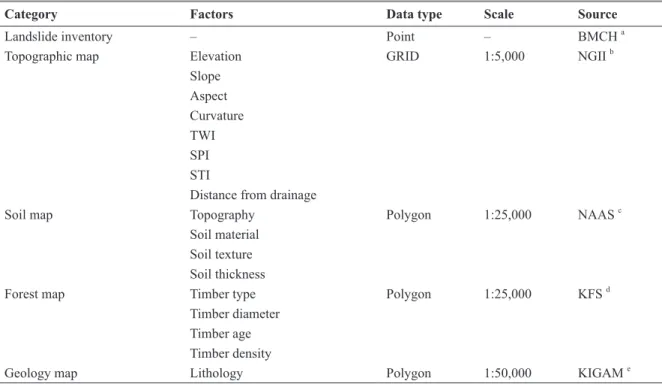
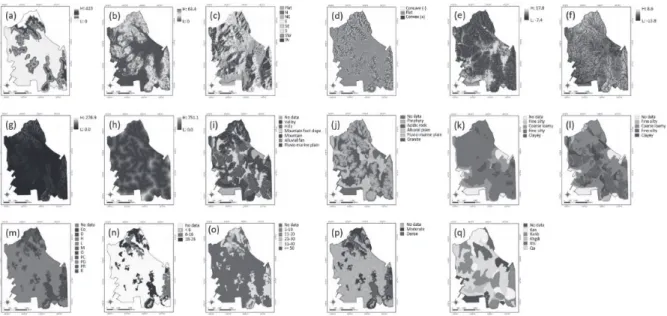
Landslide conditioning factors were collected and compiled from relevant thematic maps acquired from the Korean government. In total, 16 factors were used, and these were divided into three groups (Table 1 and Fig. 2).
The topographic factors, including elevation, slope, aspect, curvature, TWI (Topographic Wetness Index), SPI (Stream Power Index), STI (Sediment Transport Index), and distance from drainage, were derived from a DEM (Digital Elevation Model) produced using 1:5,000-scale topographic maps with ArcGIS software v. 10.2 (ESRI, Redlands, CA). Among these factors, those related to the spatial variation of hydrological conditions, including TWI, SPI, and STI, were produced based on specific catchment areas and a slope map. The amount of water accumulated was measured using the TWI.
Discharge was assumed to be proportional to the catchment area of relevance, allowing the SPI to measure the power to erode of the water flow. The STI measures the overland flow’s capacity to transport sediments (Pourghasemi et al., 2013).
These factors were calculated based on the formulas given
by Beven and Kirkby (1979), Moore et al., (1991), and Moore and Wilson (1992), respectively, as follows:
TWI = ln (
tan 𝛽𝛽𝑎𝑎) (1) SPI = 𝐴𝐴
𝑠𝑠× 𝑡𝑡𝑡𝑡𝑡𝑡𝑡𝑡 (2)
STI = �
22.13𝐴𝐴𝑠𝑠�
0.6�
0.0896𝑠𝑠𝑠𝑠𝑠𝑠𝛽𝛽�
1.3(3) 𝑡𝑡
𝐵𝐵𝐵𝐵𝐵𝐵
𝑐𝑐𝑖𝑖𝑖𝑖=
𝑁𝑁�𝐶𝐶𝑖𝑖𝑖𝑖∩𝐷𝐷�/𝑁𝑁(𝐶𝐶𝑖𝑖𝑖𝑖) 𝑁𝑁(𝐷𝐷)−𝑁𝑁�𝐶𝐶𝑖𝑖𝑖𝑖∩𝐷𝐷�/𝑁𝑁(𝑇𝑇)−𝑁𝑁(𝐶𝐶𝑖𝑖𝑖𝑖)
∑ 𝑁𝑁�𝐶𝐶𝑖𝑖𝑖𝑖∩𝐷𝐷�/𝑁𝑁(𝐶𝐶𝑖𝑖𝑖𝑖) 𝑁𝑁(𝐷𝐷)−𝑁𝑁�𝐶𝐶𝑖𝑖𝑖𝑖∩𝐷𝐷�/𝑁𝑁(𝑇𝑇)−𝑁𝑁(𝐶𝐶𝑖𝑖𝑖𝑖) 𝑚𝑚𝑖𝑖=1
(4)
𝐷𝐷𝐷𝐷𝐷𝐷
𝑐𝑐𝑖𝑖𝑖𝑖=
𝑁𝑁�𝐶𝐶𝑖𝑖𝑖𝑖∩𝐷𝐷�/𝑁𝑁(𝐶𝐶𝑖𝑖𝑖𝑖)
𝑁𝑁(𝑇𝑇)−𝑁𝑁(𝐷𝐷)−[𝑁𝑁�𝐶𝐶𝑖𝑖𝑖𝑖�−𝑁𝑁�𝐶𝐶𝑖𝑖𝑖𝑖∩𝐷𝐷�]/𝑁𝑁(𝑇𝑇)−𝑁𝑁(𝐶𝐶𝑖𝑖𝑖𝑖)
∑ 𝑁𝑁�𝐶𝐶𝑖𝑖𝑖𝑖∩𝐷𝐷�/𝑁𝑁(𝐶𝐶𝑖𝑖𝑖𝑖)
𝑁𝑁(𝑇𝑇)−𝑁𝑁(𝐷𝐷)−[𝑁𝑁�𝐶𝐶𝑖𝑖𝑖𝑖�−𝑁𝑁�𝐶𝐶𝑖𝑖𝑖𝑖∩𝐷𝐷�]/𝑁𝑁(𝑇𝑇)−𝑁𝑁(𝐶𝐶𝑖𝑖𝑖𝑖) 𝑚𝑚𝑖𝑖=1
(5)
Unc = �1 − (𝐵𝐵𝐵𝐵𝐵𝐵
𝐶𝐶𝑖𝑖𝑖𝑖) − (𝐷𝐷𝐷𝐷𝐷𝐷
𝐶𝐶𝑖𝑖𝑖𝑖)� (6)
Pls = �1 − (𝐷𝐷𝐷𝐷𝐷𝐷
𝐶𝐶𝑖𝑖𝑖𝑖)� (7) where 𝑁𝑁�𝐶𝐶
𝑠𝑠𝑖𝑖∩ 𝐷𝐷� is the density of landslides given in D, 𝑁𝑁(𝐶𝐶
𝑠𝑠𝑖𝑖)
(1)
TWI = ln (
tan 𝛽𝛽𝑎𝑎) (1) SPI = 𝐴𝐴
𝑠𝑠× 𝑡𝑡𝑡𝑡𝑡𝑡𝑡𝑡 (2)
STI = �
22.13𝐴𝐴𝑠𝑠�
0.6�
0.0896𝑠𝑠𝑠𝑠𝑠𝑠𝛽𝛽�
1.3(3) 𝑡𝑡
𝐵𝐵𝐵𝐵𝐵𝐵
𝑐𝑐𝑖𝑖𝑖𝑖=
𝑁𝑁�𝐶𝐶𝑖𝑖𝑖𝑖∩𝐷𝐷�/𝑁𝑁(𝐶𝐶𝑖𝑖𝑖𝑖) 𝑁𝑁(𝐷𝐷)−𝑁𝑁�𝐶𝐶𝑖𝑖𝑖𝑖∩𝐷𝐷�/𝑁𝑁(𝑇𝑇)−𝑁𝑁(𝐶𝐶𝑖𝑖𝑖𝑖)
∑ 𝑁𝑁�𝐶𝐶𝑖𝑖𝑖𝑖∩𝐷𝐷�/𝑁𝑁(𝐶𝐶𝑖𝑖𝑖𝑖) 𝑁𝑁(𝐷𝐷)−𝑁𝑁�𝐶𝐶𝑖𝑖𝑖𝑖∩𝐷𝐷�/𝑁𝑁(𝑇𝑇)−𝑁𝑁(𝐶𝐶𝑖𝑖𝑖𝑖) 𝑚𝑚𝑖𝑖=1
(4)
𝐷𝐷𝐷𝐷𝐷𝐷
𝑐𝑐𝑖𝑖𝑖𝑖=
𝑁𝑁�𝐶𝐶𝑖𝑖𝑖𝑖∩𝐷𝐷�/𝑁𝑁(𝐶𝐶𝑖𝑖𝑖𝑖)
𝑁𝑁(𝑇𝑇)−𝑁𝑁(𝐷𝐷)−[𝑁𝑁�𝐶𝐶𝑖𝑖𝑖𝑖�−𝑁𝑁�𝐶𝐶𝑖𝑖𝑖𝑖∩𝐷𝐷�]/𝑁𝑁(𝑇𝑇)−𝑁𝑁(𝐶𝐶𝑖𝑖𝑖𝑖)
∑ 𝑁𝑁�𝐶𝐶𝑖𝑖𝑖𝑖∩𝐷𝐷�/𝑁𝑁(𝐶𝐶𝑖𝑖𝑖𝑖)
𝑁𝑁(𝑇𝑇)−𝑁𝑁(𝐷𝐷)−[𝑁𝑁�𝐶𝐶𝑖𝑖𝑖𝑖�−𝑁𝑁�𝐶𝐶𝑖𝑖𝑖𝑖∩𝐷𝐷�]/𝑁𝑁(𝑇𝑇)−𝑁𝑁(𝐶𝐶𝑖𝑖𝑖𝑖) 𝑚𝑚𝑖𝑖=1
(5)
Unc = �1 − (𝐵𝐵𝐵𝐵𝐵𝐵
𝐶𝐶𝑖𝑖𝑖𝑖) − (𝐷𝐷𝐷𝐷𝐷𝐷
𝐶𝐶𝑖𝑖𝑖𝑖)� (6) Pls = �1 − (𝐷𝐷𝐷𝐷𝐷𝐷
𝐶𝐶𝑖𝑖𝑖𝑖)� (7) where 𝑁𝑁�𝐶𝐶
𝑠𝑠𝑖𝑖∩ 𝐷𝐷� is the density of landslides given in D, 𝑁𝑁(𝐶𝐶
𝑠𝑠𝑖𝑖)
(2)
TWI = ln (
tan 𝛽𝛽𝑎𝑎) (1) SPI = 𝐴𝐴
𝑠𝑠× 𝑡𝑡𝑡𝑡𝑡𝑡𝑡𝑡 (2)
STI = �
22.13𝐴𝐴𝑠𝑠�
0.6�
0.0896𝑠𝑠𝑠𝑠𝑠𝑠𝛽𝛽�
1.3(3) 𝑡𝑡
𝐵𝐵𝐵𝐵𝐵𝐵
𝑐𝑐𝑖𝑖𝑖𝑖=
𝑁𝑁�𝐶𝐶𝑖𝑖𝑖𝑖∩𝐷𝐷�/𝑁𝑁(𝐶𝐶𝑖𝑖𝑖𝑖) 𝑁𝑁(𝐷𝐷)−𝑁𝑁�𝐶𝐶𝑖𝑖𝑖𝑖∩𝐷𝐷�/𝑁𝑁(𝑇𝑇)−𝑁𝑁(𝐶𝐶𝑖𝑖𝑖𝑖)
∑ 𝑁𝑁�𝐶𝐶𝑖𝑖𝑖𝑖∩𝐷𝐷�/𝑁𝑁(𝐶𝐶𝑖𝑖𝑖𝑖) 𝑁𝑁(𝐷𝐷)−𝑁𝑁�𝐶𝐶𝑖𝑖𝑖𝑖∩𝐷𝐷�/𝑁𝑁(𝑇𝑇)−𝑁𝑁(𝐶𝐶𝑖𝑖𝑖𝑖) 𝑚𝑚𝑖𝑖=1
(4)
𝐷𝐷𝐷𝐷𝐷𝐷
𝑐𝑐𝑖𝑖𝑖𝑖=
𝑁𝑁�𝐶𝐶𝑖𝑖𝑖𝑖∩𝐷𝐷�/𝑁𝑁(𝐶𝐶𝑖𝑖𝑖𝑖)
𝑁𝑁(𝑇𝑇)−𝑁𝑁(𝐷𝐷)−[𝑁𝑁�𝐶𝐶𝑖𝑖𝑖𝑖�−𝑁𝑁�𝐶𝐶𝑖𝑖𝑖𝑖∩𝐷𝐷�]/𝑁𝑁(𝑇𝑇)−𝑁𝑁(𝐶𝐶𝑖𝑖𝑖𝑖)
∑ 𝑁𝑁�𝐶𝐶𝑖𝑖𝑖𝑖∩𝐷𝐷�/𝑁𝑁(𝐶𝐶𝑖𝑖𝑖𝑖)
𝑁𝑁(𝑇𝑇)−𝑁𝑁(𝐷𝐷)−[𝑁𝑁�𝐶𝐶𝑖𝑖𝑖𝑖�−𝑁𝑁�𝐶𝐶𝑖𝑖𝑖𝑖∩𝐷𝐷�]/𝑁𝑁(𝑇𝑇)−𝑁𝑁(𝐶𝐶𝑖𝑖𝑖𝑖) 𝑚𝑚𝑖𝑖=1
(5)
Unc = �1 − (𝐵𝐵𝐵𝐵𝐵𝐵
𝐶𝐶𝑖𝑖𝑖𝑖) − (𝐷𝐷𝐷𝐷𝐷𝐷
𝐶𝐶𝑖𝑖𝑖𝑖)� (6)
Pls = �1 − (𝐷𝐷𝐷𝐷𝐷𝐷
𝐶𝐶𝑖𝑖𝑖𝑖)� (7) where 𝑁𝑁�𝐶𝐶
𝑠𝑠𝑖𝑖∩ 𝐷𝐷� is the density of landslides given in D, 𝑁𝑁(𝐶𝐶
𝑠𝑠𝑖𝑖)
(3)
where
TWI = ln ( tan 𝛽𝛽 𝑎𝑎 ) (1)
SPI = 𝐴𝐴 𝑠𝑠 × 𝑡𝑡𝑡𝑡𝑡𝑡𝑡𝑡 (2)
STI = � 22.13 𝐴𝐴
𝑠𝑠� 0.6 � 0.0896 𝑠𝑠𝑠𝑠𝑠𝑠𝛽𝛽 � 1.3 (3) 𝑡𝑡
𝐵𝐵𝐵𝐵𝐵𝐵 𝑐𝑐
𝑖𝑖𝑖𝑖=
𝑁𝑁�𝐶𝐶𝑖𝑖𝑖𝑖∩𝐷𝐷�/𝑁𝑁(𝐶𝐶𝑖𝑖𝑖𝑖) 𝑁𝑁(𝐷𝐷)−𝑁𝑁�𝐶𝐶𝑖𝑖𝑖𝑖∩𝐷𝐷�/𝑁𝑁(𝑇𝑇)−𝑁𝑁(𝐶𝐶𝑖𝑖𝑖𝑖)
∑
𝑁𝑁�𝐶𝐶𝑖𝑖𝑖𝑖∩𝐷𝐷�/𝑁𝑁(𝐶𝐶𝑖𝑖𝑖𝑖) 𝑁𝑁(𝐷𝐷)−𝑁𝑁�𝐶𝐶𝑖𝑖𝑖𝑖∩𝐷𝐷�/𝑁𝑁(𝑇𝑇)−𝑁𝑁(𝐶𝐶𝑖𝑖𝑖𝑖) 𝑚𝑚𝑖𝑖=1(4)
𝐷𝐷𝐷𝐷𝐷𝐷 𝑐𝑐
𝑖𝑖𝑖𝑖=
𝑁𝑁�𝐶𝐶𝑖𝑖𝑖𝑖∩𝐷𝐷�/𝑁𝑁(𝐶𝐶𝑖𝑖𝑖𝑖)
𝑁𝑁(𝑇𝑇)−𝑁𝑁(𝐷𝐷)−[𝑁𝑁�𝐶𝐶𝑖𝑖𝑖𝑖�−𝑁𝑁�𝐶𝐶𝑖𝑖𝑖𝑖∩𝐷𝐷�]/𝑁𝑁(𝑇𝑇)−𝑁𝑁(𝐶𝐶𝑖𝑖𝑖𝑖)
∑
𝑁𝑁�𝐶𝐶𝑖𝑖𝑖𝑖∩𝐷𝐷�/𝑁𝑁(𝐶𝐶𝑖𝑖𝑖𝑖)𝑁𝑁(𝑇𝑇)−𝑁𝑁(𝐷𝐷)−[𝑁𝑁�𝐶𝐶𝑖𝑖𝑖𝑖�−𝑁𝑁�𝐶𝐶𝑖𝑖𝑖𝑖∩𝐷𝐷�]/𝑁𝑁(𝑇𝑇)−𝑁𝑁(𝐶𝐶𝑖𝑖𝑖𝑖) 𝑚𝑚𝑖𝑖=1
(5)
Unc = �1 − (𝐵𝐵𝐵𝐵𝐵𝐵 𝐶𝐶
𝑖𝑖𝑖𝑖) − (𝐷𝐷𝐷𝐷𝐷𝐷 𝐶𝐶
𝑖𝑖𝑖𝑖)� (6)
Pls = �1 − (𝐷𝐷𝐷𝐷𝐷𝐷 𝐶𝐶
𝑖𝑖𝑖𝑖)� (7) where 𝑁𝑁�𝐶𝐶 𝑠𝑠𝑖𝑖 ∩ 𝐷𝐷� is the density of landslides given in D, 𝑁𝑁(𝐶𝐶 𝑠𝑠𝑖𝑖 )
is the upslope contributing area, A
sis the specific catchment’s area, and β is the local slope gradient measured in degrees.
Soil factors, including topography, soil material, soil texture, and soil thickness, were constructed using a 1:25,000-scale soil map. Forest factors, including timber type, timber diameter, timber age, and timber density, were produced from a 1:25,000-scale forest map. Additionally, lithology was extracted from a 1:50,000-scale geologic map.
The 16 landslide conditioning factors that were produced were converted into 10-m-resolution raster grids. The
Table 1. Data layers used to analyze landslide susceptibility
Category Factors Data type Scale Source
Landslide inventory – Point – BMCH
aTopographic map Elevation GRID 1:5,000 NGII
bSlope Aspect Curvature TWI SPI STI
Distance from drainage
Soil map Topography Polygon 1:25,000 NAAS
cSoil material Soil texture Soil thickness
Forest map Timber type Polygon 1:25,000 KFS
dTimber diameter Timber age Timber density
Geology map Lithology Polygon 1:50,000 KIGAM
ea
Busan Metropolitan City Hall;
bNational Geographic Information Institute;
cNational Academy of Agriculture Science;
d
Korea Forest Service;
eKorea Institute of Geoscience and Mineral Resources
dimensions of the study area grid were 704 rows by 555 columns, so the total number of cells was therefore 390,720.
4. Results and Discussion
4.1 Landslide susceptibility mapping 4.1.1 FR
In general, the locations and frequencies of landslides are assumed to depend on a number of factors that create conditions under which landslides can occur. Future landslides are predicted to occur when conditions are the same as those that prevailed when they occurred in the past (Lee and Pradhan, 2007). The FR correlates an area of past landslides with the total area under consideration. Ratios higher than 1 indicate that occurrence and conditioning factors correlate closely, whereas values <1 indicate that the correlation is weaker (Akgun, 2012).
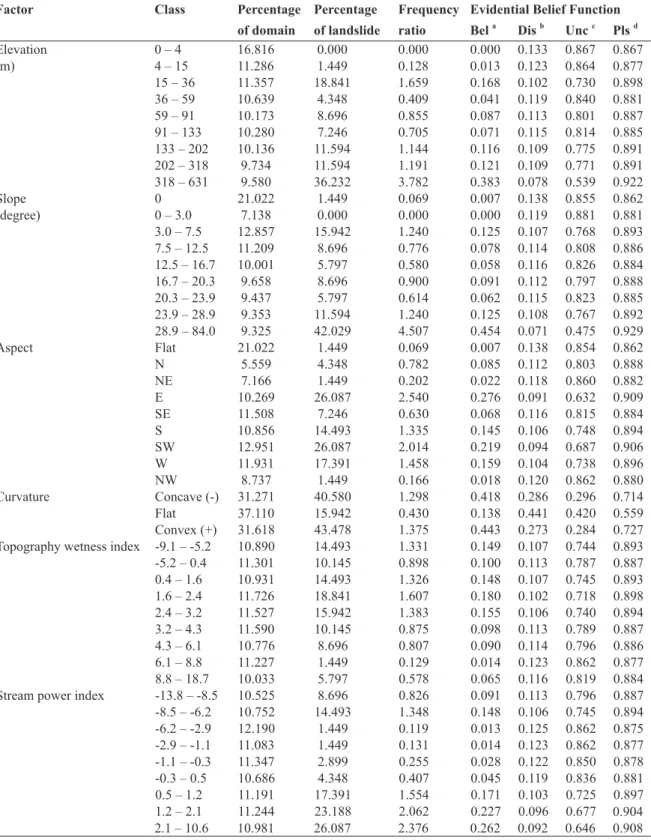
FR values were calculated for each range or category of the 16 landslide conditioning factors (Table 2). FR values increased with increasing values of elevation, and were highest for the >318 m class (3.782). With regards to slope, the 3.0–7.5˚ and >23.9˚ ranges had the highest correlations with landslide occurrence. Most landslides occurred on
east- and southwest-facing slopes, with FR values of 2.540 and 2.014, respectively. Convex areas had a higher FR value (1.375) than concave areas (1.298). For the case of TWI, the
<3.2 classes, excluding the -5.2–0.4 class, had FR values
>1.0. Among these classes, the 1.6–2.4 class had the highest FR value (1.607). The FR values of SPI mostly increased with increasing SPI values. The >2.1 class had the highest correlation with landslide occurrence. Similarly, for STI, the
>35.0 class had the highest FR value at 3.541. With regards to distance from drainage, the distance classes of 1–28.4 m and 113.4–158.0 m had high FR values of 1.573 and 2.717, respectively. Mountain foot slope and mountain were more suitable for landslide occurrence. With regards to soil material, most landslides occurred in the porphyry and acidic rock classes. The fine silty and clayey classes showed high correlations, with values of 1.271 and 1.309, respectively. The soil thickness class of 20–50 cm had a FR value of 1.465. Most landslides occurred in Pine (D) and Pinus rigida (PR) forests.
Additionally, the 6–16 cm, 21–40 years, and dense classes had the highest correlations with landslide occurrence. With regards to geology, the andesite (Kan) and volcanic breccia (Kanb) classes had FR values of 3.061 and 1.044, respectively (Table 2).
Fig. 2. Landslide conditioning factors: (a) elevation, (b) slope, (c) aspect, (d) curvature, (e) TWI, (f) SPI, (g) STI, (h) distance from drainage, (i) soil topography, (j) soil material, (k) soil texture, (l) soil thickness, (m) timber type,
(n) timber diameter, (o) timber age, (p) timber density, and (q) lithology
Table 2. Spatial relationship between each landslide conditioning factor and landslides using the frequency ratio and the evidential belief function
Factor Class Percentage Percentage Frequency Evidential Belief Function
of domain of landslide ratio Bel
aDis
bUnc
cPls
dElevation 0 – 4 16.816 0.000 0.000 0.000 0.133 0.867 0.867
(m) 4 – 15 11.286 1.449 0.128 0.013 0.123 0.864 0.877
15 – 36 11.357 18.841 1.659 0.168 0.102 0.730 0.898
36 – 59 10.639 4.348 0.409 0.041 0.119 0.840 0.881
59 – 91 10.173 8.696 0.855 0.087 0.113 0.801 0.887
91 – 133 10.280 7.246 0.705 0.071 0.115 0.814 0.885
133 – 202 10.136 11.594 1.144 0.116 0.109 0.775 0.891
202 – 318 9.734 11.594 1.191 0.121 0.109 0.771 0.891
318 – 631 9.580 36.232 3.782 0.383 0.078 0.539 0.922
Slope 0 21.022 1.449 0.069 0.007 0.138 0.855 0.862
(degree) 0 – 3.0 7.138 0.000 0.000 0.000 0.119 0.881 0.881
3.0 – 7.5 12.857 15.942 1.240 0.125 0.107 0.768 0.893
7.5 – 12.5 11.209 8.696 0.776 0.078 0.114 0.808 0.886
12.5 – 16.7 10.001 5.797 0.580 0.058 0.116 0.826 0.884
16.7 – 20.3 9.658 8.696 0.900 0.091 0.112 0.797 0.888
20.3 – 23.9 9.437 5.797 0.614 0.062 0.115 0.823 0.885
23.9 – 28.9 9.353 11.594 1.240 0.125 0.108 0.767 0.892
28.9 – 84.0 9.325 42.029 4.507 0.454 0.071 0.475 0.929
Aspect Flat 21.022 1.449 0.069 0.007 0.138 0.854 0.862
N 5.559 4.348 0.782 0.085 0.112 0.803 0.888
NE 7.166 1.449 0.202 0.022 0.118 0.860 0.882
E 10.269 26.087 2.540 0.276 0.091 0.632 0.909
SE 11.508 7.246 0.630 0.068 0.116 0.815 0.884
S 10.856 14.493 1.335 0.145 0.106 0.748 0.894
SW 12.951 26.087 2.014 0.219 0.094 0.687 0.906
W 11.931 17.391 1.458 0.159 0.104 0.738 0.896
NW 8.737 1.449 0.166 0.018 0.120 0.862 0.880
Curvature Concave (-) 31.271 40.580 1.298 0.418 0.286 0.296 0.714
Flat 37.110 15.942 0.430 0.138 0.441 0.420 0.559
Convex (+) 31.618 43.478 1.375 0.443 0.273 0.284 0.727
Topography wetness index -9.1 – -5.2 10.890 14.493 1.331 0.149 0.107 0.744 0.893
-5.2 – 0.4 11.301 10.145 0.898 0.100 0.113 0.787 0.887
0.4 – 1.6 10.931 14.493 1.326 0.148 0.107 0.745 0.893
1.6 – 2.4 11.726 18.841 1.607 0.180 0.102 0.718 0.898
2.4 – 3.2 11.527 15.942 1.383 0.155 0.106 0.740 0.894
3.2 – 4.3 11.590 10.145 0.875 0.098 0.113 0.789 0.887
4.3 – 6.1 10.776 8.696 0.807 0.090 0.114 0.796 0.886
6.1 – 8.8 11.227 1.449 0.129 0.014 0.123 0.862 0.877
8.8 – 18.7 10.033 5.797 0.578 0.065 0.116 0.819 0.884
Stream power index -13.8 – -8.5 10.525 8.696 0.826 0.091 0.113 0.796 0.887
-8.5 – -6.2 10.752 14.493 1.348 0.148 0.106 0.745 0.894
-6.2 – -2.9 12.190 1.449 0.119 0.013 0.125 0.862 0.875
-2.9 – -1.1 11.083 1.449 0.131 0.014 0.123 0.862 0.877
-1.1 – -0.3 11.347 2.899 0.255 0.028 0.122 0.850 0.878
-0.3 – 0.5 10.686 4.348 0.407 0.045 0.119 0.836 0.881
0.5 – 1.2 11.191 17.391 1.554 0.171 0.103 0.725 0.897
1.2 – 2.1 11.244 23.188 2.062 0.227 0.096 0.677 0.904
2.1 – 10.6 10.981 26.087 2.376 0.262 0.092 0.646 0.908
Table 2. (continued)
Factor Class Percentage Percentage Frequency Evidential Belief Function of domain of landslide ratio
Bel
aDis
bUnc
cPls
dSediment transport index 0 40.491 24.638 0.608 0.047 0.139 0.814 0.861
0 – 2.7 14.073 1.449 0.103 0.008 0.126 0.866 0.874
2.7 – 5.4 7.075 1.449 0.205 0.016 0.116 0.868 0.884
5.4 – 8.1 7.819 10.145 1.297 0.100 0.107 0.793 0.893
8.1 – 13.5 6.518 7.246 1.112 0.086 0.109 0.805 0.891
13.5 – 18.8 7.145 5.797 0.811 0.063 0.111 0.826 0.889
18.8 – 24.2 5.491 13.043 2.376 0.184 0.101 0.715 0.899
24.2 – 35.0 6.067 17.391 2.866 0.222 0.097 0.682 0.903
35.0 – 686.3 5.321 18.841 3.541 0.274 0.094 0.632 0.906
Distance from drainage 0 – 28.4 11.058 17.391 1.573 0.178 0.103 0.718 0.897
(m) 28.4 – 68.9 10.255 7.246 0.707 0.080 0.115 0.805 0.885
68.9 – 113.4 12.418 5.797 0.467 0.053 0.120 0.828 0.880
113.4 – 158.0 12.266 33.333 2.717 0.308 0.084 0.607 0.916
158.0 – 206.6 10.394 7.246 0.697 0.079 0.115 0.806 0.885
206.6 – 259.3 11.661 7.246 0.621 0.070 0.117 0.813 0.883
259.3 – 324.1 10.824 7.246 0.669 0.076 0.116 0.808 0.884
324.1 – 417.3 10.785 8.696 0.806 0.091 0.114 0.795 0.886
417. 3 – 1029.1 10.339 5.797 0.561 0.064 0.117 0.820 0.883
Soil topography No data 8.999 0.000 0.000 0.000 0.157 0.843 0.843
Valley 0.858 0.000 0.000 0.000 0.145 0.855 0.855
Hills 27.563 23.188 0.841 0.171 0.152 0.677 0.848
Mountain foot slope 23.260 24.638 1.059 0.216 0.141 0.643 0.859
Mountain 18.617 47.826 2.569 0.524 0.092 0.384 0.908
Alluvial fan 6.092 1.449 0.238 0.048 0.150 0.801 0.850
Fluvio-marine plain 14.610 2.899 0.198 0.040 0.163 0.797 0.837
Soil material No data 8.999 0.000 0.000 0.000 0.189 0.811 0.811
Porphyry 44.626 71.014 1.591 0.521 0.090 0.389 0.910
Acidic rock 23.984 24.638 1.027 0.336 0.170 0.493 0.830
Alluvial plain 6.092 1.449 0.238 0.078 0.180 0.742 0.820
Fluvio-marine plain 14.610 2.899 0.198 0.065 0.195 0.740 0.805
Granite 1.689 0.000 0.000 0.000 0.175 0.825 0.825
Soil texture No data 8.999 0.000 0.000 0.000 0.241 0.759 0.759
Fine silty 0.134 0.000 0.000 0.000 0.219 0.781 0.781
Coarse loamy 14.627 2.899 0.198 0.071 0.249 0.680 0.751
Fine silty 70.706 89.855 1.271 0.457 0.076 0.467 0.924
Clayey 5.534 7.246 1.309 0.471 0.215 0.314 0.785
Soil thickness No data 8.999 0.000 0.000 0.000 0.227 0.773 0.773
(cm) < 20 2.376 1.449 0.610 0.199 0.209 0.592 0.791
20 – 50 48.471 71.014 1.465 0.478 0.116 0.406 0.884
50 – 100 32.231 26.087 0.809 0.264 0.226 0.510 0.774
> 100 7.922 1.449 0.183 0.060 0.222 0.719 0.778
Timber type No data 70.320 40.580 0.577 0.044 0.172 0.784 0.828
Retinispora
0.547 0.000 0.000 0.000 0.086 0.914 0.914
Pine 14.192 33.333 2.349 0.180 0.067 0.753 0.933
Deciduous 1.946 1.449 0.745 0.057 0.086 0.857 0.914
Farmland 0.397 0.000 0.000 0.000 0.086 0.914 0.914
Mixed forest 6.470 2.899 0.448 0.034 0.089 0.877 0.911
Non-stocked forest 1.453 0.000 0.000 0.000 0.087 0.913 0.913
Artificial coniferous 0.352 0.000 0.000 0.000 0.086 0.914 0.914
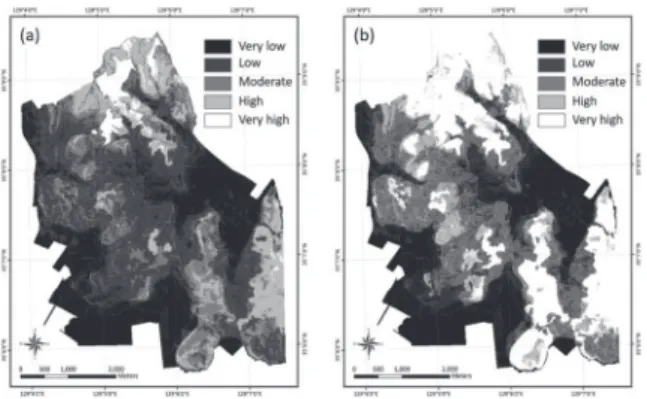
The calculated FR values were summed to calculate the LSI (Landslide Susceptibility Index). The LSI map (hereafter, FR LSI map) was classified into five zones by natural-break classification for ease of visual interpretation: very low, low, moderate, high, and very high landslide susceptibility zones.
These landslide susceptibility zones made up 26.3%, 37.3%, 28.9%, 14.1%, and 3.4% of the study area, respectively.
Approximately 17% of the study area was particularly susceptible to landslide occurrence (Fig. 3a).
4.1.2 EBF
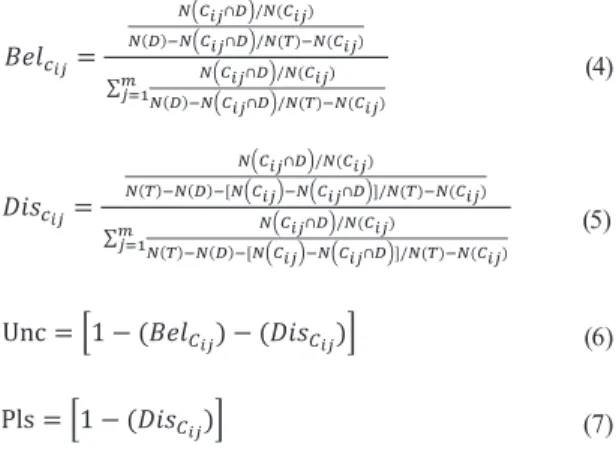
The EBF, which has its roots in Dempster–Shafer theory, is a way to bring together a number of separate items of information (the ‘evidence’) to allow for the calculation of the likelihood (the ‘probability’) that something will happen (the ‘event’) (Tangestani, 2009). There are four important EBF functions: the extent to which something is believed (Bel), the extent to which it is disbelieved (Dis), the degree of uncertainty (Unc), and the degree of plausibility (Pls) (Pourghasemi and Kerle, 2016). The upper and lower probability bounds are Pls and Bel. Unc represents the difference between belief and plausibility (Awasthi and Chauhan, 2011; Tien et al., 2012). These four functions are calculated as follows:
Table 2. (continued)
a
Believed;
bdisbelieved;
cthe degree of uncertainty;
dthe degree of plausibility
Factor Class Percentage Percentage Frequency Evidential Belief Function of domain of landslide ratio
Bel
aDis
bUnc
cPls
dTimber type Artificial pine 0.715 0.000 0.000 0.000 0.086 0.914 0.914
Pinus regida
2.443 21.739 8.899 0.684 0.069 0.248 0.931
Left-over area 1.166 0.000 0.000 0.000 0.087 0.913 0.913
Timber diameter No data 73.336 40.580 0.553 0.096 0.459 0.446 0.541
(cm) < 6 1.418 0.000 0.000 0.000 0.209 0.791 0.791
6 – 16 10.577 44.928 4.248 0.734 0.127 0.140 0.873
18 – 28 14.668 14.493 0.988 0.171 0.206 0.623 0.794
Timber age No data 73.336 40.580 0.553 0.066 0.324 0.609 0.676
(years) 1 – 10 1.418 0.000 0.000 0.000 0.148 0.852 0.852
11 – 20 1.112 0.000 0.000 0.000 0.147 0.853 0.853
21 – 30 5.547 36.232 6.531 0.781 0.098 0.120 0.902
31 – 40 18.218 23.188 1.273 0.152 0.137 0.711 0.863
>= 50 0.368 0.000 0.000 0.000 0.146 0.854 0.854
Timber density No data 74.754 40.580 0.543 0.119 0.597 0.284 0.403
Moderate 8.914 7.246 0.813 0.179 0.258 0.563 0.742
Dense 16.332 52.174 3.195 0.702 0.145 0.153 0.855
Geology No data 9.269 0.000 0.000 0.000 0.182 0.818 0.818
Andesite 13.731 42.029 3.061 0.557 0.111 0.332 0.889
Volcanic breccia 27.765 28.986 1.044 0.190 0.163 0.647 0.837
Hornblende granodiorite 4.382 1.449 0.331 0.060 0.171 0.769 0.829
Sedimentary rock 7.125 2.899 0.407 0.074 0.173 0.753 0.827
Alluvium 37.728 24.638 0.653 0.119 0.200 0.681 0.800
Fig. 3. Landslide susceptibility map produced using (a) the frequency ratio and
(b) the evidential belief function
Journal of the Korean Society of Surveying, Geodesy, Photogrammetry and Cartography, Vol. 34, No. 6, 597-607, 2016
tan 𝛽𝛽
SPI = 𝐴𝐴
𝑠𝑠× 𝑡𝑡𝑡𝑡𝑡𝑡𝑡𝑡 (2)
STI = �
22.13𝐴𝐴𝑠𝑠�
0.6�
0.0896𝑠𝑠𝑠𝑠𝑠𝑠𝛽𝛽�
1.3(3) 𝑡𝑡
𝐵𝐵𝐵𝐵𝐵𝐵
𝑐𝑐𝑖𝑖𝑖𝑖=
𝑁𝑁�𝐶𝐶𝑖𝑖𝑖𝑖∩𝐷𝐷�/𝑁𝑁(𝐶𝐶𝑖𝑖𝑖𝑖) 𝑁𝑁(𝐷𝐷)−𝑁𝑁�𝐶𝐶𝑖𝑖𝑖𝑖∩𝐷𝐷�/𝑁𝑁(𝑇𝑇)−𝑁𝑁(𝐶𝐶𝑖𝑖𝑖𝑖)
∑ 𝑁𝑁�𝐶𝐶𝑖𝑖𝑖𝑖∩𝐷𝐷�/𝑁𝑁(𝐶𝐶𝑖𝑖𝑖𝑖) 𝑁𝑁(𝐷𝐷)−𝑁𝑁�𝐶𝐶𝑖𝑖𝑖𝑖∩𝐷𝐷�/𝑁𝑁(𝑇𝑇)−𝑁𝑁(𝐶𝐶𝑖𝑖𝑖𝑖) 𝑚𝑚𝑖𝑖=1
(4)
𝐷𝐷𝐷𝐷𝐷𝐷
𝑐𝑐𝑖𝑖𝑖𝑖=
𝑁𝑁�𝐶𝐶𝑖𝑖𝑖𝑖∩𝐷𝐷�/𝑁𝑁(𝐶𝐶𝑖𝑖𝑖𝑖)
𝑁𝑁(𝑇𝑇)−𝑁𝑁(𝐷𝐷)−[𝑁𝑁�𝐶𝐶𝑖𝑖𝑖𝑖�−𝑁𝑁�𝐶𝐶𝑖𝑖𝑖𝑖∩𝐷𝐷�]/𝑁𝑁(𝑇𝑇)−𝑁𝑁(𝐶𝐶𝑖𝑖𝑖𝑖)
∑ 𝑁𝑁�𝐶𝐶𝑖𝑖𝑖𝑖∩𝐷𝐷�/𝑁𝑁(𝐶𝐶𝑖𝑖𝑖𝑖)
𝑁𝑁(𝑇𝑇)−𝑁𝑁(𝐷𝐷)−[𝑁𝑁�𝐶𝐶𝑖𝑖𝑖𝑖�−𝑁𝑁�𝐶𝐶𝑖𝑖𝑖𝑖∩𝐷𝐷�]/𝑁𝑁(𝑇𝑇)−𝑁𝑁(𝐶𝐶𝑖𝑖𝑖𝑖) 𝑚𝑚𝑖𝑖=1
(5)
Unc = �1 − (𝐵𝐵𝐵𝐵𝐵𝐵
𝐶𝐶𝑖𝑖𝑖𝑖) − (𝐷𝐷𝐷𝐷𝐷𝐷
𝐶𝐶𝑖𝑖𝑖𝑖)� (6) Pls = �1 − (𝐷𝐷𝐷𝐷𝐷𝐷
𝐶𝐶𝑖𝑖𝑖𝑖)� (7) where 𝑁𝑁�𝐶𝐶
𝑠𝑠𝑖𝑖∩ 𝐷𝐷� is the density of landslides given in D, 𝑁𝑁(𝐶𝐶
𝑠𝑠𝑖𝑖)
(4) SPI = 𝐴𝐴
𝑠𝑠× 𝑡𝑡𝑡𝑡𝑡𝑡𝑡𝑡 (2)
STI = �
22.13𝐴𝐴𝑠𝑠�
0.6�
0.0896𝑠𝑠𝑠𝑠𝑠𝑠𝛽𝛽�
1.3(3) 𝑡𝑡
𝐵𝐵𝐵𝐵𝐵𝐵
𝑐𝑐𝑖𝑖𝑖𝑖=
𝑁𝑁�𝐶𝐶𝑖𝑖𝑖𝑖∩𝐷𝐷�/𝑁𝑁(𝐶𝐶𝑖𝑖𝑖𝑖) 𝑁𝑁(𝐷𝐷)−𝑁𝑁�𝐶𝐶𝑖𝑖𝑖𝑖∩𝐷𝐷�/𝑁𝑁(𝑇𝑇)−𝑁𝑁(𝐶𝐶𝑖𝑖𝑖𝑖)
∑ 𝑁𝑁�𝐶𝐶𝑖𝑖𝑖𝑖∩𝐷𝐷�/𝑁𝑁(𝐶𝐶𝑖𝑖𝑖𝑖) 𝑁𝑁(𝐷𝐷)−𝑁𝑁�𝐶𝐶𝑖𝑖𝑖𝑖∩𝐷𝐷�/𝑁𝑁(𝑇𝑇)−𝑁𝑁(𝐶𝐶𝑖𝑖𝑖𝑖) 𝑚𝑚𝑖𝑖=1
(4)
𝐷𝐷𝐷𝐷𝐷𝐷
𝑐𝑐𝑖𝑖𝑖𝑖=
𝑁𝑁�𝐶𝐶𝑖𝑖𝑖𝑖∩𝐷𝐷�/𝑁𝑁(𝐶𝐶𝑖𝑖𝑖𝑖)
𝑁𝑁(𝑇𝑇)−𝑁𝑁(𝐷𝐷)−[𝑁𝑁�𝐶𝐶𝑖𝑖𝑖𝑖�−𝑁𝑁�𝐶𝐶𝑖𝑖𝑖𝑖∩𝐷𝐷�]/𝑁𝑁(𝑇𝑇)−𝑁𝑁(𝐶𝐶𝑖𝑖𝑖𝑖)
∑ 𝑁𝑁�𝐶𝐶𝑖𝑖𝑖𝑖∩𝐷𝐷�/𝑁𝑁(𝐶𝐶𝑖𝑖𝑖𝑖)
𝑁𝑁(𝑇𝑇)−𝑁𝑁(𝐷𝐷)−[𝑁𝑁�𝐶𝐶𝑖𝑖𝑖𝑖�−𝑁𝑁�𝐶𝐶𝑖𝑖𝑖𝑖∩𝐷𝐷�]/𝑁𝑁(𝑇𝑇)−𝑁𝑁(𝐶𝐶𝑖𝑖𝑖𝑖) 𝑚𝑚𝑖𝑖=1
(5)
Unc = �1 − (𝐵𝐵𝐵𝐵𝐵𝐵
𝐶𝐶𝑖𝑖𝑖𝑖) − (𝐷𝐷𝐷𝐷𝐷𝐷
𝐶𝐶𝑖𝑖𝑖𝑖)� (6)
Pls = �1 − (𝐷𝐷𝐷𝐷𝐷𝐷
𝐶𝐶𝑖𝑖𝑖𝑖)� (7) where 𝑁𝑁�𝐶𝐶
𝑠𝑠𝑖𝑖∩ 𝐷𝐷� is the density of landslides given in D, 𝑁𝑁(𝐶𝐶
𝑠𝑠𝑖𝑖)
(5) SPI = 𝐴𝐴
𝑠𝑠× 𝑡𝑡𝑡𝑡𝑡𝑡𝑡𝑡 (2)
STI = �
22.13𝐴𝐴𝑠𝑠�
0.6�
0.0896𝑠𝑠𝑠𝑠𝑠𝑠𝛽𝛽�
1.3(3) 𝑡𝑡
𝐵𝐵𝐵𝐵𝐵𝐵
𝑐𝑐𝑖𝑖𝑖𝑖=
𝑁𝑁�𝐶𝐶𝑖𝑖𝑖𝑖∩𝐷𝐷�/𝑁𝑁(𝐶𝐶𝑖𝑖𝑖𝑖) 𝑁𝑁(𝐷𝐷)−𝑁𝑁�𝐶𝐶𝑖𝑖𝑖𝑖∩𝐷𝐷�/𝑁𝑁(𝑇𝑇)−𝑁𝑁(𝐶𝐶𝑖𝑖𝑖𝑖)
∑ 𝑁𝑁�𝐶𝐶𝑖𝑖𝑖𝑖∩𝐷𝐷�/𝑁𝑁(𝐶𝐶𝑖𝑖𝑖𝑖) 𝑁𝑁(𝐷𝐷)−𝑁𝑁�𝐶𝐶𝑖𝑖𝑖𝑖∩𝐷𝐷�/𝑁𝑁(𝑇𝑇)−𝑁𝑁(𝐶𝐶𝑖𝑖𝑖𝑖) 𝑚𝑚𝑖𝑖=1
(4)
𝐷𝐷𝐷𝐷𝐷𝐷
𝑐𝑐𝑖𝑖𝑖𝑖=
𝑁𝑁�𝐶𝐶𝑖𝑖𝑖𝑖∩𝐷𝐷�/𝑁𝑁(𝐶𝐶𝑖𝑖𝑖𝑖)
𝑁𝑁(𝑇𝑇)−𝑁𝑁(𝐷𝐷)−[𝑁𝑁�𝐶𝐶𝑖𝑖𝑖𝑖�−𝑁𝑁�𝐶𝐶𝑖𝑖𝑖𝑖∩𝐷𝐷�]/𝑁𝑁(𝑇𝑇)−𝑁𝑁(𝐶𝐶𝑖𝑖𝑖𝑖)
∑ 𝑁𝑁�𝐶𝐶𝑖𝑖𝑖𝑖∩𝐷𝐷�/𝑁𝑁(𝐶𝐶𝑖𝑖𝑖𝑖)
𝑁𝑁(𝑇𝑇)−𝑁𝑁(𝐷𝐷)−[𝑁𝑁�𝐶𝐶𝑖𝑖𝑖𝑖�−𝑁𝑁�𝐶𝐶𝑖𝑖𝑖𝑖∩𝐷𝐷�]/𝑁𝑁(𝑇𝑇)−𝑁𝑁(𝐶𝐶𝑖𝑖𝑖𝑖) 𝑚𝑚𝑖𝑖=1
(5)
Unc = �1 − (𝐵𝐵𝐵𝐵𝐵𝐵
𝐶𝐶𝑖𝑖𝑖𝑖) − (𝐷𝐷𝐷𝐷𝐷𝐷
𝐶𝐶𝑖𝑖𝑖𝑖)� (6) Pls = �1 − (𝐷𝐷𝐷𝐷𝐷𝐷
𝐶𝐶𝑖𝑖𝑖𝑖)� (7) where 𝑁𝑁�𝐶𝐶
𝑠𝑠𝑖𝑖∩ 𝐷𝐷� is the density of landslides given in D, 𝑁𝑁(𝐶𝐶
𝑠𝑠𝑖𝑖)
(6)
SPI = 𝐴𝐴
𝑠𝑠× 𝑡𝑡𝑡𝑡𝑡𝑡𝑡𝑡 (2)
STI = �
22.13𝐴𝐴𝑠𝑠�
0.6�
0.0896𝑠𝑠𝑠𝑠𝑠𝑠𝛽𝛽�
1.3(3) 𝑡𝑡
𝐵𝐵𝐵𝐵𝐵𝐵
𝑐𝑐𝑖𝑖𝑖𝑖=
𝑁𝑁�𝐶𝐶𝑖𝑖𝑖𝑖∩𝐷𝐷�/𝑁𝑁(𝐶𝐶𝑖𝑖𝑖𝑖) 𝑁𝑁(𝐷𝐷)−𝑁𝑁�𝐶𝐶𝑖𝑖𝑖𝑖∩𝐷𝐷�/𝑁𝑁(𝑇𝑇)−𝑁𝑁(𝐶𝐶𝑖𝑖𝑖𝑖)
∑ 𝑁𝑁�𝐶𝐶𝑖𝑖𝑖𝑖∩𝐷𝐷�/𝑁𝑁(𝐶𝐶𝑖𝑖𝑖𝑖) 𝑁𝑁(𝐷𝐷)−𝑁𝑁�𝐶𝐶𝑖𝑖𝑖𝑖∩𝐷𝐷�/𝑁𝑁(𝑇𝑇)−𝑁𝑁(𝐶𝐶𝑖𝑖𝑖𝑖) 𝑚𝑚𝑖𝑖=1
(4)
𝐷𝐷𝐷𝐷𝐷𝐷
𝑐𝑐𝑖𝑖𝑖𝑖=
𝑁𝑁�𝐶𝐶𝑖𝑖𝑖𝑖∩𝐷𝐷�/𝑁𝑁(𝐶𝐶𝑖𝑖𝑖𝑖)
𝑁𝑁(𝑇𝑇)−𝑁𝑁(𝐷𝐷)−[𝑁𝑁�𝐶𝐶𝑖𝑖𝑖𝑖�−𝑁𝑁�𝐶𝐶𝑖𝑖𝑖𝑖∩𝐷𝐷�]/𝑁𝑁(𝑇𝑇)−𝑁𝑁(𝐶𝐶𝑖𝑖𝑖𝑖)
∑ 𝑁𝑁�𝐶𝐶𝑖𝑖𝑖𝑖∩𝐷𝐷�/𝑁𝑁(𝐶𝐶𝑖𝑖𝑖𝑖)
𝑁𝑁(𝑇𝑇)−𝑁𝑁(𝐷𝐷)−[𝑁𝑁�𝐶𝐶𝑖𝑖𝑖𝑖�−𝑁𝑁�𝐶𝐶𝑖𝑖𝑖𝑖∩𝐷𝐷�]/𝑁𝑁(𝑇𝑇)−𝑁𝑁(𝐶𝐶𝑖𝑖𝑖𝑖) 𝑚𝑚𝑖𝑖=1
(5)
Unc = �1 − (𝐵𝐵𝐵𝐵𝐵𝐵
𝐶𝐶𝑖𝑖𝑖𝑖) − (𝐷𝐷𝐷𝐷𝐷𝐷
𝐶𝐶𝑖𝑖𝑖𝑖)� (6)
Pls = �1 − (𝐷𝐷𝐷𝐷𝐷𝐷
𝐶𝐶𝑖𝑖𝑖𝑖)� (7) where 𝑁𝑁�𝐶𝐶
𝑠𝑠𝑖𝑖∩ 𝐷𝐷� is the density of landslides given in D, 𝑁𝑁(𝐶𝐶
𝑠𝑠𝑖𝑖)
(7)
where
tan 𝛽𝛽
SPI = 𝐴𝐴
𝑠𝑠× 𝑡𝑡𝑡𝑡𝑡𝑡𝑡𝑡 (2)
STI = �
22.13𝐴𝐴𝑠𝑠�
0.6�
0.0896𝑠𝑠𝑠𝑠𝑠𝑠𝛽𝛽�
1.3(3) 𝑡𝑡
𝐵𝐵𝐵𝐵𝐵𝐵
𝑐𝑐𝑖𝑖𝑖𝑖=
𝑁𝑁�𝐶𝐶𝑖𝑖𝑖𝑖∩𝐷𝐷�/𝑁𝑁(𝐶𝐶𝑖𝑖𝑖𝑖) 𝑁𝑁(𝐷𝐷)−𝑁𝑁�𝐶𝐶𝑖𝑖𝑖𝑖∩𝐷𝐷�/𝑁𝑁(𝑇𝑇)−𝑁𝑁(𝐶𝐶𝑖𝑖𝑖𝑖)
∑ 𝑁𝑁�𝐶𝐶𝑖𝑖𝑖𝑖∩𝐷𝐷�/𝑁𝑁(𝐶𝐶𝑖𝑖𝑖𝑖) 𝑁𝑁(𝐷𝐷)−𝑁𝑁�𝐶𝐶𝑖𝑖𝑖𝑖∩𝐷𝐷�/𝑁𝑁(𝑇𝑇)−𝑁𝑁(𝐶𝐶𝑖𝑖𝑖𝑖) 𝑚𝑚𝑖𝑖=1
(4)
𝐷𝐷𝐷𝐷𝐷𝐷
𝑐𝑐𝑖𝑖𝑖𝑖=
𝑁𝑁�𝐶𝐶𝑖𝑖𝑖𝑖∩𝐷𝐷�/𝑁𝑁(𝐶𝐶𝑖𝑖𝑖𝑖)
𝑁𝑁(𝑇𝑇)−𝑁𝑁(𝐷𝐷)−[𝑁𝑁�𝐶𝐶𝑖𝑖𝑖𝑖�−𝑁𝑁�𝐶𝐶𝑖𝑖𝑖𝑖∩𝐷𝐷�]/𝑁𝑁(𝑇𝑇)−𝑁𝑁(𝐶𝐶𝑖𝑖𝑖𝑖)
∑ 𝑁𝑁�𝐶𝐶𝑖𝑖𝑖𝑖∩𝐷𝐷�/𝑁𝑁(𝐶𝐶𝑖𝑖𝑖𝑖)
𝑁𝑁(𝑇𝑇)−𝑁𝑁(𝐷𝐷)−[𝑁𝑁�𝐶𝐶𝑖𝑖𝑖𝑖�−𝑁𝑁�𝐶𝐶𝑖𝑖𝑖𝑖∩𝐷𝐷�]/𝑁𝑁(𝑇𝑇)−𝑁𝑁(𝐶𝐶𝑖𝑖𝑖𝑖) 𝑚𝑚𝑖𝑖=1
(5)
Unc = �1 − (𝐵𝐵𝐵𝐵𝐵𝐵
𝐶𝐶𝑖𝑖𝑖𝑖) − (𝐷𝐷𝐷𝐷𝐷𝐷
𝐶𝐶𝑖𝑖𝑖𝑖)� (6) Pls = �1 − (𝐷𝐷𝐷𝐷𝐷𝐷
𝐶𝐶𝑖𝑖𝑖𝑖)� (7) where 𝑁𝑁�𝐶𝐶
𝑠𝑠𝑖𝑖∩ 𝐷𝐷� is the density of landslides given in D, 𝑁𝑁(𝐶𝐶 is the density of landslides given in D,
𝑠𝑠𝑖𝑖)
TWI = ln (
tan 𝛽𝛽𝑎𝑎) (1) SPI = 𝐴𝐴
𝑠𝑠× 𝑡𝑡𝑡𝑡𝑡𝑡𝑡𝑡 (2)
STI = �
22.13𝐴𝐴𝑠𝑠�
0.6�
0.0896𝑠𝑠𝑠𝑠𝑠𝑠𝛽𝛽�
1.3(3) 𝑡𝑡
𝐵𝐵𝐵𝐵𝐵𝐵
𝑐𝑐𝑖𝑖𝑖𝑖=
𝑁𝑁�𝐶𝐶𝑖𝑖𝑖𝑖∩𝐷𝐷�/𝑁𝑁(𝐶𝐶𝑖𝑖𝑖𝑖) 𝑁𝑁(𝐷𝐷)−𝑁𝑁�𝐶𝐶𝑖𝑖𝑖𝑖∩𝐷𝐷�/𝑁𝑁(𝑇𝑇)−𝑁𝑁(𝐶𝐶𝑖𝑖𝑖𝑖)
∑ 𝑁𝑁�𝐶𝐶𝑖𝑖𝑖𝑖∩𝐷𝐷�/𝑁𝑁(𝐶𝐶𝑖𝑖𝑖𝑖) 𝑁𝑁(𝐷𝐷)−𝑁𝑁�𝐶𝐶𝑖𝑖𝑖𝑖∩𝐷𝐷�/𝑁𝑁(𝑇𝑇)−𝑁𝑁(𝐶𝐶𝑖𝑖𝑖𝑖) 𝑚𝑚𝑖𝑖=1
(4)
𝐷𝐷𝐷𝐷𝐷𝐷
𝑐𝑐𝑖𝑖𝑖𝑖=
𝑁𝑁�𝐶𝐶𝑖𝑖𝑖𝑖∩𝐷𝐷�/𝑁𝑁(𝐶𝐶𝑖𝑖𝑖𝑖)
𝑁𝑁(𝑇𝑇)−𝑁𝑁(𝐷𝐷)−[𝑁𝑁�𝐶𝐶𝑖𝑖𝑖𝑖�−𝑁𝑁�𝐶𝐶𝑖𝑖𝑖𝑖∩𝐷𝐷�]/𝑁𝑁(𝑇𝑇)−𝑁𝑁(𝐶𝐶𝑖𝑖𝑖𝑖)
∑ 𝑁𝑁�𝐶𝐶𝑖𝑖𝑖𝑖∩𝐷𝐷�/𝑁𝑁(𝐶𝐶𝑖𝑖𝑖𝑖)
𝑁𝑁(𝑇𝑇)−𝑁𝑁(𝐷𝐷)−[𝑁𝑁�𝐶𝐶𝑖𝑖𝑖𝑖�−𝑁𝑁�𝐶𝐶𝑖𝑖𝑖𝑖∩𝐷𝐷�]/𝑁𝑁(𝑇𝑇)−𝑁𝑁(𝐶𝐶𝑖𝑖𝑖𝑖) 𝑚𝑚𝑖𝑖=1