Vol. 25, No. 3 (2015)
119
Change of Percolation Threshold in Carbon Powder-Filled Polystyrene Matrix Composites
Soon-Gi Shin
†Department of Advanced Materials Engineering, College of Samcheok, Kangwon National University, 1 Joongang-ro Samcheok, Gangwon-do 245-711, Korea
(Received December 21, 2014 : Received in revised form February 10, 2015 : Accepted February 10, 2015)
Abstract
This paper investigates the change of the percolation threshold in the carbon powder-filled polystyrene matrix composites based on the experimental results of changes in the resistivity and relative permittivity of the carbon powder filling, the electric field dependence of the current, and the critical exponent of conductivity. In this research, the percolation behavior, the critical exponent of resistivity, and electrical conduction mechanism of the carbon powder-filled polystyrene matrix composites are discussed based on a study of the overall change in the resistivity. It was found that the formation of infinite clusters is interrupted by a tunneling gap in the volume fraction of the carbon powder filling, where the change in the resistivity is extremely large. In addition, it was found that the critical exponent of conductivity for the universal law of conductivity is satisfied if the percolation threshold is estimated at the volume fraction of carbon powder where non-ohmic current behavior becomes ohmic. It was considered that the mechanism for changing the gaps between the carbon powder aggregates into ohmic contacts is identical to that of the connecting conducting phases above the percolation threshold in a random resister network system. The electric field dependence is discussed with a tunneling mechanism. It is concluded that the percolation threshold should be defined at this volume fraction (the second transition of resistivity for the carbon powder-filled polystyrene matrix composites) of carbon powder.Key words
polystyrene, percolation threshold, carbon powder, composites, tunneling conduction.1. Introduction
Carbon powder-filled polystyrene matrix composites, applied to electronic materials such as switching elements, conductive paint, are fabricated by mixing roll technique.
The mixing condition of carbon powder and polystyrene matrix is carefully chosen to control the volume fraction of carbon powders which strongly affects the electronic performance of the composites.
1-3)It is well known that the change in resistivity shows two break-points for filling carbon powder into insulating polystyrene matrix.
4-9)The first break-point of resistivity shows a large change in resistivity from insulating to non-insulating properties by filling carbon powder. The large change of the resistivity at a critical conducting-phase concentration, the universal behavior of the resistivity and the concentration depen- dence of the geometrical noise all suggest the appli- cability of percolation theory to the composites. Since the
tunneling resistivity behavior is observed above the percolation threshold, it must be concluded that the com- posites are made of percolating networks in which the local resistance values are determined by a tunneling mechanism. And this sharp break in the relationship between the volume fraction of carbon powder and the conductivity of composites implies some sudden change in the dispersing state of conducting phase, i.e. the congulation of carbon powder to from network which facilitates the electrical conduction through the composite.
The second break-point appears after the first large change and the decrease in resistivity declined with con- tinued filling carbon powder. However, it seems that there is confusion about the change of percolation threshold for carbon powder-filled polystyrene matrix composites. It should be noted that there are many ambiguous statements in previous researches about the change of percolation threshold of the composites. For
†Corresponding author
E-Mail : [email protected] (S.-G. Shin, Kangwon Nat'l Univ.)
©Materials Research Society of Korea, All rights reserved.
This is an Open-Access article distributed under the terms of the Creative Commons Attribution Non-Commercial License (http://creative- commons.org/licenses/by-nc/3.0) which permits unrestricted non-commercial use, distribution, and reproduction in any medium, provided the original work is properly cited.
have labelled the second break-point when they have examined the critical exponent of conductivity.
8,9)Nakamura reported the change of percolation threshold for polyethylene matrix made from carbon powder and high density polyethylene, by examining the changes in resistivity, relative permittivity and the electric field de- pendence of current.
6)Usually, the percolation threshold is defined at the probability which is the volume fraction of conductive bonds in the random resistor network system, where an infinite cluster is formed for the first time.
10,12)This percolation probability coincides with the percolation threshold of conductance. Therefore, it is ne- cessary to determine that either the first or second break- point is the percolation threshold based on the electrical properties of the composites.
12)In this research, investigations of the changes in re- sistivity and relative permittivity for filling carbon powder, the critical exponent of conductivity, and the electric field dependence of current are presented. It is confirmed that the second transition of resistivity is the percolation threshold for the carbon powder-filled polystyrene matrix composites.
2. Experiment Procedure
The polymer used as a matrix is a polystyrene(Wako Co.) and the carbon powder(Mitsubishi Chemical Co.
particle size 24 nm, surface area 137 m
2/g) used as a conductive phase. Carbon powder is produced by the thermal oxidative deposition process.
13)Before mixing with matrix, carbon powder is heated at 370 K for 3.6 ks to remove absorbed water. After carbon powder is mixed with at 410 K for 0.25 ks, the composite is cooled to 350 K and is cut into pieces. To improve the dispersion of carbon powder in polystyrene matrix, pieces of the com- posites are mixed at 410 K for 0.25 ks and cut into pieces again after cooling(step A). Step A is repeated 4 times.
Volume fraction of carbon powder(X) is estimated by assuming that the density of carbon powder is 1.85 g/cm
3. Sheet type specimens for electrical measurements are prepared by pressing the composite pieces at 420 K for 0.25 ks. Thickness is in the range of 0.05 mm to 2 mm depending on resistivity. Copper is evaporated as electrodes of 2.5 cm in diameter. Measurements of resistivity are carried out using a Takedariken TR-84M vibrating reed electrometer for resistance above 20 M Ω in air. Other- wise, measurements are conducted using a Keithely 196A digital electrometer. For measurements of the electric field dependence of current larger than 30 μA, a pulse voltage of 1 ms width is applied to avoid joule heating. For currents smaller than 30 μA, DC voltage is applied and
mittivity of the composites are made at 100 kHz and 1V AC amplitude with an LCR meter(HP-4284A).
3. Results and Discussion
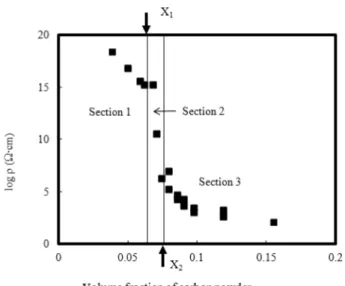
Fig. 1 shows the changes of resistivity( ρ) as a function of carbon powder volume fraction for the carbon powder- filled polystyrene matrix composites. The resistivity was taken under the electric field of 0.5 kV/cm. It is seen that there are three volume fraction sections each with a characteristic change in resistivity. At low volume frac- tions, from zero to the volume fraction denoted as X
1, the resistivity is almost the same as that of polystyrene.
2)In the range of the volume fraction from X
1to X
2, the change in resistivity is more than 3 times. The change in resistivity above X
2gets smaller for filling carbon pow- der than that in the range from X
1to X
2. Here, we shall divide the carbon powder volume fraction into three sections according to the above discussion: the section 1 is from zero to X
1, the section 2 is from X
1to X
2, and the section 3 is above X
2. Values for X
1and X
2are listed in Table 1. The feature of the dependence of X
1and X
2is similar to that reported for carbon powder-filled poly- ethylene matrix.
14,15)Namely, higher structure carbon pow- der shows lower values X
1and X
2than lower structure
Fig. 1. Resistivity of carbon powder-filled polystyrene matrix composites as a function of carbon powder volume fraction.
Table 1. Values of X1 and X2 in carbon powder-filled polystyrene matrix composites.
Composites
X1 0.064
X2 0.075
carbon powder.
Fig. 2 shows electric field dependence of current for section 1, 2 and 3 in Fig. 1. Ohmic current behaviors for the electric field take place at first upon filling of carbon powder. Although non-ohmic current behaviors for the applied field have been presented on polystyrene films, the ohmic dependence of current on electric field has usually been observed for low applied fields such as shown in this figure.
14,15)In section 2, current is extremely small at low electric field and show a sharp increase with increasing applied field. The ohmic dependence of re- sistivity on applied field appears again in section 3, and resistivity is less than about 10
5Ω · cm.
Usually, the change in conductivity( σ) after the per- colation threshold(X
c) is expressed by equation (1)
σ
∝(X - X
c)
t(1)
Where t is the critical exponent of conductivity.
10,15)In Fig. 3, ρ is shown as a function of X-X
1when X
1is
assumed to be X
cin equation (1). The relationship bet- ween ρ and X-X
1can be expressed as a straight line on a log-log scale. The value of t is estimated from the slope and is indicated in this figure(t = 9.7). It is seen that the estimated value of t is larger than 8.
Fig. 4 shows as ρ as a function of X-X
2, when X
2is taken as X
c. The relationship between ρ and X-X
2can also be expressed as a straight line. The values of t estimated from the slope are 1.9 and are satisfied with the universal law of conductivity.
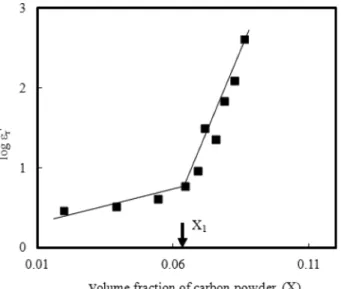
11,15,16)Relative permittivity( ε
r') of carbon powder-filled poly- styrene matrix composites is shown as a function of X in Fig. 5. At first ε
r' shows an increase with increasing X up
Fig. 2. Applied field dependence of current for section 1, 2 and 3in Fig. 1.
Fig. 3. Resistivity as a function of X-X1 in carbon powder-filled polystyrene matrix composites(when X1 is assumed to be Xc in σ∝(X-Xc)t.
Fig. 4. Resistivity as a function of X-X2 in carbon powder-filled polystyrene matrix composites(when X2 is assumed to be Xc in σ∝(X-Xc)t.
Fig. 5. Dependence of relative permittivity on volume fraction of the carbon powder in carbon powder-filled polystyrene matrix com- posites.
angle of the impedance of the composites above X
2becomes smaller than the readability of the LCR meter.
15)In section 2, resistivities show a change of more than 3 times and currents present a non-ohmic behavior(Fig. 1 and Fig. 2). These behaviors may be explained by the fluctuation-induced tunneling conduction, which has been presented by Shin
10,14)and Sheng.
18)Although this tun- neling conduction takes account of only a single tunneling junction which governs the entire conduction current, it has been successful for explaining the temperature de- pendence of resistivity and the electric field dependence of current for the composites of polystyrene and carbon powder.
10)By using this tunneling conduction model, the non- ohmic current behavior for the electric field and the sharp decrease in resistivity with filling of carbon powder in section 2 are discussed. Important parameters of tunneling conduction model are barrier height(h), gap width( ω) and tunneling area(s).
18)Recently, the work function of carbon powders is known to be 4.3~4.8 eV,
15)and the energy gap of polystyrene is approximately 7.4 eV. If the Fermi energy of polystyrene exists at the center of the energy gap, the h of tunneling is approximately 3.7 eV. The value of h decreases by the electron affinity of polystyrene, which is not well estimated. Therefore, we use the value of h in the range of 1~3 eV in order to know how h influences the magnitude of current. Other parameters of ω and s are chosen by referring to the calculated results by Shin.
15)By fitting the tunneling conduction model to the temperature dependence of resistivity for the com- posites of polyethylene and carbon powder, Shin
15)have
ω is assumed in the range of 2~10 nm in our calculation (s is assumed as 0.1~100 nm
2).
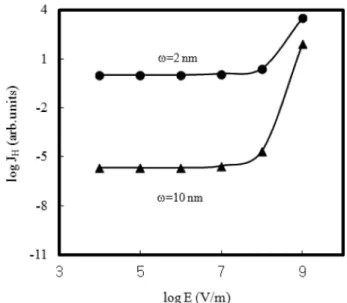
Fig. 6 shows an example of the electric field depen- dence of current with a parameter of ω, using equation (2)
18).
The details of the parameters required for this calcu- lation are found in the reference 15 and 19. It is seen that the current decreases by more than 5 times for increasing ω and the rate of current decrease becomes smaller with a wider ω. It seems to be reasonable to use the fluctuation- induced tunneling conduction model to explain the electric field dependence of current and the large change in resistivity for the filling carbon powder in section 2.
However, the electric fields used in Fig. 6 are much larger than the apparent electric field(E) shown in Fig. 2.
From another point of view, the electric field at the tunneling gap is much larger than E because the average size of the conducting clusters is much larger than the average tunneling width [18]. Therefore, it is reasonable to expect that the actual electric field at the tunneling gap is larger than the apparent electric field by more than 2 or 3 orders of magnitude.
Dependence of current on h is shown Fig. 7. Although the rate of the decrement of current for increasing h depends on the value of s, it can be seen that current for s = 10 nm
2changes by about 8 orders of magnitude for the range of h.
JH T1 πT---
⎝ ⎠⎛ ⎞
12 ---
dεT
0 τ E( )A
∫
J0(εA+εT) T---εT1 T2 TT1o
---φ ε( A+εT) –
– exp
×
= dεT
τ E( )A
∫
∞ J1(εA+εT)exp⎝⎛–T---εT1 T2⎠⎞∫
0EAdεTJ ε( A–εT)exp⎝⎛–T---εT1 T2⎠⎞+ +
Fig. 6. Dependence of current density on electric field with a parameter of gap width. Current density is normalized with the current density at E = 104V/m and s = 2 nm.
Fig. 7. Dependence of current density on barrier height with a para- meter of tunneling area. Current density is normalized with the current at h = 1 eV, s = 0.1 nm2.
As shown in Fig. 2, the ohmic dependence of current on electric field has been observed in sections 1 and 3.
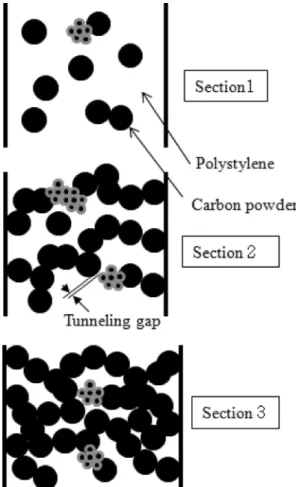
From the above discussions, a change of carbon powder dispersion in polystyrene with filling can be schematic descriptions as shown in Fig. 8.
20)The black circle symbol represents the carbon powder or its aggregate. For low carbon powder filling in section 1, carbon powder aggre- gates exist as a sparse distribution in the polystyrene matrix, leading to extremely high resistivities and a small rate of growth of relative permittivity. In section 2, some of carbon powder aggregates closely contact each other and others form relatively large tunneling gaps. As shown in Fig. 5, a rapid rate of growth in relative permittivity has been observed in section 2, which may primarily be related to changes in the tunneling gap width and the surface area of the tunneling gap. In section 3, the tunneling gaps in section 2 start to change into ohmic contacts by eliminating the polystyrene, leading to a small resistivity. Therefore, an extremely small phase angle of the low impedance makes it impossible to measure relative permittivity.
The values of t estimated at X
1are larger than 8(Fig.
3). On the other hand, the values estimated at X
2are
satisfied with the universal law of conductivity(Fig. 4).
However, it has been found that the values of t estimated at X
1are larger than 2 and that those estimated at X
2are satisfied with the universal law. X
1is called the percolation threshold by Song.
8)This seems to explain the large critical exponent of conductivity estimated at X
1, leading to the conclusion that X
1is the percolation threshold. However, the existence of the tunneling gap in section 2 has been experimentally confirmed and relative permittivity was observed even above X
1.
From the point of view of the value of t, the mech- anism of changing the tunneling gap and the relatively large gaps(Fig. 8) into ohmic contacts seems to correspond to that of connecting conductive phases above the per- colation threshold in a random resister network.
10,14,15)Therefore, it is reasonable to conclude that the percolation threshold should be defined at the volume fraction where the break-point from tunneling to ohmic conduction mechanisms takes place.
4. Conclusion
It is concluded that the change of percolation threshold is defined at the volume fraction where the ohmic current behavior appears after the disappearance of the non- ohmic current behavior. Although the break-point of re- sistivity from insulating to non-insulating properties of the carbon powder-filled polystyrene matrix composites is usually called the percolation threshold, it is found that the tunneling gap exists even beyond this break-point and interrupts to form infinite clusters of carbon powder ag- gregates. Relative permittivity has also been observed even above this break-point. It is further found that the critical exponent of conductivity estimated by another break-point of resistivity from the tunneling to ohmic conduction is satisfied with the universal law of con- ductivity. It has been considered that the mechanism for changing the gaps between the carbon powder aggregates into ohmic contacts is the same as that of connecting conducting phases above the percolation threshold in a random resister network system. This observation then lends further support to my interpretation of the results since, according to the above discussion, the carbon powder structure determines the competition between the neighbor closet-distance distribution function and the two particle(carbon powder) conductance function.
References
1. G. E. Pike and C. H. Seager, Phys. Rev. B, 10, 1421 (1974).
2. R. Mukhopadhyay, S. K. De and S. Basu, J. Appl.
Fig. 8. Schematic descriptions of carbon powder dispersion in polystyrene matrix for section 1, 2 and 3.
J. B. Donnet, Rubber Chem. Tech., 50, 735 (1977).
4. R. Matsushita, M. Senna and H. Kuno, J. Mater. Sci., 12, 509 (1977).
5. K. Miyasaka, K. Watanabe, E. Jojima, H. Aida, M.
Sumita and K. Ishikawa, J. Mater. Sci., 17, 1610 (1982).
6. S. Nakamura, K. Saito, G. Sawa, K. Kitajima and A.
Snarskii, Trans. IEE Jpn. 117-A 371 (1997).
7. J. P. Reboul, Carbon Black-Polymer Composites, p.80- 120, Marcel Dekker, New York (1982).
8. Y. Song, T. W. Noh, S. I. Lee and J. R. Gaines, Phys.
Rev. B, 33, 904 (1986).
9. I. Balberg, Phys. Lett., 59, 1305 (1987).
Theory, p.21-61, Tayler & Francies, London (1992).
12. M. J. Kim and J. B. Yoo, Electron Mater. Lett., 4, 57 (2008).
13. G. Kuhner and M. Voll, Carbon Black, p.8-23, Marcel Dekker, New York (1992).
14. S. G. Shin, Electron. Mater. Lett., 7(3), 249 (2011).
15. S. G. Shin, Kor. J. Met. Mater., 20(5), 271 (2010).
16. S. Kirkpatrick, Rev. Mod. Phys., 45, 574 (1973).
17. S. G. Shin, Kor. J. Met. Mater., 49(10), 805 (2011).
18. P. Sheng, Phys. Rev. B, 21, 2180 (1980).
19. T. Tanaka, J. Appl. Phys., 44, 2430 (1973).
20. S. G. Shin, Electron. Mater. Lett., 6(2), 65 (2010).