Effects of Sensory Integration Therapy with Sibling on Play Level and Time for Children with Disabilities
Ki-Yeon Chang, OT, Ph.D Ki-Jong Kim, PT, Ph.D
ǂDept. of Occupational Therapy, Woosong University, Professor
Abstract
Purpose : There is a lack of research on this field in the Republic of Korea, especially those that have seen the effect of interaction between siblings through sensory integration therapy (SIT). Therefore, this study sought to find out the effectiveness of SIT with siblings through the Revised Knox Preschool Play Scale (RKPPS) and playtime.
Methods : The experimental group consisted of 10 disabled children, and 10 normal siblings of the disabilities joined the program as a helper. In addition, 10 children with disabilities conducted the intervention as a control group. The difference between the experimental group and the control group is whether they participate with their sibling or not during the intervention period. The present study was conducted a SIT for 40 minutes per week for the experimental and the control group and then had 10 minutes of an interview with the parents of children with disabilities. A total of 10 programs were implemented for 10 weeks.
Results : The experimental group showed statistically significant differences in space management, material management, pretense/symbolic, participation, and total scores. The control group showed significant differences between pre and post results in the participation and the total scores. The experimental group and the control group showed significant differences in the pre-post comparison results. The comparison of post-intervention between both groups of the RKPPS and playtime results showed a statistically significant increase in the experimental group.
Conclusion : The sibling SIT showed better play level and time than the individual therapy. However, comparisons before and after the intervention in the level of play showed significant results only in participation and total scores in the control group.
Clinically, it is recommended to make good use of sibling relationships when applying SIT, and if that is not possible, continuous observation is needed that children who received treatment become familiar with the environment in which they can be treated.
Key Words : play level, playtime, revised knox preschool play scale, sensory integration therapy, sibling
⧧
Corresponding author : Ki-Jong Kim, [email protected]
1)
Received : April 27, 2021 | Revised : May 24, 2021 | Accepted : June 11, 2021
Ⅰ . Introduction
The beginning of human relationships is born in the family, and it is the brotherhood that accounts for an important part. These siblings have affected both positive and negative effects on relationship building. Especially for children with disabilities, sibling relationships have a greater impact. For example, a self-reported study found that children with autism spectrum disorder (ASD) might suffer from sibling relationships, resulting in psychosocial difficulties (Toseeb et al., 2020). On the contrary, good sibling relationships have a positive effect on children's growth and social life.
Ayres' Sensory Integration Therapy (SIT) is the most frequently used treatment in pediatric occupational therapy (Schoen et al., 2019). One area in which this treatment is used is the ASD. According to one Internet survey, the approaching was the third most described treatment (Green et al., 2006; Iwanaga et al., 2014). SIT is a neurological process for sensory information, and when problems arise in this area, purposeful behaviors are hindered (Pfeiffer et al., 2011; Schaaf & Miller, 2005; Watling & Dietz, 2007).
Play is essential in preschool because it stimulates cognitive, emotional, language, physical, sensory, and social development (Lifter et al., 2011). To be more specific, it enables understanding and assimilation of culture.
Furthermore, learning, and problem-solving from the play are making the integration of environmental information, the composition of mental expressions, and the flexibility of thinking. Playful activities connect and bond among participants even if this is only short time (Sposito et al., 2019). Through the play, the child can communicate anxiety, fear, gain control of the situation, and experience other emotions such as joy, success, and frustration; these are various experiences that will help the structure of the personality (Gariépy & Howe, 2003). This play prepares children for their future work by increasing attention, stimulating self-esteem, and helping them develop their
relationship of trust. It will have a more positive effect if children have a colleague when they participate in the play together.
As play is very important and relates to child development, it is possible to measure the stage of development of a child by applying a play assessment tool (Case-Smith & O’Brien, 2010). What this means is that if there are standardized tools for evaluating play, the most effective treatment can be selected or monitored for children. One of the best tools is the Revised Knox Preschool Play Scale (RKPPS). The RKPPS is highly reliable because it has been evaluated on a variety of children and modified based on the results (Howard, 1986;
Kielhofner et al., 1983; Morrison et al., 1991; Restall &
Magill-Evans, 1994). However, there is a lack of research on this field in the Republic of Korea, especially those that have seen the effect of interaction between siblings through SIT. Therefore, this study sought to find out the effectiveness of the sibling SIT through RKPPS and playtime.
Ⅱ . Methods
1. Study participants and design
The study had a total of 20 participants. The experimental group consisted of 10 disabled children, and 10 normal siblings of the disabilities joined all the programs at the same SIT room as a helper. In addition, 10 children with disabilities conducted the intervention as a control group. The difference between the experimental group and the control group is whether they participate with their sibling or not during the intervention period. The criteria for selection of research subjects are as follows.
First, all subjects were preschoolers, ages 3~7. Second, they
were disabled children using a child development center for
the treatment. Third, all participants in the study should
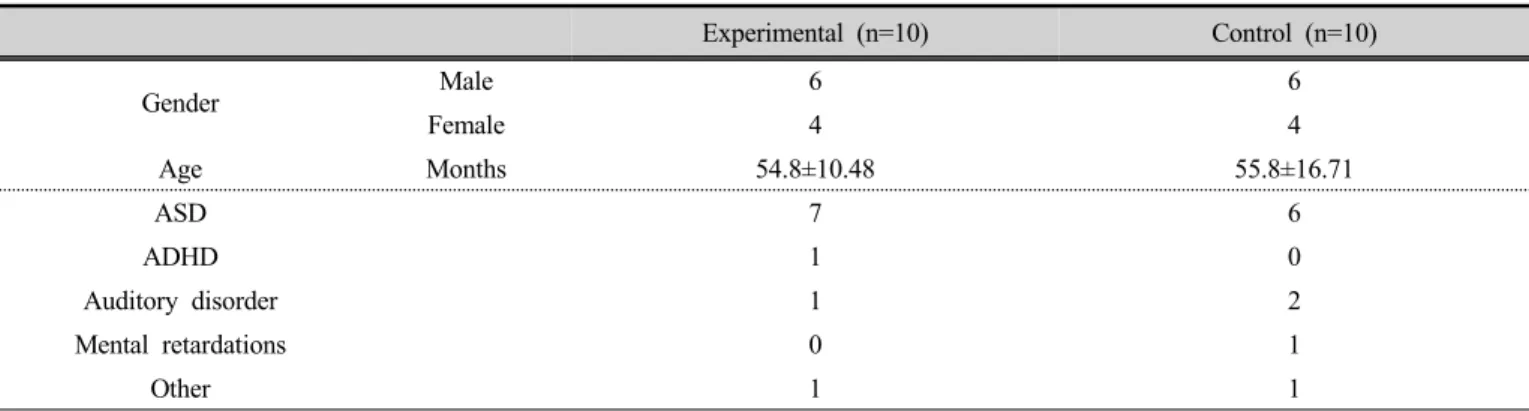
have their siblings. Fourth, the children involved in the study received parental consent. The general characteristics are as follows (Table 1). Prior to participation in the study, the purpose of the study and its process were explained to the child's primary caregiver and signed a consent form.
Prior to starting the experiment, all research procedures were approved by the institutional review board of Woosong University (IRB No. 1041549-160412-SB-27).
Since the study subjects were selected, the experimental and the control groups were randomly allocated according to the order of study registration. RKPPS and playtime with sibling interaction were measured before and after intervention. Both the experimental and the control group conducted in situations where disabled children, and their non-disabled siblings were in the same place in order to equalize the measurement environment.
Experimental (n=10) Control (n=10)
Gender Male 6 6
Female 4 4
Age Months 54.8±10.48 55.8±16.71
ASD 7 6
ADHD 1 0
Auditory disorder 1 2
Mental retardations 0 1
Other 1 1
ASD; autism spectrum disorder
Table 1. General characteristics of the subjects (n=20)
2. Sensory integration therapy with sibling
The research place was a SIT room in a child development center. Present study was conducted a SIT for 40 minutes per week for the experimental and the control group and then had 10 minutes of an interview with the parents of children with disabilities. A total of 10 programs were implemented for 10 weeks. The intervention program provided a selection of plays according to the neurological needs of each child based upon the theory of SIT. The main sensory activities were vestibular-proprioceptive, proprioceptive-vestibular, tactile-proprioceptive-vestibular, and tactile-fine motor. Before and at the end of all programs, researchers wrote the RKPPS and checked playtime while all participants enjoyed the play without disturbance.
3. Measure tools and method
1) Revised knox preschool play scale; RKPPS The RKPPS was used to evaluate the level of play in children. This tool has used a lot to evaluate play in the domestic occupational therapy field, and according to a prior research, 30 out of 32 therapists used the RKPPS and 2 used test of playfulness (Lee et al., 2018). The interrater (r=.88, p=.0001) and test-retest reliability (r=.91, p=.0001) of this measurement tool were very high (Harrison &
Kielhofner, 1986). This assessment is evaluated by observing the play of children aged 0 to 6 in a natural environment. The scale is measured every six months from 0 to three years of age, and one-year intervals from three-six years of age, and is examined for four dimensions:
space management, material management, pretense/symbolic,
and participation.
Spatial management includes gross motor and interest as subtopics, seeing how children use the space and body that surrounds them. Material management includes items such as manipulation, construction, purpose, and attention to see if the materials in the surrounding environment are dealt with by a child and used for the intended purpose. The pretense/symbolic includes imitation and dramatization as sub-items, looking for the way children learn from the world through imitation and the ability to separate and understand reality through impersonation. Participation refers to the amount and manner of social interactions in children and includes type, cooperation, humor, and language as sub-categories. The overall age of play is calculated from the average of each dimension score, and the dimension score is determined by the average of each sub-item.
2) Playtime with sibling interaction
The place of measurement was a group therapy room in the children's development center, where various rides and mats for children's age were installed. All groups were evaluated at the same place. In this study, children with disabilities and non-disabled siblings were allowed to perform indoor free play activities for 50 minutes to measure playtime, and a researcher could measure the time when interactions were conducted and maintained during observation. One researcher observed all groups so that time could be measured in a consistent manner. A brief sketch, photography, and video shooting were performed by the researcher. The main situation and interaction between the brothers were recorded during the observation time.
The time measurement method used a 10-second partial interval recording method with an 8-second observation/2-second writing. The playtime was calculated when interactions were attempted to measure observations of sibling social interactions, positive response behaviors (i.e., response, laughter) appeared within 5 seconds of the start action, and the interactions that occurred in the
previous observation (10 seconds) persisted in the following observation interval (Lee & Lee, 2005). The definition of sibling interaction behavior has been revised and used in accordance with this study with some modifications referring to the Shin (2015).
4. Statistical analysis
This study used SPSS version 25.0 (Statistical Package for the Social Sciences; IBM Co., Armonk, NY, USA) for all data for statistical analysis. The general characteristics of the subjects in the study were calculated through descriptive statistics. The data in this study applied nonparametric statistical methods based on normality test results. Wilcoxon signed-rank test was conducted to determine the statistical significance of the RKPPS pre and post results of all subjects. The current study was performed Mann-Whitney U test for the analysis of differences (i.e., (post-pre) values) between the experimental and the control group after the intervention. Alpha value of the significance level was set to 0.05.
Ⅲ . Results
1. An improvement in the level of play
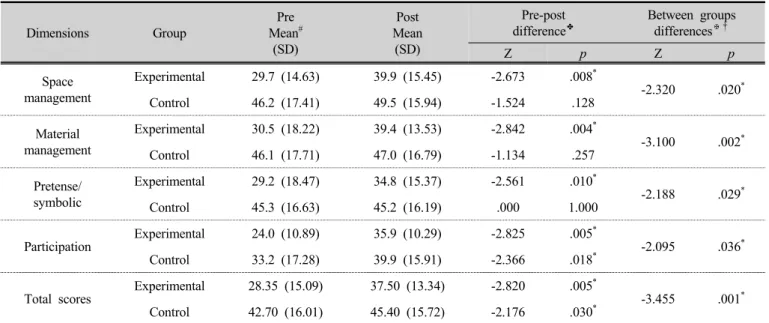
The comparison results of pre and post of the RKPPS in
the experimental group and the control group are as
follows. The experimental group showed statistically
significant differences in space management, material
management, pretense/symbolic, participation, and total
scores (p<.05). The control group showed significant
differences between pre and post results in the participation
and the total scores (p<.05). The comparison of
post-intervention between both groups of all the RKPPS
results showed a statistically significant increase in the
experimental group (p<.05)(Table 2).
2. Playtime with the interaction
The results are as follows for measuring and comparing playtime with the interaction between experimental and control groups. The experimental group and the control
group showed significant differences in the pre-post comparison results (p<.05). The comparison of post-intervention between both groups of playtime results showed a statistically significant increase in the experimental group (p<.05)(Table 3).
Dimensions Group
Pre Mean
#(SD)
Post Mean (SD)
Pre-post difference
✤Between groups differences
✠†Z p Z p
Space management
Experimental 29.7 (14.63) 39.9 (15.45) -2.673 .008
*-2.320 .020
*Control 46.2 (17.41) 49.5 (15.94) -1.524 .128
Material management
Experimental 30.5 (18.22) 39.4 (13.53) -2.842 .004
*-3.100 .002
*Control 46.1 (17.71) 47.0 (16.79) -1.134 .257
Pretense/
symbolic
Experimental 29.2 (18.47) 34.8 (15.37) -2.561 .010
*-2.188 .029
*Control 45.3 (16.63) 45.2 (16.19) .000 1.000
Participation Experimental 24.0 (10.89) 35.9 (10.29) -2.825 .005
*-2.095 .036
*Control 33.2 (17.28) 39.9 (15.91) -2.366 .018
*Total scores Experimental 28.35 (15.09) 37.50 (13.34) -2.820 .005
*-3.455 .001
*Control 42.70 (16.01) 45.40 (15.72) -2.176 .030
**
p<.05,
#play age in month,
✤performed by Wilcoxon signed-rank test,
✠analyzed by Mann-Whitney U test,
†comparison of differences (i.e., (post-pre) values) between both groups after the intervention, SD; standard deviation
Table 2. Comparison of the improvement of play levels in the experimental and the control groups (n=20)
Group
Pre Mean
#(SD)
Post Mean (SD)
Pre-post difference
✤Between groups differences
✠†Z p Z p
Experimental 3.90 (2.95) 10.05 (5.07) -2.668 .008
*-2.153 .031
*Control 3.60 (3.44) 5.10 (3.25) -2.020 .043
**