• 검색 결과가 없습니다.

Differences in Flood-Stress Tolerance among Sprout Soybean Cultivars

N/A
N/A
Protected

Academic year: 2021

Share "Differences in Flood-Stress Tolerance among Sprout Soybean Cultivars"

Copied!
6
0
0

로드 중.... (전체 텍스트 보기)

전체 글

(1)

Differences in Flood-Stress Tolerance among Sprout Soybean Cultivars

Cho, Jin-Woong*

*College of Agricultural and Life Science, Chungnam National University, Daejeon 305-764, Korea

190

Corresponding author: (Phone) +82-42-821-5725 (E-mail) [email protected]

<Received 30 March, 2013; Accepted 13 April, 2013>

ABSTRACT In this study, the response of 22 soybean cultivar sprouts to flooding stress was investigated. After sprouts were subjected to flooding stress for 10 days at the V4-V5 growth stages, their dry weights were compared. All plants were kept in a greenhouse under natural light conditions, an average daytime temperature of 35.6 ± 5.3℃ and an average nighttime temperature of 18.2±1.7°C. Soybeans were grown in a concrete bed filled with silt loam soil. Subjecting plants to flooding stress resulted in a large reduction in plant dry weight, plant height, number of nodes, and number of leaves. Cultivars differed significantly in their responses to flooding stress, as indicated by these characteristics (p<0.05). Soybean cultivars were classified into three groups based on their degree of flood tolerance: strong, moderate, and weak. Hannamkong, Namhaekong, Sobaegnamulkong, and Sorogkong had strong tolerance for flood conditions. Tawonkong, Pureunkong, Eunhakong, Myeongjunamulkong, Doremikong, Saebyeolkong, Paldokong, Sowonkong, Pungsannamulkong, Dagikong, Dachaekong, and Anpyeongkong had weak tolerance for flood conditions.

Keywords : sprout soybean, flooding stress, relative dry weigh

Because soybeans, which has high protein and fat content, are widely used for food, industry and forage, the worldwide production and consumption of soybeans increases every year. However, because of low yield and income per unit area of cultivated soybean and insufficient mechanization of cultivation, the area devoted to the cultivation of soybeans decreased rapidly from 297,000 ha in 1970 to 77,849 ha in 2011. The self-supply of soybeans was, at most, 10.1% in 2011 (MFAFF. 2012.). Therefore, in order to increase the self-supply of soybeans, it is essential to increase the yield per unit area. It is also very important to expand the area in which soybeans are cultivated, apply new cultivation techniques, and develop quality cultivars (Cho and Yamakawa 2006; Cho et al.,

2006; Park, et al. 2001).

Soybean growth and yield are affected by water conditions during the growth season and significant quantities of water are required during the growing season.

Water can improve potential plant growth rates when either too much or too little is available. The effect of too much water is known as aeration stress and too little water was referred to as drought stress (Scott et al. 1989). Plant damage due to flooding is usually attributed to an oxygen supply that is insufficient to maintain root respiration.

Flooding may be detrimental to root growth, nodule formation, and nodule function in soybean (Cho et al., 2006; Sallan and Scott, 1987). The duration of flood conditions also affects soybean plants, as plants subjected to prolonged flooding exhibited in yellowing and abscission of leaves at the lower nodes, stunting, and reduced dry weight and seed yield (Scott et al., 1989).

Plants in early reproductive stages (R1-R5) have greater sensitivity to flooding than those in vegetative stages (emergence-R1). The flooding sensitivity of plants at specific developmental stages throughout the soybean life cycle has not been identified, but the greatest sensitivity to flooding occurs at the R3 stage (Linkemer et al., 1998).

Flooding for as little as 2 days can reduce soybean yield by 18% at the V4 stage (Fehr and Cavines, 1977) and 26%

at the R2 stage (Scott et al., 1989). Yields are generally

similar for plants at different growth stages when flood

periods last 1-2 days. However, when flood periods last

longer than 2 days, the average yield of plants at the R2

stage is about 50% of the yield of non-treated plants

(Griffin & Saxton, 1988). In addition, the determinate

soybean cultivars are more susceptible to prolonged excess

water stress during early reproductive growth than during

early vegetative growth (Griffin & Saxton, 1988). Soybean

(2)

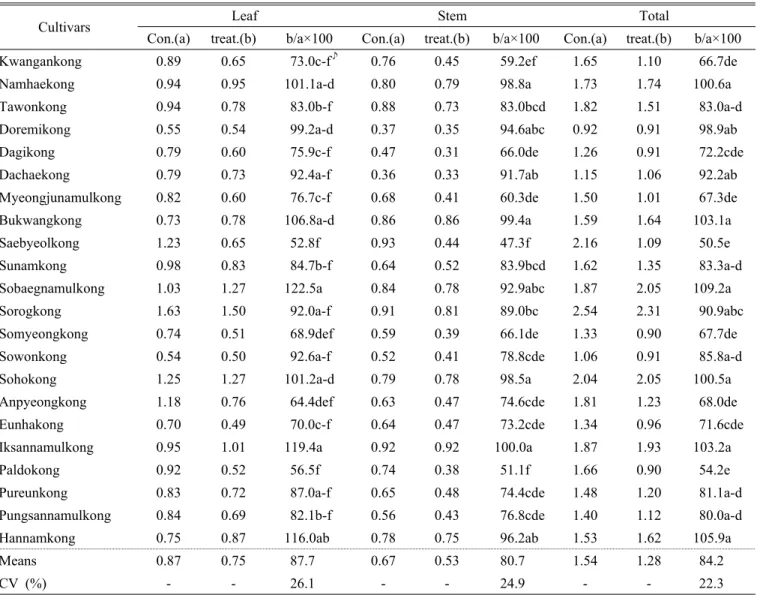
Table 1. Difference of dry weight on leaf and stem among 22 soybean cultivars with flooding for 10 days.

Cultivars Leaf Stem Total

Con.(a) treat.(b) b/a×100 Con.(a) treat.(b) b/a×100 Con.(a) treat.(b) b/a×100

Kwangankong 0.89 0.65 73.0c-f

0.76 0.45 59.2ef 1.65 1.10 66.7de

Namhaekong 0.94 0.95 101.1a-d 0.80 0.79 98.8a 1.73 1.74 100.6a

Tawonkong 0.94 0.78 83.0b-f 0.88 0.73 83.0bcd 1.82 1.51 83.0a-d

Doremikong 0.55 0.54 99.2a-d 0.37 0.35 94.6abc 0.92 0.91 98.9ab

Dagikong 0.79 0.60 75.9c-f 0.47 0.31 66.0de 1.26 0.91 72.2cde

Dachaekong 0.79 0.73 92.4a-f 0.36 0.33 91.7ab 1.15 1.06 92.2ab

Myeongjunamulkong 0.82 0.60 76.7c-f 0.68 0.41 60.3de 1.50 1.01 67.3de

Bukwangkong 0.73 0.78 106.8a-d 0.86 0.86 99.4a 1.59 1.64 103.1a

Saebyeolkong 1.23 0.65 52.8f 0.93 0.44 47.3f 2.16 1.09 50.5e

Sunamkong 0.98 0.83 84.7b-f 0.64 0.52 83.9bcd 1.62 1.35 83.3a-d

Sobaegnamulkong 1.03 1.27 122.5a 0.84 0.78 92.9abc 1.87 2.05 109.2a

Sorogkong 1.63 1.50 92.0a-f 0.91 0.81 89.0bc 2.54 2.31 90.9abc

Somyeongkong 0.74 0.51 68.9def 0.59 0.39 66.1de 1.33 0.90 67.7de

Sowonkong 0.54 0.50 92.6a-f 0.52 0.41 78.8cde 1.06 0.91 85.8a-d

Sohokong 1.25 1.27 101.2a-d 0.79 0.78 98.5a 2.04 2.05 100.5a

Anpyeongkong 1.18 0.76 64.4def 0.63 0.47 74.6cde 1.81 1.23 68.0de

Eunhakong 0.70 0.49 70.0c-f 0.64 0.47 73.2cde 1.34 0.96 71.6cde

Iksannamulkong 0.95 1.01 119.4a 0.92 0.92 100.0a 1.87 1.93 103.2a

Paldokong 0.92 0.52 56.5f 0.74 0.38 51.1f 1.66 0.90 54.2e

Pureunkong 0.83 0.72 87.0a-f 0.65 0.48 74.4cde 1.48 1.20 81.1a-d

Pungsannamulkong 0.84 0.69 82.1b-f 0.56 0.43 76.8cde 1.40 1.12 80.0a-d

Hannamkong 0.75 0.87 116.0ab 0.78 0.75 96.2ab 1.53 1.62 105.9a

Means 0.87 0.75 87.7 0.67 0.53 80.7 1.54 1.28 84.2

CV (%) - - 26.1 - - 24.9 - - 22.3

♪different letters in the same row indicate significant differences at the 0.05 level by DMRT.

genetic lines from southeastern China are adapted to high water table conditions (Ralph, 1983) and appear more tolerant of simulated laboratory flooding than some soybean cultivars from the Midwest (Vantoai et al. 1993).

The flooding tolerance of 84 U.S. soybean cultivars has been fully tested under field conditions (Vantoai et al.

1994). In addition, Choi et al. (1995, 1996) reported the physiological responses of different soybeans under excessive soil water stress. Thus, objectives of this study are to determine the variability among soybean cultivars in flooding tolerance at the V4-V5 growth stage, and to provide basic data to inform parental selection for breeding.

MATERIALS AND METHOD

A concrete bed (11 m×2 m×1 m) in a greenhouse was

filled with silt loam soil. Three seeds of each of 22

soybean cultivars (Anpyeongkong, Bukwangkong, Dachaekong,

Dagikong, Doremikong, Eunhakong, Hannamkong, Iksannamul-

kong, Kwangankong, Myeongjunamulkong, Namhaekong,

Paldokong, Pungsannamulkong, Pureunkong, Saebyeolkong,

Sobaegnamulkong, Sohokong, Somyeongkong, Sorogkong,

Sowonkong, Sunamkong, and Tawonkong) were sown at a

plant density of 50×10 cm. Basal fertilization was applied

to the soil at a rate of 3 kg N, 3 kg P, and 4 kg K per

10 a. Plants were grown under natural photoperiod and

(3)

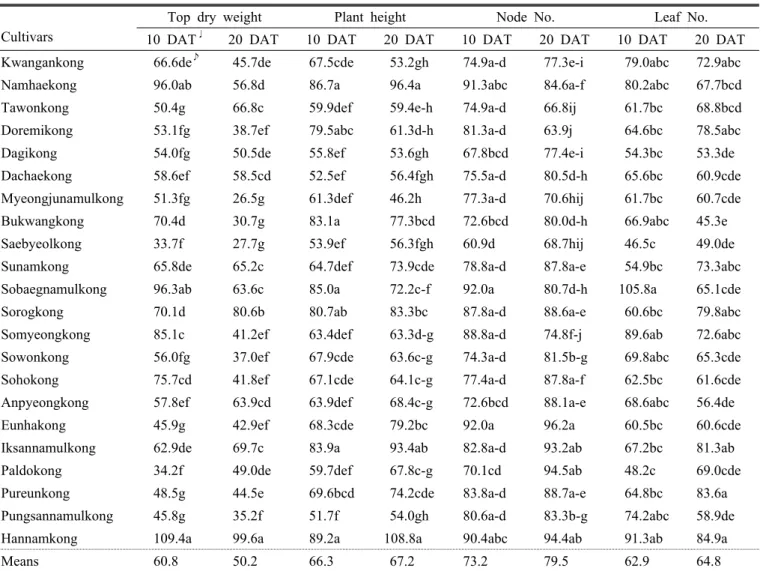
Table 2. The changes in the growth of flooded soybean plants relative the growth of controls (%)for top dry weight, plant height, number of nodes on the main stem, and number of leaves on the main stem among 22 soybean cultivars, 10 and 20 days after the end of a 10-day flood period.

Cultivars

Top dry weight Plant height Node No. Leaf No.

10 DAT

20 DAT 10 DAT 20 DAT 10 DAT 20 DAT 10 DAT 20 DAT

Kwangankong 66.6de

45.7de 67.5cde 53.2gh 74.9a-d 77.3e-i 79.0abc 72.9abc

Namhaekong 96.0ab 56.8d 86.7a 96.4a 91.3abc 84.6a-f 80.2abc 67.7bcd

Tawonkong 50.4g 66.8c 59.9def 59.4e-h 74.9a-d 66.8ij 61.7bc 68.8bcd

Doremikong 53.1fg 38.7ef 79.5abc 61.3d-h 81.3a-d 63.9j 64.6bc 78.5abc

Dagikong 54.0fg 50.5de 55.8ef 53.6gh 67.8bcd 77.4e-i 54.3bc 53.3de

Dachaekong 58.6ef 58.5cd 52.5ef 56.4fgh 75.5a-d 80.5d-h 65.6bc 60.9cde

Myeongjunamulkong 51.3fg 26.5g 61.3def 46.2h 77.3a-d 70.6hij 61.7bc 60.7cde

Bukwangkong 70.4d 30.7g 83.1a 77.3bcd 72.6bcd 80.0d-h 66.9abc 45.3e

Saebyeolkong 33.7f 27.7g 53.9ef 56.3fgh 60.9d 68.7hij 46.5c 49.0de

Sunamkong 65.8de 65.2c 64.7def 73.9cde 78.8a-d 87.8a-e 54.9bc 73.3abc

Sobaegnamulkong 96.3ab 63.6c 85.0a 72.2c-f 92.0a 80.7d-h 105.8a 65.1cde

Sorogkong 70.1d 80.6b 80.7ab 83.3bc 87.8a-d 88.6a-e 60.6bc 79.8abc

Somyeongkong 85.1c 41.2ef 63.4def 63.3d-g 88.8a-d 74.8f-j 89.6ab 72.6abc Sowonkong 56.0fg 37.0ef 67.9cde 63.6c-g 74.3a-d 81.5b-g 69.8abc 65.3cde Sohokong 75.7cd 41.8ef 67.1cde 64.1c-g 77.4a-d 87.8a-f 62.5bc 61.6cde

Anpyeongkong 57.8ef 63.9cd 63.9def 68.4c-g 72.6bcd 88.1a-e 68.6abc 56.4de

Eunhakong 45.9g 42.9ef 68.3cde 79.2bc 92.0a 96.2a 60.5bc 60.6cde

Iksannamulkong 62.9de 69.7c 83.9a 93.4ab 82.8a-d 93.2ab 67.2bc 81.3ab

Paldokong 34.2f 49.0de 59.7def 67.8c-g 70.1cd 94.5ab 48.2c 69.0cde

Pureunkong 48.5g 44.5e 69.6bcd 74.2cde 83.8a-d 88.7a-e 64.8bc 83.6a Pungsannamulkong 45.8g 35.2f 51.7f 54.0gh 80.6a-d 83.3b-g 74.2abc 58.9de

Hannamkong 109.4a 99.6a 89.2a 108.8a 90.4abc 94.4ab 91.3ab 84.9a

Means 60.8 50.2 66.3 67.2 73.2 79.5 62.9 64.8

All data are shown as flooded plant/control×100(%)

♩ DAT indicates the number of days after the end of flooding.

♪ different letters in the same row indicate significant differences at the 0.05 level by DMRT.

light with an average daytime temperature of 30.6±2.3°C and nighttime temperature of 17.8±2.5°C. The concrete bed was flooded for 10 days when plants were at the V4–V5 of trifoliolate leaf stage. Tap water was added to the concrete bed until it reached 1 cm above the level of the soil surface. Control plants remained well watered (about 60% soil moisture) during the experiment. Experimental design for growth data was a completely randomized design with three replications. Measurements were obtained on the final day of flooding, and again 10 and 20 days after removal of flood conditions. Dry matter, plant

height, leaf area, number of main stem nodes, and number leaves number were measured. To obtain dry matter, all plant parts were dried for 3 days at 80°C and then weighed. Leaf area was measured using a leaf area meter (Licor Model LI-3100, USA).

RESULTS

The dry weight of soybean leaves and stems after 10

days of flooding at the V4–V5 growth stage is shown in

Table 1. Control leaf dry weight for the 22 soybean

(4)

Table 3. Analysis of variance for different characteristics of 22 soybean cultivars 10 and 20 days after the end of a 10-day flood period.

Source df

10 DAT

20 DAT

Leaf D.W.

Stem D.W.

Plant

height Leaf no. Node no.

Leaf D.W.

Stem D.W.

Plant height

Leaf no.

Node no.

Cultivars 21 ** ** ** ** * ** ** ** ** **

CV, % 15.9 15.4 9.8 27.1 13.4 16.4 33.4 11.7 12.8 5.5

*, ** significant at the 0.05 and 0.01 level, respectively.

♩DAT indicates days after removal of flooding.

cultivars ranged from 0.54 g to 1.63 g per plant (average, 0.89 g) and stem dry weight ranged from 0.36 g to 0.93 g per plant (average, 0.66 g). The leaf dry weight of flooded soybean plants ranged from 0.49 g to 1.50 g per plant (average, 0.74 g) and the dry weight stem ranged from 0.31 g to 0.92 g per plant (average, 0.53 g). The waterlogging index (flooding/control×100) ranged from 52.8 to 122.5 (average, 87.7) for leaves and ranged from 47.3 to 100.0 (average, 80.7) for stems. There were significant differences between cultivars in the dry weight of flooded plants.

Table 2 shows changes in the relative growth rate (%) of flooded plants, as compared to controls, of top dry weight, plant height, node number and leaf number at 10 and 20 days after removal of flooding in 22 soybean cultivars. The relative growth rate of top dry weight on 10 and 20 days in 22 soybean cultivars was 60.8 and 50.2, respectively. The dry weight of flooded cultivars relative to that of controls tended to be lower 20 days after the end of the flood period than it was 10 days after the end of flooding. It was ranged from 109.4 (Hannamkong) to 33.7 (Saebyeolkong) on 10 days after removal of flooding, and ranged from 99.6 to 26.5 on 20 days after removal stress.

The height of flooded plants was an average of 67.2% of the height of controls 10 days after flooding and was 73.2% of the height of controls 20 days after flooding.

Similarly, the number of nodes per plant was, on average of 73.2% of the number found on control plants 10 days after flooding and averaged 79.5% of the number found on control plants 20 days after flooding. The number of leaves per flooded plant ranged from 46.5% to 105.8% (average, 62.9%) of the number of leaves per control plant 10 days after flooding, and ranged between 45.3% and 84.8%

(average, 64.8%) 20 days after flooding.

The leaf dry weight, stem dry weight, plant height, number of leaves, and number of nodes of the flooded plants were all significantly different from those of control plants at 10 and 20 days after flooding (p < 0.05 and 0.01, respectively: Table 3). In addition, growth measurements for flooded plants relative to those for controls on the last day flooding were linearly related to relative growth measurements obtained 10 and 20 days after the end of flooding (R

2

=0.23 and R

2

=0.47, respectively; Fig. 1).

Based on these results, the soybean cultivars were classified as having strong, moderate, or weak tolerance for flooding. Hannamkong, Namhaekong, Sobaegnamulkong, and Sorogkong had strong flood tolerance, while Tawonkong, Pureunkong, Eunhakong, Myongjunamulkong, Doremikong, Saebyeolkong, Paldokong, Sowonkong, Pungsannamulkong, Dagikong, Dachaekong, and Anpyeongkong had weak tolerance for flooding (Table 4).

DISCUSSION

This study was conducted to identify soybean cultivars

that were flood-tolerant. The damage to plants caused by

various stresses during the growing season differs between

growth stages. In general, the disaster occurred vigorously

at seedling, early vegetative growth, reproductive growth,

and germination stage Flooding is a major limiting factor

of soybean growth and yield during the rainy season,

which occurs when soybean plants are in the early

vegetative growth stage. Therefore, the reaction of these

plants to flooding during the early vegetative growth stage

is very important. Soybean crops are sensitive crop to

flooding and flooding generally influences growth and

(5)

0 20 40 60 80 100 120

25 50 75 100 125 150

R e l a t i v e g r o w t h ( T E D )

R e la ti v e g ro w th a t 10 a n d 20 D A T

R

2

= 0 .4 7 **

R

2

=0 .2 3 *

Fig. 1. Relationship between relative growth on last day of flooding (TED), at 10 days after of the end of flooding (DAT; closed marks, dotted line), or 20 DAT (open marks, solid line) flooding. *, ** indicate significance at the 0.05 and 0.01 level, respectively.

Table 4. Classification of 22 soybean cultivars according to flood tolerance, as determined by relative growth (in percent of control) after flooding for 10 days.

Degree of tolerance to flooding Cultivars Number of Cultivars

Strong (above 80%) Hannamkong, Namhaekong, Sobaegnamulkong, Sorogkong 4 Moderate (79-60%) Somyeongkong, Sohokong, Kwangankong, Bukwangkong,

Iksannamulkong, Sunamkong 6

Weak (below 59%)

Tawonkong, Pureunkong, Eunhakong, Myeongjunamulkong, Doremikong, Saebyeolkong, Paldokong, Sowonkong, Pungsannamulkong Dagikong, Dachaekong, Anpyeongkong

12 yield when it occurs during the V3-R5 growth stages.

Soybeans subjected to flood conditions while at the vegetative stage have reduced leaf area, dry weight, and plant weight relative to those that are not subjected to flooding (Choi, et. al. 1996; Choi, et al. 1995; Griffin &

Saxton, 1988; Linkemer et al., 1998; Scott et al., 1989).

Griffin & Saxton (1988) stated that flooding soybean plants at the V6 stage resulted in severe chlorosis and stunting after 4 days of standing water. These researchers also reported that crop growth rates are typically affected when flooding stress is applied for longer than 2 days. In the present study, the dry weight of the leaves and stems of 22 soybean cultivars that were subjected to flooding for 10 days relative to those of controls were 87.7% and 80.7%, respectively (Table 1). The reduction in stem growth was more severe than that of leaves. Differences in

X among stressed soybean cultivars at the V4-V5 growth stage were significant (p<0.05) Comparison of the relative growth parameters among the 22 soybean cultivars showed that flooded Hannamkong, Iksannamulkong, Namhaekong, Bukwangkong, and Sobaegnamulkong had growth parameters that were more similar to controls than those of any of the other cultivars. In contrast, flooded Saebyeolkong and Paldokong had growth parameters that were the most different from control growth parameters (measurements for flooded plants were an average of 50.5% and 54.2%, respectively, of control measurements).

On the other hand, previous studies have indicated that soybeans are more sensitive during the early reproductive stage than during vegetative stages (Griffin & Saxtion, 1988; Scott et al., 1989). Grifin & Saxtion (1988) stated that the recovery and yield of soybean flooded was less affected at vegetative stages than when flooding was applied postflowering stages and soybean with flooding at V3–V5 had yield as if it had. Bacanamwo and Purcell (1999) reported that, although 7 days of flooding had no effect on biomass accumulation in soybean plants, biomass accumulation was significantly inhibited after 14 days of flooding.

The soybean cultivars in the present study can be

classified into 3 groups, based on their response to

flooding: (i) a severely decreased soybean cultivars group,

(ii) a soybean cultivars group similar to growth of ending

date, and (iii) a restarting soybean cultivars group (Table

2). The overall growth of flooded soybean plants was

lower relative to the growth controls at 10 days (60.8%)

and 20 days (50.2%) after removal of stress than on last

day of flooding (Table 1, Table 2). Sohokong, Namhae-

kong, Sobaegnamulkong, Myeongjunamulkong, and Somyeong-

(6)

kong should be classified to a severe decreased soybean cultivars group. The dry weight of flooded Hannamkong, relative to the dry weight of controls, was similar at 10 and 20 days after the end of flooding, and it can therefore be classified as a cultivar that did not change relative to controls. Tawonkong, Iksannamulkong, and Sorogkong, should be classified to a growth restarting soybean cultivar group. The results of analysis of variance showed a highly significant difference (p < 0.01 or p < 0.05) in all factors with flooding for 10 days (Table 3).

On the other hand, the coefficient of determination for relative dry weight on the last day of flooding and 10 days after the end of flooding (R

2

=0.23) was lower than that for relative dry weight on the last day of flooding and 20 days after the end of flooding (R

2

=0.47). This analysis was used to classify the tolerance of 22 soybean cultivars to flooding as strong, moderate, or weak. Hannamkong, Namhaekong, Sobaegnamulkong, and Sorogkong had strong tolerance for flooding, while Tawonkong, Pureunkong, Eunhakong, Myeong- junamulkong, Doremikong, Saebyeolkong, Paldokong, Sowonkong, Pungsannamulkong, Dagikong, Dachaekong, and Anpyeongkong had weak tolerance for flooding (Fig. 1, Table 4).

Linkemer et al. (1998) reported significant yield loss when soybean plants in the V2 growth stage were subjected to flooding and stated that waterlogging must be avoided during the early vegetative period (V2) in order to obtain optimal yield. Scott et al. (1989) reported a high significant between yield and canopy height or dry weight to flooding at V4. Although the classification of cultivars into tolerance categories was based only on growth characters, in the present study, the classifications can be used to inform the breeding and cultivation of soybean cultivars that are tolerant to flooding.

REFFERENCES

Bacanamwo, M. and L. C. Purcell. 1999. Soybean root morphological and anatomical traits associated with acclimation to flooding. Crop Sci. 39 : 143-149.

Cho, J. W. and T. Yamakawa. 2006. Effects on growth and seed yield of small seed soybean cultivars of flooding conditions in paddy field. J. Fac. Agr. Kyushu Univ. 51 : 189-193.

Cho, J. W., J. J. Lee, Y. J. Oh, J. D. So, J. Y. Won, and C.

H. Kim. 2006. Soybean growth and yield as affected by

spacing of drainage furrows in paddy field. Korean J. Crop Sci. 51 : 26-31.

Choi, K. J., H. S. Lee, S. D. Kim, and E. H. Hong. 1996. Dry matter and grain yield production of soybean cultivars as affected by flooding at vegetative growth stage and flowering stage. RDA. J. Agri. Sci. 38 : 117-122.

Choi, K. J., S. L. Hong, and Y. W. Kwon. 1995.

Physiological response of soybean under excessive soil water stress during vegetative growth period. Korean J.

Crop Sci. 40 : 595-599.

Griffin, J. L. and A. M. Saxton. 1988. Response of solid-seeded soybean to flood irrigation. II. Flood duration.

Agron. J. 80 : 885-888.

Hwang Y. H. and S. G. Park. 1993. Growth characteristics and yield potentials of soybeans in upland and paddy field.

Korean J. Crop Sci. 38 : 336-342.

Heatherly, L. G. and H. C. Pringle, III. 1991. Soybean cultivars, response to flood irrigation of clay soil. Agron.

J. 83 : 231-236.

Kwon Y. W. and M. K. Lee. 1988. Physiological responses of soybean plants to flooding at the vegetative growth and the flowering stages. Res. Rept. RDA. 31 : 289-300.

Linkemer, G., J. E. Board, and M. E. Musgrave. 1998.

Waterlogging effects on growth and yield components in late-planted soybean. Crop Sci. 38 : 1579-1584.

MFAFF. 2012. Food, agriculture, forestry and fisheries statistical yearbook. Ministry for Food, Agriculture, Forestry and Fisheries.

Park, H. K., Y. J. Oh, H. S. Kim, K. H. Kim, S. K. Suh, and D. Y. Suh. 2001. Future prospects for increase production of soybean. International symposium for

‘Development strategy for self-production of soybean (Glycine max L.). NHAES. RDA. pp. 79-121.

Ralph, W. 1983. Soybeans respond to controlled waterlogging.

Rural Res. 120 : 4-8.

Sallam, A. and H. D. Scott. 1987. Effects of prolonged flooding on soybeans during early vegetative growth. Soil Sci. 144 : 61-66.

Scott, H. D., J. DeAngulo, M. B. Daniels, and L. S. Wood.

1989. Flood duration effects on soybean growth and yield.

Agron. J. 81 : 631-636.

Son B. Y., D. H. Kim, E. S. Kim, S. K. Kim, D. J. Kang, W. K. Shin, and H. S. Lee. 1997. Effect of planting dates and drainage methods on growth and yield of sprout soybeans in cultivated upland from paddy field. Korean J.

Crop Sci. 42 : 323-332.

VanToai, T. T., J. Zhang, and S. K. St. Martin. 1993. RAPD markers of flooding tolerant Chinese soybean germplasm.

Soybean Genetics Newsl. 20 : 153-159.

VanToai, T. T., J. E. Beuerlein, A. F. Schmitthenner, and S.

K. S

T

. Martin. 1994. Genetic variability for flooding

tolerance in soybean. Crop Sci. 34 : 1112-1115.

수치

Table 1. Difference of dry weight on leaf and stem among 22 soybean cultivars with flooding for 10 days.
Table 2. The changes in the growth of flooded soybean plants relative the growth of controls (%)for top dry weight, plant height,  number of nodes on the main stem, and number of leaves on the main stem among 22 soybean cultivars, 10 and 20  days after the
Table 3. Analysis of variance for different characteristics of 22 soybean cultivars 10 and 20 days after the end of a 10-day  flood period
Table 4. Classification of 22 soybean cultivars according to flood tolerance, as determined by relative growth (in percent of  control) after flooding for 10 days.

참조

관련 문서

PH; plant height, LN; leaf number, RL; Rhizome length, LA; leaf area, FW_A; fresh weigh of aerial part, DW_A; dry weight of aerial part, RGR; Relative growth rate of leaf, NAR;