한발 기간에 따른 콩의 생육 특성과 수량 분배 양상
이윤호⋅상완규⋅조정일⋅서명철*1) 농촌진흥청 국립식량과학원 작물재배생리과
(2019년 9월 30일 접수; 2019년 11월 13일 수정; 2019년 11월 20일 수락)
Duration of Drought Stress Effects on Soybean Growth Characteristic and Seed Yield Distribution Patterns
Yun-Ho Lee, Wan-Gyu Sang, Jung-Il Cho and Myung-Chul Seo
*Crop physiology and production, National Institute of Crop Science, Rural Development Administration, 181, Hyeoksin-ro, Iseo-myeon, Wanju-gun, Jeollabuk-do 55365, Republic of Korea
(Received September 30, 2019; Revised November 13, 2019; Accepted November 20, 2019)
ABSTRACT
A semi-greenhouse experiment with field grown soybean (Glycine max L. cv Deawon, Uram, Jinpong, Soyon, Pungsangnamul, and Haewon) was performed in 2018. The experiment was aimed to investigate individual impacts of drought stress on soybean characteristic and seed yield. The three treatments were used in non-water stress (Control) during the soybean growth season, vegetative stage stress (VS), and flowering period stress (FS). Leaf number, LAI, leaf nitrogen concentration, and leaf biomass were decreased by drought at R4. In our study, the number of pods was 33.6% and 40.5% lower, respectively, in control than in VS and FS. In 100 seed weight, was 16.1% and 10.1% lower, respectively, in control than in VS and FS at R8. As a result, seed yield was 39.8% and 45.1% lower, respectively, in control than in VS and FS. Depending on the drought period, Daewon and Haewon showed a large decrease in yield, while Soyon did not change. The results of this study showed that flower and beginning pod setting stage responded more sensitively to the drought period than vegetative stage. Overall, these results demonstrate soybean seed yield formation more sensitive the during the flowing and beginning pod setting stage. We conclude that adequate water supply for pod setting stage, guaranteeing a high seed yield.
Key words: Drought stress, Soybean, Pod number, 100 seed weight, Seed yield
I. 서 론
최근 지구온난화의 진행으로 기후변화가 일어나고 있다. 지구온난화가 현재 속도로 진행된다면 2030년 에서 2055년 사이 온도는 1.5 ℃가 상승될 가능성이 높다(IPCC, 2018).
2018년 우리나라의 온도와 무 강우 일수는 1973년
기상관측이래 최고 기록을 갱신하였다(KMA, 2019).
특히 여름철 장마가 짧아지면서 폭염과 무강우 일수가 동반하면서 농작물 생육에 직접적인 피해를 주었다.
일반적으로 가뭄 발생은 강수 부족, 증발산량 증가 그 리고 토양수분 감소 및 지하수위 감소로 진행된다. 따 라서 무강우 일수가 길어지게 되면 가뭄으로 이어지고 이로 인해 작물 생산과 수량 증가를 저해한다
* Corresponding Author : Myung-Chul Seo ([email protected])
DOI: 10.5532/KJAFM.2019.21.4.269
ⓒ Author(s) 2019. CC Attribution 3.0 License.
(Manavalan et al., 2009). 이러한 가뭄의 영향으로 식 물 생장은 양적 또는 질적으로 차이가 나타난다 (Farooq et al., 2009).
한발은 비생물적 스트레스로 작물의 생육과 수량에 다양한 영향을 준다(Wang et al., 2013). 한발에 의한 작물 수량 감소는 3개의 메커니즘으로 1) 군락 광합성 효율 감소, 2) 유효 광합성 감소, 3) 수확 지수가 감소 하였다(Earl and Davis, 2003). 또한 수분 스트레스는 식물체의 팽압, 증산작용, 기공 전도도 그리고 물 효율 능력을 감소시킨다(Mutava et al., 2015). 그리고 수량 에 영향을 주는 엽면적 확보와 광합성 효율을 저하시 킨다(Wahid and Rasul, 2005). 결국 한발은 작물과 생 육 단계에 따라 수량이 최소 13%에서 최대 92 % 까지 감소를 보인다(Farooq et al., 2009).
콩[Glycine max (L.)]은 기름과 단백질 함량이 높은 작물로서 여름을 대표하는 밭 작물 중의 하나이다. 우 리나라의 콩의 개화기와 착협기는 7월 하순에서 8월 중 순 사이이다. 이 기간은 콩 생육에 있어서 물을 가 장 많이 필요로 하는 시기이다(Souza et al., 2013).
그러나 우리나라에 있어서 이 기간은 장마철이 끝나고 고온과 무 강우일이 증가하여 토양수분이 부족한 상태 로 콩이 성숙하게 되면서 수량 확보에 어려움을 줄 수 있다.
개화기와 착협기에서 수분 스트레스가 발생하게 되 면 수량에 직접적인 영향을 준다(Dybing et al., 1986;
Desclaux and Roumet, 1996). 이시기에 형태적으로 주경장과 분지 및 엽면적이 감소와 생리적으로 임실률 을 저하시킨다(Andriani et al., 1991; Nitami et al., 2013). 콩의 생식 생장 단계에서 한발은 수량에 직접 인 영향을 주는 반면에 영양 생장 단계에서는 수량과 직접 관계가 낮다고 하였다(Eck et al., 1987; Cui et
al., 2019). 한발은 주경장과 주경 마디 수를 적게 하고,
화아분화기에서 개화기까지에는 낙화가 많아지고 결 협률을 저하를 시킨다(Wijewardana et al., 2018). 한 발은 잎에서 협으로 진행되는 탄수화물 동화 작용이 감소하여 질소와 엽록소 함량이 감소시키며(Liu et al., 2004; Ergo et al., 2018), 동화 작용과 뿌리에서의 양 분 흡수를 나쁘게 하여서 약 24-50%의 수량을 이루게 한다(Bashir et al., 2019; Gavili et al., 2019).본 연구는 콩 품종과 한발 기간에 따른 생육특성 , 잎 건물중 및
II. 재료 및 방법
2.1. 최적화 온실 및 작물재배
본 연구는 국립식량과학원(35° 84' 34" N, 127° 04' 84" E) 최적화 온실 25.0m × 9.0m × 7.0m(길이 × 폭 × 높이)로 설계된 시설에서 수행하였다. 최적화 온 실은 반 필드형 온실이다. 온실 내부의 광 투과율을 높이이기 위해 온실 천창은 플랙시글라스(Plexiglas) 두께 16 mm와 측창은 폴리올레핀(Polyolefin)을 피복 하였다. 천창을 제외한 모든 측창은 공기 순환을 위해 상시 개폐하였다. 높은 강수와 태풍 발생시에는 강우 감시 센서에 의해 측창이 자동으로 닫혀지게 되었다.
온실 내부에는 수분 제어를 위해 콘크리트로 만들어진 토양 통 18.5m × 7.0m × 1.0m (길이 × 폭 × 깊이)로 토양 통 내부에는 부직포와 유공관을 설치하였다.
시험 품종은 장류용인 대원콩, 우람콩, 진풍콩 그리 고 나물용인 소연콩, 풍산나물콩, 해원콩을 6월 20일 에 주당 2립씩 파종하였다. 재식 간격은 60cm × 15cm 로 하였다. 사양토인(모래 37.1%와 실트 35.7% 및 점 토 27.2%) 토양 통 안에 시비량은 N-P2O5-K2O를 10a 당 3-3-3.4 kg을 파종전에 전량 시비하였다.
수분 스트레스 처리는 대조구(생육기간 주 2회 관 수)와, VS 처리구(개화기전에서 개화기까지 약 20일 단수) 그리고 FS처리구(개화기에서 착협시까지 약 21 일 단수)로 하였다.
2.2. 생육 조사 방법 및 질소 함량 분석
콩 생육 단계 조사는 Feher et al.(1971)의 기준으로 하였다. 엽의 특성을 조사를 위해 엽이 최대로 전개되 는 R 3.5-4단계(Pedersen, 2004; Tagliapietra et al., 2018)에서 각 처리 당 8주씩 채취하여 엽수, 엽면적, 잎 건물중 및 잎 질소 농도를 조사하였다.
엽수는 복엽이 완전히 전개된 잎을 기준으로 하였 다. 완전히 전개된 복엽을 엽면적 측정기(LI-3100C, LI-COR, Biosciences, Inc., Lincoln, USA)로 엽면적 을 측정하였다. 엽면적이 측정된 엽은 75℃의 항온 건 조기에 72시간 건조 후 건물중을 측정하였다. 건조된 엽의 시료를 곱게 분쇄하여 0.2 g씩 칭량한 후 건식 연소법(Dumas)으로 원소분석기(Elementary, vario MAX cube., Germany)를 이용하여 3 반복으로 질소
Varieties Treatment
Plant height (cm)
Node no (plant-1)
Stem diameter
(mm)
Leaf number (g m-2)
LAI
Leaf nitrogen concentration
(%)
Leaf biomass
(g m-2) DWK♩ Control 71.2a 13.2a 10.4a 588a 8.3a 4.37a 347.9a
VS♪ 86.0a 15.0a 9.2a 322b 4.7b 3.82b 197.4b FS 79.0a 12.5a 8.2a 312b 4.4b 3.45c 193.7b URK Control 80.0a 13.8a 8.0a 249a 3.2a 3.45b 179.7a VS 77.8a 14.3a 7.0a 242a 3.3a 3.39b 148.2a FS 86.7a 15.7a 8.1a 296a 4.4a 3.53a 198.6a JPK Control 64.4a 15.5a 10.6a 476a 7.3a 4.17a 272.3a VS 57.7a 14.8a 7.9a 323b 4.0b 3.46c 140.9b FS 58.6a 15.2a 8.5a 277b 3.7b 3.77b 167.8b SYK Control 73.6a 15.7a 7.9a 571a 4.1a 4.87a 147.3a
VS 58.4b 14.5a 7.4a 396a 3.0a 4.30b 118.8a
FS 70.6a 15.5a 8.4a 448a 3.3a 4.07c 147.0a
PSNK Control 74.0a 17.8a 8.3a 786a 7.2a 4.45a 294.0a VS 65.6a 16.7a 7.4a 350b 3.6b 4.03b 164.5b FS 75.4a 17.5a 7.3a 375b 3.7b 3.98b 174.0b HWK Control 70.7a 16.7a 9.4a 676a 4.9a 4.71a 188.3a VS 41.4b 15.5a 7.4a 595a 3.0a 4.03b 129.7a FS 65.5a 17.7a 9.1a 536a 3.9a 3.93c 185.3a Values not followed by same letters between row are significantly different at P < 0.05
♩Daewonkong: DWK, Uramkong: URK, Jinpongkong: JPK, Soyonkong: SYK, Pungsannamulkong: PSNK, Haewonkong: HWK
♪Vegetative stage stress: VS, Flowering period stress: FS
Table 1. Effect of soybean drought stress plant height, stem diameter, leaf number, LAI, leaf biomass, leaf
nitrogen concentration, and leaf biomass during the R4 stagePlant height (cm)
Node no (plant-1)
Stem diameter
(mm)
Leaf number (g m-2)
LAI
Leaf nitrogen concentration
(%)
Leaf biomass
(g m-2) Varieties DWK♩ 74.1ab 13d 9.9a 450bc 6.4a 3.88c 267.6a URK 85.8a 15cd 8.3a 289c 4.1c 3.45e 184.5bc JPK 62.5d 15bc 9.2a 358bc 5.2a 3.80d 204.9abc SYK 68.6cd 15bc 7.5a 496ab 3.5c 4.41a 137.4c PSNK 72.6bc 17a 7.6a 490ab 4.6ab 4.16b 202.7ab HWK 66.8d 17ab 9.4a 650a 4.3bc 4.22b 194.3bc Treatment Control 72.3a 15a 9.10a 558.1a 8.34a 4.33a 347.9a VS♪ 64.5b 15a 7.70b 371.7b 3.94b 3.84b 178.3b FS 72.6a 15a 8.28ab 374.5b 5.17b 3.80b 212.5b ANOVA
Varieties[V] <0.001 <0.001 0.2402 <0.001 0.0010 <0.001 0.0010 Treatment[T] 0.0088 0.5605 0.0692 <0.001 <0.001 <0.001 <0.001 [V] x [T] 0.0192 0.3402 0.8880 0.1458 0.0039 <0.001 0.0800 Values not followed by same letters between row are significantly different at P < 0.05
♩Daewonkong: DWK, Uramkong: URK, Jinpongkong: JPK, Soyonkong: SYK, Pungsannamulkong: PSNK, Haewonkong: HWK
♪Vegetative stage stress: VS, Flowering period stress: FS
Table 2. Analysis of variance for soybean plant height, node number, stem diameter, leaf number, LAI, leaf
biomass, leaf nitrogen concentration, and leaf biomass during the R4 stage as affected by drought여 주경과 분지로 구분하여 협수와 100립 중 조사 후 종실 수량을 구하였다.
통계 분석은 SAS 9.2를 이용하여 그룹간 유의성 분석은 Tukey 검정(P <0.05)으로 하였고, 분산분석으 로 품종, 처리 그리고 품종 × 처리에 대해 요인분석을 하였다.
III. 결과 및 고찰
3.1. 한발 기간에 따른 생육 특성 변화
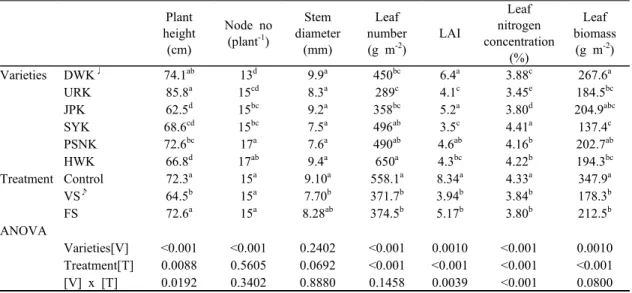
종실비대기에서 콩 품종과 한발 기간은 고도의 유 의성을 보였다(Table 1). 대원콩은 엽수, LAI, 잎 질소 농도 및 잎 건물중이 상당히 유의한 차이를 보였다. 우람콩은 잎 질소 농도가 유의한 차이를 보였다. 진풍
콩은 엽수, LAI, 잎 질소 농도 및 잎 건물중이 유의한 차이를 보였다. 소연콩은 잎 질소 농도가 유의한 차이 를 보였다. 풍산나물콩은 엽수, LAI, 잎 질소 농도 및 잎 건물중이 고도의 유의성을 보였다. 해원콩은 잎 질 소 농도가 고도로 유의하였다.
콩 품종과 한발 기간 및 품종 × 한발 기간에 따라 생육 특성의 상호작용은 고도로 유의한 차이를 보였다 (Table 2). 품종은 경장, 마디수, 엽수, LAI, 질소 농도 및 잎 건물중은 고도로 유의하였다(<0.001). 한발 기 간은 경장, 엽수, LAI, 질소 농도 및 잎 건물중은 고도 로 유의하였다(<0.001). 품종 × 한발 기간은 잎 질소 농도가 고도의 유의성을 보였고(<0.001), 경장, LAI 및 잎 건물중과는 유의하였다. 광합성에 영향을 주는 LAI는 대조구와 대비하여 VS와 FS는 각각 52.8%와
Varieties Treatment
Mains stems Branches Total
Pods no (m-2)
100-seed weight
(g)
Pods no (m-2)
100-seed weight
(g)
Pods no (m-2)
Seed pod-1
100-seed weight
(g)
Yield (g m-2) DWK♩ Control♪ 599.3a 25.0a 402.6a 27.1a 1001.9a 1.3a 26.0a 260.9a
VS 345.3b 21.0b 195.2c 17.9c 540.6b 1.5a 19.4c 105.0b FS 254.7b 22.1b 306.3b 22.7b 561.0b 1.2a 22.4b 125.5b URK Control 426.8a 25.3a 253.5a 21.5a 680.3a 1.6a 23.4a 159.2a VS 397.3a 20.3b 424.8a 19.9a 822.1a 1.0b 20.1b 165.5a FS 280.3b 21.9b 160.0b 17.6b 440.3b 1.4b 19.7b 86.7b JPK Control 460.7a 19.0a 308.1a 17.9a 768.8a 1.4a 18.4a 141.7a
VS 366.3a 15.1b 180.4b 15.5b 546.8b 1.5b 15.3b 83.7b FS 315.1b 18.1a 172.0b 17.8a 487.1b 1.7a 18.0a 87.6b SYK Control 479.8a 12.4a 630.0a 11.0a 1,109.8a 0.8a 11.7a 129.6a
VS 348.8b 12.2a 454.6a 11.0a 803.3a 0.8a 11.6a 93.2a FS 449.1a 11.2b 548.1a 10.2b 997.2a 0.8b 10.7b 106.a PSNK Control 683.9a 10.7a 496.7a 12.8a 1,180.6a 1.3a 11.8a 138.4a
VS 542.5ab 9.4c 449.6a 9.4c 992.1ab 1.1c 9.4c 93.3b FS 409.8b 10.6a 345.4a 10.9b 755.3b 1.2b 10.7b 81.1b HWK Control 891.3a 9.2a 1,381.0a 9.5a 2,272.3a 0.7a 9.4a 212.6a
VS 403.1b 9.1a 544.8b 9.0a 947.8b 0.8a 9.0a 86.2b FS 411.6b 9.0a 520.3b 9.1a 931.9b 0.9a 9.0a 84.0b Values not followed by same letters between row are significantly different at P < 0.05
Table 3. Effect of soybean drought stress on plant height, node number, pods number, 100 seed weight, and
yield (R8)38.0%가 감소하였고, 대조구에 비하여 VS와 FS는 각 각 11.3%와 12.2%가 감소하였으며, 잎 질소 농도는 잎 건물중은 대조구와 대비하여 VS와 FS는 48.7%와 38.9%가 감소하였다.
콩 종실비대기의 LAI와 잎의 질소 농도는 수량과 직간접적인 관계가 있다고 하였다(Rotundo et al., 2009). 본 연구에서 한발은 콩의 엽수, LAI, 잎 질소 농도 및 건물중에 영향을 주었다. 한발 스트레스로 인 해 잎 급격하게 잎이 노화가 되면서 LAI와 잎 건물중 감소와 함께 콩의 질소고정 효소에 부정적인 영향을 주어 잎의 질소 농도와 축적을 감소시킨다고 하였다 (Andriani et al., 1991; Streeter, 2003; He et al., 2017;
Wijewardana et al., 2018).
3.2. 수량 구성 요소와 종실 수량
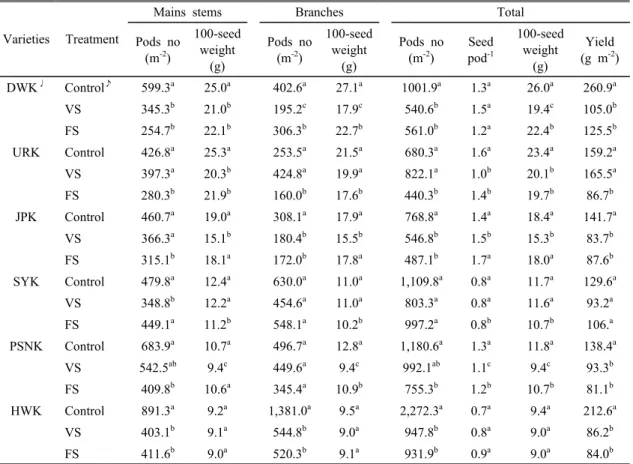
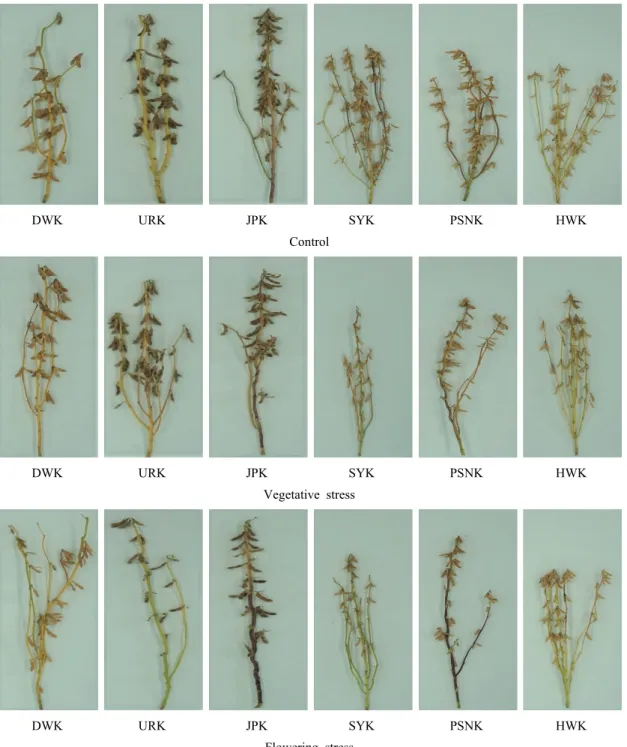
최종 수확한 품종에 따라서 한발 기간은 주경의 협 수와 100립 중 그리고 분지의 협수와 100립 중 및 종 실 수량은 고도의 유의성을 보였다(Table 3; Fig. 1).
대부분의 품종에서 대조구와 대비하여 VS와 FS는 주
경과 분지 각각의 협수와 100립 중 및 수량이 크게 감소하였다. 특히 대원콩과 해원콩이 수량 감소 폭이 컸다. 그러나 소연콩은 전체 협수와 종실 수량은 차이 가 없었다.
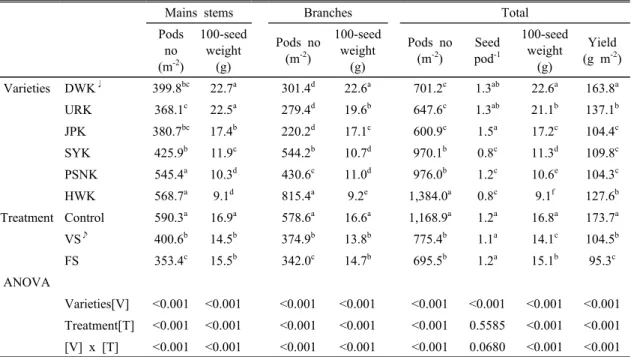
최종 수확한 품종과 한발 기간 및 품종 × 한발 기간 에 따른 수량구성요소와 종실 수량의 상호작용은 고도 의 유의성을 보였다(Table 4). 품종과 주경의 협수와 100립 중 그리고 분지의 협수와 100립 중 및 종실 수 량은 고도로 유의하였다(<0.001). 한발 기간과 주경의 협수와 100립 중 그리고 분지의 협수와 100립 중 및 종실 수량은 유의하였으나, 협 당 립수는 유의하지 않 았다. 품종 × 한발 기간은 협 당 립수를 제외한 수량 구성 요소는 고도의 유의성을 보였다. 한편 용도에 따 라 전체 협수는 장류용보다는 나물용이 높았고, 100립 중은 나물용보다는 장류용이 높았다. 최종 수확한 면 적 당 협수는 대조구에 비하여 VS와 FS가 각각 33.6%
와 40.5%가 감소하였다. 100립 중은 대조구와 대비하 여 VS와 FS는 각각 16.1%와 10.1%가 감소하였다.
주경의 100립 중이 분지의 100 립 중 보다는 높았는데
Mains stems Branches Total
Pods no (m-2)
100-seed weight
(g)
Pods no (m-2)
100-seed weight
(g)
Pods no (m-2)
Seed pod-1
100-seed weight
(g)
Yield (g m-2) Varieties DWK♩ 399.8bc 22.7a 301.4d 22.6a 701.2c 1.3ab 22.6a 163.8a URK 368.1c 22.5a 279.4d 19.6b 647.6c 1.3ab 21.1b 137.1b JPK 380.7bc 17.4b 220.2d 17.1c 600.9c 1.5a 17.2c 104.4c SYK 425.9b 11.9c 544.2b 10.7d 970.1b 0.8c 11.3d 109.8c PSNK 545.4a 10.3d 430.6c 11.0d 976.0b 1.2c 10.6e 104.3c HWK 568.7a 9.1d 815.4a 9.2e 1,384.0a 0.8c 9.1f 127.6b Treatment Control 590.3a 16.9a 578.6a 16.6a 1,168.9a 1.2a 16.8a 173.7a VS♪ 400.6b 14.5b 374.9b 13.8b 775.4b 1.1a 14.1c 104.5b FS 353.4c 15.5b 342.0c 14.7b 695.5b 1.2a 15.1b 95.3c ANOVA
Varieties[V] <0.001 <0.001 <0.001 <0.001 <0.001 <0.001 <0.001 <0.001 Treatment[T] <0.001 <0.001 <0.001 <0.001 <0.001 0.5585 <0.001 <0.001 [V] x [T] <0.001 <0.001 <0.001 <0.001 <0.001 0.0680 <0.001 <0.001 Values not followed by same letters between row are significantly different at P < 0.05
♩Daewonkong: DWK, Uramkong: URK, Jinpongkong: JPK, Soyonkong: SYK, Pungsannamulkong: PSNK, Haewonkong: HWK
♪Vegetative stage stress: VS, Flowering period stress: FS
Table 4. Analysis of variance for soybean pod number, 100 seed weight, seed pod and yield as affected by
drought (R8)DWK URK JPK SYK PSNK HWK Control
DWK URK JPK SYK PSNK HWK
Vegetative stress
DWK URK JPK SYK PSNK HWK
Flowering stress
Daewonkong: DWK, Uramkong: URK, Jinpongkong: JPK, Soyonkong: SYK, Pungsannamulkong: PSNK, Haewonkong: HWK
Fig. 1. Effect of drought stress regimes on stem status and pods at R8.
Ergo et al., 2018). 따라서 안정적인 콩 생산을 위해서 는 면적 당 협수의 확보가 중요한 한데, 이는 주경과 분지 발달에 의해 결정된다고 하였다(Ahmed et al., 2010; Nitami et al., 2013). 그러나 한발은 낙화수 증 가와 함께 결협률을 감소시켜 착협수 확보에 어려움을 준다 하였다(Frederick et al., 2001; Nitami et al., 2013). 특히 FS의 한발은 착협 지연, 착협수 및 100립 중을 감소시킨다 하였다(Egli and Bruening, 2004;
Wijewardana et al., 2018). 또한 FS는 분지수의 감소 와 신장을 억제한다 하였다(Andriani et al., 1991). 본 연구 결과 종실 수량은 대조구와 대비하여 VS와 FS는 각각 39.8%와 45.1%가 감소하였다. 결국 수량 감소는 VS에 비하여 FS가 손실이 크다고 한 결과와 일치하였 다(Eck et al., 1987; Desclaux et al., 1996; Dogan
et al., 2007; He et al., 2017; Cui et al., 2019; Gavili et al., 2019).
적 요
본 연구는 지구온난화로 인한 콩 생육기간 중 한발 기간에 따른 생육 특성과 수량 구성요소 변화에 대한 연구 결과로서 대조구에 비하여 VS와 FS는 수량에 직접적인 영향을 주었다. 한발은 잎의 노화를 가속하 여 LAI, 잎 질소 농도 및 잎 건물중이 감소하였다. 이 러한 결과 품종과 한발 기간이 LAI, 잎 질소 농도 및 잎 건물중이 고도로 유의하였다. 최종 수확에서 전체 협수는 대조구에 비하여 VS와 FS가 각각 33.6%와 40.5%가 감소였고, 100립 중은 대조구에 비하여 VS 와 FS가 각각 16.1%와 10.1%가 감소하였다. 이러한 결과 종실 수량은 대조구에 비하여 VS와 FS가 각각 39.8%와 45.1%가 감소하였다. 한발 기간에 따라 대 원콩과 해원콩이 수량 감소 폭이 큰 반면에 소연콩은 크지 않았다. 본 연구 결과 한발 기간은 VS에 비하여 FS가 좀 더 민감하게 반응을 하였으며, 품종과 한발 기간은 고도의 유의성을 보였다. 본 연구에서 주목할 것은 개화기 10일전부터 착협기까지 수분 공급이 제 대로 이루어 진다면 주경에서의 협수와 100립 중이 확보가 되어 수량 감소를 방지할 것으로 기대된다.
감사의 글
본 연구는 농촌진흥청 작물시험연구사업(과제 번 호: PJ01352103)의 지원에 의해 수행되었다.
REFERENCES
Ahmed, M. S., M. M. Alam, and M. Hasanuzzaman, 2010: Growth of different soybean (Glycine max L. Merrll) varieties as affected by sowing dates.
Middle-east Journal of scientific Research 5,
388-391.Andriani, J., F. Andrade, E. Suero, and J. Dardanelli, 1991: Water deficits during reproductive growth of soybeans. I. their effects on dry matter accumulation, seed yield and its component. Agronomie 11, 37-746.
Bashir, W., S. Anwar, Q. Zhao, I. Hussain, and F.
Xie, 2019: Interactive effect of drought and cadmium stress on soybean root morphology and gene expression. Ecotoxicology and Environmental
Safety 175, 90-101.
Cui, Y., S. Jiang, J. Jin, S. Ning, and P. Feng, 2019: Quantitative assessment of soybean drought loss sensitivity at different growth stage based on S-shaped damage curve. Agricultural Water
Management 213, 821-832.
Desclaux, D., and P. Roumet, 1996: Impact of drought stress on the phenology of two soybeans (Glycine max L. Merr) cultivars. Field Crops
Research 46, 61-70.
Dogan, E., H. Kirnak, and O. Copur, 2007: Deficit irrigations during soybean reproductive stages and GROPGRO- soybean simulations under semi-arid climatic conditions. Field Crops Research 103, 154-159.
Dybing, C. D., H. Ghiasi, and C. Paech, 1986:
Biochemical characterization of soybean ovary growth from anthesis to abscission of aborting ovaries. Plant Physiol 81, 1069-1074.
Eck, H. V., A. C. Mathers, and J. T. Musick, 1987:
Plant water stress at various growth stages and growth and yield of soybeans. Field Crops
Research 17, 1-16.
Egli, D. B., and W. P. Bruening, 2004: Water stress, photosynthesis, seed sucrose levels and seed growth in soybean. Journal Agriculture Science
142, 1-8.
Ergo, V. V., R. Lascano, C. R. C. Vega, R. Parola, and C. S. Carrera, 2018: Heat and water stressed
field-grown soybean: A multivariate study on the relationship between physiological - biochemical traits and yield. Environmental and Experimental
botany 148, 1-11.
Farooq, M., A. Wahid, N. Kobayashi, S. Fujita, and S. M. A. Basra, 2009: Plant drought stress: effect, mechanisms and management. Agronomy for
Sustainable Development 29, 185-212.
Fehr, W. R., and C. E. Caviness, 1997: Stages of soybean development. Iowa State University of Science and Technology, Special Report 80.
Frank, B., 2012: Fundamentals of chemistry: Laboratory
studies. Elsevier Science, 75pp. ISBN 978-0-323-
16215-9.Frederick, J. R., C. R. Camp., and P. J. Bauer, 2001: Drought stress effects on branch and main stem seed yield and yield components of determinate soybean. Crop Science 41, 759-763.
Gavili, E., A. A. Mossavi, and A. A. K. Haghigi, 2019: Does biochar mitigate the adverse effects of drought on the agronomic traits and yield components of soybean? Industrial Crop &
Products 128, 445-454.
He, J., Y. L. Du, T. Wang, N. C. Turner, R. P.
Yang, Y. Jin, Y. Xi, C. Zhange, T. Cui, X. W.
Fang, and F. M. Li, 2017: Conserved water use improves the yield performance of soybean (Glycine max (L.) Merr.) under drought.
Agricultural water management 179, 236-245.
IPPC, 2018: Global warming of 1.5 ℃. Summary for policymakers. Contribution of working group
Ⅰ to the fourth eight assessment report of the intergovernmental panel on climate change.
Switzerland.
Kahlon, C. S., J. E. Board, and M. S. Kang, 2011:
An analysis of yield component changes for new vs. old soybean cultivars. Agronomy Journal 103, 13-22.
KMA, 2019: Available at: http://data.kma.go.kr/data/
publication/publicationAblist.do (accessed Jun 20, 2019)
Liu, F., C. R. Jensen, and M. N. Andersen, 2004:
Drought stress effect on carbohydrate concentration in soybean leaves and pods during early reproductive development: its implication in altering pod set. Field Crops Research 86, 1-13.
Manavalan, L. P., S. K. Guttikonda., L. S. P. Tran, and H. T. Nguyen, 2009. Physiological and
B. Valliydan, W. Chen, and H. T. Nguyen, 2015.
Understanding abiotic stress tolerance mechanisms in soybean: A comparative elalution of soybean responses to drought and flooding stress. Plant
Physiology and Biochemistry 86, 109-120.
Nitami, H., T. Sato, T. Matunami, R. Itoh, and T.
Ikeda, 2013: Effect of water stress during flowing on yield and yield components in determinate and indeterminate types of soybean. Japan Journal
Crop Science 82(2), 141-149.
Pedersen, P., and Lauer, J. G, 2004: Soybean Growth and Development in various management systems and planting dates. Crop Science 44, 508- 515.
Rotundo, J., L. Borras, M. E. Westgate, J. H. Orf, 2009: Relationship between assimilate supply per seed during seed filling and soybean seed composition. Field Crops Research 112, 90-96 Serraj, R., L. H. Allen, and T. Sinclair, 1999:
Soybean leaf growth and gas exchange response to drought under carbon dioxide enrichment.
Global Change Biology 5, 283-291.
Souza, G. M., T. A. Catuchi, S. C. Bertolli, and R.
P. Soratto, 2013: Soybean under water deficit:
Physiological and yield response. A Comprehensive Survey of International Soybean Research - Genetics, Physiology, Agronomy and Nitrogen Relationships, James E. Board, IntechOpen. DOI: 10.5772/54269.
Streeter, J. G, 2003: Effect of drought on nitrogen fixation in soybean root nodules. Plant, Cell and
Environment 26, 1199-1204.
Tagliapietra, E. L., N. A. Streck, T. S. M. de.
Rocha, G. L. Richter, M. R. da. Silva, J. C.
Cera, J. V. C. G. Guedes, and A. J. Zanon, 2018:
Optimum leaf area index to reach soybean yield potential in subtropical environment. Agronomy
Journal 110, 932-938.
Wahid, A., and E. Rasul, 2005: Photosynthesis in leaf, stem, flower and fruit, in: Pessarakil M.
(Ed.), Handbook of Photosynthesis, 2nd ed., CRC Press, Florida. 104-109.
Wang, Z. Q., F. He, W. H. Fang, Y. F. Liao, 2013:
Assessment of physical vulnerability to agricultural drought in China. Natural Hazards 67, 645-657.
Wijewardana, C., K. Reedy, F. A. Alsajri, J. T. Irby, J. Krutz, and B. Golden, 2018: Quantifying soil moisture deficit effects on soybean yield and yield component distribution patterns. Irrigation Science.