This is an Open Access article distributed under the terms of the Creative Commons Attribution Non-Commercial License (http: //creativecommons.org/licenses/by- nc/4.0/) which permits unrestricted non-commercial use, distribution, and reproduction in any medium, provided the original work is properly cited.
Copyright: © 2019 Korean Journal of Agrcultural Science
https://doi.org/10.7744/kjoas.20190005
PLANT & FOREST
Tuber quality of Ashwagandha ( Withania somnifera Duanal) affected by different
growth conditions
Ewon Kaliyadasa1,*, Lalith Jayasinghe2, Sriyani Peiris3
1Department of Export Agriculture, Faculty of Animal Science and Export Agriculture, Uva Wellassa University, Badulla 90000, Sri Lanka
2National Institute of Fundamental Studies, Kandy 20000, Sri Lanka
3Postgraduate Institute of Agriculture, University of Peradeniya, Peradeniya 20400, Sri Lanka
*Corresponding author: [email protected]
Abstract
Ashwagandha (Withania sominifera Duanal) is an important medicinal herb with increased demand after discovering its anti-stress and sex stimulating properties that are attributed to the presence of biologically active alkaloid compounds. The aim of this study was to elucidate a proper agro technological package that ensures the optimum growth of Ashwagandha to obtain the finest quality without degrading the pharmacologically active constituents. Mixtures of organic and inorganic fertilizers were combined with direct seeding and transplanted as four different treatments in this study. The fresh and dry weights of the tubers were recorded up to 12 months starting from two months after sowing (MAS) while the shoot height, root length, number of leaves, fresh and dry weights of the shoot and the root with a shoot ratio of up to 6 MAS were determined. The results revealed that the growth of Ashwagandha was not affected significantly by the method of planting, type of fertilizer or their combinations during most of the harvests. However, tubers harvested at 6 MAS had the highest recorded dry tuber weight per plant in all four treatments compared to the early harvests where two direct seeded treatments had the best results. Comparison of the phytochemical compounds showed that direct seeding with organic fertilizer had the highest recorded values for alkaloid and withaferine A contents with a lower percentage of fiber compared to the treatments with inorganic fertilizer. In conclusion, direct seeding with organic fertilizer and tubers harvested at 6 MAS are recommended as the best cultivation conditions and harvesting stage to obtain high quality tubers of Ashwagandha, respectively.
Keywords: alkaloids, direct seeding, organic fertilizer, transplanting, withaferine A
Introduction
Ashwagandhaisoneofthemostvaluableherbsintheayurvedicmedicalsystemdatingbackmore than3000yearsinancientayurvedicliterature. Itholdsaplaceintheayurvedictraditionssimilarto KoreanGinsenginChinesetherapiesandhasthereforebeenoftenreferredtoastheIndianGinseng. OPEN ACCESS
Accepted: February 7, 2019 Revised: December 10, 2018 Received: April 10, 2018 DOI:
Citation: Kaliyadasa E, Jayasinghe L, Peiris S. 2019. Tuber quality of Ashwagandha (Withania somnifera Duanal) affected by different growth conditions. Korean Journal of Agricultural Science. https://doi.org/10.7744/
kjoas.20190005
Mostofitsbiologicalactivitieshavebeenattributedtothepresenceofgroupofcompoundsreferredtoaswithanolides, one ofthemajoralkaloids. Atpresent, Ashwagandhaisverypopularamongcommercialherbalistsafterthediscoveryofitssex stimulatingpropertiesinmales. Inaddition, thisherbhasbeenusedinawiderangeofconditionsasitpossessesanti-stress, antioxidant, anti-carcinogenic, anti-aging, cardio protective, hypothyroid, and immuno-modulatory activities (Singh et al., 2010).
Ashwagandha belongs to family Solanaceae and known as Amukkara in Sri Lanka. This important herb is native to India andgrowsthroughoutthedryandsubtropicalpartsofIndia. Thoughtheseeds, leavesandrootsofAshwagandhahave variousmedicinalvaluesthemosteconomicallyimportantpartistheroot. UnderIndiangrowingconditionsAshwagandha rootscontain0.43% alkaloids (Shamarajetal., 2010), 12.8% starch (Kubsadetal., 2009), 35.65% fiber (Kumaretal., 2011) andminorquantityofoilwithanaveragerootyieldof1.848gplant-1 (Kubsadetal., 2009) atmaturity. Limitedcultivations ofAshwagandhaandsharplyrisenglobaldemandsignifythenecessityofaproperagrotechnologicalpackageforcultivation ofthismedicinalplantunderdifferentgeographicalconditions.
ThecommercialsuccessofAshwagandhabasicallydependsonyieldandqualityoftubers, thecommercialproduct. The processofgrowthanddevelopmentoftubersandtheinformationonthebiochemicallyactiveconstituentsunderdifferent growingconditionsarescarce. Therefore, thefactorsaffectingitsyieldandtuberqualityneedtobestudiedandoptimizedfor makingAshwagandhacultivationthemostremunerative. Thus, itisatimelyrequirementforaninvestigationofscientific approachforagrotechnologyofmedicinalplants. Consideringthemedicinalvalueofthecrop, itsgrowingdemandand paucityofinformationonscientificproductiontechnology, thepresentinvestigationwasundertakenwiththeobjectiveof studyingthegrowthandtuberqualityofAshwagandhaasaffectedbymethodofplantingandtypeoffertilizerusedfor investigatingthecorrectharvestingstage.
Materials and Methods
Experimental location and plant material
Thisstudywascarriedoutunder20% shadeinapolytunnelinBadulla, SriLanka, theareabelongstoIntermediate1a agro climatic zonewhere the average annual rainfall and temperatureare 2000 - 2500 mmand 27°C, respectively. Ashwagandhaplantwasauthenticatedanddepositedasvoucherspecimen [PEK21042013 (PDA)] intheNationalHerbarium, DepartmentofNationalBotanicGardensatPeradeniyainSriLanka.
Treatments and design
Fourdifferenttreatmentswereusedinthisstudyasdirectseedingwithorganicfertilizer (T1), directseedingwithinorganic fertilizer (T2), transplantingwithorganicfertilizer (T3), andtransplantingwithinorganicfertilizer (T4). Thepottingmedia withorganicfertilizer (6tonsha-1) wasconsistedofsand, soil, andcompost (N, P, Kcompositionofcompostwas1.38, 0.27, and0.8percent, respectively) in1 : 2 : 1ratioandpottingmediawithinorganicfertilizerwascomprisedofsandandsoilin1 : 2ratiowithUrea, TripleSuperphosphate, andMurateofPotashatarateof40 : 60 : 20kgha-1 (Muthumanickamand Balakrishnamurthy, 1999). Thefertilizermixtureswereappliedaspertreatmentasbasalapplication. Thesoilusedinboth treatmentswasconsistedof1.38, 0.27, and0.81percentofnitrogen, phosphorous, andpotassium, respectively. Indirect
seededtreatments, seedsweresowningrowbagsatarateof2 - 4seedsperholeandtwoholeswerepreparedata10cm spacinginasinglepolybag. Theadditionalseedlingswerethinnedoutleavingonlyoneplantperholeafter30daysof plantingtomaintainrequiredplantpopulation. Healthyandvigorous, 30-day-old, seedlingsmaintainedinanursery (topsoil andsandin2 : 1ratioasnurserymixture) wereestablished, withoutdamagingtherootsystem, inrespectivepolybagsfor transplantedtreatments.
Completelyrandomizeddesign (withtwofactors) wasusedastheexperimentaldesign. Thefourtreatmentswereallocated randomlywithfourreplicates. Eachreplicateconsistedoftwoplants.
Harvesting and sample processing
Theplantsfromeachpolybagdesignatedforeachmonthwereuprootedmanuallyfromthesecondmonthaftersowing (MAS)/transplantingupto12monthsandpre-cleanedtuberswereusedtorecordfreshanddrytuberweights. Plantheight,
rootlength, numberofleavesperplant, andfreshanddryweightsofshootswererecordedmonthlyfrom2MAStodetermine thegrowthperformances.
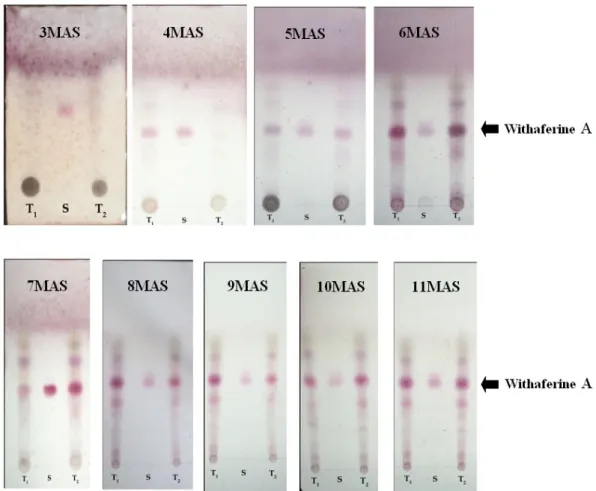
Screening for availability of withaferine A
Tubersat6MASfromT1andT2thatrecordedthehighesttuberdryyieldsinthisstudywereusedtocomparethe availabilityofwithaferineAwithstandardwithaferineAsampleusingthinlayerchromatography (TLC). Onegram (1g) of samplewasstirredovernightwith10mLof50% aqueousmethanolusingamagneticstirrer (BenchMixer) andthen centrifugedtoobtainaqueousmethanolextract. Then, 3mLoftheaboveextractwaspartitionedwithequalvolumeof chloroformforthreetimestoobtainthechloroformextract. Thesolventwasevaporatedandtheresiduewasdissolvedin methanolforTLCanalysis. MethanolextractwasspottedonTLCplates (SilicagelGF254precoated) andallowedtorunwith hexane: ethylacetate: methanolinaratioof2 : 14 : 1. TLCplatesweresprayedwithvanillinesulphuricacid, heatedat110°C for3minutesandobservedunderUVlight.
Phyto-chemical analysis
Consideringthehighestdryweightoftuberrecordedinthisstudyduringtheearlyharvests, tubersfromT1andT2at6 MASwereusedforchemicalanalysisafterbulkingthemfromdifferentreplicatesandvalueswerecomparedwiththoseof importedAshwagandhatubersamplesavailableinthemarketasastandardsample. Tuberswerecleanedanddriedat40°C for48hoursinadryoven (JSOF-150, JSResearchInc., Korea) untilaconstantweightwasreached. Tubersampleswerethen groundandsievedtoobtainafinepowderforanalysis. TotalfibercontentwasanalysedasperthemethodofMaynard (1970).
Further, totalalkaloidandwithaferineAcontentswerequantifiedaccordingtothemethodsdescribedbyHarborne (1976) andChaurasiaetal. (2008), respectively.
Statistical analysis
Datawereanalyzedusingone wayand two-wayanalysisofvariance (ANOVA) proceduresfor phytochemicalsand growthparametersusingMinitab17statisticalpackage, respectively. Themeanswerecompared usingTukey’stestto determinethestatisticalsignificancebetweenthetreatments.
Results and Discussion
Informationontheprocessofrootgrowthanddevelopment, andphytochemicalconstituentsofAshwagandhaisscarce butstudiescoveringtheseareasarevitaltoencouragecommercialcultivations. Hence, thisstudyisanattempttodiscussthe significantfindingsthatenabletoenhancetheproductionofagloballyimportanthighdemandingmedicinalherbutilizedin newproductdevelopmentinherbalindustry.
Theestablishmentofoptimumplantpopulationperunitareaisthemostimportantparametertorealizethemaximumtuber yieldofAshwagandha. Therefore, itisarequisitetostudythetimeandmethodsofplantingtomaintaintheoptimumplant stand (plantdensity) asbothfactorsareimportantforboostingyieldandqualityofdrytubers. Moreover, thetuberqualityis governedbyalkaloidandstarchcontentsoftubers, whichcouldbeachievedbymanipulatingtimeofharvest. Generally, Ashwagandhadoesnotrequireanyfertilizerandpreviousexperimentshaveshownthatindigenouscultivarsdidnotrespond
tofertilizerapplication. However, severalrecentstudiesconductedindifferentregionsofIndiaindicatedapositiveresponse ofAshwagandhatonitrogenapplicationsintermsofqualityandquantityofitsyield (MuthumanickamandBalakrishnamurthy, 1999; Pateletal., 2003; Kubsadetal., 2009). Duetotheincreaseddemandfororganicandsafeproductsinthemarketand formulationofvariousAyurvedicandUnanimedicinesfromAshwagandhatubers, leavesandseeds, itissensibletocultivate thiscropwiththeapplicationoforganicfertilizers. However, consideringtheneedtoenhancetheproductionofdrytubers withtraderequirements, differentagronomicpracticesthatdirectlyaffectthefinalproductionalsoneedtobeattempted.
Tuber fresh weight
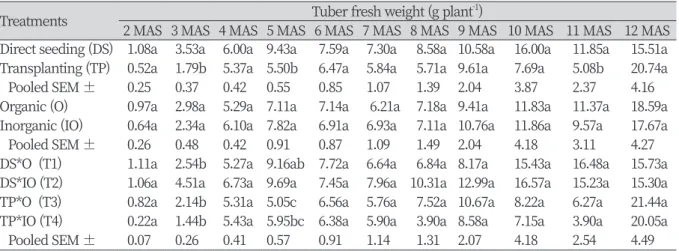
Meanvaluesoftuberfreshweightasaffectedbymethodofplantingandtypeoffertilizeroverthestudyperiodare presentedinTable 1. Remarkably, main effects or interaction effects did not significantly affect fresh weight of Ashwagandha tubers during the 12-month period (p > 0.05) except in 3, 5, and 11 MAS. At 3, 5, and 11 MAS, a significantly higher tuber fresh weight was obtained in direct seeded plants compared to transplanted plants (p < 0.05). Further, out of direct seeded treatments, inorganically grown plants showed the highest tuber fresh weight in many harvests during the study period.
Table 1. Mean values of the tuber fresh weight (g plant-1) of Ashwagandha as affected by method of planting and source of fertilizer during the study period (n = 8).
Treatments Tuber fresh weight (g plant-1)
2 MAS 3 MAS 4 MAS 5 MAS 6 MAS 7 MAS 8 MAS 9 MAS 10 MAS 11 MAS 12 MAS Direct seeding (DS) 1.08a 3.53a 6.00a 9.43a 7.59a 7.30a 8.58a 10.58a 16.00a 11.85a 15.51a Transplanting (TP) 0.52a 1.79b 5.37a 5.50b 6.47a 5.84a 5.71a 9.61a 7.69a 5.08b 20.74a
Pooled SEM ± 0.25 0.37 0.42 0.55 0.85 1.07 1.39 2.04 3.87 2.37 4.16 Organic (O) 0.97a 2.98a 5.29a 7.11a 7.14a 6.21a 7.18a 9.41a 11.83a 11.37a 18.59a Inorganic (IO) 0.64a 2.34a 6.10a 7.82a 6.91a 6.93a 7.11a 10.76a 11.86a 9.57a 17.67a
Pooled SEM ± 0.26 0.48 0.42 0.91 0.87 1.09 1.49 2.04 4.18 3.11 4.27 DS*O (T1) 1.11a 2.54b 5.27a 9.16ab 7.72a 6.64a 6.84a 8.17a 15.43a 16.48a 15.73a DS*IO (T2) 1.06a 4.51a 6.73a 9.69a 7.45a 7.96a 10.31a 12.99a 16.57a 15.23a 15.30a TP*O (T3) 0.82a 2.14b 5.31a 5.05c 6.56a 5.76a 7.52a 10.67a 8.22a 6.27a 21.44a TP*IO (T4) 0.22a 1.44b 5.43a 5.95bc 6.38a 5.90a 3.90a 8.58a 7.15a 3.90a 20.05a
Pooled SEM ± 0.07 0.26 0.41 0.57 0.91 1.14 1.31 2.07 4.18 2.54 4.49 MAS, months after sowing.
a, b: Means followed by the same letters in a column do not differ significantly by Tukey’s test (p < 0.05).
Tuber dry weight
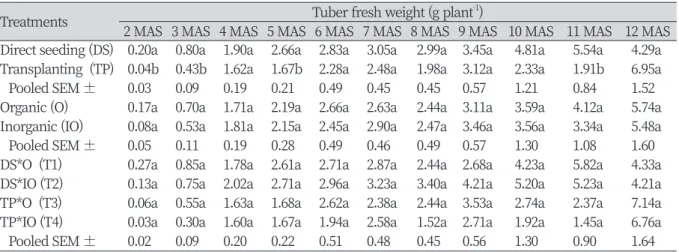
Similartotuberfreshweight, interactioneffectswerenotsignificantontuberdryweight (p > 0.05). However, themethod ofplantinghadasignificanteffectontuberdryweightat2, 3, 5, and11MAS (p < 0.05; Table2). Similartothetuberfresh weight, thehighesttuberdryweightwasreportedinplantswithdirectseededtreatmentsupto11MASwithsignificant valuesat2, 3, 5, and11MAS. However, therewasnosignificantinfluenceoftypeoffertilizerusedontuberdryweight (p >
0.05) duringtotalperiodofthisstudy.
Tuberdryweightisthemostimportantparameterthatdeterminestheeconomicreturnstofarmers. However, noattention isgenerallygiventothechemicalcompositionoftubersatharvestingstage. Thebalancebetweentheyieldandchemical compositionatharvestingstagewouldresultthemaximumbenefitstofarmersaswellasthecommercialprocessors. Inthe presentstudy, none of the interaction effects between the method of planting and type of fertilizer used was significant on tuber dry weight, irrespective of the harvesting period. Tuber dry weights in direct seeded treatments (T1 and T2), were higher compared to transplanted treatments (T3 and T4) at each harvest, and tuberyieldofAshwagandhaincreasedwith extendedperiodofharvesting. TheTubersharvestedat6MASrecordedthehighestrootyieldcomparedtoearlyharvestings. Thetuberdryweightat6MASwas2.71gand2.96ginT1andT2plantsinthecurrentstudy, respectivelyandthevalues are inagreement withthefindingsofKhannaetal. (2006) whoreportedthatthreeofthefivedivergentaccessionsof AshwagandhagrowninIndia, exhibitedthetuberyieldintherangeof1.0 - 2.8gand4.8 - 5.3gat150and210daysafter planting (DAP), respectively. ThissuggeststhatperformancesofAshwagandhagrownunderSriLankanconditionsare comparabletothatgrownunderIndianconditionswithrespecttotuberdryyield.
Shoot height
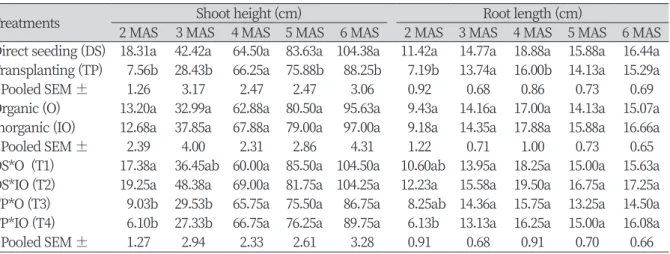
Shootheightwashighlyinfluencedbytreatmentcombinationsofmethodofplantingandtypeoffertilizerusedduring earlyharvestsuntil3MAS (p < 0.05) butnotsignificantlydifferentafter4MAS (Table3). Allfourtreatmentsshoweda gradualincrementinshootheightoverthedatarecordedperiod. Thecombinationofdirectseedingandinorganicfertilizer
Table 2. Mean values of the tuber dry weight (g plant-1) of Ashwagandha as affected by method of planting and source of fertilizer during the study period (n = 8).
Treatments Tuber fresh weight (g plant-1)
2 MAS 3 MAS 4 MAS 5 MAS 6 MAS 7 MAS 8 MAS 9 MAS 10 MAS 11 MAS 12 MAS Direct seeding (DS) 0.20a 0.80a 1.90a 2.66a 2.83a 3.05a 2.99a 3.45a 4.81a 5.54a 4.29a Transplanting (TP) 0.04b 0.43b 1.62a 1.67b 2.28a 2.48a 1.98a 3.12a 2.33a 1.91b 6.95a Pooled SEM ± 0.03 0.09 0.19 0.21 0.49 0.45 0.45 0.57 1.21 0.84 1.52 Organic (O) 0.17a 0.70a 1.71a 2.19a 2.66a 2.63a 2.44a 3.11a 3.59a 4.12a 5.74a Inorganic (IO) 0.08a 0.53a 1.81a 2.15a 2.45a 2.90a 2.47a 3.46a 3.56a 3.34a 5.48a Pooled SEM ± 0.05 0.11 0.19 0.28 0.49 0.46 0.49 0.57 1.30 1.08 1.60 DS*O (T1) 0.27a 0.85a 1.78a 2.61a 2.71a 2.87a 2.44a 2.68a 4.23a 5.82a 4.33a DS*IO (T2) 0.13a 0.75a 2.02a 2.71a 2.96a 3.23a 3.40a 4.21a 5.20a 5.23a 4.21a TP*O (T3) 0.06a 0.55a 1.63a 1.68a 2.62a 2.38a 2.44a 3.53a 2.74a 2.37a 7.14a TP*IO (T4) 0.03a 0.30a 1.60a 1.67a 1.94a 2.58a 1.52a 2.71a 1.92a 1.45a 6.76a Pooled SEM ± 0.02 0.09 0.20 0.22 0.51 0.48 0.45 0.56 1.30 0.90 1.64 MAS, Months after sowing.
(T2) hadthehighestshootheightuntil4MASandthenhighestshootheightwasreportedindirectseededandorganically grownplants (T1; Table3).
Root length
The treatment combination had no significant effect on root length up to 6 MAS (Table 3). At 2 MAS, T2 produced the highest root length among the combinations and significantly different with compared to T4 (Table 3). The type of fertilizer used had no significant effect on root length during the study period. When the method of planting is considered, the direct seeded plants showed significantly higher root length at 2 and 4 MAS compared to transplanted plants. Irrespective of different treatments used, a gradual increment in root length was observed till 4 MAS followed by a reduction in root length at 5 MAS and then an almost constant at the end of data recorded period.
Number of leaves
Table4indicatesasimilartrendasinrootlengthforthenumberofleaves, wherenosignificantdifferencebetween treatmentcombinationscanbeobservedafter2MAS. However, eachtreatmentshowedthehighestnumberofleavesper plantat4MASandthereafteritdecreased. Thissuggeststhattheplantsundergosenescenceofleavesduetomutualshading oflowerleaveswiththegrowth. At5MASonwards, alltreatmentsrecordedanalmostconstantnumberofleavesperplant. Thetypeoffertilizersignificantlyinfluencedonthisparameterat4, 5, and6MASwherethehighestnumberofleavesper plantwasrecordedininorganicallygrownplants comparedtoits counterpart. Incontrast, method ofplantinghad no significanteffectonnumberofleavesperplantduringthestudyperiod, exceptat2MASwheredirectseededplantsshowed thehighestvalue.
Shoot fresh weight
Treatmentcombinationshadsignificanteffectsonfreshshootweightduringfirst3MAS. Amongfourtreatmentsdirect seededplantsrecordedthesignificantlyhighestfreshshootweightcomparedtotransplantedplantsupto3MAS, irrespective Table 3. Mean values of shoot height (cm) and root length (cm) of Ashwagandha as affected by method of planting and source of fertilizer during the study period (n = 8).
Treatments Shoot height (cm) Root length (cm)
2 MAS 3 MAS 4 MAS 5 MAS 6 MAS 2 MAS 3 MAS 4 MAS 5 MAS 6 MAS Direct seeding (DS) 18.31a 42.42a 64.50a 83.63a 104.38a 11.42a 14.77a 18.88a 15.88a 16.44a Transplanting (TP) 7.56b 28.43b 66.25a 75.88b 88.25b 7.19b 13.74a 16.00b 14.13a 15.29a Pooled SEM ± 1.26 3.17 2.47 2.47 3.06 0.92 0.68 0.86 0.73 0.69 Organic (O) 13.20a 32.99a 62.88a 80.50a 95.63a 9.43a 14.16a 17.00a 14.13a 15.07a Inorganic (IO) 12.68a 37.85a 67.88a 79.00a 97.00a 9.18a 14.35a 17.88a 15.88a 16.66a Pooled SEM ± 2.39 4.00 2.31 2.86 4.31 1.22 0.71 1.00 0.73 0.65 DS*O (T1) 17.38a 36.45ab 60.00a 85.50a 104.50a 10.60ab 13.95a 18.25a 15.00a 15.63a DS*IO (T2) 19.25a 48.38a 69.00a 81.75a 104.25a 12.23a 15.58a 19.50a 16.75a 17.25a TP*O (T3) 9.03b 29.53b 65.75a 75.50a 86.75a 8.25ab 14.36a 15.75a 13.25a 14.50a TP*IO (T4) 6.10b 27.33b 66.75a 76.25a 89.75a 6.13b 13.13a 16.25a 15.00a 16.08a Pooled SEM ± 1.27 2.94 2.33 2.61 3.28 0.91 0.68 0.91 0.70 0.66 MAS, Months after sowing.
a, b: Means followed by the same letters in a column do not differ significantly by Tukey’s test (p < 0.05).
ofthetypeoffertilizerused (p < 0.05). Moreover, at6MAS, typeoffertilizerusedhadasignificanteffectonfreshshoot weight; inorganicallygrownplantsrecordedthehighestweightcomparedtoorganicallygrownplants (p < 0.05; Table 4).
Shoot dry weight
MeanvaluesofshootdryweightasaffectedbythemethodofplantingandtypeoffertilizerusedarepresentedinTable5. Theinteractioneffectwassignificantonshootdryweightat2and6MAS (p < 0.05). Maineffectofmethodofplantinghad asignificanteffectonshootdryweightthroughoutthestudyperiodwheredirectseedinghadthehighestshootdryweight. Typeoffertilizerusedhadasubstantialeffectonshootdryweightat6MAS.
Table 4. Mean values of number of leaves and shoot fresh weight (g plant-1) of Ashwagandha as affected by method of planting and source of fertilizer during the study period (n = 8).
Treatments Number of leaves per plant Shoot fresh weight (g plant-1) 2 MAS 3 MAS 4 MAS 5 MAS 6 MAS 2 MAS 3 MAS 4 MAS 5 MAS 6 MAS Direct seeding (DS) 11.63a 21.13a 50.38a 29.13a 28.63a 8.54a 17.11a 29.68a 62.86a 100.36a Transplanting (TP) 8.13b 19.25a 53.88a 32.50a 32.00a 2.18b 10.21b 32.98a 65.24a 98.14a Pooled SEM ± 0.87 1.17 4.15 3.90 3.69 0.78 1.42 2.70 3.48 2.71 Organic (O) 9.63a 19.50a 45.50b 24.88b 24.63b 5.13a 12.50a 30.64a 60.34a 95.15b Inorganic (IO) 10.13a 20.88a 58.75a 36.70a 36.00a 5.59a 14.82a 32.01a 67.76a 103.35a Pooled SEM ± 1.09 1.19 3.37 3.25 3.06 1.43 1.88 2.75 3.22 2.26 DS*O (T1) 10.50ab 19.00a 42.00a 23.50a 23.00a 7.33a 13.34b 24.82a 54.46a 96.43a DS*IO (T2) 12.75a 23.25a 58.75a 34.75a 34.25a 9.74a 20.87a 34.54a 71.26a 104.30a TP*O (T3) 8.75ab 20.00a 49.00a 26.25a 26.25a 2.93b 11.67b 36.46a 66.23a 93.88a TP*IO (T4) 7.50b 18.50a 58.75a 38.75a 37.75a 1.43b 8.76b 29.49a 64.25a 102.40a Pooled SE M ± 0.86 1.08 3.50 3.44 3.23 0.73 1.00 2.34 2.86 2.40 MAS, Months after sowing.
a, b: Means followed by the same letters in a column do not differ significantly by Tukey’s test (p < 0.05).
Table 5. Mean values of shoot dry weight (g plant-1) and shoot: root ratio of Ashwagandha as affected by method of planting and source of fertilizer during the study period (n = 8).
Treatments Shoot dry weight (g plant-1) Shoot : root ratio
2 MAS 3 MAS 4 MAS 5 MAS 6 MAS 2 MAS 3 MAS 4 MAS 5 MAS 6 MAS Direct seeding (DS) 0.84a 21.13a 3.17a 4.45a 5.99a 0.22a 0.34a 0.46a 0.46a 0.40a Transplanting (TP) 0.26b 19.25a 1.62b 4.25a 4.65b 0.19 a 0.27a 0.38a 0.43a 0.39a
Pooled SEM ± 0.11 1.17 0.44 0.31 0.42 0.04 0.06 0.02 0.08 0.06
Organic (O) 0.63a 19.50a 2.49a 4.16a 5.22a 0.21a 0.34a 0.43a 0.43a 0.41a Inorganic (IO) 0.47a 20.88a 2.30a 4.53a 5.43a 0.19a 0.28a 0.41a 0.46a 0.38a
Pooled SEM ± 0.15 1.19 0.53 0.31 0.49 0.04 0.06 0.03 0.08 0.06
DS*O (T1) 0.89a 19.00a 2.88a 3.78a 5.89a 0.26a 0.37a 0.48a 0.46a 0.38a DS*IO (T2) 0.78ab 23.25a 3.46a 4.73a 6.09a 0.17a 0.31a 0.44a 0.46a 0.41a TP*O (T3) 0.35ab 20.00a 2.09a 4.55a 4.55a 0.17a 0.30a 0.39a 0.39a 0.42a TP*IO (T4) 0.17b 18.50a 1.14a 4.34a 4.77a 0.21a 0.25a 0.38a 0.47a 0.35a
Pooled SEM ± 0.12 1.08 0.45 0.31 0.46 0.04 0.06 0.03 0.08 0.07
MAS, Months after sowing.