1. 서론
1.1 연구의 배경 및 목적
우리나라는 건물 부문의 온실가스 감축목표 달성을 위해 신축 건축물 에너지성능의 기준강화를 지속적으로 추진하 는 로드맵(단열, 에너지소비 총량제, 제로에너지 건축물 인 증제도)을 수립하고 있으며, 제로에너지 건축물과 관련해서 는 2025년부터는 모든 민간 신축건축물에 대하여 제로에너 지 건축물 의무화를 추진하고 있다. 그러나 시장에서는 건 설비용의 증가, 전문인력 부족, 절감기술의 신뢰도 문제 등 의 이유로 제로에너지 주택에 대한 부정적인 의견이 존재하 고 있으며, 특히 추가되는 건설비용은 제로에너지 인증 활성
화에 큰 걸림돌이 되고 있는 상황이다. 따라서 2025년 민간 부분 공공주택까지 제로에너지빌딩 인증 의무화에 대비하기 위해서는 인증에 필수적인 에너지 절감요소와 요구되는 적정 비용에 대한 검토가 선행되어야 하며, 이를 적용하기 위한 추 가적인 제도적 뒷받침이 필요하다고 할 수 있다. 우선적으로 공공에서 발주되는 공동주택부터 에너지성능 향상기술 및 신 재생에너지 도입에 따른 적정 추가공사비가 사업비에 반영되 어야 할 것이며, 소비자들을 통해 초기 투자금액 대비 에너지 절감비용의 이익이 크다는 결론이 도출된다면 실현가능한 시 점이 좀 더 앞당겨질 수 있을 것이다. 따라서 본 연구에서는 공동주택에서 제로에너지빌딩 인증을 위해 발생되는 최적의 기술요소 산정과 추가공사비, 에너지 절감비용의 생애주기 비교분석을 통해 적정 가산비를 분석하고 제안하고자 한다.
1.2 연구의 범위 및 방법
본 연구에서는 현재 설계를 진행하고 있는 ‘세종시 4-2생 활권 민관합동 분양아파트 건설사업’을 연구 대상으로 선정 하고 설계초기 계획단계부터 제로에너지 인증을 위한 세부요
공동주택 제로에너지빌딩 인증을 위한 적정가산비 산정에 관한 연구
사용기1·한찬훈*
1충북대학교 건축공학과
A Study on the Estimation of Additional Cost for the Certification of Zero Energy Apartment Buildings
Sa, Yong-gi
1, Haan, Chan Hoon
*1Department of Architectural Engineering, Chungbuk National University
Abstract :
Environmental and energy issues such as abnormal climate and depletion of fossil fuel due to global warming have emerged as a critical task to threaten human survival. As a result, interest in the Zero Energy Building is increasing as it is an innovative building that can significantly contribute to building energy reduction and greenhouse gas reduction. In the market, however, the added cost of construction is a major stumbling block to the revitalization of the Zero Energy certification. In this study, general private apartment complexes were selected for research, detailed elements for Zero Energy certification were presented based on the construction criteria for eco-friendly houses from the initial design stage, and the cost efficiency analysis of the components for certification were presented. It has been analyzed that only Grade 3 certification can be implemented in apartments due to technical level and physical limitations. Also, after reviewing the cost trend during the lifecycle cost, all expenses can be recovered within 13 years after completion only in the case of grade 5 of the Zero Energy Building. The additional costs proposed in the present study are reflected appropriately in the review of projects for apartments scheduled for order in the future to contribute to the revitalization of the Zero Energy Building certification.
Keywords :
Zero Energy Building Certification, Additional Cost, Cost Efficiency Analysis
* Corresponding author: Haan, Chan-Hoon Department of Architectural Engineering, Chungbuk National University, Cheongju 28644, Korea
E-mail: [email protected]
Received February 18, 2019: revised June 19, 2019 accepted June 28, 2019
소들을 검토하여 비용효율 분석을 실시하였다. 에너지 절감 기술의 선정을 위해서 에너지효율등급 인증에서부터 친환 경의무인증 사항과 제로에너지빌딩 인증까지 이론적 고찰을 통해 적용 아이템을 선정하였으며, 선정된 아이템을 기준으 로 인증시 사용되는 ECO2 프로그램을 이용하여 에너지 절 약기법(패시브/액티브) 각 요소별 건축물의 1차 에너지 소요 량 변동을 확인하였다. 이에 따른 추가공사비 비용효율 분석 을 통해 우선순위 기술을 도출하여 기술요소별 CASE조합을 통해 제로에너지빌딩 인증을 위한 최적의 가산비용을 검토 하였다. 또한 생애주기동안 비용가치 분석을 통해 에너지비 용의 절감효과를 확인하고 가산비에 대한 적정성 분석을 실 시하였다.
2. 제로에너지빌딩의 비용모델
2.1 비용효율 분석을 위한 기준모델 설정 2.1.1 제로에너지빌딩 인증개요
국내의 제로에너지건축물 인증에서는 준 제로에너지건 축물의 개념을 에너지 자립율(단위면적당 1차 에너지 생산 량/ 단위면적당 1차 에너지 소비량)에 따라 5단계로 평가하 여 구분하고 법적인 의미의 제로에너지 건축물로 사용하고 있으며, 등급 기준을 살펴보면 1∼5등급 까지 그 기준에 따 라 명기하고 있다. 제로에너지건축물 인증제의 인증기준은
<Table 1>과 같으며, 평가 기준을 살펴보면 최소 에너지효율 등급 1++등급과 동시에 에너지모니터링시스템(BEMS)이 기 본적으로 적용되어야 한다. 또한 공동주택의 경우 냉방에 대 한 검토가 이루어지지 않기 때문에 난방, 조명, 급탕, 환기 에너지 성능을 높이기 위한 기술요소에 대한 면밀한 검토가 필요하며, 에너지 자립율을 만족하기 위한 최적 설계방안이 제시되어야 한다. 우선 필수 요소인 건축물 에너지효율등급 1++등급을 만족하기 위한 아이템의 선별과 비용검토부터 선행되어야 한다.
Table 1. Criteria for certification of zero energy building
Certification grade Certification standard
zero-energy 1st-grade energy self-reliance ratio (100% ) zero-energy 2nd-grade energy self-reliance ratio (80% ~ 100%) zero-energy 3rd-grade energy self-reliance ratio (60% ~ 80%) zero-energy 4th-grade energy self-reliance ratio (40% ~ 60%) zero-energy 5th-grade energy self-reliance ratio (20% ~ 40%)2.1.2 기준모델의 설정
기준모델 단지<Table 2>는 세종시 4-2생활권 내에 위치 하고 있으며 단열기준은 중부2 기준을 따른다. 모든 동을 남
향(남향, 남동향, 남서향)으로 계획하여 일조성능이 극대화 될 수 있도록 기본설계를 진행하였으며, 현재 일조 만족률 은 평균 88.23%를 보이고 있다. 분양성을 극대화하기 위해 전 평형 4BAY를 적용하였으며, 창면적비는 모듈 최적화를 통해 전체 20% 수준이 되도록 적용하였다. 제로에너지 실 증단지와 같은 일반적인 아파트 설계와 차별화된 설계안이 아니기에 제로에너지 인증을 득하기 위한 현실적인 접근을 해볼 수 있다는 장점이 있다.
Table 2. Overview of Reference Model
Master plan Outline
Location: Sejong-si 4-2block Lot area: 32,026㎡
Gross area: 84,670㎡
-Underground: 28,634㎡
-Ground: 56,035㎡
Basement 2story, ground 29story Number of household: 9 buildings 612 units (60㎡이상)
Parking: 782 cars Basic Design Performance Flat-type : 6 buildings Tower-type : 2 buildings percentage of sunshine: 88.23%
window areas rate 20%
2.1.3 에너지절약 요소기술 도출
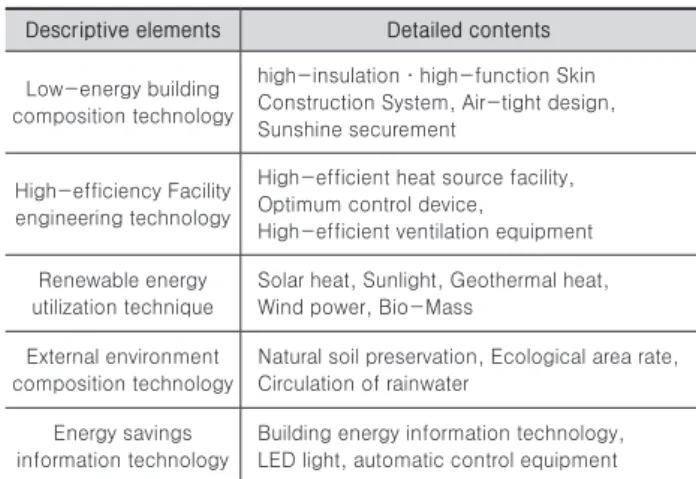
에너지절감 요소기술의 도출은 ‘에너지절약형 친환경주택 건설기준’의 구성기술 요소를 기준으로 적용하였으며, 에너 지 절약요소는 현재 공동주택에서 보편적으로 사용되는 요 소기술들로 아래의 <Table 3>과 같이 분류하였다.
Table 3. Components of construction technology Descriptive elements Detailed contents
Low-energy building composition technology
high-insulation·high-function Skin Construction System, Air-tight design, Sunshine securement
High-efficiency Facility engineering technology
High-efficient heat source facility, Optimum control device,
High-efficient ventilation equipment Renewable energy
utilization technique
Solar heat, Sunlight, Geothermal heat, Wind power, Bio-Mass
External environment composition technology
Natural soil preservation, Ecological area rate, Circulation of rainwater
Energy savings information technology
Building energy information technology, LED light, automatic control equipment
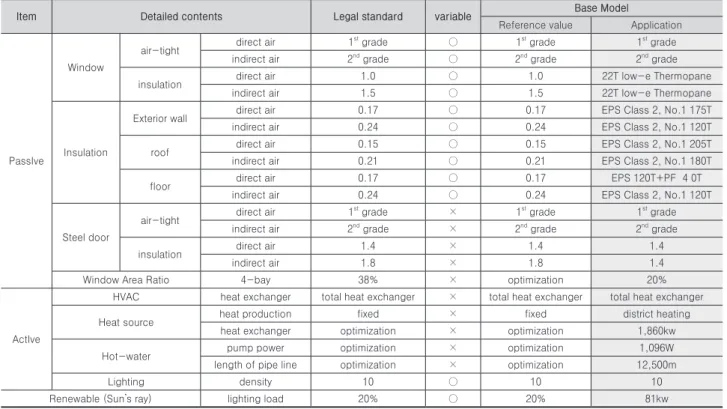
구성 기술요소에 대한 세부내용과 기준모델에 적용 가능 한 항목을 <Table 4>와 같이 검토하였다.
단열재는 ㎜당 단가가 가장 경제적인 비드법단열재를 우 선 적용하였지만, 고 단열로 갈수록 단열재 두께가 증가되
기 때문에 내부 시공면적 증가에 따른 골조공사비용이 상승 되므로, 필요시 요구 성능에 따라서 비드법단열재 → 압출 법단열재 → 경질우레탄폼단열재 → PE폼단열재 순으로 적 용검토가 필요하다. 직접외기에 면하는 필로티 세대의 바닥 하부의 경우 난연단열재인 PF보드로 적용하였다. 창호의 성능은 발코니 외부창호기준 열관류율 1.0W/㎡K 미만 기밀 성 1등급 창호로 적용하였으며, 강제문은 직접외기에 접한 창호가 없어 직접외기 1.4W/㎡K기준으로 상향 적용 후 변 수검토에서는 제외하였다. 또한, 기계실과 전기실은 부하의 중심에 위치하도록 설계에 반영하였고, 급탕배관길이는 각 실별 배관길이를 실질적으로 산출하였으며 장비용량은 부 하량 계산을 통해 최적이 되도록 적용하였기에 변수로 산정 하지 않았다. 세대 내에는 LED조명을 적용하지 않고 일반 적인 FPL 형광등을 적용하여 조명밀도 의무기준인 10W/㎡
을 기준값으로 설정하였다, 신재생에너지는 가장 효율이 높 은 태양광 패널 설치를 통해 조명부하의 20%를 신재생에너 지 용량으로 산정하여 법적기준을 충족하도록 하였다.
2.1.4 기준모델의 연간 1차 에너지 소요량 도출 에너지절약형 친환경주택 건설기준 의무사항에 따른 기 준값적용시 기준모델의 1차 에너지 소요량 값은 122.7kWh/
㎡으로 건축물 에너지효율등급은 1등급이 산출되었다. 이 수치는 일반적인 민간부문의 공동주택 설계시 법적인 의무 이행사항만을 적용하였을 경우에 도출되는 수치라고 볼 수 있다. 해마다 단열기준 상향이 많이 이루어져 현재 법적인
기준만 충족하여도 1등급 이상의 주거시설을 확보할 수 있 다고 판단할 수 있다.
2.2 변수항목에 따른 대안검토 2.2.1 비용효율지수의 산출
본 연구에서는 주요인자 도출을 위한 비용효율 분석에 대 해서는 기존에 에너지절약 설계를 위한 다수의 논문 중에서 적용한 ‘에너지절감효과’ 및 ‘비용’을 통합한 ‘경제성 지수’ 개 념을 적용하였다(Son et al., 2013, 2014).
비용효율지수는 아래의 식(1)과 같이 정의하였으며, 도출 된 1차 에너지 소요량 1kWh/㎡를 낮추는데 필요한 비용(단 위: 억)을 확인할 수 있다.
2.2.2 변수항목별 비용효율지수 산정
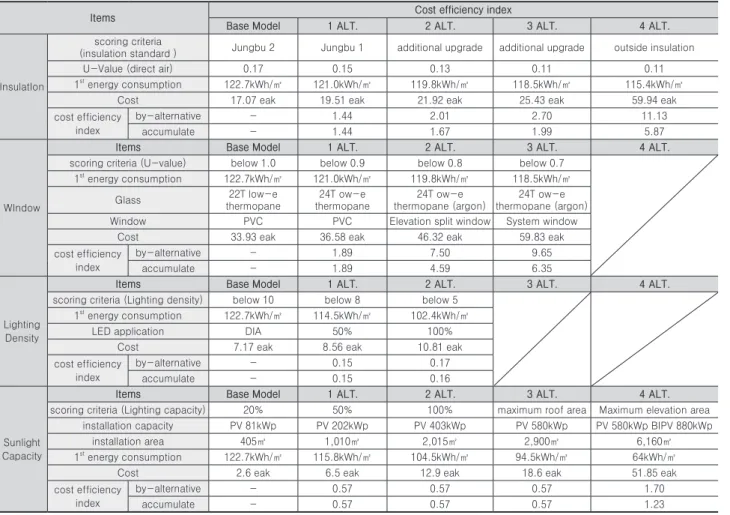
변수별 항목별 전체 시공물량을 확인하여 공사비를 산출 하였으며 요소별 ECO2 시뮬레이션을 통해 1차 에너지 소요 량 값을 도출하였다. 비용효율지수를 검토한 결과 LED등의 적용이 비용대비 가장 효율이 높았으며, 그 다음으로 태양 광 PV 설치를 통한 신재생에너지 항목이었다. 외단열은 투 입비용대비 에너지 절감율이 높지 않아서 요소기술 CASE 검토에서는 제외하였다. 단, 태양광 PV판넬의 설치를 위해 서는 넓은 설치공간이 필요하기 때문에 옥상설치면적의 한
Table 4. Reference value of base model
Item Detailed contents Legal standard variable Base Model
Reference value Application
PassIve
Window
air-tight direct air 1st grade ○ 1st grade 1st grade
indirect air 2nd grade ○ 2nd grade 2nd grade
insulation direct air 1.0 ○ 1.0 22T low-e Thermopane
indirect air 1.5 ○ 1.5 22T low-e Thermopane
Insulation
Exterior wall direct air 0.17 ○ 0.17 EPS Class 2, No.1 175T
indirect air 0.24 ○ 0.24 EPS Class 2, No.1 120T
roof direct air 0.15 ○ 0.15 EPS Class 2, No.1 205T
indirect air 0.21 ○ 0.21 EPS Class 2, No.1 180T
floor direct air 0.17 ○ 0.17 EPS 120T+PF 4 0T
indirect air 0.24 ○ 0.24 EPS Class 2, No.1 120T
Steel door
air-tight direct air 1st grade × 1st grade 1st grade
indirect air 2nd grade × 2nd grade 2nd grade
insulation direct air 1.4 × 1.4 1.4
indirect air 1.8 × 1.8 1.4
Window Area Ratio 4-bay 38% × optimization 20%
ActIve
HVAC heat exchanger total heat exchanger × total heat exchanger total heat exchanger
Heat source heat production fixed × fixed district heating
heat exchanger optimization × optimization 1,860kw
Hot-water pump power optimization × optimization 1,096W
length of pipe line optimization × optimization 12,500m
Lighting density 10 ○ 10 10
Renewable (Sun’s ray) lighting load 20% ○ 20% 81kw
비용효율지수 = 투입비용(억원)
1차 에너지 소요량 절감수치 (1)
계로 인해 인증등급 상향을 위해서는 추가적인 BIPV의 설 치가 요구되었다. 태양광 PV 설치면적은‘태양광 발전 최대 설치 용량’을 산출하기 위해 적용한‘연속일조 5시간’만족구 간으로 에코텍시뮬레이션을 통해 적정면적을 산출하고 용 량을 계산하였다(Lee et al., 2011).
세대 내 LED의 적용과 태양광 PV판넬의 적용은 1차 에 너지 소요량의 절감과 에너지 자립률 상승에 절대적으로 영 향을 주기 때문에 제로에너지빌딩 인증을 위한 가장 중요한 변수라고 할 수 있으며 우선적인 적용이 필요한 항목임을 확인할 수 있었다. 단열재와 창호 등 패시브적인 요소는 기 존에 연구되었던 경제성을 고려한 기존공동주택의 에너지 성능향상 방안에 관한 연구(Han et al., 2016)에서 보여주었 던‘공사비’와 ‘에너지 절감비용’의 검토결과 비용투입대비 절 감성능은 향상은 이루어졌으나 성능비용은 효율이 높지 않 았던 것과 유사한 결론이 도출되었으며, 아래 <Table 6>과 같이 우선순위에서도 낮게 분석되었다.
Table 6. Prioritization by cost efficiency index Contents application standard variable
cost- efficiency
index
additional cost priority
PassIve
A Insulation 1st deal
insul. standard
(0.15) A-1 1.44 2.45 eak 6 2nd
deal
insul. standard
(0.13) A-2 2.01 2.41 eak 9 3rd
deal
insul. standard
(0.11) A-3 2.70 3.51 eak 10
B Window &
Glass 1st
deal K-value (0.9) B-1 1.89 2.64 eak 8 2nd
deal
K-value
(0.8) B-2 7.50 9.75 eak 11 3rd
deal
K-value
(0.7) B-3 9.65 13.51 eak 12
ActIve
CLighting Density (LD)
1st deal
LD
(below 8) C-1 0.15 1.39 eak 1 2nd
deal LD
(below 5) C-2 0.17 2.25 eak 2
Renewable
D Sunlight Capacity
1st
deal 50% of LD D-1 0.57 3.90 eak 3 2nd
deal 100% of LD D-2 0.57 6.40 eak 4 3rd
deal
PV 580kWp (maximum rooftop area)
D-3 0.57 5.70 eak 5 4th
deal
PV 580kWp +
BIPV 880kWp D-4 1.70 51.85 eak 7
※ K-value : coefficient of over-all heat transmission eak : one hundred million won
Table 5. Review of cost efficiency index analysis
Items Cost efficiency index
Base Model 1 ALT. 2 ALT. 3 ALT. 4 ALT.
InsulatIon
scoring criteria
(insulation standard ) Jungbu 2 Jungbu 1 additional upgrade additional upgrade outside insulation
U-Value (direct air) 0.17 0.15 0.13 0.11 0.11
1st energy consumption 122.7kWh/㎡ 121.0kWh/㎡ 119.8kWh/㎡ 118.5kWh/㎡ 115.4kWh/㎡
Cost 17.07 eak 19.51 eak 21.92 eak 25.43 eak 59.94 eak
cost efficiency index
by-alternative - 1.44 2.01 2.70 11.13
accumulate - 1.44 1.67 1.99 5.87
WIndow
Items Base Model 1 ALT. 2 ALT. 3 ALT. 4 ALT.
scoring criteria (U-value) below 1.0 below 0.9 below 0.8 below 0.7
1st energy consumption 122.7kWh/㎡ 121.0kWh/㎡ 119.8kWh/㎡ 118.5kWh/㎡
Glass 22T low-e
thermopane
24T ow-e thermopane
24T ow-e thermopane (argon)
24T ow-e thermopane (argon)
Window PVC PVC Elevation split window System window
Cost 33.93 eak 36.58 eak 46.32 eak 59.83 eak
cost efficiency index
by-alternative - 1.89 7.50 9.65
accumulate - 1.89 4.59 6.35
Lighting Density
Items Base Model 1 ALT. 2 ALT. 3 ALT. 4 ALT.
scoring criteria (Lighting density) below 10 below 8 below 5 1st energy consumption 122.7kWh/㎡ 114.5kWh/㎡ 102.4kWh/㎡
LED application DIA 50% 100%
Cost 7.17 eak 8.56 eak 10.81 eak
cost efficiency index
by-alternative - 0.15 0.17
accumulate - 0.15 0.16
Sunlight Capacity
Items Base Model 1 ALT. 2 ALT. 3 ALT. 4 ALT.
scoring criteria (Lighting capacity) 20% 50% 100% maximum roof area Maximum elevation area
installation capacity PV 81kWp PV 202kWp PV 403kWp PV 580kWp PV 580kWp BIPV 880kWp
installation area 405㎡ 1,010㎡ 2,015㎡ 2,900㎡ 6,160㎡
1st energy consumption 122.7kWh/㎡ 115.8kWh/㎡ 104.5kWh/㎡ 94.5kWh/㎡ 64kWh/㎡
Cost 2.6 eak 6.5 eak 12.9 eak 18.6 eak 51.85 eak
cost efficiency index
by-alternative - 0.57 0.57 0.57 1.70
accumulate - 0.57 0.57 0.57 1.23
※ eak : one hundred million won
2.2.3 제로에너빌딩 인증을 위한 CASE검토
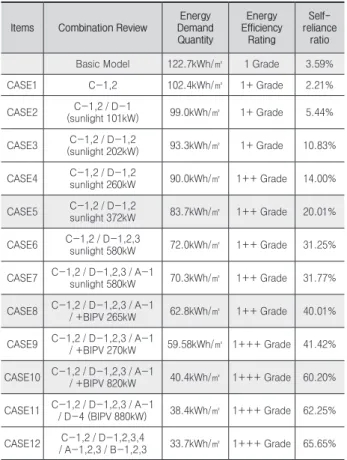
대안별 비용효율이 높은 것부터 낮은 순으로 순위를 정리 하여 ECO2 시뮬레이션 실시에 따른 인증등급을 만족하는 CASE조합을 검토해본 결과 <Table 7>과 같은 자립율 결과 값을 도출할 수 있었다.
모든 비용효율 검토 아이템을 적용하였을 경우에도 자립 율은 시뮬레이션 결과 65.65%로 검토되었다. 이는 에너지 절약형 공동주택의 기본 설계시 요구되는 제로에너지빌딩 인증 등급 3등급 수준이다. 태양광 PV용량은 최대설치면적 으로 검토하였기에 현재의 물리적 한계치라고 볼 수 있으 며, 자립율의 추가적인 상향을 위해서는 태양광 PV기술의 혁신을 통한 효율향상이 요구된다.
Table 7. Result of energy self-sufficiency rate by union
Items Combination Review
Energy Demand Quantity
Energy Efficiency
Rating
Self- reliance
ratio
Basic Model 122.7kWh/㎡ 1 Grade 3.59%CASE1 C-1,2 102.4kWh/㎡ 1+ Grade 2.21%
CASE2 C-1,2 / D-1
(sunlight 101kW) 99.0kWh/㎡ 1+ Grade 5.44%
CASE3 C-1,2 / D-1,2
(sunlight 202kW) 93.3kWh/㎡ 1+ Grade 10.83%
CASE4 C-1,2 / D-1,2
sunlight 260kW 90.0kWh/㎡ 1++ Grade 14.00%
CASE5 C-1,2 / D-1,2
sunlight 372kW 83.7kWh/㎡ 1++ Grade 20.01%
CASE6 C-1,2 / D-1,2,3
sunlight 580kW 72.0kWh/㎡ 1++ Grade 31.25%
CASE7 C-1,2 / D-1,2,3 / A-1
sunlight 580kW 70.3kWh/㎡ 1++ Grade 31.77%
CASE8 C-1,2 / D-1,2,3 / A-1
/ +BIPV 265kW 62.8kWh/㎡ 1++ Grade 40.01%
CASE9 C-1,2 / D-1,2,3 / A-1
/ +BIPV 270kW 59.58kWh/㎡ 1+++ Grade 41.42%
CASE10 C-1,2 / D-1,2,3 / A-1
/ +BIPV 820kW 40.4kWh/㎡ 1+++ Grade 60.20%
CASE11 C-1,2 / D-1,2,3 / A-1
/ D-4 (BIPV 880kW) 38.4kWh/㎡ 1+++ Grade 62.25%
CASE12 C-1,2 / D-1,2,3,4
/ A-1,2,3 / B-1,2,3 33.7kWh/㎡ 1+++ Grade 65.65%
3. 제로에너지 인증 가산비용의 산정
에너지 자립율 검토를 통해 적용아이템의 시공비용을 합 산하면 제로에너지빌딩 인증 등급별 추가공사비를 <Table 8>과 같이 산출할 수 있다.
제로에너지 5등급 획득을 위해서 세대 내 LED조명 100%
적용 시 3.64억, 태양광 PV 372kW 설치비용 9.3억을 포함 하여 약 13억의 추가 공사비가 산출되었으며, 4등급 획득을
위해서는 옥상에 태양광 PV 최대 설치비용 6.7억과 BIPV 265kW 16억원과 단열성능 향상비용 2.45억원이 증가되어 약 38억의 추가공사비가 산출되었다. 제로에너지 3등급 획 득할 경우 BIPV 설치비용이 32.7억이 추가되며 약 70억의 직접공사비가 추가로 발생하였다. 이는 각각 지상층 연면적 기준 평당 7.7만원, 22.4만원, 41.8만원이 증가된 비용으로 제로에너지 인증을 검토하기 위해서는 초기 사업성 검토단 계부터 공사비 대비 각각의 추가 직접공사비가 반영되어야 한다. 사업성 검토를 위한 일반적인 간접공사비 비율 24%를 반영하여 산정된 총공사비 증가비용은 <Table 9>와 같다.
지상층 연면적기준(16,951평) 도급공사비는 제로에너지빌 딩 5등급 구현시 평당 10만원, 4등급 구현시 29만원, 3등급 구현시 55만원이 증가된다.
4. 제로에너지 인증비용의 검증
4.1 제로에너지빌딩 인증등급별 에너지절감비용 산출
기준모델의 에너지절감비용을 검토하기 위해 난방, 급 탕, 조명, 환기에너지, 신재생에너지에 대한 연간 에너지 소요량을 기준으로 에너지원별 비용산출 <Table 11~13>을 진행하였으며, 난방과 급탕은 지역난방비용으로 검토하고, 조명과 환기에너지는 전력비용을 산출하기 위해 한국지역 난방공사와 한국전력공사의 기준요금 <Table 10>으로 산 정하였다.
Table 8. Additional cost for zero energy building certification contents Case 1
stenergy
consumption
self-reliance ratio
construction cost
zero-energy5th grade CASE5 83.7kWh/㎡ 20.01% 12.94 eak zero-energy
4th grade CASE8 62.8kWh/㎡ 40.01% 37.7 eak zero-energy
3rd grade CASE10 40.4kWh/㎡ 60.20% 70.4 eak
※ eak : one hundred million won
Table 9. Additional cost for zero energy building certification
Grade
Additional Cost
(hundred million won) Cost/py (ten thound direct won)
construction cost (76%)
indirect construction
cost (24%) Total
zero-energy 5th grade 12.94 4.09 17.03 @10.1 zero-energy 4th grade 37.7 11.91 49.61 @29.4 zero-energy 3rd grade 70.4 22.23 92.63 @54.9
Table 10. Scale of price for energy sources
Item usage fee unit cost Item usage fee unit cost
District heating charge
basic rate 52.4won/㎡
Electric charges
∼ 200kWh 78.3won/kWh spring & fall 63.38won/Mcal
200kWh∼ 147.3won/kWh summer 57.04won/Mcal
400kWh∼ 215.6won/kWh winter 66.58won/Mcal
Table 11. Calculation of District heating charges of basic model
Item
Energy requirment
(kWh/㎡) Annual total amount
(Mcal) unit cost (won)
Total sum (won) heating hot-
water sim
Hot- water &
Heating
basic rate 52.4 2,920,200
spring & fall 10.87 21.35 32.22 1,544,435 63.38 97,886,264 summer 0 10.68 10.68 511,620 57.04 29,182,810 winter 35.03 10.68 45.71 2,190,272 66.58 145,828,324 Total 45.9 42.71 88.61 4,246,327 275,817,598
Table 12. Calculation of electric charges of basic model
Item Energy
requirment
Annual total amount
(kWh)
unit cost (won)
Total sum (won)
Lightingenergy 16.9kWh 941,820 78.3 15,660
147.3 29,460
Ventilation
energy 3.8kWh 211,770 215.6 248,627,829
Total 20.7kWh 1,153,590 248,672,949
Table 13. Cost of renewable energy for basic model
Item Energy
requirment
annual production
(kWh)
unit cost (won)
Total sum (won)
renewable energyPV 81kW -1.7 -94,739 215.6 -20,425,793
기준모델의 에너지 비용 산출조건을 반영하여 제로에너 지 5등급에서 3등급까지 에너지비용(부가세포함)을 산출하 여 아래<Table 14>와 같은 결과를 도출하였다.
Table 14. Energy consumption and energy saving costs
Items Energy Consumption
Basic model 5
thGrade 4
thGrade 3
rdGrade
Heating energy 45.9kWh/㎡ 49.1kWh/㎡ 48.9kWh/㎡ 44.4kWh/㎡Hot-water energy 42.7kWh/㎡ 42.6kWh/㎡ 42.5kWh/㎡ 42.4kWh/㎡
Lighting energy 16.9kWh/㎡ 4.1kWh/㎡ -0.9kWh/㎡ -5.5kWh/㎡
Ventilation energy 3.8kWh/㎡ 1.8kWh/㎡ -0.4kWh/㎡ -2.5kWh/㎡
Total 105.5kWh/㎡ 97.6kWh/㎡ 90.1kWh/㎡ 78.8kWh/㎡
Renewable energy -1.7kWh/㎡ -7.6kWh/㎡ -15.2kWh/㎡ -61.2kWh/㎡
Annual Energy Cost
district
heating 3.03 eak 3.14 eak 3.13 eak 2.98 eak Electricity 2.74 eak 0.78 eak -0.17 eak -1.05 eak total 5.77 eak 3.92 eak 2.96 eak 1.93 eak Annual
Saving Cost
Total 1.85 eak 2.81 eak 3.84 eak
cost/unit 301,614 Won 458,090 Won 628,165 Won
※ eak : one hundred million won
<Table 14>의 결과를 살펴보면 기준모델 대비 제로에너 지 5등급에서 3등급까지 연간 에너지소요량에 따른 에너지 비용 절감액을 산출한 결과 5등급 제안 시 전체 에너지 절 감액은 1.85억원 이었으며, 세대당 301,614원의 절감 효과 가 있는 것으로 분석되었다. 4등급 제안 시에는 전체 에너 지 절감액은 2.81억원이며, 세대당 458,090원의 절감효과 가 있었으며, 제로에너지 3등급 제안 시에는 총 3.84억원 의 절감액이 분석되었고, 세대당 에너지 절감금액은 연간 628,165원의 절감효과가 산출되었다. 에너지비용 추이를 비교해 보면 <Fig. 1>과 같다.
에너지 절감비용만을 계산할 경우 제로에너지 5등급에서 3등급까지 30년이내 기준모델 대비 비용회수가 가능한 것 을 확인할 수 있다.
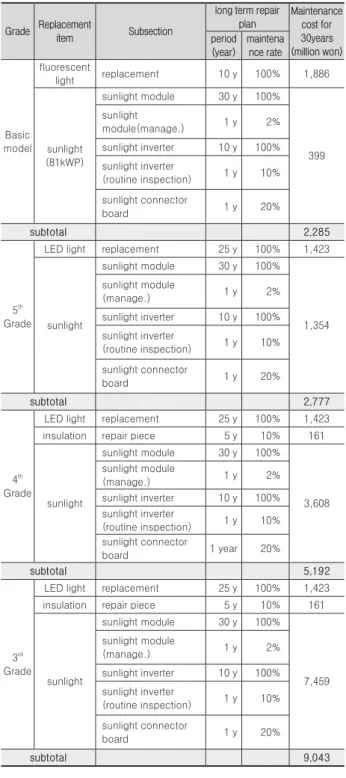
4.2 제로에너지빌딩 인증등급별 유지보수비용 검토 제로에너지빌딩 인증등급별 가산비용의 산출결과를 토대 로 현재 재건축 가능년수인 30년까지 초기투자비 대비 에너 지비용 절감액, 장기수선비용에 따른 생애주기비용을 검토 하여 제로에너지인증에 따른 LCC비용에 대해서 최종적인 비용가치 검토를 통해 30년간 비용추이를 분석하였다. 유지 보수비의 산출기준은 <Table 15>와 같다.
Table 15. Long-term repair plan application criteria by items construction assortment repair method period
(year)
maintenance rate
A Insulation (wall,ceiling) piece repair 5 y 10%Insulation (wall,ceiling) replacement 40 y 100%
C fluorescent light replacement 10 y 100%
LED light replacement 25 y 100%
D
solar module replacement 30 y 100%
solar module (manage.) piece repair 1 y 2%
solar module inverter replacement 10 y 100%
태solar module inverter
(regular inspection) piece repair 1 y 10%
solar cell connection board piece
replacement 1 y 20%
Fig. 1. Trends in Energy Cost Increase by Ratings
단, 유지보수기간중 30년째 도래된 교체 및 수선에 대해 서는 폐기로보고 30년째 도래되는 금액에 대해서는 유지보 수비 산정에서 제외하였다. 등급별 유지보수비 산출결과는
<Table 16>과 같다.
Table 16. Result of calculation of repair and replacement cost
Grade Replacement
item Subsection
long term repair plan
Maintenance cost for 30years (million won) period
(year) maintena
nce rate
Basic model
fluorescent
light replacement 10 y 100% 1,886
sunlight (81kWP)
sunlight module 30 y 100%
399 sunlight
module(manage.) 1 y 2%
sunlight inverter 10 y 100%
sunlight inverter
(routine inspection) 1 y 10%
sunlight connector
board 1 y 20%
subtotal 2,285
5th Grade
LED light replacement 25 y 100% 1,423
sunlight
sunlight module 30 y 100%
1,354 sunlight module
(manage.) 1 y 2%
sunlight inverter 10 y 100%
sunlight inverter
(routine inspection) 1 y 10%
sunlight connector
board 1 y 20%
subtotal 2,777
4th Grade
LED light replacement 25 y 100% 1,423
insulation repair piece 5 y 10% 161
sunlight
sunlight module 30 y 100%
3,608 sunlight module
(manage.) 1 y 2%
sunlight inverter 10 y 100%
sunlight inverter
(routine inspection) 1 y 10%
sunlight connector
board 1 year 20%
subtotal 5,192
3rd Grade
LED light replacement 25 y 100% 1,423
insulation repair piece 5 y 10% 161
sunlight
sunlight module 30 y 100%
7,459 sunlight module
(manage.) 1 y 2%
sunlight inverter 10 y 100%
sunlight inverter
(routine inspection) 1 y 10%
sunlight connector
board 1 y 20%
subtotal 9,043
4등급과 3등급에서는 유지보수비가 크게 증가됨을 확인 할 수 있다. 에너지비용과 30년간 수선 교체비용을 포함한 추이를 비교해 보면 <Fig. 2>와 같다.
인증등급별 초기공사비 에너지비용과 유지보수비용의 추 이를 보면, 제로에너지 5등급과 4등급의 경우 30년간 수선, 교체비용을 포함하더라도 초기비용의 회수가 가능하였으 나, 제로에너지 3등급에서는 30년 내 초기금액의 회수가 불 가능한 것으로 확인되었다.
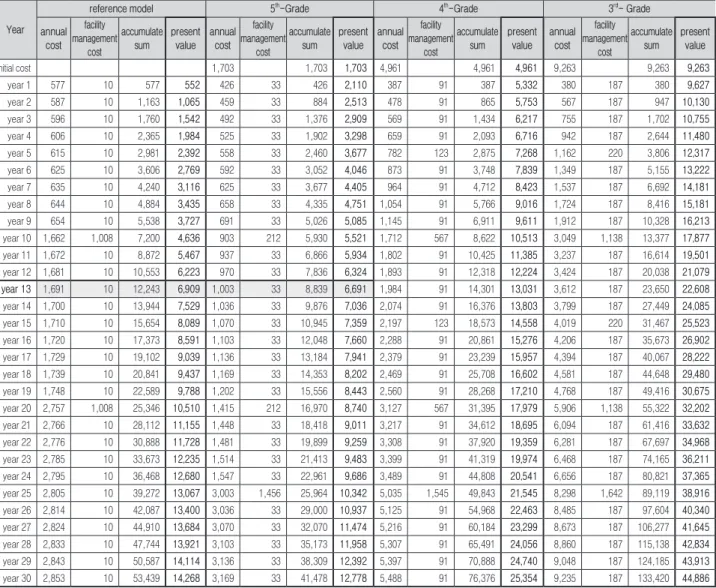
4.3 제로에너지빌딩 인증등급별 비용가치 비교 한국은행 경제통계시스템에서 20년간 생산자 물가지수 (전력)의 변동추이를 확인한 결과 연평균 2.3%를 물가상승 에 따른 변동율이 확인되었으나, 현재가치 비용의 보편적인 결과를 도출하기 위해 에너지비용과 장기수선비의 증가비 용을 KDI에서 발표한 사회적 할인율 4.5%를 적용하여 산출 하였다. 본 연구에서는 LCC 비용에 따른 비용가치의 분석 을 위해서 기존에 제로에너자주택 비용편익 분석을 위한 논 문중에서(Lim, 2018)에서 적용한 ‘비용편익분석 방법’을 참 고하여 아래의 산식(2)로 정의하였다.
Item
LCC analysiscontent
Net-present value (NPV)Method
NPV= present value of total cost
Equation :
1) CC = initial cost 2) EC = energy cost 3) MC = long-term repair cost 4) r = social rate of discount
Fig. 2. Trends in repair-cost Increase by ratings
Fig. 3. LCC increase trend by certification grade
분석결과 <Fig. 3>과 <Table 4>에서 보이는 바와 같이 제 로에너지 3등급과 4등급의 경우 30년간 수선, 교체비용을 포함하여 물가상승과, 현재가치를 비교하여 평가하였을 경 우 초기투자비용의 회수가 불가능한 것으로 검토되었지만, 제로에너지 5등급에서는 13년 이후부터는 초기투자비의 가 치가 기준모델보다 낮아져 초기투자비의 회수가 가능한 것 으로 확인되었다.
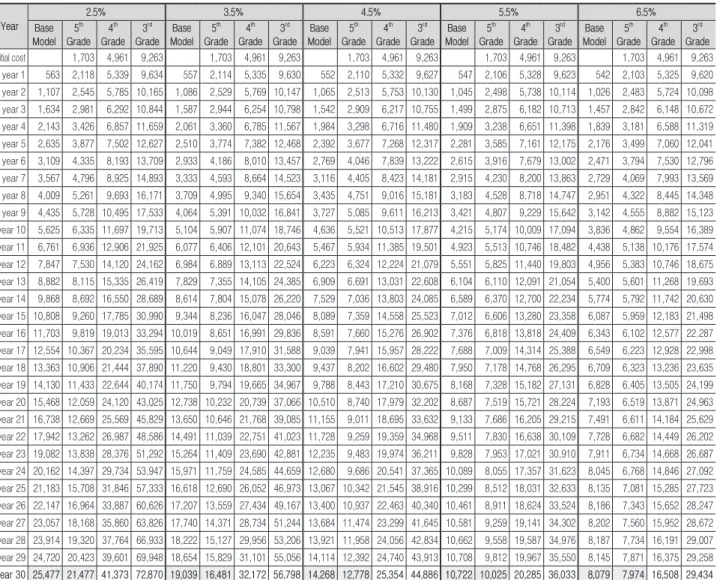
<Table 18>은 추가적으로 비용가치의 검증을 위해 제로 에너지 공동주택을 위한 주요 설계변수별 비용효율 분석 (Song et al., 2012)에서 제시되었던 10년간 소비자 물가지 수 평균값(3.19%)과 한국은행의 대출금리 평균값(6.30%) 에 따른 할인율을 반영하여 2.5~6.5% 할인율값의 변동에 따른 추가 민감도 검토를 실시한 것이다. 검토결과 할인율 6.5%까지는 기준모델과 제로에너지빌딩 인증 5등급과 비교 시 현금흐름의 역전현상은 발생되지 않았다.
5. 결론
본 연구에서는 일반적인 공동주택에서 제로에너지빌딩 인증을 위해 적용할 수 있는 요소기술을 선정하기 위하여 에너지절약 설계기준과 친환경주택건설기준의 법규를 검토 하였으며,
에너지효율등급과 에너지 자립율 확보를 위한 비용효율 을 분석하여 요소기술을 선정하고 제로에너지빌딩 인증등 급별 적정 가산비를 산출하였다.
공동주택의 제로에너지빌딩 인증을 위해 우선적으로 검 토되어야 하는 에너지성능 향상 기술을 살펴보면 세대 내 LED 100% 설치와 태양광 PV의 설치가 비용투자대비 가장 중요한 설계요소였다. 다만 공동주택에서 지붕층과 외벽에 PV패널을 설치하기 위한 면적은 한계가 있기 때문에 제로 에너지 2등급 이상의 적용은 현실적으로 불가능한 것으로
Table 17. Comparison of LCC by certification 500 grade
(unit: thousand won)
Year
reference model 5
th-Grade 4
th-Grade 3
rd- Grade
annual cost
facility management
cost
accumulate sum
present value
annual cost
facility management
cost
accumulate sum
present value
annual cost
facility management
cost
accumulate sum
present value
annual cost
facility management
cost
accumulate sum
present value
initial cost 1,703 1,703 1,703 4,961 4,961
4,961
9,263 9,2639,263
year 1 577 10 577