Dithiocarbohydrazone
류의 합성과 항균작용에 관한 연구
(I)2-Formylpyridine Dithiocarbohydrazone류 및 이들의 C u (II) 착물
최 보 길
전남대학교 약학대학
(Received April 13,1986)
Synthesis and Antimicrobial Activity of Dithiocarbohydrazones (I) 2-Formylpyridine Dithiocarbohydrazones and T heir C u ( II ) Chelates
Bo G il Choi
College o f Pharmacy, Chonnam National University,Kwangju 500, Korea
AbstractᅳIn order to study 2-formylpyridine dithiocarbohydrazones (DTCH’s) and their Cu(II) chelates as potential effective antimicrobial agents, twelve new compounds of six DTCH’s and their Cu(II) chelates were synthesized. The compositions of Cu (II) chelates were determined on the basis of the data obtained from elemental analysis, electronic and IR spectrophotometry, and other method. They were tested for antimicrobial activity in vitro against a gram-positive, seven gram-negative bacterial species and three fungal species. DTCH’s exhibited high antibacterial activity against the gram-positive Staphylococcus aureus^ but low activity against the various gram negative bacterial species. In contrast to DTCH’s,their Cu(II) chelates exhibited higher antiba
cterial activity against St. aureus, but weaker, if any, acitvity against the gram-negative bacterial species. Both DTCH’s and their Cu(II) chelates showed relatively potent antifungal activity against Cryptococcus neoformans, but weak activity against Candida albicans and Candida pseudotropicalis.
1946년 D om agk등1} 이 多-methoxybenzaldehyde
thiosemicarbazone이 결핵균의 발육을 억제한다
고 발표한 이후 이들 thiosemicarbazone (T SC)
유도체가 다수 합성되어 항균, 항바이러스, 항
진균 및 항암작용에 대해 많이 연구되었는데2) 이들 생물활성은 T S C가 생체내 금속과의 chela
tion기전에 기인하는 것으로 시사되었다. 3) Benns 등4> 은 T SC 및 이들의 C u chelate를 합성하여
항균력의 비교를,Brockman등5} 다수6ᅵ의 연구
자는 2-formylpyridine T S C ( P T )유도체의 항암
작용을 비교하면서 그 활성발현에 N-N-S tri-
dentate ligand system이필수적임을 보고하였다. 한편 T SC의analog인thiocarbohydrazone (T C H )
의 구조를 가진 화합물에 대해서는 T S C보다 늦
게 연구되었는데 W iles 둥7)은 지방족알데히드의
T C H가 항진균효과를,Brockm ann등5》은 P T와 함께 2-form ylpyridine m onothiocarbohydrazone 의 항암작용을, Rhee등8)은 본 연구와는 다른 종류의 mono- 및 dithiocarbohydrazone (각각 M T C H 및 D T C H )를 다수 합성하여 이들 화합
물의 항균, 항진균 및 항암작용을 보고하였으며
이들 활성은 T C H가 T S C와 마찬가지로 강한
chelate형성능이 있어 chelation기전에 의해 발현
될 것으로 시사하였다. 또한 T C H의 Sn 및 Sb
chelate의 항균 및 항진균작용도 보 고 되 고 있
다. 9)
따라서 저자는 항균, 항암 등의 생물활성이
우수한 D T C H 및 이들의 금속착물을 개발하기
위하여 P T의 구조는 그대로 보 지 하 며 ,N -N -S system과 두개의 azomethine linkage를 가진 2-
80 DTCH류의 합성과 항균작용 formylpyridine D T C H류를 합성하고 이들에 C u 2+
염을 작용시켜 C u ( H ) chelate를 얻어 이들 구조
를 뒷받침할 몇가지 이화학적 성질을 조사하였
으며 나아가서는 D T C H의 구조의 차이 및 착물
형성이 생물활성에 미치는 영향에 대한 지견을
얻기 위해 우선 이들의 항균시험을 행하였다.
실 험 방 법
합성ᅳ본 연구에서 출발물질,중간생성물 및
목적하는 화합물의 합성과정을 일괄하여 표시하
면 Scheme I과 같다.
1) 2-formylpyridine dithiocarbohydrazone의 합 성
a. 2-formylpyridine monothiocarbohydrazone
( DO -문헌8】에 준하여 합성하였다. 즉 문헌10때
따라 hydrazinium dithiocarbazinate ( I )를 거쳐 서 얻은 th io c a rb o h y d ra z id e (I)(1 5 .9 g , 0 . 15mol) 를 25% M e O H에 녹인 후 2-pyridine aldehyde (16. 07g, 0.15mol) 의 M e O H용액을 가하고 78°C
에서 lh r 환류하면서 반응시킨 후 실온으로 방
치하고 석출된 미황색의 목적물을 DMF-MeOH
(1 : 1) 로 재결정하였다.
미황색분말, 수득량 1 8 .14 g(62% ). mp. 178〜 179°
b. 2-formylpyridine dithiocarbohydrazone류 0 0 -문헌8 준하여 2-formylpyridine m onothi
ocarbohydrazone ( I ) (3. 9g,0. 02mol) 을 M eO H 에 녹이고 각종의 방향족알데히드 0.04mol을 녹 인 M e O H 용액을 가하여 3hr 동안 환류하면서
CS2 + NH2NH2 NH2NH^SHNH2NH2— p. > NH2NH^NHNH2
■ Me0H ^ 삐NHNH2 y 0^CH=NNHfNHN=CHR
111 iv 5
CuC1o.2H90
~ M e O H , reflux Cu(ll) chelates
«CH0: 0CHO 0 ®
CHO
O-CH0 O O jQl-CHO
o2n o
Scheme I-Synthetic pathway.
반응시킨다음 1/2가량 반응액을 농축시켜 실온 으로 방치한 후 석출된 미황색〜황 색의 목적물
을 여취하여 M e O H로 세척하고 Table I에 기재
한 용매로 재결정시켰다. 2) C u ( I I) chelate (V)의 제조
D T C H 각3mm이의M eO H 용액에CuC12.2 H 20
을 동량의 M e O H에 녹인 액을 가하고 수욕상에
서 70ᄋC로 환류하면서 lh r 반응시키고 실온으로
방치하여 석출한 황록색〜암록색의 분말을 Me
O H 및 물로 수회 세척하여 건조시켰다.
분석ᅳ 1) 분광분석ᅳU V스펙트럼은 M e O H에 녹여서 H itachi 333형의 스펙트로포토메타로, IR 스펙트럼은 K B r disk법으로 Perkin-Elmer 598형 의 스펙트로포토메타로, 1H - N M R 스펙트럼은 V arian F T - 80 A (80M H z) 로부터 T M S를 internal standard로 하여 얻었다.
2) mole 전도도 측정一C u ( D ) chelate를 D M F
에 녹여 1X10~3M로 하고 250C에서 전기저항을
측정하여 환산하였다.
C u ( I I ) c h e ta te의 조성一C u ( I ) chelate 중의
[ H L ] /[ L]의 비는 몰비법 및 연속변화법으로 리
간드의 영향이 거의 없는 420nm에서 구하였다.
항균시험ᅳ한천회석법 n) 을 사용하여 아래와 같은 조건으로 실시하였다.
1) 세균에 대한 항균시험 : 배지一Mueller-Hin- ton (pH 7. 2〜7. 4 ),균주一Staphylococcus aureus A T C C 29218 및 4균주(분리균주) , Escherichia coli A T C C 25922 및 4균주, Pscudomonas aeru- ginosa A T C C 27853 및 4균주,Klebsiella pneu
moniae 2균주,Serratia marcescens 3균주, S al
monella typhi 3균주, Salmonella paratyphi 3균 주 및 Shigella flexneri 5균주. 이 8종의 균주를 균접종 24hr전에 Trypticase soy broth에 배양하 여 saline으로 100배 희석하여 사용하였다. 배양 ᅳ화합물 및 contr이용의 MTCH 각 51.2mg을
각각 DMSO 5ml에 녹이고 같은 용매로 8단계
배수 희석한 후 그 시료용액 2. 5ml를 배지 47. 5
m l에 가해 균등히 혼합하고 균의 발육에 전혀
영향이 없는 5% D M S O 용액으로 하여 화합물 의 농도가 각각 2, 4, 8,16, 32, 64,128,256 및 512 jWg/ml로 하였다. 희석균액을 Steers’ m ultiple
J. Pharm. Soc. Korea
TableI—SomedataonW^CH=NNHpNHN=CH-R pCOgCtSd F°rmula
Analysis(Calcd.) CHNIRCcm-1)UV (nm)PT-NMR^OMHZ,DMSO-de) 187 〜DMF-40.8C13H12N6S54.703.9029.60»^NH3120332 188EtOH(54.90)(4.26)(29.56)^CH2960286 ^C=N1600228 178 〜acetone52.6C14H13N5OS56.404.6123.201>NH3120336 179(56.16)(4.35)(23.40)^C=N1585280 ^OH3260233 167 〜CHCI350.2C15H15N5OS57.704.9722.60^NH3100335 168(57.49)(4.83)(22.35)^CH2920290 ^C=N1595234 167-CHCls- EtOH 184 〜EtOH 186 DMF- EtOH
47.5C18H15N5S
(52.90) (3.81) (22.04) vCH ^C=N 65.005.0121.30 (64.83) (4.54) (21.00)
2980 1575 52.0C12H10N6O3S45.003.4626.00 (45.27) (3.17) (26.41) 283 234 J^NH3100340 샀CH2950270 ^C=N1590232 I^NH3160350 ^C=N1595280 ^NOa1350237 88.55-7.68(8H, m, 2 x pyr.) 8.15(2H, s’ -NH-CS-NH-) 12.48-11.97(2H,2x 八 II L N
-CH=) 7.02-6.77(4H, m, phenyl) 8.63-7.16(4H, m, pyr.) 12.50-11.82C1H, k/~CH=) N 3.80(3H, s, —OCH3) 7.26-6.76(4H, m, phenyl) 9.87-7.50(4H, m, pyr.) 8.83-7.25(8H, m, phenyl &pyr.) 8.25(2H, s, -NH-CS-NH-) 12.46-11.85(1H,/\ II I N
CH=) 8.63-6.88(11H, m, naph.&pyr.) 12.46-11.80(1H, 八 kj—대=) N 8.50-7.25(4H, m, pyr.) 7.90-7.65 (2H, d, •一NH一CS—NH 12.45-11.88C1H,/%、 !IJ-ch=)
82 DTCH류의 합성과 항균작용 inoculator로 접종하고 370C, 24hr 배양하였으며
판정기준은 접종부위의 균의 발육유무를 보아
최저발육저지농도( M I C )룰 결정하였다. 이때 대
주군으로 M T C H이외에도 클 로람페니콜(C P )과
nitrofurantoin (NF) 을 택하였다.
2) 진균에 대한 항균시험 : 배지一Sabouraud
agar, 균주一Cryptococcus neofor mans, Candida albicans 및 Candida pseudotropicalis, 배양一 이들 균주를 접종 48hi•전 Sabouraud broth중에서 37°
C에서 배양하여 saline으로 희석하여 사용하였으
며 화합물의 농도는 32,6 4 ,128,256 및 512//g/ml
가 되도록 상기와 같은 방법으로 평판배지를 만
들고 백금 루프로 희석균액을 배지에 접종하여
37°C, 48hr 배양시킨 다음 상기 방법으로 판정
하였다.
실험결과 및 고찰
합성화합물의 물리적성상ᅳ본 연구에서 합성
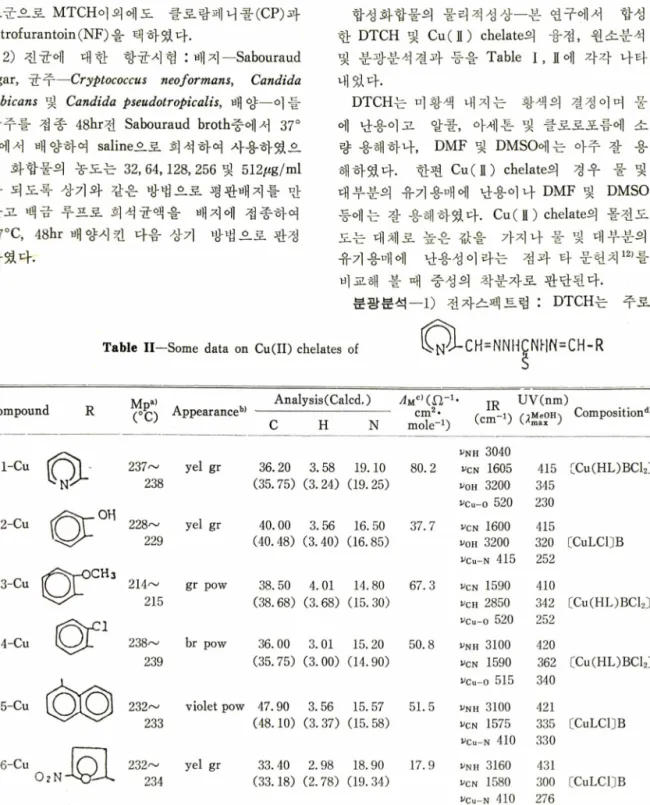
한 D T C H 및 C u ( f l ) chelate의 융점,원소분석 및 분광분석결과 등을 Table I , fl 에 각각 나타 내었다.
D T C H는 미황색 내지는 황색의 결정이며 물
에 난용이고 알콜, 아세톤 및 클로로포름에 소 량 용해하나, D M F 및 D M S O에는 아주 잘 용 해하였다. 한편 C u ( H ) chelate의 경우 물 및
대부분의 유기용매에 난용이나 및 D M S O
둥에는 잘 용해하였다. C u ( I I ) chelate의 몰전도 도는 대체로 높은 값을 가지나 물 및 대부분의 유기용매에 난용성이라는 점과 타 문헌치12) 룰
비교해 볼 때 중성의 착분자로 판단된다. 분광분석一1) 전자스펙트럼 : D T C H는 주 로
Table I I一Some data on C u (II) chelates of O - CH=NNHfNHN=CH-R
Compound R
1-Cu
2-Cu
3-Cu
4-Cu
5-Cu
6-Cu
OH
c h3
O -
o:
0 ^ '
Of1
6 0
Mpa) Analysis(Calcd.)
(o본) Appearanceb) --- cm2.
C H N mole-1)
IR U V (nm )
(cm-') (思%애) Comp° sitiond>
237〜 yel gr 238
228〜 yel gr 229
214- 215
gr pow
br pow
violet pow
yel gr
샀nh 3040
36.20 3.58 19.10 80.2 샀cn 1605 415 [Cu(H L)BCU (35.75) (3.24) (19. 25) voh 3200
^Cu-o 520 345 230 40.00 3.56 16.50 37.7 vcn 1600 415 (40.48) (3.40) (16.85) 샀oh 3200
샀Cu-n 415 320 252
〔CuLCl〕B
38.50 4.01 14.80 67.3 ycN 1590 410 (38.68) (3.68) (15.30) 샀ch 2850
vcu-o 520 342 252
〔Cu(HL)BC12〕
36.00 3.01 15.20 50.8 샀NH 3100 420 (35.75) (3.00) (14.90) vcn 1590
vcu-o 515 362 340
〔Cu(HL)BC12〕
47.90 3. 56 15.57 51.5 vnh 3100 421 (48.10) (3. 37) (15.58) ^cn 1575
^Cu-N 410 335 330
CCuLCOB
33.40 2.98 18.90 17.9 ^nh 3160 431 (33.18) (2.78) (19. 34) ^cn 1580
샀C u - N 410 300 276
CCuLCDB
a) Decomposition temperature, b) g r: green, br: brown, pow: powder, yel: yellowish, c) molar conductance of ca. 10_3M solution in DMF, d) B: H 20
J. Pharm. Soc. Korea
[HL]/[Cu(II)]+ [HL]
F ig . 2-Mole fraction of ligand as determined by the continuous variation method.
[ C u ( I)〕+〔HL〕= 2 x 10⁻⁴M 1 ,2에 표시했다.
Fig. 1 의몰비법의 경우 두 화합물 모두 [ H L ] / [ C i i ( l O ]의 비가 0 .5까지는 홉광도 증가가 완만 하나 그 비가 0. 5 ~ 1 . 0 사이에서 매우 급격하고
그 이상에서는 큰 변화가 없었다. F ig. 2의 연
0 .5 1 .0 1 .5 2 .0
tH L ] /lC u (II)]
Fijr. l-Ligand-to-metal ratios as determined by the mole ratio method.
[ C u (I)l= lx lO - 4M azomethine linkage의 흡수로 생각되는13> 330〜
340nm에서 강한 흡수를 또 270~290nm와 230 nm 부근에서도 흡수를 볼 수 있었다. Cu( n)
chelate의 경우는 금속과 리간드간의 전하이동에
기인한 것으로 생각되는 410〜420nm에서의 홉
수와 리간드자체의 전자전이에 의한것으로 보이
는,따라서 리간드자체의 경우와 유사한 330.〜
350nm, 230nm 부근에서 흡수를 볼 수 있으며
Table 1[에 기재하지 않은 650nm에서 d-d전이 에 의한 넓고 약한 흡수를 볼 수 있었다.
2) IR스펙트럼 :DTCH는 모두 3100cm-1 부근 에서 vn-h가, 2,960〜2, 980cm-1 에서 vC-h, 1, 590
〜 1, GlOcrrr1 에서 azomethine linkage의 fc=N가 각각 나타났고 화합물 2의 경우 phonolic OH에 의한 3,260cm-1 에서 uo_H가, 1,380cm-1 에서 5o_H 가 각각 나타났으며 Cu( I ) chelate는 3, 400cm_1 부근에서 H2ᄋ의 흡수로 생각되는14> 넓은 band 가 나타났는데 이는 H2ᄋ가 결정수 또는 배위
수로 들어 있을 것으로 생각된다. 또한 W=N
의 흡수가 저파수쪽으로 shift하고 있는데 이것 은 Cu(M) 이온에 azomethine linkage의 질소원 자가 직접 배위함에 기인하는 것으로 볼 수 있 다. 13> 배위가능성이 있는 화합물 2의 phenolic OH는 Cu(B) chelate의 경우 vo_H 및 5o—h가 나 타나는 것으로 보아 배위에 관여하지 않음을 시
사해 주고 있다. 배위수는 결정수와는 달리 800
cm-1 및 540cm-1에서도흡수가 나타나는 것으로
알려져있는데14) 여기서는 리간드자체가 이영역
에서 복잡한 흡수를 나타내므로 또 C u ( n) 와 배
위원자와의 신축진동이 600cmᅵ1 아래에서 일어 나므로 확인하기가 어려웠다.
3) N M R 스펙트럼 : 2-formylpyridine M T CH 의 _N H - N H 2의' _N H 2 proton peak (5: 4 .9 5,S)
가 D T C H의 경우 사라졌으며 다른 한쪽의 방향
족 ring의 proton peak는 pyridyl의 ring proton peak에인접하거나 일부 겹쳐져 나타났으며 ᅳN H -CS-NH- 및 2개의 - C H = N -의 peak도 각각 나
타났다.
Cu(II) chelate의 조성一합성화합물 1 및 3 을 리간드로 하여 몰비법 및 연속변화법에 의한
금속一리간드 조성비를측정한 결과를 각각 FiS-
0. 0. (luuo
c s r
< J-
)
(uo u coclM
ᄋwqv
§4 t/rC H류의 한성과방균파용
속변화법에서도 같은 경향을 나타내는 데 몰분
율이 0 .5 즉 그 비가 1 .0이 될때까지 증가가 현
저하여 plateau에 달하는데 그 이상에서는 감소
룰 나타낸다. 따라서 윗 실험결과로부터 유추해 볼때 C u ( I ) chelate의 일반적인 조성은 [H L ] / [Cu2+]의 비가 0 . 5일때까지는 C u ( n ) : H L의 비 가 2 : 1인 chelate가, 그 비가 1. 0인 경우는 1 :
1인 chelate가 생성되는 것으로 생각된다.
이상의 C u chelate분석결과를 종합하여 검토
하면 전자스펙트럼에서 d-d전이에 따른 band가 약하지만 나타남을 볼 때 C u 2+ (d9) 상태임을 알 수 있고 I R스펙트럼 data에 배위가능성이 큰
phenolic O H가 직접 배위에 관여하지 않음을 봐
서 P T와 마찬가지로 N-N-S tridentate ligand
system으로 C u와 결합할 것으로 사료되며 다른
종류의 D T C H의 C u ( D ) chelate의 구조에 대한
Compound
Table Ill-Minimal inhibitory concentration (MIC, //g/ml) of DTCH’s & their Cu(II) chelates on various microbial species.
Microorgan isma)
A B C D E F G H I J K
1 128 256 256 256 256 128 128 128 32 64 512
1-Cu 요 , 64 >512 >512 >512 >512 >512 >512 >512 >512 >512 >512 2
f f Y 0 H 64 128 256 256 256 64 64 128 32 128 256
2-Cu U 1 32 >512 >512 >512 >512 >512 >512 >512 64 >512 >512 3
3-Cu O r ° CH3
128 512
256
>512 256
>512 256
>512 256
>512 128
>512 128
>512 128
>512 64 128
64
>512 512
>512 4
4-Cu a ci
256 8
256
>512 256
>512 256
>512 512
>512 128
>512 128
>512 256
>512 128
<32 128 128
128
>512 5
5-Cu 6 6-Cu
256 256 256 256 512 256 256 256 8 >512 >512 >512 >512 >512 >512 >512
<32 128 >512 64 >512 >512
ᄋ? N -
16 64 512 512 512 64 64 64 8 >512 >512 >512 >512 >512 >512 >512
64 256 512 64 >512 >512 MTCHb)
CP NF
64 16 8-32
128 8 4-16
128 32
128 128
128 128
64 32
64 16
128 256
32 64 64
a) A. Staphylococcus aureus'. ATCC 29218 and isolated 4 strains (“isolated” omitted hereafter) B. Escherichia colt: ATCC 25922 and 4 strains
C . Klebsiella pneumoniae'. 2 strains
D. Pseudomonas aeruginosa \ ATCC 27853 and 4 strains E . Serratia marcescens'. 3 strains
F . Salmonella typhi: 3 strains G . Salmonella paratyphi'. 3 strains H. Shigella flexneri'. 5 strains
I . Cryptococcus neoformans'. 1 strain J . Candida albicans'. 1 strain K. Candida pseudotropicals'. 1 strain
b) MTCHl 2-formylpyridine monothiocarbohydrazone CP: chloramphenicol
N F: nitrofurantoin
J. Pharm. Soc. Korea
보고와 모순이 없다. 15) 따라서 C u ( l l ) chelate의 구조는 전기전도도측정으로 중성의 착분자라는 점과 원소분석결과와 전자 및 I R스펙트럼 data 로 봐서 [ C u ( i ) ( h l ) ( h 2o ) c i 2] 또는 [ C u ( n )
L*C1]일 것으로 추정된다.
항균력시험一그람양성균,그람음성균 및 진균
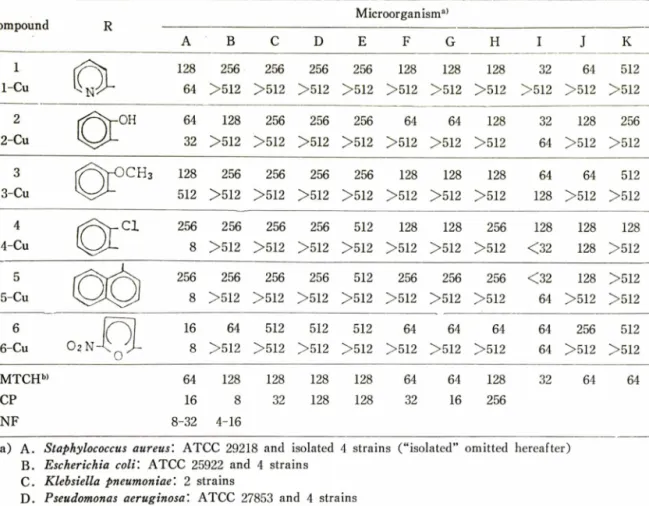
에 대한 D T C H 및 C u ( D ) chelate의 항균력을 Table III에 나타내었다.
DTCH의 경우 그람양성균인 St. jz/r似s에 대 해서는 MIC가 16〜256서g/ml인반면 그람음성균
에 대해서는 64〜256//g/ml로 그람양성균에 항
균효과가 더 높았으며 화합물 6은 그람음성균에
도 항균력이 비교적 높았다. Cu(D) chelate의
경우 그람양성균에 대해서는 3-Cu를 제외하고
는 DTCH 자체보다도 더 강력하였으며 그람음
성균에는 512서g/ml의 농도에서도 균의 억제를 볼 수 없었다• 진균의 경우 Cryptococcus neofor- 饥伽5에 대해서는 DTCH 및 Cu(D) chelate 모두
항균력이 높았고 Candida속에 대해서는 비교적
낮았으며 DTCH와 Cu( II ) chelate의 항균력의 차이는 분명하지 않았다. 이상의 항균실험결 과를 검토해 보면 DTCH 중 5-nitrofurfural의 DTCH가 그람양성균 및 음성균에 대해 높은 것 은 일반적으로 항균작용을 나타내는 5-nitrofur-
fu ry l기의 기여가 큰 것으로 생각된다. 16)
그람음성균에 대해 C u ( I ) chelate가 리간드 인 D T C H보다도 효괴-가 낮은 것은 C u ( H ) - T S C 와 마찬가지로 C u ( n ) chelate의 상태에서 배지
에의 난용성,세포막투과도의 차이 및 미생물의
필수금속에 대한 chelate 형성능의 결핍 등으로 인한 활성의 상실등4》으로 설명가능하나 같은조 건하에서 그람양성균인 St. M r해5에 대한 C u
( n ) chelate의 항균력의 증대는 위의 추정으로
해석할 수 없는 작용기전이 다른 것으로 생각되 며 그람양성균 및 음성균에 대한 이러한 선택성 의 차이는 항균제인 8-hydroxyquinoline에 C u 2+
를 동수 첨가시 그람양성균에는 항균력이 훨씬
강력하나 그람음성균에는 효과의 감소를 가져온
다는 A lbert17이와 上野17이의 보고와 본 실험결과
와 일치한다.
결 론
1. 문헌에 준하여 합성한 2-form ylpyridine monothiocarbohydrazone과 방향족 알데히드를 반 응시켜 6종의 새로운 2-form ylpyridine dithiocar-
bohydrazone을 얻고 이들을 각각 리간드로 하여
C u ( D) 염을 작용시켜 얻은 C u ( I I ) chelate등 12
종을 합성하였으며 몇가지 분석결과를 기초로
C u ( n ) chelate의 구조를 추정하였다.
2. 여기서 합성한 화합물 1〜 6은 그 람양성균 인 St. 心r애s에 대해서는 비교적 항균효과가 높 았으나 그람음성균에는 다소 낮았다. 그러나 화 합물 6 (2-formylpyridine-5-nitrofurfural dithio-
carbohydrazone) 은 양자에 대해서 효과가 높았
다. Cu( I ) chelate는 그람양성균에는 3-Cu를 제외하고는 DTCH 보다도 항균력이 높 았으 나
그람음성균에는 마 이 보 다 항균력이 약하여
512셔g/ml에서도 균의 발육이 억제되지 않았다.
진균인 Cryptococcus neoform ans^ 대 해 서는 P T C H 및 C u ( D ) chelate 모두 항균력이 비교적 높으나 Candida albicans 및 C andida pseudotro- picalso\] 대해서는 C u ( D ) chelate가 D T C H보다 도 항균력이 오히려 낮은 경향을 나타 내었다.
감사의 말씀
이 연구를 지도해 주신 영남대학교 약학대학 김종윤 교수님께 깊은 감사를 드립니다.
문 헌
1) Domagk, G., Behenisch, R., Mietzsch, F., and Schmidt, H .: Naturwissenschaften, 33, 315 (1946).
2a) Chough, Y.S., and Kim, M .Y .: Syntheses of N-piperidinothiosemicarbazones and morpholi- nothiosemicarbazones and their antimicrobial and anticancer activities. J. Pharm. Soc. Korea, 17, 147 (1973).
2b) Gingras, B.A.,Colin, G .,and Bay ley, C.H.:
Antifungal activity of thiocarbazones. J. Pharm.
86 DTCH류의 합성파 항균착용 Sci” 54, 11 (1965).
2c) French, F.A., Blanz, E.J., and Doamaral, J.R.:
The carcinostatic activity of thiosemicarbazones of formyl heteroaromatic compounds. J. Med.
Chem., 9,585 (1966).
3a) Carl, E.,and Marquardt, P.: Z. Naturforsch, 46, 280 (1949).
3b) Sartorelli, A.C., Agrawal, K.C., and Moore, E.C.: Mechanism of inhibition of ribonucleoside diphosphate reductase by a-(N)-heterocyclic aldehyde th iosem icarbazones. Biochem. Phar
macol., 20, 3119 (1971).
4) Benns, B.G., Gingras, B.A., and Bay ley, C.H.:
Antifungal activity of some th iosem icarbazones and their copper complexes. Appl. Microbial., 8, 353 (I960).
5) Brockman, R.W., and Thomson, J.R.: Obser
vations on the antileukemic activity of pyridine- 2-carboxaldehyde thiosemicarbazones and thiocar- bohydrazone. Cancer Res., 16, 167 (1956).
6a) Antholine, W ., Knight, J., Whelan, H .,and Petering, D .H .: Studies of the reaction of 2- formylpyridine thiosemicarbazone and its iron and copper complex with biological systems.
Mol. Pharmacol., 13, 89 (1976).
6b) French, F.A., and Blanz, E.J.: ᄋ:-(N)-formyla- romatic th iosem icarbazones. J. Med. Chem., 17,
172 (1979).
7) Wiles, D.M., and Suprochuk, T.: The preparation and fungistatic properties of th iosem icarbazones, J. Med. Chem., 13,323 (1970).
8) Rhee, Shanghi: Syntheses and evluation of anti- microbia卜antitumor activities of methylthiosemi- carbazones and thiocarbohydrazones. J. Pharm.
Soc. Korea, 16, 162 (1972).
9) Srivastava, T.N., Sen. Gupta, A.K., and Jain, S.P.: Biological activities of some Schiff base complexes of organo-tin and antimony chlorides.
Bokin Bobai, 9,285 (1981).
10) Audrieth, L.F., Scott, E.S., and Kippur, P.S.:
Hydrazine derivatives of the carbonic acids. J.
Org. Chem., 19,733 (1954).
11) National Comittee for Clinical Laboratory Stan
dards, Tentative Standard M7-T. Methods for dilution antimicrobial susceptibility tests for bacteria that grow aerobically. Vol. 3,No. 2 p .39 (1983).
12) Geary, W .J.: The use of conductivity measure
ments in organic solvents for the characterisation of coordination compounds. Coord. Chem. Rev.t 7, 81 (1971).
13) Lehtinen, M .: Studies on the Schiff bases of medicinal sulfonamides and formation and pro
perties of their transition metal chelates. Ann.
Acad. Sci. Fenn., Ser. A II,194 (1981).
14) Nakamoto, K .: Infrared spectra of inorganic and coordination compounds. John wiley & Sons.
New York pp. 226 (1978).
15) El-Sayed Laila, El-Toukhy Ahmed, Kady, N.
EL, and Iskander M.F.: Coordination compounds of hydrazine derivatives with transition metals, part 21. Transition Met. Chem., 5,293 (1980).
16) Tazima, Y .,Kada, T.,and Murakami, A.: Muta
genicity of nitrofuran derivatives including fur- ylamide, a food preservative. Mutation Research, 32, 55 (1975).
17a) Albert, A.: Biochem. J .’ 47, 531 (1950); ibid., 50, 690 (1952). ibid., 54, 646, (1953).
17b) 上野高正, 曰藥誌, 76,831, 839,925 (1956).
J. Pharm. Soc. Korea