Research Report
Controlled Atmosphere (CA) 환경설정 해제 후 저온저장이 ‘후지’ 과실의 품질에 미치는 영향
권헌중
1†
, 최동근2†
, 이진욱3
, 강인규4*
1국립원예특작과학원 사과시험장
2전북대학교 원예학과
3미국 농무성 과수연구실
4경북대학교 원예과학과
Fruit Quality Characteristics of ‘Fuji’ Apple Fruits in Response to Air Storage after CA Storage
Hun-Joong Kweon 1† , Dong Geun Choi 2† , Jinwook Lee 3 , and In-Kyu Kang 4*
1
Apple Research Station, National Institute of Horticultural & Herbal Science, Gunwi 716-810, Korea
2
Department of Horticulture Science, Chonbuk National University, Jeonju 570-752, Korea
3
USDA-ARS, Tree Fruit Research Laboratory, Wenatchee, WA 98801, USA
4
Department of Horticultural Sciences, Kyungpook National University, Daegu 702-701, Korea
Abstract: This study aimed to evaluate the fruit quality characteristics and incidence of flesh browning in response to air storage at 0 ± 1°C after controlled atmosphere storage (CA condition: O
22.5 ± 0.5%, CO
21.5 ± 0.5%) at 0 ± 1°C in ‘Fuji’ apples (Malus domestica Borkh.). The storage system was performed as followed: air storage for one month, CA storage 4 months + air storage 3 months (CA 4M + A ir 3M), CA storage 5 months + air storage 2 months (CA 5M + A ir 2M) and CA storage 6 months + air storage 1months (CA 6M + Air 1M), while the control fruits were stored at CA storage for 8 months right after harvest.
The incidence of flesh browning ranged from 17.1% to 30.2% during CA storage but not detected under the treatments of CA 4M + Air 3M and CA 5M + Air 2M. The respiration rate was not affected by storage treatments for 6M while the respiration rate was lower in the treatments of CA 4M + Air 3M and CA 5M + Air 2M than the other storage treatments after 7 months.
Ethylene production and internal ethylene concentration were lowest in rapid CA storage and increased with a decreasing CA storage duration. Therefore, the results indicate that CA 5M + Air 2M storage treatment should be recommended to maintain the fruit quality and reduce the risk development of flesh browning rather than typical CA storage in ‘Fuji’ apples.
Additional key words: ethylene, flesh browning, flesh firmness, titratable acidity
*Corresponding author: [email protected]
†
These authors contributed equally to this work.
※ Received 17 July 2013; Revised 13 October 2013; Accepted 19 November 2013. 본 연구는 농촌진흥청 연구개발지원금에 의해 수행되었음.
Ⓒ 2014 Korean Society for Horticultural Science
서 언
사과는 CA 저장(controlled atmosphere storage)이 저온저 장에 비하여 신선도 유지 등 품질면에서 우수하고 저장성도 아주 뛰어나지만(Chung et al., 2006; Park et al., 2010) 국내 재배면적과 생산량의 63%를 차지하는 ‘후지’ 사과는 CA 저
장 시 과육의 일부 조직이 갈변하는 저장장해 발생(Hwang et al., 1998a, 1998b; Kweon et al., 1998, 2013; Park and Lee, 1992; Park et al., 1997)으로 인하여 상업적으로 활성화 되지 못하고 있다. 상업적인 CA 저장은 여러 번에 나누어 과실을 출고하게 되고 또는 불가피하게 CA 환경이 해제되 었을 경우에 다시 저장고 내 CA환경조성을 실시하여야 한
다. 그러나 해제된 CA 환경을 다시 설정한다는 것은 비용적 인 측면이나 CA 저장고 운영상에 있어 어려운 점도 있지만 재설정에 따른 저산소 및 고이산화탄소 농도가 사과의 내부 갈변을 일으킬 수 있다(Kweon et al., 1998; Park et al., 1997). 일반적으로 사과에서 과실내부의 밀병(watercore) 발 생이 많으면 CA 저장 시 내부갈변장해가 증가하게 되지만 (Argenta et al., 2000, 2002; Fukuda, 1984; Hwang et al., 1998a, 1998b; Park et al., 1997), CA 저장 전에 일정기간 저 온저장을 실시하면 과실 내부갈변장해를 감소시키는데 효과 가 있다(Hwang et al., 1998a, 1998b; Kweon et al., 2013).
그러나 국내에서 생산되는 ‘후지’ 사과는 밀병 발생이 많은 특징이 있어 CA 저장 시 내부갈변을 방지하는 데는 한계가 있어 CA저장을 실용화하는데 어려움이 있다.
따라서 본 연구는 ‘후지’ 사과를 CA 저장한 후 환경설정 해제 기간을 달리한 다음 저온저장처리기간이 과실품질에 미치는 영향을 조사함으로써 국내 실정에 맞는 CA 저장기 술을 개발하고자 실시하였다.
재료 및 방법
실험재료
본 시험은 경북 안동의 농가에서 ‘후지(Malus domestica Borkh.)’ 8년생 나무를 대상으로 관행 수확기인 10월 20일 에 수확하여 시험재료로 사용하였다.
과실 저장처리
수확한 과실은 1개월간 0 ± 1°C인 저온저장고에 저장한 후 CA 저장을 실시하였다. 저장은 CA 저장 4개월 + 저온 저장 3개월(CA 4M + Air 3M), CA 저장 5개월 + 저온 저장 2개월(CA 5M + Air 2M), CA 저장 6개월 + 저온 저장 1개 월(CA 6M+Air 1M) 등 3개 처리로 8개월간 저장하였고, 대 조구로는 수확 즉시 실시하는 CA 저장(CA)을 실시하였다.
CA 저장 환경조건은 온도는 0 ± 1°C, 산소는 2.5 ± 0.5%, 이산화탄소는 1.5 ± 0.5%로 설정하였다.
호흡량 및 에틸렌 발생량
호흡량과 에틸렌 발생량을 조사하기 전에 과실을 1일 전 에 저장고에서 꺼내어 실온(25°C)에서 평형을 시킨 후 측 정하였다. 호흡량과 에틸렌 발생량은 1.6L 밀폐용기에 한 개의 과실을 넣어 5반복으로 항온기(25°C)에서 1시간 방
치한 후 head space에서 1mL의 gas 시료를 채취하여 TCD (thermal conductivity detector)와 FID(flame ionization detector) 를 장착한 gas chromatography(HP 6890, USA)로 분석하였다.
Gas chromatography의 분석 조건은 Porapak Q(80/100 2m, Youngin Frontier, Korea) column을 이용하여 oven temperature 70°C, detector temperature 200°C, injector temperature 100°C 로 설정하였으며, carrier gas는 He을 사용하였고, flow rate 는 분당 20mL로 하였다. Internal ethylene은 1개의 과실을 1반복으로 하여 5개의 과실을 대상으로 1mL 주사기를 꽃받 침 부위에 삽입하여 과심 내 gas 1mL를 채취하여 위와 동일 한 방법으로 분석하였다.
과실 품질특성
과실 경도는 직경 8mm plunger를 장착한 물성분석기(Texture Analyzer, Model TA. XT2, England)를 사용하여 과실 적도 면에 과피를 제거한 후 과실당 3회 측정한 값을 평균하여 Newton(N)으로 나타내었다. 가용성고형물 함량은 과실을 착즙하여 디지털 굴절 당도계(ATAGO, PR-101, Japan)로, 산 함량은 과즙 2mL에 증류수 5mL를 희석하여 0.1N NaOH 로 적정한 후 사과산으로 환산하여 표시하였다. 과실의 착 색 정도는 색차계(Konica minolta CR-400, Japan)를 이용하 여 과실 당 적도부의 3곳을 측정하여 Hunter a값을 평균 값 으로 나타내었다.
저장장해 발생률
과실의 적도부를 횡단면으로 절단하여 갈변된 과실을 조 사과실에 대한 백분율로 나타내었다.
통계분석
통계분석은 SAS 프로그램(SAS 9.1, SAS Institute Inc., USA)을 이용하여 Duncan 다중범위검정으로 분석하였다.
결과 및 고찰
과실내부갈변 발생 정도
CA 저장 후 저온저장처리에 따른 과실의 내부갈변 증상 을 보면(Table 1), 대조구인 수확 직후 CA 저장처리구는 4 개월 후에 17.1%로 시작하여 저장 7개월 후에는 30.2%로 매우 높은 발생을 보였다. 그러나 CA 저장 4개월 + 저온저 장 3개월(CA 4M + Air 3M) 처리구와 CA 저장 5개월 +
Table 1. The incidence of flesh browning in ‘Fuji’ apples stored at CA storage (CA) with 2.5 ± 0.5 % O 2 and 1.5 ± 0.5% CO 2
at 0 ± 1°C and subsequent air storage (Air) at 0 ± 1°C.
Treatmentz
Incidence of flesh browning (%) Storage duration (months)
4 5 6 7
CA 17.1 a x 22.0 a 26.5 a 30.2 a
CA 4M + Air 3M y 0.0 b 0.0 b 0.0 c 0.0 c CA 5M + Air 2M - 0.0 b 0.0 c 0.0 c
CA 6M + Air 1M - - 10.0 b 10.0 b
z Fruits were stored for 1 month in air storage and then stored CA storage.
y CA 4M + Air 3M: Fruits were stored for 4 months in CA storage and then stored for 3 months in air storage at 0
± 1°C.
x Mean separation within columns by Duncan’s multiple range test, P = 0.05 .
Fig. 1. Respiration rate of ‘Fuji’ apples stored at CA storage (CA) with 2.5 ± 0.5 % O 2 and 1.5 ± 0.5% CO 2 at 0 ± 1°C and subsequent air storage (Air) at 0 ± 1°C. Arrows indicated time of storage environment change from CA storage to air storage. Fruits were stored for 1 month in air storage and then stored CA storage. Bars represent standard errors of the means of 5 replications.
Fig. 2. Ethylene production in ‘Fuji’ apples stored at CA storage (CA) with 2.5 ± 0.5 % O 2 and 1.5 ± 0.5% CO 2 at 0 ± 1°C and subsequent air storage (Air) at 0 ± 1°C. Arrows indicated time of storage environment change from CA storage to air storage. Fruits were stored for 1 month in air storage and then stored CA storage. Bars represent standard errors of the means of 5 replications.
저온저장 2개월(CA 5M + Air 2M) 처리구는 과실 내부갈변 증상이 전혀 나타나지 않았고, CA 저장 6개월 + 저온저장 1개월(CA 6M + Air 1M) 처리구는 저장 7개월 후에 10%
내부갈변증상을 보였다(Table 1). 수확 직후 CA 저장을 할 경우 사과 과실의 품질을 유지하는데 효과적이나(Anderson and Abbott, 1975; Lau, 1983; Sharples and Munoz, 1974) 이산화탄소 장해 발생이 많아 과실내부갈변 증상이 증가하 게 된다(Bramlage et al., 1977; Colgan et al., 1999; Kwoen et al., 1998). 본 결과에서도 ‘후지’ 사과는 수확 직후 CA 저 장을 하면 과실내부갈변이 저장 4개월 후부터 발생하게 되지 만 저온저장 1개월을 실시하고 CA 저장을 하면 과실 내부갈 변이 발생하지 않으나 CA 저장기간이 6개월을 넘어가면 내 부갈변증상이 발생됨을 알 수 있었다. 이는 ‘후지’ 사과를 CA 저장할 시 밀병 증상을 감소시키기 위하여 저온저장을 1개월 실시하고 CA 저장을 하면 내부갈변을 감소시키는 효 과가 있기 때문에(Hwang et al., 1998a, 1998b; Kweon et al., 2013) 국내에서 생산되는 ‘후지’ 사과를 CA 저장할 때는 CA 저장 전에 반드시 저온저장 1개월을 실시하고, 또한 CA 환 경설정을 5개월 이내에 해제하여 저온저장한다면 과실의 내 부갈변증상을 억제할 수 있다고 판단되었다.
호흡량 및 에틸렌 발생량의 변화
각 처리별 호흡량의 변화를 보면(Fig. 1), 저장 6개월까지 는 차이를 보이지 않았으나 저장 7개월 후에는 CA 4M + Air 3M 처리구와 CA 5M + Air 2M 처리구가 낮은 호흡량
을 보였고, 일반 CA와 CA 6M + Air 1M 처리구가 다소 높은 호흡율을 보였으나 통계적 유의성은 나타나지 않아 수확 직후 CA 저장이나 CA 저장 4, 5, 6개월 후 저온저장 을 하여도 호흡량 상승에는 영향을 미치지 않았다. 에틸렌 발생량을 보면(Fig. 2), 저장기간동안 수확 직후 바로 CA 저장 처리구에서 발생량이 낮은 경향으로 특히 저장 7개월 째에는 6.8μL・kg
-1
・h-1
정도로 가장 낮았다. 그리고 CA 환경Fig. 3. Internal ethylene concentration in ‘Fuji’ apples stored at CA storage (CA) with 2.5 ± 0.5 % O 2 and 1.5 ± 0.5% CO 2
at 0 ± 1°C and subsequent air storage (Air) at 0 ± 1°C.
Arrows indicated time of storage environment change from CA storage to air storage. Fruits were stored for 1 month in air storage and then stored CA storage. Bars represent standard errors of the means of 5 replications.
Table 2. Flesh firmness in ‘Fuji’ apples stored at CA storage (CA) with 2. 5 ± 0.5 % O 2 and 1.5 ± 0.5% CO 2 at 0 ± 1°C and subsequent air storage (Air) at 0 ± 1°C.
Treatment z
Flesh firmness (N/8 mm ) Storage duration (months)
4 5 6 7
CA 31.2 a x 30.5 a 31.5 a 29.6 a
CA 4M + Air 3M y 31.5 a 30.9 a 30.8 a 28.9 a CA 5M + Air 2M - 30.6 a 30.1 a 29.9 a
CA 6M + Air 1M - - 30.5 a 30.8 a
z Fruits were stored for 1 month in air storage and then stored CA storage.
y CA 4M + Air 3M: Fruits were stored for 4 months in CA storage and then stored for 3 months in air storage at 0
± 1°C.
x Mean separation within columns by Duncan’s multiple range test, P = 0.05 .
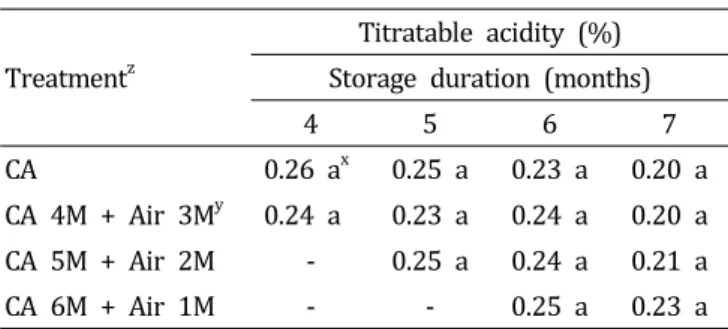
Table 3. Titratable acidity in ‘Fuji’ apples stored at CA storage (CA) with 2.5 ± 0.5% O 2 and 1.5 ± 0.5 % CO 2 at 0 ± 1°C and subsequent air storage (Air) at 0 ± 1°C.
Treatment z
Titratable acidity (%) Storage duration (months)
4 5 6 7
CA 0.26 a x 0.25 a 0.23 a 0.20 a
CA 4M + Air 3M y 0.24 a 0.23 a 0.24 a 0.20 a CA 5M + Air 2M - 0.25 a 0.24 a 0.21 a
CA 6M + Air 1M - - 0.25 a 0.23 a
z Fruits were stored for 1 month in air storage and then stored CA storage.
y CA 4M + Air 3M: Fruits were stored for 4 months in CA storage and then stored for 3 months in air storage at 0
± 1°C.
x Mean separation within columns by Duncan’s multiple range test, P = 0.05 .
해제기간이 빠를수록 에틸렌 발생량이 높아지는 경향을 보 였으나 저장 7개월 후에는 12-13μL・kg
-1
・h-1
정도의 발생량 을 보여 차이를 보이지 않았다. 비록 과실을 저장 중 CA 환경을 중간에 해제하는 처리가 지속적으로 CA 저장하는 것에 비하여 에틸렌 발생량이 높았으나 그 차이는 크지 않 음을 알 수 있었다. 그리고 내생에틸렌 발생량도(Fig. 3) CA 환경해제기간이 빠를수록 그 발생량은 증가하여 에틸렌 발 생량과 동일한 경향을 보였다. 그러나 CA 저장 처리구에 비 하여 그 양적인 차이는 에틸렌 발생량보다 크게 나타났다.사과는 수확 후 저온저장 시 저장기간이 길어질수록 호흡 량과 에틸렌 발생량이 증가하게 되고(Park et al., 2011), 또 한 일정기간 저온저장을 하고 CA환경설정을 지연시킨 과 실들에서는 호흡량은 처리 간 차이가 없었으나, 에틸렌 발 생량은 저온처리 기간이 길어질수록 증가하는 경향을 보여 (Biale and Young, 1981; Chung and Choi, 1999; Park and Youn, 1999; Park et al., 2011) 본 결과에서도 동일한 경향을 보여 저온저장이 CA 저장에 비하여 과실의 에틸렌 발생량 을 높이는 원인임을 알 수 있었다.
과실 특성 변화
저장별 각 처리에 따른 과실의 경도 변화를 보면(Table 2), 일반 CA 저장의 경우 저장 4개월 후에는 31.2N이었고, 저장 7개월 후에는 29.6N으로 경도변화가 거의 없었고, 모 든 CA 저장 후 저온저장처리구의 경우도 저장 7개월 후에
도 28.9-30.8N으로 일반 CA 저장 처리구와 차이가 없었다.
그리고 산 함량의 변화를 보면(Table 3), CA 저장 4개월 후 에는 CA 처리구와 CA 4M + Air 3M 처리구는 0.24%와 0.26%였고, 저장 7개월 후에는 모든 처리구의 산 함량은 0.20-0.23%로 다소 감소하는 경향을 보였지만 처리 간 차이 를 보이지 않았다. 따라서 일반 CA 저장에 비하여 CA 저장 4, 5, 6개월 후 저온저장처리가 과실품질 저하에 미치는 영 향이 없음을 알 수 있었다. 다른 연구결과들에서도 사과 과 실의 CA 저장 시 4-6주 지연 CA 저장과 일반 CA 저장 처 리구들에서 과실의 경도와 산 함량에서는 차이가 없었고
(Anderson and Abbott, 1975; Argenta et al., 2000; Lau, 1983, 1998; Sharples and Munoz, 1974) 본 연구에서도 CA 저장 후 저온저장이 과실의 갈변방지 및 품질을 유지하는데 우수 한 효과를 보였다.
이상의 결과를 종합하여 보면, 국내의 ‘후지’ 사과는 재배 시 밀병 발생이 많아 CA 저장 시 과육의 일부 조직이 갈변 하는 저장장해 발생으로 인하여 실용화되지 못하고 있어 일 괄적인 CA 저장방법보다는 변형된 CA 저장기술을 개발할 필요성이 있다. 따라서 본 연구에서 실시한 수확 후 1개월 저온저장을 한 후 CA 저장 4개월과 5개월 정도 실시하고 그 이후로 저온저장을 할 경우 과실 내부갈변발생이 없었고, 호흡량, 과실 경도, 산 함량이 일반 CA 저장과 차이가 없이 과실품질이 유지되는 결과를 확인하였으므로 본 연구 결과 가 국내에서 CA 저장방법을 개선할 수 있는 실용화 기술이 라고 판단된다.
초 록
본 연구는 ‘후지’ 과실을 대상으로 저온저장(온도: 0 ± 1°C) 을 1개월 처리한 후 CA 저장(CA 저장 조건: O
2
2.5 ± 0.5%, CO2
1.5 ± 0.5%, 온도: 0 ± 1°C) 4개월 + 저온저장 3개월 (CA 4M + Air 3M), CA 저장 5개월 + 저온저장 2개월(CA 5M + Air 2M), CA 저장 6개월 + 저온저장 1개월(CA 6M + Air 1M)로 처리하였고, CA 저장은 수확 후 즉시 처리한 다음 저장기간에 따라 과실 내부갈변증상과 과실품질에 미 치는 영향을 조사하였다.과실의 내부갈변 증상은 일반 CA 저장에서는 저장 4개월 후에 17.1%로 시작하여 저장 7개월 후에는 30.2%로 매우 높은 발생을 보였다. 그러나 CA 4M + Air 3M 처리구와 CA 5M + Air 2M 처리구는 과실 내부갈변증상이 전혀 나타 나지 않았다. 각 처리별 호흡량의 변화는 저장 6개월까지는 차이가 없었고, 저장 7개월 후에는 CA 4M + Air 3M 처리구 와 CA 5M + Air 2M 처리구가 낮은 호흡량을 보였다. 에틸 렌 및 내생 에틸렌 발생량은 일반 CA 저장에서는 가장 낮았 고, CA 환경해제기간이 빠를수록 다소 높은 발생량을 보였 다. 과실품질에서 처리별 경도와 산 함량의 변화를 보면 일 반 CA 저장에 비하여 CA 저장 4, 5, 6개월 후 저온저장처리 간에는 차이가 없었다. 따라서 과실의 저장력 향상을 위하 여 지속적인 CA 저장을 하기보다는 CA 저장 5개월 후에 환경설정을 해제하고 저온저장을 유지하여도 과실품질을 유지할 수 있었다.
추가 주요어 : 에틸렌, 과실내부갈변, 과실 경도, 산함량