
Online ISSN: 2288-7253 DOI: https://doi.org/10.14579/MEMBRANE_JOURNAL.2021.31.1.1
1. Introduction 1)
As the use of fossil fuels such as petroleum and coal has increased, the amount of carbon dioxide re- leased into atmosphere increased dramatically. The re- sidual carbon dioxide in the atmosphere is the main cause of global warming among greenhouse gases by
destroying ecosystem and humanity as a whole. In or- der to address this issue, CO
2capture technology has been developed. Among the separating technologies, membrane-based separation, especially gas separation by polymeric membrane, exhibits great potentiality ow- ing to its efficiency, energy saving and environ- mentally friendliness. Ionic liquid based mixed matrix
†
Corresponding author(e-mail: [email protected], http://orcid.org/0000-0002-3820-141X)
CO
2분리를 위한 이온성 액체 기반 혼합 매트릭스 멤브레인의 최근 발전
황 채 림
*
ㆍ라즈쿠마 파텔**
,†*
연세대학교 언더우드 국제대학 나노과학 공학과(NSE) 융합과학공학과(ISED),**
연세대학교 언더우드 국제대학 에너지 환경 공학부(EESE) 융합과학공학과(ISED)(2020년 12월 10일 접수, 2020년 12월 23일 수정, 2021년 1월 6일 채택)
Recent Advances on Ionic Liquid based Mixed Matrix Membrane for CO 2 Separation
Chaerim Wang * and Rajkumar Patel **
,†*Nano Science and Engineering, Integrated Science and Engineering Division (ISED), Underwood International College, Yonsei University, Songdogwahak-ro, Yeonsu-gu, Incheon 21983, South Korea
**Energy and Environmental Science and Engineering (EESE), Integrated Science and Engineering Division (ISED), Underwood International College, Yonsei University, Songdogwahak-ro, Yeonsu-gu, Incheon 21983, South Korea
(Received December 10, 2020, Revised December 23, 2020, Accepted January 6, 2021)
요 약: 이온성 액체 기반 혼합 멤브레인(MMM)은 이산화탄소 분리 매체로써 다양한 종류의 이온성 액체와 무기성 필러 폴리머에 의해 만들어진다. 이온성 액체와 무기성 필러의 강한 상호작용은 이산화탄소의 금속 유기체의 프레임워크 내 친화 력, 선택성, 흡착성을 높여 분리성능을 향상시킨다. 또, 이온성 액체에 의해 혼합 매트릭스 멤브레인의 구조적 특성이 조절되 어 이산화탄소 투과성과 선택성을 향상시킨다. 이 리뷰에서는 이산화탄소 분리를 위한 고분자 막에서의 이온성 액체(IL)와 금속 유기체 프레임워크(MOF)의 다양한 조합에 대한 연구가 논의될 것이다.
Abstract: The membrane-based CO
2capture is a fast-growing branch in gas separating field. Ionic liquid assisted mixed matrix membrane (MMM), which consists of organic fillers with dispersed ionic liquid, shows high potentiality as a candidate for CO
2separation medium. In MMM, various kinds of ionic liquid and inorganic filler are incorporated into polymer to enhance gas separating performance. Especially, the strong interaction between ionic liquid and organic filler gives huge influence on enhancing the separating performance by increasing affinity, selectivity and adsorption of CO
2into the framework. Also the mechanical properties of metal organic framework are positively tuned by input of ionic liquid to improve CO
2permeability and selectivity. In this review, study of various combinations of ionic liquid and metal organic framework (MOF) in the polymeric membrane for carbon dioxide separation is discussed.
Keywords: mixed matrix membrane, MOF, ionic liquid, CO
2membrane composed of polymer or inorganic fillers’
crystals in the matrix shows significantly enhanced properties of gas separation with high selectivity and permeability of CO
2[1-17].
The inorganic filler is a material that is incorporated into the polymer membrane in order to produce the composite with better gas separating properties.
Inorganic filler makes huge impact on determining the properties of composite depending on its types, loading amount or state of distribution into the polymer. The metal organic framework (MOF), consisting of pos- itively charged metal ions and organic ligands, is one of the promising crystalline porous filler due to the fa- vorable characteristics of gas separation. MOF exhibits ultrahigh surface area, distinctive structure, great tuna- bility, and excellent adsorption performance. By utiliz- ing different types of metal ions and organic linkers, various structures of MOF with different properties can be fabricated. One example is zeolitic imdazolate frameworks (ZIFs), made of transitional metal linked by imdazolate. Many studies regarding ZIF have been increased in the field of separation due to its high re- generability with great chemical and thermal stability.
Especially, ZIF-8 becomes the most promising material for the CO
2adsorbent with high affinity toward the gas molecules. Another example of MOF is copper benzene-1,3,5-tricarboxylate (HKUST-1) which is met- als ions linked with benzene-1,3,5-tricarboxylate. MOF can now become a substitute for the conventional non- porous adsorbents, which have been known to be ex- pensive and inefficient.
In the fabrication of the ionic liquid based MMM, the choice of ionic liquids (ILs) is as important as the choice of the inorganic filler. Ionic liquid is form of salt in the liquid state. Ionic liquid has many suitable properties as the medium for the gas separation such as minor volatility, inflammable state, high stability and great ionic conductivity; above all, its tenability can maximize the CO
2separation performance by mod- ifying the properties of polymer resulting from the tun- ing the nano-cage of composite with cations and anions as monomers. This shows that the insertion of ILs into
MOFs has resulted in a new MMM with superior gas separating properties. In this review, various ionic liq- uids are used to analyze the various combinations of composite. One will compare the thermal and chemical properties of various types of MOF/IL composite through nano-characterization methods and compare the CO
2separation performance by measuring CO
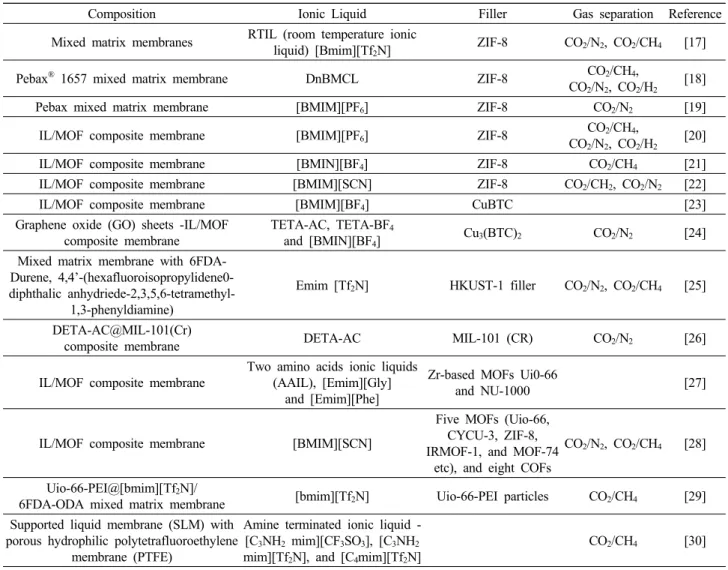
2selectivity and permeability. Schematic of the separation process is presented in Fig. 1 and summarized in Table 1.
2. Metal Organic Framework (MOF) 2.1. Zeolitic imidazolate framework (ZIF-8)
The effect of ionic liquid on the microenvironment of the MOF nanocage was reported by Ban et al. When the room temperature ionic liquid 1-butyl-3-methylimi- dazolium bis(trifluoromethylsulfonyl)imide (RTIL[bmim]
[Tf
2N]) is incorporated into the ZIF-8, the pore sizes of the microporous material is adjusted[17]. Then, the molecular sieving properties of ZIF-8 is modified, the- reafter the gas capturing performance is enhanced. In this process, the RTIL[bmim][Tf
2N] acts as both cavity occupant and the solvent. The IL confinement ratio in the nanocage is 1.4 per the cage. The confinement of IL into the nanocage is characterized by X-ray diffraction (XRD) and the attenuation total reflectance-Fourier transform infrared (ATR-FTIR). According to the XRD, the change of the XRD intensity is caused by the change of packing density inside the nanocage after the penetration of anions in IL. FT-IR shows the confine- ment of IL due to the shift of the SO
2stretching band.
Shifting of peaks is the evidence for the presence of a strong interaction between IL and the ZIF-8. As ILs occupies the volume of pore on the ZIF-8, Brunauer Emmett Teller (BET) shows the decrease in the surface area and pore volume at each 374 m
2/g and 0.18 mL/g respectively. Comparing the IL@ZIF-8 MMMs and the pristine polysulfone (PSF) membrane structure, IL@ZIF-8 MMMs shows the best performance in capturing CO
2with high selectivity. This is because IL@ZIF-8 MMM
increases the CO
2permeability by about 50% while
maintains N
2and CH
4permeability. So that, the selec-
Fig. 1. Schematic diagram of mixed matrix membrane.
tivity of MMM exceeds the upper bound of the pristine membrane structure. Also, when the permeability is compared between IL@ZIF-8 MMM and MOF based MMM, IL@ZIF-8 MMM significantly shows about 50%
enhanced CO
2permeability whereas reduced N
2and CH
4permeability. Interestingly, IL@ZIF-8 MMMs shows opposite trend with PSF membrane depending on the pressure. The pristine PSF membrane shows the de- crease of the separation factor in the increasing pres-
Composition Ionic Liquid Filler Gas separation Reference
Mixed matrix membranes RTIL (room temperature ionic
liquid) [Bmim][Tf2N] ZIF-8 CO2/N2, CO2/CH4 [17]
Pebax® 1657 mixed matrix membrane DnBMCL ZIF-8 CO2/CH4,
CO2/N2, CO2/H2 [18]
Pebax mixed matrix membrane [BMIM][PF6] ZIF-8 CO2/N2 [19]
IL/MOF composite membrane [BMIM][PF6] ZIF-8 CO2/CH4,
CO2/N2, CO2/H2 [20]
IL/MOF composite membrane [BMIN][BF4] ZIF-8 CO2/CH4 [21]
IL/MOF composite membrane [BMIM][SCN] ZIF-8 CO2/CH2, CO2/N2 [22]
IL/MOF composite membrane [BMIM][BF4] CuBTC [23]
Graphene oxide (GO) sheets -IL/MOF composite membrane
TETA-AC, TETA-BF4
and [BMIN][BF4] Cu3(BTC)2 CO2/N2 [24]
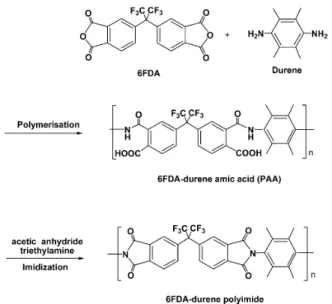
Mixed matrix membrane with 6FDA- Durene, 4,4’-(hexafluoroisopropylidene0- diphthalic anhydriede-2,3,5,6-tetramethyl-
1,3-phenyldiamine)
Emim [Tf2N] HKUST-1 filler CO2/N2, CO2/CH4 [25]
DETA-AC@MIL-101(Cr)
composite membrane DETA-AC MIL-101 (CR) CO2/N2 [26]
IL/MOF composite membrane
Two amino acids ionic liquids (AAIL), [Emim][Gly]
and [Emim][Phe]
Zr-based MOFs Ui0-66
and NU-1000 [27]
IL/MOF composite membrane [BMIM][SCN]
Five MOFs (Uio-66, CYCU-3, ZIF-8, IRMOF-1, and MOF-74
etc), and eight COFs
CO2/N2, CO2/CH4 [28]
Uio-66-PEI@[bmim][Tf2N]/
6FDA-ODA mixed matrix membrane [bmim][Tf2N] Uio-66-PEI particles CO2/CH4 [29]
Supported liquid membrane (SLM) with porous hydrophilic polytetrafluoroethylene
membrane (PTFE)
Amine terminated ionic liquid - [C3NH2 mim][CF3SO3], [C3NH2
mim][Tf2N], and [C4mim][Tf2N]
CO2/CH4 [30]
![Fig. 3. Lowest energy equilibrium conformer of [BMIM]](https://thumb-ap.123doks.com/thumbv2/123dokinfo/5467659.439362/5.892.477.796.370.673/fig-lowest-energy-equilibrium-conformer-of-bmim.webp)
![Fig. 4. Single-component excess adsorption isotherms of CO 2 , CH 4 , and N 2 in (a) ZIF-8 and (b) [BMIM][PF6]/ZIF-8 measured at room temperature (Reproduced with permis-sion from Kinik et al., 20, Copyright 2016, American](https://thumb-ap.123doks.com/thumbv2/123dokinfo/5467659.439362/6.892.146.368.143.582/component-adsorption-isotherms-measured-temperature-reproduced-copyright-american.webp)

![Fig. 9. PXRD of (a) [Emim][Gly]/UiO-66 and (b) [Emim]](https://thumb-ap.123doks.com/thumbv2/123dokinfo/5467659.439362/11.892.467.806.145.435/fig-pxrd-emim-gly-uio-b-emim.webp)
