• 검색 결과가 없습니다.

Ionic Liquid based Carbon Dioxide Separation Membrane

N/A
N/A
Protected

Academic year: 2021

Share "Ionic Liquid based Carbon Dioxide Separation Membrane"

Copied!
9
0
0

로드 중.... (전체 텍스트 보기)

전체 글

(1)

Online ISSN: 2288-7253 DOI: https://doi.org/10.14579/MEMBRANE_JOURNAL.2020.30.3.149

1. Introduction 1)

Climate change and global warming due to high CO

2

gas concentration in atmosphere has been one of the crucial problems for humanity and environment. By separating CO

2

gas from immense flue gas of factory, one can capture the CO

2

gas from dispersing and uti- lize CO

2

gas as hyrdrocarbon fuel source. In order to achieve such results, advanced gas separating mem-

brane has to be incorporated directly into power plants pipes and chimney. Gas separating membrane in such condition requires high mechanical stability, reusability, economical and high CO

2

gas selectivity[1-12].

Ionic Liquid (ILs), molten salt in low-temperature, is proved to be the ideal material for creating membrane due to its characteristics that allow high solubility and selectivity for CO

2

gas with low volatility[13]. Tuning the microstructure of crosslinked poly(ionic liquid) (PIL)

Corresponding author(e-mail: [email protected], https://orcid.org/0000-0002-3820-141X)

이온성 액체를 이용한 이산화탄소 분리막

박 정 혁⋅라즈쿠마 파텔

연세대학교 언더우드국제대학 에너지환경과학공학과(EESE) 융합과학공학과(ISED) (2020년 6월 3일 접수, 2020년 6월 16일 수정, 2020년 6월 17일 채택)

Ionic Liquid based Carbon Dioxide Separation Membrane

Jung Hyeok Park and Rajkumar Patel

Energy and Environmental Science and Engineering (EESE), Integrated Science and Engineering Division (ISED), Underwood International College, Yonsei University, 85 Songdogwahak-ro, Yeonsu-gu, Incheon 03722, South Korea

(Received June 3, 2020, Revised June 16, 2020, Accepted June 17, 2020)

요 약: 유기 양이온과 유기/무기 음이온을 포함하고 있는 이온성 액체는 저온 용융 염의 종류이며 이산화탄소 분리 기능 에 대한 잠재력을 갖고 있다. 지구 온난화와 기후 변화의 문제점을 극복하기 위해 이온성 액체를 기반으로 한 막을 개발하여 연도가스에서 이산화탄소를 걸러내는 연구가 활발히 진행되고 있다. 본 리뷰에서는 홀로 설 수 있는 중합 이온성 액체(PIL), 이온성 액체와 이온성 액체 복합 막의 혼합의 기술이 논의될 것이다. 새로운 이온성 액체의 모노머 도입, 그리고 중합 이온성 액체 막과 복합 막의 미세구조변형은 막의 기계적 특성을 향상시켜 가스투과율과 선택도를 크게 향상 시키는데 시용되어 왔 다. 이온성 액체 모너머의 양이온과 음이온의 다양한 변형은 막의 가스 분리성에 큰 영향이 있다.

Abstract: Ionic Liquid (IL) in the category of low-temperature molten salts with organic cation and organic/inorganic anion has shown great potentiality in CO

2

gas separation. CO

2

gas separation from flue gas by IL based membrane has been widely researched in recent years to overcome climate change and global warming. Membranes based on free standing polyionic liquid (PIL), blend of ionic liquid and composite ionic liquid membranes are discussed in this review. Introducing different IL monomers and tuning microstructure of PIL membrane and composite of PIL-IL to enhance mechanical properties of membranes with good CO

2

gas permeability and selectivity. Variations in cation and anions of monomer has great impact on the membrane gas separation performance.

Keywords: ionic liquids (ILs), permeability, selectivity, membrane, carbon dioxide

(2)

membranes and gels via a multicomponent reaction for improved CO

2

capture performance. The composition of ILs include organic cations and organic/inorganic anions which is used as monomers in polymer membrane can be tailored and modified to produce membrane with distinct property of gas separation. Supported Ionic Liquid membranes (SILMs) were the earliest apply of Ionic Liquids as CO

2

gas separation that showed ex- cellent performance in CO

2

gas permeability and sepa- ration. Despite SILMs outstanding performance, it was not commercially used due to low mechanical strength in high pressure conditions such as power plants that displaced ILs from the membrane[14].

To enhance the mechanical stability and CO

2

gas separation property, IL based membrane was developed in various types: Room Temperature Ionic Liquid (RTIL), Poly Ionic liquid (PIL), PIL-IL composite membrane Each specific IL based membrane was finely tuned with different Ionic liquid materials, concentration and synthesis method that was tested for gas permeability and selectivity which was plotted on Robeson plot. Not all the IL based membrane was plotted on the upper bound of Robeson plot, representing high separation performance, each experiment result clearly shines light upon the potentiality and practicability of IL based membrane that can successfully capture CO

2

gas.

Schematic diagram of the crosslinking behavior of the in PIL and IL is represented in Fig. 1.

Fig. 1. Schematic diagram of gas separation PIL/IL mem- brane.

2. Ionic Liquid-based Gas Separation Mem- brane

2.1. Poly(ionic liquid) membranes

Poly ionic liquid is simply polymerization of ionic liquids to achieve advanced CO

2

sorption than room temperature Ionic Liquid. In order to discuss the differ- ent functionality and gas separation property, phospho- nium-based PIL membrane, Styrene- based PIL mem- brane, modified Imidazolium- based PIL and cross-linked poly(vinylimidazolium) gel membrane will be discussed in detail.

Phosphonium-based poly ionic liquid (PIL) mem- brane is fabricated to obtain high CO

2

gas separation

Membrane CO2 permeability

(barrers) Selectivity References SLIM (supported ionic liquid membranes) [C2mim][NTf2] SILMs 589 ± 1.0 18.1 ± 0.3 (CO2/CH4) [14]

PIL: poly([P888VB][Tf2N])-Phosphonium base 186 0.4 (H2/CO2) [15]

Poly(RTIL)-RTIL composite: *Polymer2-[C6mim][Tf2N] Composite 19 ± 1 20 (CO2/CH4) [17]

Cross-linked PIL- RTIL Gel membrane:

cross-linked poly (vinylimidazolium)-([emim][Tf2N])(75 wt%) Gel 520 ± 30 12 (CO2/H2) [18]

Poly(RTIL) membrane: disiloxane functionalized vinyl poly(RTIL) 130 14 (CO2/N2) [19]

PIL-IL membrane: supported Epoxy-amine based ion gel membrane

(75 wt% of free [EMIM][Tf2N]) 525 18 (CO2/CH4) [24]

Poly RTIL-RTIL composite membrane:

poly([vbim][dca])-[emim][B(CN)4] (1 : 2) 340 42 (CO2/N2) [25]
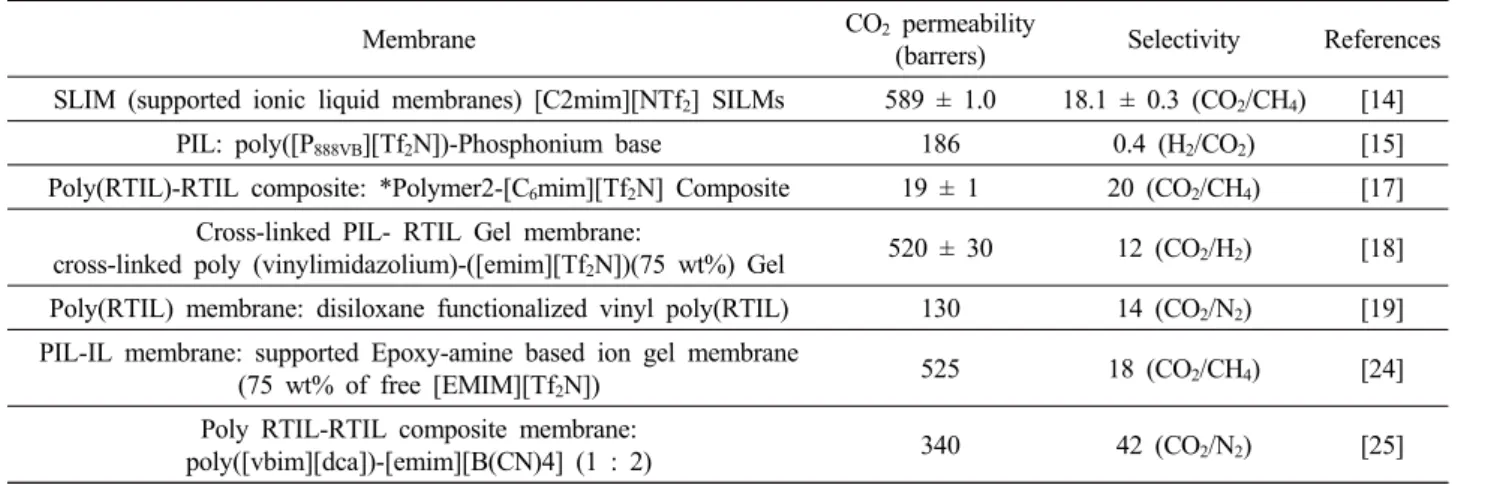
*Polymer 2: Imidazolium ionene with Tf

2

N ion.

Table 1. Summary of CO

2

Gas Separation Membrane

(3)

with high ion-conductive property[15]. Widely used imidazolium based PIL has limitations in chemical, thermal and biological conditions resulting membrane fouling property; however, phosphonium based PIL membrane’s ion-conductive property enhances the pre- vention of membrane fouling in conditions referred above. The research by Cowan et al. carefully com- pares phosphonium based PIL by free radical polymer- ization with imidazolium and ammonium based PILs to obtain results of enhancements in thermal, chemical and fouling resistance. The phosphonium based PIL is synthesized by free radical polymerization of (tri-n-al- kyl) vinyl benzyl phosphonium monomers and bis(tri- fluoromethylsulfonyl) with radical photo-initiator to prepare [P

nnnVB

][Tf

2

N] PIL. Obtained PIL is pressed between two quartz plates than irradiated at 365 nm to result free standing membrane. Tuning of alkyl chain length during the synthesis of [P

nnnVB

][Tf

2

N] showed linear relationship with permeation property while re- ducing selectivity property. The increased alkyl chain creates free volume in the PIL solid matrix which causes decrease in selectivity property and this value reaches plateau level at [P

666VB

][Tf

2

N]. Despite the loss in selectivity value, the [P

888VB

][Tf

2

N] PIL membrane showed highest CO

2

permeability value with 186 bar- rers by repeating three alkyl chains for every cation unit that greatly increased free-volume quantity. The ionic conductivity properties of [P

nnnVB

][Tf

2

N] mem- brane showed 10

-8

~10

-4

S cm

-1

value at 25 to 105°C and when compared to imidazolium based PILs showed reduction of conductivity properties. The stability of [P

nnnVB

][Tf

2

N] PIL membrane material is tested at high- er temperature than comparable PILs to prove the en- hancement of membrane fouling resistance of thermal, chemical and biological conditions. In conclusion, the [P

nnnVB

][Tf

2

N] PIL membrane material has to be re- searched in more detail to find the optimum length of alkyl chain to achieve high quality selectivity level that can be incorporated in conditions that require high re- sistance to membrane fouling.

Styrene based Ionic Liquid monomer functionalized with branching and integrating cycloalkyl group to imi-

dazolium ring showed improvements in gas separation properties compare to n-alkyl chain[16]. Modifying and branching the cyclic alkyl functionalized poly ionic liq- uid membrane showed 20% enhancement in selectivity property, but the membranes diffusivity decreased by 50% due to compact structural arrangement in cyclo- alkyl that resulted decrease in fractional free volume (FVV).

The research by Carlisle et al. on imidazolium ion- ene showed high selectivity for CO

2

gas which is poly- merized withe three different membranes[17]. First pol- ymer example is combination of imidazolium ionene with bromide counter ion and second polymer example is obtained by combining imidazolium ionene with Tf

2

N ion. Composite film is also fabricated by blending pol- ymer example 2 and RTIL. Three imidazolium-based polymer membranes gas permeability of single gases (CO

2

, CH

4

, N

2

and H

2

) regarding to selectivity of CO

2

/ CH

4

, CO

2

/N

2

and H

2

/CO

2

are plotted on Robeson plot.

Polymer1 showed permeability values of CO

2

and H

2

gases around 0.13 barrer and 0.84 barrer accordingly.

The permeability value of CH

4

and N

2

was not detected in polymer 1 due to small value of 0.01 barrer. The selectivity value of H

2

/CO

2

was 6.0 despite having very low CO

2

diffusivity value. Polymer 1 membrane’s counter-ion bromide ion created close dense packing that reduced free-volume resulting low diffusivity.

Polymer 2 showed exceptional results of CH

4

and N

2

gas permeability to that of polymer 1 with 0.25 barrer and 0.20 barrer accordingly. The CO

2

and H

2

gas in polymer 2 showed permeability of around 5.3 barrer;

however, the tradeoff relationship the selectivity level of H

2

/CO

2

reduced to 1.00. Polymer 2 has higher CO

2

diffusivity than polymer 1 due to different counter ion, but polymer 2 resulted hindering when accessing CO

2

gas due to architect and ionic functionality of the

membrane. Finally, the composite membrane showed

the most increased permeability value by 360, 430 and

380% of CO

2

, CH

4

and N

2

with slight loss of selectivity

value. Composite membrane does not outperform the

Poly(RTIL)-RTIL composite membrane with the decyl

C

2

spacer composition due to the structure of the imi-

(4)

dazolium ring that hinder structural functionality. The concept of chemical and functional modification of the imidazolium ionene membrane allows one to adapt modified spacer characteristics and functional groups to enhance permeability and selectivity level.

Room Temperature Ionic Liquids (RTILs) are also promising candidate in CO

2

gas separation due to tuna- ble chemical characteristic and low flammability prop- erty compare to volatile organic compounds. Cross-linked poly (vinylimidazolium) gel membrane is synthesized through photo-polymerization of cross-linked function- alized oligo (ethylene glycol) and non-cross-linked vi- nylimidazolium RTIL monomers with free RTIL.

Additional modification of cross-linked poly(vinylimi- dazolium) gel membranes includes the loading of free RTIL ([emim][Tf

2

N]) by 45, 65 and 75 wt%, di-func- tional monomer for cross-linking from 5 to 100 mol%

and substituting different functional RTIL monomer to test gas separation performance[18]. The membrane with 75% free RTIL component showed impressive CO

2

permeability level of 520 ± 30 barrers with high CO

2

/H

2

selectivity level of 12. Decreased cross-linking mono- mer concentration showed high gas diffusivity value with minor enhancement of CO

2

/H

2

gas selectivity val- ue; however, when the cross-linking behavior dropped below critical value, the CO

2

permeability value was reduced by inhomogeneous structure and unsaturation of membrane. Modification of substituent monomers length and chemical composition showed minimal over- all change. For example, the length change of the monomer showed very small reduction of CO

2

perme- ability and changing the chemical composition to apo- lar, n-hexyl resulted small reduction of CO

2

selectivity.

By the experiment, it was clear that increased concen- tration of RTIL in poly (RTIL)-RTIL gel resulted ex- cellent gas separation performance and modification of the membranes structural property can enhance me- chanical strength. In the future study, the relationship between poly (RTIL)-RTIL gel and network formation of the membrane needs to be researched to generate RTIL gel membranes that can be modified to suit any environment and conditions; since, the work in this

study is only possible at fixed high pressure that guar- antees the liquid stability.

2.2. Poly(ionic liquid)/Ionic liquid blend (composite) membrane

PIL-IL composite membrane incorporates different loadings of free IL that results unique gas separation property. Research Carlisle et al. examines the effect of functionalization of polymer backbone that is in- tegrated into PIL-IL composite membrane.

In previous research, the gas separation property of imidazolium based RTIL polymer membrane was con- ducted with little understanding of the polymer back- bone[19]. Imidazolium- functionalized poly styrene and poly acrylate polymer backbone can be replaced with vinyl based poly(RTIL) with poly ethylene polymer backbone which is more accessible to create than styr- ene and acrylate based analogues. The vinyl poly(RTIL) membrane will be tested with various substituents in- cluding n-alkyl, ethylene glycol, fluoro-alkyl and disil- oxane for gas transport behavior. Vinyl based poly(RTIL) showed increased gas transport effectiveness compare to styrene and acrylate based poly(RTIL) due to longer length of n-alkyl substituent; however, the CO

2

gas se- lectivity value showed lower trend, which was enhanced by modifying with ethylene glycol -ionefunctional group to vinyl poly(RTIL) membrane. CO

2

gas has fluo- rophilic conditions that can be adapted to enhance the selectivity nature of the membrane which is substituted to n-hexyl-functionalized poly(RTIL) that resulted in- creased CO

2

selectivity value. Disiloxane group was substituted to increase free volume of RTIL membrane and enhance gas permeability to maximum 130 barrers with little loss of CO

2

gas selectivity. The n-hexyl and disiloxane based vinyl poly(RTIL) showed highest gas permeability properties with 20 mol% of free (RTIL) to increase gas selectivity. Finally, it is crucial to prepare high gas selective and permeable poly(RTIL)-RTIL composite membrane with liquid and solid ion charged components held by ion-ion attraction.

Nellepalli et al. prepared poly(vinyl imidazolium)

-polystyrene (Poly(vinylbenIm) NTf

2

) homo and co-

(5)

Fig. 2. Gas permeabilities (A), diffusivities (B), and sol- ubilities (C) through the prepared imidazolium-based co-PIL-IL membranes. Error bars represent standard devia- tions based on three experimental replicas (Reproduced with permission from Nellepalli et al., 20, Copyright 2019, American Chemical Society).

polymer by random addition fragmentation chain trans- fer reaction (RAFT)[20]. Fabrication of membrane was possible by mixing it with various ionic liquid when the rigidity of the polymer was reduced (Figs. 2 and 3). Another new type of copolymer was prepared by O’Harra et al.[21]. Polyimide-ionene based on 6FDA with imdazolium moieties are prepared for CO

2

separa- tion membrane. Ionic liquids like [C4mim][Tf

2

N] and [Bnmim][Tf

2

N] are mixed with the PIL to enhance the permeability of the composite membrane. Same group reported Troger’s base containing ionene polymer to enhance carbon dioxide permeability (Figs. 4 and 5)[22].

McDanel et al. prepared epoxy amine PIL with cross- linking and PIL/IL ion gel membrane for CO

2

separa-

Fig. 3. Pictures of the PIL-IL membranes: (A) poly(ViPen- Im)-(Sty)NTf

2

with 10 wt% IL, (B) poly(ViBenIm)(Sty)NTf

2

with 25 wt% IL, (C) poly(ViPenIm)(Sty)NTf

2

with 30 wt%

IL, (D) poly(ViBenIm)NTf

2

with 20 wt% IL, (E) poly(Vi- NapIm)NTf

2

with 20 wt% IL (Reproduced with permission from Nellepalli et al., 20, Copyright 2019, American Che- mical Society).

Fig. 4. Membranes (~300 in diameter) over their respective structures. [6FDA I4A Xy][Tf

2

N] : [C2mim][Tf

2

N] (left) and [6FDA I4A pXy][Tf

2

N] : [Bnmim][Tf

2

N] (right) (Reprodu- ced with permission from O’Harra et al., 22).

Fig. 5. [Rmim][Tf

2

N] ionic liquids (ILs) utilized to form polyimide-ionene + IL composites (Reproduced with per- mission from O’Harra et al., 22).

tion[23]. Ratio of amine to epoxide and the molecular

weight of the monomer is critical for the gas separa-

tion properties. Comparison of primary and secondary

(6)

Fig. 7. Bar graphs displaying the CO

2

capacity for epoxy resins prepared with monomers A~D with TAEA at 3 : 1 and 3 : 2 monomer stoichiometries. The left plot displays CO

2

capacity in millimoles of CO

2

per gram of resin, while the graph on the right displays the data in units of moles of CO

2

per mole of amine binding sites (Reproduced with permission from McDanel et al., 23, Copyright 2015, American Chemical Society).

amine group on the gas permeation properties and rate of reaction of the epoxy group was checked and con-

ditions were optimized for tuning of CO

2

permeability and solubility (Figs. 6~8).

2.3. Modified Ionic liquid membrane

Friessa et al. reported the modification of ionic liq- uid-based gel membrane that performs in various con- ditions such as feeding pressure, humidity, fixed-si- te-carrier facilitated CO

2

transport mechanism and ionic liquid concentration[24]. Epoxy amine-based ion gel membrane exhibits high CO

2

permeability due to sec- ondary and tertiary amine sites on PIL membrane and high gas diffusivity due to liquid like transport behav- ior of free IL. In single gas studies, the permeability and diffusivity properties are alternated by different concentration of [EMIM][Tf

2

N]. When plotted in the Robeson Plot, the PIL-IL with 75 wt% of [EMIM][Tf

2

N]

resulted higher permeability than 50 wt% retaining

comparable selectivity of 18 vs 20 (CO

2

/CH

4

). The dif-

fusivity at PIL-IL 75 wt% showed rubbery polymer be-

havior of polydimethylsiloxane that penetrated large

gas molecules such as CO

2

while 50 wt% was not

capable. In mixed gas studies, the PIL-IL 75’s per-

meation properties were tested in various feeding pres-

sure of 0.27, 0.47 and 0.75 bar and humidity levels of

32 and 54%. At lowest feeding pressure, the separation

maximum is achieved because CH

4

molecules did not

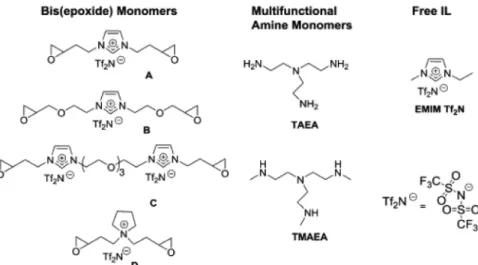
Fig. 6. Compounds utilized in this study. Compounds A~D are bis(epoxide)-functionalized IL monomers. TAEA and TMAEA

are commercially available multifunctional amine monomers. EMIM Tf

2

N is the free IL used to prepare the ion-gel mem-

branes (Reproduced with permission from McDanel et al., 23, Copyright 2015, American Chemical Society).

(7)

Fig. 8. CO

2

/N

2

and CO

2

/CH

4

Robeson plots for epoxy ion-gel membranes with either 50 or 60 wt% free IL and EMIM Tf

2

N. The data points for ion-gel membranes pre- pared with monomer A are displayed in blue, and the data points for ion-gel membranes prepared with monomer B are in red. Membranes with 3 : 1 stoichiometries are de- picted as squares, and membranes with 3 : 2 stoichiometries are displayed as circles (Reproduced with permission from McDanel et al., 23, Copyright 2015, American Chemical Society).

hinder pathways for CO

2

and humidification which al- lowed CO

2

to be soluble in water while CH

4

was not.

The advanced humid and IL content conditions allowed membranes to successfully apply separation of mixed biogas in high pressure feed. When separating CO

2

gas from natural gas (Flue gas) with pressure higher than atmosphere, the membrane system had to overcome the low partial pressure of CO

2

of 0.1 to 0.2 bar to obtain high permeability and CO

2

/N

2

selectivity[25].

Room temperature ionic liquid is used widely due to its characteristics that involve negligible vapor pressure and high CO

2

gas solubility. Pure poly ionic liquids (PILs) are unstable to use in various conditions, so PIL-IL composite membrane is created to enhance gas

selectivity and permeability behavior. The following study examines three different vinyl functionalized imi- dazolium RTILs [1-vinyl-3-ethylimidazoliumdicyanamide ([veim][dca]), 1-vinyl-3-butylimidazolium dicyanamide ([vbim][dca]) and 1-vinyl-3-heptylimidazolium dicyana- mide ([vhim][dca])] to obtain 3 different Poly RTIL-RTIL composite membrane by UV polymerization with blend of three different free RTIL [1-ethyl-3-methylimidazo- lium dicyanamide ([emim][dca]), 1-ethyl-3methylimida- zolium tetracyanoborate ([emim][B(CN)4])]. The result of the free RTILs show high permeability and selectivity value than poly RTIL. Second the increasing N-alkyl group in poly RTIL enhances overall permeation prop- erty, but the CO

2

/N

2

selectivity value reduces. Third the composite membrane created from free RTIL and Poly RTIL enhances CO

2

gas permeability and CO

2

/N

2

sep- aration value. Among three different poly RTIL-RTIL composite membrane poly ([vbim][dca])-[emim][dca] (1 : 2) and poly ([vbim][dca])-[emim][B(CN)4] (1 : 2) has permeability value of 273 and 340 barrers and se- lectivity value of 53 and 42 at 1atm and 35°C respec- tively. Two composite membrane’s gas separation re- sult was very close to Robeson upper bound, denoting that the potential of quality CO

2

gas separation membrane.

2.4. Mixed ionic liquid membrane

Binary ionic liquid mixture’s physical and chemical behavior is tested with different functional ionic liquid and viscosity behavior of CO

2

separation improvements [14]. Functional ionic liquid adapted with four different anions are controlled while maintaining 1-ethyl-3-meth- ylimidazolium cation because CO

2

gas has high affinity to anions. Modified membranes gas separation property is tested at 293 and 100 KPA for permeability, sol- ubility and diffusivity of natural gas. By the Robeson plot of [C2mim][Ac], [C2mim][Lac], [C2mim][DCA]

and [C2mim][NTf

2

] based SILM, one can clearly see the differences in gas diffusivities and permeability ac- cording to distinctive anions. [C2mim][Ac] and [C2mim][Lac] based SILMs had highest viscosity which decreased the gas permeability while [C2mim][DCA]

showed highest CO

2

/CH

4

permselectivity with lowest

(8)

viscosity. Also by the camper model that examines the solubility selectivity property plotted [C2mim][NTf

2

] SILMs at the highest among the functional anions which proved the importance of solubility when discus- sing permeability. As a result of achieving the highest CO

2

gas separation, it is crucial to find low viscosity ionic liquid mixture with functional anions for increased selectivity and permeability.

3. Conclusions

ILs used as monomers to CO

2

gas separation poly- mer membrane has clearly shown the potential to be widely used in industry that disperse flue gas to atmo- sphere. SLIMs, RTIL and PIL has each advantage but ultimately fail due to unstable IL containment and low mechanical stability of polymer membrane in high pressure and temperature. PIL-IL composite membrane with uniform structure with PIL and free-IL component has enhanced gas separation property and stability show- ing high potential with some limitations. The common limitation of gas separation membrane is the trade-off relationship between gas permeability and selectivity.

Reference

1. M. G. Cowan, D. L. Gin, and R. D. Noble, “Poly (ionic liquid)/ionic liquid ion-gels with high “free”

ionic liquid content: Platform membrane materials for CO

2

/light gas separations”, Acc. Chem. Res., 49, 724 (2016).

2. D. A. Kang, K. Kim, and J. H. Kim, “Highly-per- meable mixed matrix membranes based on SBS-g- POEM copolymer, ZIF-8 and ionic liquid”, Membr.

J., 29, 44 (2019).

3. Y. F. Hu, Z. C. Liu, C. M. Xu, and X. M. Zhang,

“The molecular characteristics dominating the sol- ubility of gases in ionic liquids”, Chem. Soc. Rev., 40, 3802 (2011).

4. K. W. Yoon and S. W. Kang, “1-Butyl-3-methylimi- dazolium tetrafluoroborate/Al

2

O

3

composite membrane for CO

2

separation”, Membr. J., 27, 226 (2017).

5. P. Luis, T. Van Gerven, and B. Van der Bruggen,

“Recent developments in membrane-based tech- nologies for CO

2

capture”, Prog. Energy Combust., 38, 419 (2012).

6. N. U. Kim, B. J. Park, M. S. Park, and J. H. Kim

“Effect of PVP on CO

2

/N

2

separation performance of self-crosslinkable P(GMA-g-PPG)-co-POEM) membranes”, Membr. J., 28, 113 (2018).

7. W. Qian, J. Texter, and F. Yan, “Frontiers in poly (ionic liquid)s: Syntheses and applications”, Chem.

Soc. Rev., 46, 1124 (2017).

8. S. J. Moon, H. J. Min, N U. Mim, and J. H. Kim,

“Fabrication of polymeric blend membranes using PBEM-POEM comb copolymer and poly(ethylene glycol) for CO

2

capture”, Membr. J., 29, 223 (2019).

9. A. S. Shaplov, D. O. Ponkratov, and Y. S.

Vygodskii, “Poly(ionic liquid)s: Synthesis, properties, and application”, Polym. Sci. Ser. B, 58, 73 (2016).

10. L. C. Tomé and I. M. Marrucho, “Ionic liquid-ba- sed materials: A platform to design engineered CO

2

separation membranes”, Chem. Soc. Rev., 45, 2785 (2016).

11. X. Yan, S. Anguille, M. Bendahan, and P. Moulin,

“Ionic liquids combined with membrane separation processes: A review”, Sep. Purif. Technol., 222, 230 (2019).

12. S. Zeng, X. Zhang, L. Bai, X. Zhang, H. Wang, J.

Wang, D. Bao, M. Li, X. Liu, and S. Zhang, “Io- nic-liquid-based CO

2

capture systems: Structure, in- teraction and process”, Chem. Rev., 117, 9625 (2017).

13. J. Yin, C. Zhang, Y. Yu, T. Hao, H. Wang, X.

Ding, and J. Meng, “Tuning the microstructure of crosslinked poly(ionic liquid) membranes and gels via a multicomponent reaction for improved CO

2

capture performance”, J. Membr. Sci., 593, 117405 (2020).

14. L. C. Tomé, D. J. S. Patinha, C. S. R. Freire, L.

P. N. Rebelo, and I. M. Marrucho, “CO

2

separa-

tion applying ionic liquid mixtures: The effect of

mixing different anions on gas permeation through

supported ionic liquid membranes”, RSC Adv., 3,

12220 (2013).

(9)

15. M. G. Cowan, M. Masuda, W. M. McDanel, Y.

Kohno, D. L. Gin, and R. D. Noble, “Phosphoni- um-based poly(Ionic liquid) membranes: The effect of cation alkyl chain length on light gas separation properties and Ionic conductivity”, J. Membr. Sci., 498, 408 (2016).

16. W. J. Horne, M. A. Andrews, M. S. Shannon, K.

L. Terrill, J. D. Moon, S. S. Hayward, and J. E.

Bara, “Effect of branched and cycloalkyl function- alities on CO

2

separation performance of poly(IL) membranes”, Sep. Purif. Technol., 155, 89 (2015).

17. T. K. Carlisle, J. E. Bara, A. L. Lafrate, D. L. Gin, and R. D. Noble, “Main-chain imidazolium poly- mer membranes for CO

2

separations: An initial study of a new ionic liquid-inspired platform”, J. Membr.

Sci., 359, 37 (2010).

18. T. K. Carlisle, G. D. Nicodemus, D. L. Gin, and R. D. Noble, “CO

2

/light gas separation performance of cross-linked poly(vinylimidazolium) gel mem- branes as a function of ionic liquid loading and cross-linker content”, J. Membr. Sci., 397-398, 24 (2012).

19. T. K. Carlisle, E. F. Wiesenauer, G. D. Nicodemus, D. L. Gin, and R. D. Noble, “Ideal CO

2

/light gas separation performance of poly(vinylimidazolium) membranes and poly(vinylimidazolium)-ionic liquid composite films”, Ind. Eng. Chem. Res., 52, 1023 (2013).

20. P. Nellepalli, L. C. Tomé, K. Vijayakrishna, and I.

M. Marrucho, “Imidazolium-based copoly(ionic liq-

uid) membranes for CO

2

/N

2

separation”, Ind. Eng.

Chem. Res., 58, 2017 (2019).

21. E. K. O’Harra, I. Kammakakam, M. E. Devriese, M.

D. Noll, E. J. Bara, and M. E. Jackson, “Synthesis and performance of 6FDA-based polyimide-ionenes and composites with ionic liquids as gas separation membranes”, Membranes, 9, 79 (2019).

22. I. Kammakakam, K. E. O’Harra, J. E. Bara, and E. M. Jackson, “Design and synthesis of imidazo- lium-mediated Tröger’s base-containing ionene pol- ymers for advanced CO

2

separation membranes”, ACS Omega, 4, 3439 (2019).

23. W. M. McDanel, M. G. Cowan, J. A. Barton, D.

L. Gin, and R. D. Noble, “Effect of monomer struc- ture on curing behavior, CO

2

solubility, and gas permeability of ionic liquid-based epoxy-amine res- ins and ion-gels”, Ind. Eng. Chem. Res., 54, 4396 (2015).

24. K. Friess, M. Lanč, K. Pilnáček, V. Fíla, O.

Vopička, Z. Sedláková, M. G. Cowan, W. M.

McDanel, R. D. Noble, D. L. Gin, and P. Izak,

“CO

2

/CH

4

separation performance of ionic-liquid-ba- sed epoxy-amine ion gel membranes under mixed feed conditions relevant to biogas processing”, J.

Membr. Sci., 528, 64 (2017).

25. P. Li, D. R. Paul, and T. S. Chung, “High per-

formance membranes based on ionic liquid poly-

mers for CO

2

separation from the flue gas”, Green

Chem., 14, 1052 (2012).

수치

Fig.  1.  Schematic  diagram  of  gas  separation  PIL/IL  mem-  brane.
Fig.  3.  Pictures  of  the  PIL-IL  membranes:  (A)  poly(ViPen-  Im)-(Sty)NTf 2   with  10  wt%  IL,  (B)  poly(ViBenIm)(Sty)NTf 2
Fig.  7.  Bar  graphs  displaying  the  CO 2   capacity  for  epoxy  resins  prepared  with  monomers  A~D  with  TAEA  at  3  :  1  and  3  :  2  monomer  stoichiometries
Fig.  8.  CO 2 /N 2   and  CO 2 /CH 4   Robeson  plots  for  epoxy  ion-gel  membranes  with  either  50  or  60  wt%  free  IL  and  EMIM  Tf 2 N

참조

관련 문서

According to above, liquid based cytology is considered to be adequate for routine oral examination or diagnostic tool for oral dysplasia and carcinoma

(4)the spiral ganglion (5)the auditory nerve fibres.. The Basilar Membrane is a Mechanical Analyzer of Sound Frequency The Basilar Membrane is a Mechanical Analyzer of

Improved electrolytes for Li-ion batteries: Mixtures of ionic liquid and organic electrolyte with enhanced safety and electrochemical performance.. Journal

5) Temperature will be progressively lower upon expansion. The process continues until liquid is formed during the expansion from high to low pressure. 6) The liquid

Yanga, “Mesoporous activated carbon fiber as electrode material for high-performance electrochemical double layer capacitors with ionic liquid electrolyte”, J...

~ a model in which the entire resistance to diffusion from the liquid surface to the main gas stream is assumed to occur in a stagnant or laminar film of constant thickness

A convenient liquid chromatographic method for the separation of α-amino acid esters as benzophenone Schiff base derivatives on coated chiral stationary phases

• Program Context-Aware Data Separation Technique – Predicts update times of data based