INTRODUCTION
Lateral ligament sprain of the ankle commonly occurs during powerful jumping and cutting movements (Delahunt, Monaghan, & Caulfield, 2006; Hubbard-Turner & Truner, 2015), and is estimated to account for 15% of all sports-related injuries (Hotman, Dick, & Agel, 2007).
Among 447 patients diagnosed as having ankle sprain, 55~72.6% were reported to show residual symptoms, such as lateral ankle weakness or restricted jumping ability, at 6 weeks to 18 months post-injury (Braun, 1999; Gerber, Williams, Scovile, Arciero, & Taylor, 1998). However, approxi- mately 55% of patients with ankle sprain avoid treatment by a health- care specialist (McKay, Goldie, Payne, & Oakes, 2001; Smith & Reischi, 1986), and the extent of ankle sprain has also been underestimated in athletes (Hertel, 2002).
Ankle sprain can cause more serious problems than is typically ex- pected, making it difficult to maintain the previous level of physical activity (Hubbard-Turner & Turner, 2015). Therefore, when an ankle sprain
occurs, the decline in athletic performance may not be properly re- solved with general treatment methods (Braun, 1999; Smith & Reischl, 1986), and if the patient is not given appropriate treatment and reha- bilitation time, chronic ankle instability (CAI) may develop. CAI can be caused by mechanical ankle instability, functional ankle instability (FAI), or a combination of the two factors (Tropp, Odenrick, & Gillquist, 1985;
Wilkerson & Nitz, 1994).
FAI is caused by impaired neuromotor control, which includes ele- ments of proprioception, muscle strength, muscle response time, and postural control (Richie, 2001). In particular, weaker proprioception in FAI not only delays the fibular response time but also negatively affects the balance of the limbs (Cornwall & Murrell, 1991; Löfvengerg, Kärrholm, Sudelin, & Ahigren, 1995). For this reason, patients with FAI show abnormal landing in contrast to healthy individuals, and slower time to stabilization in the anterior-posterior and medial-lateral axes (Brown, Ross, Mynark, & Guskiewicz, 2004; Caulfield & Garrett, 2002, 2004; Ross
& Guskiewicz, 2004).
http://e-kjsb.org eISSN 2093-9752
ORIGINAL
Effect of Functional Ankle Instability and Surgical Treatment on Dynamic Postural Stability and Leg Stiffness Variables
during Vertical-Drop Landing
Kyoung Kyu Jeon
1,2, Kew Wan Kim
2, Che Cheong Ryew
3, Seung Hyun Hyun
31
Sport Science Institute, College of Arts and Physical Education, Incheon National University, Incheon, South Korea
2
Division of Sport Science, College of Arts and Physical Education, Incheon National University, Incheon, South Korea
3
Department of Kinesiology, College of Natural Science, Jeju National University, Jeju Special Self-Governing Province, South Korea
Received : 02 April 2018 Revised : 28 May 2018 Accepted : 29 May 2018
Corresponding Author Seung Hyun Hyun
Department of Kinesiology, College of Natural Science, Jeju National University, 102 Jejudaehak-ro, Jeju, 63243, South Korea
Tel : +82-64-723-2273 Fax : +82-64-757-1752 Email : [email protected]
Objective: The purpose of this study was to investigate the effect of functional ankle instability (FAI) and
surgical treatment (ST) on postural stability and leg stiffness during vertical-drop landing.
Method: A total of 21 men participated in this study (normal [NOR]: 7, FAI: 7, ST: 7). We estimated
dimensionless leg stiffness as the ratio of the peak vertical ground reaction force and the change in stance- phase leg length. Leg length was calculated as the distance from the center of the pelvis to the center of pressure under the foot. Furthermore, the analyzed variables included the loading rate and the dynamic postural stability index (DPSI; medial-lateral [ML], anterior-posterior [AP], and vertical [V]) in the initial contact phase.
Results: The dimensionless leg stiffness in the FAI group was higher than that of the NOR group and the
ST group (p = .018). This result may be due to a smaller change in stance-phase leg length (p = .001). DPSI (ML, AP, and V) and loading rate did not show differences according to the types of ankle instability during drop landing (p > .05).
Conclusion: This study suggested that the dimensionless leg stiffness was within the normal range in the
ST group, whereas it was increased by the stiffness of the legs rather than the peak vertical force during vertical-drop landing in the FAI group. Identifying these potential differences may enable clinicians to assess ankle instability and design rehabilitation protocols specific for the impairment.
Keywords: Vertical-drop landing, Leg stiffness, Loading rate, Postural stability
In addition to these distinctive problems in postural control, when patients with FAI are exposed to impact force, they minimize joint movement to reduce the load on the joints (Thonnard, Bragard, Willems,
& Plaghki, 1996). Moreover, positional sense deficits have been shown to increase the likelihood that patients will not find the ideal foot position to minimize the ground reaction force (GRF) before landing (Konradsen, Voigt, & Hojsgaard, 1997). These characteristics in patients with FAI are caused by altered patterns of motor control learning due to injury, and increase the stress on the joint cartilage by making the ankle less able to support a given loading rate (Caulfield & Garrett, 2004).
Thus, although athletes with FAI can achieve functional motor impro- vement with non-surgical treatment methods, problems recur in 20%
of athletes, ultimately leading to motor impairment (Krips, van Dijk, Lehtonen, Halasi, & Moyen, 2002). When rehabilitation interventions are insufficient to maintain normal functional stability, surgical treatment (ST) is required (Krips et al., 2002). To date, various surgical methods have been used to treat CAI; however, typically, patients are treated with distraction and anatomical reconstruction using the modified Brostrom procedure (Brostrom, 1966; Karlsson, Bergsten, Lansinger, & Peterson, 1988, 1989). Coetzee, Ellington, Ronan, and Stone (2018) reported ex- cellent outcomes after the Brostrom procedure, with the ligament in a stretched, normalized, and relaxed state over time; however, they also reported incomplete recovery of lower-limb mechanics (Fujimaki, Miyawaki, Thorhauer, Prisk, & Tashman, 2013).
Despite the extensive clinical and basic scientific research on ankle sprain to date, the recurrence rate remains high. In other words, the initial lower-limb mechanics during functional movements after FAI have been well investigated, and patients are provided with appropriate feedback. However, there are very few instruments with proven reliability, validity, and reactivity to assess the state of patients with various ankle injuries before and after treatment (Button & Pinney, 2004).
Individuals participating in sporting activity frequently perform jumping and landing movements in dynamic situations, which place excessive demands on ankle joint function. To restore the motor function of the lower limb in patients undergoing surgery and patients with FAI, it is very important to analyze and evaluate the functional differences in lower-limb mechanics during functional movements and landing. In particular, leg stiffness is closely related to the impact (N) and change in leg length (%) during landing from a jump (Farley, Glasheen, &
McMahon, 1993), and a certain level of stiffness must be maintained for optimal athletic performance (Arampatzis, Brüggemann, & Metzler, 1999;
Donelan & Kram, 2000; Farley & Gonzalez, 1996; McMahon & Cheng,
1990). However, while movements are performed by complex musculo- skeletal systems of muscles, tendons, and ligaments (Farley & Gonzalez, 1996), the complex mechanisms involved in lower-limb function can be explained by leg stiffness (Arampatzis et al., 1999; Dutto & Smith, 2002; McMahon & Cheng, 1990). Our study can provide very useful information for patients who require ST for an ankle injury.
This study aimed to quantitatively analyze changes in postural stability, leg stiffness, and related variables, in order to evaluate the functional characteristics of the lower limb during vertical-drop landing in patients undergoing surgery and patients with FAI.
METHODS 1. Subjects
A total of 21 adult male subjects participated in the present study, consisting of 7 individuals with no musculoskeletal abnormalities of the lower limb (NOR group), 7 individuals diagnosed as having FAI (FAI group), and 7 individuals who had undergone surgery on the right ankle 1 year ago (ST group) (Table 1). The subjects had no difficulties in performing a vertical-drop task. The study was conducted according to the experimental procedure after receiving approval from the Incheon National University Institutional Review Board.
2. Experimental procedure
All subjects were first informed of their individual test time, and per- formed at least 30 min of warm-up exercises before the test to prevent injury. During the vertical-drop test, a motion analysis system consisting of eight video cameras (six Eagle and two Raptor Camera System; Motion Analysis Corp., USA) was used alongside two GRF sensors (OR6-5-2000;
AMTI Inc., USA) to measure the kinetics and kinematics of the major joints of the lower limb. The eight cameras were installed anteriorly and to the left and right of the subject at a distance of <7 m. After setting up the environment to completely capture the range of motion, calibra- tion was performed in order to set the spatial coordinates. The sampling rate of the video cameras was set to 120 frames/sec, and the accuracy was 0.3 mm. Finally, 15-mm reflective markers (a total of 19 markers) were placed on the subjects' lower limbs based on the Helen Hayes markers set before performing the vertical-drop test.
The vertical-drop test was designed with reference to a study on shock absorption strategies of body segments (Seegmiller & McCaw,
Table 1. Characteristics of subjectsSection Age (years) Height (cm) Weight (kg)
Normal (NOR) 23.8 ± 0.6 177.2 ± 2.9 73.7 ± 4.7
Functional ankle instability (FAI) 21.8 ± 1.6 177.4 ± 6.9 82.7 ± 10.8
Surgical treatment (ST) 21.2 ± 1.8 175.2 ± 3.6 79.5 ± 21.0
Mean ± standard deviation 22.3 ± 1.8 176.6 ± 4.6 78.6 ± 13.7
2003), using a height of 30 cm and a stable base. After taking three measurements for each subject, success or failure was evaluated based on assessments by the researcher and the subject.
Data on the GRF generated upon landing was collected at a sampling rate of 1,200 Hz, and were synchronized with the motion analysis data using an A/D converter (NI USB-6218; National Instruments, Hungary).
All the kinetic and kinematic data were processed using Cortex 4 (Motion Analysis Corp., USA). The body was treated as a linked rigid body system. The center of the hip joint was found using joint center localization, and the center of weight of each segment was calculated using parametric estimate data for each segment (Plagenhoef, Evans,
& Abdelnour, 1983). All video data were subjected to Butterworth low- pass digital filtering, with a cutoff frequency of 10 Hz.
3. Analysis and processing of data
In this study, to evaluate lower-limb function during vertical-drop landing, we focused on the dynamic postural stability index (DPSI) and leg stiffness. The detailed calculation methods are given below.
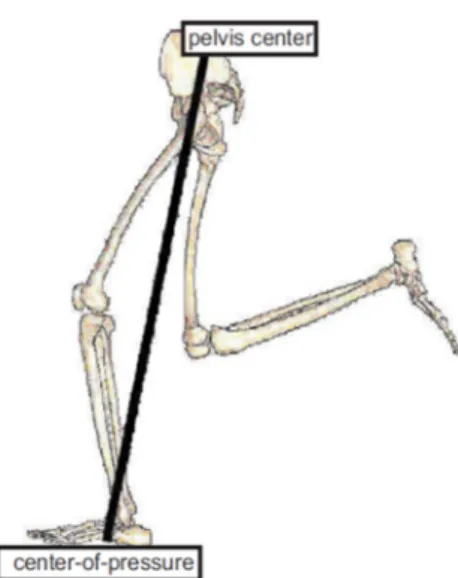
Leg stiffness ( 𝐾 ) was calculated using the method proposed by Silder, Besier, and Delp (2015). Leg length was calculated as the three- dimensional distance from the pelvis center to the center of pressure at the moment of initial contact, and at the moment of peak vertical force (PVF) (Hyun & Ryew, 2016, 2017) (Figure 1).
𝐾 = PVF
(𝑙 − 𝑙 )/𝑙 .
Here, the normalized leg length (100%) was given by
𝑙
,𝑙 = (𝑋 − 𝑋 ) + (𝑌 − 𝑌 ) + (𝑍 − 𝑍 ) ,
𝑍 = 0.
PVF is the peak vertical force generated during the support phase, and the normalized value (N/BW) was calculated by dividing by each subject's body weight. 𝑙 is the normalized leg length at the initial contact of the foot with the ground, and 𝑙 is the leg length at PVF after landing. Here, as shown in Figure 1, the leg length was calculated as the three-dimensional distance from the center of pressure (Bullimore
& Burn, 2006) to the center of the pelvis (Plagenhoef et al., 1983).
For the DPSI, we referred to Wikstrom, Tillman, Smith, and Borsa (2005); however, to set a clear endpoint after landing, we modified the time for evaluating the number of data points and the equation for the vertical direction. Although the zero point for GRF is the same, the endpoint was set as the moment of PVF (Hyun & Ryew, 2014).
Medial-lateral stability index (MLSI) = √[Σ(0 − 𝑥 )
2/ number of data points].
Anterior-posterior stability index (APSI) = √[Σ(0 − 𝑦 )
2/ number of data points].
Vertical stability index (VSI) = √[Σ(0 − 𝑧 )
2/ number of data points].
DPSI = √[Σ(0 − 𝑥 )
2+ Σ(0 − 𝑦 )
2>+ Σ(0 − 𝑧 )
2/ number of data points].
An increase in the index indicates worse stability, whereas a decrease in the index indicates improved stability.
PASW 18.0 was used to calculate means and standard deviations for the kinetic and kinematic variables, and to perform a one-way analysis of variance for the subject type. Statistically significant differences were subjected to post-hoc testing with Duncan's test. We used a statistical significance level of α = .05 for all tests.
RESULTS
1. Results of leg stiffness and GRF variables
In sports activities and daily living, both legs are used for walking and running. Therefore, in this study, we evaluated lower-limb function using the mean of both legs.
Table 2 shows the results of the analysis of differences in leg stiff- ness and related variables upon landing according to ankle instability type. There were no large differences for PVF and loading rate, and the differences were not statistically significant ( p > .05). Leg stiffness was significantly higher in the FAI group than in the NOR and ST groups ( p
< .01). The change in leg length was significantly lower in the FAI and ST groups than in the NOR group ( p < .001).
2. Results of DPSI
Table 3 shows the results of the analysis of differences in the DPSI upon landing according to ankle instability type. There were no signifi- cant differences in MLSI, APSI, VSI, or DPSI ( p > .05).
Figure 1. Leg length was estimated by calculating the distance from