동중국과 한반도 경상분지의 백악기초기 화성활동의 성인 고찰
최성희*
충남대학교 자연과학대학 지질환경과학과
Petrogenesis of Early Cretaceous Magmatism in Eastern China and the Gyeongsang Basin, Korean Peninsula
Sung Hi Choi*
Department of Geology and Earth Environmental Sciences, Chungnam National University, Daejeon 34134, Korea
요 약: 동중국과 우리나라 경상분지에 분포하는 백악기초기 화성활동의 지구화학적 특징을 고찰하였다. 동 중국에 분포하는 암상은 피크라이트-현무암-안산암-조면암-유문암 및 황반암의 분출암과 반려암-섬록암-몬조니 암-섬장암-화강암 및 휘록암의 관입암체로 다양하다. 이들은 고-칼륨 칼크-알칼리 내지는 쇼쇼나이트 계열에 속한다. 경상분지의 하양층군 속에 협재되어 있는 화산암은 같은 계열의 현무암질 조면안산암이다. 미량원소 (Zr, Nb, Y) 를 이용한 현무암류의 생성 지구조환경 분류도에서, 이들은 대개 판내부환경 현무암류의 범주에 도시된다. Sr-Nd 동위원소상관도에서 북중국지괴와 북·남중국지괴의 충돌대에 분포하는 현무암류는 대개 맨틀 배열 보다 매우 부화된 동위원소비를 가진다. 남중국지괴 현무암류의
87Sr/
86Sr 비는 북중국지괴의 범위와 유 사하나 ε
Nd값은 북중국지괴에 비하여 상대적으로 높은 편이다. 북중국지괴와 충돌대의 현무암류들은 대개 낮 은
206Pb/
204Pb(t) 비를 가지는 것이 특징이며,
207Pb/
204Pb(t)-
206Pb/
204Pb(t) 상관도에서 지오크론의 왼쪽에 도시된 다. 남중국지괴 현무암류는 지오크론의 오른쪽에 도시되며, 상대적으로 높은 방사기원 Pb 동위원소비를 가진 다. 하양층군 현무암류는 Sr-Nd과 Pb-Pb 동위원소 상관도에서 북중국지괴 현무암류의 범주 내에 도시된다. 오 랜 기간 동안 변성교대작용에 의해 지구화학적으로 부화된 암석권맨틀이 위 현무암류를 생성한 근원물질로 추정된다. 백악기초기의 확장응력장에서 발생한 연약권의 용승이 열원이 되어 암석권맨틀의 부분용융이 가능 하였을 것이다. 암석권맨틀을 부화시킨 매체로는 엽렬되어 침몰된 하부지각이 재활성화되어 생성된 액, 섭입 된 양쯔지괴 대륙지각 기원 액 내지는 섭입된 고태평양판 기원의 유체/액 등을 들 수 있다.
핵심어: 백악기초기, 동중국, 경상분지, 현무암, 암석권맨틀
Abstract:
Geochemical characteristics of the Early Cretaceous igneous rocks from eastern China and the Gyeongsang Basin, Korean Peninsula has been summarized. They have wide range of lithological variation with extrusive picrite-basalt-andesite-trachyte-rhyolite and lamprophyre, and intrusive gabbro-diorite- monzonite-syenite-granite and diabase in eastern China, mostly belonging to the high-K calc-alkaline or shoshonitic series. The volcanic rocks intercalated with the Hayang Group sedimentary assemblages in the Gyeongsang basin are high-K to shoshonitic basaltic trachyandesites. The Early Cretaceous basaltic rocks studied mostly fall within the field of within-plate basalts on the Zr/Y-Zr and Nb-Zr-Y tectonic discrimination diagrams. On a Sr-Nd isotope correlation diagram, basaltic rocks from the North China block (NCB) and the continent-continent collision zone (CZ) between the North and South China blocks plot into the enriched lower right quadrant along the extension of the mantle array. The initial 87Sr/86Sr ratios of basaltic rocks from the South China block (SCB) are indistinguishable from those of the NCB and CZ basaltic rocks, but their εNd (t) values are relatively more elevated, plotting in right side of the mantle array. Basaltic rocks from the NCB and CZ are characterized by low 206Pb/204Pb(t) ratios, lying to the left of the Geochron on the 207Pb/204Pb(t) vs. 206Pb/204Pb(t) correlation. Meanwhile, the SCB basaltic*Corresponding author Tel: +82-42-821-6428 E-mail: [email protected]
rocks have relatively radiogenic Pb isotopic compositions compared with those of the NCB and CZ basaltic rocks. Basaltic rocks from the Hayang Group plot within the field of the NCB basaltic rocks in Sr-Nd and Pb-Pb isotope spaces. Metasomatically enriched subcontinental lithospheric mantle (SCLM) is likely to have been the dominant source for the early Cretaceous magmatism. Asthenospheric upwelling under an early Cretaceous extensional tectonic setting in eastern China and the Korean Peninsula might be a heat source for melting of the enriched SCLM. Metasomatic agents proposed include partial melts of lower continental crust delaminated and foundered into the mantle or subducted Yangtze continental crust, or fluid/melt derived from the subducted paleo-Pacific plate.
Keywords:
Early Cretaceous, Eastern China, Gyeongsang basin, Basalt, Lithospheric mantle서 론
북중국지괴(North China Craton)의 동측 하부에 존 재하는 암석권맨틀의 진화과정에 관한 선행연구들 (Menzies et al., 1993; Menzies and Xu, 1998;
Xu, 2001; Gao et al., 2002)에 의하면 오르도비스기 에 존재하던 강괴(craton)성의 두껍고(150-220 km) 난용적(refractory)인 차가운 암석권맨틀이 신생대에 와서는 얇고(60-120 km) 부화(fertile)되어 있으며 상 대적으로 고온의 해양성 암석권맨틀로 바뀌었다는 사 실이 알려져 있다. 이는 적어도 120 km 이상 두께의 암석권맨틀이 제거되었음을 의미한다. 이러한 변화는 타 강괴와는 다르게 북중국지괴의 진화과정동안 발생 한 고유한 특성이다. 그러나 그 생성기작은 여전히 논란의 대상이다. 요약하면 열적·화학적 침식(Menzies et al., 1993; Griffin et al., 1998; Xu, 2001), 암석 권맨틀의 엽렬(delamination) (Wu et al., 2003a,b, 2005; Gao et al., 2004, 2008) 및 페리도타이트 (peridotite)와 액(melt) 혹은 유체와의 반응 모델(Niu, 2005; Zhang, 2005; Tang et al., 2008a)등으로 정 리할 수 있다. 이를 유발한 원동력에 관한 모델 역시 다양하다. 요약하면 맨틀 플룸(plume) (Wilde et al., 2003; Deng et al., 2005), 인도판과 유라시아판의 충돌(Menzies et al., 1993), 북중국지괴와 남중국지 괴의 충돌(Menzies and Xu, 1998; Gao et al., 2002; Xu et al., 2006) 및 태평양판의 섭입(Griffin et al., 1998; Xu, 2001, 2014; Wu et al., 2005;
Sun et al., 2007; Zhang et al., 2009; Xu et al., 2013) 등으로 정리할 수 있다. 북중국지괴 동측에 분 포하는 광범위한 백악기초기 화성활동은 이러한 암석 권맨틀의 변화과정과 연계되어 있는 것으로 추정된다 (Zhang et al., 2002; Zhang and Sun, 2002; Chen et al., 2004; Wu et al., 2005). 아울러 북중국지괴
와 남중국지괴 사이의 충돌대 및 남중국지괴 동측에 도 백악기 초기 확장환경하에서 발생한 다양한 암상 의 화성활동들이 보고되고 있다(Lapierre et al., 1997; Swell and Campbell, 1997; Darbyshire and Sewell, 1997; Li and McCulloch, 1998; Li, 2000;
Fan et al., 2001, 2004; Guo et al., 2004; Wu et al., 2005; Yu et al., 2006; Tang et al., 2008b).
본 연구의 목적은 동중국(북중국지괴, 충돌대 및 남중 국지괴)의 백악기초기 화성활동을 Sr-Nd-Pb 동위원소 를 포함한 지구화학적인 자료들에 근거하여 정리하고, 우리나라 백악기초기 경상분지의 현무암질 화산활동 과 더불어 그 근원물질 및 생성 기작을 이해하고자 함에 있다.
지질개요
북중국지괴는 주로 시생대(3.8-2.5 Ga)와 고원생대 (2.2-1.8 Ga) 편마암과 이를 부정합적으로 피복하고 있 는 중원생대와 신원생대(1.8-0.54 Ga)의 퇴적암류로 구 성되어 있다(Jahn et al., 1988). 북중국지괴는 약 1.8 Ga경에 안정화되어 대략 삼첩기까지는 유지되다 가 지괴의 동측부가 재활성화되어 광범위한 중생대 화성활동과 분지생성이 수반되었다(e.g., Zhang and Sun, 2002; Chen et al., 2004; Wu et al., 2005;
Lu et al., 2008). 북중국지괴의 남측에는 삼첩기에 남중국지괴와의 충돌에 의해 형성된 다비(Dabie)-쑬루 (Sulu) 초고압변성대가 분포한다(Yin and Nie, 1993).
남중국지괴는 북서측의 양쯔(Yangtz)지괴와 남동측 의 크테이시아(Cathaysia) 습곡대로 구성되어 있다. 양 쯔지괴는 시생대-고원생대(3.5-1.8 Ga)에서 중원생대- 신원생대(1.8-0.80 Ga)에 걸친 기반암류 구성되어 있 다(Wan and Zeng, 2002). 크테이시아 블록은 고원생 대에서 신원생대(1.9-0.7 Ga)에 형성된 대륙지각이다
(Chen and Jahn, 1998; Yu et al., 2010; Yao et al., 2012). 양자의 접합은 신원생대에 이루어졌다(Chen and Jahn, 1998; Yao et al., 2012). 양쯔지괴의 남 동측에는 850-730 Ma와 470-410 Ma에 로디니아 초 대륙의 분열 및 칼레도니아 조산운동과 관련된 열구 조운동이 기록되어 있다(Yao et al., 2012). 북중국과 남중국의 충돌이후 남동중국지괴는 변동대로 전이되 어 쥐라기와 백악기 화성활동이 크테이시아 블록의 연안을 따라 약 600 km 폭의 벨트를 이루며 분포하 고 있다(Swell and Cambell, 1997; Li, 2000).
경상분지는 한반도에서 가장 큰 백악기 분지로 암 층서적으로 신동층군, 하양층군, 유천층군으로 구분된 다(e.g., Chough and Sohn, 2010). 신동층군은 비화 산성 퇴적층군으로 부분적인 화산쇄설층을 가지고 있 는 하양층군에 의해 피복되어 있다. 하양층군 내에는 분지확장 과정에서 생성된 현무암에서 현무암질 안산 암 성분의 퇴적동시성 용암류들이 협재되어 있다 (Chough and Sohn, 2010; Kwon et al., 2013). 이 들의 퇴적층서적 연대는 약 110-85 Ma이다(Chough and Sohn, 2010; Kwon et al., 2013). 유천층군은 약 94 Ma보다 젊은 안산암과 유문암질의 화산암 및 화산쇄설암으로 주로 구성되어 있다(Kwon et al., 2013 and references therein). 유천층군 화산암은 대 개 칼크-알칼리 계열로 태평양판의 섭입과정에서 생 성되었다(Yun et al., 2000; Kim et al., 2003;
Chough and Sohn, 2010).
암 상
동중국에서 백악기초기 화성활동이 가장 강렬하던 시기는 약 125-115 Ma이다(Guo et al., 2001). 북중 국지괴 동측에 분포하는 백악기초기(약 144-100 Ma) 화성암은 피크라이트(picrite)-현무암-현무암질 안산암 및 황반암(lamprophyre)의 분출암(Qiu et al., 2002;
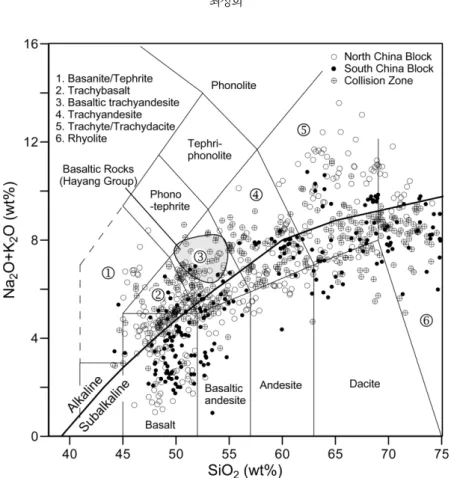
Zhang et al., 2002; Chen and Zhai, 2003; Yang et al., 2004; Guo et al., 2005, 2013; Liu et al., 2006; Gao et al., 2008; Ma et al., 2014a, b)과 반려암-섬록암-몬조니암-섬장암-화강암 및 휘록암의 관 입암체(Xu et al., 2002, 2006; Chen et al., 2003, 2004; Zhang et al., 2004, 2005, 2010, 2012; Wu et al., 2005; Yang et al., 2006, 2012a, b; Liu et al., 2008a, 2009)로 구성되어 있다. 실리카 대 토탈 알칼리(TAS)도(Fig. 1)에서 화학성분에 의한 암상은
현무암부터 유문암에 걸쳐 넓게 분포하고 있으며, 알 칼리와 비알칼리 계열의 암상이 혼재되어 있다.
다비-쑬루 충돌대를 따라 분포하는 백악기초기(약 143-111 Ma) 화성암은 현무암-안산암-조면암 및 황반 암의 분출암(Fan et al., 2001, 2004; Guo et al., 2004; Wang et al., 2005)과 반려암-섬록암-몬조니암- 섬장암-화강암 및 휘록암의 관입암체(Jahn et al., 1999; Yang et al., 2005a; Guo et al, 2006, 2014;
Huang et al., 2006, 2007; Wang et al., 2007;
Zhao et al., 2005, 2007a; Liu et al., 2008b;
Tang et al., 2008b; Zhang et al., 2010, 2012; He et al., 2011, 2013)로 구성되어 있다. TAS도(Fig. 1) 에서의 암상분포는 북중국지괴의 것과 유사하나 고철 질암의 경우는 상대적으로 알칼리 계열이 우세한 반 면 규장질암은 비알칼리 계열이 우세한 편이다.
남중국지괴의 동측에 분포하는 백악기초기(약 146- 88 Ma) 화성암은 현무암-안산암-유문암의 분출암 (Lappierre et al., 1997; Swell and Campbell, 1997;
Chen et al., 2001, 2008; Wang et al., 2003, 2008; Shu et al., 2004; Yu et al, 2006; Yang et al., 2013)과 고철질 암맥(Li and McCulloch, 1998;
Zhao et al., 2007b) 및 반려암-섬록암-몬조니암-섬장 암-화강암의 관입암체(Charoy and Raimbault, 1994;
Martin et al., 1994; Sewell and Campbell, 1997;
Chen et al., 2001; Wang et al., 2004; Wu et al, 2005; Xie et al., 2008; Liu et al., 2010; Su et al., 2013; Li and Jiang, 2014)로 구성되어 있다.
TAS도(Fig. 1)에서 암상분포는 현무암에서부터 유문 암에 이르기까지 다양하나 알칼리 보다는 비알칼리 계열이 우세한 편이다.
우리나라 경상분지내 진주소분지와 의성소분지의 하양층군 속에 협재되어 있는 화산암(청룡사, 학봉, 하 마, 채약산 화산암)은 암석층서상 Aptian과 Albian을 거쳐 Coniacian에 걸쳐서 분출한 것으로(약 112-86 Ma; Chough and Sohn, 2010; Kwon et al., 2013) 알칼리 계열의 현무암질 조면안산암 성분이다(Fig. 1).
지구화학성분
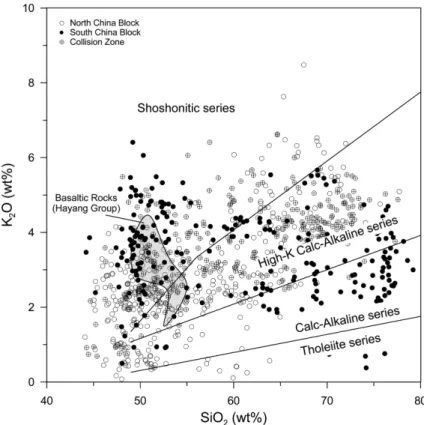
SiO2 대 K2O 함량의 상관도를 Fig. 2에 나타내었 다. 동중국의 백악기초기 화성암은 대개 고-칼륨 칼크 -알칼리(Calc-Alkali) 내지는 쇼쇼나이트(Shoshonite) 계열에 속한다. 하양층군 현무암질 암석 역시 이에 해
당한다(Fig. 2). 콘드라이트 값(Sun and McDonough, 1989)에 표준화 한(La/Yb)N 비와 La 농도의 상관관 계를 Fig. 3에 나타내었다. 비교를 위하여 결핍된 중 앙해령현무암(N-MORB)과 전형적인 해양도현무암 (OIB) 및 대륙지각의 평균성분을 함께 도시하였다. 동 중국과 우리나라의 백악기초기 화성암류는 모두 경희 토류원소에 부화한 즉 (La/Yb)N 비가 1 이상인 특징 을 가진다. 이는 N-MORB와 상이하며, OIB나 대륙 지각과 유사한 특징이다(Fig. 3). 생성된 지구조환경 을 파악하기 위하여, 현무암질 암석(SiO2<57 wt%)을 선별하여 풍화와 같은 이차거동에 비교적 안정적인
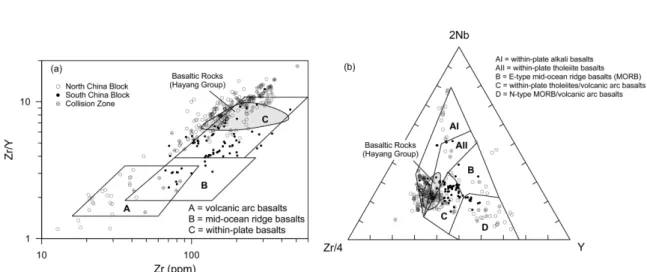
미량원소들(Zr, Nb, Y)들을 이용하여 Zr-Zr/Y(Fig.
4a)과 Nb-Zr-Y(Fig. 4b) 지구조환경 판별도에 도시하 였다. 북중국지괴 현무암류는 화산호와 판내부환경 현 무암류의 범주 내에 도시된다. 양적으로는 판내부환 경 기원이 우세하다(Fig. 4a, b). 충돌대 내지는 남중 국지괴 현무암류 역시 일부 화산호 현무암의 범주에 도시되는 것이 있으나 대개는 판내부기원 현무암류의 범주에 도시된다(Fig. 4a, b). 우리나라 하양층군 현무 암류는 모두 판내부기원 현무암류의 범주에 도시된다 (Fig. 4a, b).
Fig. 1. Classification of Early Cretaceous igneous rocks from eastern China in terms of SiO
2vs. total alkali (Le Maitre et al., 1989). For comparison, the field for basaltic rocks from the Hayang Group in the Gyeongsang basin, Korean Peninsula (Kwon et al., 2013) are also shown. The boundary line dividing the alkaline and subalkaline series is from Irvine and Baragar (1971). Data sources for eastern China from Charoy and Raimbault (1994), Martin et al. (1994), Lapierre et al. (1997), Swell and Campbell (1997), Li and McCulloch (1998), Jahn et al.
(1999), Chen et al. (2001, 2003, 2004, 2008), Fan et al. (2001, 2004), Guo et al. (2001, 2004, 2005, 2006, 2013, 2014), Xu et al. (2002, 2006), Zhang et al. (2002, 2004, 2005, 2010, 2012), Chen and Zhai (2003), Wang et al.
(2003, 2004, 2005, 2007, 2008), Shu et al. (2004), Yang et al. (2004, 2005a, 2006, 2012a, b, 2013), Zhao et al.
(2005, 2007a, b), Huang et al. (2006, 2007), Liu et al. (2006, 2008a, b, 2009, 2010), Yu et al. (2006), Gao et al.
(2008), Xie et al. (2008), Tang et al. (2009), He et al. (2011, 2013), Su et al. (2013), Li and Jiang (2014), and Ma
et al. (2014a, b).
근원물질: 암석권맨틀
마그마의 분화작용동안 발생한 지각혼염의 정도를 파악하기 위하여, 연구대상 화성암의 SiO2 함량 대
87Sr/86Sr 내지는 εNd 초깃값 간의 상관도를 Fig. 5에 나타내었다. 대륙지각은 맨틀에 비하여 87Sr/86Sr 비가 높거나 εNd 값이 낮은 물질로 구성되어 있으므로 (Zindler and Hart, 1986), 대륙지각의 혼염이 있을 경우에는 마그마의 분화가 진행될수록 즉, SiO2 값이 증가할수록 87Sr/86Sr 비가 증가하거나 또는 εNd 값이 감소하는 경향을 보이게 될 것이다. 동중국 화성암의 경우 SiO2 함량과 87Sr/86Sr 동위원소비 간의 뚜렷한 상관관계는 관찰되지 않는다(Fig. 5a). 그러나 εNd값 은 SiO2 함량이 증가할수록 미약한 음의 상관관계를 보여 분화가 진행된 규장질 암석의 경우 지각혼염의 영향을 완전히 배제하기는 어렵다고 판단된다. 하양 층군 현무암의 경우는 양자간의 유의미한 상관관계는 관찰되지 않으므로(Fig. 5a, b), 지각혼염의 영향은 배
Fig. 2. Classification of Early Cretaceous igneous rocks from eastern China in terms of SiO
2vs. K
2O. Data sources as in Fig. 1. The nomenclature of the fields is from Le Maitre et al. (1989). Also shown is the field for basaltic rocks from the Hayang Group in the Gyeongsang basin (Kwon et al., 2013).
Fig. 3. Chondrite-normalized (La/Yb)
Nratio vs. La
(ppm) for Early Cretaceous igneous rocks from
eastern China. Data sources as in Fig. 1. Also shown
is the field for basaltic rocks from the Hayang Group
in the Gyeongsang basin (Kwon et al., 2013). OIB =
oceanic island basalt (Sun and McDonough, 1989); N-
MORB=normal mid-ocean ridge basalt (Sun and
McDonough, 1989); CC=average continental crust
(Rudnick and Gao, 2005).
제될 수 있다.
Sr-Nd 동위원소 상관도를 Fig. 6에 나타내었다. 지 각 혼염의 영향을 배제하고 근원 맨틀의 성분을 파악 하기 위하여 데이터는 현무암질 암석(SiO2<57 wt%) 에 국한하여 도시하였다. 비교를 위하여 결핍된 중앙 해령현무암(N-MORB)의 범위를 함께 도시하였다. 아 울러 중앙해령현무암과 해양도현무암의 동위원소성분
에 기초하여 작성된 지구 맨틀의 성분 범위인 맨틀 배열(Mantle Array)도 함께 도시하였다. 백악기초기 북중국지괴 현무암류는 대개 맨틀 배열보다 매우 부 화된 Sr-Nd 동위원소비를 가진다. 충돌대 현무암류의 Sr-Nd 동위원소비는 북중국지괴 현무암류의 범주에 포함된다. 남중국지괴 현무암류의 87Sr/86Sr 비는 북중 국지괴의 범위와 유사하다. 그러나 εNd값은 N-MORB
Fig. 4. Tectonic discrimination diagrams for Early Cretaceous basaltic rocks from eastern China based on (a) Zr/Y- Zr (after Pearce and Norry, 1979) and (b) Nb-Zr-Y (after Meschede, 1986). Data sources from Charoy and Raimbault (1994), Lapierre et al. (1997), Swell and Campbell (1997), Li and McCulloch (1998), Jahn et al. (1999), Chen et al. (2003, 2004, 2008), Fan et al. (2001, 2004), Guo et al. (2001, 2004, 2005, 2013, 2014), Xu et al.
(2002, 2006), Zhang et al. (2002, 2012), Chen and Zhai (2003), Wang et al. (2003, 2004, 2005), Shu et al. (2004), Yang et al. (2004, 2005a, 2006, 2012a, b), Zhao et al. (2005, 2007b), Huang et al. (2007), Liu et al. (2006, 2008a, b, 2009, 2010), Yu et al. (2006), Gao et al. (2008), Xie et al. (2008), Tang et al. (2009), and Ma et al. (2014a, b).
Also shown is the field for basaltic rocks from the Hayang Group in the Gyeongsang basin (Kwon et al., 2013).
Fig. 5. SiO
2(wt%) vs. initial
87Sr/
86Sr (a) and εNd(t) (b) for Early Cretaceous igneous rocks from eastern China.
Data sources and symbols as in Fig. 1. Also shown is the field for basaltic rocks from the Hayang Group in the
Gyeongsang basin (Kwon et al., 2013). FC=fractional crystallization; AFC=assimilation and fractional crystallization.
보다는 낮지만, 북중국지괴 현무암류에 비해서는 상 대적으로 결핍되어 있는 즉 높은 εNd 값을 가진다. 하 양층군 현무암류의 Sr-Nd 동위원소비는 북중국지괴의 범주 내에 도시된다.
맨틀 배열보다 매우 부화된 Sr-Nd 동위원소비를 가 지며 현무암질 마그마를 생성할 수 있는 지구내 공간 은 경희토류원소와 친석원소(Large Ion Lithophile Element, LILE)에 부화되어 Sr, Nd 동위원소비가 달 라지기에 충분한 장시간 동안 존재할 수 있었던 공간 즉, 오랜 기간 동안 변성교대작용에 의해 지구화학적 으로 부화된 암석권맨틀이다. 그러므로 상당수의 선 행연구는 동중국의 백악기 초기 화성활동의 주된 근 원물질로 부화된 암석권맨틀을 고려한다(Chen et al., 2001; Fan et al., 2001, 2004; Guo et al., 2001, 2004, 2013; Qiu et al., 2002; Zhang et al., 2002, 2004, 2005; Chen and Zhai, 2003; Chen et al.,
2003, 2004; Wang et al., 2003; Yang et al., 2004; Wang et al., 2005, 2008; Yang et al., 2005a, 2006, 2012a, b; Zhao et al., 2005, 2007b;
Liu et al., 2006, 2008a, b, 2009; Gao et al., 2008; Tang et al., 2008b; Guo et al., 2014; Ma et al., 2014a, b). 이는 위 암석들이 고-칼륨 칼크-알 칼리 내지는 쇼쇼나이트 계열에 속한다(Fig. 2)는 특 징과도 일맥상통한다. 선행연구(Venturelli et al., 1984; Turner et al., 1996; Miller et al., 1999;
Duggen et al., 2005; Conticelli et al., 2009a, b;
Pe-Piper et al., 2012)에 의하면 티벳, 알프스, 지중 해 등지의 쇼쇼나이트 계열의 충돌후기 용암류들의 지구화학적 특징이 이와 유사하며 근원물질로 부화된 암석권맨틀을 들고 있다. 아울러 섭입작용이 약해지 는 섭입대 말기나 또는 배호분지의 초기 내지는 대륙 열곡대 등지의 확장환경하의 화산암류들에서 위와 유 사한 지구화학적 특징을 가지는 암석권맨틀 기원 화 산암류들이 보고되어 있다(Gill and Whelan, 1989;
Ishizuka et al., 2010). 확장환경에서는 연약권의 용 승이 가능하고 이것이 열원이 되어 부화된 암석권맨 틀의 부분용융이 발생할 수 있는 것이다(Yang et al., 2004; Zhang et al., 2005; Tang et al., 2008b).
Chen et al. (2004)는 북중국지괴 하부로 고태평양 판이 섭입하면서 생성된 배호분지 환경에서 연약권의 용승이 가능하였고 이를 열원으로 부화된 북중국지괴 암석권맨틀이 부분용융 할 수 있었다고 주장하였다.
반면에 Guo et al. (2013)는 섭입된 고태평양판으로 부터 공급된 유체에 의해 북중국지괴 암석권맨틀의 가수용융(hydrous melting)이 가능하였을 것으로 추론 하였다. Fan et al. (2001)은 고태평양판인 이자나기 판(Izanagi plate)의 북방 주향이동성 운동에 따른 탄 루(Tan-Lu) 단층대의 이동 및 이와 동반된 확장 응력 장에서 암석권맨틀이 부분용융 할 수 있었다고 주장 하였다. 경상분지 역시 이자나기판의 사교섭입(oblique subduction)과 동반되어 생성된 인리형분지(full-apart basin)로 추론되며, 분지생성과 동반된 암석권맨틀의 신장 및 연약권 용승이 부화된 암석권맨틀의 부분용 융을 초래하여 하양층군 현무암질 마그마가 생성된 것으로 추론된다(Lee, 1999; Kwon et al., 2013).
반면에 Guo et al. (2004)은 섭입하는 슬랩(slab)의 결렬(break-off) 및 이와 동반된 연약권의 용승으로부 터 공급된 열에 의해서 충돌대의 암석권맨틀이 부분 용융 하였을 것으로 추론하였다. 그러나 다비-쑬루 충
Fig. 6. εNd(t) vs. initial
87Sr/
86Sr isotopic ratios for
Early Cretaceous basaltic rocks from eastern China (Lapierre et al., 1997; Li and McCulloch, 1998; Jahn et al., 1999; Chen et al., 2001, 2003, 2004, 2008;
Fan et al., 2001, 2004; Guo et al., 2001, 2004, 2005,
2013, 2014; Xu et al., 2002; Zhang et al., 2002,
2004, 2012; Chen and Zhai, 2003; Wang et al., 2003,
2004, 2005, 2008; Yang et al., 2004, 2005a, 2006,
2012a, b; Liu et al., 2006, 2008a, b, 2009; Yu et al.,
2006; Huang et al., 2007; Zhao et al., 2007b; Gao et
al., 2008; Xie et al., 2008; Tang et al., 2009; Ma et
al., 2014a, b). Data source for basaltic rocks from the
Hayang Group in the Gyeongsang basin from Kwon
et al. (2013). Fields for present-day mid-ocean ridge
basalts (MORB) and the mantle array (Zindler and
Hart, 1986) are also shown. Symbols as in Fig. 1.
돌대에서 슬랩의 결렬시기는 약 175 Ma(Li et al., 1999)로 추정되므로 이 모델로 백악기초기 화성활동 을 설명하기는 시기적으로 어려운 면이 있다. 한편 Zhao et al. (2005, 2007a)는 백악기 초기에 존재하 였던 거대 맨틀 플룸이 암석권맨틀 용융의 열원이 되 었을 것이라고 주장한 바 있다. 그러나 중생대 동아 시아에 거대 맨틀 플룸이 존재하였다는 직접적인 증 거는 없다. 아울러 맨틀 페리도타이트의 고상선이 약 3 GPa에서 최대 1470oC(Hirschmann, 2000)인 점을 감안하면 거대 플룸은 암석권뿐만 아니라 연약권 맨 틀도 대량 용융시켜야 하는데 동아시아에서 백악기초 기 연약권 맨틀 기원 화성활동의 존재에 관한 증거는 발견되지 않았다(Huang et al., 2007).
백악기초기 다비-쑬루 조산대는 인리형분지의 발달 (Xu and Zhu, 1994; Zhang et al., 2003), 바이모달 (bimodal)식 화산활동(Fan et al., 2001), 변성심부복 합체(metamorphic core complex)의 존재(Sun et al., 1995) 등과 더불어 확장 환경하에 놓여 있었다고 추 정된다. 남중국지괴의 경우 백악기초기 화성활동은 대 륙연변부 내지는 북동-남서 방향의 주단층대를 따라 분포하고 있다. 이는 중국-인도차이나 가장자리와 필 리핀 블록 서측이 충돌한 이후의 확장환경하에서 생 성된 것으로 사료된다(Lapierre et al., 1997; Sewell and Campbell, 1997; Darbyshire and Sewell, 1997; Li and McCulloch, 1998; Li, 2000; Yu et al., 2006). 남중국지괴의 백악기초기 관입암체는 고- 칼륨의 I-type 또는 A-type 화강암이 우세하다(Su et al., 2013; Yang et al., 2013; Zhou et al., 2013;
Li and Jiang, 2014). A-type 화강암은 북중국지괴 (Wu et al., 2005; Yang et al., 2006)와 충돌대(Liu et al., 2008b)에도 분포하고 있다. A-type 화강암은 조산대후기나 판의 분열과 같은 확장 응력장에서 생 성되는 것으로 알려져 있다(Li and McCulloch, 1998; Wu et al., 2005). 아울러 고-칼륨 칼크-알칼리 계열의 암석 역시 섭입환경보다는 판의 확장 동안 발 생하는 화성활동으로 알려져 있다(Hooper et al., 1995; Hawkesworth et al., 1995; Wu et al., 2005).
암석권맨틀에서 변성교대작용을 유도한 매체
동중국과 하양층군내 백악기초기 현무암류에 대하 여 콘드라이트 값에 표준화 한 (La/Nb)N과 (Ba/Nb)N
값의 상관도를 Fig. 7에 나타내었다. 비교를 위하여 N-MORB, OIB 및 평균 대륙지각의 성분을 함께 나 타내었다. 북중국지괴와 충돌대에 분포하는 현무암류 는 모두 높은 (La/Nb)N과 (Ba/Nb)N 값을 가지는 것 이 특징이며, 이는 맨틀기원 현무암류(N-MORB, OIB) 보다는 대륙지각의 특성과 유사하다. 남중국지 괴 현무암류는 북중국지괴나 충돌대의 경우 보다는 미약하나 역시 대륙지각처럼 부화된 (La/Nb)N과 (Ba/
Nb)N 값을 가진다. 하양층군 현무암류의 (La/Nb)N과 (Ba/Nb)N값은 북중국지괴 현무암류의 범주에 도시된 다.
동일 현무암류에 대하여 U/Pb와 Th/U 비의 상관 도를 Fig. 8에 나타내었다. 비교를 위하여 N-MORB, OIB 및 평균 상·하부 대륙지각의 성분을 함께 나타 내었다. 하부대륙지각은 상부대륙지각 내지는 맨틀기 원 현무암류(N-MORB, OIB)에 비하여 우라늄에 상 대적으로 결핍되어 있다는 특성이 있다. 그러므로 하 부대륙지각은 상대적으로 Th/U 비가 높고, U/Pb 비 는 낮은 편이다. 연구대상 현무암류들은 모두 N- MORB, OIB 또는 상부대륙지각에 비해 높은 Th/U
Fig. 7. Chondrite-normalized (La/Nb)
Nvs. (Ba/Nb)
Nratios for Early Cretaceous basaltic rocks from eastern China. Data sources as in Fig. 3. Also shown is the field for basaltic rocks from the Hayang Group in the Gyeongsang basin (Kwon et al., 2013). OIB=oceanic island basalt (Sun and McDonough, 1989); N-MORB
=normal mid-ocean ridge basalt (Sun and McDonough,
1989); CC=average continental crust (Rudnick and
Gao, 2005).
및 낮은 U/Pb 비를 보여 하부대륙지각의 특성을 가 지고 있다.
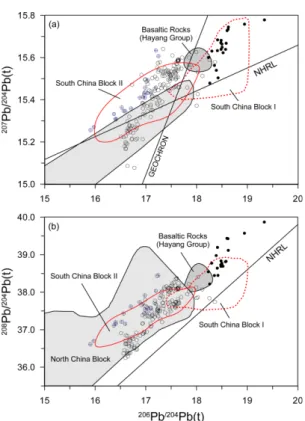
연구대상 현무암류들의 Pb-Pb 동위원소성분비의 상 관도를 Fig. 9에 나타내었다. 북중국지과와 충돌대의 현무암류들은 대개 낮은 206Pb/204Pb(t) 비를 가지는 것이 특징이며, 207Pb/204Pb(t)-206Pb/204Pb(t) 상관도에서 지오크론(Geochron)의 왼쪽에 도시된다. 이는 낮은 μ 값 즉, 하부대륙지각처럼 U/Pb 비가 낮은 물질이 장 시간 고립되어 있을 수 있는 공간 기원임을 암시한다.
하양층군 현무암류는 평균적인 북중국지괴 현무암류 에 비해서는 높은 Pb 동위원소비를 가지지만, Pb-Pb 동위원소 상관도에서(Fig. 9a, b) 북중국지괴 현무암 류의 범주 내에 도시된다. 남중국지괴 현무암류는 북 중국지괴나 충돌대 현무암에 비해서는 보다 높은 방 사기원 Pb 동위원소비를 가진다.
선행 실험결과(Rushmer, 1991; Wolf and Wyllie, 1994; Rapp and Watson, 1995; Rapp et al., 2003;
Xu et al., 2006)에 의하면 고철질의 하부지각이 부 분용융 될 경우 화강암류와 같은 규장질 마그마가 생
성되므로 연구 대상인 현무암질 암석이 하부대륙지각 의 부분용융 산물이라고 보기는 어렵다. 전술한 바와 같이 위 암석들의 Sr-Nd 동위원소성분에서 대륙지각 혼염의 가능성은 발견되지 않으므로 이와 같은(하부) 대륙지각 성분의 흔적은 근원 맨틀 즉, 암석권맨틀에 내재되어 있는 특성이라고 추론할 수 있다.
변성암내 저어콘의 SHRIMP U-Pb 연대측정과 P-T 경로 추적 등의 자료에 의하면, 북중국과 남중국(양쯔)
Fig. 8. U/Pb vs. Th/U ratios for Early Cretaceous
basaltic rocks from eastern China. Data sources as in Fig. 3. Also shown is the field for basaltic rocks from the Hayang Group in the Gyeongsang basin (Kwon et al., 2013). OIB=oceanic island basalt (Sun and McDonough, 1989); N-MORB=normal mid-ocean ridge basalt (Sun and McDonough, 1989); LCC=average lower continental crust (Rudnick and Gao, 2005);
UCC=average upper continental crust (Rudnick and Gao, 2005).
Fig. 9. Plots of initial
207Pb/
204Pb (a) and
208Pb/
204Pb (b) vs.
206Pb/
204Pb ratios for Early Cretaceous basaltic rocks from eastern China (Qiu et al., 2002; Xu et al., 2002; Zhang et al., 2002, 2004; Chen et al., 2004, 2008; Yang et al., 2004, 2012b; Liu et al., 2006, 2008a, b, 2009; Huang et al., 2007; Zhao et al., 2007b; Wang et al., 2005, 2008; Ma et al., 2014a, b).
For comparison, Pb isotope data for basement rocks
from the North China block, South China block I
(represented by rocks from the middle-lower Yangtze
valley and the regions south of it) and South China
block II (represented by the Dabie-Sulu ultra-high
pressure eclogites and gneisses, all calculated back to
t = 130 Ma) from Yang et al. (2012b), and Zeng and
Yan (2014). Data source for basaltic rocks from the
Hayang Group in the Gyeongsang Basin from Kwon
et al. (2013). The Northern Hemisphere reference line
(NHRL) is from Hart (1984). Symbols as in Fig. 1.
지괴의 충돌에 의한 초고압변성작용은 약 240-230 Ma 에 발생하였으며, 각섬암상의 후퇴변성작용은 약 220- 200 Ma에 발생한 것으로 알려져 있다(e.g., Hacker et al., 1998; Zheng et al., 2002; Liu et al., 2004).
북중국지괴 하부로 양쯔지괴가 섭입하는 과정에서 농 후된(thickened) 대륙지각 하부는 에클로자이트화 (eclogitization)될 수 있다. 에클로자이트(eclogite)의 밀도는 맨틀 페리도타이트보다 높다(Rudnick and Fountain, 1995). 이런 밀도 차이는 고철질 하부지각 을 그 하부의 암석권맨틀과 함께 연약권으로 재순환 (recycling)할 수 있게 한다(Gao et al., 2004, 2008;
Xu et al., 2006). 암석권맨틀의 엽렬 시기는 쥬라기 말기 또는 백악기 초기에 발생한 현상(Xu, 2001; Xu et al., 2002; Chen et al., 2003; Gao et al., 2004; Wu et al., 2005; Zhai et al., 2007; Huang et al., 2007; Liu et al., 2008a, b; Ma et al., 2014a)으로 추론된다. Gao et al. (2008)은 이처럼 엽렬된 에클로자이트 성분의 하부지각이 부분용융된 액(melt)에 의해서 그 상부의 암석권맨틀이 변성교대 작용을 받아 백악기초기 북중국지괴 현무암류의 근원 물질이 되었을 것이라고 주장하였다. 암석권맨틀의 파 괴 원인으로는 이처럼 삼첩기의 북중국과 남중국지괴 의 충돌에 의한 물성변화(Menzies et al., 1993;
Griffin et al., 1998; Xu, 2001; Zhang et al., 2002;
Gao et al., 2004, 2008; Huang et al., 2007; Liu et al., 2008a, b, 2009) 이외에도, 동아시아 연변부에 서 쥐라기와 백악기 동안 발생한 고태평양판(Izanagi 판)의 섭입에 의한 대륙성 배호분지 환경에서의 대류 성 전복(convective overturn) 즉 열적 침식과 암석권 맨틀의 측방이동 때문(Griffin et al., 1998; Chen et al., 2004; Wu et al., 2005; Ma et al., 2014a,b)이 라는 주장도 있다. 동중국에 분포하는 대규모의 백악 기초기 화성활동의 분포로 비추어 볼 때, 암석권맨틀 이 제거된 주요시기는 아마도 130-110 Ma일 것으로 추정된다(Wu et al., 2003b; Liu et al., 2008b; Ma et al., 2014a).
Gao et al. (2004, 2008)은 북중국지괴의 고-마그 네슘(high-Mg) 현무암-안산암 및 아다카이트(adakite) 성분의 화산암류들에서 시생대의 상속(inherited) 저어 콘의 존재, Mg#, Ni, Cr 함량 등에서 역누대구조를 보이는 반정의 존재 및 2.5 GPa 이상의 깊이에서 생 성된 것으로 추정되는 중심부에 티탄철석 용리 (exsolution lamellae)를 보이는 단사휘석 반정의 존재
등을 제시하면서 이와 같은 증거들은 위 화성활동을 엽렬되어 침몰(foundering)된 하부지각 기원 모델로 가장 잘 설명할 수 있다고 주장하였다. 비화산호 환 경에서 산출되는 백악기초기의 대륙형(C-type) 아다카 이트는 북중국지괴(Xu et al., 2002, 2006) 뿐만 아 니라 다비-쑬루 충돌대(Guo et al., 2006)에도 분포하 고 있다.
한편 암석권맨틀의 변성교대작용의 매체 내지는 백 악기초기 현무암류에서 보이는 지각물질의 흔적을 섭 입된 양쯔지괴 하부지각의 부분용융액으로 생각하는 연구그룹(Fan et al., 2001, 2004; Qiu et al., 2002;
Zhang et al., 2002, 2004, 2005; Guo et al., 2004, 2005; Ying et al., 2004; Yang et al., 2012a; Huang et al., 2007)도 있다. 북중국지괴와 충돌대에 분포하 는 동중국의 백악기초기 현무암류의 Pb 동위원소성 분을 비교하면, 충돌대쪽이 동일 206Pb/204Pb 대비 상 대적으로 높은 207Pb/204Pb와 208Pb/204Pb 비를 가진다 는 특징이 있다(Fig. 9a, b). 비교를 위하여 Pb-Pb 동위원소 상관도에 북중국과 남중국지괴의 기반암 성 분을 함께 도시하였다. 섭입한 양쯔지괴의 영향을 파 악하기 위하여 남중국지괴의 경우 섭입한 후 융기한 양쯔지괴 지각에 해당하는 다비-쑬루 충돌대의 초고 압변성암인 에클로자이트 내지는 편마암 성분(South China Block II)을 양쯔계곡 중·하위이남 지역 기반암 (South China Block I)과 분리하여 도시하였다. 섭입 한 남중국지괴 블록 II는 남중국지괴 블록 I에 비하여 상대적으로 낮은 Pb 동위원소비를 가진다(Fig. 9a, b). 그러나 블록 II는 동일 206Pb/204Pb 대비 북중국지 괴 현무암류에 비하여 높은 207Pb/204Pb 내지는 208Pb/
204Pb 비를 가진다는 특징이 있다(Fig. 9a, b). 흥미롭 게도 충돌대에 분포하는 현무암류의 Pb 동위원소비 는 섭입한 남중국지괴 블록 II의 성분과 유사하다.
Yang et al. (2012b)는 이와 같이 충돌대로부터의 거 리에 따른 Pb 동위원소성분비의 변화에 주목하여, 충 돌대로부터 약 200 km 이내의 마그마는 섭입된 양쯔 지괴 대륙지각 기원 액에 의해 변성교대작용을 받은 암석권맨틀이 근원물질인 반면, 그 보다 먼 거리의 마그마는 엽렬된 북중국지괴 하부대륙지각 기원 액에 의해 변성교대작용을 받은 암석권맨틀의 부분용융산 물이라고 해석하기도 하였다. 다비-쑬루 충돌대 내의 고압-초고압 변성암에 대한 탄소와 산소 동위원소성 분 자료에 의하면 빠른 속도로 섭입되던 차가운 양쯔 지괴로부터의 탈수작용은 매우 미미하였을 것으로 추
정된다(Zheng et al., 2003). 아울러 충돌과 동시기적 인 화산호가 존재하지 않는다는 점으로부터 양쯔지괴 의 섭입과정과 동반되어 상부의 암석권맨틀이 슬랩기 원의 유체나 멜트에 의해서 변성교대작용을 받은 양 은 크지 않았을 것으로 판단된다(Yang et al., 2005b).
특히 충돌대로부터 500 km 이상 거리까지 백악기초 기 화성활동이 존재한다는 사실은 섭입하는 양쯔지괴 로부터의 영향이 비교적 제한적이었음을 시사한다 (Guo et al., 2001). 북중국지괴 현무암류는 기반암에 비해 동일 206Pb/204Pb 대비 상대적으로 부화된 207Pb/
204Pb 비를 가진다(Fig. 9a). 아울러 남중국지괴 현무 암류는 기반암에 비해 상대적으로 높은 208Pb/204Pb 비 를 가지므로(Fig. 9b), 위 마그마의 진화과정에서 지 각혼염의 영향은 미미하였음을 다시 한 번 확인할 수 있다.
한편 섭입한 고태평양판 기원의 함수유체가 북중국 지괴 암석권맨틀의 변성교대작용의 매체일 수 있다고 주장하는 선행연구(Chen et al., 2004; Ma et al., 2014a, b)도 있다. 남중국지괴의 경우도 대개 해양판 의 섭입작용이 변성교대작용의 원인일 것으로 지목된 다(Zhao et al., 2007b; Wang et al., 2008; Li and Jiang, 2014). 그러나 이 경우는 연구대상 현무암류에 서 관찰되는 하부대륙지각 성분의 근원이 무엇인지 충분히 설명되지 않는다는 단점이 있다.
백악기초기 북중국지괴와 남중국지괴 암석권맨틀의 비교
백악기초기 남중국지괴 현무암류는 북중국지괴 현 무암류에 비해서 상대적으로 높은 εNd 값과 206Pb/
204Pb, 207Pb/204Pb 및 208Pb/204Pb 비를 가진다(Figs. 6 and 9). 이는 양자의 암석권맨틀이 지구화학적 부화정 도가 상이하다는 것을 암시한다. Sr-Nd 동위원소상관 도(Fig. 6)에서 남중국지괴 현무암류는 동일 εNd 대비 맨틀배열도 보다 높은 87Sr/86Sr 비를 가진다. 이는 해 수의 영향 즉, 섭입한 고태평양판 기원의 함수유체의 영향이 남중국지괴 측에 우세하였음을 반영한다. 하 양층군 현무암류의 Sr-Nd 동위원소비는 맨틀배열도의 연장선상에 도시된다(Fig. 6). 아울러 하양층군 현무 암류의 Sr-Nd 및 Pb-Pb 동위원소비는 북중국지괴 현 무암류의 범주에 도시된다(Figs. 6 and 9). 이는 경상 분지 및 이의 기반암인 영남육괴(Chough et al., 2000)의 암석권맨틀이 동위원소적으로 북중국지괴와
유사하다는 사실을 암시한다.
결 론
동중국과 경상분지의 백악기초기 화성활동은 확장 환경에서 부화된 암석권맨틀이 부분용융하여 생성된 것이다. 고장력 내지는 U 등의 미량원소와 Sr-Nd 및 Pb-Pb 동위원소비로 판단하건데 엽렬되어 재활성화 된 북중국지괴의 하부지각 또는 섭입된 양쯔지괴 하 부지각의 부분용융액이 변성교대작용의 주요 매체였 을 것으로 추정된다. 그러나 남중국지괴의 경우 섭입 한 고태평양판 기원의 함수유체의 역할을 무시할 수 없다. 하양층군 현무암류를 생성한 암석권맨틀은 동 위원소적으로 북중국지괴의 암석권맨틀과 유사하다.
사 사
이 연구는 2015년도 충남대학교 자체연구비에 의 해 지원되었습니다. 심사과정에서 건설적인 비평을 해 주신 정창식 박사님과 이미정 박사님께 감사드립니다.
References
Charoy, B. and Raimbault, L., 1994, Zr-, Th-, and REE-rich biotite differentiates in the A-type granite pluton of Suzhou (Eastern China): the key role of fluorine. Journal of Petrology, 35, 919-962.
Chen, B., Jahn, B., Arakawa, A., and Zhai, M.G., 2004, Petrogenesis of the Mesozoic intrusive complexes from the southern Taihang Orogen, North China Craton and Sr-Nd-Pb isotopic constraints. Contributions to Mineral- ogy and Petrology, 148, 489-501.
Chen, B., Jahn, B.-M., and Zhai, M., 2003, Sr-Nd isotopic characteristics of the Mesozoic magmatism in the Tai- hang-Yanshan orogen, North China craton, and implica- tions for Archean lithosphere thinning. Journal of the Geological Society of London, 160, 963-970.
Chen, B. and Zhai, M., 2003, Geochemistry of late Meso- zoic lamprophyre dykes from the Taihang Mountains, north China, and implications for the sub-continental lithospheric mantle. Geological Magazine, 140, 87-93.
Chen, C.-H., Lee, C.-Y., and Shinjo, R., 2008, Was there Jurassic paleo-Pacific subduction in South China?: Con- straints from
40Ar/
39Ar dating, elemental and Sr-Nd-Pb isotopic geochemistry of the Mesozoic basalts. Lithos, 106, 83-92.
Chen, J. and Jahn, B.-M., 1998, Crustal evolution of south-
eastern China: Nd and Sr isotopic evidence. Tectonophys-
ics, 284, 101-133.
Chen, J.-F., Yan, J., Xie, Z., Xu, X., and Xing, F., 2001, Nd and Sr isotopic compositions of igneous rocks from the lower Yangtze region in eastern China: Constraints on sources. Physics and Chemistry of the Earth, 26, 719-731.
Chough, S.-K., Kwon, S.-T., Ree, J.-H., and Choi, D.K., 2000, Tectonic and sedimentary evolution of the Korean peninsula: a review and new view. Earth-Science Review, 52, 175-235.
Chough, S.-K. and Sohn, Y.-K., 2010, Tectonic and sedi- mentary evolution of a Cretaceous continental arc-backarc system in the Korean peninsula: new view. Earth-Science Review, 101, 225-249.
Conticelli, S., Guarnieri, L., Farinelli, A., Mattei, M., Avan- zinelli, R., Bianchini, G., Boari, E., Tommasini, S., Tie- polo, M., Prelević, D., and Venturelli, G., 2009b, Trace elements and Sr-Nd-Pb isotopes of K-rich, shoshonitic, and calc-alkaline magmatism of the Western Mediterra- nean Region: genesis of ultrapotassic to calc-alkaline magmatic associations in a post-collisional geodynamic setting. Lithos, 107, 68-92.
Conticelli, S., Marchionni, S., Rosa, D., Giordano, G., Boari, E., and Avanzinelli, R., 2009a, Shoshonite and sub-alka- line magmas from an ultrapotassic volcano: Sr-Nd-Pb iso- tope data on the Roccamonfina volcanic rocks, Roman Magmatic Province, southern Italy. Contributions to Min- eralogy and Petrology, 157, 41-63.
Darbyshire, D.P.F. and Sewell, R.J., 1997, Nd and Sr iso- tope geochemistry of plutonic rocks from Hong Kong:
implications for granite petrogenesis, regional structure and crustal evolution. Chemical Geology, 143, 81-93.
Deng, J.F., Mo, X.X., Zhao, H.L., Wu, Z.X., Luo, Z.H., and Su, S.G., 2005, A new model for the dynamic evolution of Chinese lithosphere: ‘continental roots-plume tecton- ics’. Earth Science Review, 65, 223-275.
Duggen, S., Hoernle, K., Van Den Boggard, P., and Garbe- Schönberg, D., 2005, Post-collisional transition from sub- duction- to intraplate-type delamination of subcontinental lithosphere. Journal of Petrology, 46, 1155-1201.
Fan, W.-M., Guo, F., Wang, Y.-J., Lin, G., and Zhang, M., 2001, Post-orogenic bimodal volcanism along the Sulu orogenic belt in eastern China. Physics and Chemistry of the Earth, 26, 733-746.
Fan, W.-M., Guo, F., Wang, Y.-J., and Zhang, M., 2004, Late Mesozoic volcanism in the northern Huaiyang tec- tono-magmatic belt, central China: partial melts from a lithospheric mantle with subducted continental crust rel- icts beneath the Dabie orogen? Chemical Geology, 209, 27-48.
Gao, S., Rudnick, R.L., Carlson, R.W., McDonough, W.F., and Liu, Y., 2002, Re-Os evidence for replacement of ancient mantle lithosphere beneath the North China cra- ton. Earth and Planetary Science Letters, 198, 307-322.
Gao, S., Rudnick, R.L., Xu, W.-L., Yuan, H.-L., Liu, Y.-S., Walker, R.J., Puchtel, I.S., Liu, X., Huang, H., Wang, X.- R., and Yang, J., 2008, Recycling deep cratonic litho- sphere and generation of intraplate magmatism in the North China craton. Earth and Planetary Science Letters, 270, 41-53.
Gao, S., Rudnick, R.L., Yuan, H.-L., Liu, X.-M., Liu, Y.-S., Xu, W.-L., Ling, W.-L., Ayers, J., Wang, X.-C., and Wang, Q.-H., 2004, Recycling lower continental crust in the North China craton. Nature, 432, 892-897.
Gill, J. and Whelan, P., 1989, Early rifting of an oceanic island arc (Fiji) produced shoshonitic to tholeiitic basalts.
Journal of Geophysical Research, 94, 4561-4578.
Griffin, W.L., Andi, Z., O’Reilly, S.Y., and Ryan, C.G., 1998, Phanerozoic evolution of the lithosphere beneath the Sino-Korean craton. In: Flowers, M.F.J., Chung, S.L., Lo, C.H., Lee, T.Y. (Eds.), Mantle dynamics and plate interactions in East Asia. Geophysical Monograph: Amer- ican Geophysical Union, 27, 107-126.
Guo, F., Fan, W., and Li, C., 2006, Geochemistry of late Mesozoic adakites from the Sulu belt, eastern China:
magma genesis and implications for crustal recycling beneath continental collisional orogens. Geological Maga- zine, 143, 1-13.
Guo, F., Fan, W., Li, C., Wang, C.Y., Li, H., Zhao, L., and Li, J., 2014, Hf-Nd-O isotopic evidence for melting of recycled sediments beneath the Sulu Orogen, North China. Chemical Geology, 381, 243-258.
Guo, F., Fan, W., Wang, Y., and Zhang, M., 2004, Origin of early Cretaceous calc-alkaline lamprophyres from the Sulu orogen in eastern China: implications for enrichment processes beneath continental collisional belt. Lithos, 78, 291-305.
Guo, F., Fan, W., Wang, Y., and Li, C., 2005, Petrogenesis and tectonic implications of Early Cretaceous high-K calc-alkaline volcanic rocks in the Laiyang Basin of the Sulu Belt, eastern China. Island Arc, 14, 69-90.
Guo, F., Fan, W.M., Wang, Y.J., and Lin, G., 2001, Late Mesozoic mafic intrusive complexes in North China Block: constraints on the nature of subcontinental litho- spheric mantle. Physics and Chemistry of the Earth (A), 26, 759-771.
Guo, J., Guo, F., Wang, C.Y., and Li, C., 2013, Crustal recycling processes in generating the early Cretaceous Fangcheng basalts, North China Craton: New constraints from mineral chemistry, oxygen isotopes of olivine and whole-rock geochemistry. Lithos, 170-171, 1-16.
Hacker, B., Ratschbacher, L., Webb, L., Ireland, T., Walker, D., and Dong, S., 1998, U/Pb zircon ages constrain the architecture of the ultrahigh-pressure Qinling-Dabie oro- gen, China. Earth and Planetary Science Letters, 161, 215-230.
Hart, 1984, A large-scale isotope anomaly in the southern
hemisphere mantle. Nature, 309, 753-757.
Hawkesworth, C., Turner, S., Gallagher, K., Hunter, A., Bradshaw, T., and Rogers, N., 1995, Calc-alkaline mag- matism, lithospheric thinning and extension in the Basin and Range. Journal of Geophysical Research, 100, 10271- 10286.
He, Y., Li, S., Hoefs, J., Huang, F., Liu, S.-A., and Hou, Z., 2011, Post-collisional granitoids from the Dabie orogen:
New evidence for partial melting of a thickened continen- tal crust. Geochimica et Cosmochimica Acta, 75, 3815- 3838.
He, Y., Li, S., Hoefs, J., and Kleinhanns, I.C., 2013, Sr-Nd- Pb isotopic compositions of Early Cretaceous granitoids from the Dabie orogen: Constraints on the recycled lower continental crust. Lithos, 156-159, 204-217.
Hirschmann, M.M., 2000, The mantle solidus: experimental constraints and the effect of peridotite composition. Geo- chemistry Geophysics Geosystems, 1 (2000GC000070).
Hooper, P.R., Bailey, D.G., and Holder, G.A.M., 1995, Ter- tiary calc-alkaline magmatism associated with lithospheric extension in the Pacific Northwest. Journal of Geophysi- cal Research, 100, 10303-10319.
Huang, F., Li, S., Dong, F., Li, Q., Chen, F., Wang, Y., and Yang, W., 2007, Recycling of deeply subducted continen- tal crust in the Dabie Mountains, central China. Lithos, 96, 151-169.
Huang, J., Zheng, Y.-F., Zhao, Z.-F., Wu, Y.-B., Zhou, J.-B., and Liu, X., 2006, Melting of subducted continent: Ele- ment and isotopic evidence for a genetic relationship between Neoproterozoic and Mesozoic granitoids in the Sulu orogen. Chemical Geology, 229, 227-256.
Irvine, T.N. and Baragar, W.R.A., 1971, A guide to the chemical classification of the common volcanic rocks.
Canadian Journal of Earth Sciences, 8, 523-548.
Ishizuka, O., Yuasa, M., Tamura, Y., Shukuno, H., Stern, R.J., Naka, J., Joshima, M., and Taylor, R.N., 2010, Migrating shoshonitic magmatism tracks Izu-Bonin-Mari- ana intra-oceanic arc rift propagation. Earth and Planetary Science Letters, 294, 111-122.
Jahn, B.M., Auvray, B., Shen, Q.H., Liu, D.Y., Zhang Z., Dong, Y.J., Ye, X.J., Zhang Q.Z., Cornichet, J., and Macé, J., 1988, Archean crustal evolution in China: the Taishan complex, and evidence for juvenile crustal addi- tion from long-term depleted mantle. Precambrian Research, 38, 381-403.
Jahn, B.-M., Wu, F., Lo, C.-H., and Tsai, C.-H., 1999, Crust-mantle interaction induced by deep subduction of the continental crust: geochemical and Sr-Nd isotopic evi- dence from post-collisional mafic-ultramafic intrusions of the northern Dabie complex, central China. Chemical Geology, 157, 119-146.
Kim, H.-S., Koh, J.-S., and Yun, S.-H., 2003, Petrology of the Cretaceous igneous rocks in the Mt. Baegyang area,
Busan. Journal of Petrological Society of Korea, 12, 32- 52.
Kwon, S.-K., Choi, S.H., and Lee, D.-C., 2013, Sr-Nd-Hf- Pb isotope geochemistry of basaltic rocks from the Cre- taceous Gyeongsang Basin, South Korea: Implications for basin formation. Journal of Asian Earth Sciences, 73, 504-519.
Lapierre, H., Jahn, B.M., Charvet, J., and Yu, Y.W., 1997, Mesozoic felsic arc magmatism and continental olivine tholeiites in Zhejiang Province and their relationship with the tectonic activity in southeastern China. Tectonophys- ics, 274, 321-338.
Le Maitre, R.W., Bateman, P., Dudek, A., Keller, J., Lameyre, J., Le Bas, M.J., Sabine, P.A., Schmid, R., Sorensen, H., Streckeisen, A., Woolley, A.R., and Zanet- tin, B., 1989, A Classification of Igneous Rocks and Glossary of Terms. Blackwell, Oxford.
Lee, D.-W., 1999, Strike-slip fault tectonics and basin for- mation during the Cretaceous in the Korean Peninsula.
Island Arc, 8, 21-231.
Li, B. and Jiang, S.-Y., 2014, Geochronology and geochem- istry of Cretaceous Nanshanping alkaline rocks from the Zijinshan district in Fujian Province, South China: Impli- cations for crust-mantle interaction and lithospheric exten- sion. Journal of Asian Earth Sciences, 93, 253-274.
Li, S.-G., Jagoutz, E., Lo, C.-H., Chen, Y.Z., Li, Q.L., and Xiao, Y.L., 1999, Sm/Nd, Rb/Sr, and
40Ar/
39Ar isotopic systematics of the ultrahigh-pressure metamorphic rocks in the Dabie-Sulu belt, central China: A retrospective view. International Geology Review, 41, 1114-1124.
Li, X.-H., 2000, Cretaceous magmatism and lithospheric extension in Southeast China. Journal of Asian Earth Sci- ences, 18, 293-305.
Li, X.-H. and McCulloch, M.T., 1998, Geochemical charac- teristics of Cretaceous mafic dikes from Northern Guan- dong, SE China: age, origin and tectonic significance. In:
Flower, M.F.J., et al. (Eds.), Mantle Dynamics and Plate Interaction in East Asia. American Geophysical Union, pp. 405-419.
Liu, J., Xu, Z., Liou, J.G., and Song, B., 2004, SHRIMP U- Pb ages of ultrahigh-pressure and retrograde metamor- phism of gneisses, south-western Sulu terrane, eastern China. Journal of Metamorphic Geology, 22, 315-326.
Liu, S., Hu, R., Gao, S., Feng, C., Qu, Y., Wnag, T., Feng, G., and Coulson, I.M., 2008b, U-Pb zircon age, geochem- ical and Sr-Nd-Pb-Hf isotopic constraints on age and ori- gin of alkaline intrusions and associated mafic dikes from Sulu orogenic belt, Eastern China. Lithos, 106, 365-379.
Liu, S., Hu, R., Gao, S., Feng, C., Yu, B., Feng, G., Qi, Y.,
Wang, T., and Coulson, I.M., 2009, Petrogenesis of Late
Mesozoic mafic dykes i the Jiaodong Peninsula, eastern
North China Craton and implications for the foundering
of lower crust. Lithos, 113, 621-639.
Liu, S., Hu, R.Z., Gao, S., Feng, C.Z., Qi, L., Zhong, H., Xiao, T., Qi, Y.Q., Wang, T., and Coulson, I.M., 2008a, Zircon U-Pb geochronology and major, trace elemental and Sr-Nd-Pb isotopic geochemistry of mafic dykes in western Shandong Province, east China: Constraints on their petrogenesis and geodynamic significance. Chemical Geology, 255, 329-345.
Liu, S., Zou, H., Hu, R., Zhao, J., and Feng, C., 2006, Mesozoic mafic dikes from the Shandong Peninsula, North China Craton: Petrogenesis and tectonic implica- tions. Geochemical Journal, 40, 181-195.
Liu, S.-A., Li, S., He, Y., and Huang, F., 2010, Geochemi- cal contrasts between early Cretaceous ore-bearing and ore-barren high-Mg adakites in central-eastern China:
Implications for petrogenesis and Cu-Au mineralization.
Geochimica et Cosmochimica Acta, 74, 7160-7178.
Lu, S., Zhao, G., Wang, H., and Hao, G., 2008, Precambrian metamorphic basement and sedimentary cover of the North China Craton: A review. Precambrian Research, 160, 77-93.
Ma, L., Jiang, S.-Y., Hofmann, A.W., Dai, B.-Z., Hou, M.- L., Zhao, K.-D., Chen, L.-H., Li, J.-W., and Jiang, Y.-H., 2014a, Lithospheric and asthenospheric sources of lam- prophyres in the Jiaodong Peninsula: A consequence of rapid lithospheric thinning beneath the North China Cra- ton? Geochimica et Cosmochimica Acta, 124, 250-271.
Ma, L., Jiang, S.-Y., Hou, M.-L., Dai, B.-Z., Jiang, Y.-H., Yang, T., Zhao, K.-D., Pu, W., Zhu, Z.-Y., and Xu, B., 2014b, Geochemistry of Early Cretaceous calc-alkaline lamprophyres in the Jiaodong Peninsula: Implication for lithospheric evolution of the eastern North China Craton.
Gondwana Research, 25, 859-872.
Martin, H., Bonin, B., Capdevila, R., Jahn, B.M., Lameyre, J., and Wang, Y., 1994, The Kuiqi peralkaline granitic complex (SE China): petrology and geochemistry. Journal of Petrology, 35, 983-1015.
Menzies, M.A., Fan, W.M., and Zhang, M., 1993, Palaeo- zoic and Cenozoic lithoprobes and loss of >120 km of Archean lithosphere, Sino-Korean craton, China. In:
Prichard, H.M., Alabaster, T., Harris, N.B.W., Neary, C.R.
(Eds.), Magmatic processes and plate tectonics. Geologi- cal Society of London Special Publications, Vol. 76, p.
71-81.
Menzies, M.A., and Xu, Y.G., 1998, Geodynamics of the North China Craton. In: Flowers, M.F.J., Chung, S.L., Lo, C.H., Lee, T.Y. (Eds.), Mantle dynamics and plate inter- actions in East Asia. Geophysical Monograph: American Geophysical Union, 27, 155-165.
Meschede, M., 1986, A method of discriminating between different types of mid-ocean ridge basalts and continental tholeiites with the Nb-Zr-Y diagram. Chemical Geology, 56, 207-218.
Miller, C., Schuster, R., Klötzli, U., Frank, W., and
Purtscheller, F., 1999, Post-collisional potassic and ultrapotassic magmatism in SW Tibet: geochemical and Sr-Nd-Pb-O isotopic constraints for mantle source charac- teristics and petrogenesis. Journal of Petrology, 40, 1399- 1424.
Niu, Y., 2005, Generation and evolution of basaltic magmas:
some basic concepts and new views on the origin of Mesozoic-Cenozoic basaltic volcanism in eastern China.
Geological Journal of China Universities, 11, 9-46.
Pearce, J.A. and Norry, M.J., 1979, Petrogenetic implica- tions of Ti, Zr, Y and Nb variations in volcanic rocks.
Contributions to Mineralogy and Petrology, 69, 33-47.
Pe-Piper, G., Piper, D.J.W., Koukouvelas, I., Dolansky, L.M., and Kokkalas, S., 2012, Postorogenic shoshonitic rocks and their origin by melting underplated basalts: The Mio- cene of Limnos, Greece. Geological Society of America Bulletin 121, 39-54.
Qiu, J., Xu, X., and Lo, C.-H., 2002, Potash-rich volcanic rocks and lamprophyres in western Shandong Province:
40