Ni-Cr합금과 도재간의 결합력에
gold-based bonding agent가 미치는 영향
이 정 환∙주 규 지 (광주보건대학 치기공과)
The effect of the gold based bonding agents on the bond between Ni-Cr alloys and ceramic restorations
Jung-Hwan Lee Kyu-Ji Joo
Dept. of Dental Lab. Technology, Gwang-Ju Health College
The success of a porcelain fused to metal (PFM) restoration depends upon the quality of the porcelain-metal bond. The adhesion between metal substructure and dental porcelain is related to the diffusion of oxygen to the reaction layer formed on cast-metal surface during firing.
The purposed of this investigation was to study the effects of gold based bonding agent on Ni-Cr alloy-ceramic adhesion between porcelain matrix, gold based bonding agent and metal substructure interface. gold based bonding agent have been applied as an intermediate layer between a metal substructure and a ceramic coating. gold based bonding agent(Aurofilm NP, Metalor, Swiss) was applied on Ni-Cr alloy surface by four method. Surfaces only air abraded with 110ß≠ Al2O3 particles were used as control. metal ceramic adhesion was evaluated by a biaxial flexure test(N=5) and volume fraction of adherent porcelain was determined by SEM/EDS analysis. Result of this study suggest that the layering sequence of gold based bonding agent is very important and can improve porcelain adherence to PFM.
Key word : Gold based bonding agent, PFM, porcelain Abstract
교신 저자
성 명
이 정 환
광주광역시 광산구 신창동 683-1 광주보건대학
062-958-7691 [email protected]
주 소전 화 E-mail
� 본 연구는 2007년도 광주보건대학 연구비 지원에 의하여 수행된 것임.
Ⅰ. 서 론
금속-도재 수복물은 우수한 심미성, 저작압에 대해 높은 파괴 저항성, 구강 내에서의 안정성으 로 인하여 가장 널리 사용 되는 보철물의 한 형 태이다(Dent, 1982). 금합금이나 비 귀금속 합 금을 이용한 금속-도재 수복물의 가장 많은 실 패의 한 요인으로는 도재 소성 온도에서 발생된 과도한 산화막과 산화막에 의해 발생되는 치경 부 색조의 부자연스러움이다. 이를 해결하는 방 법으로 도재 소부용 치과 합금의 경우에 미량원 소로써 Mo, Al, Mn, Be, Si, B, Cu, Nb, Ga, Fe, Se, Sn, Ti, Zr등을 첨가하여 금속-도재의 물성을 조절하는 연구들이 많이 보고되고 있다 (Diaz-Arnold et al, 1996; Mackert et al, 1985). 최근에 들어서는 심미성에 관한 관심이 높아지면서 금속-도재 수복물 제작 시 opaque 도재를 소성하기 전에 gold bonding agent를 degassing 한 금속의 표면에 코팅하여 금속 특 유의 색조를 차단해서 심미성을 높이고 금속-도 재간의 결합력도 증진시키는 연구들이 보고되고 있다(Goeller et al, 1972; Sperner, 1979).
Wang과 Russell등은 금속의 표면에 Au나 Cr 등을 코팅을 하는 방법들이 금속-도재의 산화막 을 조절하여 결합력을 증진시켰다고 보고하였다 (Wang, 1997; Wang, 1999; Lee, 2004;
Russell, 1999).
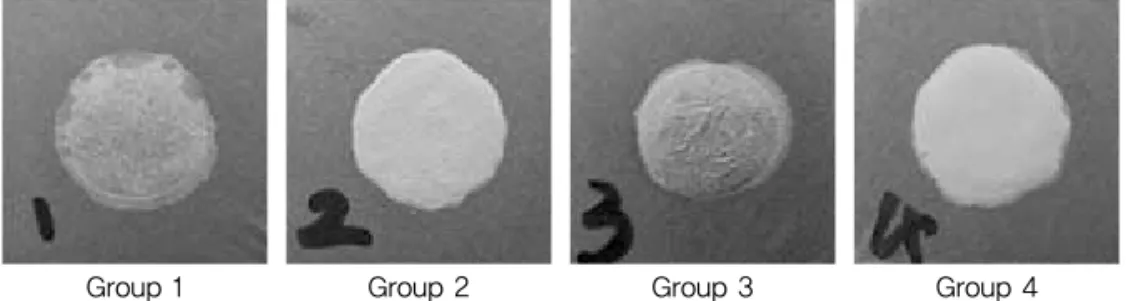
본 연구에서는 금속-도재 수복물을 제작할 때 금속 도재 간 결합력에 gold bonding agent가 미치는 영향을 조사하기 위해 금속의 표면에 opaque 도재와 gold bonding agent의 적층
순서를 달리하여 2축 굴곡 실험을 하였고 SEM/EDS 분석을 하였다.
Ⅱ. 실험 재료 및 방법
1. 실험 재료
1) 금속 시편 제작
금속 시편을 제작하기 위해 13×13×1㎜의 납 형을 제작한 뒤 인산염계 매몰재(Univest
�Plus, Metalor, Swiss)를 사용하여 매몰하고 치과용 Ni-Cr계 비귀금속 합금인 Rexillium
Ⅲ(Rx Jeneric Co, USA)를 Gas-oxygen torch로 용융하여 원심 주조기로 주조하였다.
시편은 bench cooling 시키고 50㎛ Al
2O
3입자 (Korox
�Bego, Bremen, Germany)로 sand- blasting하여 매몰재를 제거하고 증류수와 methyl alcohol로 초음파 세척 후 건조하였다 (n=5).
2) 표면처리
금속 시편의 표면 처리는 비귀금속 합금전용
stone point(Cerasive 1 blue, Metalor,
Swiss)로 grinding하고, 110㎛ Al
2O
3입자
(Korox
�Bego, Bremen, Germany)로 노즐과
시편의 거리를 약 1㎝(20초, 80psi)로 유지한체
sand-blasting하였다. gold bonding agentt
(Aurofilm NP, Metalor, Swiss) 도포는
degassing, 1st, 2st opaque과 적층 순서를 달
리하고 중심부위에 직경이 6㎜ 원형이 되게 하
였고(Fig. 1) 소성은 제조회사의 추천대로 시행
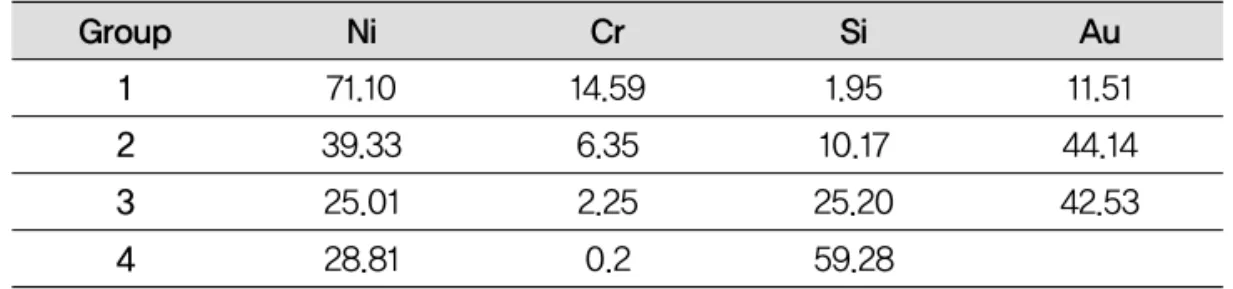
하였다(Table 1). Gold-based bonding agent 에 대한 2축 굴곡 실험 후 파단면의 EDS 분석
을 위한 화학 성분 조성은 Table 2와 같다.
금속 시편은 gold bonding agent를 적층하는
Fig. 1. Specimens after gold bonding agent coating
Group 1 Group 2 Group 3 Group 4
Melting range(℃) Firing temperature(℃)
melting point 1,060 ± 10℃
980℃
Table 1. Firing schedule for gold bonding agent
Compositions Specification (wt%) Note
Paste
Liquid
Au Cu Terpineol Eucalytol Ethylcellulose Terpineol Eucalytol Ethylcellulose
90.00 0.18 7.22 0.60 2.00 95.50 1.75 2.75
Principal component
Evaporation after firing
Evaporation after firing Table 2. Chemical composition of gold bonding agent
순서를 달리하여 제작한 20개의 시편을 각각 4 군으로 나누어 분류하였다(Table 3).
3) 도재 소성
각각의 금속 시편은 장석류 도재(Noritake
Super Porcelain EX-3, Noritake. Japan)를
사용하여 제조 회사의 추천 방식으로(Table 4)
소성하였고, 시편의 중심에 6㎜ 직경의 원형으
로 1.1㎜ 높이가 되게 적층하였다(n=5).(Fig. 2)
Process Group
1 2 3 4
Degassing Degassing Degassing Degassing
Gold-coating Gold-coating 1st opaque 1st opaque
Body, Glaze 1st opaque 2nd opaque Gold-coating
2nd opaque Gold-coating
2nd opaque
Body, Glaze Body, Glaze Body, Glaze Table 3. The layering sequence of gold bonding agent used in this study.
Fig. 2. Dimensions of metal-ceramic specimens
Group 1 Group 2 Group 3 Group 4
Porcelain furnace Setting Porcelain Layer
1st and 2nd paste Opaque 1st layer dentin porcelain 2nd layer dentin porcelain Glaze
Heat from 500 to 980℃ at 65℃/min without vacuum, hold at 980℃ for 1㎜
Heat from 600 to 930℃ at 45℃/min in vacuum Heat from 600 to 920℃ at 45℃/min in vacuum Heat from 600 to 910℃ at 50℃/min in vacuum
Table 4. Setting of the porcelain furnace used for fusing the dental porcelain in this study
2. 연구 방법
1) 2축 굴곡실험
실험은 특별한 Die와 Plunger(Fig. 3)가 장착 된 screw driven Universal Testing machine (Model 1125, instron, Canton, MA)을 사용하 여 금속에서 도재가 탈락 될 때까지 0.1㎜/min 의 cross head speed로 압축강도를 가하였다.
실험 후 시편상의 부착된 도재 조각들은 nylon bristle brush로 제거하였다.
2) SEM/EDS analysis
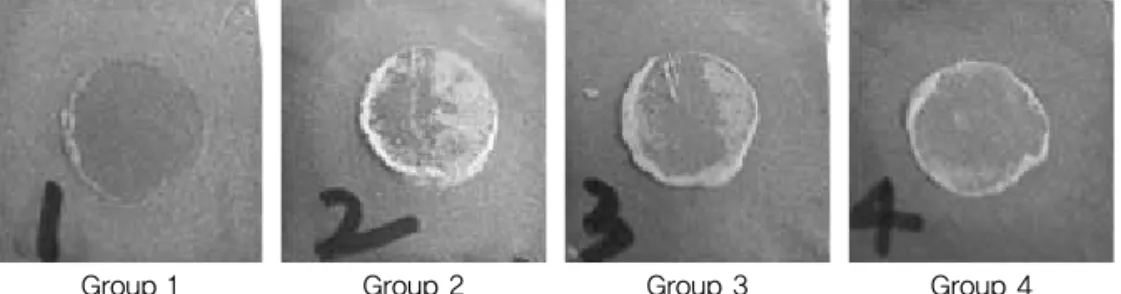
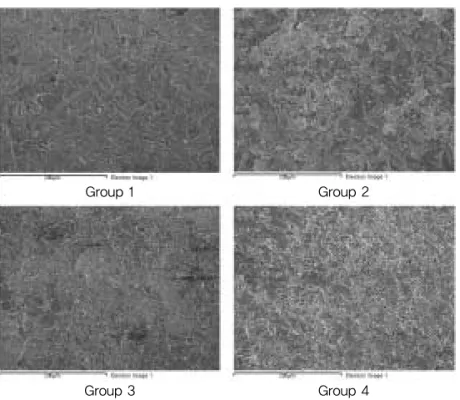
2축 굴곡 실험이 끝난 시편의 표면(Fig. 4)은 EDS (energy-dispersive X-ray spectroscopy,
Horiba, Japan)가 있는 SEM (Scanning electron microscope, S-4700, Hitachi, Japan)상의 secondary electron image mode 상에서 검사하였다. Ultra-thin window 가 있 는 Si(Li) X-ray detector와 X-ray microanalysis, digital imaging system이 EDS 분석을 위해 사용되었고, EDS 분석대로 모든 시편의 표면을 분석하였다.
Si ka X-ray count는 금속 표면에 남아 부착 된 도재를 측정하는데 매우 신뢰할만한 방법이 고 Si 함량은 금속-도재 결합강도의 지표로 이 용되는데, 본 실험에서는 실험이 끝난 시편 중심 원내 (4.2×3.7㎜)의 사각형 내에서 각 시편 당 임의의 5곳을 300배 확대하여 사각형 (420×
300㎛)내에서 조사 하였다.
Si kαX-ray collection에서 SEM operating 조건은 15kV accelerating voltage, 12mm working distance, 20㎂ deam current. 0�
take-off angle, 150s live time이었다.
EDS 결과는 ZAF correction에 준하고 Si 원 자분율(anatomic percentage)을 검사하였다.
실험 후 각 시편의 부착도재 면적분율(AFAP : Area fraction of adherent porcelain)이 다음 과 같이 계산되었다.
Group 1 Group 2 Group 3 Group 4
Fig. 3. Schematic diagram of a special die and plunger
Fig. 4. Specimens surface after Biaxial Flexure Test
Ⅲ. 실험 결과 및 고찰
1. SEM photographs
Fig. 5는 Group1, 2, 3, 4의 각 시편의 단면을 300배율로 촬영하였고 각 층의 성분을 Line- profile한 주사전자현미경(SEM) 사진이다.
1군에서는 Au와 Ni-Cr 합금 사이의 계면에서 미세한 잔금들이 관찰되었다. 2군의 경우 불투 명 도재와 Au층은 결합이 잘 일어났지만, Ni- Cr 합금과 Au층의 계면에서 상당한 크랙의 발 생으로 Au층과 Ni-Cr의 결합이 불량한 것을 볼 수 있었다. 1군은 degassing이 끝난 Ni-Cr 합금위에 opaque 도재를 소성하지 않고 Au층 을 먼저 코팅하여 1차 소성을 하였고, 2군은 Au 층 위에 opaque 도재를 소성하였다.
Au층과 Ni-Cr합금 사이에서 결합 불량이 관 찰되는 것은 Au층과 Ni-Cr 합금사이의 결합력 보다 opaque 도재를 소성하는 과정동안 Au층
과 opaque 도재층이 결합하여 서로 다른 열팽 창 계수 차이에 의해 발생되는 인장력이 Au층 과 Ni-Cr 합금사이의 결합을 방해하는 것으로 Si
d- Si
tAFAP(%) = ×100 Si
p- Si
tSi
p: 도재의 첫 번째층 소성후 Si 원자분율 Si
d: 도재 탈락후 Si 원자분율
Si
t: 도재 소성전 Si 원자분율
Group 1
Group 3 Group 4
Group 2
Ni-Cr Au
Au Si
Au
Si
Ni-Cr Si
Ni-Cr
Si
Au
Ni-Cr