1Date Received July 6, 2015, Date Accepted August 19, 2015
2강원대학교 산림환경과학대학. College of Forest & Environmental Sciences, Kangwon National University, Chuncheon 24341, Republic of Korea
3Faculty of Forestry, Bogor Agricultural University, Bogor 16680, Indonesia
†교신저자(Corresponding author): 김남훈(e-mail: [email protected])
인도네시아 주요 조림수종의 연소특성1
박 세 휘2⋅장 재 혁2⋅Wahyu Hidayat2⋅Yue Qi2⋅Fauzi Febrianto3⋅김 남 훈2,†
Combustion Properties of Major Wood Species Planted in Indonesia1
Se-Hwi Park2⋅Jae-Hyuk Jang2⋅Wahyu Hidayat2⋅Yue Qi2⋅Fauzi Febrianto3⋅Nam-Hun Kim2,†
요 약
본 연구에서는 인도네시아 조림지에서 생장한 4수종의 효율적 활용방안을 마련하기 위해 콘칼로리미터법에 의해 연 소특성을 조사하였다. 그 결과, 평균열방출량(HRRmean)은 비중에 비례하였으며, 총열방출량(THR) 및 연소시간(FT) 등 열관련 계수도 같은 경향을 나타냈다.
Albizia는 열방출 시간이 짧았고, Mindi는 4수종 중 점화시간(TTI)과 연소시간(FT)이 길어져 4수종 중 연소속도가 늦었고, 열방출 시간도 가장 길게 이어져 결국은 Mangium 수종과 비슷한 총열방출률을 나타내는 것을 확인할 수 있었 다. Albizia는 공시수종 중 가장 높은 비소화면적 값을 나타내어 연기발생비율이 높았고, 반대로 Mindi는 가장 낮은 비 소화면적 값을 나타내 연기발생비율이 낮았다. 초기 연기방출률은 Albizia가 높았으나 이후에는 Gmelina와 Mangium 의 연기방출률이 높아져 총연기발생량이 높게 나타났다. Gmelina는 불완전연소로 인해 연소기간 중 가장 많은 일산화 탄소 연기를 생성하였고, CO/CO2 비율은 다른 수종에 비해 3배 이상 높았다.
ABSTRACT
This study was performed to understand combustion properties four major Indonesian wood species such as Albizia, Gmelina, Mangium and Mindi were investigated by cone-calorimeter for better utilization of theses wood species. Heat release rate (HRR), total heat release (TSR), specific mass loss rate (SMLR), effective heat of combustion (EHC), time to ignition (TTI), flame time (FT), specific extinction area (SEA), smoke production rate (SPR) and CO compound production rate were measured. HRR, THR and FT were proportional to the density of woods. Albizia showed the highest HRR, while Mindi had the lowest HRR. For SPR, Albizia showed the highest value due to its higher SEA.
On the other hand, Mindi had the lowest SPR due to a lower SEA value. The highest smoke emission was for Albizia at the beginning of combustion. After 300 seconds, smoke emission of Gmleina and Mangium was increased greatly.
Mangium and Mindi showed the highest total carbon dioxide emission. Expecially, Gmelina released the highest carbon
1. 서 론
목재는 높은 비강도와 아름다운 천연 문양의 선호 로 인해 오랫동안 건축재료로 사용되어져 왔으며, 최 근에는 친환경, 저탄소 녹색성장의 중심으로 각광받 고 있다. 그리고 친환경 주거를 선호하는 소비자의 경향에 따라 주거공간으로써의 한옥 및 목조주택 등 의 수요가 늘고 있다.
일반적으로 목재는 셀룰로오스, 헤미셀룰로오스, 리그닌 등의 유기물질로 이루어져 있으며(Shafizadeh et al., 1976), 이로 인해 근본적으로 화재에 매우 취 약한 특성을 가지고 있다. 화재 발생 시 복사열과 대 류열에 의해 가열되면 매우 빠른 속도로 화염이 전 파되기 때문에 일반 소방기구로도 진화가 어려운 상 태이다(Baysal et al., 2007). 나아가 현재 수요가 급 증하고 있는 목조주택에서는 주거생활을 위한 난방, 취사 설비 등을 갖추고 있어 화재의 위험성이 상존 하고 있으며, 목재를 천연상태로 사용하기에는 어려 움이 따르고 있다(Choi, 2011).
목재는 열분해시 175℃부터 함유된 수분, 유분 등 의 손실에 의한 수증기, CO2 및 무기화합물과 같은 비연소성 물질 생성을 시작으로, 200℃부터 헤미셀 룰로오스, 250℃에서 셀룰로오스, 280 ∼ 500℃에서 리그닌이 분해된다(Drysdale et al., 1996). 450℃ 이 상으로 가열되면 모든 휘발성 물질은 증발되고 숯이 생성되는데 이 탄화층은 산소가 연소층에 쉽게 접근 하는 것을 허용하지 않아 목재의 연소속도를 감소시 킨다(Pearce et al., 1981). 이에 따라 수종별로 목재 가 지니는 성분비율, 추출물 등에 따라 숯의 생성속 도에 차이가 생기며, 유분 등 휘발분을 다량 함유하 는 수종은 초기 에너지 방출이 많아 숯이 생성되는 온도에 이르기 전까지 열이 빠르게 확산되어진다. 이 는 다른 수종에 비해 더 위험한 수종으로 판단된다.
그러므로 목재의 연소 시 수종별 연소특성에 대한 세밀한 분석이 필요하다. 이와 관련하여 해외에서는 비교적 많은 연구가 진행되고 있으나(Ragland et al,.
1991; Hull et al., 2007; Brostow et al., 2009;
Audeber et al., 2013), 국내에서의 연구는 많지 않다 (Chung et al., 2010; Choi, 2011; Park et al., 2012;
Son et al., 2014).
우리나라는 부족한 목재수급 및 해외 주요 목재수 출국의 원목반출 금지 등을 해결하기 위하여 해외조 림을 진행하고 있다. 현재 인도네시아, 베트남, 남미 의 칠레 등을 비롯하여 전 세계에 약 33만 ha에 이 를 정도로 많은 조림지가 만들어졌으며 목재가 생산, 유통되고 있다(Korea Forest Service, 2014). 우리나 라 산림조합중앙회는 인도네시아 조림지에 Albizia (Paraserianthes falcataria), Gmelina (Gmelina arbor- ea), Mangium (Acacia mangium) 및 Mindi (Melia azedarach) 4수종을 조림하여 수년 내에 대량의 목 재생산을 앞두고 있다. 최근 Kim et al. (2012, 2014) 은 Albizia, Gmelina 및 Mangium을 포함한 10수종에 대하여, Jang et al. (2014)은 Mindi 외 7수종에 대하 여 해부학적, 물리적 및 역학적 특성을 조사하여 다 양한 분야로의 활용을 위한 기초자료를 획득하였다.
본 연구에서는 해외주요 조림수종 목재의 건축 내 장재로서의 활용 가능성을 분석하고자 기초적인 연 소성능을 평가하였으며, 화재안전을 위한 자료로 활 용할 수 있는 콘칼로리미터법을 이용하여 열적특성 과 연기특성을 조사하였다.
2. 재료 및 방법 2.1. 공시재료
본 연구에 사용한 목재시료는 인도네시아 서부 자 monoxide during the combustion period and presented three times higher CO/CO2ratio than those of other species due to incomplete combustion.
Keywords : combustion, cone-calorimeter, heat release rate, total heat release, smoke production rate, specific ex- tinction area, CO compound emission
바지역의 Purwakarta와 Bogor에 위치한 대한민국 산 림조합중앙회의 조림지역에서 채취되었다. Albizia (Paraserianthes falcataria)와 Mindi (Melia azedar- ach)는 2010년 Purwakarta지역에 조림된 수종이고 Gmelina (Gmelina arborea)와 Mangium (Acacia mangium)은 2009년 Bogor지역에 조림된 수종이다.
채취된 수종은 각재로 제작되어 강원대학교 목재실 험동에서 3개월간 기건상태로 건조시켜 항량에 도달 한 후 사용하였다. 기건상태의 각 수종별 기건밀도와 기건함수율을 Table 1에 나타냈다.
2.2. 실험방법
연소성능시험 방법(KS F ISO 5660-1)에 따라 기 건상태로 건조된 각 수종별 목재를 10 (R) × 10 (L)
× 1 (T) cm3크기의 시편으로 제작하였다. 이후 연소 실 내부를 온도 23 ± 2℃, 상대습도 50 ± 5%에서 항 량에 도달할 때까지 유지한 다음 실험을 진행하였다 (Park et al., 2012).
연소시험은 ISO 5660-1에 의거하여, 실화재실험장 치(콘칼로리미터)를 이용하여 실시하였다(Fig. 1). 실 험방법은 다음과 같다.
1) 공시수종 목재의 비노출면을 알루미늄 호일로 감싸 복사열에 노출되지 않도록 하였다.
2) 콘히터의 열량이 설정값 ± 2% 이내, 배출유량 을 0.024 ± 0.002 m3/s로 설정하고, 산소분석기 의 산소농도가 20.95 ± 0.01%가 되도록 교정하 였다.
3) 불연성 합성금속 용기 안에 섬유 담요(blanket) 를 깔고 그 위에 시편을 놓았다.
4) 시편을 50 kW/m2 복사열에 노출시켜 불꽃 연
소가 시작되고 30분 경과 후 종료하였으며, 추 가로 2분간의 데이터 수집시간을 부여하였다.
Dual cone calorimeter에 의한 열방출률 측정은,
「유기재료가 연소 중에 산소 1 kg이 소비되면 약 13.1 MJ의 열이 방출되는 산소소비 원리」를 바탕으 로 하고 있다. 설정한 복사열에 노출된 시편이 착화 되어 연소될 때의 열방출률은 연소 생성물 흐름속의 산소 농도와 유속으로부터 유도된 산소 소비량을 측 정하여 평가하였다. 측정한 연소특성은 Table 2의 식 들을 이용하여 분석하였다.
3. 결과 및 고찰 3.1. 열적특성
에너지 방출속도, 연기생성, 가스독성 등은 목재연 소 시 중요한 연소특성으로서 연소모델링을 위한 중 요한 측정값으로 사용되어 지고 있다(Pearce et al., 1981; Quntiere, 1992). 이 중 에너지 방출을 나타내 는 열방출률(Heat Release Rate)은 연소에 있어 가장 중요한 요소이다(Barbrauskas, 1984; Barbrauskas et Common name Scientific name Location Age Density (kg/㎥) Moisture contents (%)
Albizia Paraserianthes falcataria Purwakarta 6 271 10.62
Gmelina Gmelina arborea Parunpanjang 7 523 14.50
Mangium Acacia mangium Parunpanjang 7 584 13.56
Mindi Melia azedarach Purwakarta 6 493 14.44
Table 1. Materials for combustion test
(A) Large scale cone-calorimeter
(B) Specimen and container Fig. 1. Cone-calorimeter for combustion properties.
al., 1992).
Table 3은 공시수종의 열적특성을 종합한 결과이 다. 평균열방출률(HRRmean)은 Albizia (23.67 kW/m2) 와 Gmelina (25.87 kW/m2)가 낮았고, Mangium (40.13 kW/m2) 및 Mindi (41.77 kW/m2)가 크게 나타 났다. 최대열방출률(HRRpeak)은 Mangium (145.61 kW/m2)이 가장 컸고 Albizia (106.54 kW/m2), Mindi (100.82 kW/m2) 및 Gmelina (78.07 kW/m2) 순서로 서 Gmelina 수종이 열방출률이 낮아 화재시 발생되 는 열이 가장 적은 것으로 판단되었다. Son et al.
(2014)은 국내에서 주로 실내에 사용되는 Western pine, Teak, Walnut 등 12종의 목재에 대하여 연소특 성을 조사하여, 최소 137 kW/m2에서 최대 371 kW/m2 범위의 열방출률 값을 보고하였다. 공시수종 의 최대열방출률은 Mangium이 145 kW/m2로써 국 내에서 사용되는 수종들에 비해 열방출률이 대체적 으로 낮았다.
난연성능 기준에서 난연등급은 총열방출량(THR) 을 통해 평가된다. 총열방출량은 Albizia (44.3 MJ/m2), Gmelina (48.0 MJ/m2), Mangium (75.1 MJ/m2) 및 Midni (76.7 MJ/m2)의 순서로 나타났으 며, Albizia가 가장 낮은 총열방출량을 나타냈다.
Son et al. (2014)의 연구에서 조사된 수종들의 총열
방출량은 62 MJ/m2부터 286 MJ/m2 범위를 가졌으 며, 본 연구의 공시수종들의 총열방출량이 낮은 것을 알 수 있었다.
연소가 시작되는 점화시간(TTI)은 Albizia가 12초 로 가장 빨랐으며, Mindi는 48초로 가장 느렸다.
HRRpeak 값에 도달된 시간을 나타내는 연소시간(FT)
은 Mindi가 480초로 다른 수종에 비해 길었으며, Albizia가 315초로 가장 짧았다. 이를 종합하면 Albizia는 4수종 중 가장 빨리 점화되고 연소가 빠른 것을 알 수 있으며 Mindi는 반대로 가장 늦게 점화 되고 연소가 느린 것으로 분석되었다. Chung et al.
(2010)은 실온에서 건조된 리기다 소나무와 밤나무 의 연소특성을 조사하여, 점화시간은 각각 15초, 34 초로 보고하였다. 이를 통해 Mindi 수종은 이들 수종 보다 화재의 확산이 느릴 것으로 분석되었다.
연소과정에서 수종별 열방출률의 변화를 Fig. 2에 나타냈다. Albizia는 가장 단기간 내에 열방출률 피 크를 나타냈으며, 이는 밀도에 기인하는 것으로 생각 되었다. Son et al. (2014)은 소나무, 햄록, 라디에타 파인, 티크 및 월넛의 연소특성을 조사하였다. 수종 별 비중은 각각 414 kg/m3, 407 kg/m3, 418 kg/m3, 648 kg/m3 및 674 kg/m3이었으며, 열방출률 곡선에 서 소나무-라디에타파인-햄록-월넛-티크 순으로 피크
Contents Formulas
Heat released rate
∆∆
(1)
(2)
∙∆ (3)
×
∆
∙
-
: heat release (kW/m2) : heat release per unit area (kW/m2) C: calibration constants (m1/2·kg1/2·K1/2) (t): speed of heat release (kW)
hc: pure heat of combustion (kJ/kg) ro: mass ratio of oxygen and fuel (ℓ) P: pressure difference of orifice (Pa) Te: absolute temperature of gas in orifice (K) XoO2: initial value of oxygen analyzer XO2: value of oxygen analyzer to mole fraction
= : heat release (kW/m2) As: specimen’s surface (㎡)
∙ ∆: Specific mass loss rate (kg/㎡s) ∆: effective heat of combustion (kJ/kg)
: density of the fuel ℃ : thermal conductivity
Table 2. Formulas for combustion properties
에 도달하여 본 연구의 결과와 일치하는 것을 확인 하였다. Mindi 는 Table 3과 Fig. 2에서 보여주는 것 과 같이 점화시간(TTI)과 연소시간(FT)이 길어져 4 수종 중 연소속도가 늦었고, 열방출 시간도 가장 길 게 이어져 결국은 Mangium 수종과 비슷한 총열방출 을 나타내는 것을 확인할 수 있었다.
Fig. 3은 공시수종 목재의 연소과정 전후의 형태를 비교한 사진이다. 다른 세 수종은 소량의 회백색의 재만 남은 것이 관찰된 것에 비해, Mindi는 불완전 연소에 의해 검은색의 잔여물이 많이 남은 것을 관 찰할 수 있었다. 이를 통해 Mindi 수종은 다른 수종 에 비해 연소특성이 다소 다른 것으로 판단되었다.
Tran et al. (1992)의 연구에서 연소특성은 비중에 비례하는 것으로 보고하였다. 재료의 연소로 인한 열 방출률과 단위면적당 열방출량은 Table 2의 식 (1)과 (2)에 의하여 계산되며, 식 (3)에서 열방출률(HRR)은 비질량손실률(SMLR)과 유효연소열(EHC)의 곱이며,
항목 단위 Albizia Gmelina Mangium Mindi
aSMLRave (g/s⋅㎡) 1.69 3.09 2.86 3.82
bHRRmean (kW/㎡) 23.67 25.87 40.13 41.77
cHRRpeak (kW/㎡) 105.54 78.07 145.61 100.82
dTHR (MJ/㎡) 44.3 48.0 75.1 76.7
eTTI (s) 12 29 19 48
fFT (s) 315 355 395 480
gEHC (MJ/kg) 14.71 19.72 22.93 25.63
a: Specific mass loss late, b: Mean heat release rate, c: Peak heat release rate, d: Total heat release, e: Time to ignition, f: Flaming time, g: Effective heat of combustion.
Table 3. Thermal properties of each species
Fig. 2. HRR curves of each wood species at 50 kW/m2 radiant heat flux.
(A) Albizia (B) Gmelina
(C) Mangium (D) Mindi
Fig. 3. Sample images before (top) and after (bottom) combustion test in wood samples.
열방출률은 비질량손실률(SMLR)에 비례한다는 점 이 유추된다(Pearce et al., 1981; Chung et al., 2010).
Gmelina 수종을 제외한 Albizia, Mangium 및 Mindi 수종에서 열방출률과 비중 간 비례하는 경향을 확인 하였다. Gmelina 목재는 밀도에 비해 매우 낮은 열 방출률을 나타내 특이한 연소특성을 지니는 것으로 판단하였다.
3.2. 연기특성
재료의 연소 시 열과 연기가 발생하며, 특히 연기 는 화재 발생 시 실질적으로 인체에 피해를 주는 요 소로써 이에 대한 연구는 대단히 중요하다.
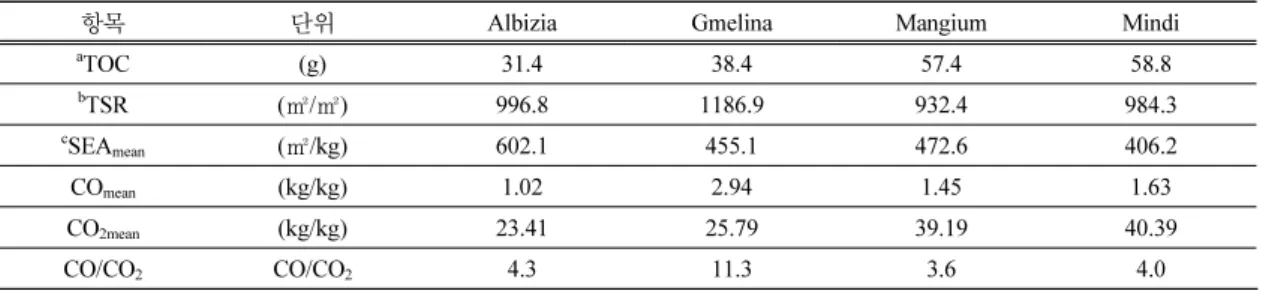
Table 4는 공시수종의 연기특성을 나타낸 결과이 다. 총산소소모량(TOC)은 Albizia (31.4 g), Gmelina (38.4 g), Mangium (57.4 g) 및 Mindi (58.8 g)으로 나타났으며, Mindi 수종이 가장 많은 산소를 소모하 였다. 총연기방출량(TSR)은 Albizia (996.8 m2/m2), Gmelina (1186.9 m2/m2), Mangium (932.4 m2/m2) 및 Mindi (984.3 m2/m2)로 나타났으며, Gmelina가 가장 크고 Mangium이 가장 작았다. Chung et al. (2010) 의 연구에서 리기다소나무와 밤나무의 총산소소모량 은 각각 53.8 g과 81.2 g, 총연기발생량은 각각 232.5 m2/m2과 292.6 m2/m2로 나타나, 공시수종은 산소소 모량은 낮지만 연기가 많이 발생되는 것을 확인하 였다.
일반적으로 건축재 및 내장재의 내화성 평가기준 으로 사용되는 지표는 비소화면적(SEAmean)이며, 연 기방출률(SPR)을 비질량손실률(SMLR)로 나눈 것이
다. Albizia (602.13 m2/kg)의 비소화면적은 Gmelina (455.17 m2/kg), Mangium (472.61 m2/kg) 및 Mindi (406.28 m2/kg)의 값보다 높게 나타났다. 비소화면적 이 낮을수록 연기발생량이 적은 것이며, Albizia의 경우 다른 공시수종 중 가장 높은 비소화면적 값을 나타내어 연기발생비율이 높으며, 반대로 Mindi는 가장 낮은 비소화면적 값이 낮아 연기발생비율은 낮 은 것으로 분석되었다.
Fig. 4는 연소과정 중 연기방출률(Smoke pro- duction rate, SPR)을 나타낸 그래프이다. 초기 연기 방출률은 Gmelina, Albizia가 비교적 높았고 약 300 초 이후 Gmelina와 Mangium이 급격이 높아졌으며, 특히 Gmelina는 약 800초까지 다량의 연기가 발생하 였다. Midni 수종의 경우 가장 긴 시간 연기가 발생 하였다.
목재의 연소시 발생하는 연소가스의 독성은 탄소 화합물 방출에 의하여 결정되어진다. Fig. 5는 연소 시간에 따른 CO2의 발생률을 나타낸 것이다. Albizia
항목 단위 Albizia Gmelina Mangium Mindi
aTOC (g) 31.4 38.4 57.4 58.8
bTSR (㎡/㎡) 996.8 1186.9 932.4 984.3
cSEAmean (㎡/kg) 602.1 455.1 472.6 406.2
COmean (kg/kg) 1.02 2.94 1.45 1.63
CO2mean (kg/kg) 23.41 25.79 39.19 40.39
CO/CO2 CO/CO2 4.3 11.3 3.6 4.0
a: Total oxygen consumption, b: Total smoke release, c: Specific extinction area
Table 4. Smoke properties of each species
Fig. 4. SPR curves of each wood species at 50 kW/m2 radiant heat flux.
는 약 1200초에서 연소가 종료되어 CO2 발생률이 멈췄고, 다른 수종에서는 꾸준히 CO2가 발생되었다.
CO2 발생률 피크는 Albizia (340초), Gmelina (120 초), Mangium (440초) 및 Mindi (520초)에서 가장 높게 관측되었다. 총 CO2 발생량은 Mangium과 Mindi가 크게 나타났다. 또한 CO2 발생은 열방출 곡 선과 비슷한 경향이 관측되어 일정한 상관관계가 있 는 것으로 판단된다.
Fig. 6의 일산화탄소 발생 경과곡선을 보면, Gmelina는 다른 공시수종들에 비해 상당히 높은 비 율의 CO를 빠른 시간에 생성하는 것을 확인하였다.
Table 4의 COmean생성량은 Albizia (1.02 kg/kg), Gmelina (2.94 kg/kg), Mangium (1.45 kg/kg) 및 Mindi (1.63 kg/kg)로서 Albizia가 가장 적고 Gmelina가 가장 많게 나타났다. 또한 독성지수의 주 요 지표인 CO/CO2 비율은 Albizia (4.3), Gmelina (11.3), Mangium (3.6) 및 Mindi (4.0)로 나타났다.
Son et al. (2014)의 연구에서 CO/CO2 비율은 1.6에 서 3.3의 범위를 나타냈으며, Chung et al. (2010)은 국내산 리기다소나무와 밤나무의 연소특성을 연구 하여 각각 5.3, 3.4의 CO/CO2의 값을 보고하였다.
이를 통해 본 연구의 Gmelina는 타 수종에 비해 높은 CO 방출을 확인할 수 있었다. 이는 구성성분 및 추출물 등에서 기인하는 것으로 생각되어진다.
Gmelina는 열방출량이 적어 화재시 연소가 많이 되 지 않는 장점을 지녔으나, 일산화화합물을 많이 지 닌 연기가 다량으로 발생되는 점은 주의해야 할 것 이다.
4. 결 론
인도네시아 조림지에서 생장한 4수종에 대한 연소 특성을 조사한 결과는 다음과 같다.
1. 공시재료의 평균열방출량(HRRmean)은 비중에 비례하였으며, 총열방출량(THR) 및 연소시간 (FT) 등 열관련 계수도 같은 경향을 나타냈다.
2. 공시재료 중 Albizia는 연소시간(FT) 내에서 가장 빠른 열방출률 피크를 나타냈고 총열방 출 시간이 짧았다. Mindi는 4수종 중 열방출 시간이 가장 길고 총열방출량이 가장 크게 나 타났다.
3. Albizia는 공시수종 중 가장 높은 비소화면적 값을 나타내어 연기발생비율이 높았고 반대로 Mindi는 가장 낮은 비소화면적 값을 나타내 연 기발생비율이 낮았다.
4. 초기 연기방출률은 Gmelina, Albizia가 비교적 높았고 총 연기방출량은 Gmelina와 Mangium 이 높았다.
5. CO2 발생량은 Mangium과 Mindi가 크게 나타 났다.
6. Gmelina는 연소기간 중 가장 많은 2.94 kg/kg의 COmean를 생성하였고 CO/CO2 비율이 11.3으로 매우 높게 나타나, 타 수종에 비해 일산화탄소 비율이 높은 연기가 빠르게 많이 발생하는 것 을 알 수 있었다.
Fig. 5. CO2 production rate curves of each wood species at 50 kW/m2 radiant heat flux.
Fig. 6. CO production rate curves of each wood spe- cies at 50 kW/m2 radiant heat flux.
본 연구의 결과를 통해 열대조림목의 향후 국내 내장재 활용지표로 사용될 것으로 생각된다.
사 사
본 연구는 산림청 “산림과학기술개발사업 (S121212L150100)”의 지원에 의하여 이루어진 것입 니다.
REFERENCES
Audeber M., Dhima D., Taazount M., Bouchair, A.
2013. Thermo-mechanical behaviour of tim- ber-to-tiber conections exposed to fire. Fire Safety Journal 56: 52-64.
Babrauskas, V. 1984. Development of cone calo- rimeter: A bench-scale consumption. Fire and Materials 8(2): 81-95.
Babrauskas, V., Grayson, S.J. 1992. Heat release in fires. E&FN Spon (Chapman and Hall), London, UK.
Baysal, E., Altinok, M., Colak, M., Ozaki, S.K., Toker, H. 2007. Fire Resistance of Douglas fir (Psedotuga menzieesi) treated with borates and natural extractives. Bioresources Technology 98:
1101-1105.
Brostow W., Menard K., Menard, N. 2009.
Combustion properties of several species of wood. Chemistry & Chemical Technology 3(3):
173-176.
Choi, J.M. 2011. A study on combustion character- istics of fire retardant treated Pinus densiflora and Pinus koraiensis. Journal of the Korean Wood Science and Technology 39(3): 244-251.
Chun, Y.J., Jin, E. 2010. Combustion characteristics of the Pinus rigida and Castanea savita dried at room temperature. Journal of Korean Institute of Fire Science and Engineering 24(3): 86-92.
Drysdale D. 1996. An introduction to fire dynamics.
john Wily & Sons, USA.
Hull R.T. and Paul K.T. 2007. Bench-scale assess- ment of combustion toxicity - a critical analysis of current protocols. Fire safety Journal 42(5):
340-365.
Jang, S.R., Jang, J.H., Kim, J.H., Febrianto, F., Kim, N.H. 2014. Anatomical characteristics of major plantation species growing in Indonesia Ⅱ.
Journal of the Korean Wood Science and Technology 42(6): 635-645.
Kim, C.J., Masataka, A., Kang, K.K. 1999.
Combustion characteristics of wood chips (Ⅱ)- Flame shape of combustion and ignition delay. Journal of the Korean Society of Industrial Application 2(2): 139-146.
Kim, J.H., Jang, J.H., Kwon, S.M., Febrianto, F.
Kim, N.H. 2012. Anatomical properties of major planted and promising species growing in Indonesia. Journal of the Korean Wood Science and Technology 40(4): 244-256.
Kim, J.H., Jang, J.H., Ryu, J.Y., Febrianto, F., Hwang, W.J., Kim, N.H. 2014. Physical and me- chanical properties of major plantation and promising tree species grown in Indonesia(Ⅰ).
Journal of the Korean Wood Science and Technology 42(4): 467-476.
Korean Agency for Technology and Standard. 2006.
Reaction to fire test-Heat release, smoke pro- duction and mass loss late - Part 1 : Heat re- lease rate(Cone calorimeter method). KS F ISO 5660-1.
Park S.B., Park, J.S. 2012. Combustion character- istics of bamboo charcoal boards. Journal of the Korean Wood Science and Technology 40(1):
19-25.
Pearce, F.M., Khanna, Y.P., Raucher, D. 1981.
Thermal analysis in polymer flammability.
Chapter 8: Thermal characterization of polymeric materials. Academic press. New York. USA.
Quintiere, J.G. 1992. A semi-quantitative model for the burning rate of solid materials. NISTIR 4840, National institute of standards and technol- ogy, Gaithersburg, MD.
Ragland. K.W. and Aerts D.J. 1991. Properties of wood for combustion analysis. Bioresource Technology 37: 161-168.
Shafizadeh, F., Degroot, W.F. 1976. Combustion characteristics of cellulosic fuels in : Tillman, thermal uses and properties of carbohydrates and lignins. Academic press. New York, USA.
Son, D.W. and Kang, S.G. 2014. Combustion
Properties of Woods for Indoor Use (I).
Journal of the Korean Wood Science and Technology 42(6): 675-681.
Son, D.W., Kang, M.R., Son, S.W., So, I.S., Park, S.B. 2014. Comparison of combustion character- istics of woods used in indoor. Proc. of 2014 Annual Meeting of The Korean Society of Wood Science and Technology. Cheong-Ju, Republic of Korea. pp. 348-349.
Tran, H.C., White, R.H. 1992. Burning rate of solid wood measured in a heat release calorimeter.
Fire and Materials 16: 197-206.