Human Topoisomerase I-DNA 절개가능 복합체에 대한
Indenoisoquinolin e 유도체들의 결합양상 연구
박인선†·김보연†·김춘미·최선# 이화여자대학교 약학대학 대학원 생명·약학부
(Received June 30, 2009; Revised August 3, 2009; Accepted August 4, 2009)
Binding Mode Studies of Indenoisoquinoline Analogues into Human Topoisomerase I-DNA Complex Using Flexible Docking
In Seon Park
†, Boyeon Kim
†, Choonmi Kim and Sun Choi
#College of Pharmacy and Division of Life and Pharmaceutical Sciences, Ewha Womans University, Seoul 120-750, Korea
Abstract— Topoisomerase I (Topo I) participates in the DNA replication, transcription, and repair. Binding of Topo I inhib- itor to the Topo I-DNA cleavage complex forms stabilized ternary complex which blocks DNA religation and ultimately causes cell death. Camptothecin (CPT) and its derivatives have been among the most effective anticancer drugs by inhi- bition of topo I. However, efforts to synthesize non-CPT drugs have been actively going on because the CPT derivatives have several limitations such as poor solubility, short half-life, and side effects. As an indenoisoquinoline, NSC314622 is not as potent as CPT, but its chemical stability and slower reversibility of the cleavage complex made it a good lead compound.
Recently, a series of indenoisoquinoline analogues were synthesized with substituted dimethoxy or methylenedioxy on the aromatic ring and alkylamino on the lactam nitrogen.1) Some of them showed quite good Topo I inhibitory activity. Using the computer docking program, Surflex-Dock, indenoisoquinoline analogues were docked into the human Topo I-DNA cleav- able complex. The docking results showed that the compounds with activity better than NSC314622 intercalated between the -1 and +1 base pairs at the cleavage site, but those with little or no activities did not appear to intercalate. These results could be useful to design new Topo I inhibitors improved than CPT.
Keywords □topoisomerase I-DNA complex, indenoisoquinoline, docking, binding modes
Topoisomerase I(Topo I)은세포의핵에존재하며 DNA의위
상상태를조절하고세포내에서일어나는전사, 복제, 그리고복
구과정에관여하는효소이다.2-5) Topo I의촉매작용을하는
Tyr723의 hydroxyl group이 DNA 끊어진 가닥의 -1 deoxy- nucleoside의 3' 말단과공유결합을형성하여한쪽가닥의끊어
짐을유도한다. 그결과 3'-phosphotyprosine(Ptr723) 결합이형 성되면 Topo I과 DNA는절개가능복합체(cleavable complex)라
고불리는가역적인복합체를형성하고일시적인 DNA의절단
으로끊어진가닥이회전을하여 positively supercoiled DNA는 풀어주고 negatively supercoiled DNA는더꼬아줘서본래의 DNA 이중나선을 유지하도록 한다. DNA를 풀어준 후 +1
deoxynucleoside의 5'-OH가 Ptr723 결합을다시공격하여재연
결이일어나 DNA 이중나선이복구된다.6) Topo I 저해제는 Topo
I-DNA 절개가능복합체를안정화시켜서재연결단계를특이적
으로저해하여세포독성을일으키는것으로알려져있다. DNA
복제도중에 Topo I 저해제가 Topo I-DNA 절개가능복합체와
결합하여안정한삼성분복합체(ternary structure)를이루면복 제포크와충돌하게되어세포의 apoptosis가유도된다.6)
현재알려져있는대표적인 Topo I 저해제는 Camptothecin (CPT) 유도체이다. 그러나 CPT 유도체는한계점들을가지고있 다. 첫째, 화학적으로불안정하다. E 환의 hydroxylactone이생
리적인 pH에서빠르게 carboxylate으로전환하여인간혈청알
부민과강하게결합하기때문에, CPT의 99.5% 이상이약효가 없는 carboxylate 형태로 존재하고약효가있는 lactone 형은 0.5% 미만이존재한다.7)둘째, Topo I-DNA 절개가능복합체로
부터빠르게확산되어나오므로삼성분복합체를유지하기위해 지속적인약물주입이필요하다.8)셋째, 백혈구감소와같은부작
#본논문에관한문의는저자에게로
(전화) 02-3277-4503 (팩스) 02-3277-2851 (E-mail) [email protected]
†공동제1저자임.
용을유발하므로안전성을위해투약용량의제한이필요하다.9)
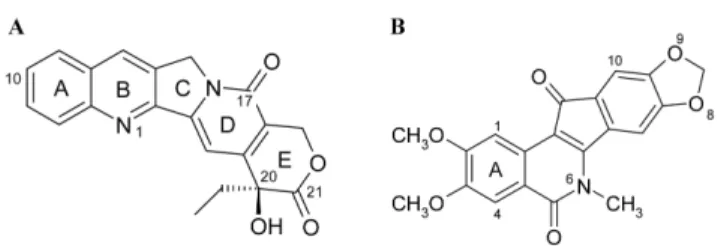
이와같은한계점을극복하고자새로운 Topo I 저해제연구가 시작되어, CPT를 seed로 사용한 National Cancer Institute (NCI) drug screen database의 COMPARE analysis에 의해 indenoisoquinoline(NSC314622)가 Topo I 저해제로확인되었다.10) NSC314622는 indenoisoquinoline 계열화합물의선도화합물로
서새로운 Topo I 저해제개발에사용되었다. NSC314622은 CPT
와다른생물학적활성을가지므로그한계점을극복하고다른 항암효과프로필을보일수있다. 첫째, indenoisoquinoline 계열
화합물인 NSC314622는생리적인 pH에서 CPT와달리화학적으
로안정하다.11)둘째, 이물질은 CPT가 Topo I-DNA 절개가능복 합체의가역성으로인해지속적인주입이필요한것에비해, 절
개가능복합체를더안정화시켜서오래유지되도록한다.12)셋째,
이 indenoisoquinoline 화합물은 DNA 절개부위의특이성에서
CPT와다르므로, 다른항암스펙트럼을제공할수있다10)(Fig. 1).
2005년에 Staker 등은 CPT, indenoisoquinoline(MJ238), indolocarbazole(SA315F) 등을각각리간드로포함하는결정구 조를발표하였다. 세계열모두같은삽입결합양상을가지고
절개부위의 DNA 염기쌍에유사하게작용한다는것을확인하
였다. Indenoisoquinoline 계열인 MJ238은 NSC314622의 A 환 에치환된 dimethoxy기와 D 환에치환된 methylenedioxy기가
수소로치환되어있고 N6의 methyl기가 butylcarboxylic acid로 치환되어있는형태이다. MJ238은절개부위의 +1/-1 염기쌍 사이에삽입되어있고 C 환과 D 환은끊어지지않은 DNA 가
닥의염기위에, A 환과 B 환은끊어진 DNA 가닥의염기위에
stacking 상호작용을 하고 있다. C 환의 carbonyl기가 minor groove 방향으로향하여 Arg364 guanidino group의질소두개
와각각수소결합을형성하고있다. B 환의 butyl-carboxylic acid
는 Ala351과 Asn352가 있는 major groove로 향하고 있다.6) Marchand 등은 nor-indenoisoquinoline을리간드로포함하는결
정구조를발표하고그것을발표된다른구조와비교하여, 수소 결합망을이루는잔기들에일부차이가있으나 CPT, indenoiso- quinoline, indolocarbazole, nor-indenoisoquinoline 계열의약물
이같은결합양상을보이고있으며같은작용기전을가질것이 라고주장하였다.13)
본연구에서는 MJ238의삼성분복합체를통하여밝혀진 MJ238
의결합양상을근거로 Topo I 저해작용을나타낼것으로예상되
는 indenoisoquinoline 유도체들을인간 Topo I-DNA 절개가능
복합체에 docking시켜단백질과저해제들의결합양상을분석하
고새로운 non-CPT계열약물의개발연구에중요한정보를제공
하고자하였다.
실험방법
모든 실험은 SYBYL molecular modeling program package (version 7.3.3)로 RHEL 4.1 Intel Xeon processor 5050 Linux workstation에서수행하였다.
Docking을위한Topo I-DNA X-선결정구조의선택과처리 인간 Topo I-DNA 절개가능 복합체에저해제인 indenoiso- quinoline(MJ238)이결합된삼성분복합체결정구조의 1SC7.pdb
를선택하였다. 1SC7.pdb는 3.0 Å의해상도를가지며 Tyr723이
DNA의 -1 site인 T10과 phosphotyrosine 결합으로연결된구조
이다.6)
1SC7.pdb를 docking에적합한상태로만들기위해 X-선결정 구조를수정하였다. 활성부위잔기에서벗어나위치한 glycol은
제거하고리간드의원자형을확인, 수정하였다. DNA의안정한
결정구조를만들기위해 G11의 5'-OH기가 5'-SH기로치환2,4)된
5'-thio-2'-deoxy-guanosine phosphonic acid(TGP) 구조로되어
있어 황을산소로 수정하였다. 그리고 SYBYL의 Biopolymer Structure Preparation Tool을사용하여 atom types, backbone, N-, C-termini, hydrogen bonding, bump 등을고려하여 docking
실험에적합하도록 구조를처리하였다. 그리고, 단백질에는 Kollman-all-atom charge를, DNA와 리간드에는 Gasteiger- Hückel charge를주었다. 원래 1SC7.pdb의 DNA 서열과최종
수정된 DNA 서열은다음과같다.
수정전 5'-AAAAAGACTT TGPGAAAAATTTTT-3' 잘리는쪽
수정전3'-TTTTTCTGAA-C CTTTTTAAAAA-5' 잘리지않는쪽
수정후 5’'-AAAAAGACTT GGAAAAATTTTT-3' 잘리는쪽
수정전3'-TTTTTCTGAA-CCTTTTTAAAAA-5' 잘리지않는쪽
Docking에사용할화합물의처리
실험에사용된화합물들은 Cushman 등에의해 NSC314622
를선도화합물로하여합성된것으로 A 환, D 환, 및 N6에치 환기를달리하였고 Topo I 저해활성에대한자료가반정량적으 로(semi-quantitatively) 나타나있다. 추가로현재임상개발을위
한 NCI Developmental Therapeutics Program의 '0'상 단계에 있는 NSC725776과 NSC724998도 docking에사용하였다.
Fig. 1 −Structures of camptothecin (A) and indenoisoquinoline derivative, NSC 314622 (B).
Docking 실험에사용된 12개의 indenoisoquinoline 유도체구
조는결정구조의 MJ238을추출하여 MJ238의 4-환모핵을바
탕으로 sketch하고 CONCORD로정리하였다. 생리적조건에서
protonation 또는 deprotonation 될수있는것들은 protonation
상태에맞게조절하고그에상응하는 formal charge를주었다.
그리고 Tripos force field, Gasteiger-Hückel charge를사용하여 에너지를 최소화하였다(Method, Powell; gradient, 0.001 kcal/
(mol*A); maximum iterations, 100000). 재현성실험을위해결 정구조의리간드를수정한후위방법과마찬가지로처리하였다.
Topo I-DNA결정구조에대한리간드 docking 실험
Surflex-Dock14,15)에서는단백질구조로부터가상으로리간드들 이배열하는수용체와의결합공간을나타내는 protomol을만든
다. Protomol 생성후, Surflex-Dock의기본 setting을사용하여
(단, additional starting conformations per molecule은 5로설정)
각리간드당 30개의 pose가도출되도록 indenoiso- quinoline 유
도체의 docking 실험을수행하였다. Scoring fuction은 Surflex score외에 ChemScore, G_Score, D_Score, PMF_Score가포함되
어있는 CScore(consensus score)를추가로계산하였다.
평가기준
Surflex-Dock 실험 결과로 각 리간드마다 도출된 30개의 conformation 중에서함께계산된 Surflex_Score, CScore를분 석하여각리간드의 conformation을선택하였다. CScore(Chem_
Score, G_Score, D_Score, PMF_Score)는 docking 결과로나온 30개 conformation에서개별 score들의평균값을각각계산하여 개별 score에서평균값이상을가지면 1을주고그이하의값을
가지면 0을준후개별 score에서얻은값의합이다. 본실험에
서는 CScore가 4~5로높은 conformation에서 G_Score16)값이
Topo I 저해활성 정도와비교적좋은 상관성을보였으므로
CScore가높으면서 G_Score가가장좋은 conformation을선택
하였다. G_Score는 genetic algorithm을 이용한 docking pro- gram인 GOLD(Genetic Optimization for Ligand Docking)의 scoring function을통해도출된 score이다. 위와같이선택된
conformation을 Topo I-DNA 절개가능 복합체와 indenoiso-
quinoline 유도체의상호작용을리간드의모핵환이절개부위의
염기사이에서 staking 상호작용을형성하며삽입형태로결합하
고있는지, 리간드가활성부위잔기와근접하여결합하고있는 지의두가지를중심으로분석하였다.
실험결과 및 고찰
X-선결정구조리간드의재현성실험
재현성 실험은 docking을 수행하기 전에 사용한 docking
protocol에의해본래의결정구조가얼마나정확하게재현되는
지를검증하기위한실험으로, X-선결정구조의리간드와그리
간드를 docking하였을때를비교하는것이다. Topo I-DNA 절개 가능복합체의 X-선결정구조 1SC7.pdb 에서리간드를제거하
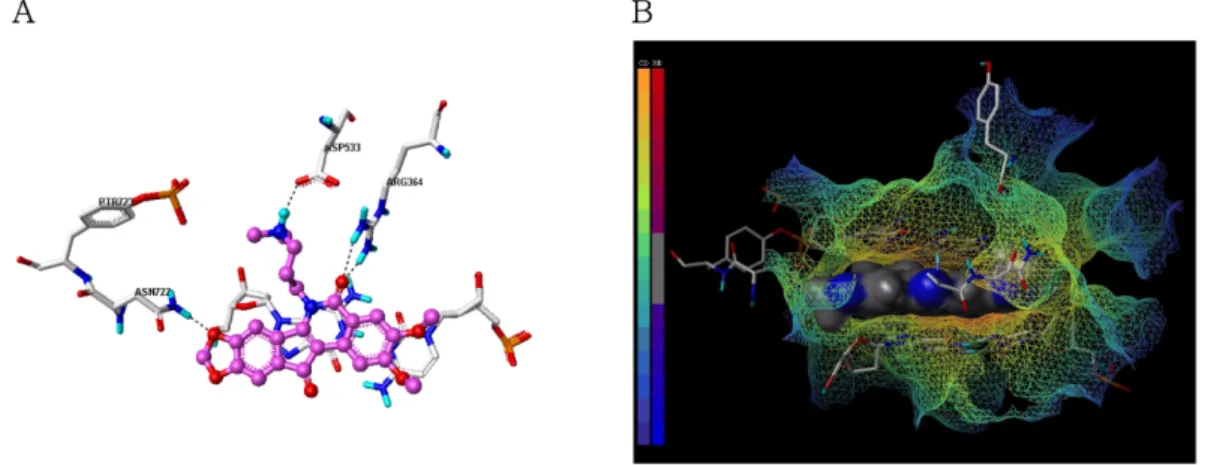
고그구조에제거한리간드를 docking하였다. 원래결정구조 에 docking한결과모두리간드가 DNA 염기와 stacking 상호작 용을했고, intercalative mode로결합하였다. RMSD는 1.48 Å으
로 Surflex-Dock의좋은재현성을확인하였다(Fig. 2).
Topo I-DNA절개가능복합체와indenoisoquinoline유도체의 docking결과분석
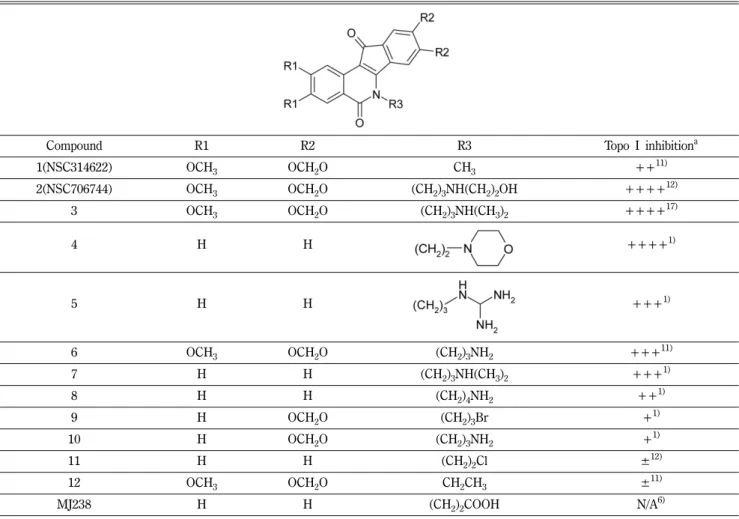
Docking에사용한 indenoisoquinoline 유도체의구조와그 Topo I 저해활성값을 Table I에나타내었다. NSC314622를기준으로
하여 ++는 NSC314622와유사한활성을보이는것이고, +++, ++++는 NSC314622보다높은활성을나타내는것이며, +, ±
는 NSC314622보다약한활성이거나활성이없는것이다.
NSC314622의docking결과 −Docking 결과 NSC314622는
DNA의끊어진가닥의 +1/-1 염기(G11/T10) 사이에 intercalative mode로위치하였으며 methylenedioxy기가있는 D 환은끊어진
가닥에향해있고 dimethoxy기가있는 A 환은끊어지지않은가 닥으로향하였다.
NSC314622와 Arg364, Asn722사이의수소결합은 Topo I을저
해하는중요한상호작용으로생각된다(Fig. 3). Arg364는 CPT
내성에관여하는잔기로 CPT와비슷한작용기전을가지는 Topo I 저해제와도중요한결합을할것으로예상되며, Asn722를 Ser
으로 mutation하여약물내성을시험해보았을때 CPT와마찬 가지로 NSC314622도또한교차내성(cross-resistance) 현상을
나타내었다.10)
NSC314622보다높은활성을갖는화합물의docking결과 −
NSC314622보다활성이좋은화합물은공통적으로 DNA의 +1/
-1 염기(G11-T10) 사이에서염기쌍과평행하게 intercalative mode
결합을하였으며인접한 Topo I 잔기들과수소결합을이루었다.
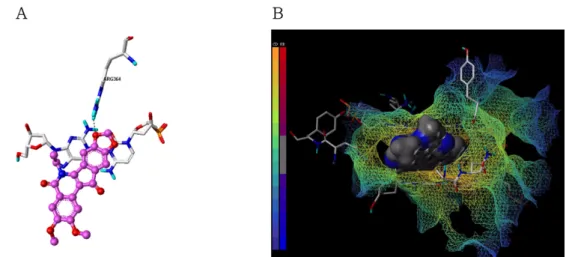
NSC314622, compound 3, 6, 8은 N6 치환기가 minor groove의
빈공간으로향하고있는데, 빈공간이 N6 치환기들이들어갈정 도로충분하고주위의 Topo I이나 DNA 잔기들과상호작용이가 능하기때문에모핵의염기쌍사이에서의 stacking 상호작용을
방해하지않는다는전제하에, 유의한결합양상으로판단되었다.
모두 Arg364와 수소결합을 형성하고 있었고 A, D 환에
dimethoxy기, methylenedioxy기가치환된화합물들은공통적으
로 methylenedioxy기가결합되어있는 D 환이끊어진가닥방 향으로향하여 Asn722와수소결합을형성하였다. 이는 meth- ylenedioxy기가 dimethoxy기에비해입체장애를덜일으키기때
문인것으로보여졌다. A, D 환에치환기가없는구조들은모핵
환의 stacking 상호작용을통한 intercalative mode에의존하고
Fig. 2 −Docking result of MJ238 into Topo I-DNA cleavable complex. A, binding interactions of the crystal ligand MJ238 and its docked conformation at the active site; B, side view of the active site in the presence of the crystal ligand MJ238 and its docked conformation.
Active site generated by Connolly surface and colored by electrostatic potential. The crystal ligand MJ238 is illustrated in capped stick, and its docked conformation is in ball and stick. Carbon atoms in the crystal ligand MJ238 are in green, and those in the docked conformation are in magenta. All hydrogen atoms are in cyan. Hydrogen bonds are displayed as green dashed lines in the crystal ligand MJ238 and as black dashed lines in the docked conformation, and the participating residues are marked.
Table I −Structures of indenoisoquinoline analogues and their inhibitory activity on human Topo I-DNA cleavable complex
Compound R1 R2 R3 Topo I inhibitiona
1(NSC314622) OCH3 OCH2O CH3 ++11)
2(NSC706744) OCH3 OCH2O (CH2)3NH(CH2)2OH ++++12)
3 OCH3 OCH2O (CH2)3NH(CH3)2 ++++17)
4 H H ++++1)
5 H H +++1)
6 OCH3 OCH2O (CH2)3NH2 +++11)
7 H H (CH2)3NH(CH3)2 +++1)
8 H H (CH2)4NH2 ++1)
9 H OCH2O (CH2)3Br +1)
10 H OCH2O (CH2)3NH2 +1)
11 H H (CH2)2Cl ±12)
12 OCH3 OCH2O CH2CH3 ±11)
MJ238 H H (CH2)2COOH N/A6)
aThe compounds were tested at concentration ranging up to 10µM. The activity of the compounds to produce Topo I-mediated DNA cleavage was expressed semiquantitatively as follows: +: weak activity; ++: similar activity as NSC314622; +++ and ++++:
greater activity than NSC314622.
있고 N6 alkylamino group 치환기의추가적인상호작용으로삼 성분복합체의안정화를유지한다고추정되었다(Fig. 4).
NSC314622보다낮은활성을갖는화합물의docking결과 −
NSC314622보다활성이좋지않은화합물은공통적으로 DNA
염기사이에 intercalative mode로결합을못하거나불안정하게
한것으로나타났다. 모핵의일부분만이 DNA 염기위에있거나 DNA 염기와평행을이루지못해서 stacking 상호작용을형성하 지못하였다.
Compound 9, 10은경우 D 환에만 methylenedioxy기가치환 되어있는형태이고, compound 11은 A, D 환양쪽에모두치 환기가없다. 이로인해 stacking 상호작용이약해지고활성부
위잔기들과의수소결합이줄어듦과함께 R3의치환기가수소 결합을 이루지 않거나, 적절하지 않은 수소결합을 이루어 intercalating mode를이루지못했다. Compound 12는 A, D 환
에각각 dimethoxy기와 methylenedioxy기가치환되어있으나
R3의 ethyl기가모핵의 stacking을방해하여역시 intercalating mode를만족시키지못하였다(Fig. 5).
결 론
본 연구에서는 non-camptothecin 계열의 Topo-I 저해제인
indenoisoquinoline 유도체들을인간 Topo I-DNA 절개가능복합
Fig. 3 −Docking result of compound 1 into human Topo I-DNA cleavable complex. A, binding interactions of compound 1 at the active site.
Compound 1 is illustrated in ball and stick, protein and DNA are in capped stick. Carbon atoms in compound 1 are in magenta.
Hydrogen bonds are displayed as black dashed lines, and the participating residues are marked; B, side view of the active site in the presence of the docked compound 1. Multi-channel MOLCAD surface (Connolly) was generated for the protein and DNA and colored by cavity depth, where the deepest cavity of the hydrophobic pocket is in orange. MOLCAD surface (van der Waals) was generated for compound 1, where the hydrogen donor is in red and the hydrogen accepter is in blue.
Fig. 4 −Docking result of compound 3 into human Topo I-DNA cleavable complex. A, binding interactions of compound 3 at the active site.
Compound 3 is illustrated in ball and stick, protein and DNA are in capped stick. Carbon atoms in compound 3 are in magenta.
Hydrogen bonds are displayed as black dashed lines, and the participating residues are marked; B, side view of the active site in the presence of the docked compound 3. Multi-channel MOLCAD surface (Connolly) was generated for the protein and DNA and colored by cavity depth where the deepest cavity of the hydrophobic pocket is in orange. MOLCAD surface (van der Waals) was generated for compound 3, where the hydrogen donor is in red and the hydrogen accepter is in blue.
체인 1SC7.pdb에 docking하여결합양상을분석하였다. Indeno- isoquinoline 유도체들을선도화합물인 NSC314622보다활성이 더좋은화합물과좋지않은화합물로분류하여분석한결과, NSC314622보다활성이좋은화합물들은대부분 DNA 염기사
이에 intercalative mode로결합하는것으로나타났다. 몇몇화 합물들은모핵의 N6의위치가 X-선결정구조와달리 minor
groove로 향해 있었으나 모핵 환이 DNA 염기 사이에서
intercalative mode로결합하고주위의아미노산들및 DNA와수 소결합을형성하고있어타당한 결합양상으로판단되었다. NSC314622보다 활성이 좋지 않은 화합물들은 intercalative mode로결합하지못하거나수소결합형성에실패하였다. R1, R2
모두에각각 dimethoxy기와 methylenedioxy기가치환된경우 stacking과수소결합을통해 intercalative mode를잘형성하고 R1,
R2에치환기가없을경우에도 R3의치환기가적절할경우모핵
의 stacking과 R3의수소결합만으로 intercalating mode를안정시
켜주고, R1, R2에치환기가없고 R3의치환기도적절하지못할 경우 intercalating mode를유지하지못하는것으로나타났다.
이상의결과로부터결합양상과 Topo I 활성저해효과사이에
밀접한상관관계가있음을발견하였고 docking 연구에서제시된 결합양상은새로운 non-CPT 약물을개발하는데에구조적정보
를제공하여 Topo I을표적으로하는항암제개발에기여할수
있을것으로판단된다.
감사의 말씀
본연구는 2단계두뇌한국 21 사업, 이화여자대학교세포신호
전달계바이오의약연구센터를통한교육과학기술부/한국과학재
단국가핵심연구센터, 한국학술진흥재단(No. KRF-2005-005- J01501), 이화여자대학교 Research Grant of 2006의지원으로
수행되었습니다.
참고문헌
1) Cushman, M., Jayaraman, M., Vroman, J. A., Fukunaga, A. K., Fox, B. M., Kohlhagen, G., Strumberg, D. and Pommier, Y. : Synthesis of new indeno[1,2-c]isoquinolines: cytotoxic non- camptothecin topoisomerase I inhibitors. J. Med. Chem. 43, 3688 (2000).
2) Chrencik, J. E., Staker, B. L., Burgin, A. B., Pourquier, P., Pommier, Y., Stewart, L. and Redinbo, M. R. : Mechanisms of camptothecin resistance by human topoisomerase I mutations.
J. Mol. Biol. 339, 773 (2004).
3) Staker, B. L., Hjerrild, K., Feese, M. D., Behnke, C. A., Burgin, A. B., Jr. and Stewart, L. : The mechanism of topoisomerase I poisoning by a camptothecin analog. Proceedings of the National Academy of Sciences of the United States of America 99, 15387 (2002).
4) Krogh, B. O. and Shuman, S. : Catalytic mechanism of DNA topoisomerase IB. Mol. Cell 5, 1035 (2000).
5) Liu, L. F., Desai, S. D., Li, T. K., Mao, Y., Sun, M. and Sim, S. P. : Mechanism of action of camptothecin. Annals of the New York Academy of Sciences 922, 1 (2000).
6) Staker, B. L., Feese, M. D., Cushman, M., Pommier, Y., Zembower, D., Stewart, L. and Burgin, A. B. : Structures of
Fig. 5 −Docking result of compound 12 into human Topo I-DNA cleavable complex. A, binding interactions of compound 12 at the active site.
Compound 12 is illustrated in ball and stick, protein and DNA are in capped stick. Carbon atoms in compound 12 are in magenta.
Hydrogen bonds are displayed as black dashed lines, and the participating residues are marked; B, side view of the active site in the presence of the docked compound 12. Multi-channel MOLCAD surface (Connolly) was generated for the protein and DNA and colored by cavity depth, where the deepest cavity of the hydrophobic pocket is in orange. MOLCAD surface (van der Waals) was generated for compound 12, where the hydrogen donor is in red and the hydrogen accepter is in blue.
three classes of anticancer agents bound to the human topoisomerase I-DNA covalent complex. J. Med. Chem. 48, 2336 (2005).
7) Burke, T. G. and Bom, D. : Camptothecin design and delivery approaches for elevating anti-topoisomerase I activities in vivo.
Ann. N. Y. Acad. Sci. 922, 36 (2000).
8) Brangi, M., Litman, T., Ciotti, M., Nishiyama, K., Kohlhagen, G., Takimoto, C., Robey, R., Pommier, Y., Fojo, T. and Bates, S. E. : Camptothecin resistance: role of the ATP-binding cassette (ABC), mitoxantrone-resistance half-transporter (MXR), and potential for glucuronidation in MXR-expressing cells. Cancer Research 59, 5938 (1999).
9) Pommier, Y. : Topoisomerase I inhibitors: camptothecins and beyond. Nature Reviews 6, 789 (2006).
10) Kohlhagen, G., Paull, K. D., Cushman, M., Nagafuji, P. and Pommier, Y. : Protein-linked DNA strand breaks induced by NSC 314622, a novel noncamptothecin topoisomerase I poison. Molecular Pharmacology 54, 50 (1998).
11) Fox, B. M., Xiao, X., Antony, S., Kohlhagen, G., Pommier, Y., Staker, B. L., Stewart, L. and Cushman, M. : Design, synthesis, and biological evaluation of cytotoxic 11-alkenylindenoiso- quinoline topoisomerase I inhibitors and indenoisoquinoline- camptothecin hybrids. J. Med. Chem. 46, 3275 (2003).
12) Pommier, Y. : Eukaryotic DNA topoisomerase I: genome gatekeeper and its intruders, camptothecins. Seminars in Oncology 23, 3 (1996).
13) Marchand, C., Antony, S., Kohn, K. W., Cushman, M., Ioanoviciu, A., Staker, B. L., Burgin, A. B., Stewart, L. and Pommier, Y. : A novel norindenoisoquinoline structure reveals a common interfacial inhibitor paradigm for ternary trapping of the topoisomerase I-DNA covalent complex. Mol. Cancer. Ther.
5, 287 (2006).
14) Jain, A. N. : Surflex: fully automatic flexible molecular docking using a molecular similarity-based search engine. J. Med.
Chem. 46, 499 (2003).
15) Jain, A. N. : Surflex-Dock 2.1: Robust performance from ligand energetic modeling, ring flexibility, and knowledge-based search. J. Comput. Aided Mol. Des. 21, 281 (2007).
16) Jones, G., Willett, P., Glen, R. C., Leach, A. R. and Taylor, R. : Development and validation of a genetic algorithm for flexible docking. J. Mol. Biol. 267, 727 (1997).
17) Strumberg, D., Pommier, Y., Paull, K., Jayaraman, M., Nagafuji, P. and Cushman, M. : Synthesis of cytotoxic indenoiso- quinoline topoisomerase I poisons. J. Med. Chem. 42, 446 (1999).