접착 및 계면 제
7
권 제4
호, 2006
년Journal of Adhesion and Interface Vol.7, No.4, 2006
24
Manual Application of Adhesives
Mark Hellmanns
†, Stefan Böhm, and Klaus Dilger
Institute of Joining and Welding, Technical University Braunschweig, 38106 Braunschweig, Germany (Received November 3, 2006; Accepted November 21, 2006)
Abstract: International standards claim the best possible reliability in industrial manufacturing processes.
This is also essential for the application with manual applicators. The application of adhesives with manual applicators is one of the most frequently used application techniques. The range of application reaches from the building of prototypes in the automobile industry over the use in single or small-batch manufacturing up to applications in crafts enterprises. Conventional manual applicators for adhesives and sealants don’t fulfill the demands in international standards for the best possible reliability. Only the worker is able to control the quality and the quantity of the bond. A velocity-controlled manual applicator solves these restrictions. Special sensors and micro controllers calculate the flow-rate, the velocity and the location of the manual applicator. This leads to stable and repeatable application processes which are claimed in international standards. The location of the bond can be compared with the nominal value, so that it is possible to check the quality of the bond during application. Furthermore there is the potential to document the data of the manufacturing process.
Keywords: manual applicator, adhesive bonding, velocity control, standard, prototypes, single manu- facturing, small batch manufacturing, tracking
1. Introduction
1)
The application of adhesives with manual applicators is one of the most frequently used application techni- ques. Below some examples of the wide range of appli- cation with a manual applicator:
∙Building of prototypes
∙Single or small-batch manufacturing ∙Railway vehicle construction ∙Aircraft construction
∙Aerofoil fuel tanks ∙Craft-enterprises
Specific know-how is necessary in order to ensure high quality standards. Adhesive bonding is used more and more in order to manufacture structural parts.
Defects of fabrication cause errors in structure. Therefore the process of manufacture is safety relevant. Using manual applicators only the worker is able to control the quantity and location of the adhesives and sealants. For this reason only trained and experienced workers are able to accomplish an approximately constant adhesive
†
Corresponding author: e-mail: [email protected]
application. With changing the type of adhesive further problems can occur. Fabrication reliability will get more important under the factor, that there is no industrial method available which can check bonds online.
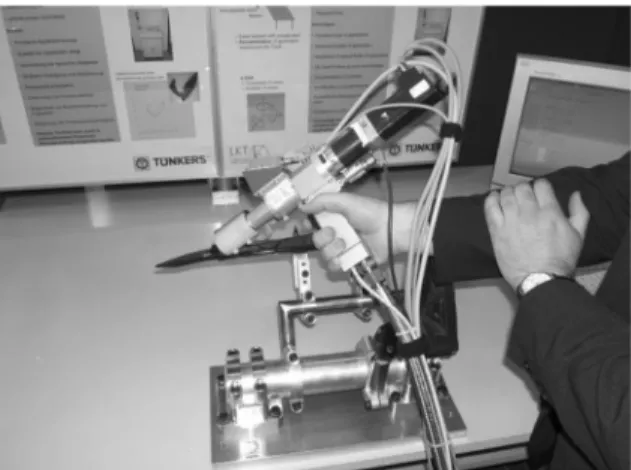
In this paper the advantages of a velocity-controlled manual applicators are presented. Special sensors and micro controllers calculate the flow-rate, the velocity and the location of the manual applicator. This applicator controls the quality of the bond. Even the location of the bond can be compared with the nominal value, so that it is possible to check the quality of the structural part during application. Some assembly parts require dif- ferent thicknesses of the glueline. The velocity controlled applicator is able to offer the proper thickness at any location. So the quality of the manual application of ad- hesives and sealants becomes much better and more safety. Additionally station times can be reduced.
The requirements in the context of the DIN ISO
900X, intended for a modern production result in a sit-
uation, where manufacturing conditions in companies
must be established, which have as high manufacturing
reliability as possible. Economical and high-quality prod-
ucts can only be obtained in a process under stable and
Manual Application of Adhesives
25
Journal of Adhesion and Interface Vol.7, No.4 2006 Figure 1. Manual application.
Figure 2. Function of a rotary positive-displacement pump, source: Netzsch.
safe manufacturing conditions.
Unfortunately, still numerous working environments may be found today during the processing of adhesives, which do not fulfill the demands of a modern produc- tion. Above all, the dosing process still produces large
Figure 3. Control enclosure.
problems for numerous users. This leads partially to the fact that other (more controllable) joining techniques are used, which under technical aspects are less qualified than adhesive bonding. In the case of longer distances of application (e.g. adhesively bonding of side elements in the rail and commercial motor vehicles industry) fur- ther substantial fluctuations in the adhesive flow can oc- cur, which can’t be detected optically without further aids. For this reason a control system was developed for the manual application of adhesives, which is able to detect short- and longtime changes of movement and compensates them. This contributes an increase of appli- cation quality. Such a control system makes a substantial contribution to a more stable and better manual applica- tion process.
2. Velocity Controlled Manual Applicator
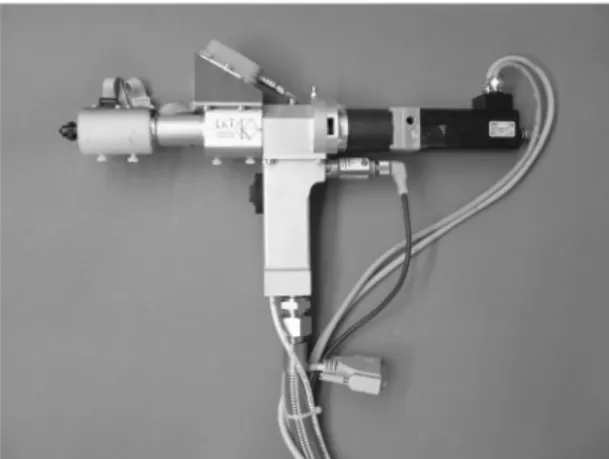
A system of sensors in combination with micro-
controllers acquires the flow-rate, the velocity and loca-
tion of the manual applicator. An actuating variable is
created through the computed velocity and the set point
of the desired thickness of the glue line. This actuating
variable controls a very fast application unit with a pro-
portional characteristic. A rotary positive-displacement
pump features these attributes. These properties of the
control path ensure a sufficiently fast answer of the ap-
plication unit on changes of velocity.
26
Mark Hellmanns, Stefan Böhm, and Klaus Dilger접착 및 계면 제 7 권 제 4 호 , 2006 년 Figure 4. Manual applicator.
Figure 5. Configuration.
The principle of the rotary positive-displacement pump arranges an uniform proportioning of adhesives different kinds of type. Viscosity, composition and fillers don’t affect the adhesive sealing.
The cognition of the velocity and a fast controller prevent the typical batch faults like underdose, overdose or contractions. Adhesive is delivered only if the appli- cation unit is in motion. This effects the omission of beginning and ending blots. A velocity controlled manual applicator prevents most of the typical batch faults.
Additionally such a system is able to calculate the posi- tion of the applicator. This attribute opens up new po- tentials in quality assurance.
A rating-adhesive sealing OK or not OK-an be given during application or immediately after. This allows a postprocessing of inaccurate assembly parts and prevents rejections. The glue line thickness can be changed auto- matically, if an assembly part expects different sizes.
Conventional manual applicators offer a constant flow-
Figure 6. Typical batch faults.
Figure 7. Tracking.
rate. This size depends of the speed of the worker.
Using a velocity controlled applicator station times will be decreased. A reduction of expenses of the whole application process will be the result.
Current international standards claim the documentation of manufacturing processes. Such a velocity controlled manual applicator fulfills this claim. Data of the location and thickness of the glue line can be stored in a file.
Additional comments like detected failures, deflections or postprocess actions can be added.
These features of the sensor technology of the veloc-
ity controlled manual applicator are transferable to the
automated, non manual adhesive bonding processes. An
automation machine, which is equipped with this tech-
nology, has the same possibilities of documentation. Ex-
pensive and fault-prone optical systems with image rec-
ognition like cameras aren't needed any longer.
Manual Application of Adhesives