시효처리 후의 컴포지트에 대한 레진 컴포지트의 미세 인장 결합강도에 표면처리가 미치는 효과
전북대학교 치과대학 보존학 교실 유민진․허미자․김희량․유미경․이광원
이전에 존재하던 컴포지트와 새로운 컴포지트 사이의 결합강도의 강화는 미세 기계적 유지를 증진하기 위한 표면 거칠기의 증가가 필요하다. 이 연구는 시효처리 후의 레진 컴포지트의 repair 결합강도에 다른 표면처리의 효과를 평가하는 것이다. 알루미늄 옥사이드를 이용한 air abrasion, chair-side silica coating한 그룹들에서 대조군과 불산 적용에 비하여 유의하게 높은 결합강도를 보였다. 레진 수복물의 repair시에 air abrasion의 사용은 필요한 것 으로 보이며 부가적으로 silane의 적용은 결합강도에 긍정적 영향을 미치는 것으로 보인다.
주요어: 표면처리, air abrasion, silane (구강회복응용과학지 2010:26(3):339~347)
서 론
컴포지트 레진의 물리적 기계적 특성들이 많 이 개선되었지만 마모, 변색, 중합수축, 미세누출 이 컴포지트 수복물의 수명을 제한한다.1-3) 컴포 지트 수복물의 실패는 임상적 상황에서 일어날 수 있고 수복물의 교체 혹은 repair를 필요로 한 다. 파절되거나 변색된 손상된 레진 수복물의 완 전한 제거가 바람직하지 않을 수 있는데 특히 수 복물이 치수 가까이 있거나. 크다면 더욱 그러하 다.1,4)손상된 수복물의 repair는 건전한 치아구조 를 보존할 수 있고 비용과 chair-side time을 줄인 다는 면에서 선택되어진다.1,5)
그러나 기존에 존재하던 레진에 새로운 레진 의 repair는 결합강도 증진 면에서 어려운 일일
교신 저자 : 이광원
전북대학교 치과대학 보존학 교실
561-756, 전북 전주시 덕진구 덕진동 1가 664-14, 대한민국, Fax:+82-063-250-2129, E-mail: [email protected]
원고접수일: 2010년 06월 05일, 원고수정일: 2010년 08월 21일, 원고채택일: 2010년 09월 25일
수 있다.6-8) 구강 내에서 컴포지트는 레진 상을 통한 확산에 의해 물을 흡수하고 레진과 필러 입 자 사이 계면을 통해 물을 흡수한다. 이는 노화 된 컴포지트에 새로운 컴포지트가 접착하는 능 력에 영향을 미친다. 레진 표면의 미반응 methacrylate group이 시간이 지남에 따라 감소하 고 레진을 polishing하는 기구조작은 반응성 그룹 의 감소와 inorganic filler의 감소를 촉진하기 때 문이다.1,6)
이전에 존재하던 컴포지트와 새로운 컴포지트 사이의 결합강도의 강화는 표면 거칠기의 증가 가 필요하다. 표면 거칠기는 다른 컴포지트 사이 의 미세 기계적 유지를 촉진하여 물질의 접착능 력을 개선하는 일반적인 특징이다. Shoderholm과 Roberts는 표면 abrasion이 컴포지트 repair에서 가
장 중요한 요소라고 주장한다.1)알루미늄 옥사이 드로 air abrasion하여 표면을 거칠게 하는 것은 결합할 표면적을 증가시키고 표면장력은 감소시 키게 된다.6,9) 실리카 코팅에 의한 air abrasion은 blasting pressure가 실리카 입자를 표면에 박히게 하여 레진이 실란을 통하여 더욱 화학적으로 잘 반응하게 한다.6.9) 또한 불산의 사용이 미세인장 결합강도를 증진시킨다는 여러 연구들이 있지만 이 효과가 적용되는 컴포지트에 따라 다양하다 는 의견들이 존재한다.1.10.11)
그러므로 이 연구에서는 aging condition 후의 repair 결합강도에 여러 표면 처리의 효과에 대해 평가하고자 한다.
연구재료 및 방법 1. 레진 시편 준비
25개의 레진 블록은 5×5×7mm의 크기로 FiltekTM Z250(3M ESPE), shade :A1를 이용하여 실리콘 주형으로 제작 후에 40초간 광중합 하였 다. aging procedure로 thermocycling 3000 cycle 시 행하였다.( 5-55℃ dwell time :30s) 레진 블록은 5 개의 임의의 그룹(n=5)로 나누어서 서로 다른 표 면처리를 시행하였다. air abrasion은 구강 내 sandblasting 장치인 Microetcher (Danville, Cailif) 을 사용하였고 sand로는 50μm Al2O3와 30μm Cojet sand (silica modified Al2O3)가 사용되었다.
그룹 1 : 표면처리를 시행하지 않았다.(대조 그 룹).
그룹 2 : 4% 불산 젤로 60초간 적용 후 2분간 air-water syringe로 수세하였다.
그룹 3 : 50μm 알루미늄 옥사이드로 4초간 air abrasion 하고(Microetcher, Danville) 부드럽게 air blown 시행하였다.
그룹 4 : 30μm Cojet sand (3M ESPE)로 4초간 air abrasion하고(Microetcher, Danville) 부드럽게 air blown 시행하였다.
그룹 5: 30μm Cojet sand (3M ESPE)로 4초간 air
abrasion하고(Microetcher, Danville) 부드럽게 air blown 시행 후 5분간 silane (Monobond-S, Vivadent, Liechtenstein)적용 하였다.
처리된 표면에 bonding agent (All bond 2,Bisco, Itasca, Ill)적용 후 20 초간 광중합하였다.
그 위에 새로운 레진 FiltekTMZ250을 전의 레진 과 색조 차이가 두드러지게 하기 위하여 shade C2 를 이용하여 쌓아 올린 후 40초간 광중합 하였다.
2. 미세인장 결합강도 측정
모든 레진 블록을 24시간 동안 37℃ 증류수에 보관하였다. 각각의 레진 블록은 low speed diamond saw (Isomet, Buehler Ltd., Lake Bluff, IL, USA)를 이용하여 1 mm 두께로 잘랐고 그리하여 sample stick이 횡단면이 1mm2가 되게 하였 다.(Fig. 1). 각 시편의 정확한 크기는 0.01mm의 눈금 측정이 가능한 digital micrometer(Mitutoyo corp., Japan) 을 이용하여 주의깊게 측정하였다.
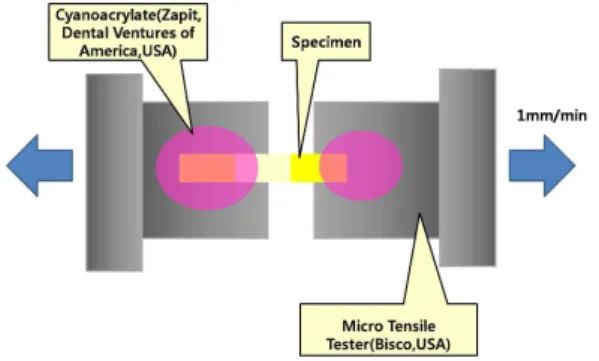
미세인장 결합강도 측정을 위해 각 시편을 cyanoacrylate cement(Zapit; Dental Ventures of America, Corona, CA)를 이용해 미세인장 결합강 도 측정기(Micro Tensile Tester; Bisco, USA)에 고 정시켰다(Fig. 2). 1 mm/min의 속도로 인장력을 가하여 파절된 시점의 maximum load를 기록하였 고, 이를 시편의 단면적으로 나누어 인장강도를 MPa로 환산하였다.
Fig. 1. 시편의 제작
3. 통계 분석
결과는 SPSS 12.0 프로그램을 이용해 평균과 표준편차를 계산하였고, one- way ANOVA와 Tukey post hoc test를 통하여 분석하였다(p<0.05).
4. Failure Mode 분석
미세인장 결합강도 측정 후, 각 그룹의 모든 시편에 대하여 파절 양상을 5배 확대율의 Loupe (MP244L)를 이용하여 다음과 같이 구분하였다;
“Interfacial”, 접착계면에서 파절이 일어난 경우 로 일부 old 레진 또는 new 레진이 계면에 부착 된 경우도 포함; “Resin”, 레진 내에서의 cohesive 파절
Fig. 2. 미세인장 결합강도 측정의 도식
Group Surface treatment Mean±SD
Group 1 Control 45.48±6.09
Group 2 4% HF 44.09±3.33
Group 3 50μm Al2O3 54.52±7.66*
Group 4 30μm Co jet 52.01±3.85*
Group 5 30μm Co jet +silane 61.75±4.90*
*Significance at the level of p<0.05
Table I. 표면처리에 따른 미세인장 결합강도 (Mean±SD).
5. Scanning electron microscope (SEM) 관찰 각각의 표면처리에 따른 레진 표면의 변화를 알아보기 위하여 각각의 그룹과 똑같은 실험적 과정을 거친 별도의 레진 블록을 준비하였다. 레 진 블록을 100%알콜에 48시간 저장후 완전 건조 시켰다. gold coating하여 SEM(JSM 6400; JEOL, Tokyo, Japan) 상을 관찰하였다.
결 과
1. 미세인장 결합강도
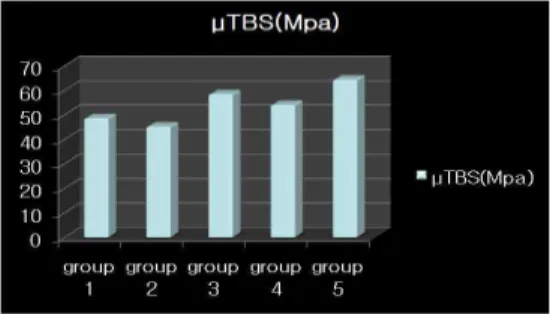
각 그룹의 미세인장 결합강도의 평균과 표준 편차를 Table I과 Fig. 3에 제시하였다. 알루미늄 옥사이드로 air abrasion한 그룹과 silica coating한 그룹인 그룹 3,4,5가 대조군에 비해 유의하게 높 은 결합강도를 보였다. 그 중에서도 30μm Cojet sand로 sandblasting하고 silane 처리한 것이 가장 높은 결합강도를 보였다.
2. Failure Mode
모든 그룹에서 “Interfacial” 파절이 대부분 (98.0%)을 차지하였다(Table Ⅱ). “Resin” 파절은 Al2O3그룹(1%)과 Cojet+silane그룹(1%)에서 소수 나타났다.
Fig. 3. 표면처리에 따른 미세인장 결합강도의 비교
Control 4% HF Al2O3 Cojet Cojet+silane
Interfacial 20 20 19 20 19
Resin 0 0 1 0 1
Total 20 20 20 20 20
Table Ⅱ. Interfacial and Resin failures
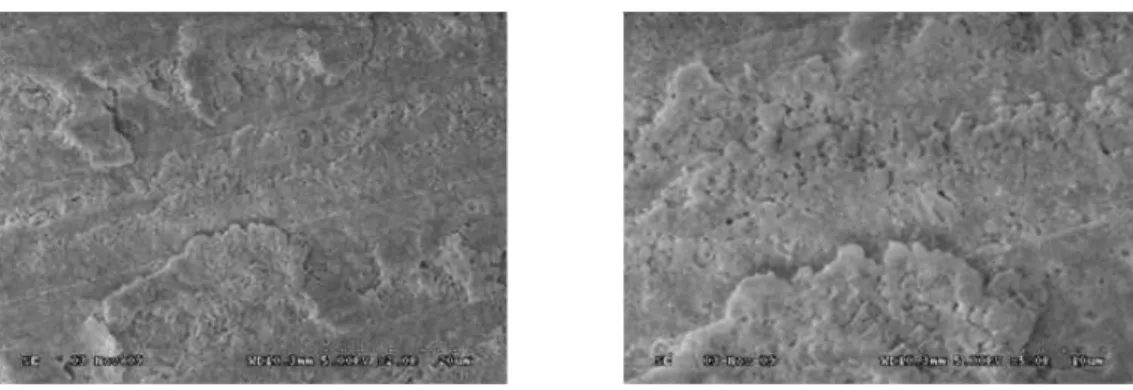
Fig. 4. Control group(2K)(5K). 비교적 매끄러운 레진 표면을 보이고 있다.
Fig. 5. 4%불산 60초 적용(2K)(5K). 다공성의 불규칙한 표면을 보이고 있다.
3. SEM 관찰
시편 관찰은 2,000배와 5,000배의 SEM 하에서 표면처리한 레진면을 관찰하였다.(Fig. 4-8).
SEM 관찰 결과 대조군은 매끄러운 표면, 불산을 처리한 그룹은 다공성의 불규칙한 표면, air abrasion한 그룹들은 거친 고른 표면을 나타내었다.
Fig. 6. 50μm Al2O3 4초(2K)(5K). 표면에 많은sand particle과 비교적 고른 거친 표면을 나타내고 있다.
Fig. 7. 30μm Cojet sand 4초(2K)(5K). 많은 양의 sand particle과 고른 거친 표면을 나타내고 있다.
Fig. 8. 30μm Cojet sand 4초+silane 5분(2K)(5K).다른 air abrasion과 비슷한 양상의 거친 표면을 보인다.
총괄 및 고안
최근 10~20년간 물리적,기계적 특성이 많이 개 선되었지만 구강내에 존재하는 효소는 컴포지트 를 변화시킬 수 있다.12-15) 게다가 컴포지트는 용 액에 덜 안정적이고 그들의 변성율은 타액 자극 상태에서 높다. 또한 피로가 컴포지트의 마모과 정을 촉진할 수 있다. 변색, 변성, 미세누출, 마 모, 변연에서의 ditching, 파절이 임상 상황에서 일어날 수 있고 수복물의 repair 또는 교체가 필 요하게 된다.16-20)완전한 제거 대신에 repair는 치 아 구조를 보존할 수 있는데 완전한 제거시에는 치아의 건전한 부분의 제거없이 접착 수복물만 을 제거하는 것이 어렵기 때문이다. 21,22)
컴포지트의 정상적인 적용과정 동안 컴포지트 의 두 번째 층을 첨가할 때 첫 번째 층의 표면에 는 oxygen inhibition의 결과 상대적으로 높은 비 율의 미중합 -c=c 결합이 존재하고 교차 중합을 쉽게한다.23,24,25)임상적으로 두 개의 컴포지트 층 사이의 결합은 미중합 레진의 oxygen inhibited layer의 존재로 얻어진다. 만약 이 표면이 제거된 다면 다음 컴포지트 층의 결합은 유의하게 감소
한다.23,26) 노화된 수복물들은 미중합층을 포함하
지 않는다. 그러므로 수복물의 노화는 컴포지트 repair에서 중요한 요소이다. 컴포지트의 aging process를 묘사하기 위해 thermocycling과 수분 용 매 또는 citric acid에 저장하는 방법이 소개되었
다.1,27)이 연구에서는 thermocycling을 사용하였다.
성공적인 컴포지트 레진의 repair는 이전에 존 재하던 레진과 새로운 컴포지트 레진 사이의 적 절한 계면 결합을 필요로 한다. 많은 표면처리 방법의 repair 결합강도를 개선하기 위해 제안되 어져 왔는데 이는 roughening, 인산, 불산으로의 식각, air-borne particle abrasion 또는 adhesive resin으로 표면처리하는 것이다.1,5,10)
이 연구에서 알루미늄 옥사이드를 이용한 air abrasion과 chairside silica coating, silane의 적용은 대조군과 불산적용에 비하여 높은 결합강도를 보였다.(p<0.05) 그 중에서도 silica 입자로의 air
abrasion 후에 silane의 적용이 가장 높은 결합강 도를 보였다. 각 시편의 파절 양상은 "Interfacial"
파절이 가장 많았다.
sandblasting이란 매우 작은 조각의 입자가 높 은 속도로 추진하는 작용에 의해 표면을 깨끗이 하거나 etching하는 작용을 말한다. 알루미늄 옥 사이드로 air abrasion하여 표면을 거칠게 하는 것 은 결합할 표면적을 증가시키고 표면장력은 감 소시키게 된다.6,7) silica 코팅에 의한 air abrasion 은 blasting pressure가 실리카 입자를 표면에 박히 게 하여 레진이 실란을 통하여 더욱 화학적으로 잘 반응하게 한다.28,29) 표면에 알루미나 혹은 silica 입자는 표면 hydroxyl 그룹과 silane의 silanol 그룹의 공유결합을 통해 충분히 강한 화 학적 결합을 이룰 수 있다고 예상할 수 있다.12) silica 코팅의 접착의 기전은 tribochemistry라는 기계적 에너지를 이용하여 화학적 결합을 생성하 는 것으로 이들 에너지는 문지르기나 blasting을 통해 공급되어질 수 있다. silica로 modified된 30 마이크로미터 크기의 입자는 충격 에너지에 의한 큰 에너지로 표면을 강타하면 silicated가 이루어 질 수 있다. 과정동안 abrasive의 blasting 구성물질 은 15마이크로미터 깊이로 금속에 박히게 된다.
surface morphology를 빠르고 간편하게 분석할 수 있는 방법으로써 scanning electron microscope (SEM)을 이용할 수 있고30) 이 연구에서는 각 표 면처리에 따른 변화를 알아보기 위하여 각각의 그룹과 똑같은 실험 과정을 거친 별도의 시편을 준비하였다. SEM 관찰 결과 air abrasion한 그룹 들에서 표면에 많은 양의 sand particle과 비교적 고른 거친 표면을 나타낸데 비하여 불산을 적용 한 그룹은 다공성의 불규칙한 표면을 보였다. 불 산이 컴포지트의 결합을 위한 컴포지트 표면 거 칠기에 효과적이라고 발견되어졌지만 불산으로 식각하는 것이 어떤 컴포지트에는 적절한 결합 을 형성하지 않는다. 이 연구의 결과 불산 젤로 의 conditioning은 다른 방법들과 비교하여 낮은 repair 강도를 나타냄으로써 레진의 형태학적 특 징에 불리한 영향을 미친 것으로 나타났다.31,32)
보통 무기필러는 소수성 레진 기질과 친수성 필러 입자 사이의 계면을 형성하는 silane coupling agent에 의해 polymer 기질 안에 합쳐져 있다. 일 반적으로 수화된 γ-MPS가 필러의 coupling agent 로 사용된다. 레진 기질이 불산 젤에 노출되었을 때 water monolayer가 필러의 void를 통해 침투하 고 이것이 필러와 레진 계면 안정화에 책임이 있 는 silane층을 파괴할 수 있다.12) 이 모든 기전이 입자-기질 계면을 약화시키고 필러 용해를 가져 온다. 이런 현상은 SEM 분석에서 불산에 노출된 후 필러의 큰 부분이 기질로부터 소실된 것이 관 찰되었다. 또한 불산의 사용은 연조직 화상의 위 험이 있으므로 구강내 적용시 주의깊게 사용해야 한다. 더욱이 불산의 효과는 적용되는 컴포지트 에 따라 다양한데 이들 효과는 무기필러의 함유 량, 크기, 종류와 관계있다고 보여진다.10,11) 그러 므로 불산은 일상적인 컴포지트 repair 치료에서 추천되지 않으며 특히 이전 컴포지트의 정확한 구성을 알지 못할 때 더욱 그러하다.4)
air abrasion 후에 silane의 적용은 결합강도의 증가를 가져왔다. 표면의 알루미나 또는 실리카 가 표면의 hydroxyl 그룹과 silane의 수화된 silanol 그룹과 강한 공유결합을 형성할 수 있다.
silane 처리는 또한 필러의 젖음성을 개선하여 표 면 에너지에 영향을 미치고 기질의 퍼짐을 강화 시킨다.12)
결 론
이 연구 결과에 기초하여, 레진 수복물 repair 의 미세인장 접착강도에서 표면처리가 미치는 영향에 대해 다음과 같은 결론을 내렸다.
1. 알루미늄 옥사이드를 이용한 air abrasion, chair-side silica coating한 그룹들에서 대조군 과 불산 적용에 비하여 유의하게 높은 결합강 도를 보였다.
2. 가장 높은 결합강도를 보인 것은 silica 입자로 의 air abrasion 후에 silane을 적용한 것이다.
3. 레진 수복물의 repair시에 air abrasion의 사용 은 필요한 것으로 보이며 부가적으로 silane의 적용은 결합강도에 긍정적 영향을 미치는 것 으로 보인다.
참 고 문 헌
1. Yesilyurt et al. Initial repair bond strength of a nano-filled hybrid resin : Effect of surface treatments and bonding agents. J Esthet Restor Dent 2009;21:
251-261
2. Gordan VV, Mjor IA, Blum IR, Wilson N. Teaching students the repair of resin based composite restorations: a survey of North American dental schools. J Am Dent Assoc 2003;134;317-23 3. Major IA, Moorhead JE, Dahl JE. Selection of
restorative materials in permanent teeth in general dental practice. Acta Odontol Scand 1999;57:257-62 4. Brosh T, Pilo R, Bichacho N, Blutstein R. Effect of combinations of surface treatments and bonding agents on the bond strength of repaired composites.
J Prosthet Dent 1997;77:122-6
5. Blum IR, Schriever A, Heidemann D, et al. The repair of direct composite restorations: an international survey of the teaching of operative techniques and materials. Eur J Dent Educ 2003;7:41-8
6. Ozcan M, Barbosa SH, Melo RM. Effect of surface conditioning methods on the microtensile bond strength of resin composite to composite after aging conditions. Den Mater 2007;23 1276-1282
7. Soderholm KJ, Roberts MJ, Variables influencing the repair strength of dental composites. Scand J Dent Res 1991;99:173-80
8. Frankenberger R, Kramer N, Ebert J. Fatigue behavior of the resin-resin bond of partially replaced resin- based composite restorations. Am J Dent 2003;16:
17-22
9. Guggenberger R. Rocatec system-adhesion by tribochemical coating. Dtsch Zahnnarztl Z. 1989;44:
874-6
10. Luccena-Martin C, Gonzalez-Lopez S, Navajas- Rodriguez de Mondelo JM. The effect of various
surface treatments and bonding agents on the repaired strength of heat-treated composites. J Prosthet Dent 2001;86:481-8
11. Swift EJ Jr, Cloe BC, Boyer DB. Effect of a silane coupling agent on composite repair strengths. Am J Dent 1994;7: 200-2
12. Ӧzcan M. Alander P, Vallittu K. Effect of three surface conditioning methods to improve bond strength of particulate filler resin composites.
Springer Science+ Business Media 2005
13. Larsen IB, Freund M, Munksgaard ECChange in surface hardness of BisGMA/TEGDMA polymer due to enzymatic action. J Dent Res. 1992 Nov;71(11):
1851-3
14. Söderholm KJ, Mukherjee R, Longmate J. Filler leachability of composites stored in distilled water or artificial saliva.J Dent Res. 1996 Sep;75(9):1692-9.
15. Sarrett DC, Coletti DP, Peluso AR. The effects of alcoholic beverages on composite wear. Dent Mater.
2000 Jan;16(1):62-7.
16. Mjör IA, Toffenetti F. Placement and replacement of resin-based composite restorations in Italy. Oper Dent. 1992 May-Jun;17(3):82-5.
17. Mjör IA, Um CM. Survey of amalgam and composite restorations in Korea. Int Dent J. 1993 Aug;43(4):
311-6.
18. Browning WD, Dennison JB. A survey of failure modes in composite resin restorations. Oper Dent.
1996 Jul-Aug;21(4):160-6.
19. Burke FJ, Cheung SW, Mjör IA, Wilson NH.
Reasons for the placement and replacement of restorations in vocational training practices.Prim Dent Care. 1999 Jan;6(1):17-20.
20. Al-Negrish AR. Composite resin restorations: a cross-sectional survey of placement and replacement in Jordan. Int Dent J. 2002 Dec;52(6):461-8.
21. Mjör IA, Gordan VV. Failure, repair, refurbishing and longevity of restorations. Oper Dent. 2002 Sep-Oct;
27(5):528-34.
22. Ӧzcan M, Niedermeier W. IClinical study on the reasons for and location of failures of metal-ceramic restorations and survival of repairs. Int J Prosthodont.
2002 May-Jun ;15(3):299-302.
23. Padipatvuthikul P, Mair LH, Bonding of composite to water aged composite with surface treatments. Dent Mater 2007; 23:519-525
24. Ruyter I. Unpolymerized surface layers on sealants.
Acta Odontol Scand 1981;39:27-32
25. van Kerckhoven H, Lambrechts P, etal. Unreacted methacrylate groups on the surfaces of composite resins. J Dent Res 1982;61:791-5
26. Li J. Effects of surface properties on bond strength between layers of newly cured dental composites. J Oral Rehail 1997;24:358-60
27. Yap AU, Sau CW, Lye KW. Effect of aging on repair bond strengths of a polyacid-modified composite resin. Oper Dent 1999;24; 371-376
28. Ӧzcan M. The use of chairside silica coating for different dental application: a clinical report. J Prosthet Dent 2002;87:469-72
29. Ӧzcan M, Lassila L, Raadschelders J. Effect of some parameters on silica-deposition on azirconia ceramic.
J Dent Res 2005;84
30. Andrew Joiner. Review of the effects of peroxide on enamel and dentin properties J Dent 2007;35:889-896 31. Swift EJ Jr, LeValley BD, Boyer DB. Evaluation of new methods for composite repair.Dent Mater. 1992 Nov;8(6):362-5.
32. Turner CW, Meiers JC. Repair of an aged, conta- minated indirect composite resin with a direct, visible-light-cured composite resin.Oper Dent. 1993 Sep-Oct;18(5):187-94.
33. Kupiec KA, Barkmeier WW. Laboratory evaluation of surface treatments for composite repair. Oper Dent 1996;21:59-62
34. Soderholm KJ, Roberts MJ. Variables influencing the repair strength of dental composites. Scand J Dent Res 1991;99:173-80
35. Tezvergil A, Lassila LV, Vallittu PK. Composite- composite repair bond strength : effect of different adhesion primers. J Dent 2003;31(8) 521-5 36. Lloyd CH, Baigrie DA, Jeffrey IW. The tensile
strength of composite repairs. J Dent 1980;8:17107 37. Ӧztas N, Alacam A, Bardakci Y. The effect of air
abrasion with two new bonding agents on composite repair. Oper Dent 2003;28:149-54
Effect of Surface Treatments of on the Microtensile Bond Strength of Resin Composite to Composite after aging Conditions
Min-Jin yoo, Mi-Ja Her, Hee-Lyang Kim, Mi-Kyung yu, Kwang-Won Lee Dept. of Conservative Dentistry, Chonbuk National University
Enhancement of bond strength between new and old composite usually requires increasing the surface roughness to promote mechanical interlocking. This study evaluated the effect of different surface treatments on repair bond strength of resin composite after aging condition.
Air abrasion with Al2O3, chairside silicacoating, and silanization provided higher resin-resin bond strength values compared to control group and HF group. Air abrasion is necessary to repair a resin restoration and additional application of silane seems to have good effects on bond strength.
Key words: surface treatment, air abrasion, silane
Correspondence to : Prof. Kwang-Won Lee
Department of Conservative Dentistry, Chonbuk National University 664-14 Dukjin-Dong, Dukjin-gu, Jeonju, 561-756, Korea
Fax:+82-063-250-2129, E-mail: [email protected]
Received: June 05, 2010, Last Revision: August 21, 2010, Accepted: September 25, 2010