• 검색 결과가 없습니다.

Relation between Chemical Properties and Microbial Activities in Soils from Reclaimed Tidal Lands at South-western Coast Area in Korea

N/A
N/A
Protected

Academic year: 2021

Share "Relation between Chemical Properties and Microbial Activities in Soils from Reclaimed Tidal Lands at South-western Coast Area in Korea"

Copied!
9
0
0

로드 중.... (전체 텍스트 보기)

전체 글

(1)

Relation between Chemical Properties and Microbial Activities

in Soils from Reclaimed Tidal Lands at South-western Coast Area in Korea

Mi-Na Park, Gang-Seuk Go, Chang-Hwan Kim

1

, Hui-Su Bae

2

, Tongmin Sa

3

, and Joon-Ho Choi*

Division of Food & Environmental Sciences, Wonkwang University, Iksan, 570-749, Korea

1

Department of Ecology Landscape Architecture-Design, Chonbuk National University, Iksan, 570-752, Korea

2

National Institute of Crop Science, Rural Development Administration, Wanju, 565-851, Korea

3

Department of Environmental Science and Biological Chemistry, Chungbuk National University, Cheongju, 361-763, Korea

(Received: June 23 2015, Revised: August 18 2015, Accepted: August 20 2015)

The scientific information between microbial community and chemical properties of reclaimed tidal soil is not enough to understand the land reclamation process. This study was conducted to investigate the relation between chemical properties and microbial activities of soils from reclaimed tidal lands located at south-western coastal area (42 samples from Goheuong, Samsan, Bojun, Kunnae, Hwaong and Yeongsangang sites). Most of the reclaimed soils showed chemical characteristics as salinity soil based on EC. Only Na + in exchangeable cation was dependent on EC of reclaimed soil, whereas other cations such as K + , Ca 2+ , and Mg 2+

were independent on EC. The mesophilic bacteria decreased with an increase in EC of soil. Microbial population increased with soil organic content in the range of 0~10 g kg -1 and dehydrogenase activity less than 100 μg-TPF g -1 h -1 . Microbial population of soils from reclaimed tidal lands was closely related to the microbial community containing hydrolytic enzyme activities of cellulase, amylase, protease, and lipase.

Key words: Salinity, Microbial population, Microbial community containing hydrolytic enzyme activity, Electrical conductivity

Relation between total microbial population and microbial community containing hydrolytic enzyme activities in soils from reclaimed tidal lands at south-western coastal area.

1)

*Corresponding author : Phone: +82638506679, Fax: +82638507308, E-mail: [email protected]

§
Acknowledgement : This work was carried out with the support of “Cooperative Research Program for Agricultural Science &

Technology Development (Project No. PJ009287)”, Rural Development Administration, Republic of Korea.

(2)

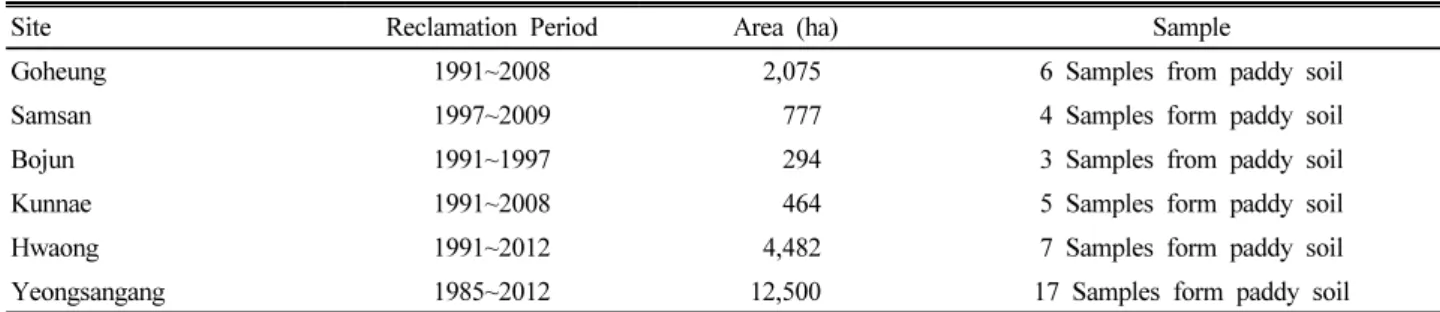
Table 1. Information of the reclaimed tidal lands at south-western coastal area.

Site Reclamation Period Area (ha) Sample

Goheung 1991~2008 2,075 6 Samples from paddy soil

Samsan 1997~2009 777 4 Samples form paddy soil

Bojun 1991~1997 294 3 Samples from paddy soil

Kunnae 1991~2008 464 5 Samples form paddy soil

Hwaong 1991~2012 4,482 7 Samples form paddy soil

Yeongsangang 1985~2012 12,500 17 Samples form paddy soil

Introduction

우리나라 서남해안 간척지는 대부분 인위적으로 방조제 를 설치하는 방식으로 조성되었으며 농지확대, 산업화 및 도시화 과정의 토지수요를 충족하기 위하여 개발되어왔다.

이러한 간척지 토양은 일반적으로 낮은 비옥도, 높은 염류 농도, 미발달된 토양구조, 높은 지하수위로 인한 배수불량 등으로 식물의 발아 및 생육에 매우 불리한 토양특성을 가 지고 있다. 이러한 간척지 토양의 숙전화와 활용성 증대를 위하여 현재까지 간척공사가 진행되어 조성된 12개 국가관 리 간척지구에 대하여 매년 간척지의 농업적 이용에 대한 실태조사가 지속적으로 실시되어 왔다.

간척지 토양의 높은 염류 농도는 작물의 생육저하와 더 불어 품질저하의 중요한 원인으로 알려져 있다 (Lee et al., 2013a; Lee et al., 2013b). 또한, 국내에서 간척지 토양의 개선을 위하여 적정량의 시비, 유기물 투입, 토양개량제 사 용 등 물리화학성 측면에서 노력이 추진되었으나 친환경적 인 토양관리를 위한 축분퇴비를 포함한 유기질비료 등 다양 한 유기물이 사용되면서 토양에 중금속 집적을 초래하는 부 작용도 일부 나타나고 있는 것으로 보고되고 있다 (NIAST, 2012). 최근에는 간척지 토양의 범용화를 위하여 논농사 위 주에서 밭작물, 사료작물, 원예작물 등 종합적인 작물재배 기반을 조성하는 방향으로 연구범위가 확대되고 있다 (Lee et al., 2007).

간척사업에 따른 간척지 토양을 지속가능한 일반 토양으 로 변화시키는 숙전화 과정은 자연환경 및 농업환경 등에 의한 영향을 포함하여 복잡하게 진행되기 때문에 토양의 물 리적 구조, 유기물 함량 및 각종 화학적 특성과 더불어 미생 물 분포 및 물질순환, 작물재배와 연관된 식물상 등 토양의 생물학적 환경을 활성화하는 방안을 함께 고려하여야 한다 (Flip, 2002). 일반적으로 토양에 유기물을 투입하면 토양미 생물체량과 효소활성이 증가하여 미생물에 의한 물질순환 이 이루어진다고 알려져 왔다 (Crecchio et al., 2004). 이러 한 관점에서 미생물에 의해 영향을 받는 토양의 건전성은 미생물상, 미생물체량, 군집구조 등이 함께 고려되어야 한 다 (Bossio and Scow, 1998; Hu and Cao, 2007; Shu, 1998).

토양미생물체량은 토양 pH와 상관관계가 높고, 화학비료나

유기물 사용은 토양화학성과 미생물활성에 영향을 주며, 이 는 유기물이 분해되는 과정에서 탈수소효소활성이 증가되 기 때문에 토양의 특성을 대표하는 인자로 인식되어 왔다 (Clegg, 2006; Deenik, 2006; Dinesh et al., 1998; Kemmitt et al., 2006). 또한 유기물공급, 단일작물 연작, 시비방법, 제초, 경운작업 등은 미생물 활성에 영향을 주기 때문에 다 양한 관점에서 연구되고 있다 (Kirk et al., 2004; Sardans et al., 2008; Timothy and Dick, 2004).

그러나 지금까지 간척지 토양에 대한 연구는 대부분 토 양의 물리화학성과 내염성 작물 재배 위주로 이루어져 왔고 특히 내염·호염성 미생물을 포함한 미생물과 다양한 유기물 분해력을 지닌 미생물 상에 대한 연구결과는 매우 미흡한 것이 현실이다. 토양미생물 생태계는 토양의 유기물 함량과 염류농도에 민감하게 반응하며, 토양의 염류집적은 간척지 토양뿐만 아니라 시설재배 및 건조한 환경에서 중요한 관리 인자로 인식되고 있다. 우리나라의 4계절 변화에 따라 표층 토양이 반복되는 건조와 습윤, 동결과 건조, 그리고 지하수 위 등 환경적인 요인에 노출됨에 따라 토양미생물의 구성에 많은 영향을 받고 있다. 특히 토양미생물은 물질순환 및 다 른 생물에 의한 영향을 많이 받기 때문에 농업환경의 미생 물학적 특성을 평가하고 기후 변화와 더불어 지속적으로 조 사해야 할 대상이 되고 있다.

본 연구에서는 국가관리 간척지구 중에서 고흥, 삼산, 보 전, 군내, 화옹, 영산강 지구의 토양을 대상으로 토양의 화 학적 특성과 미생물의 다양성 및 유기물 분해력을 지닌 생 화학적 특성을 조사하여 간척지 토양의 변화 양상을 조사하 였다.

Materials and Methods

조사지점 및 시료채취 국가관리 간척지구 중 남서해

안에 위치한 간척지 토양의 이화학적 특성과 미생물 분포를

조사하기 위하여 고흥, 삼산, 보전, 군내, 화옹 및 영산강

지구의 총 42개 지점에서 2014년 3~4월에 표층토양에서 시

료를 채취하였다. 간척지구별 간척시기와 면적, 그리고 조

사지점에 대한 정보는 Table 1에 정리하였다.

(3)

Table 2. Screening media and dye used for the detection of hydrolytic enzymatic activities.

Enzyme Substrate (basal medium) Dye Identification

Cellulase 1% (w/v) Avicel

®

Clear zone

Amylase 1% (w/v) Soluble starch 0.2% (w/v) Congo red solution Clear zone

Protease 1% (w/v) Skim milk powder

0.5% (w/v) Casein from milk Clear zone

Lipase 1% (w/v) Tributyrin Clear zone

Basal medium contains yeast extract 0.1%, peptone 0.1%, NaCl 0.5%, Agar 1.5%

토양 시료조제 및 화학성 분석 토양의 화학적 특성 분석은 농업과학기술원 토양 및 식물체분석법에 준하여 실 시하였다 (RDA, 2000). 표층토양 (0~10 cm)을 채취하여 음 건 한 이후 2 mm체에 통과시켜 분석시료로 사용하였다.

pH 및 EC (Electrical conductivity)는 토양과 증류수를 1:5 (w/v) 비율로 한 초자전극법, 토양 유기물은 Tyurin법, 치 환성 양이온은 1N-NH

4

OAc (pH 7.0)으로 추출하여 유도결 합플라즈마 발광광도계 (ICP, Varian)로 분석하였다. 토양 의 수분함량은 수분측정기 (ML-50, AND)를 이용하여 측정 하였다.

토양 시료제조 및 토양미생물 분석 토양미생물 분석 을 위하여 채취한 토양시료는 4°C 냉장고에서 45일 이내로 보관하였으며, 2 mm체를 통과시킨 후 미생물 생균수는 생 리식염수를 이용한 희석평판법을 이용하여 측정하였다. 토 양 중 호기성 세균은 Yeast Glucose (YG) 한천배지 (James, 1958)를 이용하여 28°C와 55°C에서 7일간 배양한 결과를 바 탕으로 중온성 (MB; Mesophilic bacteria) 및 고온성 (TB;

Thermophilic bacteria) 세균에 대하여 조사를 수행하였다.

곰팡이 (F; Fungi)는 Streptomycin이 첨가된 Rose-bengal (RB) 한천배지 (Martin, 1950)를 이용하였고, 방선균 (A;

Actinomycetes)은 Starch Casein Agar (SCA) (Wellington and Cross, 1983) 배지를 이용하여 30°C에서 7일간 배양한 결과를 분석하였다. 내염성 (HTB; Halotolerant bacteria) 및 호염성 (HB; Halophilic bacteria) 세균은 Tryptic Soy Agar (TSA) 배지 (Brisou et al., 1974)에 각각 5% 및 10%

NaCl을 첨가하여 28°C에서 7일간 배양한 결과를 분석하였 다. 미생물의 분포는 수분함량을 적용하여 산출한 건조토양 (g) 당 CFU (colony forming unit)로 환산하였다.

토양의 탈수소효소활성 분석 토양 내 생존 미생물의 탈수소효소활성을 측정하기 위하여 토양미생물 분석용 토 양 시료 2 g에 0.1 M Tris 완충용액 (pH 7.6)으로 제조한 2% 2,3,5-Triphenyltetrazolium (TTC) 용액 0.5 mL, 2%

(w/v) 포도당 용액 1 mL, 그리고 토양 시료의 pH에 따른 0.1 M Tris 완충용액 1.5 mL을 첨가하여 잘 혼합한 이후 암 상태의 25°C에서 24~72시간 반응시켰다 (Klein et al.,

1971; Rossel et al., 1997). 반응 후 생성된 Triphenylfro- mazan (TPF)를 10 mL 메탄올을 이용하여 추출하여 여과한 뒤 485 nm에서 흡광광도계 (POP, Optigen)를 이용하여 흡 광도를 측정하였다. 탈수소효소 활성은 수분함량을 적용하 여 μg-TPF g

-1

h

-1

로 환산하였다.

유기물 분해력을 지닌 토양미생물 분석 토양 내 생 존하는 미생물 중 다양한 유기물 분해력을 지닌 미생물의 생균수는 2 mm체를 통과시킨 토양시료를 생리식염수를 이 용한 희석평판법을 이용하여 30°C에서 5일간 배양한 결과 로 분석하였다. 유기물 분해력을 지닌 생균수는 셀룰로오스 (Avicel

®

PH-101, Fluka 11363, Cellulose microcrystalline), 전분 (Soluble starch), 단백질 (Skim milk powder, Fluka 70166), 지질 (Tributyrin, Fluka W222305)을 기질로 분해 하여 생육할 수 있는 선별배지에서 투명환 (Clear zone)을 확인하는 방법으로 조사하였으며 건조토양 (g) 당 CFU로 환산하였다 (Table 2) (Kim et al., 2007). 또한 세균과 방선 균·곰팡이를 구분하기 위하여 선별배지 내에 적량의 chlo- ramphenicol과 kanamycin 혼합물, 그리고 cycloheximide 를 각각 첨가하였다.

Results and Discussion

간척지구별 토양의 화학적 특성 간척지 토양이 일반

토양으로 숙전화되는 과정에서 중요한 인자로 인식되는

pH, EC, 유기물 함량, 그리고 치환성 양이온에 대하여 남서

해안에 위치한 6개 국가관리 간척지구별 토양을 대상으로

분석한 결과를 Table 3에 정리하였다. 간척지구 42개 지점

토양 중에서 10개 지점 (화옹, 1개; 영산강, 9개)을 제외한

32개 지점 토양의 EC는 4 dS m

-1

이상으로 대부분 작물 생

육에 영향을 미칠 수 있는 임계수치보다 높은 수준이었고,

2 dS m

-1

이하인 지점은 영산강 지구 1개 지점에 불과하였

다. pH는 군내지구에서만 일반 토양에 근접한 수치 (pH

5.35~7.01)를 보였다. 유기물 함량은 화옹지구와 삼산지구

에서 각각 4.65 g kg

-1

, 5.09 g kg

-1

으로 다른 지역의 절반

이하 수준이었고 다른 지역 역시 아직까지 일반적인 논토양

에 비하여 낮은 수준으로 확인되었다 (NIAST, 2006). 간척

(4)

Table 3. The chemical properties of soils from reclaimed tidal lands at south-western coastal area.

Site pH EC OM Exchangeable cation

Sample

K Ca Mg Na

1:5 dS m

-1

g kg

-1

--- cmol

c

kg

-1

---

Goheung Mean 7.99 5.26 9.24 1.57 8.70 5.30 5.28 6

Min. 7.63 4.31 7.49 1.16 3.93 4.76 3.94

Max. 8.31 11.4 18.6 2.59 21.5 8.20 8.81

Samsan Mean 8.12 26.7 5.09 1.04 12.3 7.44 6.57 4

Min. 8.03 9.18 4.98 0.91 10.6 4.08 4.65

Max. 8.40 34.8 7.77 1.09 13.3 10.1 28.6

Bojun Mean 7.22 7.30 9.65 0.75 5.80 2.95 5.28 3

Min. 4.47 4.33 8.87 0.72 3.39 2.08 2.85

Max. 7.70 10.2 10.2 0.92 6.66 4.88 8.03

Kunnae Mean 6.90 7.71 12.1 1.20 10.9 6.70 5.15 5

Min. 5.35 4.55 10.7 0.98 6.99 3.77 2.14

Max. 7.01 9.85 17.1 1.70 12.2 9.02 7.27

Hwaong Mean 7.65 5.94 4.65 1.28 2.42 4.50 5.09 7

Min. 6.67 3.41 3.38 1.01 1.50 3.11 3.78

Max. 8.63 30.5 6.20 1.54 10.1 7.38 26.0

Yeongsang gang Mean 7.15 4.60 11.6 1.44 6.40 5.81 4.33 17

Min. 4.89 1.47 7.09 0.78 2.92 2.93 1.60

Max. 8.21 7.84 22.0 1.91 14.3 8.27 7.54

Fig. 1. Relation between electrical conductivity and ex- changeable cations in soils from reclaimed tidal lands at south-western coastal area. Na, exchangeable Na

+

(R

2

=0.807);

K, exchangeable K

+

(R

2

=0.012); Ca, exchangeable Ca

2+

(R

2

= 0.132); Mg, exchangeable Mg

+2

(R

2

=0.148).

기간을 고려한 간척지 토양의 숙전화는 장기간에 이루어진 영산강 지구를 제외하면 보전  고흥·군내  삼산  화옹 지구의 순서로 진행될 것으로 예상되었지만, 실제 유기물 함량을 적용할 경우 군내  영산강  고흥·보전  삼산 

화옹 지구 순으로 확인되었다. 실제 유기물 함량은 간척 기 간뿐만 아니라 객토, 작물재배형태, 퇴비 등의 유기물 공급

등 외부 환경요인과 인위적인 투입에 영향을 받으며 영산강 과 군내지구에서 이를 보여주는 것으로 판단된다.

토양의 EC는 치환성 Na

+

과 유의적인 상관관계가 존재하 며, 일반적으로 염류농도의 증가는 Na

+

과 K

+

이온 사이에 복합적인 경쟁작용이 일어난다고 알려져 있다 (Wang et al., 1997). 이번 6개 국가관리 간척지구 정점토양의 EC와 치환성 양이온 간의 상관관계에서는 Na

+

만이 높은 정의 상 관관계 (R

2

=0.8068)를 갖고 있는 반면 다른 치환성 양이온 인 K

+

, Ca

2+

, Mg

2+

의 경우에는 유의성이 없었다 (Fig. 1). 염 류 토양에서 Na

+

과 K

+

이 경쟁적인 작용으로 EC와 K

+

양이 온 간에도 정의 상관관계가 존재하는 경우와는 다른 결과를 보이고 있었다 (Ko et al., 2014).

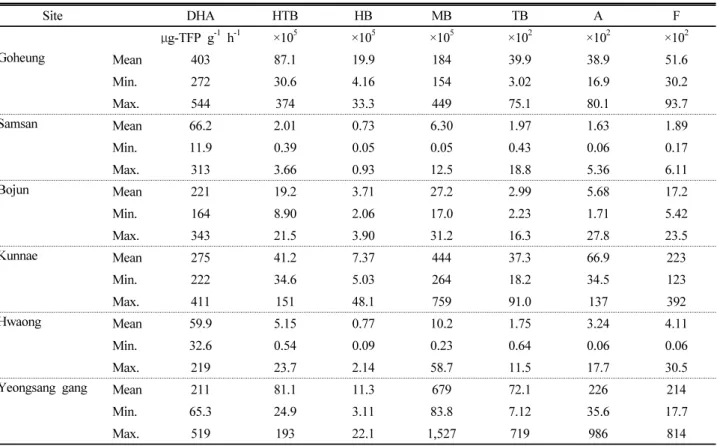
간척지구별 토양미생물 분포 남서해안에 위치한 6개

국가관리 간척지구 토양의 미생물 분포를 내염성 및 호염성

세균을 포함하여 분석한 결과를 Table 4에 정리하였다. 상

대적으로 간척사업이 일찍 완료된 보전지구의 경우 중온성

대비 내염·호염성 세균의 비중이 87%로 확인되었다. 이는

아직까지 간척지 토양의 염류농도가 높은 관계로 인하여 일

반 세균과 내염·호염성 세균이 상존하는 것으로 확인되었

다. 또한 보전지구의 곰팡이와 방선균의 분포는 아직까지

염류토양에서 일반 토양으로 전환되는 중간단계로 점진적

(5)

Table 4. Dehydrogenase activities and microbial population (CFU g

-1

) in soils from reclaimed tidal lands at south-western coastal area.

Site DHA HTB HB MB TB A F

μg-TFP g

-1

h

-1

×10

5

×10

5

×10

5

×10

2

×10

2

×10

2

Goheung Mean 403 87.1 19.9 184 39.9 38.9 51.6

Min. 272 30.6 4.16 154 3.02 16.9 30.2

Max. 544 374 33.3 449 75.1 80.1 93.7

Samsan Mean 66.2 2.01 0.73 6.30 1.97 1.63 1.89

Min. 11.9 0.39 0.05 0.05 0.43 0.06 0.17

Max. 313 3.66 0.93 12.5 18.8 5.36 6.11

Bojun Mean 221 19.2 3.71 27.2 2.99 5.68 17.2

Min. 164 8.90 2.06 17.0 2.23 1.71 5.42

Max. 343 21.5 3.90 31.2 16.3 27.8 23.5

Kunnae Mean 275 41.2 7.37 444 37.3 66.9 223

Min. 222 34.6 5.03 264 18.2 34.5 123

Max. 411 151 48.1 759 91.0 137 392

Hwaong Mean 59.9 5.15 0.77 10.2 1.75 3.24 4.11

Min. 32.6 0.54 0.09 0.23 0.64 0.06 0.06

Max. 219 23.7 2.14 58.7 11.5 17.7 30.5

Yeongsang gang Mean 211 81.1 11.3 679 72.1 226 214

Min. 65.3 24.9 3.11 83.8 7.12 35.6 17.7

Max. 519 193 22.1 1,527 719 986 814

DHA, Dehydrogenase activity; HTB, Halotolerant bacteria; HB, Halophilic bacteria; MB, Mesophilic bacteria; TB, Thermophilic bacteria; A, Actinomyces; F, Fungi

으로 세균의 증가와 더불어 곰팡이와 방선균의 증가가 예상 된다. 고흥지구의 경우, 중온성 대비 내염·호염성 세균의 비 중은 52%로 보전지구에 비하여 낮은 반면 고온성 세균, 방 선균, 곰팡이는 보전지구에 비하여 3~13배 증가한 것으로 확인되었다. 군내지구의 경우에는 중온성 대비 내염·호염성 세균의 비중이 19% 수준으로 낮아졌으며 곰팡이가 2.2×10

4

CFU g

-1

수준으로 증가하였다. 영산강지구의 경우에도 중 온성 대비 내염·호염성 세균의 비중은 21% 수준으로 군내지 구와 유사한 반면 방선균이 군내지구보다 3배 이상 높은 실 정이다. 간척지구별 토양미생물의 분포를 기반으로 간척지 구별 숙전화 정도는 영산강  군내  고흥  보전  화옹·

삼산 지구 순으로 판단할 수 있다.

일반적인 농경용지의 미생물 분포는 중온성 세균이 10

6

CFU g

-1

, 방선균이 10

4

CFU g

-1

, 곰팡이는 10

3

CFU g

-1

이상 이 존재하는 것으로 보고되었고 (Suh and Shin, 1997), 우 리나라 농경지를 대상으로 2004년부터 2007년간에 조사된 미생물 분포에서 세균은 6개 구간으로 곰팡이는 5개 구간으 로 구분하였으며 세균과 곰팡이의 최저 구간은 각각 5×10

6

CFU g

-1

과 5×10

4

CFU g

-1

을 적용하였다 (Suh et al., 2010).

남서해안 6개 간척지구 중 농경용지에 대한 세균 및 곰팡이 의 최저 기준을 넘는 지구는 영산강과 군내지구 2개 지구이 며 고흥지구가 근접한 실정이다. 농경용지에 대한 세균의

최저 기준은 삼산지구를 제외한 나머지 5개 지구에서 충족 시켰지만 염류농도로 인한 내염·호염성 세균의 높은 분포와 곰팡이·방선균의 낮은 분포로 인하여 아직 일반 농경지 토 양으로 전환까지는 시간이 필요할 것으로 예상된다. 특히, 군내 지구의 토양에서는 EC가 4 dS m

-1

(4.55~9.85) 이상 인 전형적인 염류토양의 화학적 특성을 지니고 있지만 중온 균 대비 내염·호염성 세균 비중이 20% 내외로서 서해안 간 척지 토양의 미생물 분포와 EC 간의 상관관계에서 보고된 사례와는 달리 높은 EC에서도 중온균 대비 내염·호염성 세 균 비중이 낮은 사례가 확인되었다 (Ko et al., 2014). 이는 토양의 염류도 이외에 농업환경에 의한 간섭효과가 발생한 것으로 판단된다.

간척지구별 토양화학성과 미생물 분포 간의 상관관

계 6개 국가관리 간척지구 중 일반 농경용지의 미생물 분

포 기준에 미달하는 삼산, 보전, 화옹 지구의 14개 지점토양

에 한하여 염류화 정도를 의미하는 EC와 중온성 세균 간에

부의 상관관계 (R

2

=0.7299)가 확인되었다 (Fig. 2). 이는 서

해안 간척지구 (남포, 인원, 석문, 시화)에서의 결과와 일치

하였으며 (Ko et al., 2014), 토양미생물 중 방선균과 곰팡

이는 10

2

CFU g

-1

수준으로 염류에 의한 삼투압에 민감하다

(6)

Fig. 2. Relation between electrical conductivity and meso- philics in soils from reclaimed tidal lands at south-western coastal area.

Fig. 3. Relation between soil organic matter and total micro- bial population in soils from reclaimed tidal lands at south-western coastal area.

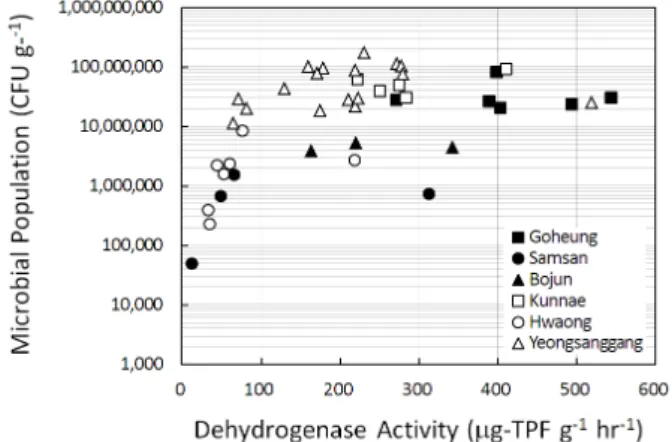
Fig. 4. Relation between total microbial population and de- hydrogenase activities in soils from reclaimed tidal lands at south-western coastal area.

는 점과 생균수가 염류도 증가에 따라 감소한다는 사실과도 일치하였다 (Omar et al., 1994; Pankhurst et al., 2001).

일반적으로 토양 내 유기물함량, 미생물체량, 탈수소효 소활성, pH, 유기탄소함량들 간에 상관관계가 있다고 알려 져 있으나 (Joa et al., 2013; Kemmitt et al., 2006; Yao et al., 2000), 토지이용과 경작방법, pH, 토양관리방법, 수분 및 온도 등의 환경요인 등에 따라 상관관계의 유의성은 일 정하지 않은 것으로 보고되고 있다 (Aciego and Brookes, 2009; Ahn et al., 2011; Lee and Ha, 2011; Rahman et al., 2008). 이번 연구에서도 간척지구별 토양의 유기물 함량에 따른 미생물 분포는 유기물 함량이 10 g Kg

-1

이하에서만 유의적인 상관관계를 확인할 수 있었으며, 유기물 함량이 10 g Kg

-1

이상에서는 미생물 분포가 2~17×10

7

CFU g

-1

수 준에서 정체되는 현상을 보이고 있다 (Fig. 3). 이러한 정체 현상은 토양 내에 존재하는 유기물을 원활하게 분해·순환시 키는 미생물이 제한되었거나 이미 토양 내 미생물의 분포가 포화상태에 근접한 경우로 판단된다.

간척지구별 토양화학성과 탈수소효소활성 간의 상 관관계 탈수소효소활성은 토양의 생물학적 특성을 대표 하는 인자이지만 토양의 수분함량, 산소이용도, 산화환원 전위, pH, 유기물함량, 온도 등 토양의 환경적인 인자에 의 하여 영향을 받는 것으로 알려져 있다 (Quilchano and Maranon, 2002). 간척지구별 토양의 탈수소효소활성과 전 체 미생물 분포 간의 상관관계는 유기물 함량과 유사하게 탈수소효소활성이 100 μg-TPF g

-1

h

-1

이내에서만 제한적 으로 상관관계가 존재하였다 (Fig. 4). 실제 토양의 화학성 과 탈수소효소활성 간의 상관관계는 시설재배지와 과수원 토양의 유기물 함량 (Ahn et al., 2011; Joa et al., 2013)과 pH (Kim et al., 2011)에서 보고되었으나 탈수소효소활성이 토양 온도, 유기물공급, 연작, 시비, 제초, 경운, 표토관리 등 다양한 요인에 영향을 받기 때문에 상관관계를 확정하기 는 어렵다 (Kang et al., 2009; Nosalewicz and Nosalewicz, 2011; Sardans et al., 2008; Sebiomo et al., 2011; Timothy and Dick, 2004).

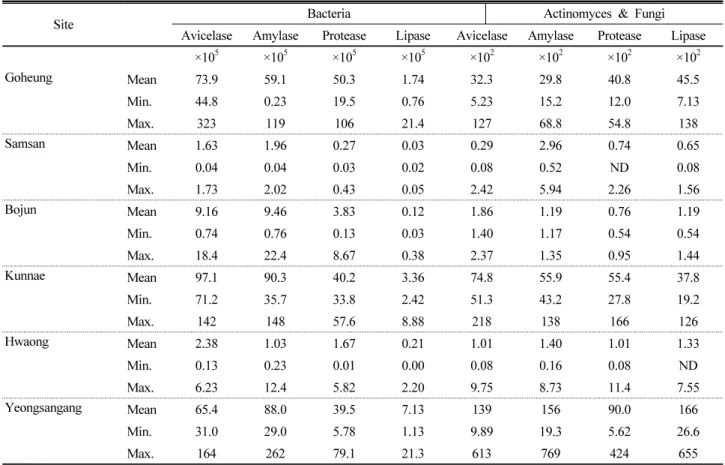
토양미생물 분포와 유기물 분해력을 지닌 미생물

간의 상관관계 간척지구별 42개 지점 토양에 대하여 유

기물을 분해할 수 있는 다양한 효소 (cellulase, amylase,

protease, lipase) 활성을 지닌 미생물 (중온성 세균 및 방선

균·곰팡이)의 생균수를 조사하여 그 결과를 Table 5에 정리

하였다. 일반적으로 유기물 분해에 중요한 역할을 하는 미

생물은 초기에는 세균이 중반 이후에는 곰팡이가 중요한 역

할을 수행한다고 알려져 있으며, 토양미생물 중 곰팡이는

세균에 비하여 염류에 의한 삼투압에 민감한 것으로 알려져

있다 (Pankhurst et al., 2001). 간척지구별 토양에 존재하

는 총 미생물의 분포와 효소활성을 지닌 미생물의 생균수

간에 정의 상관관계 (R

2

=0.8688)를 확인하였다 (Fig. 5). 토

양미생물의 분포를 산출하는 과정에서 내염·호염성 세균과

중온성 세균을 중복 산출하였기 때문에 4가지 효소활성을

(7)

Table 5. Microbial community (CFU g

-1

) containing hydrolytic enzyme activities in soils from reclaimed tidal lands at south-western coastal area.

Site Bacteria Actinomyces & Fungi

Avicelase Amylase Protease Lipase Avicelase Amylase Protease Lipase

×10

5

×10

5

×10

5

×10

5

×10

2

×10

2

×10

2

×10

2

Goheung Mean 73.9 59.1 50.3 1.74 32.3 29.8 40.8 45.5

Min. 44.8 0.23 19.5 0.76 5.23 15.2 12.0 7.13

Max. 323 119 106 21.4 127 68.8 54.8 138

Samsan Mean 1.63 1.96 0.27 0.03 0.29 2.96 0.74 0.65

Min. 0.04 0.04 0.03 0.02 0.08 0.52 ND 0.08

Max. 1.73 2.02 0.43 0.05 2.42 5.94 2.26 1.56

Bojun Mean 9.16 9.46 3.83 0.12 1.86 1.19 0.76 1.19

Min. 0.74 0.76 0.13 0.03 1.40 1.17 0.54 0.54

Max. 18.4 22.4 8.67 0.38 2.37 1.35 0.95 1.44

Kunnae Mean 97.1 90.3 40.2 3.36 74.8 55.9 55.4 37.8

Min. 71.2 35.7 33.8 2.42 51.3 43.2 27.8 19.2

Max. 142 148 57.6 8.88 218 138 166 126

Hwaong Mean 2.38 1.03 1.67 0.21 1.01 1.40 1.01 1.33

Min. 0.13 0.23 0.01 0.00 0.08 0.16 0.08 ND

Max. 6.23 12.4 5.82 2.20 9.75 8.73 11.4 7.55

Yeongsangang Mean 65.4 88.0 39.5 7.13 139 156 90.0 166

Min. 31.0 29.0 5.78 1.13 9.89 19.3 5.62 26.6

Max. 164 262 79.1 21.3 613 769 424 655

Avicelase, Cellulose-hydrolytic activities based on Avicel

®

; Amylase, Starch-hydrolytic activities based on soluble starch;

Protease, Protein-hydrolytic activities based on skim milk; Lipase, Lipid-hydrolytic activities based on tributyrin; ND, Not detected.

Fig. 5. Relation between total microbial population and microbial community containing hydrolytic enzyme activities in soils from reclaimed tidal lands at south-western coastal area.

Fig. 6. Relation between actinomyces·fungi population and actinomyces·fungi community containing hydrolytic enzyme activities in soils from reclaimed tidal lands at south-western coastal area.

지닌 미생물의 생균수도 중복하여 산출하였다. 유기물 분해 와 관련된 효소활성을 지닌 방선균과 곰팡이의 생균수는 10

2

~10

5

CFU g

-1

범위에서 방선균·곰팡이의 분포와 매우 높 은 정의 상관관계 (R

2

=0.9042)가 존재하며 상관계수 역시 0.956으로 1에 근접하였다 (Fig. 6). 효소활성을 지닌 중온

성 생균수 역시 중온성 세균의 분포 간에도 정의 상관관계

(R

2

=0.8983)가 존재하지만 1×10

7

CFU g

-1

이상에서는 정체

하는 양상을 보이고 있으며 상관계수 역시 0.852로 감소하

는 것으로 확인되었다. 이는 토양 내에 존재하는 유기물의

물질순환에 관여하는 유기물 분해력을 지닌 미생물의 생육

(8)

이 제한되거나 토양의 토성 등 물리적인 제약요건에 의한 것으로 예측된다. 이러한 현상은 간척지 토양에 존재하는 미생물의 분포와 유기물 함량 및 탈수소효소활성 간의 상관 관계가 제한되는 원인 중에 한 인자로 판단된다.

Conclusion

6개 국가관리 간척지구 표토의 EC는 대부분 4 dS m

-1

이 상으로 염류토양의 특성을 지니고 있었으며, 치환성 양이온 (Na

+

, K

+

, Ca

2+

, Mg

2+

) 중에서 Na

+

만이 EC와 정의 상관관계 (R

2

=0.8068)가 있음을 확인하였다. 대부분 토양이 화학적 인자인 EC에 의하여 염류성 토양으로 분류되지만, 중온성 세균의 경우 삼산, 화옹, 보전 지구를 제외한 고흥, 군내, 영산강 지구에서 일반 농경지의 최저 기준을 상회하는 1.84~6.79×10

7

CFU g

-1

의 분포를 확인하였다. 고흥, 군내, 영산강 지구에서는 중온성 세균 대비 내염·호염성 세균의 비중은 고흥 (52%), 군내 (19%), 영산강 (21%)으로 군내와 영산강 지구의 토양에서 염류가 미생물 분포에 미치는 영향 이 가장 낮은 것으로 확인되었다. 토양염류에 의한 영향이 민감한 곰팡이 분포 역시 군내 (2.23×10

4

CFU g

-1

)와 영산 강 (2.14×10

4

CFU g

-1

) 지구에서만 일정 수준 이상이 확인 되었다. 이는 간척지 토양의 염류도를 판정하는 지표로서 대표적인 화학적 인자인 EC에 추가적으로 생물학적 지표로 서 미생물의 분포를 고려하여야 한다. 6개 간척지구 토양의 총 미생물 분포는 제한적인 유기물 함량 (0~10 g Kg

-1

)과 탈수소효소활성 (0~100 μg-TPF g

-1

h

-1

) 간에 유의성 있는 상관관계를 보이고 있다. 이러한 제한적인 상관관계는 토양 과 관련된 다양한 환경인자에 의한 영향을 받기 때문이다.

특히, 토양에 존재하는 유기물의 분해와 환원에 관여하는 생화학적 특성은 유기물 분해력을 지닌 미생물의 생균수와 매우 밀접한 것으로 확인되었다. 미생물의 분포와 유기물 분해력을 지닌 미생물의 생균수 간에는 중온성 세균의 경우 에 10

4

~10

7

CFU g

-1

그리고 방선균·곰팡이의 경우는 10

2

~10

5

CFU g

-1

에서 정의 상관관계가 존재하였으며 미생 물의 분포가 10

7

CFU g

-1

이상에서는 유의성이 감소하였다.

References

Aciego, P.J.C. and P.C. Brookes. 2009. Substrate inputs and pH as factors controlling microbial biomass, activity and community structure in an arable soil. Soil Biol. Biochem.

41:1396-1405.

Ahn, B.K., H.J. Kim, S.S. Han, Y.H. Lee and J.H. Lee. 2011.

Response of microbial distribution to soil properties of orchard fields in Jeonbuk area. Korean J. Soil Sci. Fert.

44:696-701.

Bossio, D.A. and K.M. Scow. 1998. Impacts of carbon and

flooding on soil microbial communities: phospholipid fatty acid profiles and substrate utilization patterns. Micro. Ecol.

35:265-278.

Brisou, J., D. Courtois and F. Denis. 1974. Microbiological study of a hypersaline lake in French Somaliland. Appl.

Microbiol. 27:819-822.

Clegg, C.D. 2006. Impact of cattle grazing and inorganic fertiliser additions to managed grasslands on the microbial community composition of soils. Appl. Soil Ecol. 31:73-82.

Crecchio, C., M. Curici, M.D.R. Pizzigallo, P. Ricciuti and P. Ruggiero. 2004. Effects of municipal solid waste compost amendments on soil enzyme activities and bacterial genetic diversity. Soil Biol. Biochem. 36:1595-1605.

Deenik, J. 2006. Nitrogen Mineralization potential in important agricultural soils of Hawaii. Soil Crop Manage. 15:1-5.

Dinesh, R., R.P. Dubey and G.S. Prasad. 1998. Soil microbial biomass and enzyme activities as influenced by organic manure incorporation into soils of a rice-rice system. J.

Agron. Crop Sci. 181:173-178.

Filip, Z. 2002. International approach to assessing soil quality by ecologically-related biological parameters. Agric. Ecosyst.

Environ. 88:169-174.

Hu, C. and Z. Cao. 2007. Size and activity of the soil micro- bial biomass and soil enzyme activity in long-term field experiments. World J. Agri. Sci. 3:63-70.

James, N. 1958. Soil extract in soil microbiology. Can. J.

Microbiol. 4:363-370.

Joa, J.H., K.H. Moon, K.S. Choi, S.C. Kim and S.W. Koh.

2013. Soil dehydrogenase activity and microbial biomass C in croplands of Jeju province. Korean J. Soil Sci. Fert. 46:

122-128.

Kang, H.J., S.K. Kang and D.W. Lee. 2009. Variations of soil enzyme activities in a temperate forest soil. Ecol. Res.

24:1137-1143.

Kemmitt, S.J., D. Wright, K.W.T. Goulding and D.L. Jones.

2006. pH regulation of carbon and nitrogen dynamics in two agricultural soils. Soil Biol. Biochem. 38:898-911.

Kim, Y.I., S.H. Jung, J.S. Seok, S.Y. Yang, J.W. Huh and W.S. Kwak. 2007. Isolation and identification of high cellulolytic bacteria from spent mushroom substrate and determination of optimal medium conditions for the growth.

Kor. J. Microbiol. Biotechnol. 35:255–260.

Kim, B.Y., H.Y. Weon, I.C. Park, S.Y. Lee, W.G. Kim and J.K. Song. 2011. Microbial diversity and community analysis in lettuce or cucumber cultivated greenhouse soil in Korea.

Korean J. Soil Sci. Fert. 44:1169-1175.

Kirk, J.L., L.A. Beaudette, M. Hart, P. Moutoglis, J.N.

Klironomos, H. Lee and J.T. Trevors. 2004. Methods of studying soil microbial diversity. J. Microbiol. Meth. 58:

169-188.

Klein, D.A., T.C. Loh and R.L. Goulding. 1971. Short

communication: A rapid procedure to evaluate the dehydro-

(9)

genase activity of soils low in organic matter. Soil Biol.

Biochem. 3:385-387.

Ko, E.S., J.A. Joung, C.H. Kim, S.H. Lee, T.M. Sa and J.H.

Choi. 2014. Relationship between chemical property and microbial activity of reclaimed tidal lands at western coast area in Korea. Korean J. Soil Sci. Fert. 47:254-261.

Lee, K.B., J.G. Kang, J. Li, D.B. Lee, C.W. Park and J.D.

Lim. 2007. Evaluation of salt-tolerant plant for improving saline soil of reclaimed land. Korean J. Soil Sci. Fert.

40:173-180.

Lee, S., H.S. Bae, S.H. Lee, J.G. Kang, H.K. Kim, K.B. Lee and K.H. Park. 2013a. Effect of soil salinity levels on silage barley growth at Saemangeum reclaimed tidal land, Korean J. Soil Sci. Fert., 46:365-372.

Lee, S., H.K. Kim, S.W. Hwang and K.B. Lee. 2013b.

Changes of soil properties with various soil amendments in Saemangeum reclaimed tidal saline soil, Korean J. Soil Sci.

Fert., 46:281-287.

Lee, Y.H. and S.K. Ha. 2011. Impact of chemical properties on microbial population from upland soils in Gyeongnam province. Korean J. Soil Sci. Fert. 44:242-247.

Martin, J.P. 1950. Use of acid, rose bengal and streptomycin in the plate method for estimating soil fungi. Soil Sci.

69:215-232.

NIAST. 2006. Fertilization standard of crop analysis. National Institute of Agricultural Science and Technology. RDA.

Suweon. Korea

NIAST. 2012. Monitoring project on agro-environmental quality. National Institute of Agricultural Science and Tech- nology. DRA. Suweon, Korea.

Nosalewicz, A. and M. Nosalewicz. 2011. Effect of soil compaction on dehydrogenase activity in bulk soil and rhizosphere. Int. Agrophys. 25:47-51.

Omar, S.A., M.A. Abdel-Sater, A.M. Khallil and M.H.

Abdalla. 1994. Growth and enzyme activities of fungi and bacteria in soil salinized with sodium chloride. Folia Micro- biol. 39:23-28.

Pankhursy, C.E., S. Yu, B.G. Hawke and B.D. Harch. 2001.

Capacity of fatty acid profiles and substrate utilization patterns to describe differences in soil microbial communities associated with increased salinity or alkalinity at three locations in South Australia. Biol. Fert. Soil 33:240-217.

Quilchano, C. and T. Maranon. 2002. Dehydrogenase activity

in Mediterranean forest soils. Biol. Fert. Soils 35:102-107.

Rahman, M.H., A. Okubo, S. Sugiyama and H.F. Mayland.

2008. Physical, chemical and microbiological properties of an andisol as related to land use and tillage practice. Soil Till. Res. 101:10-19.

Rossel, D., J. Taradellas, G. Bitton and J. Morel. 1997. Use of enzymes in soil ecotoxicology: A case for dehydrogenase and hydrolytic enzymes, p. 179-206. In: J. Taradellas, G.

Bitton, D. Rossel (ed.) Soil Ecotoxicology. CRC Press, Boca Raton, FL, USA.

RDA (Rural Development Administration). 2000. Method of soil and plant analysis. National Institute of Agricultural Science and Technology. Sueon. Korea.

Sardans, J., J. Penuelas and M. Estiarte. 2008. Changes in soil enzymes related to C and N cycle and in soil C and N content under prolonged warming and drought in a Mediterranean shrubland. Appl. Soil Ecol. 39:223-235.

Sebiomo, A., V.W. Ogundero and S.A. Bankole. 2011. Effect of four herbicides on microbial population, soil organic matter and dehydrogenase activity. Afr. J. Biotechnol. 10:

770-778.

Suh, J.S. and J.S. Shin. 1997. Soil microbial diversity of paddy fields in Korea. Korean J. Soil Sci. Fert. 30:200-207 Suh, J.S. 1998. Soil Microbiology. Korean J. Soil Sci. Fert.

31(S):76-89.

Suh, J.S., H.J. Noh, J.S. Kwon, H.Y. Weon and S.Y. Hong.

2010. Distribution map of microbial diversity in agricultural land. Korean J. Soil Sci. Fert. 43:995-1001.

Timothy, R.K. and R.P. Dick. 2004. Differentiating microbial and stabilized β-Glucosidase activity relative to soil quality.

Soil Biol. Biochem. 36:2089-2096.

Wang, L.W., A.M. Showalter and I.A. Ungar. 1997. Effect of salinity on growth, ion content and cell wall chemistry in Atriplex prostrata (Chenopodiaceae). Am. J. Botany 84:1247-1255.

Wellington, E.M.H. and T. Cross. 1983. Taxonomy of antibiotic producing Actinomycetes and new approaches to their selective isolation. In: "Progress in industrial microbiology?"

Bushell, M. E. (eds.). Elsevier, Amsterdam. pp. 36.

Yao, H., Z. He, M.J. Wilson and C.D. Campbell. 2000.

Microbial biomass and community structure in a sequence of soils with increasing fertility and changing land use.

Microb. Ecol. 40:223-237.

수치

Table 1. Information of the reclaimed tidal lands at south-western coastal area.
Table 2. Screening media and dye used for the detection of hydrolytic enzymatic activities.
Table 3. The chemical properties of soils from reclaimed tidal lands at south-western coastal area.
Table 4. Dehydrogenase activities and microbial population (CFU g -1 ) in soils from reclaimed tidal lands at south-western coastal  area
+3

참조

관련 문서

The purpose of the present study was to elucidate the effect of photography and reporting activities conducted at a day care center on 5-year-old

Distribution of Cd in stream sediments, paddy soils, rice stalks and grains from the Kubong

Students in Group C thought that the biology content of learning from outdoor activities was limited, and said the findings from outdoor activities

In conclusion, the growth and yield of potato was not different between mixed fertilizer(chemical fertilizer : liquid pig manure = 1:1) and the

This study aims to increase the understanding of textbooks, analyzing the contents that the singing/instrumental music activities in the Expression Area in

Objective: This study was conducted to identify the association between vitamin D and osteosarcopenia among all adults in Korea using data from the Korea National Health

This study was conducted on elementary school children aged 11 to 13 from displaced North Korean (NK) families to compare their growth and nutritional status with those

At last, the paper comparative study on South Korea and China consumer's overseas travel pattern and travel behavior and predict the South Korea's and