Printed in the Republic of Korea
요 약. 디시클로헥실 텔루르염은 에탄올 수용액에서 NaTeH와 디시클로헥실 브롬화물의 반응에 의해 높은 수율로 얻어진다. 일반식 (cyclo-C6H11)2Te(R)X (where R = CH3, X = I (1); R = C2H5, X = Br(2); R = C2H5, X = I (3); R = C3H5, X = Br (4)) 인 유기텔루로늄의 새로운 시리즈는 그에 상응하는 알킬 할로겐화물과 (cyclo-C6H11)2Te의 반응에 의해 만들어진다. NaBPh4와 1의 반응은 78% 수율로 화합물 5를 제공하였다.
벤질 브롬화물과 (cyclo-C6H11)2Te, 4-bromophenacyl bromide의 반응에서는 뜻밖에 각각dibenzylcyclohexyl- telluronium 브롬화물과 and bis(4-bromophenacyl)cyclohexyltelluronium bromide을 얻었다. 높은 수율의 tetraphenylborate 유도체는 NaBPh4과 6의 반응으로 얻었다. CDCl3용매에서 1H NMR분석을 통해 화합물 1 이 알킬 할로겐화물의 제거 반응을 일으킴을 확인할 수 있었다. 새로운 화합물은 전도성, IR, 1H와13C NMR, 열분석를 통해 규명되었다.
주제어: 디시클로헥실 텔루르염, 텔루로늄염, 환원성 제거, 산화성 첨가, Tetraphenylborate
ABSTRACT. Dicyclohexyl telluride was obtained in a high yield by the reaction of cyclohexyl bromide with NaTeH(prepared in situ) in an aqueous ethanolic solution. A series of new organotelluronium salts of the general formula (cyclo-C6H11)2Te(R)X (where R = CH3, X = I (1); R = C2H5, X = Br(2); R = C2H5, X = I (3); R = C3H5, X = Br (4)) were prepared by the reaction of (cyclo-C6H11)2Te with the corresponding alkyl halide. Reaction of 1 with NaBPh4 gave compound 5 ( i.e. R = CH3, X = BPh4‒) in 78% yield. Reaction of (cyclo-C6H11)2Te with benzyl bromide and 4-bromophenacyl bromide gave unexpectedly dibenzylcyclohexyltelluronium bromide (6) and bis(4-bromophenacyl)cyclohexyltelluronium bromide (7), respectively. Reaction of 6 with NaBPh4 gave the corresponding tetraphenylborate derivative (8) in high yield. 1H NMR studies revealed that in CDCl3solution compound 1 eliminated alkyl halide. Conductivity, IR, 1H and 13C NMR and thermal data for the new compounds are presented and discussed.
Keywords: Dicyclohexyl telluride, Telluronium salts, Reductive elimination, Oxidative addition, Tetraphenylborate
디시클로헥실 텔루르염에 기반한 유기텔루로늄염의 합성과 분광학적 분석
Ali Z. Al-Rubaie*, Dhafir M. H. Al-Mudhaffar, Ali H. Al-Mowali, and Kahtan A. Asker Department of Chemistry, College of Science, University of Basrah, Basrah, Iraq
(접수 2009. 6. 4; 수정 2009. 8. 4; 게재확정 2009. 8. 14)
Synthesis and Spectroscopic Investigations of Some New Organotelluronium Salts Based on Dicyclohexyl Telluride
Ali Z. Al-Rubaie*, Dhafir M. H. Al-Mudhaffar, Ali H. Al-Mowali, and Kahtan A. Asker Department of Chemistry, College of Science, University of Basrah, Basrah, Iraq
(Received June 4, 2009; Revised August 4, 2009; Accepted August 14, 2009)
INTRODUCTION
Recently, the synthesis, structures and properties of triorganotelluronium salts have received conside-
rable attention.1,2 Thus, new and general approaches to a variety of unsymmetrical telluronium salts have been developed.3,4 A special attention is also given to the applications of these compounds in preparative
디시클로헥실 텔루르염에 기반한 유기텔루로늄염의 합성과 분광학적 분석
organic synthesis.5,6 Our previous work described the synthesis and solution properties of a series of cyclic and non cyclic telluronium salts.7,8 It was observed that some of these telluronium salts are unstable toward reductive elimination of alkyl ha- lide in organic solvents,7,8 such a CDCl3, DMSO and DMF. Recently, we reported the synthesis and solution properties of some new telluronium salts based on bis(cyclohexylmethyl) telluride.7a
The synthesis of dicycyclohexyl telluride9,10 and its dihalo,11,12 pseudohalido11 and diazido13 deriva- tives have been reported previously. No work has been done on the reactions of dicycyclohexyl tellu- ride with alkyl halides, as far as we aware. Thus, the present work describes the synthesis, solution properties and some solid state data of a new series of telluronium salts based on dicyclohexyl telluride.
Some unexpected reactions are also reported.
EXPERIMENTAL Physical measurements
1H and 13C NMR spectra were recorded on Jeol EX-90FT (90 MHz) spectrometers with TMS as an internal reference. Infrared spectra were recorded with KBr discs in the range of 4000-200 cm-1 on a Pye-Unicam SP-300s infrared spectrophotometer.
Microanalysis for carbon, hydrogen and nitrogen was obtained on a Carlo-Ebra EA1-108 Elemental Analyzer. All melting points were determined by a Gallenkamp melting point apparatus and are unco- rrected. Molar conductances at 10-3-10-5 dilution in DMSO were measured with a WTW D812 con- ductivity meter LBR, using a standard cell with cell constant of 0.81 cm-1. The thermal analyses were carried out using Du Pont thermoanalyser, model 990, which measure TGA and DTG simultaneously.
All measurements were carried out under nitrogen atmosphere. The analyses were performed by hea- ting the sample at a steady rate of 50 oC min-1, from ambient temperature to 600 oC.
Synthesis
All reactions were carried out in a dry oxygen- free, nitrogen atmosphere. Solvents were dried and distilled before use, using standard procedures.
Dicyclohexyl telluride
NaBH4 (2.1 g; 59 mmol) was added under nitro- gen atmosphere at room temperature to a suspension of tellurium powder (2.55 g; 20 mmol) in 70 cm3 ethanol/water (6/1). The reaction mixture was then refluxed whereupon a vigorous evolution of H2
started. All the tellurium was consumed within 20 min, producing a faintly yellow solution. To cooled resulting solution was added a solution of cyclo- hexyl bromide(6.52 g; 40 mmol) in ethanol (40 cm3).
The resulting solution was refluxed for 1 h and then water bath was removed and the stirring continued for 2 h at room temperature. The solution was fil- tered, pored into 500 cm3 of distilled water and ex- tracted with chloroform (4 × 50 cm3). The combined extracts were dried with anhydrous MgSO4. Evapo- ration of solvent by a rotary evaporator, gave heavy orange oil with a persistent odour in 86% yield (4.70 g).
1H NMR (CDCl3) δ: 3.35 (m, Te-CH, 2H); 0.80- 2.26 (m, Cy-CH2, 20H).
Methyldicyclohexyltelluronium iodide (1).
A freshly distilled methyl iodide (2.13 g; 15 mmol) and a solution of (cyclo-C6H11)2Te (2.94 g, 10 mmol) in diethyl ether (10 cm3) were placed in a flask flushed with dry nitrogen. The reaction mixture was stoppered and left overnight. A white precipitate was formed, recrystallized from ethanol and dried in vacuo to give 3.62 g (60%) of compound 1, mp 118-120 oC.
Anal. Calc. for C13H25TeI: C, 35.82; H, 5.78.
Found: C, 35.78; H, 5.99.
1H NMR (CDCl3) δ: 2.45 (s, CH3, 3H); 3.81 (m, Te-CH, 2H); 1.00-2.40 (m, Cy-CH2, 20H).
Ethyldicyclohexyltelluronium bromide (2).
This compound was obtained as white crystals in 68% yield and prepared by the same way as com- pound 1 using ethyl bromide, mp 205 oC.
Anal. Calc. for C14H27TeBr: C, 41.74; H, 6.76.
Found: C, 41.71; H, 6.69.
Ethyldicyclohexyltelluronium iodide (3).
This compound was prepared by the reaction of ethyl iodide with (cyclo-C6H11)2Te under conditions reported for compound 1. White crystals, mp >
300 oC.
Anal. Calc. for C14H27TeI: C, 37.38; H, 6.05.
Found: C, 36.96; H, 5.53.
Allyldicyclohexyltelluronium bromide (4).
Reaction of allyl bromide with dicyclohexyl tellu- ride under conditions reported for compound 1, gave white crystals of compound 4, mp 158 oC (dec.).
Yield: 65%.
Anal. Calc. for C15H27TeBr: C, 43.42; H, 6.56.
Found: C, 43.22; H, 6.32.
1H NMR (CDCl3) δ: 1.02-2.38 (m, Cy-CH2, 20H);
2.72 (d, CH2-Te, 2H, J = 7.3 Hz); 3.81 (qui, Te-CH, 2H, J = 6.9 Hz); 5.11 (m, CH2 = CH-, 2H); 5.78 (m, CH2 = CH-CH2, 1H).
Methyldicyclohexyltelluronium tetraphenylbo- rate (5).
Compound 1 (0.40 g; 0.92 mmol) dissolved in 30 cm3 of hot ethanol/water (3/1) was added to a solu- tion of sodium tetraphenylborate (0.34 g; 1 mmol) in hot ethanol (10 cm3). A voluminous white precipi- tate was immediately formed. The reaction mixture was stirred at room temperature for 1 h. The white precipitate was collected and washed several times with hot ethanol. Recrystallization from DMF and water gave a white solid of compound 5 in 78%
yield, mp 161-162 oC.
Anal. Calc. for C37H45BTe: C, 70.75; H, 7.22. Fo- und: C, 70.53; H, 7.08.
1H NMR (CDCl3) δ: 2.90 (s, CH3, 3H); 3.90 (m, Te-CH, 2H); 0.80-2.20 (m, Cy-CH2, 20H); 6.80-7.90 (m, Ar-H, 20H).
Dibenzylcyclohexyltelluronium bromide (6).
This compound was prepared by the oxidative addition of benzyl bromide (2.57 g; 15 mmol) to dicyclohexyl telluride (2.94 g; 10 mmol) under previous conditions reported for compound 1. White crystals, mp 106-108 oC. Yield: 69%.
Anal. Calc. for C20H25TeBr: C, 50.79; H, 5.33.
Found: C, 50.55; H, 5.11.
1H NMR (CDCl3) δ: 3.50 (m, Te-CH, 1H); 0.80- 2.40 (m, Cy-CH2, 10H), 4.45 (q, Ph-CH2, 4H, J = 7.2 Hz); 6.70-7.80 (m, Ar-H, 10H).
13C NMR (CDCl3) δ: 25.1, 27.5, 29.1, 30.5, 45.0, 121.5, 126.8, 129.0, 136.7.
Bis(4-bromophenacyl)cyclohexyltelluronium bromide (7).
4-Bromophenacyl bromide (4.17 g; 15 mmol) in 20 cm3 of diethyl ether was added to dicyclohexyl telluride (2.94 g; 10 mmol) in 30 cm3 of diethyl ether.
The flask was stoppered and left overnight. The de- posited white precipitate was separated and washed with chloroform and ethanol, respectively. Recrys- tallization from ethanol gave a white solid, mp 99- 101 oC. Yield: 52%.
Anal. Calc. for C22H23 O2TeBr3: C, 38.82; H, 3.38.
Found: C, 39.28; H, 3.27.
1H NMR (CDCl3) δ: 3.40 (m, Te-CH, 1H); 1.00- 2.70 (m, Cy-CH2, 10H), 4.45 (q, Ph-CO-CH2, 4H, J = 7.4 Hz); 7.40-8.70 (m, Ar-H, 8H).
Dibenzylcyclohexyltelluronium tetraphenylbo- rate (8).
This compound was prepared by the same above method for compound 5 and gave white crystals in 75% yield, mp 138-140 oC.
Anal. Calc. for C44H45 BTe: C, 74.20; H, 6.37.
Found: C, 74.03; H, 6.14.
1H NMR (CDCl3)δ: 3.35 (m, Te-CH, 1H); 1.00- 2.10 (m, Cy-CH2, 10H), 3.50 (s, Ph- CH2, 4H); 6.90- 7.78 (m, Ar-H, 30H).
13C NMR (CDCl3) δ: 25.0, 27.5, 29.1, 30.5, 45.1, 121.3, 125.3, 126.4, 128.6, 129.2, 132.3, 136.7, 164.5, 167.
RESULTS AND DISCUSSION Reaction of NaTeH, prepared in situ from reac- tion of tellurium powder with NaBH4 in an aqueous ethanol, with cyclohexyl bromide gave dicyclohexyl telluride in 86% yield. This method gave dicyclo- hexyl telluride in a high yield compare with other reported methods.9,10 This compound starts to de- compose if left under ambient conditions for more than a day and should be used immediately to pre- pare its derivatives.
Oxidative addition of methyl iodide, ethyl bro- mide, ethyl iodide and allyl bromide to dicyclohexyl telluride produce the corresponding telluronium salts (i.e. compounds 1, 2, 3 and 4) in good yields.
Reaction of 1 with sodium tetraphenylborate gave compound 5 in 78% yield (Scheme 1).
Unexpectedly, addition of benzyl bromide and
디시클로헥실 텔루르염에 기반한 유기텔루로늄염의 합성과 분광학적 분석
Br Te
2
Te 2
R
X ii
iii i
Te+ Ar Ar
Br-
iv
Te+ Ar Ar
BPh4
R = CH3, X = I (1); R = C2H5, X = Br (2); R = C2H5, X = I (3); R = C3H5, X = Br (4)
Te 2
CH3
BPh4
5
Ar = Ph (8) Ar = Ph (6); Ar = 4-BrC6H4CO (7) iv
Scheme 1. Methods of preparation of compounds 1-8. (i) Te/NaBH4/ EtOH-H2O. (ii) alkyl halides. (iii) benzyl bromide or 4-phenacyl bromide. (iv) NaBPh4.
(cyclo-C6H11)2Te + ArCH2Br [(cyclo-C6H11)2Te (CH2Ar)] Br
(cyclo-C6H11)TeCH2Ar + C6H11Br ArCH2Br
(cyclo-C6H11)Te(CH2Ar)2] Br
Ar = C6H5 (6); Ar = 4-BrC6H4CO (7) Scheme 2
4-bromophenacyl bromide to dicyclohexyl telluride gave dibenzylcyclohexyltelluronium bromide (6) and bis(4-bromophenacyl)cyclohexyltelluronium bromide (7), respectively as unexpected products.
Thus it seems likely that in both reactions, telluroni- um salt species were initially formed and reductively eliminated cyclohexyl bromide to form the unsym- metrical telluride ((cyclo-C6H11)Te-CH2Ar)). These unsymmetrical tellurides react again with benzyl bromide or 4-bromophenacyl bromide to afford com- pounds 6 and 7, respectively as shown in Scheme 2.
The proposed mechanism is not unique, since it is well establishedthat oxidative addition of alkyl halides to diorganyl tellurides proceeded via radical pathways and the products depended on the stability of alkyl radicals.14,15 The reaction of compounds 6
with sodium tetraphenylborate gave compound 8 in good yield, which supports the formation of com- pound 6, Scheme 1. An authentic sample of 6 was prepared by reaction of dibenzyl telluride with cy- clohexyl bromide and gave the same melting point and the same IR spectrum in comparison with com- pound 6. Compounds 2 and 3 are insoluble in most common organic solvents and have high melting points in compare with other derivatives.
The IR spectra of 1-8 display characteristic band at certain region. All compounds showed medium to strong bands due to C-H asymmetric and symmetric stretching (νas and νs) in the range 2960-2900 and 1260-1240 cm-1, respectively. Two weak to medi- um bands due to νas(C-Te) and νs(C-Te) generally appeared at 510-495 and 663-635 cm-1, respectively.
0 0.01 0.02 0.03 0.04 (Concentration)1/2
250
200
150
100
50
0
Molar conductance
4 6 5 8
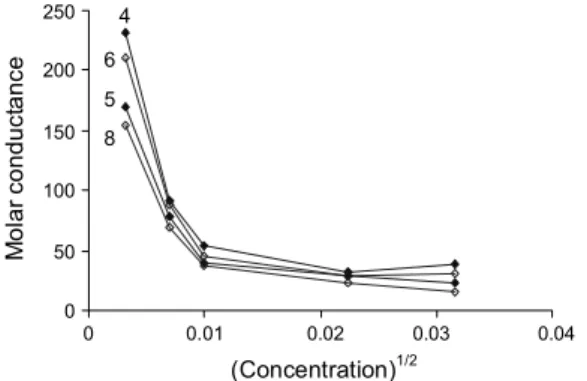
Fig. 1. Plots of molar conductance ((ΛM) ohm-1 cm2 mol-1)) against (concentration)1/2 for compounds 4, 5, 6 and 8 in DMSO solution.
Thus, it seems that energy differences between νas
(C-Te) and νs(C-Te) for (cyclo-C6H11)2Te and its de- rivatives is increased significantly in compare with other alkyl and heterocyclic tellurium compounds.7-9
1H NMR spectra of compounds 1 and 5-8 show all the expected peaks in proper intensity ratio.
The 1H NMR spectrum of compound 1 in CDCl3
shows signals due to CH2-cyclo, CH-Te and CH3- Te at δ 1.00-2.40(m), 3.81(m) and 2.45(s), respecti- vely, but as time passes (24 h) the spectrum shows two extra new signals at δ 2.16(m) and at δ 3.36(s), due to CH-Te and CH3I, respectively. This may due to methylation and demethylation equilibrium of compound 1 in CDCl3 solution and as shown in the following equation:
(cyclo-C6H11)2Te(CH3)I (cyclo-C6H11)2Te CH3I
Such behavior was also observed with other tellu- ronium salt.7,8,16,17
The molar conductivities compounds 4, 5, 6 and 8 in 10-3 M of DMSO were determined and their values approach those expected for 1:1 electrolytes (ΛM ≈ 30 ohm-1 cm2 mol-1). Plots of molar conduc- tance (ΛM) against (concentration)1/2 are typical of weak electrolytes (Fig. 1) which agree well with previous works.7,8,16,17
The thermogravimetric curve for compound 1 shows one decomposition peak at 190 oC. This loss reaches value of 48.8% (calculated 48.2%), which
points to loss C6H11I and formation of C6H11TeCH3
as a residual product. A loss at 210 oC is observed for compound 6. This effect corresponds to removal of C6H11Br (mass loss observed 43.8% compared with the calculated 43.4%). Thus, same decompo- sition pattern can be applied for both compounds.
On the other hand, compound 6 was completely evaporated at 190 oC. On heating compound 8, a massive loss occurs at 210 oC, amounting to 82.5%
(calculated 82.0%), which can be attributed to the thermal extrusion of tellurium and as residual pro- duct. Extrusion of tellurium may be promoted ther- mally18 or photochemically.19 Thus we believe that tellurium is thermally extruded from compound 8.
In conclusion, a series of new organotellurium compounds derived from dicyclohexyl telluride have been prepared in good yield and their solid decom- position and solution properties have been studied.
Acknowledgments. Authors thank Department of Chemistry, College of Science, University of Basrah for financial support.
REFERENCES
1. Zakharov, A. V.; Sadekov, I. D.; Minkin, V. I. Russ.
Chem. Rev. 2006, 75, 207.
2. Petragnani, N.; Stefani, H. A. Tellurium in Organic Synthesis, 2nd edn. Elsevier Ltd., Netherlands, 2007.
3. Lenardão, F. T.; Mendes, S. R.; Ferreira, P. C.; Perin, G.; Silveira, C. C.; Jacob, R. G. Tetrahedron Lett.
2006, 47, 7439.
4. a) Matano, Y.; Suzuki, H.; Azuma, N. Organimetallics, 1996, 15, 3760. b) Zhang, J.; Koizumi, T.; Tetrahedron Asym. 2000, 11, 3323.
5. Hirabayashi, K.; Takedo, Y.; Shimizu, T.; Kamigata, N. Synlett. 2005, 2230.
6. Hirabayashi, K.; Nara, Y.; Shimizu, T.; Kamigata, N.
Chem. Lett. 2004, 33, 1280.
7. a) Al-Rubaie, A. Z.; Al-Derawi, A. K. Heteroatom Chem. 2007, 18, 93. b) Al-Rubaie, A. Z.; Al-Najar, A. A.; Jassim, F. A. Basrah J. Sci. C, 1994, 12, 2. c) Al-Rubaie, A. Z.; Al-Najar, A. A.; Jassim, F. A. Inorg.
Chim. Acta, 1990, 175, 181.
8. a) Al-Rubaie, A. Z.; McWhinnie, W. R.; Granger, P;
Chapelle, S. J. Organomet. Chem. 1982, 234, 287. b) Al-Rubaie, A. Z.; Al-Masoudi, E. A. Heteroatom Chem. 1991, 2, 417.
디시클로헥실 텔루르염에 기반한 유기텔루로늄염의 합성과 분광학적 분석 9. Karaghiosoff, K.; Klapötke, T. M.; Krumm, B.;
Ruscitti, O. P. J. Organomet. Chem. 1999, 577, 69.
10. Singhal, K. Indian J. Chem. 1993, 24A, 429.
11. Kulkarni, Y. D.; Srivastava, S. Indian J. Chem., 1985, 32A, 542.
12. Klapotke, T. M.; Krumm, B.; Mayer, P.; Piotrowski, H.; Ruscitti, O. P. Z. Anorg. Allg. Chem. 2002, 628, 229.
13. Klapötke, T. M.; Krumm, B.; Mayer, P.; Piotrowski, H.; Ruscitti, O. P.; Schiller, A. Inorg. Chem. 2002, 41, 1184.
14. a) McWhinnie, W. R.; Mallaki, J. Polyhedron, 1982, 1, 13. b) Musa, F. H.; McWhinnie, W. R. J. Organomet.
Chem. 1978, 159, 37.
15. Dance, N. S.; McWhinnie, W. R.; Mallaki, J.; Mirzai, Z. M. J. Organomet. Chem. 1980, 198, 131.
16. a) Al-Rubaie, A. Z.; Al-Shirayada, H. A.; Auoob, A.
I. Inorg. Chim. Acta, 1988, 356, 49. b) Al-Rubaie, A.
Z.; Uemura, S.; Masuda, H. J. Organomet. Chem.
1991, 410, 309.
17. Rainville, D. P.; Zingaro, R. A. Inorg. Chim. Acta, 1984, 86, L33.
18. a) Higuchi, H.; Misumi, S. Tetrahedron Lett. 1982, 23, 5571. b) Clive, D. I. J.; Anderson, P. C.; Moss, N.; Singh, A. J. Org. Chem. 1982, 47, 1641.
19. Sadekov, I. D.; Rivkin, B. B.; Minkin, V. I. Usp. Khim.
1987, 56, 586; Russ. Chem. Rev. (Engl. Transl.), 1987, 56, 234.