Introduction
The annual incidence rate of spontaneous vertebral ar- tery dissection (VAD) has been reported at about 1 to 1.5 per 100000.3) However, the natural history of spontaneous un- ruptured VAD is not completely understood.8)
The primary presentation of spontaneous unruptured VAD is severe headache only or focal neurologic deficits caused by vertebrobasilar artery ischemia.
Unruptured VAD tends not to follow an aggressive clini- cal course, and because the prognosis tends to be favor- able, conservative treatment of these lesions has been advo- cated.5,9,11,14,17,20,24)
However, if there is the event of aneurysmal rupture, it might lead to be fatal. Therefore, complete understanding
of mechanism and pathogenesis of VAD is needed, and pa- tients with VAD need a careful follow-up.
In this retrospective review, we investigated the clinical outcomes of unruptured VAD and discuss strategies for their treatment with review of literatures.
Materials and Methods
Seven patients with headache or nuchal pain by unrup- tured VAD visited our institute between March 2011 and April 2013, were included in our investigation. Clinical data included chart of medical records and angiographic stud- ies. Age, sex, past medical history of hypertension, related trauma history, the pattern of initial presentation, functional outcome were reviewed.
Either computed tomographic angiography (CTA) or vas- cular wall magnetic resonance angiography (MRA) was performed to identify double lumen or thrombus in the ves- sel at the initial diagnosis. All patients with unruptured VAD were followed up at the outpatient clinic. Radiologic studies including CTA, magnetic resonance imaging (MRI), MRA
Clinical Experiences of Unruptured Vertebral Artery Dissection
Ji Sang Kim, MD, Jin Hwan Cheong, MD, PhD, Sang Kook Lee, MD, PhD, Jae Min Kim, MD, PhD and Choong Hyun Kim, MD, PhD
Department of Neurosurgery, Guri Hospital, College of Medicine, Hanyang University, Guri, Korea
Objective: The natural course of unruptured vertebral artery dissection remains unclear. The clinical manifestation of un- ruptured vertebral artery dissection varies from headache, focal neurologic deficits caused by ischemia to subarachnoid hemorrhage with high mortality. The purpose of this study is to investigate the clinical course of unruptured vertebral ar- tery dissection.
Methods: From March 2011 to April 2013, 7 patients with headache or nuchal pain by spontaneous vertebral artery dissec- tion visited our institute were retrospectively reviewed. Their clinical data was obtained by medical records and radiologic studies including computed tomographic angiography, magnetic resonance imaging, magnetic resonance angiography and digital subtraction angiography.
Results: No patient experienced fatal outcome by subarachnoid hemorrhage or vertebrobasilar ischemia during follow-up period. Radiologic studies also did not show the evidence of subarachnoid hemorrhage or vertebrobasilar ischemia. Follow- up angiography showed the decreased size or disappearance of aneurysm in 3 patients.
Conclusion: This study suggests that the natural course of unruptured vertebral artery dissection is not aggressive. Patients with unruptured vertebral artery dissection could be managed with conservative treatment including anticoagulants and/or
antiplatelet agents. (Korean J Neurotrauma 2013;9:69-73)
KEY WORDS: Vertebral artery dissection ㆍSubarachnoid hemorrhage ㆍDissecting aneurysm.
Received: July 15, 2013 / Revised: October 7, 2013 Accepted: October 7, 2013
Address for correspondence: Jin Hwan Cheong, MD, PhD Department of Neurosurgery, Guri Hospital, College of Medicine, Hanyang University, 153 Gyeongchun-ro, Guri 471-701, Korea Tel: +82-31-560-2324, Fax: +82-31-560-2327
E-mail: [email protected]
Korean J Neurotrauma 2013;9:69-73 http://dx.doi.org/10.13004/kjnt.2013.9.2.69
or digital subtraction angiography were performed every 1 month to 6 months, those were mostly done with CTA.
Results
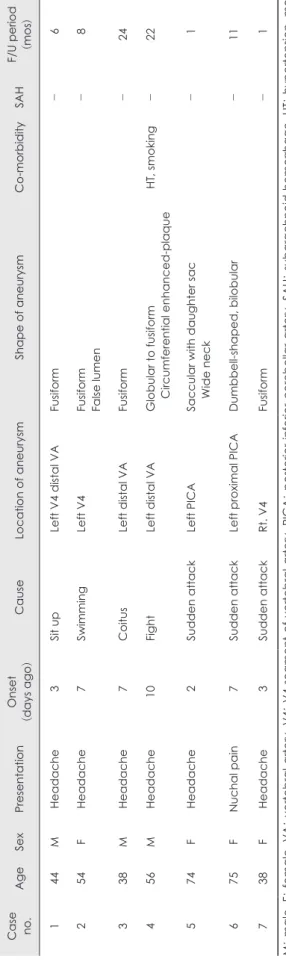
Of 7 patients with unruptured VAD, 3 were men and 4 were women. Mean age was 54.14 years (ranging from 33 to 75 years). Mean total follow-up period was 10.4 months (ranging from 1 month to 2 years). Table 1 shows the char- acteristics of the patients. Four patients had a history of pre- ceding symptoms including headache after minor trauma, and the other 3 patients were detected spontaneously.
At the time of diagnosis, 5 VAD were categorized as dis- tal vertebral artery dissection above the origin of posterior inferior cerebellar artery (PICA)(distal vertebral artery), 2 involving the PICA. No one had VAD below the origin of PICA (proximal vertebral artery).
In two patients, aneurysms showed getting smaller dur- ing follow-up period. One of them showed the complete disappearance of aneurysm. Another two patients showed unstable state of aneurysm due to change in shape during the follow-up period. They were evaluated more frequent- ly using CTA, roughly weekly base. They were also man- aged with antihypertensive and analgesics medications. In one of them with unstable aneurysm, the aneurysmal size decreased in the last follow-up study. Others show no in- terval change of size or shape of aneurysm during the fol- low-up period.
No patient experienced neurological deterioration due to subarachnoid hemorrhage or vertebrobasilar ischemia dur- ing follow-up period.
Illustrated cases Case 2
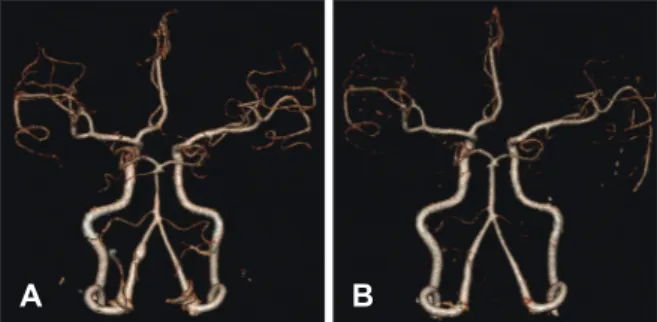
A 54-year-old woman visited outpatient clinic complain- ing intermittent headache after swimming 7 days ago. Neck CTA was taken to identify stenosis of carotid arteries and it showed a fusiform aneurysm at left V4 segment (Figure 1A). We followed up her monthly, the aneurysm disap- peared completely after 4 months (Figure 1B). Finally, in- termittent headache of the patient subsided in accordance with the disappearance of dissecting aneurysm.
Case 4
A 56-year-old male presented headache after a physical fight 10 days ago. He had a history of hypertension and heavy smoking. Brain CTA was taken in consideration of transient ischemic attack and it showed a fusiform aneurysm
TABLE 1. Clinical characteristics of the patients and location and shape of aneurysm
Case no.
AgeSexPresentationOnset
(days ago
)CauseLocation of aneurysmShape of aneurysmCo-morbiditySAHF/U period (mos
) 144MHeadache03Sit upLeft V4 distal VAFusiform-06 254FHeadache07SwimmingLeft V4
Fusiform False lumen
-08 338MHeadache07CoitusLeft distal VAFusiform-24 456MHeadache10FightLeft distal VAGlobular to fusiform Circumferential enhanced-plaqueHT, smoking-22 574FHeadache02Sudden attackLeft PICASaccular with daughter sac Wide neck-01 675FNuchal pain07Sudden attackLeft proximal PICADumbbell-shaped, bilobular-11 738FHeadache03Sudden attackRt. V4Fusiform-01 M: male, F: female, VA: vertebral artery, V4: V4 segment of vertebral artery, PICA: posterior inferior cerebellar artery, SAH: subarachnoid hemorrhage, HT: hypertension, mos:
months
at left distal vertebral artery (Figure 2A). After 5 months from initial CTA, follow-up angiography showed an increase in size and a change in shape of the aneurysm from fusi- form to globular (Figure 2B). The next follow-up angiog- raphy was done one month later, size of the aneurysm de- creased and its shape also changed from globular to fusiform (Figure 2C). Two follow-up CTAs were done during 3 months thereafter, which showed no significant change of contour or size of aneurysm. In the next follow-up studies, 14 months and 22 months from the initial one, aneurysm became small- er gradually (Figure 2D).
Discussion
VAD is a relatively uncommon disease, however, its clin- ical course is known to be somewhat devastating, with es- timated mortality to be 17-46%.1,12) VAD can occur spon- taneously or after blunt or penetrating trauma. Spontaneous VAD is the term used to describe vertebral dissections that do not involve blunt or penetrating trauma as a precipitat- ing factor. Traumatic VAD means VAD due to major blunt or penetrating traumas like motor vehicle accidents, falls or penetrating injuries. Minor trauma also causes VAD.
Mechanical stress to the arteries may be even caused by sudden head rotation in daily life.2)
The first type of VAD is partial thickness disruption. Dis- sections of vertebral arteries usually arise from an intimal tear. The internal elastic lamina is weakened and disrupt- ed with aging and long-standing hemodynamic stress. The tear allows blood under arterial pressure to enter the wall of the artery and form an intramural hematoma. The intra- mural hematoma is located within the layers of the tunica media, but it may be eccentric, either toward the intima or toward adventitia. Most of this type showed tapered narrow- ing or double lumen, and presented as vertebrobasilar ar- tery ischemia with a fair outcome. In this analysis, no patient showed the evidence of vertebrobasilar artery ischemia on radiologic evaluation.
The other type of VAD is full thickness disruption, the most common type. It shows a widespread disruption of the entire thickness of the arterial wall with the formation of a dilated pseudo-aneurysm, which consisted of thin ad- ventitia. This type of VAD appeared as subarachnoid hem- orrhage (SAH) and resulted in devastating disease with high mortality rates.8)
Most defects were located near the branching of the PICA 10 to 20 mm distal to the site of penetration of the dura ma- ter, this may be related to the development of dissection at these site.
According to Kim et al.,8) the shape of VAD was not con- siderably related to the functional outcome. There were 5 patients with fusiform aneurysm, 1 with saccular aneurysm, and 1 with dumbbell-shaped aneurysm in our analysis. All the patients had benign clinical outcomes. The shape of VAD was not significantly related to the outcome. Many studies suggested that shape of aneurysm is related to the risk of rup- ture, but those in VAD are few. More studies are needed to verify the relationship between shape of VAD and its risk.
Conventional angiography has long been the gold stan- dard in the diagnosis of VAD, since it can show the arterial lumen and allows extensive characterization of dissections of vertebral arteries. In our analysis, not all patients were FIGURE 1. Case 2. A 54-year-old woman with intermittent head-
ache after swimming. A: Initial CTA showing fusiform aneurysm at left V4 segment. B: After 4 months, the aneurysm disappeared completely. CTA: computed tomographic angiography.
A B
FIGURE 2. Case 4. A 56-year-old male with headache after a physical fight. A: Initial CTA showing fusiform aneurysm at left distal vertebral artery. B: After 5 months, increase in size and change in shape of the aneurysm from fusiform to globular. C: One month lat- er, size of the aneurysm decreased reversely and its shape changed from globular to fusiform. D: The recent CTA, aneurysm became smaller. CTA: computed tomographic angiography.
A B C D
diagnosed with conventional angiography. Conventional an- giography was done at initial presentation only in 3 cases of acute onset. But vascular wall MRI was used to diagnose in all patients. The diagnosis of dissecting aneurysm has been discussed by many authors based on angiographic findings such as “pearl and string” sign,12,16,22) fusiform,3,19) linear de- fect,4) true and false lumen (double lumen),6) and retention of the contrast medium in the venous phase.10)
Some authors reported the interval between onset of pre- ceding symptoms and bleeding episode.7,11,13,15,21,22) Those studies suggest that if 4 or more days pass without bleed- ing episodes, the prognosis of patient with unruptured VAD may be good. In our analysis, most patients visited our institute after the acute stage. Because initial angiog- raphy was performed at least several days after the onset of the preceding symptoms, most of the VADs that were un- ruptured at diagnosis already had little risk for bleeding.
There were several debates for the treatment and progno- sis of unruptured VAD, and their optimal treatment has not been established. The most important factor for treatment and prognosis was the clinical presentation of the pa- tients;9,12,14,17,19,21,23,24) SAH versus non-SAH. Therefore the treatment should be adapted to the patient’s clinical presen- tation. The VAD patients with SAH should have surgical or endovascular treatment immediately. Some studies showed that VAD patients with SAH had a high rebleeding and high mortality rate.12,18) But those without SAH, could be man- aged conservatively with antiplatelet therapy and/or anti- coagulation. Also, they tend to follow a benign clinical course.
One of the limitations of this study is small number of pa- tient and short term of follow-up period. Another limitation is that it was a retrospective analysis performed at a single center. Finally, there was no control group of unruptured VAD patients with surgical or endovascular treatment. A control group consisting of ruptured VAD patients with con- servative treatment could have also been included as well.
Conclusion
Unruptured VAD are not usually aggressive. VAD patients without SAH could be managed conservatively to prevent ischemia, and serial follow-up angiography is needed.
■ The authors have no financial conflicts of interest.
REFERENCES
1) Aoki N, Sakai T. Rebleeding from intracranial dissecting aneu- rysm in the vertebral artery. Stroke 21:1628-1631, 1990
2) Auer RN, Krcek J, Butt JC. Delayed symptoms and death after minor head trauma with occult vertebral artery injury. J Neurol
Neurosurg Psychiatry 57:500-502, 1994
3) Broom ND, Ramsey G, Mackie R, Martin BJ, Stehbens WE. A new biomechanical approach to assessing the fragility of the in- ternal elastic lamina of the arterial wall. Connect Tissue Res 30:
143-155, 1993
4) Hayes WT, Bernhardt H, Young JM. Fusiform arteriosclerotic an- eurysm of the basilar artery. Five cases including two ruptures.
Vasc Surg 1:171-178, 1967
5) Hosoya T, Adachi M, Yamaguchi K, Haku T, Kayama T, Kato T.
Clinical and neuroradiological features of intracranial vertebro- basilar artery dissection. Stroke 30:1083-1090, 1999
6) Ishikawa T, Nakamura N, Houkin K, Nomura M. Pathological consideration of a “blister-like” aneurysm at the superior wall of the internal carotid artery: case report. Neurosurgery 40:403-405;
discussion 405-406, 1997
7) Kai Y, Nishi T, Watanabe M, Morioka M, Hirano T, Yano S, et al.
Strategy for treating unruptured vertebral artery dissecting aneu- rysms. Neurosurgery 69:1085-1091; discussion 1091-1092, 2011 8) Kim CH, Son YJ, Paek SH, Han MH, Kim JE, Chung YS, et al.
Clinical analysis of vertebrobasilar dissection. Acta Neurochir (Wien) 148:395-404, 2006
9) Kitanaka C, Tanaka J, Kuwahara M, Teraoka A, Sasaki T, Takaku- ra K, et al. Nonsurgical treatment of unruptured intracranial verte- bral artery dissection with serial follow-up angiography. J Neu- rosurg 80:667-674, 1994
10) Masawa N, Glagov S, Zarins CK. Quantitative morphologic study of intimal thickening at the human carotid bifurcation: II. The compensatory enlargement response and the role of the intima in tensile support. Atherosclerosis 107:147-155, 1994
11) Mizutani T. Natural course of intracranial arterial dissections. J Neurosurg 114:1037-1044, 2011
12) Mizutani T, Aruga T, Kirino T, Miki Y, Saito I, Tsuchida T. Recur- rent subarachnoid hemorrhage from untreated ruptured vertebro- basilar dissecting aneurysms. Neurosurgery 36:905-911; discus- sion 912-913, 1995
13) Mizutani T, Kojima H, Asamoto S. Healing process for cerebral dissecting aneurysms presenting with subarachnoid hemorrhage.
Neurosurgery 54:342-347; discussion 347-348, 2004
14) Mokri B, Houser OW, Sandok BA, Piepgras DG. Spontaneous dis- sections of the vertebral arteries. Neurology 38:880-885, 1988 15) Naito I, Iwai T, Sasaki T. Management of intracranial vertebral ar-
tery dissections initially presenting without subarachnoid hem- orrhage. Neurosurgery 51:930-937; discussion 937-938, 2002 16) Nass R, Hays A, Chutorian A. Intracranial dissecting aneurysms
in childhood. Stroke 13:204-207, 1982
17) Pozzati E, Padovani R, Fabrizi A, Sabattini L, Gaist G. Benign ar- terial dissections of the posterior circulation. J Neurosurg 75:69- 72, 1991
18) Ramgren B, Cronqvist M, Romner B, Brandt L, Holtås S, Larsson EM. Vertebrobasilar dissection with subarachnoid hemorrhage: a retrospective study of 29 patients. Neuroradiology 47:97-104, 2005 19) Sakata N, Takebayashi S, Kojima M, Masawa N, Suzuki K, Takata- ma M, et al. Different roles of arteriosclerosis in the rupture of in- tracranial dissecting aneurysms. Histopathology 38:325-337, 2001 20) Sasaki O, Ogawa H, Koike T, Koizumi T, Tanaka R. A clinicopath- ological study of dissecting aneurysms of the intracranial vertebral artery. J Neurosurg 75:874-882, 1991
21) Schievink WI. Spontaneous dissection of the carotid and vertebral arteries. N Engl J Med 344:898-906, 2001
22) Tsutsumi M, Kawano T, Kawaguchi T, Kaneko Y, Ooigawa H. Dis- secting aneurysm of the vertebral artery causing subarachnoid hemorrhage after non-hemorrhagic infarction--case report. Neu- rol Med Chir (Tokyo) 40:628-631, 2000
23) Willis BK, Greiner F, Orrison WW, Benzel EC. The incidence of vertebral artery injury after midcervical spine fracture or sublux- ation. Neurosurgery 34:435-441; discussion 441-442, 1994
24) Yoshimoto Y, Wakai S. Unruptured intracranial vertebral artery dissection. Clinical course and serial radiographic imagings. Stroke 28:370-374, 1997