The Survey of Dentists: Updated Knowledge about Basic Life support and Experiences of Dental Emergency in Korea
Kyoung-Ah Cho, Hyuk Kim, Brian Seonghwa Lee, Woon-Yong Kwon*, Mi-Seon Kim, Kwang-Suk Seo, Hyun-Jeong Kim
Department of Dental Anesthesiology, School of Dentistry, Seoul National University, Seoul, *Department of Emergency Medicine, Seoul National University Hospital, Seoul, Korea
Background: Various medical emergency situations can occur during dental practices. Cardiac arrest is known to comprise approximately 1% of emergency situation. Thus, it is necessary for dentists to be able to perform cardiopulmonary resuscitation (CPR) to increase the chance of saving patient's life in emergency situation. In this paper, we conducted a survey study to evaluate to what extent dentists actually understood CPR practice and if they had experience in handling emergency situations in practice.
Method: The survey was done for members of the Korean Dental Society of Anesthesiology (KDSA), who had great interest in CPR and for whom survey-by-mail was convenient. We had selected 472 members of the KDSA with a dental license and whose office address and contact information were appropriate, and sent them a survey questionnaire by mail asking about the degree of their CPR understanding and if they had experience of handling emergency questions before. Statistical analyses –frequency analysis, chi-square test, ANOVA, and so on- were performed by use of IBM SPSS Statistics 19 for each question.
Result: Among 472 people, 181 responded (38.4% response rate). Among the respondents were 134 male and 47 female dentists. Their average age was 40.4 ± 8.4. In terms of practice type, there were 123 private practitioners (68.0%), 20 professors (11.0%), 16 dentists-in-service (8.8%), 13 residents (specialist training) (7.2%) and 9 military doctors (5%). There were 125 dentists (69.1%) who were specialists or receiving training to be specialist, most of whom were oral surgeon (57, 31.5%) and pediatric dentists (56, 30.9%). There were 153 people (85.0%) who received CPR training before, and 65 of them (35.9%) were receiving regular training. When asked about the ratio of chest pressure vs mouth-to-mouth respiration when conducting CPR, 107 people (59.1%) answered 30:2. However, only 27.1% of them answered correctly for a question regarding CPR stages, C(Circulation)- A(Airway)- B(Breathing)- D(Defibrillation), which was defined in revised 2010 CPR practice guideline. Dentists who had experience of handling emergency situations in their practice were 119 (65.6%). The kinds of emergency situations they experienced were syncope (68, 37.6%), allergic reactions to local anesthetic (44, 24.3%), hyperventilation (43, 23.8%), seizure (25, 13.8%), hypoglycemia (15, 8.3%), breathing difficulty (14, 7.8%), cardiac arrest (11, 6.1%), airway obstruction (6, 3.3%), intake of foreign material and angina pectoris (4, 2.2%), in order of frequency. Most respondents answered that they handled the situation appropriately under the given emergency situation. In terms of emergency equipment they had blood pressure device (70.2%), pulse oximetry (69.6%), Bag-Valve-Mask (56.9%), emergency medicine (41.4%), intubation kit (29.8%), automated external defibrillator (23.2%), suction kit (19.3%) and 12 people (6.6%) did not have any equipment.
In terms of confidence in handling emergency situation, with 1-10 point scale, their response was 4.86 ± 2.41 points. The average point of those who received regular training was 5.92 ± 2.20, while those who did not was 4.29 ± 2.29 points (P<0.001)
Conclusion: The result showed they had good knowledge of CPR but the information they had was not up-to-date. Also, they were frequently exposed to the risk of emergency situation during their dental practice but the level of confidence in handling the emergency situation was intermediate. Therefore, regular training of CPR to prepare them for handling emergency situation is deemed necessary.
Key Words: Basic life support; BLS; CPR; Dental emergency; Dentist
Received: 2014. 3. 26•Revised: 2014. 4. 1•Accepted: 2014. 4. 1 Corresponding Author: Kwang-Suk Seo, Department of Dental Anesthesiology, School of Dentistry, Seoul National University, 101 Daehaka-ro Jongno-gu, Seoul 110-768, Korea
Tel: +82.2.2072.0622 Fax: +82.2.766.9427 email: [email protected]
INTRODUCTION
Emergencies occurring in the dental field, include all clinical situations caused in a confined dental space for dentists, patients, dental practitioners, and parents simply brought into. Emergencies taken place in a private dental office are fainting, mild allergic reaction, angina pectoris, postural hypotension, seizures, and so on. Today, as the increase of elderly patients to receive dental care, technological development in the field of dental treatment, the growth of invasive dental procedures which result in the extension of treatment time, and dental care due to an increase in drug use, the probability of causing life-threatening emergencies is more likely to be increased [1,2].
Cardiac arrest, an infrequent emergency happening in the dental office, occurs in about 1% of the total emergency cases [1,3,4]. 4 to 6 minutes time elapse after cardiac arrest causes fatal brain injuries, so it is important to practices BLS (basic life support) activity in the place where it can save the lives of cardiac arrest cases.
Therefore, if patients receiving dental treatment or before and after and severe cardiac arrest emergency situation occurs, immediate CPR activity can delay the progression of biological death of the patients [5]. Actually, lack of professional knowledge and skills for resuscitation of nurses and doctors after a cardiac arrest was reported to influence low rates of resuscitation [6]. In particular, the insufficient performing capability of CPR from nurses, and other hospital residencies at the sight of right place can have a huge impact on the success rate of inhibiting cardiac arrest [7]. Thus, the knowledge and skills of health professionals to perform CPR is extremely important. Also, the legal and moral responsibility of emergencies occurred in the dental area are in the hands of dentists. To be prepared in case of occurring cardiac arrest in the dental field, proper knowledge and training
of how to manipulate CPR to the dentists can be essential.
In the past, exactly the education rate of CPR was not very high for dentists to be performed properly. In the survey study of 2004 targeted for dentists opened in Seoul area in Korea, dentists themselves who could undergo emergency care was 49.73% and who had exact knowledge of an showed were only 23.06% [8]. Since 2002, the KDSA has trained CPR for dentists and all of the dental colleges in Korea have adopted CPR training as a mandatory program. In addition, majority of dentists were taught CPR from institutes, hospitals, associations of Korean cardiac and lung resuscitation and other institutions. Korean Dental Association also makes varieties of effort to train CPR to the dentists more and more. Thus, the number of emergency care in the dental field is getting more and more awareness. Needs for first-aid training courses are obvious. However, the current situation of CPR training and its application degree of there have not been investigated yet. In this study, from a target for members of the KDSA, it is necessary to investigate the actual conditions of CPR training happening in Korean and want to measure the degree of how to take care of emergency situations in the dental field. In addition, compared with those who received CPR training and who did not receive one, we want to be both aware of the need for CPR training and clarify the goal of CPR education. It could be the standard for the insufficient part of CPR training learned from former educated people from the educational point. CPR guidelines in 2005, and revised version in 2010, are continually regained. It is essential to reeducate dentists in field of emergency care. The latest knowledge and technique to make a long-lasting quality improvement and management through re-education in such a way might be helpful.
SURVEY AND RESEARCH METHODS
1. Survey
Surveyed dentists who were interested in lots of knowledge of CPR and one of whom easily accessible to mail survey of all members in the KDSA, and correct office addresses and contact information of 472 people was selected. 181 people replied to the survey of the questionnaire sent by mail were analyzed.
2. Methodology
In September 2011, we have constructed a questionnaire for how much level do you know about cardiopulmonary resuscitation knowledge, how much do you know about preparedness for emergency situations.
In December 2011, Both a questionnaire and a stamped self-addressed envelope was mailed to the members and if there was no reply from the recipients, text messages and telephone calls were performed several times to receive a final reminder questionnaire responses until February 2012. We did prepare portable pocket mask package for the recipients who answer the required survey in order to increase the reply rate. The items in each question were applied to IBM SPSS Statistics 19 for each statistical analysis of the context of frequency, chi-square test, ANOVA and other statistical analyzes were performed. Statistically significant difference was meant by if p-value is less than 0.05.
RESULTS
1. Analysis of survey subjects
181 out of the 472 questionnaires were replied (38.4%
of the reply rate). Survey respondents were 134 members of male and 47 members of female, with a mean age of 40.4 ± 8.4 years. Throughout the members, less than 34 years old was 48 persons (26.5%), between 35 years
old to 39 years old were 47 ones (26.0%), between 40 years to 44 years old were 33 ones (18.2%), and less than 49 years to more than 45 years were 29 ones (16.0%), as well as more than 50 years were 24 ones (13.3%), respectively. The position of the member were 123 general practitioners (68.0%), 20 dental professors (11.0%), 16 payed-doctors (8.8%), 13 residents (7.2%), 9 military surgeons (5.0%), respectively. Residents who have received or are receiving training in dentistry were 125 persons (69.1%). Most of their positions were in the fields of the oral and maxillofacial surgery (57 persons, 31.5%) and pediatric dentistry (56 ones, 30.9%). Members who have received CPR training were 153 people (85.0%). All professors and residents had received CPR training. 79.7% of practitioners, 93.8% of payed-doctors, and 77.8% of military surgeons were experienced in CPR, respectively. Those who have received CPR training regularly were 65 patients (35.9%). Residents (10 persons, 76.9%) were the most who have received regular training. Professors (13 ones, 65%), payed-doctors (8 ones, 50%), general practitioners (32 ones, 26.9%), military surgeons (2 ones, 22.2%) were positioned in order. More than 34 years old age group had received regular CPR training.
2. Knowledge about CPR
2.1. What is the correct rate of chest compressions during CPR in adults?
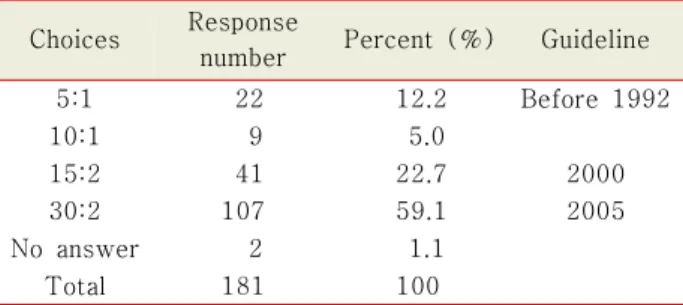
Chest compressions during cardiopulmonary resusci- tation vs. ventilation ratio are 30:2 (2005 Revision). The correct answer who gave the right one (59.1%) was 107 people (Table 1). Correct answers ever received training in cardiopulmonary resuscitation was 96 people (90.6%), and in the case of regular education were 51 people (47.7%). A significant difference has been shown to the presence of education and regular education (P = 0.018,
< 0.001, respectively).
Table 1. The results of question about the ratios of chest compressions and ventilations in CPR of adults Choices Response
number Percent (%) Guideline
5:1 22 12.2 Before 1992
10:1 9 5.0
15:2 41 22.7 2000
30:2 107 59.1 2005
No answer 2 1.1
Total 181 100
Table 2. The results of question about steps of CPR Choices Response
number
Percent
(%) Guideline A-B-C-D 126 69.1 2005 and before
C-A-B-D 49 27.1 2010
D-A-B-C 6 2.8
D-C-A-B 2 1.1
Total 181 100
Table 3. The results of question about how to perform by manually for airway patency
Choices Response
number
Percent (%)
Chin up 15 8.3
Turn the head to the side 3 1.7 Support the pillow behind the neck 0 0 Tilt the head and lift the chin up 163 90.1
Total 181 100
Table 4. The results of question about the cause of cardiac arrest
Choices Response
number
Percent (%)
Airway obstruction 81 44.8
Ventricular fibrillation 98 54.1
Traffic Accident 1 0.6
Pneumonia 0 0
Total 181 100
2.2. What is the correct order in case of CPR?
A. Airway patency B. Artificial respiration C. Chest compressions D. Defibrillation
The changed steps of CPR in revised 2010 versions are chest compressions (C) - airway patency (A) - artificial respiration (B) - Defibrillation (D). Those who replied the correct answer were 49 out of 181 (27.1%) (Table 2). Those who answer correct one were received regular training people in 30 patients (61.2%), thus one who received regular training gave in the higher percentage (P < 0.001).
2.3. What is the hand maneuver to get patients airway patency in case of patients do not breath?
In order to open airway, patient's head placed in back position and also lifting the patient's chin up (head tilt and chin lift) is the correct answer. Those who replied the answer one was 163 people (90.1%) and one of them have experienced CPR training were the 139 people (85.3%) (Table 3). There were no differences in answering the correct one whether one who have experience in presence of residency, the presence or
absence of regular training or experience in CPR training (P = 0.085, 0.748, 0.511, respectively).
2.4. Which is the most high frequent case in the cause of cardiac arrest?
Most the frequent cause of cardiac arrest is ventricular fibrillation. 98 people (54.1%) were set at the correct answer (Table 4). Those who received residency training were 73 people (79.6%) and those who did not receive the training (25 people, 20.4%) and it showed a higher percentage of correct answers for residency trainers (P
= 0.035).
3. Readiness for emergency cares
3.1. Number of experience in emergency cares After achieving the license of dentists, surveyors had experienced their dental emergencies in their clinics which were 119 people (65.6%). 1 or 2 cases of experi- encing emergencies during treatments were the most common (75 people, 41.4%). Also, more than five cases of emergency cares (22 people, 12.2%) was the 2nd place and 3 to 4 cases of them (21 people, 11.6%) were
Table 5. The kinds of experience in emergency cares
Choices Response
number
Percent (%)
Syncope 68 37.6
Allergic reactions to local anesthetic 44 24.3
Hyperventilation 43 23.8
Epilepsy 25 13.8
Hypoglycemia 15 8.3
Dyspnea 14 7.8
Cardiac arrest 11 6.1
Airway obstruction 6 3.3
Foreign body aspiration 4 2.2
Angina 4 2.2
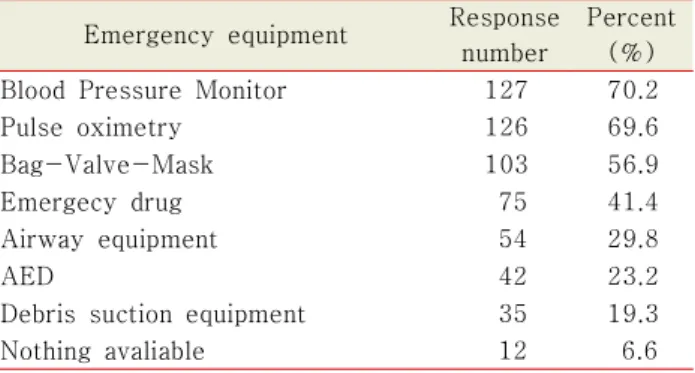
Table 6. The kind of emergency equipment in the clinic Emergency equipment Response
number
Percent (%)
Blood Pressure Monitor 127 70.2
Pulse oximetry 126 69.6
Bag-Valve-Mask 103 56.9
Emergecy drug 75 41.4
Airway equipment 54 29.8
AED 42 23.2
Debris suction equipment 35 19.3
Nothing avaliable 12 6.6
followed. Especially in the case of professors, 18 persons out of 19 surveyors had experienced in one or more of the emergency cares and professors (31.6%) and oral surgeons (33.3%) experiencing in more than five cases were often.
3.2. Kinds of experience in emergency cares The kinds of overlapping-check and the results of experiencing emergency situations are shown below (Table 5).
3.3. Technical and emergency measures We have found statistical evaluation in how to deal with emergency situations and technologies from respondents. Dealing with a faint syncope placing a patient in a supine or shock position was the most common position (34.2%). Oxygen supply (23.7%), releasing the waist belt and transferring to ER (emergency room) (11.8% each), ammonia inhalation, and shouting or screaming as well as soothing the patient (7.9% each) was in order.
In case of allergic reactions to local anesthetics, surveyors took care of patients in supplying of oxygen (each 23.8%), emergency room transfer (19.0%), dress relaxed and anti-histamines administered (each 9.5%) were in order.
Dealing with hyperventilation response was oxygen supply and utilization of reservoir bag (23.8%), posture change (19.8%), emergency room transfer (9.5%) in
order. Dealing with seizures was transfer to the emergency room (22.2%), intubation, airway patency, posture change, recall to anesthesiologists (11.1% each) in order.
Dealing with Hypoglycemia was ER transfer (50.0%), sugar supply (33.3%) in order. Dealing with dyspnea was oxygen supply (35.7%), airway patency, tracheal intu- bation, or position change (14.2% each), emergency room transfer and CPR (7.1% each) in order. Dealing with cardiac arrest was CPR (28.5%), oxygen supply, dress relaxed, emergency room transfer (each 14.2%) in order.
In the case of airway obstruction, airway tracheostomy (28.6% each), oxygen supply, CPR and emergency room transfer (14.2% each) were in order. In case of aspiration of debris, emergency room transfer (40%), spontaneous emission, and Heimlich maneuver (20% each) were in order.
3.4. Emergency equipment in the clinics A multiple choices for the response of emergency equipment were allowed and the result was shown below (Table 6).
3.5. Self-confidence in responding to emergency care Emergency treatment can be done for a proper evaluation of their own questions about the 10-point scale for an average of 4.86 ± 2.41 was the answer. The surveyors of the regular education average was 5.92 ± 2.20 and those who does not receive regular training average was 4.29 ± 2.29, the regular first aid training
to cope with the recipient's confidence was higher (P
< 0.001). In addition, those who were untrained in experience of emergency cases was 4.35 ± 2.21 than those who experienced an emergency (5.12 ± 2.49) was higher confidence (P = 0.044). Surveyors who was under the age of 34 was 4.36 ± 1.21, and age between 35 years to 39 years was 4.27 ± 0.95. Age of 40 years or older and under 44 years of age was 3.00 ± 0.73. Age of 45 years or older and under 49 years of age was 2.64 ± 0.31, Age more than 50 was 2.18 ± 0.63. This meant that the older people, the less confident they had (P <
0.001).
3.6. Willingness to be educated in responding to emergency care
Willingness to be educated in responding to emergency care was an average of 7.57 ± 2.09 out of 10 points. The degree of willing to receive a CPR training was whether or not regular training interested in the education experience showed no statistically difference (P = 0.852, 0.814).
DISCUSSION
Targeting for members in KDSA, this study evaluated the acquisition of knowledge about CPR and got an information about the actual emergency situation occurred during their dental careers. 181 surveyors out of 472 members had a reply of questionaries (38.4%).
This showed compared with a mail survey in the Germany dentist cases in 2008 resulted in 21% of reply rate that a significantly higher response [4]. This survey examined the difference between reply rate variability and other areas, but because of the study included only members in KDSA other than general dentists, both a questionnaire and a stamped self- addressed envelope was mailed to the members and if there was no reply from the recipients, text messages and telephone calls
were performed several times to receive a final reminder questionnaire responses. Besides, portable pocket mask package had provided for the recipients who answer the required survey in order to increase the reply rate.
Those who had received CPR training are 153 people (85.0%). Dentists who had opened in Seoul area were 53.46% in survey of the 2004 study [8]. However, compared with the survey of the 2005 study, those who included all the members of the Society of Pediatric Dentistry were 56% of people who utilized the sedation method in their clinics, the proportion of CPR training and their experience has been increased significantly [9].
In addition, because members of KDSA were interested in CPR training than other groups, the ratio in participated in the training is high. Also, those who were regularly receiving CPR training were 65 people (35.9%).
Dentists had high degree of knowledge of cardio- pulmonary resuscitation and those who had CPR training had shown a higher percentage of correct answers in the mail survey. However, recently a lower percentage of correct answers showed in the revised content and those who had regular education showed higher percentage of correct answers. In order to increase the survival rate of patients with cardiac arrest by performing CPR correctly and consistently, however, it is necessary to maintain technical knowledge of CPR regularly not to reduce the skills. In a study of 2008 for targeted to nurses showed after four months the decrease in natural knowledge of CPR has confirmed [10] and in a 2006 study of targeting medical students training in CPR technical skills showed until eight months the skill has been maintained, but after 26 months later it was reported that the performance of CPR was poor [11]. Thus, it is not enough to received one CPR training to maintain knowledge and performance; it is recommended being prepared in a periodic repetition. Especially, if medical practitioners learned to periodic CPR training, then
improvement and maintenance of CPR performance is said to be the most effective [12]. In addition, every 4-6 years for each CPR guidelines established by the American Heart Association (AHA) and the International Liaison Committee on Resuscitation (ILCOR) were provided [5]. As a result of changes made are in accordance with CPR training of continuous and periodic retraining may be necessary. The survey also asked questions about the recent changes in the guidelines of wrong answers chosen because much of the wrong answer was due to the majority of the revised guidelines before it. Thus, it is necessary to update the new guidelines and perform periodic training to them.
However, the interval for re-education, and research papers for each subject is so controversial, additional research is thought to be necessary about the proper training and re-education for dentists.
Since the members were becoming a dentist, those who experienced in dental emergencies were 119 people out of 181 (65.6%). This showed higher frequency of the experience in emergency cares. In a mail survey of 2001 in New Zealand, 65.2% of participants experienced an emergency situation for 10 years in their occupation [13].
In a survey conducted in Germany of 2008, 57% of dentists had experienced emergency cases 3 times for 12 months and 36% of them experienced an emergency situations 10 times, respectively [4]. Emergency situations are followed in order; syncope (68 people, 37.6%), allergic reactions to local anesthetics (44 people, 24.3%), hyperventilation (43 people, 23.8%), seizures (25 people, 13.8%), hypoglycemia (15 people, 8.3%), dyspnea (14 people, 7.8%), cardiac arrest (11 people, 6.1%), airway obstruction (6 people, 3.3%), foreign body aspiration, and angina pectoris (4 people, 2.2%). Syncope was the highest incidence (63% in 12 months) in the UK of another survey in 1999 [3]. In New Zealand of other mail survey in 2001 showed 61.1% for 10 years [13] and a
survey in 2008 from Germany appealed 57.7% for 12 months experiencing syncope [4]. However, in this study, results experienced in syncope showed a low rate than in other studies. Cardiac arrest performed in the United Kingdom survey in 1999 showed 0.3% of 12 months [3]
and a survey conducted in Germany in 2008 showed 0.3% in the 12 months [4]. The results in our study showed a significantly higher percentage than others.
The surveys of both United Kingdom and Germany was targeted at the general dentists, while this result was because our study filled the percentage of over 31.5%
whose members of the major oral surgery department in KDSA. Cardiac arrest is most often caused by the oral surgeon examined.
For dealing with emergency situations is most suitably performed in each one of the survey report being examined. A successful feature of the adequacy and proper use of the equipment depended on emergency first aid one [14]. All of the dental practitioners who are work-related medical emergencies in the fields are always ready to cope with the condition dealing with cardio- pulmonary arrest and medical emergencies. The recom- mended minimum emergency dental equipment are oropharyngeal airway apparatus, portable suction apparatus, pocket masks, Bag-Valve-Mask, face masks, oxygen cylinders, spacer for bronchodilator, AED, sterile syringe and needle, emergency drugs, and the like. In this survey sphygmomanometer (70.2%), pulse oximeter (69.6%), and Bag-Valve-Mask (56.9%), emergency medications (41.4%), airway equipment (29.8%), AED (23.2%), foreign body aspiration equipment (19.3%) were equipped in the clinics. However, there were some practitioner (12 patients, 6.6%) was not ready for any emergency equipment. In a 2005 study for Korean Pediatric Dental Society members who performing sedation, equipment is prepared with an oxygen mask and ambu bag (19.5%), emergency drugs, laryngeal
mask, first aid kit, etc (11.4%) [9]. Compared with our study, the ratio of equipment was lower. However, there were no equipment setting at all in some clinics (6.4%)(Interest and needs for sedation education was high). A study targeted at practitioners in Seoul 2004 showed first aid equipment and drugs required to be prepared was 10.41%, which was less than our study [8].
For the evaluation of confidence in the case of happening an emergency in the 10-point scale, 4.86 ± 2.41 points on average were answered. The regular training in first aid and coping with the recipient's confidence was higher. This is targeted at the general public who received a 2000 paper, retraining more confident that the results are consistent with [15]. Also, those who experienced in emergency situations with those did not showed higher in confidence. In the study of 1990, it is intended for practitioners that CPR on the experience and confidence in between real-world experience with a number of research groups that are consistent with a high confidence [16]. However, experience and confidence of CPR is high, that did not necessarily mean the accuracy of the technique. In our study, the real measure of confidence in CPR was measured; however, dealing with an emergency situation in the real life is a different matter. In fact, additional study might be performed between the measure of confidence in CPR and performance. The older a practitioner is the fewer confident in emergency situ- ations. Targeted at the general public in the study of 2011, older people to performing CPR by themselves showed a negative attitude to others, because it can be interpreted in this age there is less confidence [17]. In addition, whether regular training in CPR, except for groups of less than 34 years old, older people are getting more regular training, which can be interpreted as the effect of self-confidence.
The education degree of responding to emergency
cares in a 10-point scale were an average of 7.57 ± 2.09 points willing to get a CPR education. In the study of 2004, targeted at practitioners in the Seoul area showed the need for education relating on the prevention of accidents and maintenance measures was necessary for 98.86% and 69.53% of practitioners responded to the urgent needs of education [8].
From the results of the survey, the degree of knowledge for dentists was high. However, dentists did not update the current knowledge. Therefore, it is necessary to provide emergency care training for dentists and continue to build CPR and the ability to perform CPR on a regular basis. The inspection interval of CPR refresher training every person and papers of the period of re-education is also controversial because it is in the context of investigating the dentist, you will have to determine the appropriate interval.
Confidence with emergency situations was average.
CPR training is important; however, whether partitioners can actually do is much more important. The study did not evaluate the performance of the actual situation correctly. This survey for local dentists about CPR training which cope with emergency situations and take advantage of one of the data, the insufficient part of CPR training to improve the standard, in the future more research and discussion should be underway.
REFERENCES
1. Fast TB, Martin MD and Ellis TM: Emergency pre- paredness: a survey of dental practitioners. J Am Dent Assoc 1986; 112(4): 499-501.
2. Dym H: Preparing the dental office for medical emer- gencies. Dent Clin North Am 2008; 52(3): 605-8, x.
3. Girdler NM, Smith DG: Prevalence of emergency events in British dental practice and emergency management skills of British dentists. Resuscitation 1999; 41(2): 159-67.
4. Muller MP, Hansel M, Stehr SN, Weber S, Koch T: A state-wide survey of medical emergency management in dental practices: incidence of emergencies and training experience. Emerg Med J 2008; 25(5): 296-300.
5. Travers AH, Rea TD, Bobrow BJ, Edelson DP, Berg RA, Sayre MR, et al: Part 4: CPR overview: 2010 American Heart Association Guidelines for Cardiopulmonary Resuscitation and Emergency Cardiovascular Care. Circu- lation 2010; 122(18 Suppl 3): S676-84.
6. Inwood H: Knowledge of resuscitation. Intensive Crit Care Nurs 1996; 12(1): 33-9.
7. Ryoo JH, Jeong KU, Wee JS, Moon JM, Jun BJ, Moon WS, et al: Analysis of Cardiopulmonary Resuscitation In Ward of Tertiary Hospital. Journal of the Korean Society of Emergency Medicine 2001; 12(4): 369-78.
8. Yoon J, Kang J, Ahn H, Choi J, Kim C: A Study on Types and Counterplans of Medical Accident Experienced by Dentists in Seoul. Korean Journal of Oral Medicine 2004;
30(2): 163-89.
9. An S, Choi B, Kwak J, Kang J, Lee J: A Survey of Sedation Practices In The Korean Pediatric Dental Office. Korean Acad Pediatr Dent 2005; 32(3): 444-53.
10. Oh SI, Han S: A Study on the Sustainable Effects of Reeducation on Cardiopulmonary Resuscitation on Nurses’
Knowledge and Skills. J Korean Acad Nurs 2008; 38(3):
383-92.
11. Park JW, Sung CM, Cho YS, Choi YH, Park IC, Kim SH:
The Retraining Effect and Retention of CPR Skill in Medical Students. Journal of the Korean Society of Emergency Medicine 2006; 17(1): 8-13.
12. Park Y, Y. K, Lee W, Kim HJ, Kim Y, Jeong W, et al:
How Knowledge-only Reinforcement Can Impact Time- related Changes in Basic Life Support (BLS) Skills of Medical Students on Clinical Clerkship. Journal of the Korean Society of Emergency Medicine 2006; 17(1): 45-60.
13. Broadbent JM, Thomson WM: The readiness of New Zealand general dental practitioners for medical emer- gencies. N Z Dent J 2001; 97(429): 82-6.
14. Dyson E, Smith GB: Common faults in resuscitation equipment--guidelines for checking equipment and drugs used in adult cardiopulmonary resuscitation. Resuscitation 2002; 55(2): 137-49.
15. Atherton GJ, Pemberton MN, Thornhill MH: Medical emergencies: the experience of staff of a UK dental teaching hospital. Br Dent J 2000; 188(6): 320-4.
16. Marteau TM, Wynne G, Kaye W, Evans TR: Resus- citation: experience without feedback increases confi- dence but not skill. BMJ 1990; 300(6728): 849-50.
17. Enami M, Takei Y, Inaba H, Yachida T, Ohta K, Maeda T, et al: Differential effects of ageing and BLS training experience on attitude towards basic life support. Resus- citation 2011; 82(5): 577-83.
<Supplementary>
Survey questionnaire
A. How much do you know about CPR?Read problems and please mark only one V in .
1. What is the correct rate of chest compressions during CPR in adults?
Chest compression : Artificial respiration
5 : 1
10 : 1
15 : 2
30 : 2
2. What is the correct order in case of CPR?
A. Airway patency B. Artificial respiration C. Chest compressions D. Defibrillation A → B → C → D
C → A → B → D D → A → B → C D → C → B → A
3. What is the hand maneuver to get patients airway patency in case of patients do not breath?
Chin up
Turn the head to the side
Support the pillow behind the neck Tilt the head and lift the chin up
4. Which is the most high frequent case in the cause of cardiac arrest?
Airway obstruction Ventricular fibrillation Traffic Accident Pneumonia
5. What is the most recommended equipment in the emergency airway patency case in the dental clinic?
laryngoscope, endotracheal tube laryngeal mask
tracheotomy kit Magill forceps
6. In what year did the most recent American Heart Association guidelines for cardiopulmonary resuscitation published ?
1992 2000 2005 2010
B. How do you prepare for your emergency situations?
7. What is the number of emergency situations you have experienced during your dental treatment 0 1-2 times 3-4 times 5 times or more
8. What was the type of emergency situation you experienced? (Multiple answers possible) Syncope Allergic reactions to local anesthetic
Epilepsy Angina
Cardiac arrest Hyperventilation Hypoglycemia Other ( )
9. If you have experienced any emergency situations, what was the kind of it and how do you prepare for that situation. Please write it briefly.
--- --- 10. Are you routinely reeducate your CPR and first aid training for the dental emergency situation?
Yes □ No
11. What is your emergency equipment in the your clinic?
masks and self-inflated bag (Ambu bag) Blood Pressure Monitor
automated external defibrillator (AED) Emergency drugs (epinephrine, etc.) Airway devices (laryngeal mask, combination tube, laryngoscope)
Debris suction equipment (Magill forceps, etc.) Other ( )
12. Are you able to perform an appropriate care to the patients in case of an emergency occurs?
Never Able to
0 1 2 3 4 5 6 7 8 9 10
13. Are you willing to receive training which deals with an emergency situation?
Do not Willing to
0 1 2 3 4 5 6 7 8 9 10
14. What is your gender?
Male □Female 15. What is your age?
_____________________________________________________
16. Do you have any professional training program?
general □professional majors (Majored in: ) 17. Where is your affiliation?
General practitioners □ublic health practitioners in army □specialists Payed doctors □Professors
18. Do you have received any CPR training ever?
Yes □No