PGHN
Case Report
Benign Recurrent Intrahepatic Cholestasis with a Single Heterozygote Mutation in the ATP8B1 Gene
Yun Seok Lee, M.D., Mi Jin Kim, M.D., Ph.D., Chang Seok Ki, MD., Ph.D.*, Yoo Min Lee, M.D., Yoon Lee, M.D. and Yon Ho Choe, M.D., Ph.D.
Departments of Pediatrics and *Laboratory Medicine & Genetics, Samsung Medical Center, Sungkyunkwan University School of Medicine, Seoul, Korea
Benign recurrent intrahepatic cholestasis (BRIC) is a rare autosomal recessive inherited disorder characterized by multiple recurrent episodes of severe cholestatic jaundice without obstruction of extrahepatic bile duct. We present the case of a 7-year-old boy with BRIC confirmed by mutation analysis in the ATP8B1 gene and typical clinical manifestation. Despite inheritance of BRIC, we detected a mutation on only one allele. To our knowledge, this is the first report of BRIC with a confirmed single heterozygote novel mutation in the ATP8B1 gene in Korea. (Pediatr Gastroenterol Hepatol Nutr 2012; 15: 122∼126)
Key Words: Intrahepatic cholestasis, Single heterozygote, ATP8B1 gene
Received:May 9, 2012, Revised:June 14, 2012, Accepted:June 18, 2012
Corresponding author: Yon Ho Choe, M.D., Ph.D., Department of Pediatrics, Samsung Medical Center, Sungkyunkwan University School of Medicine, 50, Ilwon-dong, Gangnam-gu, Seoul 135-710, Korea Tel: +82-2-3410-3539, Fax: +82-3410-0043, E-mail: [email protected] Copyright ⓒ 2012 by The Korean Society of Pediatric Gastroenterology, Hepatology and Nutrition
This is an openaccess article distributed under the terms of the Creative Commons Attribution NonCommercial License (http://creativecommons.org/licenses/by-nc/3.0/) which permits unrestricted noncommercial use, distribution, and reproduction in any medium, provided the original work is properly cited.
INTRODUCTION
Benign recurrent intrahepatic cholestasis (BRIC) is a rare autosomal recessive inherited disorder char- acterized by multiple recurrent episodes of severe cholestatic jaundice without extrahepatic bile duct.
Often the diagnosis is delayed, and patients fre- quently experience invasive diagnostic procedures without any conclusions. The identification of the genes responsible for the familial intrahepatic cho- lestasis has significantly improved the under- standing of the disease and made the diagnosis of BRIC easier [1].
In Korea, BRIC patients diagnosed with typical history have been reported [2,3], but the presence of single heterozygote mutations in the ATP8B1 gene has not been described.
CASE REPORT
A male born in 2004 experienced his first choles- tatic attack at 6-months-of-age. The patient was ad- mitted with unexplained jaundice. There was no sig- nificant familial history. Immunologic and viral tests were negative. Both the 99mTc-diisopropyl iminodi- acetic acid (DISIDA) scan and liver biopsy were nor-
Fig. 1. Direct sequencing of PCR products amplified from exon 22 of the ATP8B1 gene.
The patient displayed a he- terozygote frame shift muta- tion by insertion of a nu- cleotide C at 2610_2611.
mal except for mild cholestatic features in the biopsy.
The first cholestatic episode lasted for about 6 months. Maximum total bilirubin and direct bilir- ubin were 20 mg/dL and 16.4 mg/dL, respectively, but γ-glutamyltranspeptidase (GGT) was normal.
Ursodeoxycholic acid and rifampicin were given with little effect.
Three months later (2005), the second attack de- veloped. The attack was preceded by an upper respira- tory tract infection. During this attack, ursodeox- ycholic acid and rifampicin were given with some effect. This attack ended after 3 months. Growth pa- rameters were appropriate with a body weight of 11 kg (75-90th percentile) and a length of 77 cm (50-75th percentile).
After 2 years (2007), the patient suffered a third cholestatic episode, complicated with pancreatitis.
The patient had taken herbal medicine 2 weeks prior to the episode. The total bilirubin level rose to more than 29.5 mg/dL. Maximum alkaline phosphatase (ALP), alanine aminotransferase (ALT), and GGT level was 390, 44, and 22 U/L, respectively. Amylase increased to 1,173 U/L. A computed tomography (CT) scan confirmed the diagnosis of acute pancreatitis.
Bilirubin normalized after 5 months. Despite the di- agnosis, there was a suspicion of BRIC. However, a genetic study was not performed due to lack of consent. Cholestyramine and antihistamines were given without any effect on the pruritus. In this at- tack, phenobarbital was administered in addition to
ursodeoxycholic acid, but had no effect. Growth pa- rameters were relatively small for age with a birth weight of 13.4 kg (10-25th percentile), a length of 92.9 cm (10-25th percentile). During the third attack, the patient was prepared for a liver transplantation (LT) due to severe pruritus and growth retardation.
But the bilirubin normalized after 8 months.
One year later, in 2008, the patient experienced a fourth attack, which was preceded by an acute sinusitis. Ursodeoxycholic acid and cholestyramine were given for pruritus. Subsequently, bilirubin nor- malized after 6 months.
In 2009, the patient experienced a fifth attack. At that time, a gene study was performed. Written in- formed consent was obtained. DNA was extracted from peripheral blood leukocytes as previously de- scribed [4] and the sequences of all coding exons of ATP8B1, including the exon-intron boundaries, were determined. A heterozygote frame shift mutation by insertion of a nucleotide C at 2610_2611 (p.K871Q- fsX) was detected. The results confirmed a single het- erozygote mutation in the ATP8B1 gene (Fig. 1).
According to the literature concerning the inheritance of BRIC, mutation on two alleles is necessary.
However, this patient displayed typical clinical manifestations. BRIC was diagnosed by genetic and clinical findings. This attack ended after 8 months.
In March, 2010, the patient experienced a sixth at- tack, which was complicated with pancreatitis.
Ursodeoxycholic acid and cholestyramine were giv-
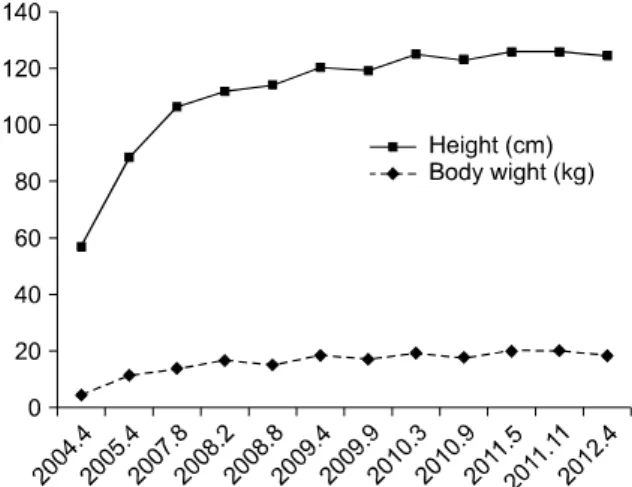
Fig. 2. Growth parameters with height and body weight. From the third attack (2007) to date, catch-up growth is not shown.
Fig. 3. The total bilirubin, direct bilirubin and GGT level changes over the patient’s natural history. Between attacks, the patient was in complete remission with no cholestasis. GGT was normal during an episode with profound cholestasis.
en early in the course. The symptoms of pruritus im- proved but total bilirubin levels reached a maximum of 34.6 mg/dL and have not normalized. At that time, growth parameters were a body weight of 13.4 kg (10-25th percentile) and a length of 92.9 cm (10-25th percentile). To date, the patient’s growth has not caught up (Fig. 2). The most recent liver ul- trasonography finding was mild hepatospleno- megaly. Although the radiologic finding was near normal, we are considering LT because of the pa- tient’s severe growth retardation.
Fig. 3 shows total bilirubin, direct bilirubin and GGT level follow-up from the third attack to date.
DISCUSSION
Progressive familial intrahepatic cholestasis (PFIC), BRIC, and intrahepatic cholestasis of preg- nancy (ICP) represent three different forms of fami- lial intrahepatic cholestasis (FIC) characterized by intrahepatic cholestasis. Inheritance is autosomal recessive. The differentiation between PFIC, BRIC, and ICP is based on phenotypic presentation [1,5].
While PFIC starts in infancy or early childhood and often leads to liver cirrhosis, BRIC usually appears later in life and has a more benign recurrent pattern [6]. BRIC was first described by Summerskill and Walshe in 1959 [7]. In 1969, Tygstrup and Jensen [8]described the condition in five young males from the Faroe Islands. It was long suspected that the con- dition was inherited, and in 1994 it was possible to show that three different patients had the same gene segment on chromosome18 [9]. In 1998, a mutation in the ATP8B1 gene on chromosome 18q21 was lo- calized [10].
The ATP8B1 gene is an aminophospholipid trans- locator (aminophospholipid flippase) localized on ca- nalicular membranes in hepatocytes and in cholan- giocytes. It is important for the normal flow of bile over the membranes, probably by maintaining an asymmetric distribution of different phospholipids between the outer and inner leaflets of the plasma membrane [11]. Deficiency of ATP8B1 may result in membrane instability, lack of cholesterol in the apical membrane, and reduced function of transmembrane transporters like the bile salt export pump (BSEP).
The BSEP is the most important transporter of bile salts into the canaliculus. Therefore, it is not surpris- ing that a malfunction can be responsible for severe cholestasis. ATP8B1 is expressed in extrahepatic tis- sues such as pancreas and small intestine. Therefore, pancreatitis and diarrhea can be present in patients [1,5]. Our patient had two attacks of pancreatitis.
To diagnose BRIC, the patient must have a mini- mum of two episodes of jaundice separated by inter-
vals of weeks to years without any symptoms or cholestasis. Typically, GGT is normal during an epi- sode with profound cholestasis. Ultrasound exami- nation and magnetic resonance cholangio-pan- creaticography do not show any abnormality. Other factors associated with cholestasis had to excluded.
This combined clinical, biochemical, radiological, and histological approach associated with liver im- munostaining and biliary lipid analysis should help to select BRIC candidates in whom a molecular diag- nosis can be proposed [12].
By the sequencing of all coding exons of ATP8B1, we detected a heterozygote frame shift mutation by insertion of a nucleotide C at 2610_2611 (p.K871Q- fsX). To date, over 50 distinct mutations in ATP8B1 have been described [4,10,13]. The mutations G308V, D554N, and I661T are among the most frequently de- tected [5]. Seventy nine percent (27 of 34 combining this and our previous studies) [10,14,15] of Western European BRIC patients harbor ATP8B1 mutations carrying at least one copy of I661T4). However, a mu- tation in p.K871QfsX has not previously been re- ported, and so represents a novel mutation.
We detected a mutation on only one allele.
Similarly, Leo et al. [4] analyzed 50 BRIC families and found three families with a mutation on single allele.
A possible explanation is that a counter allele was present but was not detected. Some mutations (e.g., large deletions) may be undetectable by the methods used or may affect regions not analyzed (viz., un- translated regions, upstream regulatory sequences, introns) [4].
BRIC is a characterized by multiple episodes of cho- lestasis without extrahepatic bile duct obstruction and without permanent liver damage. Usually, LT is not indicated. But we are considering LT in the pres- ent case due to the severe growth retardation.
Another case reported BRIC with LT due to uncon- trolled pruritus, which could not be continued for life.
The female patient underwent transplantation with- out requiring any blood transfusion and immediately became free of pruritus [16].
Our patient’s last attack has not yet terminated.
Two suppositions are possible. Our hypothesis is pos-
sibility of progression to PFIC. Occasionally BRIC will progress to the more severe and permanent form of PFIC, indicative of a clinical continuum, with inter- mediate phenotypes between mild and progressive disease [17-19]. Another hypothesis is a long dura- tion of attack. But, according to other case, attack usually lasts for 2-24 weeks [7]. So, we are more con- cerned with the possibility of progression to PFIC and are conducting frequent radiologic evaluations.
We report here a typical BRIC patient confirmed with a single heterozygote novel mutation in the ATP8B1 gene.
REFERENCES
1. Folvik G, Hilde O, Helge GO. Benign recurrent intra- hepatic cholestasis: review and long-term follow-up of five cases. Scand J Gastroenterol 2012;47:482-8.
2. Kim OY, Sung BY, Kowg GD, Yoon HS, Shin YM, Oh HT, et al. A case of nonfamilial benign recurrent intra- hepatic cholestasis. Korean J Hepatol 1998;4: 188-93.
3. Ko JS, Seo JK. The etiologies of neonatal cholestasis.
Korean J Pediatr 2007;50:835-40.
4. Klomp LW, Vargas JC, van Mil SW, Pawlikowska L, Strautnieks SS, van Eijk MJ, et al. Characterization of mutations in ATP8B1 associated with hereditary cholestasis. Hepatology 2004;40:27-38.
5. van der Woerd WL, van Mil SW, Stapelbroek JM, Klomp LW, van de Graaf SF, Houwen RH. Familial choles- tasis: progressive familial intrahepatic cholestasis, be- nign recurrent intrahepatic cholestasis and intra- hepatic cholestasis of pregnancy. Best Pract Res Clin Gastroenterol 2010;24:541-53.
6. Lykavieris P, van Mil S, Cresteil D, Fabre M, Hadchouel M, Klomp L, et al. Progressive familial intrahepatic cholestasis type 1 and extrahepatic features: no catch-up of stature growth, exacerbation of diarrhea, and appearance of liver steatosis after liver trans- plantation. J Hepatol 2003;39:447-52.
7. Summerskill WH, Walshe JM. Benign recurrent intra- hepatic "obstructive" jaundice. Lancet 1959;2:686-90.
8. Tygstrup N, Jensen B. Intermittent intrahepatic cho- lestasis of unknown etiology in five young males from the Faroe Islands. Acta Med Scand 1969;185:523-30.
9. Houwen RH, Baharloo S, Blankenship K, Raeymaekers P, Juyn J, Sandkuijl LA, et al. Genome screening by searching for shared segments: mapping a gene for be- nign recurrent intrahepatic cholestasis. Nat Genet 1994;8:380-6.
10. Bull LN, van Eijk MJ, Pawlikowska L, DeYoung JA, Juijn JA, Liao M, et al. A gene encoding a P-type ATPase mutated in two forms of hereditary cholestasis. Nat Genet 1998;18:219-24.
11. Stapelbroek JM, van Erpecum KJ, Klomp LW, Houwen RH. Liver disease associated with canalicular trans- port defects: current and future therapies. J Hepatol 2010;52:258-71.
12. Davit-Spraul A, Gonzales E, Baussan C, Jacquemin E.
Progressive familial intrahepatic cholestasis. Orpha- net J Rare Dis 2009;4:1.
13. Liu LY, Wang XH, Wang ZL, Zhu QR, Wang JS.
Characterization of ATP8B1 gene mutations and a hot-linked mutation found in Chinese children with progressive intrahepatic cholestasis and low GGT. J Pediatr Gastroenterol Nutr 2010;50:179-83.
14. Bull LN, Juijn JA, Liao M, van Eijk MJ, Sinke RJ, Stricker NL, et al. Fine-resolution mapping by hap- lotype evaluation: the examples of PFIC1 and BRIC.
Hum Genet 1999;104:241-8.
15. Tygstrup N, Steig BA, Juijn JA, Bull LN, Houwen RH.
Recurrent familial intrahepatic cholestasis in the Faeroe Islands. Phenotypic heterogeneity but genetic homogeneity. Hepatology 1999;29:506-8.
16. Mezey E, Burns C, Burdick JF, Braine HG. A case of se- vere benign intrahepatic cholestasis treated with liver transplantation. Am J Gastroenterol 2002;97:475-7.
17. van Mil SW, Klomp LW, Bull LN, Houwen RH. FIC1 dis- ease: a spectrum of intrahepatic cholestatic disorders.
Semin Liver Dis 2001;21:535-44.
18. van Ooteghem NA, Klomp LW, van Berge-Henegouwen GP, Houwen RH. Benign recurrent intrahepatic choles- tasis progressing to progressive familial intrahepatic cholestasis: low GGT cholestasis is a clinical conti- nuum. J Hepatol 2002;36:439-43.
19. van Mil SW, van der Woerd WL, van der Brugge G, Sturm E, Jansen PL, Bull LN, et al. Benign recurrent intrahepatic cholestasis type 2 is caused by mutations in ABCB11. Gastroenterology 2004;127:379-84.