Oxaliplatin-Induced Peripheral Neuropathy and Quality of Life in Patients with Digestive System Cancer
Kim, Hye Young
College of Nursing, Research Institute of Nursing Science, Chonbuk National University, Jeonju, Korea
Purpose: This study aimed to identify the levels of oxaliplatin-induced peripheral neuropathy (OXLIPN) and the quality of life (QOL) related to OXLIPN in patients with digestive system cancer. Methods: A total of 83 patients with chemotherapy-induced peripheral neuropathy (CIPN)-related symptoms participated in this study. Data were collected through self-reported questionnaire which were constructed to include general and clinical character- istics, EORTC QLQ-C30, Patient Neurotoxicity Questionnaire (PNQ), and EORTC QLQ-CIPN20. Results: The average scores of OXLIPN upper and lower extremity scale were 30.01 and 29.16, respectively. The average scores of PNQ sensory and motor scale were 2.11 and 1.70, respectively. The mean score of the QLQ-C30 global health status was 54.85, and the range of mean score of the functional and symptom subdomains was 34.85~73.29 and 17.67~53.54, respectively. The CIPN-related symptoms positively correlated with the global health status scale and all subdomains of functional scale, respectively and negatively correlated with fatigue, pain, dyspnea, insomnia, and financial problem subdomains of the symptom scale, respectively. Conclusion: Oncology nurses should pay attention and provide remedies for CIPN symptoms reported by their patients. Nursing interventions should be developed for patients with digestive system cancer to alleviate CIPN and enhance their QOL.
Key Words: Quality of life, Chemotherapy, Peripheral neuropathies, Digestive system neoplasms
Corresponding author: Kim, Hye Young
College of Nursing, Research Institute of Nursing Science, Chonbuk National University, 567 Baekje-daero, deokjin-gu, Jeonju 54896, Korea.
Tel: +82-63-270-4618, Fax: +82-82-63-270-3127, E-mail:: [email protected] Received: Mar 29, 2016 / Revised: May 20, 2016 / Accepted: Jun 20, 2016
This is an open access article distributed under the terms of the Creative Commons Attribution Non-Commercial License (http://creativecommons.org/licenses/
by-nc/3.0), which permits unrestricted non-commercial use, distribution, and reproduction in any medium, provided the original work is properly cited.
INTRODUCTION
The number of cancer patients is increasing with the in- crease in the average life expectancy. However, survival rates in cancer patients are improving at the same time ow- ing to the advancement of cancer therapies such as surgery, chemotherapy, radiation therapy, and targeted therapy.
Because of the prolonged period of survival and decreased disease severity achieved with effective cancer treatment, side effects from cancer therapies and quality of life (QOL) are becoming important outcome variables for cancer pa- tients [1,2].
Chemotherapy-induced peripheral neuropathy (CIPN) differs from carcinomatous pain owing to bone metastasis or direct pressure on nerves from nervous system infiltra- tion, and it occurs in approximately 42.0% of patients un-
dergoing chemotherapy [3]. Chemotherapy-induced pe- ripheral neuropathy is a severe complication induced in patients treated with neurotoxic chemotherapeutic drugs such as platinum compounds, vinca alkaloids, taxanes, and bortezomib [4]. Typical indolent symptoms include numbness, muscle weakness, and loss of balance, while painful symptoms are burning and tingling sensations [5].
The occurrence of these symptoms depends on the type and accumulated amount of the chemotherapeutic agent, patient age, pre-existing medical conditions such as dia- betes, and previous exposure to neurotoxic drugs [6,7].
The combination of 5-fluorouracil (5-FU) /leucovorin plus oxaliplatin (FOLFOX) is a standard regimen for the chemotherapy of metastatic digestive system cancers. The FOLFOX regimen improves the survival rate by 34.0~50.0
% for patients with progressive or metastatic digestive sys-
tem cancers; therefore, is widely used in initial treatments [8,9]. Oxaliplatin, the platinum compound which is in- cluded in the FOLFOX therapy is a recommended chemo- therapeutic agent for patients with progressive or metastatic digestive system cancers who underwent incomplete tumor resection [9]. However, oxaliplatin affects not only the ma- lignant cells, but also healthy cells, causing systemic side effects. Side effects of oxaliplatin that occurs generally are peripheral neuropathy (78.9%), neutropenia (78.9%), nau- sea (73.7%), diarrhea (56.3%) and vomiting (47.2%) and com- pare to the cisplatin in the same platinum compound affili- ation, it merely has nephrotoxicity also the toxicity of hema- tological and digestive system however, characteristically it shows acute/chronic neurologic toxicity symptoms [10].
The characteristics of oxaliplatin-induced peripheral neu- ropathy (OXLIPN) include sensory nervous pain from drug accumulation and numbness from exposure to cold; thus, the dosage of oxaliplatin is limited in certain patients [11].
OXLIPN can cause acute and chronic neurotoxic symp- toms, with the most common symptoms being dysesthesia and paresthesia induced or exacerbated by exposure to cold temperatures, accompanied by numbness, muscle cramps, spasms, stiffness, or tightness [11]. Chronic neurotoxic symp- toms include dysesthesia and paresthesia of the limbs be- tween treatment periods that are often exacerbated by drug accumulation in the body over time [5,10,11]. In the process of cancer treatment, according to the severity of peripheral neuropathy, chemotherapy should be stopped or reduced its dose as it may affect negatively to the treatment outcome so the neurologic examination and monitoring that can find neurotoxicity in its early stage is very important [4,5]. More- over, regular surveillance for OXLIPN and effective nurs- ing interventions to reduce OXLIPN are required through- out the treatment period.
OXLIPN may persist for months to years, and some- times for an entire life after chemotherapy, which makes it a major negative factor in patients' QOL [2,7,11,12]. There are ongoing studies seeking to mitigate and prevent symp- toms of OXLIPN [13] and to analyze QOL in different types of cancer patients [5,14], colorectal [11,12], breast [2], gas- trointestinal [15], and hematological malignancies [7].
However, the effects of peripheral neuropathy on the QOL of patients attributed to specific types of chemotherapy are still largely unknown.
This study aims to provide a foundation for the devel- opment of nursing interventions to reduce the symptoms of CIPN in digestive system cancer patients administered a neurotoxic chemotherapeutic drug, oxaliplatin, by in- vestigating the degree of CIPN and its relationship to QOL in a cohort of digestive system cancer patients who under-
went the FOLFOX regimen-one of the major combined chemotherapy treatments inducing CIPN.
2. Aims
This study aims to examine the degree of CIPN and QOL in digestive system cancer patients who underwent chemo- therapy including oxaliplatin and to provide fundamental data for the development of nursing interventions to relieve patients from the symptoms of OXLIPN and improve the QOL. The following is a list of more detailed aims:
To clarify the characteristics of OXLIPN symptoms;
To elucidate the difference in the degree of OXLIPN based on patients' characteristics; and
To clarify the correlation between OXLIPN and QOL.
METHODS
1. Study DesignThis study was a descriptive survey study and a secon- dary data analysis based on the study by Kim et al [16], which aimed to determine the relationship between the degree of OXLIPN and QOL in digestive system cancer patients treated with chemotherapy including oxaliplatin.
2. Participants
Patients in the study were treated at least once with FOLFOX (oxaliplatin + leucovorin + 5-FU) as adjuvant or palliative chemotherapy. Patients who had received other previous chemotherapy prior to the administration of ox- aliplatin, those with a history of neuropathy, and those less than 18 years of age were excluded from the study. A total of 83 patients with digestive system cancer under- went FOLFOX treatment, and all 83 cases were analyzed.
Digestive system cancers consisted of colorectal, gastric, biliary tract, and pancreatic cancers.
According to Cohen's sampling formula using the sam- ple size calculation program G*Power 3.1.3, 82 patients were required as the minimum sample size with a correla- tion analysis significance level of .05, a medium effect size (f) of .30, and a power of .80 [17].
3. Measurement
1) General and clinical characteristics
The questionnaire form contained 15 questions concern- ing age, sex, education, occupation, types of cancer, cancer stage, time since diagnosis, current chemotherapy, dura-
tion of CIPN, reason for the treatment, cumulative dose of oxaliplatin, presence of diabetes mellitus, hypertension, and chronic renal disease, and Eastern Cooperative Onco- logy Group performance status (ECOG PS).
2) Oxaliplatin-induced peripheral neuropathy
OXLIPN was assessed using two patient-based ques- tionnaires (the 16-item QLQ-CIPN20 [18] and the Patient Neurotoxicity Questionnaire for oxaliplatin (PNQoxalipla- tin, referred to as the PNQ from this point onwards [19]) in this study. First, OXLIPN was assessed using the 16-item QLQ-CIPN20 which was validated by Smith et al. [18]. The original tool, European organization for research and treat- ment of cancer quality of life questionnaire-chemotherapy- induced peripheral neuropathy (EORTC QLQ-CIPN20), is a submodule of the QLQ-30, which was developed by Postma et al. [20]. The module comprises 20 questions (4-point Likert scale) assessing the peripheral neuropathic side effects of chemotherapy and includes three scales as- sessing motor (8 items), sensory (9 items), and autonomic (3 items) symptoms and functioning [20]. However, a study testing the reliability and validity of the original EORTC QLQ-CIPN20 [18] identified three items in the au- tonomic symptoms subscale (dizziness, blurred vision, and erectile dysfunction) and one item (hearing-related) in the sensory symptom subscale that exhibited low correla- tions between items, which were then excluded from the original tool. A factor analysis after exclusion reorganized the questionnaire into "Lower extremity CIPN" and "Upper extremity CIPN" subscales. Hearing loss from chemothe- rapeutic agents often occurs in patients receiving ototoxic agents such as cisplatin, but it is regarded as a non-CIPN related problem because of the limited number of affected patients in this analysis. Similarly, in this study, with 72.3
% of patients being over 60 years of age, the four excluded symptoms mentioned above could arise from factors other than CIPN. Moreover, oxaliplatin has close-to-zero renal- and oto-toxicity compared to cisplatin; thus, this study evaluated only 16 of the 20 original items of the QLQ- CIPN20 tool [20] as four items were deleted during the val- idity test [18].
According to the tool's scoring guidelines, the higher the score, the higher the degree of severity of CIPN-related symptoms, with scores ranging from 0~100 [21]. Smith et al., determined the Cronbach's alpha coefficient of the 16- item QLQ CIPN 20 to be .90 (.88 in our study) for the lower extremity subscale and .91 (.87 in our study) for the upper extremity subscale [18].
Second, the PNQ developed by BioNumerik was used to measure the degree of OXLIPN [19]. The PNQ com-
prises two items that are used to identify the incidence and severity of sensory and motor dysfunction. The subjective responses to each item were graded from A (no neuro- pathy) to E (severe neuropathy) by the patients. The origi- nal PNQ was written in English and a Korean translation was used in the present study. The Korean version of the PNQ was developed using a rigorous forward and back- ward translation process with independent review by sev- eral oncologists and linguistic experts fluent in both lan- guages. The professional group consisting of three nurs- ing professors and one nurse of oncology were selected and from that, verification result of the content validity has shown that content validity coefficients were above 80% in all questions.
3) Quality of life
The QOL of patients was measured using the Korean version of EORTC quality of life questionnaire core 30 items (EORTC QLQ-C30) version 3.0 [22] which was de- veloped by the EORTC and has undergone reliability and validity testing. As a tool to investigate overall health-re- lated QOL, the EORTC QLQ-C30 consists of 2 items from a
"global health status" scale, 15 items (physical, role, emo- tional, cognitive, and social aspects) from a "functional"
scale, and 13 items (fatigue, nausea and vomiting, pain, dyspnea, insomnia, appetite loss, constipation, diarrhea, and financial problems) from a "symptom" scale. Two items regarding health-related QOL are evaluated on a 7-point Likert scale, while the remaining 28 items are scor- ed on a 4-point scale. The degree of health related QOL was measured out of 100, according to the tool developer's calculation guidelines [21]. Higher scores in the "global health status" and "functional" scales, and lower scores in the "symptom" scale indicate higher QOL. According to a study by Yun et al., the Cronbach's alpha coefficients were all above .70, with exception of that of the "cognitive func- tion" scale which was .60 [22]; the Cronbach's alpha co- efficients from this study were .79, .88, and .81 in global health status, functional, and symptom scale, respectively.
4. Data Collection
Data were collected from January to May 2013. The pri- mary investigator and another trained research assistant collected data from inpatient and outpatient visits at the Division of Oncology of the H Hospital, It took an average of 15~20 minutes for participants to complete the survey questionnaire consisting of questions about the partic- ipants' general and clinical characteristics and three in- struments from the EORTC, QLQ-CIPN20 and QLQ-C30
and PNQ. Their medical history was acquired from the electronic medical record system.
5. Ethical Consideration
The study was reviewed and approved by the Institu- tional Review Boards (IRB) of the C National University Hospital, located in J Province (IRB No. 2012-148) prior to commencement. Participants signed on written consent after being informed about the study purpose, voluntary participation, benefits of participating in this study, possi- bility of termination, directions for completing the ques- tionnaire, and expected time required to complete the questionnaire. Compensation was provided to the parti- cipants.
6. Data Analysis
The statistical software package SPSS/WIN 22.0 (SPSS Inc., Chicago, IL, USA) was used for data analysis. A two- tailed p-value of less than .05 was considered statistically significant. The characteristics of the patients were calcu- lated as frequencies and percentages. The OXLIPN and QOL levels of the patients were used to calculate the means and standard deviations of the group. OXLIPN levels were analyzed via t-test and ANOVA, and Scheffe's meth- od was used for post-hoc analysis. The relationships be- tween OXLIPN and QOL of patient were analyzed using Pearson's correlation.
RESULTS
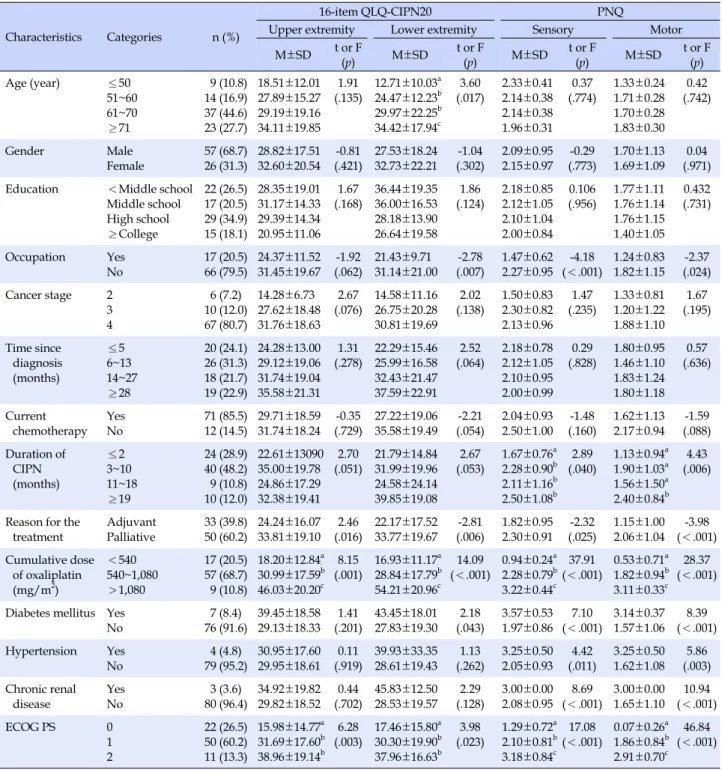
1. General and Clinical Characteristics The general and clinical characteristics of the patients are outlined in Table 1. With an average age of 64.14 years, 37 patients (44.6%) were in their 60's and 23 patients (27.7
%) were over 70 years of age. There were 57 male patients (68.7%), and 44 patients (53.0%) had at least a high-school education. Moreover, 66 patients (79.5%) were unemploy- ed. Sixty-seven patients (80.7%) had stage 4 cancer, and 10 (12.0%) had stage 3 cancer. There were 46 patients (56.4%) diagnosed within the previous year, and 71 patients (85.5
%) were under chemotherapy inducing peripheral neuro- pathy at the time of the questionnaire. There were 64 pa- tients (77.1%) with CIPN duration of less than 10 months, and more than half patients (60.0%) were on palliative care. The cumulative dose of oxaliplatin was 780.78 mg/m2 on average. There were 7 patients with diabetes (8.4%), 4 patients with high blood pressure (4.8%), and 3 patients
with chronic kidney disease (3.6%). The majority of the pa- tients (60.2%) had an ECOG PS (Eastern Cooperative On- cology Group Performance Status) of 1.
2. Characteristics of OXLIPN Symptoms The frequency and percentage of participants under FOLFOX treatment who responded, "Strongly agree" or
"Agree" on the 16-item QLQ-CIPN20 are outlined in Table 2. The two items with the highest frequency in the "upper extremity" subscale were, "Did you have cramps in your hands?" and "Did you have numbness in your fingers or hands?" with 36 (43.4%) and 32 (38.6%) responses, respec- tively. In the "lower extremity" subscale, "Did you have cramps in your feet?" and "Did you have numbness in your toes or feet?" had the highest frequencies, with 39 (47.0%) and 36 (43.4%) patients, respectively.
The characteristics of OXLIPN symptoms measured with the PNQ revealed that 46 patients indicated Grade B toxicity for the sensory nerves (55.4%), and 26 (31.3%), 5 (6.0%), and 2 (2.4%) patients indicated Grades C, D, and E, respectively. In terms of the motor nerves, Grade B toxicity was observed in 35 patients (42.2%), while Grades C, D, and E were observed in 26 (31.3%), 5 (6.0%), and 1 (1.2%) patients, respectively.
3. OXLIPN Symptoms and Health-related QOL Scores
The OXLIPN scores, measured using the 16-item QLQ- CIPN20, of the patients in this study were 30.01±18.47 and 29.16±19.59 in the upper and lower extremity subscales, respectively. The PNQ scores of the sensory and motor subscales were 2.11±0.95 and 1.70±1.11, respectively. The health-related QOL scores of the global health status show- ed as 54.85±30.21 and the score of functional scale by sub- domain showed the highest in the emotional domain as 73.29±26.21 while the physical domain was shown as low- est as 34.85±20.17. The score of symptom scale by sub- domain showed the highest in fatigue domain as 53.54±
28.62 while the nausea and vomiting domain was shown as lowest as 17.67±22.89 (Table 3).
4. Mean Differences in OXLIPN according to Patient Characteristics
The OXLIPN scores according to patients' character- istics showed a significant difference for reason for the treatment (t=-2.46, p=.016), cumulative dose of oxaliplatin (F=8.15, p=.001), and ECOG PS (F=6.28, p=.003) in the up-
Table 1. Mean Differences in OXLIPN according to General and Clinical Characteristics (N=83)
Characteristics Categories n (%)
16-item QLQ-CIPN20 PNQ
Upper extremity Lower extremity Sensory Motor
M±SD t or F
(p) M±SD t or F
(p) M±SD t or F
(p) M±SD t or F
(p)
Age (year) ≤50
51~60 61~70
≥71
9 (10.8) 14 (16.9) 37 (44.6) 23 (27.7)
18.51±12.01 27.89±15.27 29.19±19.16 34.11±19.85
1.91 (.135)
12.71±10.03a 24.47±12.23b 29.97±22.25b 34.42±17.94c
3.60 (.017)
2.33±0.41 2.14±0.38 2.14±0.38 1.96±0.31
0.37 (.774)
1.33±0.24 1.71±0.28 1.70±0.28 1.83±0.30
0.42 (.742)
Gender Male
Female
57 (68.7) 26 (31.3)
28.82±17.51 32.60±20.54
-0.81 (.421)
27.53±18.24 32.73±22.21
-1.04 (.302)
2.09±0.95 2.15±0.97
-0.29 (.773)
1.70±1.13 1.69±1.09
0.04 (.971) Education <Middle school
Middle school High school
≥College
22 (26.5) 17 (20.5) 29 (34.9) 15 (18.1)
28.35±19.01 31.17±14.33 29.39±14.34 20.95±11.06
1.67 (.168)
36.44±19.35 36.00±16.53 28.18±13.90 26.64±19.58
1.86 (.124)
2.18±0.85 2.12±1.05 2.10±1.04 2.00±0.84
0.106 (.956)
1.77±1.11 1.76±1.14 1.76±1.15 1.40±1.05
0.432 (.731)
Occupation Yes No
17 (20.5) 66 (79.5)
24.37±11.52 31.45±19.67
-1.92 (.062)
21.43±9.71 31.14±21.00
-2.78 (.007)
1.47±0.62 2.27±0.95
-4.18 (<.001)
1.24±0.83 1.82±1.15
-2.37 (.024) Cancer stage 2
3 4
6 (7.2) 10 (12.0) 67 (80.7)
14.28±6.73 27.62±18.48 31.76±18.63
2.67 (.076)
14.58±11.16 26.75±20.28 30.81±19.69
2.02 (.138)
1.50±0.83 2.30±0.82 2.13±0.96
1.47 (.235)
1.33±0.81 1.20±1.22 1.88±1.10
1.67 (.195)
Time since diagnosis (months)
≤5 6~13 14~27
≥28
20 (24.1) 26 (31.3) 18 (21.7) 19 (22.9)
24.28±13.00 29.12±19.06 31.74±19.04 35.58±21.31
1.31 (.278)
22.29±15.46 25.99±16.58 32.43±21.47 37.59±22.91
2.52 (.064)
2.18±0.78 2.12±1.05 2.10±0.95 2.00±0.99
0.29 (.828)
1.80±0.95 1.46±1.10 1.83±1.24 1.80±1.18
0.57 (.636)
Current chemotherapy
Yes No
71 (85.5) 12 (14.5)
29.71±18.59 31.74±18.24
-0.35 (.729)
27.22±19.06 35.58±19.49
-2.21 (.054)
2.04±0.93 2.50±1.00
-1.48 (.160)
1.62±1.13 2.17±0.94
-1.59 (.088) Duration of
CIPN (months)
≤2 3~10 11~18
≥19
24 (28.9) 40 (48.2) 9 (10.8) 10 (12.0)
22.61±13090 35.00±19.78 24.86±17.29 32.38±19.41
2.70 (.051)
21.79±14.84 31.99±19.96 24.58±24.14 39.85±19.08
2.67 (.053)
1.67±0.76a 2.28±0.90b 2.11±1.16b 2.50±1.08b
2.89 (.040)
1.13±0.94a 1.90±1.03a 1.56±1.50a 2.40±0.84b
4.43 (.006)
Reason for the treatment
Adjuvant Palliative
33 (39.8) 50 (60.2)
24.24±16.07 33.81±19.10
2.46 (.016)
22.17±17.52 33.77±19.67
-2.81 (.006)
1.82±0.95 2.30±0.91
-2.32 (.025)
1.15±1.00 2.06±1.04
-3.98 (<.001) Cumulative dose
of oxaliplatin (mg/m2)
<540 540~1,080
>1,080
17 (20.5) 57 (68.7) 9 (10.8)
18.20±12.84a 30.99±17.59b 46.03±20.20c
8.15 (.001)
16.93±11.17a 28.84±17.79b 54.21±20.96c
14.09 (<.001)
0.94±0.24a 2.28±0.79b 3.22±0.44c
37.91 (<.001)
0.53±0.71a 1.82±0.94b 3.11±0.33c
28.37 (<.001)
Diabetes mellitus Yes No
7 (8.4) 76 (91.6)
39.45±18.58 29.13±18.33
1.41 (.201)
43.45±18.01 27.83±19.30
2.18 (.043)
3.57±0.53 1.97±0.86
7.10 (<.001)
3.14±0.37 1.57±1.06
8.39 (<.001) Hypertension Yes
No
4 (4.8) 79 (95.2)
30.95±17.60 29.95±18.61
0.11 (.919)
39.93±33.35 28.61±19.43
1.13 (.262)
3.25±0.50 2.05±0.93
4.42 (.011)
3.25±0.50 1.62±1.08
5.86 (.003) Chronic renal
disease
Yes No
3 (3.6) 80 (96.4)
34.92±19.82 29.82±18.52
0.44 (.702)
45.83±12.50 28.53±19.57
2.29 (.128)
3.00±0.00 2.08±0.95
8.69 (<.001)
3.00±0.00 1.65±1.10
10.94 (<.001)
ECOG PS 0
1 2
22 (26.5) 50 (60.2) 11 (13.3)
15.98±14.77a 31.69±17.60b 38.96±19.14b
6.28 (.003)
17.46±15.80a 30.30±19.90b 37.96±16.63b
3.98 (.023)
1.29±0.72a 2.10±0.81b 3.18±0.84c
17.08 (<.001)
0.07±0.26a 1.86±0.84b 2.91±0.70c
46.84 (<.001)
OXLIPN=oxaliplatin-induced peripheral neuropathy; 16-item QLQ-CIPN20=16-item quality of life questionnaire-chemotherapy-induced peripheral neuropathy; PNQ=patient neurotoxicity questionnaires; ECOG PS=Eastern Cooperative Oncology Group Performance Status.
per extremity subscale. In the lower extremity subscale, age (F=3.60, p=.017), occupation (t=-2.78, p=.007), reason for the treatment (t=-2.81, p=.006), cumulative dose of ox- aliplatin (F=14.09, p<.001), diabetes mellitus (t=2.18, p=
.043), and ECOG PS (F=3.98, p=.023) had significant dif- ferences in their scores. In the sensory and motor subscales measured with the PNQ, occupation (t=-4.18, p<.001; t=
-2.37, p=.024), duration of CIPN (F=2.89, p=.040; F=4.43, p=.006), reason for the treatment (t=-2.32, p=.025; t=-3.98, p<.001), cumulative dose of oxaliplatin (F=37.91, p<.001;
F=28.37, p<.001), diabetes mellitus (t=7.10, p<.001; t=8.39, p<.001), hypertension (t=4.42, p=.011; t=5.86, p=.003), chronic renal disease (t=8.69, p<.001; t=10.94, p<.001), and ECOG PS (F=17.08, p<.001; F=46.84, p<.001) showed
Table 2. Participants Reporting "quite a bit" or "very much" on 16-item QLQ-CIPN20 and Neurotoxic Events graded by PNQ (N=83)
Subscales Items n (%)
16-item QLQ-CIPN20 Upper extremity
Did you have tingling fingers or hands?
Did you have numbness in your fingers or hands?
Did you have shooting or burning pain in your fingers or hands?
Did you have cramps in your hands?
Did you have a problem holding a pen, which made writing difficult?
Did you have difficulty manipulating small objects with your fingers?
Did you have difficulty opening a jar or bottle because of weakness in your hands?
24 (28.9) 32 (38.6) 21 (25.3) 36 (43.4) 18 (21.7) 10 (12.0) 13 (15.7) 16-item
QLQ-CIPN20 Lower extremity
Did you have tingling toes or feet?
Did you have numbness in your toes or feet?
Did you have shooting or burning pain in your toes or feet?
Did you have cramps in your feet?
Did you have problems standing or walking because of difficulty feeling the ground under your feet?
Did you have difficulty distinguishing between hot and cold water?
Did you have difficulty walking because your feet dropped downwards?
Did you have difficulty climbing stairs or getting up out of a chair because of weakness in your legs?
If you drive a car, did you have difficulty using the pedals? (n=20)
26 (31.3) 36 (43.4) 20 (24.1) 39 (47.0) 34 (41.0) 9 (10.8) 8 (9.6) 23 (27.7)
4 (8.0)
PNQ sensory Grade A
Grade B Grade C Grade D Grade E
4 (4.9) 46 (55.4) 26 (31.3) 5 (6.0) 2 (2.4)
PNQ motor Grade A
Grade B Grade C Grade D Grade E
16 (19.3) 35 (42.2) 26 (31.3) 5 (6.0) 1 (1.2) 16-item QLQ-CIPN20=16-item quality of life questionnaire-chemotherapy-induced peripheral neuropathy; PNQ=patient neurotoxicity questionnaires.
significant score differences (Table 1).
In the post-hoc analysis, all of the upper extremity sub- scale and lower extremity subscale and PNQ sensory and PNQ motor subscales, the group with less than 540 mg/m2 of cumulative dose of oxaliplatin shows the lowest OX- LIPN scores then in order, the group of 540~1,080 mg/m2 and the group of more than 1,080 mg/m2 followed. In the upper and lower extremity subscales, a group of ECOG PS score 0 showed lower OXLIPN compare to the each group of score 1 and 2 and in the sensory and motor subscales, a group of ECOG PS score 0 showed the lowest OXLIPN scores then the group of score 1 and next score 2. Finally, the PNQ sensory subscales with less than 2 month of CIPN duration showed lower OXLIPN than the other groups with 3~10 months, 11~18 months, and 19 months or more and the PNQ motor subscales, with less than 2 month of CIPN duration, a group of 3~10 months, and 11~18 months showed lower OXLIPN score than a group of 19 months or more.
5. Correlation among the 16-item QLQ-CIPN20, PNQ, and Health-related QOL Subscales The lower extremity subscale in the 16-item QLQ-CIPN 20, PNQ sensory subscale, and PNQ motor subscale showed a negative significant correlation with the QLQ-C30 global health status subscale (r=-.71, p<.001; r=-.37, p<.001; r=
-.41, p<.001), respectively (Table 4).
The upper extremity subscale, lower extremity sub- scale, PNQ sensory subscale, and PNQ motor subscale had a negative correlation in the each of subdomain of the QLQ-C30 functional scale (range of r=-.34 to -.50; r=-.31 to -.55; r=-.31 to -.40; r=-.32 to -.49).
The upper extremity subscale, lower extremity subscale, PNQ sensory subscale, and PNQ motor subscale showed the positive correlations with fatigue (r=.51, p<.001; r=
.39, p<.001; r=.36, p=.001; r=.45, p<.001), pain (r=.34, p=
.002; r=.37, p=.001; r=.33, p=.002; r=.24, p=.013), dyspnea (r=.27, p=.012; r=.32, p=.003; r=.23, p=.035; r=.27, p=.015),
Table 3. Participants' Level of 16-item QLQ-CIPN20, PNQ
and EORTC QLQ-C30 (N=83)
Subscales Categories M±SD
16-item QLQ-CIPN20
Upper extremity Lower extremity
30.01±18.47 29.16±19.59
PNQ Sensory
Motor
2.11±0.95 1.70±1.11 EORTC QLQ-C30 Global health status scale 54.85±30.21
Functional scale Physical domain Role domain Emotional domain Cognitive domain Social domain
34.85±20.17 38.35±33.71 73.29±26.21 70.88±25.87 59.23±30.93 Symptom scale
Fatigue
Nausea & vomiting Pain
Dyspnea Insomnia Appetite loss Constipation Diarrhea
Financial problem
53.54±28.62 17.67±22.89 22.69±31.62 34.13±36.43 32.93±38.42 38.55±33.93 26.10±29.92 22.89±29.87 38.54±31.00 16-item QLQ-CIPN20=16-item quality of life questionnaire- chemotherapy-induced peripheral neuropathy;
EORTC QLQ-C30=European Organization for the Research and Treatment of Cancer quality of life questionnaire core 30 items;
PNQ=patient neurotoxicity questionnaires.
Table 4. Correlation among the 16-item QLQ-CIPN20 Subscales, PNQ Subscales, and Health-related QOL (N=83)
EORTC QLQ-C30 Categories
16-item QLQ-CIPN20 PNQ
Upper extremities Lower extremities Sensory Motor
r (p) r (p) r (p) r (p)
Global health status scales -.21 (.067) -.71 (<.001) -.37 (<.001) -.41(<.001)
Functional scales Physical domain Role domain Emotional domain Cognitive domain Social domain
-.50 (<.001) -.41 (<.001) -.42 (<.001) -.43 (<.001) -.34 (.002)
-.55 (<.001) -.49 (<.001) -.32 (.003) -.43 (<.001) -.31 (.006)
-.37 (<.001) -.40 (<.001) -.33 (.002) -.28 (.012) -.31 (.007)
-.41 (<.001) -.49 (<.001) -.38 (<.001) -.38 (<.001) -.32 (<.001)
Symptom scales Fatigue
Nausea & vomiting Pain
Dyspnea Insomnia Appetite loss Constipation Diarrhea
Financial problem
.51 (<.001) .06 (.615) .34 (.002) .27 (.012) .37 (.001) .19 (.088) .18 (.110) .18 (.610) .28 (.010)
.39 (<.001) .06 (.595) .37 (.001) .32 (.003) .39 (<.001) .07 (.509) .18 (.097) .07 (.526) .25 (.026)
.36 (.001) .07 (.531) .33 (.002) .23 (.035) .39 (<.001) .27 (<.013) .11 (.306) .10 (.355) .41 (<.001)
.45 (<.001) .02 (.914) .24 (.013) .27 (.015) .37 (.001) .17 (.121) .13 (.244) .10 (.389) .35 (.001) 16-item QLQ-CIPN20=16-item quality of life questionnaire-chemotherapy-induced peripheral neuropathy; EORTC QLQ-C30=European Organization for the Research and Treatment of Cancer quality of life questionnaire core 30 items; PNQ=patient neurotoxicity questionnaires.
insomnia (r=.37, p=.001; r=.39, p<.001; r=.39, p<.001; r=
.37, p=.001) and financial problem domains (r=.28, p=.010;
r=.25, p=.026; r=.41, p<.001; r=.35, p=.001) in the sub- domain of the QLQ-C30 symptom scale, respectively.
DISCUSSION
Chemotherapy-induced peripheral neuropathy can ne- gatively affect planned drug administration, and results in reduced QOL in cancer patients by hindering their daily activities [5]. Thus, this study sought to provide funda- mental data from which nursing interventions could be developed to help relieve symptoms from peripheral neu- ropathy in digestive system cancer patients, by investigat- ing the degree or severity of OXLIPN which is a common side effect in cancer patients treated with oxaliplatin and its relationship with QOL.
Chemotherapy-induced peripheral neuropathy is a very painful symptom in patients receiving neurotoxic chemo- therapeutic drugs, and the most frequent symptoms in- clude a "tingling sensation" and "numbness" [23]. Patients who either underwent or are currently receiving FOLFOX treatment in this study also indicated "muscle cramps" and
"numbness" of both the upper and lower extremities as their most frequent symptoms. This result supports pre- vious findings that nerve lesions associated with platinum compounds including oxaliplatin target the dorsal root ganglia, causing numbness, paresthesia, muscle spasms,
and cramps [3,11]. Moreover, the frequency and percen- tages of individual items in the 16-item QLQ-CIPN20 in- dicate that patients suffer more from symptoms in their lower extremities than from those in their upper extremi- ties. It has been shown that typical CIPN causes more fre- quent and severe symptoms in the lower extremities [7,18, 23]. Results from this study also demonstrate that OXLIPN symptoms in digestive system cancer patients receiving FOLFOX treatment follow the same trend.
Furthermore, the 16-item QLQ-CIPN20 scores for the upper and lower extremity subscales were 30.01 and 29.16, respectively. Compared to the previous study reporting up- per and lower extremity subscale scores of 31.95 and 23.16 in patients with hematological malignancies [7], upper ex- tremity scores are similar, while lower extremity scores are much higher, indicating more severe CIPN symptoms in the lower extremities.
Like above, OXLIPN symptoms for the digestive sys- tem cancer patients receiving FOLFOX treatment showed often mainly as "muscle cramps" and "numbness" symp- toms in the lower extremity than the upper extremity.
Neuropathic symptoms can be divided into the symptom with pain and without and especially the numbness is a one of chronic neuropathic symptoms without pain which increases the risk of impaired physical performance, falls and injuries [11]. Thus, oncology nurses should help pa- tients to identify potential safety hazards in their environ- ment and suggest safety, measure to help patients avoid falls and injuries [24]. Fall prevention and balance pro- grams may be available that can benefit patients with numbness in the lower extremities.
Owing to insufficient research on the measurement of OXLIPN in digestive system cancer patients who received FOLFOX using the PNQ, we compared the results from this study to previous findings based on the measurement of peripheral neuropathy severity with the QLQ-CIPN20 in patients treated with neurotoxic chemotherapeutic drugs.
The PNQ scores in the sensory and motor subscales were 2.11 and 1.70 in this study, respectively, supporting pre- vious studies and suggesting that sensory nerves are more severely affected than motor nerves [2,12,14,19]. In other words, regardless of the location of tumors-the digestive system, breast, colorectal, or blood-the symptoms were more severe in sensory nerves than in motor nerves. In this study, based on the PNQ, OXLIPN-related sensory and motor neurotoxicities greater than Grade C (moderate) were observed in 39.7% and 38.5% of patients, respec- tively, which is higher than what has been reported in the previous study [25]. Previous findings indicated a propor- tional increase in CIPN frequency and severity with in-
creasing levels of oxaliplatin accumulation [11,12]; we be- lieve that the current study involved more patients with more severe sensory and motor neurotoxicities (Grade D) owing to higher than average oxaliplatin accumulation (780 mg/m2) compared to the previous study (482 mg/m2) [24]. By its cumulative dose, the preceding study showed the most of patients with 540 mg/m2 of cumulative dose of oxaliplatin experienced OXLIPN symptoms [26]. In this study, for the cumulative dose of oxaliplatin was 780 mg/m2 in average and had 79.5% of with 540 mg/m2, it is assumed that a numbers of patients may experience the OXLIPN symptoms.
OXLPLIN scores of the participants of this research by the general and clinical characteristics shows significant score differences commonly in occupation, reason for the treatment, cumulative dose of oxaliplatin, diabetic melli- tus, and ECOG PS characteristics out of all 4 subscales - the lower extremity, upper extremity, PNQ sensory, and PNQ motor subscales. The results of this study support those previous studies [2,7,11,12] that reported that showed CIPN levels are related to age, diabetes mellitus, cumula- tive dose of oxaliplatin and exposure to neurotoxic chemo- therapeutic agents, and ECOG PS. Diabetic mellitus [12], cumulative dose of oxaliplatin [11,12], and ECOG PS [2,7]
are already generally well known the risk factors of CIPN.
That means, a diabetic patient with more cumulative ox- aliplatin dose and higher ECOG PS level shows severe CIPN symptoms. In this study, a group of without occupa- tion and with palliative chemotherapy showed severe CIPN symptoms additionally. Patients whose upper ex- tremities are affected may experience difficulty with but- toning buttons, zipping zippers, writing, cooking, or any work or home activity that requires manual dexterity. And the patients whose lower extremities are affected may ex- perience difficulty driving, walking, exercising, or engag- ing in any activity that requires mobility or balance [5,11, 27]. That means, a function of upper and lower extremity should be maintained in a certain level to maintain the work life however, 30% of participants of this study had report more severe OXLIPN symptoms of upper and low- er extremity. Thus, it is thought to be the cancer patients who experience the severe OXLIPN symptoms cannot re- tain the work life. FOLFOX therapy is administered in pur- pose of adjuvant and palliative chemotherapy and the pal- liative chemotherapy is administered to the metastatic di- gestive system cancer patients. So the body condition of the metastatic digestive system cancer patients is poor than the cancer patients who receives the adjuvant chemo- therapy [28]. This can be seen that it has a thread of con- nection with the study results [2,7] of which reported that
the cancer patients who are relatively in normal condition of activity level and body condition has less CIPN symp- toms than the cancer patients who are in less activity level.
In conclusion, it shows that the OXLIPN symptoms can be affected by variety of clinical characteristics. Therefore, the variables that led to the differential scores in the OXPLIN symptoms should be incorporated into the education and counseling materials for patients with digestive system cancers who are administered neurotoxic chemotherapeu- tic agents.
From the health-related QOL subscale of this study, scores in the "global health status", "functional", and
"symptom" scales were 54.85, 34.85~73.29, and 17.67~53.54, respectively. Previous reports on the QOL of digestive sys- tem cancer patients who received chemotherapy reported scores of 50.0, 66.7~86.7, and 0.0~44.4 in the same scales [15]. Comparing the QOL level of the participants of this study to the findings of Kato et al., [15], the global health status scale was in similar level however, we came to know that the QOL in functional and symptom scales are rela- tively low. However, the study of Kato et al., [15] included multiple chemotherapeutic drugs which caused the CIPN and also their measurement timing was different from this study which grasped the quality of life throughout the middle of use of chemotherapeutic drugs and after, thus it is considered that the interpretation of this study results require caution. Looking at the results of the other solid cancer patient who was administered the neurotoxicity anticancer medicine, studies with similar methods, includ- ing a study of colorectal cancer patients who received ox- aliplatin with scores of 59.41, 62.72~76.16, and 17.92~36.08 in the above respective scales [12], and breast cancer pa- tients who received paclitaxel with scores of 46.14, 62.43, and 22.70 in the same scales [2] indicate a comparably bet- ter "global health status" in our patients with digestive system cancers than in breast cancer patients who received paclitaxel chemotherapeutic drugs, but lower QOL scores in the "functional" and "symptom" scales. Therefore, the systematic neurological investigation of OXLIPN is re- quired for digestive system cancer patients who received FOLFOX in order to prevent reduced QOL in these patients.
It is known that there is a significant correlation between CIPN and QOL [2,7,11,12]. In this study, The OXLIPN symptoms positively correlated with the global health sta- tus scale and all subdomains of functional scale, respec- tively and negatively correlated with fatigue, pain, dysp- nea, insomnia, and financial problem subdomains of the symptom scale, respectively. These results further support previous findings indicating a significant correlation be- tween subdomains of health related QOL and CIPN. The
OXLIPN symptoms appears in the evening or the night se- verely which cause the disturb of sleep and worsen the fa- tigue [11,29]. In this study also, OXLIPN symptoms showed the correlation with fatigue, pain and insomnia subdo- mains of symptom scale. Proper analgesic drugs in bed- time may be suggested [11]. CIPN can be considered one of the factors affecting QOL; therefore, Oncology nurses should carefully assess and monitor OXLIPN in digestive system cancer patients who received neurotoxic chemo- therapeutic drugs, even prior to treatment, and attempt to improve overall health-related QOL.
The most important clinical goal in assessing the se- verity of peripheral neuropathy in CIPN patients is to iden- tify functional damage affecting daily activities. The inves- tigation of CIPN in these patients is an important factor in the decision-making process, including whether the pa- tient should continue the treatment, or whether the dose or schedule of drug administration should be altered.
Therefore, clinicians treating patients who received neu- rotoxic chemotherapeutic agents must know the basics of peripheral neuropathy, diagnose symptoms early with re- gular investigation and maintenance, and apply proper in- terventions to increase the efficiency of the treatment and improve QOL in patients.
Our study has several limitations. First, as the results of this study had concluded based on the patients with diges- tive system cancers who administered the FOLFOX ther- apy in one university hospital, it requires close pay atten- tion to generalize these results to the other study partici- pants. Second, this study was a cross-sectional study invol- ving all digestive system cancer patients under FOLFOX treatment. Therefore, a longitudinal approach involving long-term follow-up of patients with completed chemo- therapy will allow better understanding of the character- istics of CIPN in these patients.
CONCLUSION
The most severely painful symptom that the digestive system cancer patients' complaint was sensory neuropa- thy and concretely there were"muscle cramps" and "numb- ness" in both the upper and lower extremities. Major com- plaints about sensory neuropathy from the patients mean the necessity of preventive nursing intervention to pre- vent the injury due to burn, blister or fall of patients.
Surely, not only the nurses but the patients themselves al- so need to be aware of and be prepared for.
Moreover, patients who received FOLFOX exhibited lower functional and symptom QOL compared to patients who received different types of drugs, and there was a cor-
relation between health-related QOL and OXLIPN in di- gestive system cancer patients. When give help to improve the QOL for the digestive system cancer patients who ad- ministered FOLFOX, the CIPN has to be considered along with. In addition, using this study as a basis, we suggest that more detailed and well-structured studies should be performed to understand the characteristics of CIPN and QOL that are associated with certain cancer types or che- motherapeutic drugs.
REFERENCES
1. Sasane M, Tencer T, French A, Maro T, Beusterien KM. Pati- ent-reported outcomes in chemotherapy-induced peripheral neuropathy: A review. The Journal of Supportive Oncology.
2010;8(6):e15-e21.
http://dx.doi.org/10.1016/j.suponc.2010.09.029
2. Kim HY, Kang JH, Song CE, Youn HJ. Chemotherapy-induced Peripheral Neuropathy and Quality of Life in Breast Cancer Patients. Asian Oncology Nursing. 2013;13(4):222-30.
http://dx.doi.org/10.5388/aon.2013.13.4.222
3. Woo IS. Recent updates on chemotherapy-induced peripheral neuropathy. The Korean Journal of Medicine. 2015;88(1):35-7.
http://dx.doi.org/10.3904/kjm.2015.88.1.35
4. Azhary H, Farooq MU, Bhanushali M, Majid A, Kassab MY.
Peripheral neuropathy: differential diagnosis and management.
American Family Physician. 2010;81(7):887-92.
5. Tofthagen C. Patient perceptions associated with chemothe- rapy-induced peripheral neuropathy. Clinical Journal of Onco- logy Nursing. 2010;14(3):E22-8.
http://dx.doi.org/10.1188/10.CJON.E22-E28
6. Dunlap B, Paice JA. Chemotherapy-induced peripheral neuro- pathy: a need for standardization in measurement. Journal of Supportive Oncology. 2006;4:398-9.
7. Song CE, Kim HY, Lee ES. Relationship between chemothe- rapy-induced peripheral neuropathy and quality of life in patients with hematological malignancies. Korean Journal of Adult Nursing. 2015;27(3):358-66.
http://dx.doi.org/10.7475/kjan.2015.27.3.358
8. Jung SH, Kim SH, Kim JH. Clinical correlation between in vitro chemoresponse assay and first line chemotherapy for meta- static colorectal cancer patients. Korean Journal of Clinical Oncology. 2015;11:51-8.
http://dx.doi.org/10.14216/kjco.15010
9. Louvet C, Andre T, Tigaud JM, Gamelin E, Douillard JY, Bru- net R, et al. Phase II study of oxaliplatin, fluorouracil, and fo- linic acid in locally advanced or metastatic gastric cancer pati- ents. Journal of Clinical Oncology. 2002;20(23):4543-8.
10. Kim H. Adjuvant chemotherapy in colorectal cancer. Korean Journal of Clinical Oncology. 2008;4(2):42-7.
11. Tofthagen C, McAllister R, McMillan SC. Peripheral neuropa- thy in patients with colorectal cancer receiving oxaliplatin. Cli- nical Journal of Oncology Nursing. 2011;15(2): 182-8.
http://dx.doi.org/10.1188/11.CJON.182-188
12. Kim JH, Choi KS, Kim TW, Hong YS. Quality of life in color- ectal cancer patients with chemotherapy-induced peripheral neuropathy. Journal of Korean Oncology Nursing. 2011;11(3):
254-62. http://dx.doi.org/10.5388/jkon.2011.11.3.254 13. Barton DL, Wos EJ, Qin R, Mattar BI, Green NB, Lanier KS, et al.
A double-blind, placebo-controlled trial of a topical treatment for chemotherapy-induced peripheral neuropathy: NCCTG trial N06CA. Supportive Care in Cancer. 2011;19(6):833-41.
http://dx.doi.org/10.1007/s00520-010-0911-0
14. Kwak MK, Kim EJ, Lee ER, Kwon IG, Hwang MS. Character- istics and quality of life in patients with chemotherapy-indu- ced peripheral neuropathy. Journal of Korean Oncology Nurs- ing. 2010;10(2):231-9.
http://dx.doi.org/10.5388/jkon.2010.10.2.231
15. Kato J, Nagahara A, Iijima K, Yoshimura M, Osada T, Yoshiza- wa T, Watanabe S. Evaluation of EORTC QLQ-C30 question- naire in patients undergoing in-hospital chemotherapy for gastrointestinal cancer in Japan. Journal of gastroenterology and hepatology. 2008;23(s2):S268-S72.
http://dx.doi.org/ 10.1111/j.1440-1746.2008.05414.x
16. Kim HY, Kang JH, Youn HJ, So HS, Song CE, Chae SY, et al.
Reliability and Validity of the Korean Version of the European Organization for Research and Treatment of Cancer Quality of Life Questionnaire to Assess Chemotherapy-induced Peripheral Neuropathy. Journal of Korean Academy of Nursing. 2014;44(6):
735-42. http://dx.doi.org/10.4040/jkan.2014.44.6.735 17. Faul F, Erdfelder E, Buchner A, Lang AG. Statistical power anal-
yses using G*Power 3.1: tests for correlation and regression analyses. Behavior Research Methods. 2009;41(4):1149-60.
http://dx.doi.org/10.3758/BRM.41.4.1149
18. Smith EM, Pang H, Cirrincione C, Fleishman S, Paskett ED, Ahles T, et al. Effect of duloxetine on pain, function, and qual- ity of life among patients with chemotherapy-induced painful peripheral neuropathy: a randomized clinical trial. Journal of the American Medical Association. 2013;309(13):1359-67.
http://dx.doi.org/10.1001/jama.2013.2813
19. Shimozuma K, Ohashi Y, Takeuchi A, Aranishi T, Morita S, Kuroi K, et al. Feasibility and validity of the Patient Neurotox- icity Questionnaire during taxane chemotherapy in a phase III randomized trial in patients with breast cancer: N-SAS BC 02.
Supportive care in cancer. 2009;17(12):1483-91.
http://dx.doi.org/10.1007/s00520-009-0613-7
20. Postma TJ, Aaronson NK, Heimans JJ, Muller MJ, Hildebrand JG, Delattre JY, et al. The development of an EORTC quality of life questionnaire to assess chemotherapy-induced peripheral neuropathy: The QLQ-CIPN20. European Journal of Cancer.
2005;41(8):1135-9.
21. Fayers PM, Aaronson NK, Bjordal K, Groenvold M, Curran D, Bottomley A, et al. The EORTC QLQ-C30 Scoring Manual , 3rd ed. Brussels: European Organization for Research and Treat- ment of Cancer; 2001.
22. Yun YH, Park YS, Lee ES, Bang SM, Heo DS, Park SY, et al.
Validation of the Korean version of the EORTC QLQ-C30.
Quality of Life Research. 2004;13(4):863-8.
23. Wolf SL, Barton DL, Qin R, Wos EJ, Sloan JA, Liu H, et al. The re- lationship between numbness, tingling, and shooting/burning pain in patients with chemotherapy-induced peripheral neuro- pathy (CIPN) as measured by the EORTC QLQ-CIPN instru- ment, N06CA. Supportive Care in Cancer. 2012;20(3):625-32..
http://dx.doi.org/10.1007/s00520-011-1141-9
24. Wickham R. chemotherapy-induced peripheral neuropathy: a review and implications for oncology nursing practice. Clini- cal Journal of Oncology Nursing. 2007;11:361-76.
http://dx.doi.org/10.1188/07.CJON.361-376
25. Yoon WK, Heo MJ, Lee OS, Lim SC. Evaluation of chemo- therapy induced peripheral neuropathy by cisplatin, carbopla- tin and oxaliplatin. Korean Journal of Clinical Pharmacology.
2012;22(4):356-66.
26. Armstrong T, Almadrones L, Gilbert MR.Chemotherapy-in- duced peripheral neuropathy. Oncology Nursing Forum. 2005;
32(2):305-11. http://dx.doi.org/10.1188/05.ONF.305-311 27. Bakitas MA. Background noise: the experience of chemothe-
rapy-induced peripheral neuropathy. Nursing research. 2007;
56(5):323-31.
http://dx.doi.org/10.1097/01.NNR.0000289503.22414.79 28. Javier NS, Montagnini ML. Rehabilitation of the hospice and
palliative care patient. Journal of Palliative Medicine. 2011;14 (5):638-48. http://dx.doi.org/10.1089/jpm.2010.0125
29. Pachman DR, Barton DL, Swetz KM, Loprinzi CL. Trouble- some symptoms in cancer survivors: fatigue, insomnia, neuro- pathy, and pain. Journal of Clinical Oncology. 2012;30(30):
3687-96. http://dx.doi.org/0.1200/JCO.2012.41.7238