Original Article: Biochemistry/Molecular Biology
Xanthine and Aldehyde Oxidase Inhibitory Activities, and Antihyperuricemic Effects of Fermented Smilax china L. Leaf Extracts and Fractions
Sang-Il Lee · Ye-Kyung Lee · Soon-Dong Kim · Jinhua Cheng · Seung Hwan Yang · Joo-Won Suh*
발효 청미래덩굴잎 용매 추출물 및 분획물의 xanthine 및 aldehyde oxidase 저해활성과 항고요산혈증 효과
이상일·이예경·김순동·성금화·양승환·서주원*
Received: 1 August 2013 / Accepted: 16 September 2013 / Published Online: 31 March 2014
© The Korean Society for Applied Biological Chemistry 2014
Abstract To evaluate the inhibitory effect of xanthine oxidase (XO) and aldehyde oxidase (AO), and antihyperuricemic effect by Aspergillus oryzae fermented Smilax china L. leaf extracts and fractions, we observed extracted yield by each solvent, the content of total polyphenol and total flavonoid (TF), the activities of XO and AO, and serum uric acid level. Extracted yield (g/kg) by 80%
ethanol (EtOH) was 13.56, those of n-hexane, dichloromethane (DICM), ethylacetate (EtOAc) and n-butanol fraction (BuOH) were 1.35 −3.33. Furthermore, total polyphenol content (mg/g- extract) of EtOAc fraction, BuOH fraction, DICM fraction and EtOH fraction is 478.07 −501.26, 259.49−289.02, 165.03−232.27, 134.02 −196.54, respectively. Those of fermented EtOAc and DICM fraction was 4.85 and 40.74% higher than that of non- fermented fraction, respectively, while the other fermented fractions were lower than those of non-fermented fractions. And total
flavonoid content (mg/g-extract) of EtOAc fraction was higher than those of other fractions. Additionally, TF of fermented EtOAc and BuOH fraction is 10.56 and 60.17% higher, than that of fermented fraction, respectively, although those of the other fermented fractions was lower than that of non-fermented fractions.
On the other hand, XO inhibitory activities of all fermented fractions was significantly higher than that of all non-fermented fraction, while those of fermented EtOAc (75.02%) and BuOH fraction (65.59%) was markedly higher than that of non-fermented fraction (39.42 and 5.34%), respectively. In addition, AO inhibitory activities of DICM and EtOAc fraction was 81.82 and 77.93%
higher, respectively, than those of the other fractions, and those of fermented fractions as with XO were significantly higher than that of non-fermented fractions. Meanwhile, serum uric acid level (SU) of hyperuricemic control mice (HC, 6.98 mg/dL) was 1.83 folds higher than that of normal control (NC, 3.82 mg/dL).
Furthermore, SU in the group treated with EtOAc fraction decreased in a dose dependent manner compared with the allopurinol control group, although those of fermented fractions were significantly lower than those of non-fermented fractions. This study suggests that fermented Smilax china L. leaf extracts may regulate the XO and AO inhibitory activities and antihyperuricemic effect due to aglycone components from glycoside form flavonoids by fermentation of A. oryzae.
Keywords antihyperuricemic effect · aldehyde oxidase · Aspergillus oryzae · fermentation · Smilax china L. · xanthine
S.-I. LeeDept. of Food, Nutrition and Cookery, Keimyung College, Daegu 704-703, Republic of Korea
Y.-K. Lee · S.-D. Kim · J. Cheng · S. H. Yang · J.-W. Suh
Center for Nutraceutical and Pharmaceutical Materials, Myongji University, Gyeonggi-Do 449-728, Republic of Korea
J.-W. Suh
Division of Bioscience and Bioinformatics, College of Natural Science, Myongji University, Gyeonggi-Do 449-728, Republic of Korea
*Corresponding author (J.-W. Suh: [email protected])
서 론
경제성장과 더불어 식생활의 서구화에 기인되어 생활습관병으 로 알려져 있는 고혈압, 비만, 당뇨 등과 같은 대사성질환 뿐만 아니라, 암과 같은 난치성 질병의 발생율이 증가하고 있어 국 민 건강에 심각한 문제를 야기하고 있다(Hill 등, 1992). 그 중 고요산혈증은 대사성 질환의 일종으로 purine 염기의 최종 대 사산물인 요산(uric acid)의 과잉 생성 또는 배설 부진에 의해 나타나는 것으로 과잉의 요산이 관절부위 등에 결정화되어 지속 적인 통증을 유발하는 통풍(gout) (Rott과 Agudelo, 2003; Chena 등, 2011)뿐만 아니라 심혈관 질환(Leyva 등, 1997; Dawson과 Walters, 2006; Duan과 Ling, 2008), 신석증(nephrolithiasis) (Kramer과 Curhan, 2002; Shekarriz과 Stoller, 2002), 당뇨와 고혈압(Chen 등, 2001) 및 생합성 purine체들은 최종적으로 xanthine oxidoreductase (XOR)에 의해 hypoxanthine에서 xanthine 으로, 다시 요산으로 산화되어 요도로 배설된다. 일반적으로 통 풍의 90%는 소변을 통한 요산의 배설 부진에 의해 발생하며, 나머지 10%는 과잉의 요산 생산으로 발생한다(Wortmann, 2002). 만성 통풍성 관절염의 치료에는 antihyperuircemic agent 들이 이용되고 있으며(Rott와 udelo, 2003), 혈중 요산의 생성 억제제인 allopurinol 및 신장의 요산 재흡수 억제제인 probenecid 와 benzbromarone 등이 처방되고 있으나, 골수 억제와 과민반응 및 간 독성(allopurinol) (Yale 등, 1996; Horiuchi 등, 2000;
Bomalaski와 Clark, 2004)이나 간 독성 benzbromarone (Schlesinger, 2004)과 같은 부작용 때문에 사용의 제한을 받고 있어 안전한 통풍치료제의 개발이 요구되고 있다. Nagao 등(1999)은 allopurionol의 대체제로 xanthine oxidase (XO) 활성 억제능을 가진 식물성 flavonoid (TF) 들을 보고한 바 있으며 또한 Kong 등(2000; 2002) 및 Mo 등(2007)은 XO억제를 통한 hypouricemic action을 나타내는 생약들을 보고한 바 있다.
한편, aldehyde oxidase (AO)는 XO와 같이 flavin adenine dinucleotide, molybdenum 및 철-유황과 같은 보결분자단을 가 지며, 질소를 함유하는 heterocyclic compounds의 산화에 관여 (Beedham, 1987; Clarke 등, 1995; Jordan 등, 1999; Kawashima 등, 1999; Kitamura 등, 1999) 함으로서, XO의 작용과 직, 간 접적인 관련이 있다(Beedham, 1987). 뿐만 아니라 XO와 AO는 체내 내외인성 기질들의 산화 과정 중에 superoxide와 같은 활 성산소종을 생성(Mira 등, 1995; Kundu 등, 2007)하며, 특히 AO는 알코올성 간 손상의 유도(Shaw와 Jayatilleke. 1990), 고 지방 식이에 의한 지방간 생성유도(Conklin 등, 2007; Weigert 등, 2008), 지방세포의 분화(Huang과 Ichikawa, 1994; Mercader 등, 2006) 등에 관여함으로서 비만조절과 간 손상의 예방 및 항 암제 개발에 대한 표적효소로 활용되고 있다(Pryde 등, 2010;
Garattini와 Terao, 2011).
청미래덩굴 (Smilax china L.)은 세계적으로 350 여종이 주로 북아메리카와 우리나라를 비롯한 동아시아 지역에 분포하며 (Shao 등, 2007), 활엽덩굴성 관목으로 근경(토복령)은 한방에서 통풍의 치료약재로 쓰이며, 요산의 생성에 관여하는 XO활성을 억제하는 TF에 속하는 kaempfrol-7-O-β-D-glucoside (Shu 등, 2006)와 astilbin 및 3-O-methylastilbin (Guo, 2007)이 풍부하게 함유되어 있다. 그리고 EtOAc 추출물에는 chlorogenic acid, caffeic acid, polydatin, resveratrol, astillbin, rutin, oxyresveratrol 등이 함유되어 있으며, 이들 대부분이 XO의 활성을 억제하는 것으로 보고되고 있다(Chena 등, 2011). 청미래덩굴잎의 항 통
풍 효과에 대한 연구는 보이지 않으나, α-tocopherol 수준의 항 산화활성을 나타내며, kaepmpfrol 배당체인 kaempferol-7-O-α-L- rhamnopyranoside와 kaempferol-3,7-O-α-L-dirhamno-pyranoside가 함유되어 있다(Cha와 Lee, 2007). TF의 대부분은 XO와 AO에 대한 저해활성을 나타내나 배당체 상태에서는 결합된 당이 XO 또는 AO 활성 site와의 결합을 방해함으로서 그 저해활성이 감 소되는 것으로 보고되고 있으며(Hamzeh-Mivehroud, 2013), TF 의 glycoside결합을 분해시키는 방법으로 다양한 미생물을 이용 한 발효법이 한 방안으로 제시되고 있다(Lee 등, 2012). 특히 차를 포함한 식물체의 발효에 미생물을 이용하면 떫은맛이 강 하고 소화성을 떨어트리는 tannin성분을 감소시키는 동시에 catechin과 같은 polyphenol 성분을 수용성의 theaflavin과 같은 기능성을 가지는 색상성분으로 전환시키며, 동시에 TF 배당체 를 분해하여 aglycone화함으로서 기능성을 높이는 효과가 있다 (Lee 등, 2012; Hamzeh-Mivehroud, 2013).
본 연구에서는 청미래덩굴잎을 이용한 기능성 차 또는 음료 개발을 위한 일련의 연구로 Aspergillus oryzae로 발효시킨 청 미래덩굴잎의 용매별 추출물에 대하여 total polyphenol 및 total TF 함량과 토끼 간 조직으로부터 부분 정제한 XO 및 AO에 대한 저해활성 및 고요산혈증을 유도한 마우스의 혈중 요산의 함량에 미치는 영향을 비발효의 경우와 비교하였다.
재료 및 방법
재료 및 발효용 균주. 실험에 사용한 청미래덩굴(Smilax china L.)잎은 2012년 7월10일에 경기도 용인시의 야산에서 채취한 후, 40oC의 열풍건조기에서 충분히 건조시킨 후 Food Mixer (HNF- 1710, Hanil Electric Co Ltd, Korea)를 사용하여 40 mesh 입 도로 분쇄하여 polyethylene bag에 넣어 4oC에서 보관하면서 시 료로 사용하였다. 발효용 균주는 Korea Food Research Institute 에서 분양받은 Aspergillus oryzae KFRI 995를 malt extract (BactoTM, Becton, Dickinson and Co, Sparks, USA)를 사용하 여 25oC에서 7일간 진탕배양하여 108 cells/mL로 균수를 조정 하여 종균으로 사용하였다.
발효차 제조방법. 청미래덩굴잎은 수돗물로 깨끗이 세척하고 70% ethanol을 분무하여 10분간 둔 후 무균수로 2
−
3회 세척하 였으며, 5 mm 내외크기로 잘라 40oC에서 열풍건조 하였다. 충 분히 건조된 것은 Food Mixer (HNF-1710, Hanil Electric Co.Ltd., Korea)를 사용하여 40 mesh로 분쇄하였다. 발효는 시료 1 kg에 대하여 종균 배양액 100 mL의 비율로 첨가하였으며, 종균 배양액은 가수용 물과 혼합하여 총 2 L가 되게 조정하여 혼합 하여 첨가한 수분함량을 67%로 조정하였다. 발효용 상자는 70%
ethanol로 제균한 플라스틱 발효상자(가로 40×세로 60×높이 12 cm)에 두께 5 cm 정도로 펴 담은 후, polyethylene film으로 밀 봉하여 25oC에서 10일간 발효시켰다. 발효가 끝난 청미래덩굴 잎은 polypropylene bag에 담아 121oC에서 60분간 증자한 후, 45
−
50oC에서 건조시켜 발효 청미래덩굴잎을 제조하였다.추출, 분획물의 수율. 청미래덩굴잎 발효차 1 kg을 냉각관을 부 착한 추출장치에 넣어 5 L의 80% ethanol을 가하여 3시간동안 가열 추출하였다. 추출한 액은 Whatman No. 2 filter paper (Whatman International Ltd, England)로 추출여과 하는 과정을 3회 반복하여 얻은 추출물을 40oC에서 증발, 건조시켰다. 이 건 조물은 증류수에 현탁시키고 분액깔때기를 이용하여 n-hexane
(Hex), ethylacetate (EtOAc), dichloromethane (DICM) 및 n- butanol (BuOH) 및 최종적으로 남은 획분(REMSF: residual ethanol mother solution fraction) 순으로 용매별 추출 분획물을 얻었다. 각 분획물은 3회 반복하여 추출하였으며, 얻어진 각 분 획물은 40oC에서 농축하여 수율측정과 동물실험용 재료로 사용 하였고, 일부는 80% ethanol에 재 용해시켜, total polyphenol 및 total TF의 함량과 XO 및 AO 활성의 측정용 시료로 사용 하였다.
총 polyphenol 및 총 TF함량 측정. 총 polyphenol (TP) 함량은 Minussi 등 (2003)의 방법에 따라 시액 100 µL에 2% sodium carbonate 2 mL와 50% Folin-Ciocalteu reagent 100 µL를 가한 후 720 nm에서 흡광도를 측정하였으며, gallic acid (Sigma- Aldrich Co, USA)의 표준검량선에 의하여 함량을 산출하였다.
총 TF 함량은 Meda 등 (2005)의 방법에 따라 시액 0.1 mL에 2% aluminum chloride 1.6 mL와 50% 에탄올 1.5 mL를 혼합 하여 실온에서 10분간 반응시킨 다음, 415 nm에서 흡광도를 측 정하였으며, 표준품 quracetin (Sigma-Aldrich Co., USA)의 표 준검량선에 의하여 함량을 산출하였다.
Xanthine oxidase (XO) 및 aldehyde oxidase (AO)의 활성도 측정. 효소원은 Rajagopalan 등(1962) 및 Maia와 Mira (2002) 의 방법에 따라 토끼 간 조직으로부터 XO 및 AO를 추출, ammonium sulfate 분획, 투석 및 원심분리를 행하여 부분 정제 한 후, −70oC에서 보관하면서 공시하였다. 시료는 청미래덩굴잎 발효차 및 비발효차로부터 분획한 용매별 추출액을 사용하였으 며, XO 활성도는 Stirpe와 Della Corte (1969)의 방법에 따라 기질 xanthine을 요산으로의 전환 정도를 %로 나타내었으며, AO 활성도는 Rajagopalan 등(1962)의 방법에 따라 기질 NMN (N1-methyl nicotinamide)으로부터 산화된 pyridone을 300 nm에 서 측정한 다음 시료대신에 80% ethanol을 첨가한 대조구에 대 한 %로 나타내었다.
동물실험, 고요산혈증의 유도 및 혈중 요산 함량 측정. 실험동 물은 4주령의 평균체중 21
−
24 g의 ICR (Crljori: CD-1), SPF/VAF outbred mice (Orient Ltd., Korea)를 무작위로 5마리씩 13개 군으로 나누어 플라스틱 케이지에 넣은 후 기본사료인 5L79 diets (PMI Nutrition, Brentwood, LA)로 1주일간 사육하 여 환경에 적응시킨 후, 실험에 사용하였다. 실험동물의 사육과 사용 등 실험과정이, 실험이 행하여진 기관의 윤리위원회 승인 을 받았고 해당 연구기관의 윤리위원회 규정에 저촉되지 않게 실시하였다. 실험군은 기본사료만을 급여한 정상군(NC), 고요산 혈증 대조군(HC), 고요산혈증 마우스에 allopurinol (10 mg/kg)을 투여한 군(ALL), 고요산혈증 마우스에 체중 kg당 dichloromethyl fraction (600 mg/kg)을 투여한 군(DICM), 고요산혈증 마우스에 EtOAc fraction (300, 600 및 900 mg/kg)을 투여한 군(EtOAc) 및 butanol fraction (600 mg/kg)을 투여한 군(BuOH)의 13군으 로 구분하여 1주일간 실험하였다. Allopurinol을 비롯한 모든 추 출 분획물은 0.5% Na-CMC 용액에 현탁시켜, 매일 1회 오전 8시에서 9시 사이에 1회씩 1주간 경구투여 하였다. 식이와 물 은 투여 1.5시간 전에 공급을 중단하였다. 고요산혈증의 유도를 위한 uricase 저해제인 potasium oxonate (Sigma Co., USA)의 처리는 Hokazono 등 (2010)의 방법에 따라 7일째 allopurinol 및 추출분획물의 투여 1시간 전에 0.5% Na-CMC 용액에 25 mg/mL의 농도로 현탁시켜 250 mg/kg을 복강 주사하였으며, potasium oxonate 주사 3시간 후에 diethylether로 마취시킨 다 음 개복하여 하대정맥으로부터 채혈하여 분리한 혈청 내 요산
의 함량을 auto uric acid kit (YD diagonostics, Korea)를 이 용하여 분석하였다. 식이는 4oC에서 보관하면서 공급하였고, 사 육장의 온도 및 습도는 각각 23±2oC, 60±5%로, 명암주기는 12 시간 간격으로 설정하였으며, 물과 사료는 자유 섭취시켰다.
통계처리. 결과분석은 3회 반복측정 평균치와 표준편차로 나타 내었으며, 동물실험결과는 실험동물 5마리의 측정 평균치와 표 준편차로 나타내었다. 유의성 검증은 version 12의 SPSS (Statistical Package for Social Sciences, SPSS Inc, Chicago, IL, USA) software package program을 이용하여 Duncan's multiple range test와 t-test를 행하였다.
결과 및 고찰
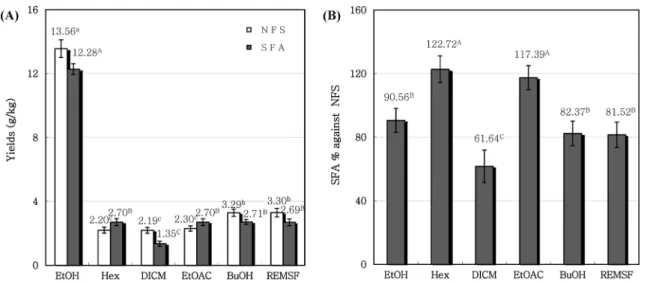
용매별 분획물의 수율. 청미래덩굴잎과 Aspergillus oryzae 균주 와의 발효 후 발효청미래덩굴잎의 용매별에 따른 추출분획물의 수율을 비발효의 경우와 비교 조사한 결과는 Fig. 1과 같다. 용 매별 수출물의 수율(g/kg)은 80% ethanol (EtOH) fraction에서는 13.56 g이었으며 Hex, dichloromethane (DICM), ethylacetate (EtOAc) 및 n-butanol (BuOH) fraction은 1.35
−
3.33 g 범위를 나 타내었다. 한편, 발효시킨 경우는 EtOH fraction은 비발효에 비 하여 약 10% 정도가 감소되었으나, Hex과 EtOAc 분획물에서는 각각 22.72 및 17.39%가 증가하였다(Fig. 1). 일반적으로 n- hexane은 지용물질을 용해시키는 용매로 발효에 따라 주로 수용 성 성분의 감소가 일어남을 알 수 있으며, EtOAc 분획물이 증 가하는 것으로 보아 발효에 의하여 ethylacete 가용성의 새로운 polyphenol 성분이 생성(Lee, 2012) 되거나 세포벽과 강하게 결 합되어 있던 polyphenol성 물질이 발효에 의하여 추출되기 쉬운 형태로 전환(Shi 등, 2012) 되는 것으로 사료된다. Chena 등 (2011)은 토복령(40 mesh)의 경우 EtOH fraction의 수율(g/kg)을 120 g으로 보고하여, 본 실험에서 사용한 잎 추출물에 비하여 약 10배 정도가 높고, BuOH (48 g)과 EtOAc 분획물(30 g)에서도 약 10배가 높은 것으로 보고하였다. 용매 추출물의 수율은 일반적 으로 품종과 재배지역, 수확시기 등에 따라 차이가 있을 뿐 아 니라, 유효성분의 함량도 상당한 차이가 있는 것으로 알려져 있다.총 polyphenol 및 총 flavonoid 함량. 용매별 추출 분획물에 함유된 총 TP 및 총 TF 함량을 조사한 결과는 Fig. 2와 같다.
TP 함량(mg/g-extract)은 EtOAc 478.07
−
501.26이고, BuOH 259.49−
289.02이며, DICM 165.03−
232.27, EtOH 134.02−
196.54 이었으며, EtOAc 및 DICM 분획추출물에서는 발효시킨 경우가 비발효에 비하여 각각 4.85 및 40.74%가 높았으나 그 외 모든 분획추출물에서는 발효시킨 경우가 낮았다(Fig. 2A). TF의 함량 은 EtOAc 분획추출물에서 11.24−
12.43%로 가장 높은 함량을 나타내었으며, EtOAc과 BuOH에서의 TF 함량은 발효시킨 경 우가 비 발효에 비하여 각각 10.56% 및 60.17%가 높았으나, 여타 분획추출물들에서는 발효시킨 경우가 낮았다(Fig. 2B). Lee 등(2012)은 발효청미래덩굴잎이 비 발효에 비하여 TF를 포함한 TP의 함량 감소율이 높으나 관능적인 품질은 향상되는 것으로 보고하였다. 본 연구에서도 각 분획추출물의 TP 및 TF 함량의 합계가 발효시킨 경우에서 낮아 동일한 결과를 보였다. 이러한 현상은 발효에 의하여 주로 polyphenol 중에서 강하며 삽미를 나타낼 뿐만 아니라, 단백질 또는 효소류와 강하게 결합함으로 서 소화작용을 떨어트리는 tannin 성분(Bennick, 2002; Lesschaeve 와 Noble, 2005)이 감소됨과 동시에 차의 발효에서와 같이 발효에 의하여 색상을 나타내는 새로운 TF가 생성되는 것으로 생 각 된다(Lee 등, 2012).
청미래덩굴의 근경인 토복령에서는 kaempfrol-7-O-β-D- glucoside (Shu 등, 2006), astilbin 및 3-O-methylastilbin (Guo, 2007), dihydrokaempferol, resveratrol, oxyresveratrol, scirpusin, kaempfrol-7-O-β-D-glucoside 및 dihydrokaempferol- 3-O-α-O-rhamnoside (Wu 등, 2010), chlorogenic acid, caffeic acid, polydatin, resveratrol, astillbin, rutin 및 oxyresveratrol (Chena 등 2011)과 같은 polyphenol 성분이 분리된 바 있다.
그리고 Cha와 Lee(2007)는 청미래덩굴잎에서 polyphenol 성분 의 가용 획분인 EtOAc의 주 성분이 glycoside 결합방식에는 차 이가 있으나, 토복령에서도 분리 된 바 있는 kaempferol-7-O-α-
L-rhamnopyranoside 및 kaempferol-3,7-O-α-L-dirhamno- pyranoside 와 같은 TF 배당체라 하였으며, 이들 성분이 발효에 의하여 aglycone화 되는 것으로 사료된다.
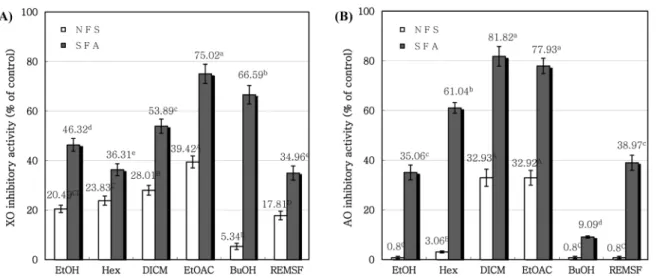
XO 및 AO에 대한 저해활성. 비발효 및 발효 청미미래덩굴잎 의 용매별 추출분획물이 토끼 간 조직으로부터 부분 정제한 XO 와 AO에 대한 저해활성을 조사한 결과는 Fig. 3과 같다. XO 저해활성은 모든 용매추출분획물에서 비발효에 비하여 발효시 킨 경우가 현저하게 높은 활성을 나타내었다. 특히 발효청미래 덩굴잎 EtOAc 및 BuOH fraction의 XO 저해활성은 각각 75.02% 및 65.59%로 비 발효 경우의 39.42% 및 5.34%에 비 하여 현저하게 높았다(Fig. 3A). AO 저해활성은 DICM과 EtOAc fraction에서 각각 81.82% 및 77.93%로 여타 fraction들 에 비하여 높았으며 XO의 경우와 마찬가지로 비발효에 비하여 발효시킨 경우의 저해활성도가 현저하게 높았다(Fig. 3B).
XO는 식이로부터 섭취되거나 체내에서 생합성 된 핵산의 대 사산물인 hypoxanthine 또는 xanthine을 요산으로 전환시키는데 관여하는 효소(Fig. 4)로 정상 생리상태에서는 NAD+를 전자수 용체로 이용하는 xanthine dehydrogenase로 작용하나 병태생리 Fig. 1 Yields of various solvent partitioned fractions from non-fermented (NFS, A) and fermented Smilax china L. leaf (SFA, B). Abbreviations: EtOH;
80% ethanol, Hex; n-hexane fraction, DICM; dichloromethane fraction, EtOAc; ethyl acetate fraction, BuOH; n-butanol fraction, REMSF; residual ethanol mother solution fraction. Values are mean ± standard deviation of triplicate determination, different letters on the bars (a−c, A−E) indicate significant differences (p <0.05).
Fig. 2 Total polyphenol (A) and total flavonoid (B) contents of various solvent partitioned fractions from non-fermented (NFS) and fermented Smilax china L. leaf (SFA). Abbreviations: See Fig. 1. Values are mean ± standard deviation of triplicate determination, different letters on the same bars (A−E, a−f) indicate significant differences (p <0.05).
학적 조건 하에서는 분자상의 O2를 전자수용체로 이용하는 XO 로 작용한다(Parks와 Granger, 1986). 한편, AO는 간, 폐, 신장 의 세포질에 존재하는 효소(Al-Salmy, 2001)로 전자공여체가 존 재할 경우에는 sulfoxides, N-oxides, nitrosamines, hydroxamic acids, azo 염료, oximes, epoxides, 방향족 nitro화합물 및 1,2- benzisoxazole 유도체의 환원에 관여함으로서 해독(Hirao 등, 1994; Sugihara 등, 1996)과 다중약물에 대한 저항성 해소에도 관여(McCrystal 등, 1999) 하나 methotrexate 또는 famciclovir 와 같은 aldehyde 또는 질소를 함유하는 heterocyclic compounds 의 산화를 촉진함으로서 약효를 감소시킬 수도 있다(Beedham, 1987; Kitamura 등, 1999). 또한 AO는 XO의 작용과 밀접한 관련이 있으며 XO가 결핍되었을 때 작용할 수 있는 것으로 알
려져 있으나 확실하게 밝혀져 있지는 않다. Tayama 등(2011)은 녹차음료가 AO의 활성에 미치는 영향을 조사한 결과 0.1% 음 료는 24.3
−
38.8%, 1% 음료는 73.9−
90.0%, 10% 음료는 90.0−
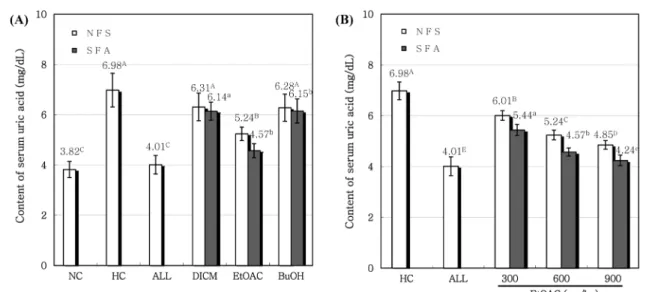
93.5%의 저해활성을 나타낸다고 하였다. 통풍의 약 90%는 신 장의 기능 부진으로 발생한다는 보고(Wortmann 2002)가 있으 나 XO의 활성화에 의하여 생성된 요산의 용해성이 낮은 특성 으로 인하여 그 정도가 더욱 심해질 수 있어 신장의 기능회복 을 위한 처방과 동시에 XO의 활성을 저해시킬 수 있는 천연제 재의 개발이 요구되고 있다.항 고요산혈증 효과. 발효 및 비발효 청미래덩굴잎 용매별 추 출 분획물 중 XO에 대한 저해활성이 높은 DICM, EtOAc 및 BuOH 분획추출물을 potassium ozonate로 유도한 고요산혈증 mouse에 1주간 투여하였을 때의 혈중 요산(SU) 함량에 미치는 영향을 조사한 결과는 Fig. 5와 같다. 고요산혈증 대조군(HC)의 SU 함량은 6.98 mg/dL로 정상대조군(NC)의 3.82 mg/dL에 비하 여 1.83배가 높았으며, DICM군(600 mg/kg) 및 BuOH군(600 mg/kg)의 경우도 각각 6.14
−
6.31 mg/dL 및 6.15−
6.28 mg/dL로 HC군의 차이를 보이지 않았다. 그러나 EtOAc (600 mg/kg) 투 여군은 비발효에서는 5.24 mg/dL, 발효에서는 4.57 mg/dL로 HC 군에 비하여 유의적인 감소를 보였으며, 비 발효군에 비하여 발 효군에서 뚜렷하게 감소하는 경향을 나타내었다(Fig. 5A). 또한, 표준 XO 저해제인 allopurinol을 투여한 경우와 유의적인 차이 를 보이지 않았다. EtOAc 분획추출물의 투여량을 300, 600 및 900 mg/kg으로 변화시켰을 때 투여량에 비례하여 SU 함량이 감 소하는 경향을 보였으며 투여군 모두에서 발효시킨 경우가 비 발효에 비하여 낮은 SU 함량을 나타내었다(Fig. 5B).이 같은 결과는 청미래덩굴의 잎에 존재하는 TF의 XO에 대 한 활성억제작용과 관련이 있는 것으로 판단된다. 이러한 결과 는 발효에 의해 주로 생성되는 polyphenol 중tannin 성분 (Bennick, 2002; Lesschaeve와 Noble, 2005)이 감소됨과 동시에 차의 발효에서와 같이 발효에 의하여 색상을 나타내는 새로운 TF가 생성되기 때문이라 판단 된다(Lee 등 2012).
Fig. 3 XO (A) and AO (B) inhibitory activities of various solvent partitioned fractions from non-fermented (NFS) and fermented Smilax china L. leaf (SFA) against XO and AO extracted and partial purified from rabbit liver. Abbreviations: See Fig. 1. Values are mean ± standard deviation of triplicate determination, different letters on the same bars (A−E, a−f) indicate significant differences (p <0.05).
Fig. 4 Metabolismic pathway of uric acid. Abbreviations: IMP; inosine monophosphate, AMP; adenosine monophosphate, GMP; guanosine monophosphate, XOR; xanthine oxidoreductase, AO; aldehyde oxidase.
초 록
Aspergillus oryzae로 발효시킨 청미래덩굴잎 용매추출분획물의 xanthine oxidase (XO) 및 aldehyde oxidase (AO) 저해활성과 항고요산혈증에 미치는 영향을 조사하였다. 용매별 추출수율(g/kg) 은 80% ethanol (EtOH)은 13.56이었으며, n-hexane, dichloromethane (DICM), ethylacetate (EtOAc) 및 n-butanol fraction (BuOH) 은 1.35
−
3.33 범위였다. Total polyphenol 함량(mg/g-extract)은 EtOAc fraction 478.07−
501.26, BuOH fraction 259.49−
289.02, DICM fraction 165.03−
232.27, EtOH fraction 134.02−
196.54 이었으며 EtOAc 및 DICM fraction에서는 발효시킨 경우가 비 발효에 비하여 각각 4.85 및 40.74%가 높았으나 그 외 모든 fraction에서는 발효시킨 경우가 낮았다.총 flavonoid 함량은 EtOAc fraction이 여타 fraction에 비하 여 높았다. EtOAc 및 BuOH fraction의 TF 함량은 발효시킨 경우가 비 발효에 비하여 각각 10.56% 및 60.17%가 높았으나 여타 fraction들에서는 발효시킨 경우가 낮았다. XO 저해활성은 모든 분획물에서 발효시킨 경우가 비발효에 비하여 현저하게 높 았으며 EtOAc 및 BuOH fraction의 경우 발효시킨 경우는 각 각 75.02 및 65.59%로 비발효 경우 39.42 및 5.34% 보다 현 저하게 높았다. AO 저해활성은 DICM과 EtOAc fraction에서 각각 81.82 및 77.93%로 여타 fraction들에 비하여 높았으며 XO의 경우와 마찬가지로 발효시킨 경우가 비발효에 비하여 현 저하게 높았다. 고요산혈증 mouse의 혈중 요산(SU) 함량에 미 치는 영향을 조사한 결과, 고요산혈증 대조군의 SU 함량은 6.98 mg/dL로 정상대조군 (NC)의 3.82 mg/dL에 비하여 1.83배가 높 았으나, EtOAc fraction은 투여량에 의존적으로 SU의 함량이 감소하였으며, 발효시킨 경우가 비발효에 비하여 유의적인 감소 를 보였다. 이상의 결과, A. oryzae와 청미래덩굴잎의 발효과정 을 통해, glycoside형태의 flavonoid를 aglycone화하여 비발효에 비해 높은 XO 및 AO 저해활성과 함께 항고요산혈증 효과를 나타내는 것으로 사료된다.
Keywords 발효·아스페르길루수 오리제·알데히드 산화효 소·잔틴 산화효소·청미래덩굴잎·항요고산산혈증 효과 감사의 글 본 연구는 농촌진흥청 “차세대 바이오그린21사업(과제번호:
PJ009521)의 지원에 의해 이루어진 연구이며, 연구비 지원에 감사드립니다.
References
Al-Salmy HS (2001) Individual variation in hepatic aldehyde oxidase activity.
IUBMB Life 51, 249–53.
Beedham C (1987) Molybdenum hydroxylases: biological distribution and substrate- inhibitor specificity. Prog Med Chem 24, 85–121.
Bennick A (2002) Interaction of plant polyphenols with salivary proteins. Crit Rev Oral Biol Med 13, 184–96.
Bomalaski JS and Clark MA (2004) Serum uric acid-lowering therapies:
where are we heading in management of hyperuricemia and the potential role of uricase. Curr Rheumatol Rep 6, 240–7.
Cha BC and Lee EH (2007) Antioxidant activities of flavonoids from the leaves of Smilax china Linne. Kor J Pharmacogn 38, 31–6.
Chena L, Yina H, Lanb Z, Maa S, Zhanga C, Yanga Z et al. (2011) Anti- hyperuricemic and nephroprotective effects of Smilax china L. J Ethnopharmacol 135, 399–405.
Clarke SE, Harrell AW, and Chenery RJ (1995) Role of aldehyde oxidase in the in vitro conversion of famciclovir to penciclovir in human liver. Drug Metab Dispos 23, 251–4.
Conklin D, Prough R, and Bhatanagar A (2007) Aldehyde metabolism in the cardiovascular system. Mol Biosyst 3, 136–50.
Dawson J and Walters M (2006) Uric acid and xanthine oxidase: future therapeutic targets in the prevention of cardiovascular disease? Br J Clin Pharmacol 62, 633–44.
Duan X and Ling F (2008) Is uric acid itself a player or a bystander in the pathophysiology of chronic heart failure? Med Hypotheses 70, 578–81.
Garattini E and Terao M (2011) Increasing recognition of the importance of aldehyde oxidase in drug development and discovery. Drug Metab Rev 43, 374–86.
Guo J, Qian F, Li J, Xu Q, and Chen T (2007) Identification of a new metabolite of astilbin, 3-O-methylastilbin, and its Immunosuppressive activity against contact dermatitis. Clinical Chemistry 53, 465–71.
Fig. 5 Effects of various solvent partitioned fractions from non-fermented (NFS) and fermented Smilax china L. leaf (SFA) on the content of serum uric acid in potassium oxonate-induced hyperuricemic mice. Abbreviations: See Fig. 1, CON; control, HC; hyperuricemic control, All; allopurinol (10 mg/
kg), DICM; dichloromethane fraction (600 mg/kg), EtOAc; ethylacetate fraction (300, 600, and 900 mg/kg), BuOH; n-butanol (600 mg/kg). Values are mean ± standard deviation of 5 mice, different letters on the same bars (A−E, a−f) indicate significant differences (p <0.05).
Hamzeh-Mivehroud M, Rahmani S, Rashidi MR, Hosseinpour Feizi MA, and Dastmalchi S (2013) Structure-based investigation of rat aldehyde oxidase inhibition by flavonoids. Xenobiotica 43, 661–70.
Hill JO, Lin D, Yakubu F, and Peter JC (1992) Development of dietary obesity in rats: influence of amount andcomposition of dietary fat. Int J Obes Relat Matab Disord 16, 321–33.
Hirao Y, Kitamura S, and Tatsumi, K (1994) Epoxide reductase activity of mammalian liver cytosols and aldehyde oxidase. Carcinogenesis 15, 739–43.
Hokazono H, Toshiro Omori T, and Kazuhisa Ono K (2010) Anti- hyperuricemic effect of fermented barley extract is associated with increased urinary uric acid excretion. Food Sci Technol Res 16, 295–304.
Horiuchi H, Ota M, Nishimura S, Kaneko H, Kasahara Y, Ohta T et al. (2000) Allopurinol induces renal toxicity by impairing pyrimidine metabolism in mice. Life Sci 66, 2051–70.
Huang DY and Ichikawa Y (1994). Two different enzymes are primarily responsible for retinoic acid synthesis in rabbit liver cytosol. Biochem Biophys Res Commun 205, 1278–83.
Jordan CGM, Rashidi MR, Laljee H, Clarke SE, Brown JE, and Beedham C (1999) Aldehyde oxidase-catalyzed oxidation of methotrexate in the liver of guinea- pig, rabbit and man. J Pharm Pharmacol 51, 411–8.
Kawashima K, Hosoi K, Naruke T, Shiba T, Kitamura M, and Watabe T (1999) Aldehyde oxidasedependent marked species difference in hepatic metabolism of the sedative–hypnotic, zeleplon, between monkeys and rats. Drug Metab Dispos 27, 422–8.
Kitamura S, Nakatani K, Sugihara K, and Ohta S (1999) Strain differences of the ability to hydroxylate methotrexate in rats. Comp Biochem Physiol 122, 331–6.
Kong LD, Cai Y, Huang WW, Christopher HK, Cheng CHK, and Tan RX (2000) Inhibition of xanthine oxidase by some Chinese medicinal plants used to treat gout. J Ethnopharmacol 73, 199–207.
Kong LD, Zhou J, Wen YL, Li JM, and Cheng CHK (2002) Aesculin possesses potent hypouricemic action in rodents but is devoid of xanthine oxidase/dehydrogenase inhibitory activity. Planta Med 68, 175–
8.
Kramer HM and Curhan G (2002) The association between gout and nephrolithiasis: the National Health and Nutrition Examination Survey III 1988–1994. Am J Kidney Dis 40, 37–42.
Kundu TK, Hille R, Velayutham M, and Zweier JL (2007) Characterization of superoxide production from aldehyde oxidase: an important source of oxidants in biological tissues. Arch Biochem Biophys 460, 113−21.
Lee SI, Lee YK, Kim SD, Kang YH, and Suh JW (2012) Antioxidative activity of Smilax china L. leaf teas fermented by different strains.
Korean J Food Nutr 25, 807–19.
Lesschaeve I and Noble AC (2005) Polyphenols: factors influencing their sensory properties and their effects on food and beverage preferences.
Am J Clin Nutr 81, 330S–5S.
Leyva F, Anker SD, Swan JW, Godsland IF, Wingrove CS, Chua TP et al.
(1997) Serum uric acid as an index of impaired oxidative metabolism in chronic heart failure. Eur Heart J 18, 858–65.
Maia L and Mira L (2002) Xanthine oxidase and aldehyde oxidase: A simple procedure for the simultaneous purification from rat liver. Arch Biochem Biophys 400, 48–53.
McCrystal M, Evans B, Harvey V, Thompson P, Porter D, and Baguley B (1999) Phase 1 study of the cytotoxic agent N-w2-(dimethylamino) ethylxacridine-4- carboxamide. Cancer Chemother Pharmacol 44, 39–
44.
Meda A, Lamien CE, Romito M, Millogo J, and Nacoulma OG (2005) Determination of the total phenolic, flavonoid and proline contents in
burkina fasan honey, as well as their radical scavenging activity. Food Chem 91, 571–7.
Mercader J, Ribot J, Murano I, Felipe F, Cinti S, Bonet ML et al. (2006).
Remodeling of white adipose tissue after retinoic acid administration in mice. Endocrinology 147, 5325–32.
Minussi RC, Rossi M, Bologna L, Cordi L, Rotilio D, Pastore GM et al.
(2003) Phenolic compounds and total antioxidant potential of commercial wines. Food Chem 82, 409–16.
Mira L, Maia L, Barreira L, and Manso CF (1995) Evidence for free radical generation due to NADH oxidation by aldehyde oxidase during ethanol metabolism. Arch Biochem Biophys 318, 53–8.
Mo SF, Zhou F, Lv YZ, Hu QH, Zhang DM, and Kong LD (2007) Hypouricemic action of selected flavonoids in mice, structure–activity relationships. Biol Pharm Bull 30, 1551–6.
Nagao A, Seki M, and Kobayashi H (1999) Inhibition of xanthine oxidase by flavonoids. Biosci Biotechnol Biochem 63, 1787–90.
Parks DA and Granger DN (1986) Xanthine oxidase: Biochemistry, distribution and physiology. Acta Physiol Scand Suppl 548, 87–99.
Pryde DC, Dalvie D, Hu Q, Jones P, Obach RS, and Tran TD (2010).
Aldehyde oxidase: an enzyme of emerging importance in drug discovery.
J Med Chem 53, 8441–60.
Rajagopalan KV, Fridovich I, and Handler P (1962) Hepatic aldehyde oxidase. . Purification and properties. J Biol Chem 237, 922–8.
Rott KT and Agudelo CA (2003) Gout. J Am Med Assoc 289, 2857–60.
Schlesinger N (2004) Management of acute and chronic gouty arthritis:
present state-of-the-art. Drugs 64, 2399–416.
Shao B, Guo HZ, Gui YJ, Ye M, Han J, and Guo DA (2007) Steroidal saponins from Smilax china L. and their anti-inflammatory activities.
Phytochem 68, 623–30.
Shaw S and Jayatilleke E (1990) The role of aldehyde oxidase in ethanol- induced hepatic lipid peroxidation in the rat. Biochem J 268, 579–83.
Shekarriz B and Stoller ML (2002) Uric acid nephrolithiasis: current concepts and controversies. J Urol 168, 1307–14.
Shi M, Yang Y, Wang Q, Zhang Y, Wang Y, and Zhang Z (2012) Production of total polyphenol from fermented soybean curd residue by Lentinus edodes. Int J Food Sci Technol 47, 1215–21.
Shu XS, Gao ZH, and Yang XL (2006) Anti-inflammatory and anti- nociceptive activities of Smilax china L. aqueous extract. J Ethnopharmacol 103, 327–32.
Stirpe F and Della Corte E (1969) The regulation of rat liver xanthine oxidase.
Conversion in vitro of the enzyme activity from dehydrogenase (type D) to oxidase (type O). J Biol Chem 244, 3855–63.
Sugihara K, Kitamura S, and Tatsumi K (1996) Involvement of mammalian liver cytosols and aldehyde oxidase in reductive metabolism of zonisamide. Drug Metab Dispos 24, 199–202.
Tayama Y, Sugihara K, Sanoh S, Miyake K, Morita S, Kitamura S et al.
(2011) Effect of tea beverages on aldehyde oxidase activity. Drug Meta Pharmacokinet 26, 94-101.
Weigert J, Neumeier M, Bauer S, Mages W, Schnitzbauer AA, Obed A et al.
(2008) Small-interference RNA-mediated knock-down of aldehyde oxidase 1 in 3T3-L1 cells impairs adipogenesis and adiponectin release.
FEBS Lett 582, 2965–72.
Wortmann RL (2002) Gout and hyperuricemia. Curr Opin Rheumatol 14, 2281–6.
Wu LS, Wang XJ, Wang H, Yang HW, Jia AQ, and Ding Q (2010) Cytotoxic polyphenols against breast tumor cell in Smilax china L. J Ethnopharmacol 130, 460–4.
Yale SH, Yale ES, and Mann DS (1996) Fever, rash and angioedema after a course of allopurinol. Hosp Pract 31, 92–4.