Study on the Effect of Surface Finishing Methods on Pitting Corrosion Behavior of 304 Stainless Steel Alloy
Juntae Yun, Se-Woong kim, Hyangan Hwang, Ihsan-ul-haq Toor†, and Minyoung Shon
Coating and Corrosion Research Department, Samsung Heavy Industries, Jangpyung-ri 530, Shinhyun-up, Geoje, 656-710, KOREA
(Received June 4, 2009; Revised November 24, 2009; Accepted November 26, 2009)
In this study the effect of different surface finishing techniques on the pitting corrosion behaviour of a commercial 304 stainless steel alloy was investigated. Surface finishing methods were divided into two categories, i.e. mechanical and chemical. Mechanical treatment methods include power tooling such as grinding, emery paper brushing, stainless steel wire brushing and stainless steel shot blasting. Chemical treatment methods include chemical passivation (phosphoric acid, citric acid, nitric acid) and electro-cleaning (phosphoric acid and citric acid). Potentiodynamic polarization experiments were carried out in 3.5 wt. % NaCl solution at room temp. (20 ℃). The results showed that chemical treatment methods improved the corrosion resistance of stainless steel 304, measured in terms of pitting potential (Epit). Corrosion resistance of the specimens was increased in the order of; electro-cleaning > manual passivation > mechanical cleaning. Surface of electro-cleaned specimens was smoother than rest of the surface treatment methods. Chrome content in chemically treated specimens was higher than in mechanically treated specimens as shown by EDX analysis.
Keywords : stainless steel, passivation, surface treatment, corrosion, blasting
†Corresponding author: [email protected]
1. Introduction
Stainless steels have excellent corrosion resistance ow- ing to their stable and protective chrome oxide films which forms on their surface.1) Naturally occurring conditions such as air or aerated water easily passivate stainless steel surface and hence passive films normally cover stainless steel surface. Stability of passive film depends on many factors such as alloy composition, temperature and work- ing environment etc.2) However, if the surface has some defects or damage during fabrication process (welding, heat treatment etc), passive film will not heal perfectly.
Surface defects such as heat tints, arc strikes, grind marks and scratches etc have negative effects on corrosion resist- ance of stainless steels. Therefore, stainless steel surface should be properly prepared so that it can restore its max- imum corrosion resistance by forming protective chrome oxide layer for practical applications.
Depending on the requirements of final application, dif- ferent surface finishing techniques such as chemical passi- vation (citric acid, nitric acid, phosphoric acid etc) and mechanical cleaning (stainless steel ball or glass bead blasting, stainless steel wire brushing, buffing etc) can be
used. Although grinding and blasting are useful techniques for damaged surface preparation (weld bead, heat tints), final surface is not very smooth. Grinding can induce use- ful compressive stresses in the specimen but at the same time it can cold work the specimen and leaves rough sur- face which can cause pitting and crevice corrosion prob- lems during application.3) Surface treatment such as shot blasting and wire brushing can be useful in improving cor- rosion resistance as well as surface integrity of austenitic stainless steels. It has been reported in the literature that surface hardening and generation of near surface com- pressive residual stress are the benefits that can be in- troduced by blasting and brushing operations.4)
Chemical treatment methods (nitric acid passivation, electro-cleaning) are considered to be very effective in im- proving the overall corrosion resistance of stainless steels, as they increase chrome content of passive film by se- lective dissolution of surface iron particles.5)-7) But there are limitations to use nitric acid due to increasing environ- mental concerns, as NOx fumes are generated during passivation. Removal of the process waste also needs chemical treatment. Electro-cleaning or electro-polishing is another useful chemical treatment method and good al- ternative to nitric acid chemical passivation.8),9) Electro- cleaning using phosphoric acid or citric acid does not cause
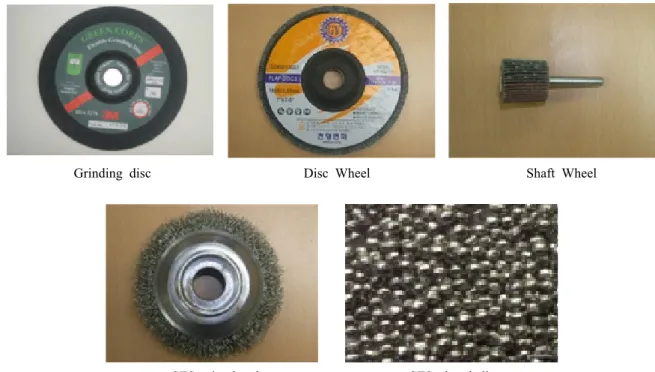
Grinding disc Disc Wheel Shaft Wheel
STS wire brush STS shot ball
Fig. 1. Different tools used for mechanical surface treatment methods.
any significant environmental problems. Electro-cleaning removes surface imperfections and embedded particles, making surface smoother than that treated by chemical passivation and improve corrosion resistance.
The objective of this study was to investigate the effect of mechanical and chemical methods on the corrosion be- haviour of 304 stainless steel alloy. The efficiency of dif- ferent mechanical treatment methods was compared to find a suitable method among mechanical treatment methods.
2. Methods and materials
2.1 Specimen preparation
Commercial 304 stainless steel alloy was used in this study. Small plate shape specimens were prepared accord- ing to different mechanical and chemical surface treatment methods. Usually in mechanical methods, an abrasive ma- terial is used to remove a layer of metal from its surface.
The surface finish of mechanical methods is dependent on a number of factors including the grit size (coarseness) of abrasive used.10) In this study grinding was carried out using disc and shaft type wheels with # 80 grit size emery paper. Fig. 1 shows different tools used for surface prepa- ration of stainless steel alloy by mechanical means.
Chemical passivation was carried out manually using commercially available gel type passivation chemicals.
Trade names for different chemical are as follows; nitric
acid (SD-S by Daejoo) and phosphoric acid (CW-R2 by Chub-woo). A citric acid with 30 wt. % chemical composi- tion was used in this study. In chemical treatments, gel-type chemicals were spread on the specimens for 20~30 minutes at room temperature and subsequently washed/rinsed in distilled water and cleaned ultrasonically.
Electro-cleaning uses both the electric current and chemical solution for material passivation. In this study electro-cleaning is carried out using phosphoric acid and citric acid at an applied voltage of 1.2 ~ 1.6 kV. After electro-cleaning specimen surface was thoroughly rinsed to remove any remaining chemicals.
2.2 Specimen surface examination
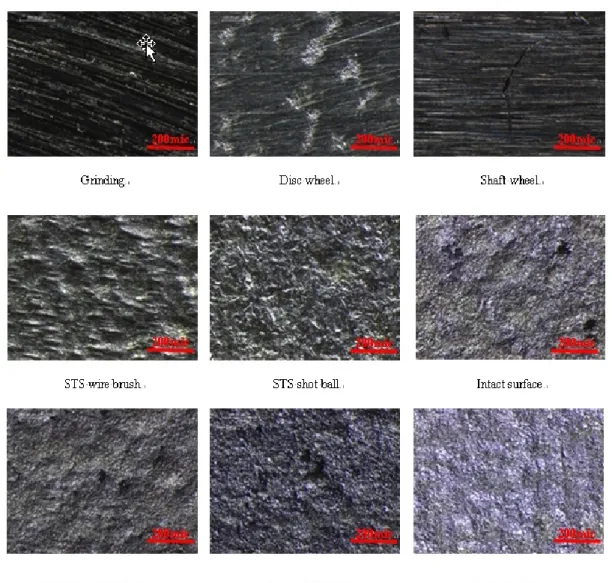
Surface of the specimens was observed after each treat- ment with optical microscope as shown in Fig. 2. Surface roughness of the specimens was measured using a com- mercial roughness measurement meter, named Handysurf E-35A. Energy dispersive analysis (EDS) was carried out to see the effect of different surface treatments.
2.3 Ferroxyl test
Ferroxyl test was according to ASTM 380 was used to investigate the condition of specimen surface after each treatments. It is highly sensitive test to detect the free iron particles on the surface of specimens. The test can detect iron contamination, including iron-tool marks, residual-
Fig. 2. Specimen surface condition after each kind of surface treatment.
iron salts from pickling solutions, iron dust, iron deposits in welds, embedded iron or iron oxide, etc. The test sol- ution was prepared by first adding nitric acid to distilled water and then adding potassium ferricyanide.
2.4 Corrosion evaluation
Potentiodynamic polarization experiments were carried out according to ASTM G 61 in 3.5 wt. % NaCl solution at room temperature. Princeton flat corrosion cell was used for electrochemical experiments. A saturated calomel elec- trode (SCE) equipped with a Luggin capillary was used as reference and a platinum net was used as counter electrode. The specimen exposed area for Potentiodynamic polarization experiments was 1 cm2. Specimens were
mounted tightly to avoid any crevices between the speci- men and plastic ring on the cell at specimen exposed area.
3. Results and discussion
3.1 Effect of surface preparation methods on surface roughness
Fig. 2 shows optical micrographs of specimens after dif- ferent surface treatments. It is clear that different surface treatment methods result in different surface topographies.
Electropolished specimens show smoother surface, com- pared to mechanically prepared specimens. Grinding marks are observed parallel to the grinding direction on speci- mens whose surface was prepared using disc and shaft
a) Surface morphology of mechanically treated specimens
b) Surface roughness morphology of chemically treated specimens Fig. 3. Surface roughness morphology of specimens after different surface treatment
type grinding wheels. Stainless steel wire brushing and shot blasting show almost similar surface morphology, while wire brushed specimen shows bit deeper and wide ditches. The surface is smoother when treated by chemical methods than by mechanical ones. The most uniform sur- face is obtained by electro-cleaning.
Fig. 3 shows the actual surface roughness pattern of mechanically or chemically treated specimens. Mechanical treatment methods demonstrate different surface morpho- logy. The surface of specimens after grinding has many narrowly spaced peaks and troughs as compared to wire brushed and blasted specimens. The average depth of peaks and troughs was lower than blasted and wire brushed specimens. Average surface roughness (Rz) of mechan- ically treated specimens was found in the order of, i.e.
grinding (7.51) < emery paper brush 1 (11.50) < intact surface (26.30). <stainless steel wire shot ball (27.05) <
stainless wire brush (27.75). On the other hand, chemical and electro-cleaning methods did not show significant dif- ference in their surface morphology. These methods pro- duced fewer and more widely spaced peaks and troughs than mechanical ones. These results suggest that chemical (manual and electrochemical) methods enhance surface uniformity, which will help formation of a smooth surface.
Such a surface will help forming a uniform passive film on specimen surface.
3.2 Effect of surface preparation methods on corrosion behavior
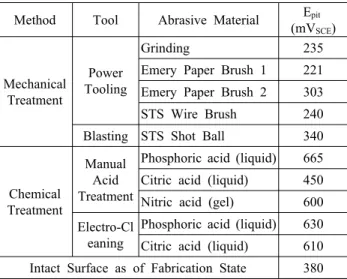
Based on the specimen surface topography and rough- ness measurement, different corrosion behaviour was ex- pected for samples with different treatments. Table 1 sum- marized the pitting corrosion results for these different sur-
Table 1. Effect of surface treatment methods on the pitting potential in 3.5 wt. % NaCl solution
Method Tool Abrasive Material Epit
(mVSCE)
Mechanical Treatment
Power Tooling
Grinding 235
Emery Paper Brush 1 221 Emery Paper Brush 2 303
STS Wire Brush 240
Blasting STS Shot Ball 340
Chemical Treatment
Manual Acid Treatment
Phosphoric acid (liquid) 665 Citric acid (liquid) 450 Nitric acid (gel) 600 Electro-Cl
eaning
Phosphoric acid (liquid) 630 Citric acid (liquid) 610 Intact Surface as of Fabrication State 380
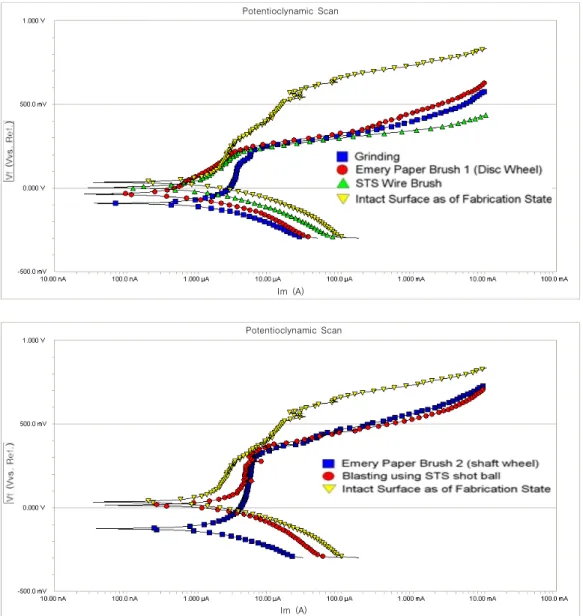
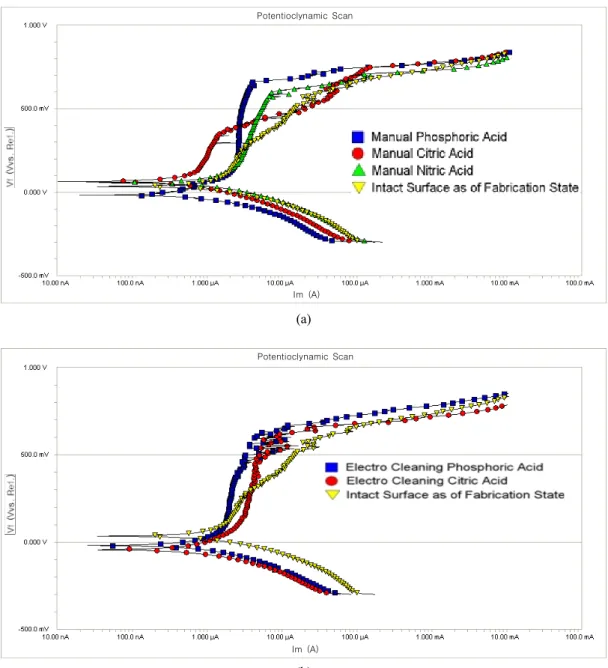
face treatment methods. Polarization curves of mechan- ically and chemically treated samples were compared with intact surface (no treatment) in Figs. 4 and 5.
The average surface roughness of group 1 specimens (grinding, disc wheel brushing) was less than group 2 (shaft wheel brushing, stainless steel shot blasting). Based on this it was expected that group 2 specimens would have lower pitting corrosion resistance, as their surface rough- ness was higher. It has been reported before that as the surface roughness increases or surface smoothness de- creases, pitting corrosion resistance of the alloys de- creases.11) The beneficial effect of decreasing surface roughness has also been proved by quantifying the nuclea- tion rates of metastable pitting and electrochemical noise measurement.12),13) However, Fig. 4(a) and (b) show that pitting potential was increased with increase in surface roughness of mechanically treated specimens. This in- crease in pitting potential can be explained with the help of surface roughness profiles shown in Fig. 3 (a). Though the average depth of peaks and troughs of group 1 speci- mens is small as compared to group 2, however the number of closely spaced peaks and troughs was much higher.
These closely spaced ridges (peaks and troughs) along with grinding marks (Fig. 2) by disc wheeling, and stainless steel wire brushing, can produce crevices in chloride environments.14),15) This also means that surface after grinding has many micro-anodes and cathodes, which de- creases its passivation ability.16) In case of stainless steel wire brushing, though the surface seems more clean and bright, but brushing can distort and contaminate the surface. During ferroxyl test on wire brushed samples, free iron particles were observed on their surfaces which de- creased the corrosion resistance. On the other hand, surface roughness profile of the blasted specimens was different (few widely spaced peaks and troughs) and such a surface morphology did not create any crevices and so its corro- sion resistance (Epit) was bit higher. In one study it was shown that strain hardening of superficial layers induced by mechanical compression stress generated by sand- blasting plays a significant role in improving corrosion resistance.16) Other authors have noted that shot peening has a similar effect on the resistance of an austenitic stain- less steel to intergranular corrosion. In general, com- pressive stress enhances resistance to stress corrosion cracking (SCC) because they reduce the applied tensile stress and thus reduce corrosion. So after any treatment (chemical, mechanical), it can be deduced that surface roughness and morphology affects corrosion performance of a material.
Corrosion resistance of the specimens was compared in terms of their pitting potential (Epit), which was the point
Potentioclynamic Scan
Im (A)
Potentioclynamic Scan
Im (A)
Fig. 4. Potentiodynamic polarization behavior of the specimens in 3.5 wt.% NaCl solution at room temperature at a scan rate of 0.5 mV/s, a) polarization curves of group 1 mechanically treated specimens, b) polarization curves of group 2 mechanically treated specimens.
where current increases abruptly disrupting the passive film (when current exceeded 10 uA, that point was taken as the pitting potential). Results of polarization experi- ments show that pitting potentials (Epit) of all mechanically treated specimens were lower than the reference specimen (intact surface), which has a pitting potential of 0.38 VSCE. The passive current density of intact specimen was less than mechanically treated specimens, which means that passive film on intact specimen was more protective. It is because the reference specimen has smooth surface re- sulting from steel mill treatment, while mechanical treat- ment makes surface rougher and disrupt intact passive film, lowering its corrosion resistance. New passive film formed on these rough surfaces is not so intact and perfect
and so therefore, corrosion resistance is decreased.
Polarization behavior of chemically passivated and elec- tro-cleaned specimens can be seen in Fig. 5 (a) and (b), respectively. Results show a significant increase in pitting potential (Epit) of chemically treated specimens as com- pared to reference and mechanically treated specimens.
Fig. 5(a) shows that all three treatments (nitric acid, phos- phoric acid and citric acid) improved pitting potentials and passive films stability as compared to reference specimen.
Pitting potential was found in the order of, i.e. phosphoric acid (0.65 VSCE) > Nitric acid (0.55 VSCE) > Citric acid (0.42 VSCE) > intact surface (0.4 VSCE). Polarization curves obtained after electro-cleaning (Fig. 5(b)) show a stable passive film till pitting potential was reached and pitting
Potentioclynamic Scan
Im (A)
(a)
Potentioclynamic Scan
Im (A)
(b)
Fig. 5. Potentiodynamic polarization behavior of the chemically treated specimens in 3.5 wt.% NaCl solution at room temperature at a scan rate of 0.5 mV/s, a) polarization curves of chemically treated specimens, b) polarization curves of electro-cleaned specimens.
potential was found in the order of, i.e. phosphoric acid (0.63 VSCE) > citric acid (0.53 VSCE). It can be said that citric acid can also give comparable results with other chemicals, when electrochemically cleaned. It is also clear that passive film on electro-cleaned specimens is more sta- ble and protective as compared to rest of the specimens.
These results are in agreement to those previously re- ported in the literature,8),9) which showed that elec- tro-polished or electro-cleaned specimens had a greater tendency to repassivate and so their pitting potential was higher than mechanical methods. The peaks and valleys
on rougher surface can accumulate more chloride ions, which can fasten the passive film breakdown and can in- crease the corrosion rate considerably. It was suggested that8),9) electropolishing dissolves initial oxide layer and leads to the reformation of new passive film which pro- ceeds through a high-field ionic conduction mechanism..
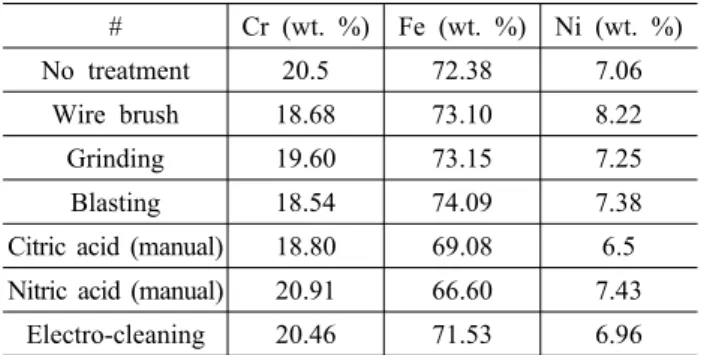
Finally specimen surface quality was examined using EDS, especially chrome content in the surface was exa- mined. It has been reported that corrosion resistance is closely related to chromium enrichment in the film formed by different surface treatments. T. HONG et. al.17) reported
Table 2. EDS analysis of the specimens after different surface treatments
# Cr (wt. %) Fe (wt. %) Ni (wt. %)
No treatment 20.5 72.38 7.06
Wire brush 18.68 73.10 8.22
Grinding 19.60 73.15 7.25
Blasting 18.54 74.09 7.38
Citric acid (manual) 18.80 69.08 6.5 Nitric acid (manual) 20.91 66.60 7.43
Electro-cleaning 20.46 71.53 6.96
that the pitting potentials depend on HN03 concentrations used for surface treatments, and pointed out that the rela- tionship between the pitting potentials and quantities of chromium in the film formed by HN03 treatments exhibits a single curve. Ogushi18),19) proposed a quantitative rela- tionship between the surface chromium concentration and corrosion resistance. Considering the importance of chrome content, surface quality of the all specimens was examined using EDS. These results show (Table 2) that there is no significant enrichment of chromium in mechan- ically treated specimens as compared to non-treated (intact surface) specimen. Rather chrome content was slightly de- creased which resulted in decreased corrosion resistance of mechanically treated specimens. However chemical treatment improved the chrome content in the specimen surface and it was almost similar to the intact surface specimen, which ultimately improved the corrosion resist- ance of chemically treated specimens.
4. Conclusions
1) Effect of different surface treatment methods on cor- rosion resistance of 304 stainless steel alloy was examined in terms of pitting potential measurements. It was found that surface topography and corrosion resistance of 304 stainless steel alloy was strongly affected depending on surface treatment methods.
2) Results showed that pitting potential (corrosion resist- ance measured in terms of Epit) of mechanically treated 304 stainless steel alloy specimens was decreased when compared with intact surface specimens. Among different mechanical treatment methods, stainless steel shot blasting showed the best results, as they exhibited the highest pit- ting potential (Epit).
3) In case of chemical treatment methods (both man- ually and Electrocleaning), pitting corrosion resistance was significantly improved as compared to mechanical treat-
ment methods as well as to that of intact surface. The substantial increase of pitting corrosion resistance by chemical treatment methods was due to chrome enhance- ment in the surface of specimens, so passive film formed on these specimens was more protective and stable.
Acknowledgements
This work is carried out in coating and corrosion re- search center of SHI and authors gratefully acknowledge the financial assistance in the completion of this project.
References
1. A.H. Tuthill and R.E. Avery, “Specifiying stainless steel surface treatments (NiDI technical series No 10068)”, The Nickel development institute (NiDI), Toronto, 1992.
2. M. Fathi, M.Salehi, A. Saatchi, Dental Mater., 19 (2003).
3. R.M. Kain, “Surface Treatments Affecting the Crevice Corrosion Resistance of Stainless Steels”, ISIJ Proc. Int.
Conf. Stainless Steels, Iron and Steel Institute of Japan, 1991
4. A. Ben Rhouma, C. Braham, M.E. Fitzpatrick, J. Ledion, and H. Sidhom, Journal of Materials Engineering and Performance, 10 (2001).
5. C-O.A. Olsson and S.E. Hornstrom, Corr. Sci., 36 (1994).
6. I. Olefjord and L. Wegrelius, Corr. Sci., 38, 1203 (1996).
7. S. Jin and A. Atrens, Appl. Phys., A 42 (1987).
8. T. Debold, ‘Passivation of stainless steel parts’ in TAPPI (1988).
9. S.J.Lee and J.J.Lai, Journal of Materials Processing Technology, 140 (2003).
10. B.V. Hecke, Marc Thijs, and Tildonk, “The mechanical finishing of decorative stainless steel surfaces”, The European stainless steel development association, Ma- terials and application series, Volume 6.
11. M. H. Moayed and R. C. Newman, Corrosion Science, 45, June (2003).
12. YuZuo, Haitao Wang, and Jinping Xiong, Corrosion Science, 44, Jan. (2002).
13. G.T.Burstein, and P.C.Pistorious, Corrosion, May 1995 14. NIDI Reference Book Series No.10 068, Specifying
Stainless Steel Surface Treatments
15. NIDI Reference Book Series No.11 026, fabricating stainless steel for water industry
16. N. Ben Salah-Rousset, M.A. Chaouachi, and A. Chellouf, Role of surface finishing on pitting corrosion of a duplex stainless steel, JMEPEG 5, 1996.
17. T. Hong, T. Ogushis, and M. Nagumo, Corrosion Science, 38 (1996).
18. T. Ogushi, Corros. Engng (Zairyo-to-Kankyoj), 42 (1993).
19. T. Ogushi, Corros. Engng (Zairyo-to-Kankyo), 41 (1992).