- 대한 치과 보철학회지 Vol. 24 No. 1, 1986 -
도재전장주조관의 제작방법에 따른 순측 치경부 변연 적합도에 관한 주사전자현미경적 연구
서울대학교 치과대학 보철학교실
장완식 ∙ 양재호 ∙ 이선형
A SCANNING ELECTRON MICROSCOPIC STUDY ON THE LABIAL MARGINAL FIT OF METAL CERAMIC CROWNS
MADE BY DIFFERENT TECHNIQUES
II Joong Yoon, D.D.S., M.S.D., Wan Shik Chang., Ph.D.,
Jae Ho Yang, D.D.S., M.S.D., Ph.D., Sun Hyung Lee, D.D.S., M.S.D., Ph.D.
Department of Prosthodontics, College of Dentistry, Seoul National University
= Abstract =
The purpose of this study was to evaluate the marginal fit of metal ceramic crowns made by different techniques. The techniques were metal but margin technique, platinum foil technique, shoulder powder technique : and wax technique. The latter three techniques were for the fabrication of collarless metal ceramic crowns.
Ten crowns were made of each techniques, and marginal fit was evaluated using scanning electron microscope under X200 magnification.
The results were as follows.
1. The marginal fit in the descending order were, wax technique shoulder powder technique, platinum foil technique and metal butt margin, before cementation, and wax technique, shoulder powder technique, metal butt margin, and platinum foil technique, after cementation.
2. The fit of collarless metal ceramic crowns was comparable to metal ceramic crowns with metal butt margins.
3. There were no statistically significant differences between marginal fit of metal ceramic
crowns made by different techniques.
Ⅰ. 서 론
도재전장 주조관은 1956년 Brecker(1)에 의해 소개된 이래, 가장 많이 사용되는 보철물의 1종이 되었다. 최근 에 castable apatite ceramic crown이나 full ceramic Cerestore system등이 소개되었으나 아직 널리 사용되 지는 않고 있다(2~5). 도재전장주조관은 특히 심미적인 면 에서 우수한 특성을 지니고 있으나, 금속 collar는 심미 성을 저해하는 중요한 요소이다.
도재전장주조관의 순측 변연부 설계에는 심미성과 적 합도를 고려해야 한다. 적합도면에서는 금속 collar에 어 느 정도 두께를 부여하고, bevel을 형성 하는 것이 좋다
(6~11). 그러나 이러한 형태의 금속 collar는 상당한 폭을
가지게 되어 주의해서 지대치 형성을 하여도 치은연하에 위치시키기 어려우며 치은이 얇은 사람들의 경우 청회색 으로 비쳐 보인다. bevel을 없애고 금속 collar를 얇게 하면 금속 collar자체가 보이는 것은 방지할 수 있지만 opaque가 도재 표면 가까이까지 나와서 빛의 반사도가 높아져 지나치게 밝은 색을 띄게 되어 부자연스런 느낌 을 준다. 그래서 금속 collar를 제거하여 도재가 shoulder에 직접 접촉하는 collarless 도재전장주조관이 소개되었다. collarless 도재전장주조관은 금속collar가 없어 변연부를 치은연 상부에 두어야 할 경우에도 사용 이 가능하며, 잘 glaze된 도재는 금속에 비해 치태침착이 적어 치주건강에도 도움을 준다(12~14).
collarless도재전장주조관의 제작방법은 백금박 이용 법, 내열성 die를 이용하는 방법, direct lift technique 으로 크게 나눌 수 있다(15~23). 백금박 이용법은 가장 먼저 개발된 방법으로 종래의 porcelain jacket crown 제작 방법과 비슷하지만, porcelain jacket crown에서와는 달리 백금박의 두께만큼 변연부가 벌어지는 것을 피할 수 없으며, 지대치 형성이 어렵고, 도재소성시 상당한 숙 련을 요한다. 내열성 die를 이용한 방법은 백금박에 의해 변연부가 벌어지는 것을 막을 수 있으나, 내열성 die가 마모에 약해 변연부가 쉽게 부서져 나가 변형이 오기 쉬 운 단점이 있다(24). direct lift technique에는 도재를 die로부터 직접 분리하는 방법(20), opaque나 shoulder powder등을 이용해 shoulder 부위를 먼저 형성하는 방
법(21, 22), wax를 이용한 방법(23)등이 있다.
이에 저자는 비귀금속 합금과 도재를 사용하여 metal butt margin을 가진 도재전장주조관과 백금박 이용법, shoulder powder이용법, wax이용법등 3가지 방법을 이용한 collarless 도재전장 주조관등 4가지 방법으로 도 재전장주조관을 제작하여 순측 치경부 변연의 적합도를 주사전자현미경으로 비교 연구 하였다.
Ⅱ. 실험재료 및 방법
1. master die의 제작
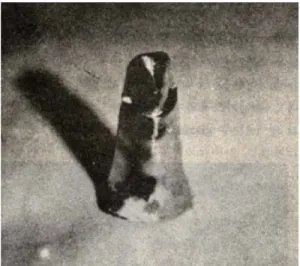
dentiform상의 상악 우측 중절치에서 도재전장주조 관을 위한 지대치 형성을 하였다. 이때 순측에는 1㎜의 shoulder를 형성하고, 설측에는 chamfer를 형성하였 다. 형성된 지대치를 vinyl polysiloxane 인상재 (Exaflex, G-C Co.)로 인상을 채득하여 여기에 inlay wax를 주입하여 납형을 만든 다음, 비귀금속 합금인 Rexillium Ⅲ(Jeneric gold Co.)로 주조하였다. 이 주조 체를 #556 bur 및 round end tapered diamond point 를 이용해 shoulder 및 chamfer부위의 cavosurface angle을 예리하게 다듬고, 주의해서 표면을 연마하였다 (Fig.1).
2. 작업모형 제작
master die를 다시 vinyl polysiloxane 인상재로 인 상을 채득한 후 여기에 epoxy resin die material(pri- die, JELENKO Co.)을 주입하여 40개의 작업 모형을 제작하였다(Fig.2).
3. coping의 제작
작업모형상에서 inlay wax를 이용하여 납형을 만들었 다. 이때 순측에는 0.5㎜가량의 reinforcing collar를 만 들어 매몰 및 주조과정에서 변형이 적어지도록 했다. 납 형을 인산염 결합 매몰재(Hi-Temp, Whip-mix Co.)에 매몰하고 소환한 후 Rexillium Ⅲ로 주조하였다. 주조체 를 50㎛ aluminum oxide로 sand blasting하고 내면기 포를 #2 round bur로 제거하였다. 40개의 coping중 10 개는 metal collar를 0.1㎜~0.2㎜ 폭이 되도록 갈아냈으 며, 30개는 metal collar를 제거하여 coping이 axio- gingival line angle에서 끝나도록 했다.
4. 도재전장주조관의 제작
도재전장주조관은 4가지 방법으로 각 10개씩 제작하 였다.
Ⅰ군(metal butt margin)
metal collar가 있는 coping에 ceramco #65도재를 사용하여 도재로에서 통상의 방법대로 metal butt margin을 가진 도재전장주조관을 제작하였다.
Ⅱ군(백금박 이용법)
0.001”두께의 백금박(William gold Co.)을 작업모형 의 shoulder 부위에 상방 및 하방으로 2~3㎜가 연장되 게 하고 설측으로 shoulder가 끝나는 곳으로부터 1㎜가 량 연장되게 절단한 다음 끝이 예리하지 않은 기구로 압 접하고(Fig.4) metal collar가 없는 coping을 적합시켰 다. 적합된 coping과 백금박을 cyanoacrylate 접착제로 임시 접착하여 작업모형에서 제거한 다음 교정용 welder 를 이용하여 변연부를 따라 9군데에서 spot welding하 였다(Fig.5). 여기에 opaque소성을 했는데 이때 백금박 부위에는 opaque를 바르지 않았다. opaque 소성이 끝 난 coping을 작업모형에 다시 적합 시키고, body 및 incisal porcelain을 축조하고 예리한 기구로 cervical ditching을 하였다. 1차 소성이 끝난 후 작업모형에 적합 시켜 백금박을 다시 압접시키고 도재수축으로 벌어진 틈 에 다시 도재를 올리고 재차 소성하였다. 이후 glazing을 하고 백금박을 제거하였다.
Ⅲ 군(shoulder powder 이용법)
metal collar가 없는 coping에 opaque소성을 한 다 음 도재분리제(Modisol, Vita Co.)를 바른 작업모형에 적합시키고 shoulder powder(Vita Co.)를 물에 개서 gingival 1/3부위에 올리고 작업모형으로부터 분리한 다 음 소성했다. 1차 소성 후 작업모형에 압접하고 붓으로 다음에 재차 소성했다. 필요하면 다시 추가 소성했다.
shoulder powder소성이 끝나면 body 및 incisal porcelain의 축조 및 소성을 하고 glazing했다(Fig.6).
Ⅳ군(wax 이용법)
metal collar가 없는 coping에 opaque소성을 하여 도재분리제를 바른 작업모형에 적합시키고 body 및 incisal porcelain을 축조하여 작업모형으로부터 분리하 고 소성했다. 이때 도재수축으로 도재와 작업모형 사이 에 간격이 생기는데, 이것을 diamond point로 갈아 간 격이 0.5㎜정도로 균일하게 되도록 했다(Fig.7). 이 간격 Fig. 1 : Master die.
Fig. 3 : Metal butt margin.
Fig. 2 : Working die.
에 wax(Ivory wax, Kerr Mfg.Co.)와 도재의 비율이 1:4가 되도록 섞어 불에 달군 조각도로 채워 넣었다(Fig.
8). 이후 작업모형으로부터 분리하여 도재로에서 slow rising programme을 이용해 wax가 완전히 없어진 다 음 muffle내로 들어가도록하여 소성했다. 이 과정을 2~3회 반복한 후 glazing했다.
5. 적합도 측정
제작이 끝난 도재전장주조관들을 각각의 작업모형에 적합시키고 손가락으로 누른 상태에서 근원심쪽에서 shoulder가 끝난 부위보다 약간 설측에서 소량의 cyanoacrylate접착제로 접착하였다. 완성된 시편들을 Fig. 4 : Platinum foil adapted to working die.
Fig. 5 : Platinum foil is spot welded to metal coping.
Fig. 6 : Shoulder powder technique.
Fig. 7 : A rotary diamond instrument is used to create a uniform space of 0.5㎜ .
Fig. 8 : Porcelain/wax suspension is packed into marginal gap with a warm
instrument.
brass stub에 접착제로 접착 시키고 1200V, 100mA에 서 5분간 200~300A�두께로 gold coating(Ion sputter, JFC-1100)하여 주사전자현미경(JEOL, JSM35C)으로 가속전압 12kv, 배율 200배에서 관찰하 였다. 관찰은 순면 중앙부와 근심 및 원심부 위에서 했 으며 이때 시편의 각도를 조절하여 틈이 가장 많이 벌어 졌을 때 촬영했다. 촬영에는 6×7㎝ 흑백 film을 사용했 으며 흑백인화지에 인화했다. 관찰이 끝난 시편들은 도 재전장관과 작업모형을 분리하고 다시 인산아연 씨멘트 로 접착 시켰다. 접착시 씨멘트가 굳기 전에 air-water spray로 변연부위 씨멘트를 제거했다. 이 시편들을 오븐 에서 24시간 건조 시킨 후 stub에 접착제로 접착 시키고 다시 gold coating과 주사전자현미경 관찰을 시행했다.
측정은 사진상에서 밀리미터 자를 가지고 사진의 중앙 부를 중심으로 1㎝간격으로 5군데에서 측정하고 간격이 최대인 곳과 최소인 곳을 측정했다. 측정치에 사진상의 100㎛ bar와 비율을 환산하여 실제 간격을 구했다.
Ⅲ. 실험성적
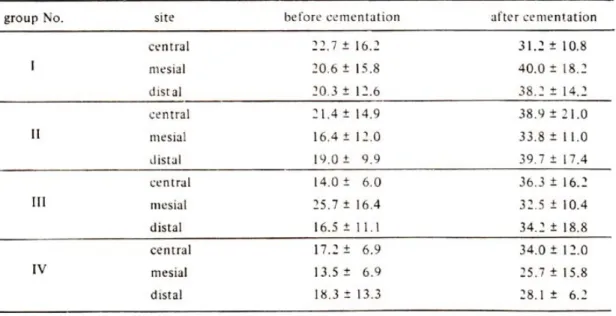
4종의 도재전장주조관의 적합도를 측정한 결과 다음 과 같은 실험성적을 얻었다(Table 1~4).
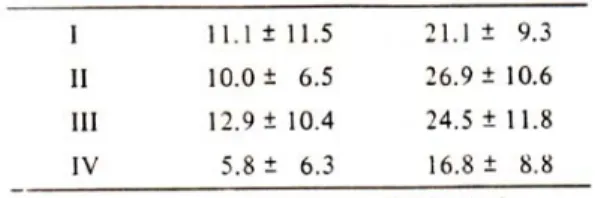
Table 1은 측정부위별(중앙부, 근심, 원심) 평균치를 군별로 나타낸 것이며 이 3개 부위를 평균한 것이 Table 2로서 인산아연 씨멘트 접착전에는 Ⅰ군(metal butt margin)이 21.2㎛으로 적합도가 가장 나빴으며, 다음이
Ⅱ군(백금박 이용법)으로 18.9㎛, 그 다음은 Ⅲ군 (shoulder powder이용법)으로 18.8㎛이었고, Ⅳ군(wax 이용법)이 16.3㎛으로 가장 좋았다. 인산아연 씨멘트 접 착 후에는 Ⅱ군이 37.4㎛으로 가장 나빴고, 다음이 Ⅰ군 으로36.5㎛, 그 다음이 Ⅲ군으로 34.3㎛이었고 Ⅳ군이 29.3㎛으로 가장 좋았다. Table 3과 4는 최대치 및 최 소치의 평균으로 Table 2와는 약간 다른 결과를 보였다.
전체 측정치들 중 가장 큰 것은 인산아연 씨멘트 접착 전에는 78.4㎛이고 접착 후에는 85.4㎛이었으며, 모두
Ⅲ군(shoulder powder이용법)에서 측정되었다.
Table 1 : Mean marginal discrepancies of 4 different types of metal ceramic crowns at 3 measuring sites
Ⅳ. 총괄 및 고안
인공치관의 변연부 적합도는 보철물의 성공여부를 결
정짓는 중요한 요인의 하나이다. 인공치관과 치아 사이 의 간격이 없는 것이 바람직하지만 전혀 없게 할 수는 없 다. 금인레이나 금주조관에서는 burnishing에 의해 적 Table 2 : Mean values of mean marginal
discrepancies.
Table 4 : Mean values of minimum marginal discrepancies.
Table 3 : Mean values of mean marginal discrepancies.
able 5 : Analysis of variance of mean marginal discrepancies.
평균치에 대해 분산분석을 한 결과 인산아연 씨멘트 접착전과 후는 통계적으로 유의한 차이를 보였으며 (P<0.001), 측정부위별로는 차이가 없었고(P>0.05), 군 별 로 도 95% 유 의 수 준 에 서 는 차 이 가 없 었 다 (P>0.05)(Table 5).
합도를 개선시킬 수가 있으나, 도재전장주조관용 금속은 경도가 높아 burnishing할 수 없다.
인공치관과 치아 사이의 간격은 씨멘트로 채워지게 되 는데, 현재 사용되는 치과용 씨멘트들은 모두 어느 정도 의 용해도를 가지고 있어 결국 타액에 의해 녹아 없어지 게 되며, 녹지않은 상태에서도 microleakage를 보인다.
marginal leakage는 적합도나 씨멘트 피막후경에 따라 좌우될 수 있기 때문에 적합도를 개선하고 씨멘트 피막 후경을 줄이려는 노력이 중요하다(25~27). 이를 위한 방법 으로는 bevel을 형성하는 방법, vent를 형성하는 방법, electrochemical stripping, die spacer를 이용하는 방 법, internal escape channel을 형성하는 방법 등이 있 다(28~33).
collarless도재전장주조관의 shoulder 부위는 주조관 이 완성된 다음에 형성되므로 주조관 자체의 적합도와 관계없이 제작기법에 따라 shoulder 부위의 적합도에 차 이가 생길 수 있다.
본 실험에서 통계적으로 유의한 차이는 없었지만 wax 이용법에서 적합도가 가장 좋았다. 이는 wax 이용법에 서는 몇 번이고 변연부의 수정을 할 수 있기 때문인 것으 로 생각된다. 본 실험에서는 평균 세 번의 수정을 했다.
shoulder powder 이용법에서도 제한 없이 수정할 수 있 지만 shoulder 부위를 형성하고 난 다음에 body와 incisal porcelain을 소성하는 과정에서 변형이 일어난 것으로 보인다. 이 변형량은 다시 correction powder를 이용하여 수정할 수 있지만 본 실험에서는 하지 않았다.
또한 수정 소성시 wax 이용법에서는 작업모형에 적합된 채로 수정하지만 shoulder powder 이용법에서는 작업 모형에서 분리하여 도재를 얹은 다음 압접하므로 shoulder 부위가 잘 맞는다고 하드라도 설측 변연부의 적합도가 나빠질 수 있다.
백금박 이용법에서는 작업모형이나 coping 내면을 백 금박 두께만큼 삭제하여야만 적합될 수 있는데 삭제량이 충분한가를 결정하기가 어렵다. 따라서 백금박 자체의 두께에 의한 영향보다는 coping의 적합이 불량한 상태에 서 shoulder부위가 제작됨으로 인해 생기는 오차가 많을 것으로 사료된다(24). metal butt margin의 경우는 도매 소성시에 변연부의 변형이 오기때문에 적합도가 불량해 지는 것으로 생각된다(6, 7).
변연부 적합도 측정은 인산아연 씨멘트 접착전과 후에 각각 시행했는데 씨멘트 접착 전에 시행 한 것이 주조관 내면때문에 생기는 적합도의 차이를 배제할 수 있어서 더욱 의의가 있는 것으로 사료된다.
Belser(34)등은 metal butt margin을 가진 도재전장 주조관과 백금박을 이용한 collarless 도재 전장 주조관 에서의 적합도가 씨멘트 접착 전에는 45㎛ 및 33㎛였 고, 씨멘트 접착후에는 모두 46㎛였다고 했고, Vyronis(21)는 opaque를 이용한 direct lift technique 으로 제작한 collarless 도재전장주조관에서 shoulder부 위의 적합도가 die상에서 6㎛, 지대치상에서 10㎛였다고 보고하였으며 Choung(18)등은 백금박을 이용한 도재전 장주조관에서의 적합도가 30~50㎛이라고 했다.
Cooney(35) 등은 백금박 이용법에서는 32~38㎛였지만 wax이용법에서는 81㎛, shoulder powder를 이용한 방 법에서는 72㎛로 wax나 shoulder powder를 이용한 방 법은 백금박 이용법에 비해 적합도가 떨어진다고 했으며 Strating(36) 등은 collarless도재전장주조관은 metal collar가 있는 도재전장주조관에 비해 적합도가 떨어진 다고 했다.
본 실험에서는 인산아연 씨멘트 접착 전후에 metal butt margin에서 21.2㎛와 36.5㎛, 백금박 이용법에서 18.9㎛와 37.4㎛, shoulder powder이용법에서 18.8㎛
와 34.3㎛, wax이용법에서 16.3㎛와 29.3㎛의 적합도를 보여 Vyronis(21)에 비해서는 적합도가 떨어졌지만 Belser(34)나 Choung(18)과 비슷한 결과를 보였고 Cooney(35)나 Strating(36)에 비해서는 훨씬 양호한 결과 를 보였다.
국내에서는 이(37), 김(38), 김(39)의 연구가 있었는데 이(37) 는 백금박 이용법에서 평균 57.9㎛, 최소평균 45.2㎛, 최 대평균 70.5㎛였다고 하여 본 실험에서 백금박 이용법의 씨멘트 접착후의 수치에 비교하면 상당한 차이를 보이 며, 김(38)은 collarless 도재 전장주조관이 metal butt margin에 비해 적합도가 떨어진다고 했으며, 김(39)은 metal butt margin과 wax 이용법 간에 차이가 없다고 했으나 본 실험에서는 씨멘트 접착 후에는 wax이용법이 metal butt margin에 비해 적합도가 좋았다.
백금박 이용법은 백금박을 압접하고 주조관을 적합 시 키면 백금박이 뜨기 때문에 다시 압접해야 했는데 이때 완전한 압접이 어려웠다. 본 실험에서 사용된 작업모형 은 이상적으로 제작된 master die로부터 제작 된 것이기 때문에 shoulder 부위가 매우 평활한 면을 이루고 있었 지만 임상적으로는 이런 작업모형을 얻기가 매우 힘들기 때문에 백금박의 압접시 오차가 더 많아질 것으로 생각 된다. 백금박 이용법에서 먼저 소성된 도재와 수정소성 된 도재사이에 틈이 생긴 경우가 발견되었다. 이는 소성 시 수축이 백금박 쪽으로 일어난 것을 보여준다.
shoulder powder 이용법에서는 shoulder powder의 투명도가 떨어져 밝게 보이는 문제가 있다. 백금박 이용 법이나 wax 이용법에서는 shoulder 부위에 body dentine을 사용하기 때문에 이런 문제가 없었다.
wax 이용법에서 Prince(23) 등은 wax와 도재의 비율을 1:6으로 했으나, 본 실험에서는 1:6의 비율로 섞었을 때 유동성이 전혀없어 작업을 할 수 없는 상태였다. 이는 Prince 등이 Plastodent U wax를 썼으나, 본 실험에서 는 Ivory wax(Kerr Mfg. Co.)을 썼기 때문에 wax성질 의 차이에 의한 것으로 보인다. 1 : 2 정도의 비율에서 작 업하기 좋은 상태였으나 소성후에 투명도가 떨어져 희게 보였다. 후에 전자현미경으로 관찰 했을 때 많은 기포가 관찰되었다. 그래서 작업 가능한 범위에서 도재의 비율 을 높인 결과 1:4정도가 적당한 것으로 나타났다. 이때는 소성 후에 투명도가 다른 부위와 차이가 없었다.
shoulder powder 이용법에서는 도재축조 후에 작업 모형으로부터 분리하는데 약간의 숙련된 기술을 요한다.
wax 이용법에서는 분리에 전혀 어려움이 없었다.
본 실험에서 wax 이용법은 양호한 적합도를 보였고 심미적으로도 만족스러웠으며, 제작방법도 쉬워 임상적 으로 사용하기에 별 어려움이 없는 것으로 보인다.
Ⅴ. 결 론
저자는 metal butt margin을 가진 도재전장주조관 과, 백금박 이용법, shoulder powder이용법, wax 이용 법등 3가지 방법으로 제작한 collarless 도재전장 주조관 등 4가지 도재전장주조관을 제작하여 제작방법에 따른 순측 치경부 변연 적합도를 주사전자현미경으로 비교하 여 다음과 같은 결론을 얻었다.
1. 적합도가 좋은 순서는 인산아연 씨멘트 접착 전에 는 wax이용법(16.3±6.5㎛), shoulder powder이 용법(18.8±6.8㎛), 백금박 이용법(18.9±6.3㎛), metal butt margin(21.2±13.0㎛)순이며, 인산아 연 씨멘트 접착 후에는 wax이용법(29.3±9.4㎛), shoulder powder 이용법(34.3±12.2㎛), metal butt margin(36.5±9.2㎛), 백금박 이용법(37.4
±13.2㎛)순 이었다.
2. collarless 도재전장 주조관과 metal collar가 있 는 도재전장주조관은 비슷한 적합도를 보였다.
3. 적합도의 차이는 통계학적으로 유의성이 없었다.
REFERENCES
1. Brecker, S.C. : Porcelain baked to gold : A new medium in prosthodontics. J Prosthet Dent 6 : 801, 1956.
2. Hobo, S., and Iwata, T. : Castable appatite ceramics as a new biocompatible restorative material. I. Theoretical considerations.
Quintessence International 16 : 135, 1985.
3. Sozio, R.B., and Riley, E.J. : Shrink-free ceramic. Dent Clin Nor Am 29 : 705, 1985.
4. Weber, H., Chan, C.R., Geis-Gerstorfer, J., Simonis, A., and Knupfer, D. : Procedural investigations and early clinical experiances with the full ceramic Cerestore crown system.
Quintessence International 16 : 463, 1985.
5. Jones, D.W. : Development of dental ceramics.
Dent Clin Nor Am 29 : 276, 1973.
6. Shillingburg, H.T., Hobo, S., and Gisher, D.W.:
Preparation design and margin distortion in porcelain fused to metal restorations J Prosthet Dent 29 : 276, 1973.
7. Faucher, R.R., and Nicholls, J.I. : Distortion related to margin design in porcelain fused to metal restorations. J Prosthet Dent 43 : 149, 1980.
8. Dederich, D.N., Svare, C.W., Peterson, L.C., and Turner, K.A. : The effect of repeated firings on the margins of nonprecious ceramometals. J Prosthet Dent 51 : 628, 1984.
9. Buchanan, W.T., Svare, C.W., and Turner, K.A. : The effect of repeated firings and strength on marginal distortion in two ceramometal systems.
J Prosthet Dent 45 : 502, 1981.
10. Rosner, D. : Function. placement and reproduction of bevels for gold castings. J Prosthet Dent 13 : 1161, 1983.
11. Pascoe, D. : Analysis of the geometry of finishing lines for full crown restorations. J Prosthet Dent 40 : 157, 1978.
12. Sillness, J. : Fixed prosthodontics and periodontal health. Dent Clin Nor Am 24 : 317, 1980.
13. Wunderlich, R.C., and Caffesse, R.G. :
Periodontal aspects of porcelain restorations.
Dent Clin Nor Am 29 : 693, 1985.
14. Gardener, F.M. : Margins of complete crowns- Literature review. J Prosthet Dent 48 : 396, 1982.
15. Goodacre, C.J., Roekel, N.B., Dykema, R.W., and Ullman, R.B. : The collarless metal ceramic crown J Prosthet Dent 38 : 615, 1977.
16. Vickery. R. C., Bandinelli, L. A., and Waltke, R.W. : The direct fabrication of restorations without foil on a refractory die. J Prosthet Dent 21 : 227, 1969.
17. Sozio, R.B., and Riley, E.J. : A precision ceramic metal restoration with a facial butted margin. J Prosthet Dent 37 : 517, 1977.
18. Choung, C.K., Garlapo, D.A., Brown, M.H., and Sorensen, S.E. : Procedure for a simplified collarless metal ceramic restoration using gold powder. J Prosthet Dent 47 : 449, 1982.
19. Schneider, D.M., Levi, M.S., and Mori, D.F. : Porcelain shoulder adaptation using direct refractory dies J Prosthet Dent 36 : 583, 1976.
20. Toogood, G.D., and Archibald, J.F. : Technique for establishing porcelain margin. J Prosthet Dent 40 : 464, 1978.
21. Vyronis, P. : A simplified approach to the complete porcelain margin. J Prosthet Dent 42 : 592, 1979.
22. McLean, J.W. : The science and art of dental ceramics. Quintessence Publishing Co., Vol. 2, p.322, Chicago, 1980.
23. Prince, J., Donovan, T.E., and Presswood, R.G. : The all porcelain labial margin for ceramometal restorations; A new concept. J Prosthet Dent 50 : 793, 1984.
24. Price, J., and Donovan, T.E. : The esthetic metal ceramic margin. a comparison of techniques. J Prosthet Dent 50 : 185, 1983.
25. Mondelli, J., Ishikiriama, A., and Galan, J.:
Marginal microleakage in cemented complete crowns. J Prosthet Dent 40 : 632, 1978.
26. Meyers, M.L., Staffanou, R.S., Hembree J. H., and Wiseman, W.B. : Marginal leakage of contemporary cementing agents. J Prosthet Dent 26 : 621, 1971.
27. Christensen, A.G., and Mitchel. D.A. : A fluorescent dye method for demonstrating leakage. J Dent Res 45 : 1485, 1966.
28. Cooper, T.M., Christensen, G.J., Laswell, H.R., and Baxter. R.: Effect of venting on cast gold full crowns. J Prosthet Dent 26. 621, 1971.
29. Tjan, A.H.L., and Sarkissian. R. Comparison of internal escape channels with die spacing and occlusal venting. J Prosthet Dent 53 : 613, 1985.
30. Pardo. G.I. a full cast restoration design offering superior marginal characteristics. J Prosthet Dent 48 : 539, 1982.
31. Ishikiriama, a., Oliveira, J.F., Vieira, D.F., and Mondelli, J. : Influence of some factors on the fit of cemented crowns. J Prosthet Dent 45 : 400, 1981.
32. J�rgensen. K.D. : Factors affecting the film thickness of zinc phosphate cements. Acta Odont Scand 18 : 479, 1960.
33. Campagni, W.V., Wright, W., and Martinoff, J.T.
: Effect of die spacer on the seating of complete cat gold crowns with grooves. J Prosthet Dent 55:324, 1986.
34. Belser, U.C., McEntee, M.I., and Richter, W.A. : Fit of three porcelain-fused-to-metal marginal designs in vivo : A scanning electron microscope study. J Prosthet Dent 53 : 24, 1985.
35. Cooney. J. P., Richter, W.A., and McEntee, M.I. : Evaluation of ceramic margins for metal-ceramic restorations. J Prosthet Dent 54 : 1. 1985.
36. Strating, H., Pameijer, C.H., and Gildenhuys, R.R. : Evaluation of the marginal integrity of ceramometal restorations, Part I. J Prosthet Dent 46:59, 1981.
37. 이선형 : Collarless metal-ceramic crown의 치경변 연 적합도에 관한 주사전자현미경적 연구. 대한치과의 사협회지. 제23권 제7호, p.585, 1985.
38. 김기환 : 도재소부전장금관의 치경부 변연의 적합도에 관한 연구. 대한치과의사협회지, 제23권 제17호, p593, 1985.
39. 김영한 : 도재전장주조관의 순측 치경부 변연 적합도에 관한 주사전자현미경적 연구. 대한치과보철학회지, 제 23권 제1호, p113, 1985.
40. Rensburg, F., and Strating, H.: Evaluation of the
marginal integrity of ceramometal restorations : 52 : 210, 1984.
41. West A.J., Goodacre, C.J., Moore, B.K., and Dykema, R.W. : A comparison of four techniques for fabricating collarless metal ceramic crowns. J Prosthet Dent 54 : 636, 1985.
42. Wanserski, D.J., Sobczak, K.P., Monaco, J.G., and McGivney, G.P.: An analysis of margin adaptation of all-porcelain facial margin ceramometal crowns. J Prosthet Dent 56 : 289, 1986.
43. Shrader. J.A., Duke. E.S., Haney, S.J., and Herbold, E.T. : Volumetric shrinkage of a porcelain suspended in was technique. J Prosthet Dent 55 : 302, 1986.
44. Saltzberg, D.S., Ceravolo, F.J., Holstein, F., Groom, G., and Gottsegen, R. : Scanning electron microscope study of the junction between restorations and gingival cavosurface margins. J Prosthet Dent 36 : 517, 1976.
45. McLean, J.M., and von Fraunhofer, J.A. : The
estimation of cement film thickness by an in vivo technique. Br Dent J 131 : 107, 1971.
46. Fukui, F., Lacy, A.M., and Jendresen, M.D.:
Effectiveness of hardening film on die stone. J Prosthet Dent 44 : 57, 1980.
47. Campagni, W.V., Prince, J., and Defreese, C. : Measurement of coating agents used for surface protection of stones. J Prosthet Dent 55 : 470, 1986.
48. The Vita VMK Technique : Working Instructions.
Vita Zahnfabrik, Germany.
49. Unibond Margin Porcelain Manual, Shofu Inc., Tokyo. March, 1983.
50. Donovan, T., and Prince, J. : An analysis of margin configurations for metal-ceramic crowns.
J Prosthet Dent 53 : 153, 1985.
51. Johnston, J.F., Mumford, G., and Dykema, R.W.
: Modern practice in dental ceramics. W.B.
Saunders Co. Philadelphia, 1967.
52. Christensen, G.J. : Marginal fit of gold inlay castings. J Prosthet Dent 16 : 297, 1966.
논문사진부도 ①
SEM photomicrographs of metal ceramic crowns (Original magnification x200) before cementation
논문사진부도 ②
SEM photomicrographs of metal ceramic crowns (Original magnification x200) before cementation
논문사진부도 ③
SEM photomicrographs of metal ceramic crowns (Original magnification x200) after cementation
논문사진부도 ④
SEM photomicrographs of metal ceramic crowns (Original magnification x200) after cementation