https://doi.org/10.15429/jkomor.2018.18.2.115 JKOMOR
pISSN 1976-9334, eISSN 2288-1522 Review Article
비만 치료에 있어서 체중 감량에 영향을 주는 인자들에 대한 고찰
남승희⋅김서영⋅임영우⋅박영배
1누베베 한의원, 1누베베 미병 의학 연구소
Review on Predictors of Weight Loss in Obesity Treatment
Seung-Hee Nam, Seo-Young Kim, Young-Woo Lim, Young-Bae Park
1Nubebe Korean Medical Clinic,
1Nubebe Mibyeong Research Institute
Received:
Revised:
Accepted:
August 17, 2018 November 17, 2018 November 18, 2018
Objectives: People often fail to reduce or maintain their weight despite trying to lose weight. The purpose of this study was to review previously published study results of the predictive factors associated with weight loss in obesity treatment.
Methods: Authors searched for the articles related to weight loss, published from 2007 to 2017 found on PubMed, Scopus, Research Information Sharing Service (RISS), and Koreanstudies Information Service System (KISS). A total of 43 articles were finally selected.
From the study results, unchangeable and changeable predictors were extracted, and these predictors were examined according to detailed categories.
Results: Predictors of weight loss in obesity treatment included genetic and physiological factors, demographic factors, history of treatment on obesity related factors, behavioral factors, psychological factors and treatment process related factors. The main factors of weight loss were unchangeable predictors such as high initial degree of obesity and young- er age, and changeable predictors such as dietary restraint, regular exercise, self-efficacy, initial weight loss and attendance. Especially dietary restraint, regular exercise, successful initial weight loss and high attendance were considered to be dominant factors for weight loss treatments.
Conclusions: Our review results suggest that unchangeable and changeable predictors of weight loss should be carefully examined during treatments of obesity.
Key Words: Weight loss, Obesity treatment, Predictors, Factors
Correspondence to: Young-Bae Park
Nubebe Mibyeong Research Institute, Top Building 2F, 10 Seongnam-daero 926beon-gil, Bundang-gu, Seongnam 13506, Korea
Tel: +82-31-745-6400 Fax: +82-31-736-2252 E-mail: [email protected]
Copyright © 2018 by The Society of Korean Medicine for Obesity Research
서론
2017 년 Organization for Economic Cooperation and Development (OECD) 국가의 성인 2명 중 1명 이상이 과 체중이거나 비만에 해당하며 적어도 2030년까지는 비만 율이 계속 증가할 것으로 전망되고 있다
1). 우리나라에서 도 비만 유병률은 지속적으로 증가하여 2016년 성인 비만 율은 28.58%이며 특히 30대 남성의 경우 46%가 비만으로 나타나 심각한 수준에 이르렀다
2).
비만은 심혈관계 질환과 당뇨, 골관절염 등 근골격계 질 환 및 각종 암의 주요 위험 인자로 body mass index (BMI)
가 증가할수록 이와 같은 질환의 위험이 증가하는데
3), 체 중의 5~10%의 감량만으로도 당뇨병과 심혈관계 질환의 위험을 줄이기 때문에 미국 국립 보건원에서는 비만 치료 의 일반적인 목표를 체중의 10%를 감량하는 것으로 권장 하고 있다
4).
많은 사람들이 체중 감량을 시도하지만 감량되지 않거나 감량 이후 다시 증가하여 실패하는 경우가 많으며, 2014년 국민건강영양조사의 자료를 활용한 연구에 따르면 체중 감소를 위해 노력한 19세 이상의 성인 집단의 31.2%에서 1년 뒤 체중이 증가한 것으로 나타났다
5).
따라서 Kim 등
6)은 효과적인 비만 관리의 가능성을 극
대화하고 개인 특성에 맞는 맞춤형 비만 치료 프로그램 개발을 위해 비만 치료 시 중도탈락 및 감량체중 유지에 영향을 주는 요인들을 가변요인과 불변요인으로 분석하여 보고하였다. 초기의 저조한 체중 감량 결과, 우울 증후, 부정적 신체 이미지, 식이 규제와 신체 활동량의 감소, 비 현실적인 체중 감량 기대치, 사회적지지 부족 등으로 분 석된 가변요인은 비만 치료 시 적극적으로 활용함으로써 치료 효과를 높이는 치료지표로 활용할 수 있고, 낮은 연 령, 여성 등의 불변요인은 개인 특성에 따른 적절한 치료 기간과 감량 목표를 제시하는 관리지표로 활용함으로써 개인 특성에 맞는 효과적인 맞춤형 비만 치료 프로그램의 개발을 위한 기초자료로 활용하고자 하였다. 이에 본 연 구에서는 효과적인 비만 치료 방안을 모색하기 위해, 비 만 치료에 있어서 체중 감량에 영향을 주는 요인을 연구 논문 검색을 통해 분석 고찰하였다.
연구 방법
논문 검색 일자는 2018년 4월 4일이며, 데이터베이스는 국내논문은 Research Information Sharing Service (RISS), Koreanstudies Information Service System (KISS)을, 해외 논문은 PubMed, Scopus를 사용하였다. 검색어는 주 검색 어로 ‘비만치료’, ‘체중감량’, ‘obesity treatment’, ‘weight loss’
는 Title로 검색하고, 세부 검색어로 ‘요인’, ‘인자’, ‘효과’,
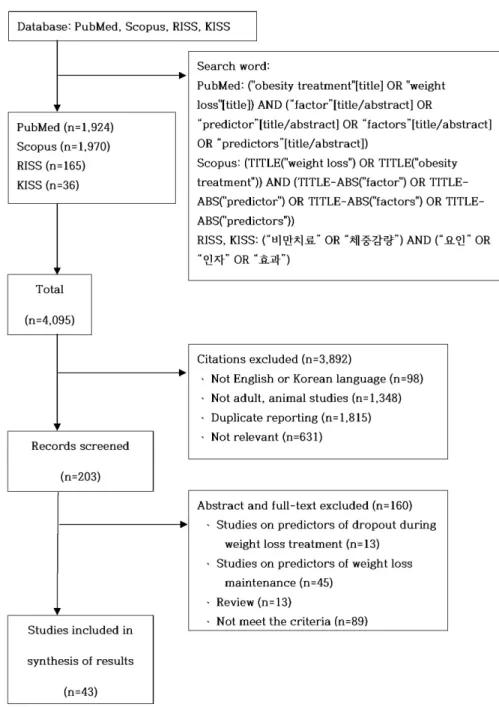
‘factor(s)’, ‘predictor(s)’ 는 국내논문은 All field로 하되, 해 외논문은 Title 및 abstract로 범위를 좁혀 검색하였다. 출 판 연도는 2007년부터 2017년까지로 설정하였다(Fig. 1).
선정기준은 과체중이거나 비만인 환자를 대상으로 일 정한 중재(수술, 약물 및 침구, 인지행동치료, 생활습관 교정 등 방법에 제한을 두지 않음)를 통한 BMI 또는 체중 의 변화를 결과값으로 포함하면서, 결과와 관련된 인자들 을 연구한 환자-대조군연구, 코호트연구, 무작위대조연구 (Randomized Controlled Trial)로 설정하였다. 배제기준은 연구 대상이 성인이 아닌 경우, 각종 암 치료 이후의 환자 나 당뇨 등 특정한 질환이 있는 환자군을 대상으로 한 경 우, 감량 중의 중도탈락이나 감량 이후 체중 유지를 주제 로 한 논문은 배제하였다. 수술요법의 경우 수술 후 2년 이상의 기간만 평가에 포함된 경우도 감량 이후 체중 유 지와 관련된 논문으로 포함시켜 제외하였는데, 이는 비만 대사 수술 후 1~2년째에 가장 많은 체중 감량을 달성하고
이후로는 조금씩 증가하는 경향
7)을 보이기 때문이다.
검색된 국내논문 201편과 해외논문 3,894편 중 서지정 보와 초록 및 본문 검토를 통해서 총 43편의 국내외 논문 을 선정하였다. 평가자 2인의 결과가 일치되지 않는 경우 해당 논문의 재검토 후 합의가 진행되었다. 선정된 논문은 치료 중재에 따라 분류하여 서술하고, 추출된 요인들은 가 변요인과 불변요인으로 분류하여 분석하였다.
결과
선정된 연구들은 치료 중재를 기준으로 하여 식이요법 및 행동 수정요법을 통한 체중 감량 연구(n=22), 비만 대사 수술을 통한 체중 감량 연구(n=13), 약물치료를 통한 체중 감량 연구(n=3), 한방치료를 통한 체중 감량 연구(n=5) 등 총 43편이 있었으며, 연구 대상자는 총 107,623명이었다.
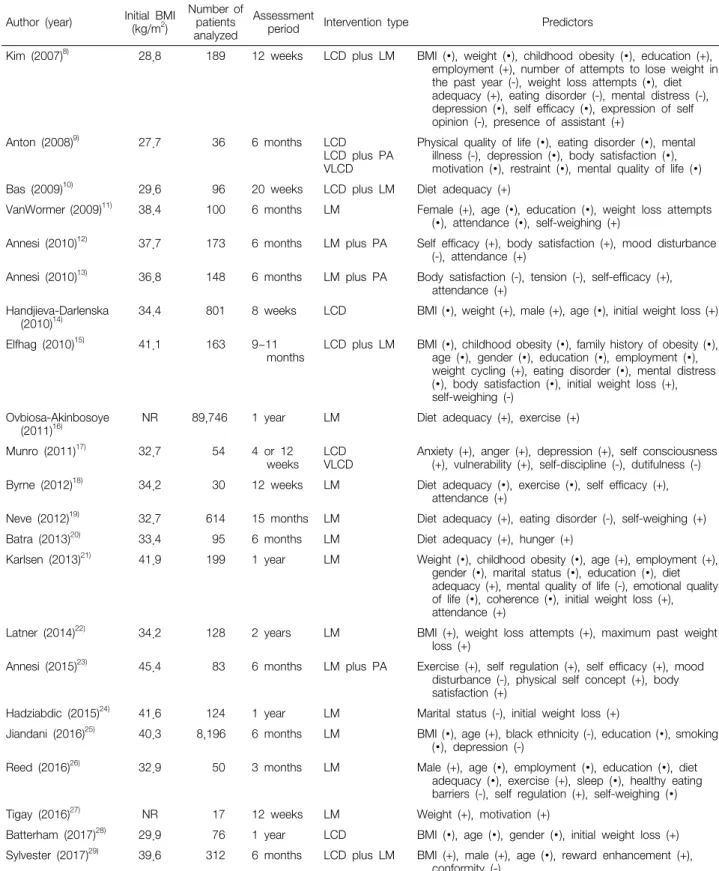
1. 저칼로리 식이요법 및 행동 수정요법을 통한 체중 감량 연구(Table 1)
Kim 등
8)은 폐경 전 비만 여성들의 체중 감량 프로그램 에 대한 성공도와 관련된 특성과 요인을 분석하였다. 이를 위해 12주간 저열량식 처방과 운동요법, 행동 수정요법 프 로그램을 모두 완수한 189명 중 초기 체중의 10% 이상 감 량한 경우를 성공군으로 설정하여 비교 분석하였다. 연구 결과 식이요법 준수율이 높고 섭식장애가 없으며 주변 식 사환경이 개선되는 경우, 조력자가 있는 경우, 교육수준이 높은 경우, 스트레스가 적은 경우, 최근 1년간 감량 시도 횟수가 적은 경우가 성공군에서 많았다.
Anton 등
9)은 6개월간의 칼로리 제한 실험 시 초기의 행동과 심리 요인이 체중 감량을 예측할 수 있는지 알아 보고자 하였다. 이를 위해 건강한 과체중인 36명을 세 가 지의 칼로리 제한 식이 그룹으로 무작위 분배하여 6개월간 진행하였다. 연구 결과 여러 요인 중에서 General Health Questionnaire (GHQ)가 높을수록 감량이 적은 것으로 나 타났는데 높은 GHQ는 부정적인 정서상태, 정신사회적 기능 저하, 신체증상과 관련이 있다.
Bas 등
10)은 체중 관리 프로그램에 참여한 환자들의 자기
효능감, 식사 행동, 다른 심리 요소들의 개선을 확인하고
자 연구를 진행했다. 이를 위해 96명의 비만 환자를 대상
으로 저칼로리 식이와 매주 1시간의 생활습관 교정 교육
을 20주간 시행하였다. 연구 결과, 치료 이후 Three Factor
Fig. 1. A review of predictors of weight loss. RISS: Research Information Sharing Service, KISS: Koreanstudies Information Service System.
Eating Questionnaire (TFEQ)의 Hunger (배고픔에 대한 민 감성)와 Disinhibition (식이조절의 탈억제) 지수가 유의하 게 감소했으며, 점수가 많이 감소할수록 체중 감량이 많은 것으로 보고했다.
VanWormer 등
11)은 체중 감량 프로그램에서 자가 체중 측정과 체중 감량의 관련성을 연구하기 위하여 6개월간 100명의 비만 환자들을 대상으로 식이와 운동 중심의 인 지행동 치료 프로그램을 진행했다. 연구 결과 자가 체중
측정과 여성인 경우가 유의하게 양호한 체중 감량의 예측 인자였고, 적어도 매주 체중을 측정하는 경우 초기 체중 의 5% 이상 감량하는 비율이 유의하게 높았다.
Annesi 등
12)은 심리요인의 변화와 신체 활동, 체중 감 량의 관계를 연구하기 위하여 173명의 비만 여성을 Class I (BMI 30.0-34.9), Class II (BMI 35.0-39.9), Class III (BMI
≥40)로 나누어 6개월간의 운동과 식이 교육 프로그램을
진행하였다. 연구 결과 자기 효능감, 신체만족도, 정서 상
Author (year) Initial BMI (kg/m
2)
Number of patients analyzed
Assessment
period Intervention type Predictors
Kim (2007)
8)28.8 189 12 weeks LCD plus LM BMI (∙), weight (∙), childhood obesity (∙), education (+), employment (+), number of attempts to lose weight in the past year (-), weight loss attempts (∙), diet adequacy (+), eating disorder (-), mental distress (-), depression (∙), self efficacy (∙), expression of self opinion (-), presence of assistant (+)
Anton (2008)
9)27.7 36 6 months LCD
LCD plus PA VLCD
Physical quality of life (∙), eating disorder (∙), mental illness (-), depression (∙), body satisfaction (∙), motivation (∙), restraint (∙), mental quality of life (∙) Bas (2009)
10)29.6 96 20 weeks LCD plus LM Diet adequacy (+)
VanWormer (2009)
11)38.4 100 6 months LM Female (+), age (∙), education (∙), weight loss attempts (∙), attendance (∙), self-weighing (+)
Annesi (2010)
12)37.7 173 6 months LM plus PA Self efficacy (+), body satisfaction (+), mood disturbance (-), attendance (+)
Annesi (2010)
13)36.8 148 6 months LM plus PA Body satisfaction (-), tension (-), self-efficacy (+), attendance (+)
Handjieva-Darlenska
(2010)
14)34.4 801 8 weeks LCD BMI (∙), weight (+), m ale (+), age (∙), initial weight loss (+)
Elfhag (2010)
15)41.1 163 9~11
months LCD plus LM BMI (∙), childhood obesity (∙), fam ily history of obesity (∙), age (∙), gender (∙), education (∙), employment (∙), weight cycling (+), eating disorder (∙), mental distress (∙), body satisfaction (∙), initial weight loss (+), self-weighing (-)
Ovbiosa-Akinbosoye
(2011)
16)NR 89,746 1 year LM Diet adequacy (+), exercise (+)
Munro (2011)
17)32.7 54 4 or 12
weeks LCD
VLCD Anxiety (+), anger (+), depression (+), self consciousness (+), vulnerability (+), self-discipline (-), dutifulness (-) Byrne (2012)
18)34.2 30 12 weeks LM Diet adequacy (∙), exercise (∙), self efficacy (+),
attendance (+)
Neve (2012)
19)32.7 614 15 months LM Diet adequacy (+), eating disorder (-), self-weighing (+)
Batra (2013)
20)33.4 95 6 months LM Diet adequacy (+), hunger (+)
Karlsen (2013)
21)41.9 199 1 year LM Weight (∙), childhood obesity (∙), age (+), employment (+), gender (∙), marital status (∙), education (∙), diet adequacy (+), mental quality of life (-), emotional quality of life (∙), coherence (∙), initial weight loss (+), attendance (+)
Latner (2014)
22)34.2 128 2 years LM BMI (+), weight loss attempts (+), maximum past weight loss (+)
Annesi (2015)
23)45.4 83 6 months LM plus PA Exercise (+), self regulation (+), self efficacy (+), mood disturbance (-), physical self concept (+), body satisfaction (+)
Hadziabdic (2015)
24)41.6 124 1 year LM Marital status (-), initial weight loss (+)
Jiandani (2016)
25)40.3 8,196 6 months LM BMI (∙), age (+), black ethnicity (-), education (∙), smoking (∙), depression (-)
Reed (2016)
26)32.9 50 3 months LM Male (+), age (∙), employment (∙), education (∙), diet adequacy (∙), exercise (+), sleep (∙), healthy eating barriers (-), self regulation (+), self-weighing (∙)
Tigay (2016)
27)NR 17 12 weeks LM Weight (+), motivation (+)
Batterham (2017)
28)29.9 76 1 year LCD BMI (∙), age (∙), gender (∙), initial weight loss (+) Sylvester (2017)
29)39.6 312 6 months LCD plus LM BMI (+), male (+), age (∙), reward enhancement (+),
conformity (-)
BMI: body mass index, LCD: low calorie diet, LM: lifestyle modification, PA: physical activity, VLCD: very low calorie diet, NR: not reported, +:
positive correlation, -: negative correlation, ∙: no correlation.
Table 1. Weight Loss Studies with Low Calorie Diet and Lifestyle Modification
태 등 심리 요인의 변화가 운동요법 참석률을 Class I/II에 서는 14%, Class III에서는 22% 유의하게 설명했으며, 운 동요법 참석률이 체중 감소에 밀접한 관련이 있었다.
Annesi 등
13)은 사회 인지 이론에 근거한 요인들이 체중 감량 성공과 실패를 구분하는지 평가하였다. 이를 위해 6 개월간 148명을 대상으로 인지행동요법을 포함한 운동요 법과 그룹 영양 교육 프로그램을 진행하고, 체중 감량의 비율에 따라서 4분위로 나누어서 비교 분석했다. 연구 결과 낮은 초기 신체만족도와 높은 초기 긴장, 6개월간의 자기 효능감과 신체만족도의 긍정적 변화가 유의하게 성공적인 감량 그룹을 결정하는 요소였고, 운동요법 참석률도 성공 적인 감량을 예측했다.
Handjieva-Darlenska 등
14)은 치료 전의 특성과 초기 체중 변화가 체중 감량의 결과를 예측하는지 연구하였다. 이를 위해 932명의 비만 환자를 대상으로 8주간 1일 800~1,000 kcal 의 저칼로리 식이가 제공되었으며, 연구 결과 초기 체 중이 높은 경우, 남성인 경우, 초기 1, 3주간의 감량이 많은 경우 8주째에 체중 감량이 많았다.
Elfhag 등
15)은 비만 치료에서 체중 감량과 관련된 치료 전 요소를 찾기 위하여 247명의 비만 환자를 대상으로 첫 5주간 매주 식이와 신체활동 등 생활습관 교육을 시행하 고 이후 회당 4~5개월의 그룹 치료를 2회 진행했다. 연구 결과 초기 5주차의 체중 감량이 가장 유의하게 높은 체중 감량과 관련이 있었으며, 3회 이상의 체중순환(weight cy- cling) 경험이 있는 경우 체중 감량이 좋고, 체중 측정을 월 1회 이상 하는 경우는 체중 감량과 부정적인 관련이 있었다.
Ovbiosa-Akinbosoye 등
16)은 직장에서의 체중 감량 프로 그램에서 장기간의 체중 감량과 유지에 관련된 요인을 분 석했다. 이를 위해 1년간 10개 업종에서 89,746명이 참여 한 대규모 연구로 개인 맞춤의 영양교육, 신체 활동 증진 방안 등이 교육되었다. 연구 결과 감량 기간 동안의 운동 량 증가와 식습관 개선 정도가 좋을수록 높은 체중 감량 을 예측할 수 있었다.
Munro 등
17)은 성격적 특성이 체중 감량에 미치는 영향 을 연구하고자 하였다. 이를 위해 54명의 비만 남녀를 12 주간의 완만한 건강식 감량군과 4주간의 초 저칼로리 식 이 감량군으로 나누어 중재를 진행했다. 연구 결과 완만 한 감량에서는 유의한 관련성이 없었으나 급격한 감량 시 에는 신경증적 성격인 불안, 분노, 우울, 자의식, 취약성
이 체중 감량에 긍정적인 관련성, 성실성에 해당하는 자 율성과 책임감은 부정적인 관련이 있었다.
Byrne 등
18)은 비만 치료 전의 자기 효능감이 감량에 미 치는 영향과 감량 중의 자기 효능감 변화를 평가했다. 이 를 위해 30명의 비만 환자를 대상으로 표준인지 행동 체 중 감량 치료 프로그램을 12주간 진행했다. 연구 결과 운 동에 대한 자기 효능감의 변화량과 치료 참석률이 높은 체중 감량을 예측했다.
Neve 등
19)은 체중 감량에 영향을 주는 행동 요인을 조 사하기 위해 웹 기반 체중 감량 프로그램을 15개월간 진행 한 614명에 대하여 연구를 진행했다. 연구 결과 자가 체중 측정 빈도가 높고 식생활 절제를 잘하고, 식사를 거르지 않는 경우, 간식을 집에 두지 않는 경우, 테이크 아웃 음식 을 덜 먹는 경우가 성공적인 감량과 관계가 있었다.
Batra 등
20)은 직장 내 체중 감량 프로그램에서 식습관과 체중 감량의 연관성을 조사하였다. 이를 위해 95명의 비만 환자를 대상으로 6개월간 생활습관 관리를 시행하여 섭취 칼로리 제한과 행동 수정요법 등이 시행됐다. 연구 결과 TFEQ 설문상 초기의 높은 Hunger, Restrain (의식적 식이 제한)의 증가, Disinhibition과 Hunger의 감소가 높을수록 높은 체중 감량과 관련이 있었다.
Karlsen 등
21)은 비만 치료에서 체중 감량의 예측인자를 조사하기 위한 전향적 코호트 연구를 진행하였으며, 이를 위해 1년간 200명의 비만 환자를 대상으로 4주간의 집중 입원 치료 1회를 포함한 총 4~5회의 입원 관리와 전화상 담을 통한 생활 습관 교정 치료를 실시하였다. 연구 결과 12주째에서 높은 식이 준수율과 높은 방문빈도가 높은 체중 감량을 예측했고, 1년째의 감량에는 나이가 많을수 록, 고용된 상태인 경우, 정신적 삶의 질이 낮고 12주째의 체중 감량이 높은 경우가 높은 체중 감량을 예측했다.
Latner 등
22)은 체중 감량 과거력에 따른 체중 감량의 예 측을 조사했다. 이를 위해 128명의 비만 환자는 10~12명 의 그룹으로 구성되어 매주 자가 그룹 행동 치료를 시행 했다. 연구 결과 이전의 체중 감량 횟수가 많은 경우는 6, 18개월, 이전 최고 감량 체중이 많은 경우 18개월, 높은 초기 BMI는 6, 12, 18, 24개월째의 좋은 감량률에 영향을 미쳤다.
Annesi 등
23)은 심리 요인이 체중 감량의 성공과 실패에
미치는 영향을 평가하기 위해 6개월간 비만 여성 83명을
대상으로 개인 맞춤 운동을 포함한 인지행동치료와 그룹
영양 교육을 받게 하였다. 초기 체중의 5% 이상 감량 시 성공군으로 분류했으며, 연구 결과 자기조절감, 자기 효 능감, 감정상태, 신체자아상, 신체만족도, 주 2회 이상의 운동이 성공적인 체중 감량과 유의한 상관성이 있는 것으 로 나타났다.
Hadziabdic 등
24)은 체중 감량 시 조기 탈락률과 성공적인 체중 감량을 예측하는 인자를 조사했다. 이를 위해 124명의 비만 환자들을 대상으로 12개월간 저칼로리 식이요법을 시 행한 결과, 초기 1개월 간의 성공적인 체중 감량과 결혼하 지 않은 경우가 1년간의 성공적인 체중 감량의 예측 인자 로 나타났다.
Jiandani 등
25)은 체중 감량에 있어 조기 탈락과 성공적 인 체중 감량에 연관된 요인을 조사하기 위해 6개월 이상 치료받은 9,498명 환자들의 전자 의료 기록을 후향적으로 분석하였다. 환자들은 매 4~6주마다 내원하여 개인별 운 동과 식이 등 생활습관 관리를 통한 체중 감량 전략을 제 공받았다. 연구 결과 연령이 50세 이상인 경우 감량 성공 률이 높았고 여성의 경우 높은 우울도가, 남성의 경우 고 혈압이 낮은 감량을 예측했다.
Reed 등
26)은 체중 감량에서 동기 요소의 변화를 조사하 고 체중 감량의 예측인자를 분석했다. 이를 위해 56명의 비만 환자들이 3개월간 매주 체중을 측정하고 건강한 생 활 습관에 대한 강의를 들으며, 웹 프로그램으로 매일의 음식 섭취를 기록했다. 연구 결과 남성, 신체활동이 많고, 자기조절능력이 좋은 경우는 좋은 감량을 예측했고, 건강 한 식이에 대한 장벽이 높은 경우는 낮은 감량을 예측했다.
Tigay 등
27)은 초기의 식이와 운동에 대한 동기가 체중 감량에 미치는 영향을 분석했다. 이를 위해 가족 건강 클 리닉에서 17명의 흑인 여성이 12주간 생활습관 교정을 통한 체중 감량 프로그램에 참여했다. 연구 결과 건강한 감량에 대한 자율적 동기, 초기의 높은 체중이 높은 평균 주당 감량 체중을 유의하게 예측했다.
Batterham 등
28)은 인구통계학적 요소와 초기 체중 감량 이 체중 감량을 예측하는지 조사했다. 이를 위해 76명의 대상자는 12개월간 연령, 성별, 체중에 따라서 Mifflin 공 식에 따라 필요 에너지의 80%에 맞추어 채소 섭취를 늘린 식단 처방을 받았다. 연구 결과 첫 1개월간의 감량이 12 개월 후 감량의 유의한 예측 인자였다.
Sylvester 등
29)은 체중 감량에 영향을 미치는 행동 요인, 특히 고칼로리의 음식을 먹는 동기를 조사했다. 이를 위
해 6개월간 312명의 비만 성인을 대상으로 저칼로리 식 이 처방과 생활습관 관리를 진행하고 백인과 흑인으로 나 누어 분석했다. 연구 결과 공통적으로 남성인 경우, 초기 BMI 가 높은 경우 체중 감량이 많았으며 백인에서는 고칼 로리 음식을 주로 보상 강화 목적으로 먹는 경우는 체중 감량이 좋으며, 다른 사람에 동조하여 먹는 경우 체중 감 량이 저조했다.
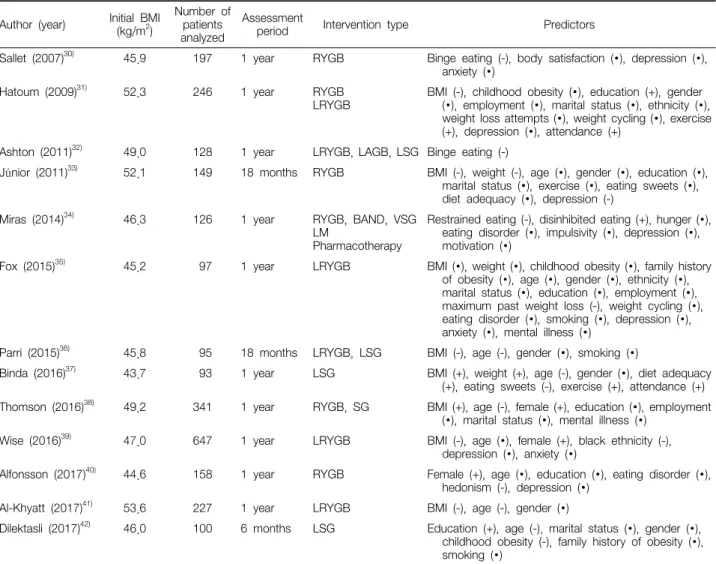
2. 비만 대사 수술을 통한 체중 감량 연구(Table 2) Sallet 등
30)은 Roux-en-Y gastric bypass (RYGB) 수술 이 전의 폭식증의 유무가 수술 이후 감량 결과에 영향을 미 치는지 알아보기 위해 216명의 환자를 대상으로 RYGB 수술 이전에 The Diagnostic and Statistical Manual of Mental Disorders, 4th Edition (DSM-IV)에 근거한 임상평가를 통 해 폭식증을 진단했다. 이후 수술 후 1년째에 추적 조사 한 결과 폭식증이 없는 그룹이 경미한 폭식증이 있었던 그룹보다 유의하게 초과체중 감량률이 높았다.
Hatoum 등
31)은 RYGB 수술 이후 체중 감량을 예측하는 인자를 찾기 위하여 RYGB 또는 Laparoscopic Roux-en-Y gastric bypass (LRYGB)를 받은 환자 246명의 차트를 검 토했다. 수술 후 1년째의 초과 체중 감량률을 분석한 결과, 높은 초기 BMI, 제한된 신체활동, 낮은 교육수준, 낮은 참 석률이 순서대로 체중 감소에 부정적인 영향을 미쳤으며, 이 다섯 가지 요인을 포함한 모델이 체중 감량 변동성의 41%를 차지했다.
Ashton 등
32)은 비만 수술 치료 전에 폭식증의 치료에 대한 반응이 수술 후 체중 감량에 연관되는지 조사하였다.
이를 위해 128명의 비만 환자를 대상으로 수술 전에 인지 행동 그룹 치료를 4주간 주 1회 진행했다. 이후 LRYGB, Laparoscopic adjustable gastric banding (LAGB), Laparoscopic sleeve gastrectomy (LSG) 등의 비만 수술을 받은 환자들 의 6개월, 12개월째의 감량을 분석한 결과, 수술 이전의 폭식증 치료에 반응을 보였던 환자들의 감량이 더 좋은 것으로 나타났다.
Júnior 등
33)은 비만 수술 이후 체중 감량에 영향을 미치
는 요인을 평가하였다. 이를 위해 RYGB 수술을 받은 환
자들 149명의 의료 기록을 후향적으로 연구했다. 수술 후
6, 12, 18개월까지의 체중 감량을 분석한 결과 초기 체중
과 BMI가 높은 경우, 우울증이 있는 경우 감량이 저조한
것으로 나타났다.
Author (year) Initial BMI (kg/m
2)
Number of patients analyzed
Assessment
period Intervention type Predictors
Sallet (2007)
30)45.9 197 1 year RYGB Binge eating (-), body satisfaction (∙), depression (∙), anxiety (∙)
Hatoum (2009)
31)52.3 246 1 year RYGB
LRYGB BMI (-), childhood obesity (∙), education (+), gender (∙), employment (∙), marital status (∙), ethnicity (∙), weight loss attempts (∙), weight cycling (∙), exercise (+), depression (∙), attendance (+)
Ashton (2011)
32)49.0 128 1 year LRYGB, LAGB, LSG Binge eating (-)
Júnior (2011)
33)52.1 149 18 months RYGB BMI (-), weight (-), age (∙), gender (∙), education (∙), marital status (∙), exercise (∙), eating sweets (∙), diet adequacy (∙), depression (-)
Miras (2014)
34)46.3 126 1 year RYGB, BAND, VSG
LM Pharmacotherapy
Restrained eating (-), disinhibited eating (+), hunger (∙), eating disorder (∙), impulsivity (∙), depression (∙), motivation (∙)
Fox (2015)
35)45.2 97 1 year LRYGB BMI (∙), weight (∙), childhood obesity (∙), family history of obesity (∙), age (∙), gender (∙), ethnicity (∙), marital status (∙), education (∙), employment (∙), maximum past weight loss (-), weight cycling (∙), eating disorder (∙), smoking (∙), depression (∙), anxiety (∙), mental illness (∙)
Parri (2015)
36)45.8 95 18 months LRYGB, LSG BMI (-), age (-), gender (∙), smoking (∙)
Binda (2016)
37)43.7 93 1 year LSG BMI (+), weight (+), age (-), gender (∙), diet adequacy (+), eating sweets (-), exercise (+), attendance (+) Thomson (2016)
38)49.2 341 1 year RYGB, SG BMI (+), age (-), female (+), education (∙), employment
(∙), marital status (∙), mental illness (∙) Wise (2016)
39)47.0 647 1 year LRYGB BMI (-), age (∙), female (+), black ethnicity (-),
depression (∙), anxiety (∙)
Alfonsson (2017)
40)44.6 158 1 year RYGB Female (+), age (∙), education (∙), eating disorder (∙), hedonism (-), depression (∙)
Al-Khyatt (2017)
41)53.6 227 1 year LRYGB BMI (-), age (-), gender (∙)
Dilektasli (2017)
42)46.0 100 6 months LSG Education (+), age (-), marital status (∙), gender (∙), childhood obesity (-), family history of obesity (∙), smoking (∙)
BMI: body mass index, RYGB: Roux-en-Y gastric bypass, LRYGB: laparoscopic Roux-en-Y gastric bypass, LAGB: laparoscopic adjustable gastric banding, LSG: laparoscopic sleeve gastrectomy, BAND: adjustable gastric banding, VSG: vertical sleeve gastrectomy, LM: lifestyle modification, SG: sleeve gastrectomy, +: positive correlation, -: negative correlation, ∙: no correlation.
Table 2. Weight Loss Studies with Obesity Surgery
Miras
34)는 심리적 요인, 식습관, 삶의 질 등이 비만수술 또는 비침습적 치료를 선택하는 환자들 간의 차이 및 수 술 이후 감량을 예측하는지 조사했다. 이를 위해 비만 클 리닉에 내원한 141명의 환자 중 진료 이후 수술요법이 진 행된 90명과 약물이나 생활습관 중재가 진행된 36명을 대상으로 연구를 진행했다. 연구 결과 TFEQ Restrain, 신 체적인 활력은 감량과 음의 상관관계, TFEQ Disinhibition 은 양의 상관관계가 있었고 식생활이나 삶의 질과 관련된 다른 설문 항목, 충동이나 우울 등 심리 요소 등은 상관관 계가 없었다.
Fox 등
35)은 비만 수술 이후 성공적인 체중 감량을 예측 하는 식습관과 심리 요인 등을 조사하기 위해 RYGB를
받은 124명을 대상으로 수술 후 1년째의 감량을 평가했 다. 다양한 요인을 분석한 결과 과거의 최대 감량 체중이 많은 경우, 탄산음료 섭취를 하는 경우가 낮은 감량 성공 과 관계가 있었다.
Parri 등
36)은 비만 수술 이후 체중 감량에 영향을 미치 는 환자의 특성을 평가했다. 이를 위해 LRYGB, LSG를 받은 환자 118명의 수술 후 4년까지의 감량을 조사했다.
연구 결과 수술 후 1년째의 감량에는 초기 BMI와 연령이 높은 경우가 낮은 감량률을 예측했다.
Binda 등
37)은 비만 수술 후 체중 감량에 영향을 주는 주
요 요인을 판별했다. 이를 위해 LSG 수술을 받은 환자 100
명의 수술 이후 1년째의 감량을 조사했다. 연구 결과 권장
Author (year) Initial BMI (kg/m
2)
Number of patients analyzed
Assessment
period Intervention type Predictors
Kim (2014)
43)NR 98 12 weeks Sibutramine
Sibutramine plus orlistat Emotional eating (-), disinhibited eating (-) Fujioka (2016)
44)38.1 2,910 56 weeks Liraglutide Initial weight loss (+)
Thomas (2016)
45)33.8 27 8 weeks Phentermine Restrained eating (-), home prospective food consumption (+)
BMI: body mass index, NR: not reported, +: positive correlation, -: negative correlation Table 3. Weight Loss Studies with Pharmacotherapy
식이의 준수, 신체활동, 후속 내원, 초기 체중, 초기 BMI가 체중 감량과 양의 상관관계, 당류 섭취와 연령이 음의 상 관관계를 보였다.
Thomson 등
38)은 정신질환 여부가 비만 대사 수술 이후의 체중 감량에 영향을 미치는지 조사했다. 이를 위해 RYGB 나 sleeve gastrectomy (SG)를 받은 341명의 수술 후 1년째 감량을 평가했다. 연구 결과 고령, 남성인 경우가 낮은 체중 감량률의 유의한 예측 인자였고 높은 초기 BMI가 높은 체중 감량률의 예측 인자였으며 정신질환은 체중 감량에 유의한 영향을 주지 않았다.
Wise 등
39)은 LRYGB 이후 초과 체중 감량을 측정하기 위한 도구 개발을 목적으로 수술 후 체중 감량을 예측하 는 인자를 조사했다. 이를 위해 647명의 전자 의료 기록 을 이용해 수술 후 6개월, 1년째의 초과 체중 감량률을 분 석한 결과 남성, 흑인, 초기 BMI가 높은 경우 낮은 체중 감량률을 예측하는 것으로 나타났다.
Alfonsson 등
40)은 심리요인이 비만 수술 이후 체중 감 량을 예측하는 정도를 분석하기 위해 RYGB를 받은 환자 158명을 대상으로 1년 후 체중 감량 결과와 시간조망관 (Zimbardo time perspective inventory, ZTPI)의 상관성을 분석하였다. 연구 결과 남성인 경우와 쾌락주의적 시간조 망관(음주나 부적절한 식이 선택과 관련됨)이 저조한 체 중 감량 결과와 관련이 있었다.
Al-Khyatt 등
41)은 비만수술 이후 적절한 감량을 예측하 는 인자를 조사하기 위해 LRYGB 수술을 받은 227명의 환자들의 수술 후 1년째의 초과 체중 감량률을 조사했다.
연구 결과 나이가 많을수록, 초기 BMI가 높을수록 체중 감량 실패와 관련이 있었다.
Dilektasli 등
42)은 비만 수술 후 체중 감량에 교육 수준 이 미치는 영향에 대하여 조사하기 위해 LSG 수술을 받 은 환자 100명에 대하여 후향적 관찰 코호트 연구를 진행
했다. 연구 결과 연령이 낮은 경우, 교육수준이 높은 경 우, 아동기 비만력이 없는 경우가 높은 체중 감량을 예측 했으며, 특히 대졸 이상인 경우 초⋅중등 졸업인 경우보 다 감량에 성공할 확률이 3.8배 높았다.
3. 약물치료를 통한 체중 감량 연구(Table 3)
Kim 등
43)은 식습관이 성공적인 체중 감량과 연관성이 있는지 평가하기 위해 12주간 98명의 비만 여성을 sibutr- amine 투여군과 sibutramine, orlistat 복합 투여군으로 나 누어 연구를 진행했다. 연구 결과 복합 투여군에서 Dutch eating behavior questionnaire (DEBQ) 와 TFEQ의 높은 re- strain과 높은 disinhibiton이 낮은 체중 감량을 예측했다.
Fujioka 등
44)은 liraglutide 3.0 mg을 56주간 복용했을 때 5% 이상의 체중 감량을 예측할 수 있는 최적의 초기 반응 수치를 결정하고자 대규모의 임상3상 연구 데이터로 총 2,910 명을 분석했다. 연구 결과 체중 감량의 가장 적합한 예측 인자는 16주째 4% 이상의 감량이었으며, 이 경우 평 균 총 체중 감량치와 5%, 10%, 15% 이상 체중 감량 달성 의 비율이 높았다.
Thomas 등
45)은 phentermine이 공복감을 줄여서 체중을
감량하기 때문에, 공복 점수가 높을수록 감량이 좋을 것이
라는 가설을 설정했다. 이를 위해 비만 성인 27명이 phen-
termine 30 mg 을 8주간 복용했으며, 아침마다 얼마나 배고
픈지(Hunger), 어느 정도 포만감이 있는지(Satiety), 얼마나
먹고 싶은 욕구가 있는지(Desire), 당장 어느 정도까지 먹을
수 있다고 생각하는지(Prospective food consumption, PFC)
를 visual analogue scale (VAS)로 기록하게 했다. 연구 결과
초기 PFC가 높은 경우와 TFEQ의 restrain이 낮은 경우 좋은
감량을 예측했다.
Author (year) Initial BMI (kg/m
2)
Number of patients analyzed
Assessment
period Intervention type Predictors
Hwang (2009)
46)25.7 40 3 months EA
EA plus PA Exercise (∙)
Lee (2009)
47)26.0 75 3 weeks EA
EA plus PA Exercise (∙)
Kim (2012)
48)27.1 46 8 weeks Herbal medicine
plus EA BMI (∙), menopause (-), age (-), weight loss attempts (∙) Lee (2015)
49)23.7 254 1 month Herbal medicine BMI (+), body fat percentage (+), age (∙)
Kang (2017)
50)29.9 139 3 months Herbal medicine Weight (+), female (+), initial weight loss (+), age (∙), weight loss attempts (∙), sleep (∙), drinking (∙), depression (∙)
BMI: body mass index, EA: electro acupuncture, PA: physical activity, +: positive correlation, -: negative correlation, ∙: no correlation.
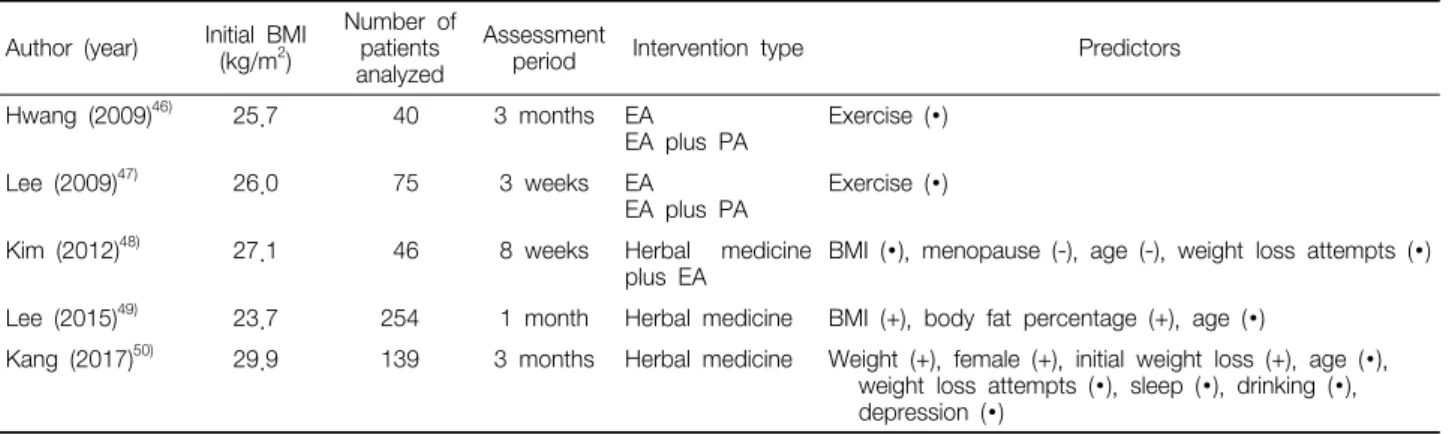
Table 4. Weight Loss Studies with Korean Medicine
4. 한방치료를 통한 체중 감량 연구(Table 4)
Hwang 등
46)은 비만 여성에서 전침의 체중 감량 효과를 조사하고자 한방병원 체형관리센터에 내원한 40명의 환 자를 대상으로 3개월간 12회의 저주파 전침 위주의 치료 및 식이요법과 행동 수정요법을 실시했다. 연구 결과 연 령이 증가할수록 체중 감량 속도가 저하되었고, 정상체중 군보다 비만군에서 체중 감량이 더 효과적이었으며, 운동 의 병행 여부는 체중 감량에 유의한 차이를 주지 않았다.
Lee 등
47)은 한방 비만 치료 프로그램의 단기간 체중 감 량 경과와 연령, 운동 유무의 차이를 비교하고자 하였다.
이를 위해 비만 여성 75명을 대상으로 3주간 6회 이상 저 주파 전침을 시술했다. 연구 결과 연령이 높은 경우 체중 감량이 적었으며, 운동 유무는 체중 감량과 관련이 없는 것으로 나타났다.
Kim 등
48)은 한방 비만 치료의 효과와 다양한 요인에 따 른 효과 차이를 평가하였다. 이를 위해 한방비만센터에 내원한 환자 46명을 대상으로 한약, 저주파 전침 등의 치 료를 약 8주간 진행했다. 연구 결과 폐경 이전이며 나이가 어릴수록 유의하게 감량률이 좋았고, 초기 BMI가 높을수 록 높은 체중 감량과 관련이 있다는 연구 결과를 얻었다.
Lee 등
49)은 한방 비만 치료의 효과를 보고하기 위하여 비만 환자 254명을 대상으로 후향적 연구를 진행했다. 체 감탕을 가감한 탕약 1개월 복용 후 체중 감량을 분석한 결 과, 체중은 유의하게 감소하였고, 체중 감량과 연령은 유 의한 관련성이 없었으며, 초기 BMI와 체지방률이 높을수 록 체중 감량이 많았다.
Kang 등
50)은 한방 비만 치료 시 체중 감량에 영향을 미 치는 요인을 분석하기 위해 3개월간 가미태음조위탕을
복용한 비만 환자 139명에 대하여 후향적 차트 리뷰를 진 행했다. 연구 결과 여성인 경우와 초기 체중이 높은 경우, 초기 2주, 6주의 높은 체중 감량이 이후의 더 높은 감량을 예측하였다.
고찰
비만 치료 시의 체중 감량에 영향을 주는 인자들에 대 한 기존 연구로는 성별
51)이나 심리요인
52)과 같이 특정 요 인에 대한 연구, 또는 비만 대사 수술
53)과 같이 특정한 중 재가 이루어진 경우에 대한 연구 등이 있다. Stubbs 등
54)은 행동 치료를 통한 체중 감량의 예측인자들을 Patient fac- tors, Process variables, Treatment factors, Behavioural changes 의 네 가지로 분류하여 제시했으며, Boutcher 등
55)은 운동 요법을 통한 체중 감량에 영향을 주는 요인을 behavioural, inherited, physiological factors의 세 가지로 분류하여 개인 에 따른 감량의 차이를 파악하고자 하였다.
본 연구는 치료 중재에 제한을 두지 않고 체중 감량에
영향을 주는 다양한 요인들에 대하여 전반적인 검색을 실
시하였다. 선정한 논문들의 분석 결과, 비만 치료에 있어서
체중 감량에 영향을 미치는 요인에는 유전 및 신체적 요인,
인구통계학적 요인, 비만 치료 과거력 관련 요인, 행동 요인,
심리 요인, 치료 과정 관련 요인 등의 다양한 요인들이 있
었다. 이것을 다시 크게 두 가지 종류, 즉 체중 감량 및 감
량 후 체중 유지 시 적극적으로 활용함으로써 치료 효과를
높일 수 있는 가변요인과 환자 개인 특성에 맞는 적절한
치료 기간과 감량 목표를 제시하는 예후 설정의 근거가 될
수 있는 불변요인으로 분류하였으며, 결과적으로 유전 및
Detailed predictors Unchangeable predictors
Genetic and physiological factors Degree of obesity (+
14,22,27,29,37,38,46,49,50)) (∙
8,14,15,21,25,28,35,48)) (-
31,33,36,39,41)) Childhood obesity (∙
8,15,21,31,35)) (-
42))
Family history of obesity (∙
15,35,42)) Menopause (-
48))
Demographic factors Age (∙
11,14,15,26,28,29,33,35,39,40,49,50)) (-
36-38,41,42,46-48)) (+
21,25)) Gender (∙
15,21,28,31,33,35-37,41,42)) Female(+
11,38-40,50)) Male (+
14,26,29)) Education (∙
11,15,21,25,26,33,35,38,40)) (+
8,31,42))
Employment (∙
15,26,31,35,38)) (+
8,21)) Marital status (∙
21,31,33,35,38,42)) (-
24)) Ethnicity (∙
31,35)) Black ethnicity (-
39,45)) Treatment history factors Weight loss attempts (∙
8,11,31,48,50)) (+
22))
Weight cycling (∙
31,35)) (+
15))
Maximum past weight loss (+
22)) (-
35))
Number of attempts to lose weight in the past year (-
8)) Changeable predictors
Behavioral factors Diet adequacy (+
8,10,16,19-21,35,37)) (∙
18,26,33)) Exercise (+
16,23,26,31,37)) (∙
18,33,46,47)) Eating disorder (-
8,19,30,32,43)) (∙
9,15,34,35,40)) Hunger (+
20,45)) (∙
35))
Restrained eating (-
34,45)) Smoking (∙
25,35,36,42)) Sleep (∙
26,50)) Drinking (∙
50))
Psychological factors Depression (∙
8,9,30,31,34,35,39,40,50)) (-
33,45)) Self efficacy (+
10,12,18,23)) (∙
8))
Mental disturbance (-
8,9,12,21,23)) (∙
15,35,38)) Body satisfaction (∙
9,15,30)) (+
12,23)) (-
13)) Self regulation (+
23,26))
Anxiety (∙
30,35,39)) (+
17)) Motivation (∙
9,34)) (+
27,29)) Neuroticism (-
13)) (+
17)) Conscientiousness (-
17)) (∙
9,21)) Expression of self opinion (-
8)) Presence of assistant (+
8)) Healthy eating barriers (-
26))
Impact of weight on quality of life (∙
34)) Impulsivity (∙
34))
Hedonism (-
40))
Treatment process factors Initial weight loss (+
14,15,21,24,28,44,50)) Attendance (+
12,13,18,21,31,37)) (∙
11)) Self-weighing (+
11,19)) (-
15)) (∙
26)) +: positive correlation, -: negative correlation, ∙: no correlation.
Table 5. Predictors of Weight Loss in Obesity Treatment
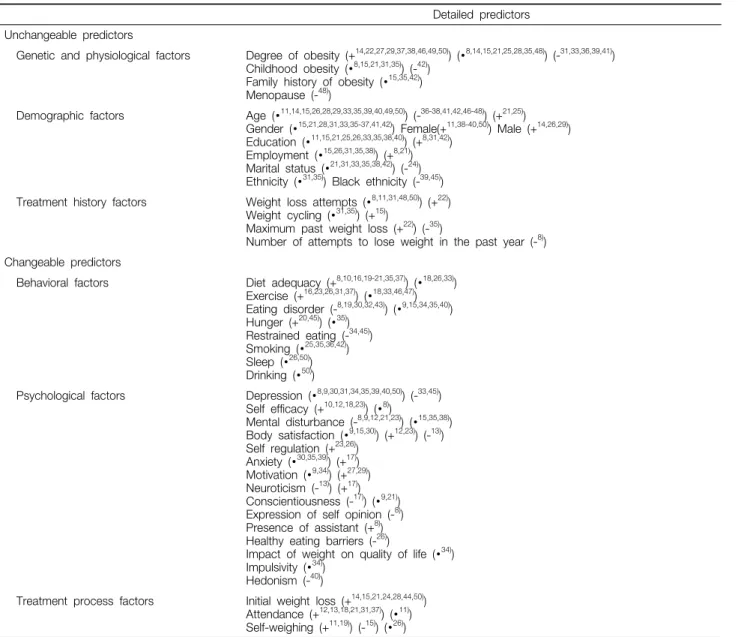
신체적 요인, 인구통계학적 요인, 비만 치료 과거력 관련 요인은 불변요인으로, 행동 요인, 심리 요인, 치료 과정 관련 요인은 가변요인으로 분류하였다(Table 5).
다양한 요인들 중 체중 감량에 영향을 주는 주요 요인 으로는 높은 초기 비만도, 젊은 연령 등의 불변요인과 지 속적인 식이 규제, 운동 및 신체활동, 자기 효능감, 치료 초기의 성공적인 체중 감량, 높은 치료 참석률 등의 가변 요인이 있었다. 그중 적합한 지속적인 식이 규제, 운동을 포함한 신체활동, 치료 초기의 성공적인 체중 감량, 높은 치료 참석률이 성공적인 체중 감량의 중요 요인이라는 연 구 결과가 가장 많았다.
지속적인 식이 규제에 있어서는, Kim 등
8)의 연구에서는 동물성 단백질과 동물성 지방의 적은 섭취와 많은 조섬유소 섭취, Karlsen 등
21)의 연구에서는 총 섭취 칼로리 및 알코 올의 제한과 탄수화물 50~60%, 단백질 10~20%, 지방 30%
이상의 식이, Bas 등
10)과 Batra 등
20)의 연구에서는 증가된
식이 절제와 감소된 공복감 및 탈억제, Ovbiosa-Akinbosoye
등
16)의 연구에서는 과일과 야채, 통곡물, 저지방이나 무지
방 유제품과 저지방 고단백 식이, Fox 등
35)의 연구에서는
탄산음료 섭취 절제, Binda 등
37)은 특히 설탕이 많이 든
음식의 제한(주 1회 미만), Neve 등
19)의 연구에서는 식사
를 거르지 않고, 간식을 집에 두지 않으며, 테이크 아웃
음식을 덜 먹는 식습관 등이 성공적인 체중 감량과 높은 상관성이 있다는 결과를 얻었다.
운동 및 신체 활동으로는, 주당 평균 1,200 METs 정도 의 운동
16), 주 2회
23)또는 3회
37)이상의 중등도 강도(빨리 걷기 등)의 운동, 주당 운동 시간이 많을수록
26), 신체 활동 가능 범위의 제약이 없는 경우
31)가 체중 감량의 성공과 연 관성이 있었다.
치료 초기의 체중 감량에 있어서는, Handjieva-Darlenska 등
14)은 초기 3주간의 체중 감량이 전체 8주간의 체중 감 량을 예측할 수 있었다고 보고하였고, Batterham 등
28)과 Hadziabdic 등
24)의 연구에서는 초기 1개월간의 성공적인 체중 감량이 전체1년간의 체중 감량 성공을 예측하였으 며, Elfhag 등
15)은 초기 5주간의 성공적인 체중 감량이 전 체9~11개월간의 체중 감량의 가장 좋은 예측인자(the best predictor)로, Karlsen 등
21)의 연구에서는 초기 12주간의 체 중 감량이 전체 1년간 체중 감량의 유의한 예측인자로, Fujioka
44)는 초기 16주 동안 4% 이상의 체중 감량이 전체 56주간의 체중 감량 성공을 가장 잘 예측한 것으로 보고 하는 등, 초기의 성공적인 체중 감량은 비만 치료에 있어 서 체중 감량의 가장 일관되고 강력한 예측 요인이었다.
또한 Kang 등
50)의 연구에서는 6, 10주의 감량을 예측할 때 이전 시기인 2, 6주의 감량을 변수로 추가한 경우 설명수 준이 높아졌다. 치료 참석률은 대부분의 연구
12,13,18,21,31,37)에서 전체 치료 일정 횟수 중 참석한 횟수의 비율이 높을 수록 체중 감량이 좋은 것으로 나타났다.
본 연구에서는 문헌 조사를 통해 비만 치료 시 체중 감 량에 영향을 주는 인자들을 불변요인과 가변요인으로 나 누고, 나아가 특성에 따른 분류를 통해 다양한 요인들의 종류와 분포를 살펴볼 수 있었다. 선정한 논문들을 대상 으로 어떠한 요인들이 연구되었는지, 그 빈도와 유의한 정도를 파악하고자 노력하였다. 그러나 논문에 따라 연구 및 평가 기간의 다양성이 컸기 때문에 감량 이후 유지 연 구와의 경계가 모호할 수 있으며, 감량 중의 중도탈락과 감량의 최종 결과와 관련된 연구 역시 혼재된 경우가 많 았기에 하나의 틀로 묶기 어려웠다. 또한 논문의 질 평가 가 이루어지지 않았고 각각의 모든 인자들에 대한 심도 있는 분석이 이루어지지 않았기 때문에 신뢰도가 부족할 수 있다는 것이 한계점으로 파악된다. 한편, 논문 선정 시 비만을 제외한 다른 질환을 가진 환자군에 대한 연구는 배제하였는데, 실제 임상에서 비만 환자의 경우 고혈압,
당뇨 등 각종 대사 질환 및 통증 질환을 함께 가지고 있 는 경우가 많기 때문에 이 부분에 대한 연구는 추가로 이 루어진다면 좋을 것으로 판단된다.
결론
비만 치료에서 체중 감량에 영향을 주는 주요 요인으 로는 높은 초기 비만도, 젊은 연령 등의 불변요인과 지속 적인 식이 규제, 운동 및 신체활동, 높은 자기 효능감, 치 료 초기의 성공적인 체중 감량, 높은 치료 참석률 등의 가 변요인이 있었다.
성공적인 체중 감량을 위해서는, 총 섭취 칼로리 및 알 코올의 제한과 과일과 야채, 통곡물, 저지방이나 무지방 유제품과 저지방 고단백 식품 섭취, 설탕이 많이 든 음식 의 제한(주 1회 미만), 식사를 거르지 않고, 간식을 집에 두지 않으며, 테이크 아웃 음식을 덜 먹는 식습관 등의 지 속적인 식이 규제와, 주 2~3회 이상의 중등도 강도(빨리 걷기 등)의 운동, 치료 초기(특히 3주 또는 1개월 이내)에 성공적인 체중 감량에 도달하는 것과 정기적인 치료 참석 이 중요하다는 결론을 얻을 수 있었다. 이러한 가변요인 들과 불변 요인들에 대한 연구 결과를 이론적 근거 기반 으로 하여 향후 개인의 특성에 맞는 효과적인 맞춤형 비 만 치료 프로그램 개발을 위한 임상 연구가 이루어져야 할 것으로 사료된다.
References
1. Organization for Economic Cooperation and Development (OECD). Obesity Update 2017 [Internet]. Paris (FR): OECD;
2017 [cited 2017 May 18]. Available from: https://www.
oecd.org/els/health-systems/Obesity-Update-2017.pdf.
2. National Health Insurance Service. 2017 Obesity white paper [Internet]. Wonju (KR): National Health Insurance Service; 2017 [cited 2017 Dec]. Available from: https://h i.nhis.or.kr/service_download.do?bm_idx=MM00000032&
bd_idx=BD00006975&ba_idx=BA00001720.
3. World Health Organization. Fact sheets-Obesity and overweight [Internet]. Geneva (CH): World Health Organization;
2018 [cited 2018 Feb 16]. Available from: http://www.w ho.int/en/news-room/fact-sheets/detail/obesity-and-over weight.
4. Padwal RS, Majumdar SR. Drug treatment of obesity: or- listat, sibutramine, and rimonabant. Lancet. 2007 ;
369(9555) : 71-7.
5. Jo SI, Lee JK, Shin JK. Factors related to failure in weight reduction or maintenance in Korean adults. Korean J Fam Pract. 2017 ; 7(1) : 72-9.
6. Kim SY, Park YJ, Park YB. Review on predictors of dropout and weight loss maintenance in weight loss interventions. J Korean Med. 2016 ; 37(3) : 62-73.
7. Sjöström L. Review of the key results from the Swedish Obese Subjects (SOS) trial - a prospective controlled in- tervention study of bariatric surgery. J Intern Med. 2013
; 273(3) : 219-34.
8. Kim SY. General characteristics and psychological and environmental factors related to successful weight re- duction programs in obese premenopausal women. J East Asian Soc Dietary Life. 2007 ; 17(5) : 634-43.
9. Anton SD, Martin CK, Redman L, York-Crowe E, Heilbronn LK, Han H, et al. Psychosocial and behavioral pre-treat- ment predictors of weight loss outcomes. Eat Weight Disord. 2008 ; 13(1) : 30-7.
10. Bas M, Donmez S. Self-efficacy and restrained eating in relation to weight loss among overweight men and wom- en in Turkey. Appetite. 2009 ; 52(1) : 209-16.
11. VanWormer JJ, Martinez AM, Martinson BC, Crain AL, Benson GA, Cosentino DL, et al. Self-weighing promotes weight loss for obese adults. Am J Prev Med. 2009 ; 36(1) : 70-3.
12. Annesi JJ, Whitaker AC. Psychological factors associated with weight loss in obese and severely obese women in a behavioral physical activity intervention. Heal Educ Behav. 2010 ; 37(4) : 593-606.
13. Annesi JJ, Whitaker AC. Psychological factors discrim- inating between successful and unsuccessful weight loss in a behavioral exercise and nutrition education treatment.
Int J Behav Med. 2010 ; 17(3) : 168-75.
14. Handjieva-Darlenska T, Handjiev S, Larsen TM, van Baak MA, Jebb S, Papadaki A, et al. Initial weight loss on an 800-kcal diet as a predictor of weight loss suc- cess after 8 weeks: the Diogenes study. Eur J Clin Nutr.
20 10 ; 64(9) : 994-9.
15. Elfhag K, Rössner S. Initial weight loss is the best pre- dictor for success in obesity treatment and sociodemo- graphic liabilities increase risk for drop-out. Patient Educ Couns. 2010 ; 79(3) : 361-6.
16. Ovbiosa-Akinbosoye OE, Long DA. Factors associated with long-term weight loss and weight maintenance: analysis of a comprehensive workplace wellness program. J Occup Environ Med. 2011 ; 53(11) : 1236-42.
17. Munro IA, Bore MR, Munro D, Garg ML. Using person- ality as a predictor of diet induced weight loss and weight management. Int J Behav Nutr Phys Act. 2011 ; 8(1) : 129.
18. Byrne S, Barry D, Petry NM. Predictors of weight loss
success. Exercise vs. dietary self-efficacy and treatment attendance. Appetite. 2012 ; 58(2) : 695-8.
19. Neve MJ, Morgan PJ, Collins CE. Behavioural factors re- lated with successful weight loss 15 months post-enrol- ment in a commercial web-based weight-loss programme.
Public Health Nutr. 2012 ; 15(7) : 1299-1309.
20. Batra P, Das SK, Salinardi T, Robinson L, Saltzman E, Scott T, et al. Eating behaviors as predictors of weight loss in a 6 month weight loss intervention. Obesity. 2013
; 21(11) : 2256-63.
21. Karlsen TI, Søhagen M, Hjelmesæth J. Predictors of weight loss after an intensive lifestyle intervention pro- gram in obese patients: a 1-year prospective cohort study.
Health Qual Life Outcomes. 2013 ; 11(1) : 165.
22. Latner JD, Ciao AC. Weight-loss history as a predictor of obesity treatment outcome: prospective, long-term results from behavioral, group self-help treatment. J Health Psychol.
2014 ; 19(2) : 253-61.
23. Annesi JJ, Johnson PH. Theory-based psychosocial fac- tors that discriminate between weight-loss success and failure over 6 months in women with morbid obesity receiving behavioral treatments. Eat Weight Disord. 2015
; 20(2) : 223-32.
24. Hadziabdic MO, Mucalo I, Hrabac P, Matic T, Rahelic D, Bozikov V. Factors predictive of drop-out and weight loss success in weight management of obese patients. J Hum Nutr Diet. 2015 ; 28 Suppl 2 : 24-32.
25. Jiandani D, Wharton S, Rotondi MA, Ardern CI, Kuk JL.
Predictors of early attrition and successful weight loss in patients attending an obesity management program. BMC Obes. 2016 ; 3(1) : 14.
26. Reed JR, Yates BC, Houfek J, Briner W, Schmid KK, Pullen CH. Motivational factors predict weight loss in rural adults. Public Health Nurs. 2016 ; 33(3) : 232-41.
27. Tigay JH, Thompson M, Sutton D, Lesley M. Motivation for weight loss. J Nurse Pract. 20 16 ; 12(4) : e169-73.
28. Batterham M, Tapsell L, Charlton K, O’Shea J, Thorne R. Using data mining to predict success in a weight loss trial. J Hum Nutr Diet. 2017 ; 30(4) : 471-8.
29. Sylvester MD, Burgess EE, Soleymani T, Daniel S, Turan B, Ray MK, et al. Baseline motives for eating palatable food: racial differences and preliminary utility in predict- ing weight loss. Eat Weight Disord. 20 17 Aug 24. doi:
10.1007/s40519-017-0426-5. [Epub ahead of print]
30. Sallet PC, Sallet JA, Dixon JB, Collis E, Pisani CE, Levy A, et al. Eating behavior as a prognostic factor for weight loss after gastric bypass. Obes Surg. 2007 ; 17(4) : 445-51.
31. Hatoum IJ, Stein HK, Merrifield BF, Kaplan LM. Capacity for physical activity predicts weight loss after roux-en-Y gastric bypass. Obesity. 2009 ; 17(1) : 92-9.
32. Ashton K, Heinberg L, Windover A, Merrell J. Positive response to binge eating intervention enhances post-
operative weight loss. Surg Obes Relat Dis. 20 11 ; 7(3) : 315-20.
33. Júnior WS, Do Amaral JL, Nonino-Borges CB. Factors re- lated to weight loss up to 4 years after bariatric surgery.
Obes Surg. 2011 ; 21(11) : 1724-30.
34. Miras AD, Al-Najim W, Jackson SN, McGirr J, Cotter L, Tharakan G, et al. Psychological characteristics, eating behavior, and quality of life assessment of obese pa- tients undergoing weight loss interventions. Scand J Surg.
20 14 ; 10 4(1) : 10 -7.
35. Fox B, Chen E, Suzo A, Jolles S, Greenberg JA, Campos GM, et al. Dietary and psych predictors of weight loss after gastric bypass. J Surg Res. 2015 ; 197(2) : 283-90.
36. Parri A, Benaiges D, Schröder H, Izquierdo-Pulido M, Ramón J, Villatoro M, et al. Preoperative predictors of weight loss at 4 years following bariatric surgery. Nutr Clin Pract. 20 15 ; 30 (3) : 420 -4.
37. Binda A, Jaworski P, Kudlicka E, Ciesielski A, Cabaj H, Tarnowski W. The impact of selected factors on param- eters of weight loss after sleeve gastrectomy. Videosurgery Miniinv. 2016 ; 11(4) : 288-94.
38. Thomson L, Sheehan KA, Meaney C, Wnuk S, Hawa R, Sockalingam S. Prospective study of psychiatric illness as a predictor of weight loss and health related quality of life one year after bariatric surgery. J Psychosom Res.
2016 ; 86 : 7-12.
39. Wise ES, Hocking KM, Kavic SM. Prediction of excess weight loss after laparoscopic Roux-en-Y gastric bypass:
data from an artificial neural network. Surg Endosc Other Interv Tech. 2016 ; 30(2) : 480-8.
40. Alfonsson S, Weineland-Strandskov S, Sundbom M. Self- reported hedonism predicts 12-month weight loss after Roux-en-Y gastric bypass. Obes Surg. 2017 ; 27(8) : 2073-8.
41. Al-Khyatt W, Ryall R, Leeder P, Ahmed J, Awad S.
Predictors of inadequate weight loss after laparoscopic gastric bypass for morbid obesity. Obes Surg. 2017 ; 27(6) : 1446-52.
42. Dilektasli E, Erol MF, Cayci HM, Ozkaya G, Bayam ME, Duman U, et al. Low educational status and childhood obesity associated with insufficient mid-term weight loss after sleeve gastrectomy: a retrospective observational cohort study. Obes Surg. 2017 ; 27(1) : 162-8.
43. Kim KK, Suh HS, Hwang IC, Ko KD. Influence of eat- ing behaviors on short-term weight loss by orlistat and anorectic agent. Eat Behav. 2014 ; 15(1) : 87-90.
44. Fujioka K, O’Neil PM, Davies M, Greenway F, Lau D, Claudius B, et al. Early weight loss with liraglutide 3.0
mg predicts 1-year weight loss and is associated with improvements in clinical markers. Obesity. 2016 ; 24(11) : 2278-88.
45. Thomas EA, McNair B, Bechtell JL, Ferland A, Cornier MA, Eckel RH. Greater hunger and less restraint predict weight loss success with phentermine treatment. Obesity.
2016 ; 24(1) : 37-43.
46. Hwang DS, Lee YJ, Lee CH, Kim YS, Jang JB, Lee KS.
The efficacy of low frequency electroacupuncture therapy for weight loss in obese Korean women. 2009 ; 22(2) : 140-50.
47. Lee YJ, Hwang DS, Cho JM, Lee JM, Lee CH, Jang JB, et al. The difference of weight loss at age and exercise in women after oriental obesity treatment in short term.
2009 ; 22(3) : 197-204.
48. Kim SJ, Kim WI. A clinical study about the effects of oriental medical therapy on obesity and different effects between groups. The Journal of Korean Medicine Ophthalmology & Otolaryngology & Dermatology. 2012
; 25(3) : 97-112.
49. Lee YH, Go NG, Min DL. Retrospective study about the effectiveness of Korean Medicine treatment on 254 pa- tients visited obesity clinic. J Korean Med Obes Res.
2015 ; 15(1) : 33-7.
50. Kang EY, Park YB, Kim MY, Park YJ. A study on fac- tors associated with weight loss by “Gamitaeeumjowee- Tang.” J Korean Med Obes Res. 2017 ; 17(2) : 68-76.
51. Williams RL, Wood LG, Collins CE, Callister R. Effectiveness of weight loss interventions-is there a difference be- tween men and women: a systematic review. Obes Rev.
2015 ; 16(2) : 171-86.
52. Wimmelmann CL, Dela F, Mortensen EL. Psychological predictors of weight loss after bariatric surgery: a review of the recent research. Obes Res Clin Pract. 20 14 ; 8(4) : e299-313.
53. Livhits M, Mercado C, Yermilov I, Parikh JA, Dutson E, Mehran A, et al. Preoperative predictors of weight loss following bariatric surgery: systematic review. Obes Surg.
2012 ; 22(1) : 70-89.
54. Stubbs J, Whybrow S, Teixeira P, Blundell J, Lawton C, Westenhoefer J, et al. Problems in identifying predictors and correlates of weight loss and maintenance: im- plications for weight control therapies based on behav- iour change. Obes Rev. 2011 ; 12(9) : 688-708.
55. Boutcher SH, Dunn SL. Factors that may impede the weight loss response to exercise-based interventions. Obes Rev. 2009 ; 10(6) : 671-80.