• 검색 결과가 없습니다.

Optical and Electronic Properties of SnO<sub>2</sub> Thin Films Fabricated Using the SILAR Method

N/A
N/A
Protected

Academic year: 2021

Share "Optical and Electronic Properties of SnO<sub>2</sub> Thin Films Fabricated Using the SILAR Method"

Copied!
4
0
0

로드 중.... (전체 텍스트 보기)

전체 글

(1)

364 J. Sensor Sci. & Tech. Vol. 24, No. 6, 2015 Journal of Sensor Science and Technology

Vol. 24, No. 6 (2015) pp. 364-367 http://dx.doi.org/10.5369/JSST.2015.24.6.364 pISSN 1225-5475/eISSN 2093-7563

Optical and Electronic Properties of SnO 2 Thin Films Fabricated Using the SILAR Method

Joohee Jang

1,2

, Haena Yim

1

, Yoon-Ho Cho

1

, Dong-Heon Kang

2

, and Ji-Won Choi

1,+

Abstract

Tin oxide thin films were fabricated on glass substrates by the successive ionic layer adsorption and reaction (SILAR) method at room temperature and ambient pressure. Before measuring their properties, all samples were annealed at 500

o

C for 2 h in air. Film thickness increased with the number of cycles; X-ray diffraction patterns for the annealed SnO

2

thin films indicated a SnO

2

single phase. Thickness of the SnO

2

films increased from 12 to 50 nm as the number of cycles increased from 20 to 60. Although the optical transmittance decreased with thickness, 50 nm SnO

2

thin films exhibited a high value of more than 85%. Regarding electronic properties, sheet resistance of the films decreased as thickness increased; however, the measured resistivity of the thin film was nearly constant with thickness (3 ×10

-4

ohm/cm). From Hall measurements, the 50 nm thickness SnO

2

thin film had the highest mobility of the samples (8.6 cm

2

/(V·s)). In conclusion, optical and electronic properties of SnO

2

thin films could be controlled by adjusting the number of SILAR cycles.

Keywords: SnO

2

, Oxide semiconductors, SILAR method

1. INTRODUCTION

In recent years, transparent oxide semiconductors (TOS) have received significant attention for application in a wide range of electronic devices requiring transparency, such as light emitting diodes, solar cells, optical sensors, CMOSs and displays [1]. One such transparent oxide semiconductor material is tin oxide (SnO

2

), which has high optical transmittance in the visible range and low electrical resistance [2-4]. SnO

2

is an n-type semiconductor that forms as a result of an excess of electrons produced by ionization of oxygen vacancies, and interstitial tin atoms that are generated during the crystal growth process. In addition, SnO

2

thin films are mechanically strong and thermally stable in oxidizing environments at high temperatures, and chemically stable in both acidic and basic solutions. However, compared to other TOS materials, SnO

2

films exhibit poor performance in some areas,

such as having low values for mobility and for on-off ratio. The optical and electronic properties of SnO

2

films can be improved by doping. The upper limit on the electron density, which determines mobility, is set by the solubility of the dopants.

However, if the concentration of dopants introduced exceeds the maximum solubility, the excess can form clusters in the lattice, accompanied by a loss of crystallinity. An increased sheet resistance then occurs as a result of atomic disorder and impurity scattering, which reduces mobility of the electrical carriers [5].

However, the presence of impurities at grain boundaries can reduce the barriers between crystallites and may consequently increase the mobility and decrease the sheet resistance [6].

Properties of SnO

2

films impurity-doped with group III, V, VI, and VII elements [6] such as In, F [7], Te, Sb, Cl [8], Al, and Br [8]

have been studied. SnO

2

can be either an n-type or p-type semiconductor, determined easily by dopant selection. Before considering such modification of SnO

2

films, uniform SnO

2

thin films should be investigated as preceding researches. Many researches groups have studied fabrication of SnO

2

thin films using various ways such as vacuum evaporation, sputtering [9], CVD, MOCVD, and spray pyrolysis [8]. A chemical method for the deposition of a thin film is the successive ionic layer adsorption and reaction (SILAR) method, which has a number of advantages, including a simple procedure. The SILAR method is known as modified version of chemical bath deposition method by which thin films of compound semiconductors can be

1

Center for Electronic Materials, Korea Institute of Science and Technology, Seoul 136-791, Korea

2

Department of Electronic Materials Engineering, University of Suwon, Suwon 445-743, Korea

+
Corresponding author: [email protected] (Received: Nov. 17, 2015, Accepted: Nov. 27, 2015)

This is an Open Access article distributed under the terms of the Creative Commons Attribution Non-Commercial License(http://creativecommons.org/

licenses/bync/3.0) which permits unrestricted non-commercial use, distribution,

and reproduction in any medium, provided the original work is properly cited.

(2)

Optical and Electronic Properties of SnO

2

Thin Films Fabricated Using the SILAR Method

365 J. Sensor Sci. & Tech. Vol. 24, No. 6, 2015 deposited in accordance with dipping the substrate in the aqueous

solution which contain ions for each component. It offers an easy means for depositing thin films, in which the thickness is simply controlled by deposition rate and number of deposition cycles.

Moreover, there are no restrictions on a substrate’s material dimensions or its surface profile. It is also relatively convenient for large area deposition, inexpensive, and simple [10]. Recently, various thin films such as CuO [11], Cu

2

O [12], NiO [13] was fabricated by SILAR method and measured optical and electronic properties. For example, the NiO thin films by using SILAR method showed the thickness grew from 125 nm to 312 nm as increased in the number of cycles from 40 to 100 cycles. In addition, the resistivity of the films obtained between 4.2 and 802.1 Ωcm.

In the present investigation, we report on synthesis of SnO

2

thin films by the SILAR method, and their structural, surface morphological, and electrical properties.

2. EXPERIMENTAL

2.1. SnO

2

Thin Film Fabrication .

In this study, SnO

2

thin films were deposited on glass substrates using the SILAR method at room temperature and ambient pressure. To deposit a SnO

2

thin film, 0.025 M tin (II) chloride (SnCl

2

·2H

2

O ≥98%, Aldrich, USA) was chosen for the cation precursor as a source of Sn

4+

. The anionic precursor was 1% H

2

O

2

. Both the cationic and anionic precursors were kept at room temperature (~300 K). One SILAR cycle consists of four steps: (i) adsorption of Sn

4+

ions on the substrate surface for 10 s, (ii) washing to remove excess salt, (iii) reaction with H

2

O

2

solution for 20 s to form a stable SnO

2

thin film on the substrate, and (iv) washing to remove residue. The number of cycles ranged from 20 to 60. After deposition, all samples were annealed at 500

o

C for 2 hours in air.

2.2 Characterization of SnO

2

Thin Films

Surface and electronic properties of the SnO

2

thin films were measured at three or four different positions on each sample to verify reproducibility. Structural properties of SnO

2

thin films were characterized by X-ray diffraction (XRD, Rigaku). Optical properties of the thin films were measured using UV-visible spectroscopy (Lambda 18, Perkin Elmer) in the range 200–

900 nm. Thicknesses of the thin films were measured by field

emission environmental scanning electron microscopy (FE- ESEM, XL-30). Electronic properties of the thin films were investigated by Hall measurements and with a four point probe (MS-TECH).

3. RESULTS AND DISCUSSIONS

3.1 Film Formation Mechanism

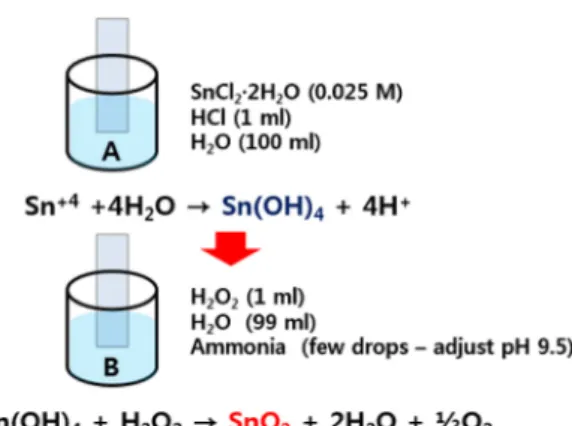
The formation mechanism of SnO

2

film is presented in Fig. 1.

The SnCl

2

solution contains Sn

4+

ions that hydrolyze to form Sn(OH)

4

, which precipitates on the immersed substrate surface.

The substrate is then rinsed in dilute H

2

O

2

solution, where formation of SnO

2

takes place through the second reaction shown in Fig. 1. This completes one cycle in the formation of a SnO

2

monolayer; the cycles are repeated to achieve a desired film thickness. By repeating this process, it is established that the thickness can be controlled, and the variation of film properties with thickness is studied.

3.2 Structural Analysis

The structural analysis of SnO

2

thin films deposited on the glass substrate and annealed at 500

o

C was carried out using XRD. The X-ray diffraction patterns of the thin films, obtained by varying the diffraction angle 2θ from 20 to 90

o

, indicate the existence of a SnO

2

single phase as shown in Fig. 2. The peaks at 2θ = 26.5, 33.8, 37.8, and 51.6

o

correspond to the (110), (101), (200), and (211) planes of SnO

2

, respectively (JCPDS card no. 77-0450).

SEM images were used to analyze the microstructure and thickness of the films. Fig. 3 (a) and (b) shows the cross-sectional images of SnO

2

thin film on glass substrate after 30 and 60

Fig. 1. SnO

2

thin films formation mechanism.

I 7 I

(3)

Joohee Jang, Haena Yim, Yoon-Ho Cho, Dong-Heon Kang, and Ji-Won Choi

J. Sensor Sci. & Tech. Vol. 24, No. 6, 2015 366 SILAR cycles. The thickness of the films at 30 and 60 cycles are 13 and 50 nm, respectively. The variation of film thickness with number of cycles is shown in Fig. 3 (c). The thickness of the film increases with number of deposition cycles from 20 to 60 cycles.

3.3 Optical Analysis

Optical transmittance in the wavelength range 200 to 900 nm for the SnO

2

films deposited on glass substrates is shown in Fig.

4. Typically, optical transmittance for a display device is measured at a standard wavelength of 550 nm, corresponding to the peak sensitivity of the human eye. The SnO

2

thin film at 20 cycles (12 nm) shows the highest transmittance (92%), while the film at 60 cycles (50 nm) shows the lowest transmittance (85%) using the 550 nm wavelength standard. As the number of layers increases, the thickness of the films increases, lowering the transmittance of the sample; however, at 60 cycles the transmittance [14] of SnO

2

thin films deposited on glass substrate is still more than 85%.

3.4 Electronic analysis

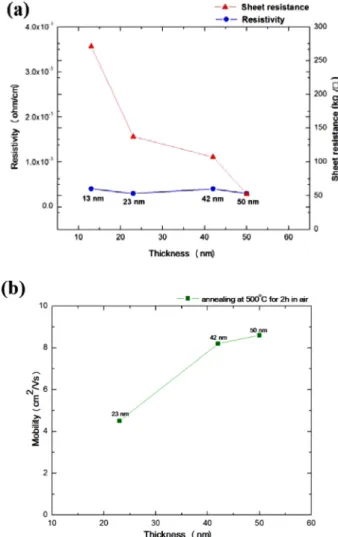
The resistivity and sheet resistance of SnO

2

thin films measured by using four point probe is shown in Fig. 5 (a). The sheet resistance of annealed SnO

2

films on glass substrates was Fig. 2. XRD pattern of SnO

2

thin film on a glass substrate.

Fig. 3. SEM images for the cross-section of the (a) 30 cycles and (b) 60 cycles SnO

2

thin films. (c) Thickness profile for cycles.

Fig. 4. Transmittance of annealed SnO

2

thin films for thickness.

Fig. 5. (a) Resistivity and sheet resistance, (b) Mobility of annealed SnO

2

thin films for different thickness.

I 8 I

(4)

Optical and Electronic Properties of SnO

2

Thin Films Fabricated Using the SILAR Method

367 J. Sensor Sci. & Tech. Vol. 24, No. 6, 2015 measured by using four point probe method. The sheet resistance

of the films is decreased as number of layers increases because the sheet resistance is depended on thickness. [15] Whereas, the measured resistivity of thin film was confirmed as almost constant value (3 ×10

-4

ohmcm) as thickness of the films increases. The resistivity value of the films is lower than the result from the recent study for SnO

2

thin film which was measured between 10

5

and 10

7

ohm · cm made by SILAR method [16].

Fig. 5 (b) is shown the mobility of SnO

2

thin films measured by using Hall measurement. The 50 nm SnO

2

thin film at 60 cycles out of the films was shown the highest mobility (8.6 cm

2

/Vs) because the mobility of thin films is increased with thickness increase [17].

4. CONCLUSIONS

SnO

2

thin films can be successfully deposited on glass substrates by the SILAR method. The film thickness increases with the increase in number of cycles whereas the transmittance of the films decreases. In addition, sheet resistance of the films decreases with increased thickness, while resistivity of the films is almost independent of thickness. Moreover, the mobility of thin films increases with thickness. As the number of layers increases, crystallite size increases and grain boundaries decrease, and as a result the mobility of the sample increases. The SnO

2

thin films of 50 nm thickness (60 cycles) show good optical and electronic properties. Therefore, we can tailor the number of cycles to obtain specified properties. Furthermore, we are able to fabricate large- area thin film applied electronic devices by the SILAR method, in a simple and inexpensive manner.

REFERENCES

[1] E. Fortunato, P. Barquinha, and R. Martins, “Oxide semi- conductor thin film transistors: A review of recent advances”, Adv. Mater., Vol. 24, No. 22, pp. 2945-2986, 2012.

[2] H. A. Klasens and H. Koelmans, “A tin oxide field effect transistor”, Solid-State Electron., Vol. 7, No. 9, pp. 701-702, 1964.

[3] A. Aoki and H. Sasakura, “Tin oxide thin film transistors”, J. Appl. Phys., Vol. 9, No. 5, pp. 582-582, 1970.

[4] R. E. Presley, C. L. Munsee, C-H. Park, D. Hong, J. F.

Wager, and D. A. Keszler, “Tin oxide transparent thin-film

transistors.” J. Phys. D: Appl. Phys., Vol 37, pp. 2810-2813, 2004.

[5] M. Mizuhashi “Electrical properties of SnO

2

films on var- ious glass substrates”, J. Non-Cryst. Solids, Vol. 38-39, No.

1, pp. 329-334, 1980.

[ 6] K. L. Chopra, S. Major, and D. K. Pandya, “Transparent conductors - a status review”, Thin Solid Films, Vol 102, No. 1, pp. 1-46, 1983.

[7] E. Shanthi, V. Dutta, A. Banerjee, and K. L. Chopra, “Elec- trical and optical properties of tin oxide films doped with F and (Sb+ F)”, J. Appl. Phys., Vol. 53, No. 3, pp. 1615-1621, 1982.

[8] D. Ginley, H. Hosono, and D. C. Paine, “Effect of F, Cl and Br doping on electrical properties of sprayed SnO

2

films”, J.

Mater. Sci. Lett., Vol. 15, No.6, pp. 497-499, 1996.

[9] B. Stjerna, E. Olsson, and C. G. Granqvist, “Optical and electrical properties of radio frequency sputtered tin oxide films doped with oxygen vacancies, F, Sb, or Mo”, J. Appl.

Phys., Vol.76, pp. 37-97, 1994.

[10] H. M. Pathan and C. D. Lokhande, “Deposition of metal chalcogenide thin films by successive ionic layer adsorption and reaction (SILAR) method”, Bull. Mater. Sci, Vol. 27, pp. 85-111, 2004.

[11] F. Bayansal, Y.Culen, B Sahin, S. Kahraman, and H.A.

Cerinkara, “CuO nanostructures grown by the SILAR method : In fumence of Pb doping on the morphological structural and optical properties”, Journal of Alloy and Compounds, Vol. 691, pp 378-382, 2015.

[12] A. T. Ravichandran, K. Dhanabalan, A. Vasuhi, R. Chan- dramohan, and Srinivas Mantha, “Morphology, bandgap, and grain size tailoring in Cu2O thin film by SILAR method”, IEEE Transactions on Nanotechnology, Vol. 14, No. 1, pp108-112, 2015.

[13] Yunus Akaltun and Tuba Çay r, “Fabrication and charac- terization of NiO thin films prepared by SILAR method”, Journal of Alloys and Compounds, Vol. 625, pp 144-148, 2015.

[14] T.R. Giraldi, M. T. Escote, M. I. B. Bernardi, V. Bouquet, E. R. Leite, E. Longoi and J. A. Varela, “Effect of thickness on the electrical and optical properties of Sb-doped SnO

2

(ATO) thin films”, J. Electroceram., Vol 13, pp. 159-165, 2004.

[15] M. D. Benoy, E. M. Mohammed, M. B. Suresh, P. J. Binu, and B. Pradeep, “Thickness dependence of the properties of indium tin oxide (ITO) films prepared by activated reactive evaporation”, Braz. J. Phys., Vol. 39, No. 7, pp. 629-632, 2009.

[16] S. M. Pusawale, P. R. Deshmukh and C.D Lokhande,

“Chemical synthesis and characterization of hydrous tin oxide(SnO

2

: H

2

O) thin films.” Indian Academy of Sciences, Vol. 34, No. 34, pp. 1179-1183, 2011.

[17] Y. Caglar, M. Caglar, S. Ilican, S. Aksoy, and F. Yak- uphanoglu, “Effect of channel thickness on the field effect mobility of ZnO-TFT fabricated by sol gel process”, J.

Alloys Compd., Vol 621, pp. 189-193, 2015.

i

I 9 I

수치

Fig. 1. SnO 2  thin films formation mechanism.
Fig. 5. (a) Resistivity and sheet resistance, (b) Mobility of annealed SnO 2  thin films for different thickness.

참조

관련 문서

at the Specific Conditions of Sputtering Power in the Preparation of CoSi 2 Thin Films by Using the Sputtering Method ……… 88 Fig.. 44 Carrier Concentration and Mobility of the

international exchange of South Korean films, korean films in the 2000s, korean domestic international film festivals, korean films in overseas film

Fabrication and Optical Properties of Polysiloxane Hybrimer Resin Using Oligohydrosiloxane 1 (OPH 1).. Fabrication and Optical Properties of Polysiloxane Hybrimer

The polarization-voltage (P-V) characteristics showed the typical hysteresis loop of PZT thin films after a post-CMP cleaning process with the optimized conditions

Lee, “Effective Ag Doping by He-Ne Laser Exposure to Improve the Electrical and the Optical Properties of CdTe Thin Films for Heterostructured Thin Film

~ a model in which the entire resistance to diffusion from the liquid surface to the main gas stream is assumed to occur in a stagnant or laminar film of constant thickness

The mechanical properties of the Ir-based films by the change of the alloy element content show that the hardness value is decreased with Re contents

The structure and film optical properties were investigated by X-ray diffraction(XRD), the particle size and thickness were investigated by scanning