J. Exp. Biomed. Sci. 2013, 19(3): 245~253 pISSN : 1738-3226
Change Pattern of Species and Antimicrobial Susceptibility of Microorganisms Isolated from Blood Culture during 5 Years: 2008-2012
Kyung-A Shin1, Kyeong Seob Shin2 and Seung Bok Hong3,†
1Department of Clinical Laboratory Science, Shinsung University, Dangjin-Si 343-861, Korea
2Department of Laboratory Medicine, Chungbuk National University, College of Medicine, Cheongju 361-711, Korea
3Department of Clinical Laboratory Science, Chungbuk Health & Science University, Cheongwon 363-794, Korea
To provide reference data or guideline for empirical treatment of bloodstream infection, we studied a change pattern in causative microorganisms and antimicrobial susceptibility in a general hospital at Gyeonggi province during five years. We retrospectively reviewed the frequency of causative microorganisms and antimicrobial susceptibility results of 5,782 microorganisms isolated from blood culture in a general hospital during the period from January 2008 to December 2012. The most common pathogens were Escherichia coli (14.7%), Staphylococcus aureus (7.5%), Streptococcus viridans group (4.9%), and Klebsiella pneumoniae (4.1%). The multiple microorganisms were isolated in 4.3% of bloodstream infection patients. The average contamination rate of blood culture during five years was 3.0%.
Methicillin-resistant S. aureus (MRSA), vancomycin-resistant Enterococcus faecium (VRE), and penicillin-resistant Streptococcus pneumoniae were isolated at 62%, 27% and 11%, respectively. Cefotaxime-resistant E. coli and K.
pneumoniae was 20% and 18%, respectively. Imipenem-resistant Pseudomonas aeruginosa (IRPA) and Acinetobacter baumannii (IRAB) was 25% and 66%, respectively. E. coli and S. aureus were most common pathogens isolated from blood culture for five years. The increase of multidrug-resistant microorganisms, such as MRSA, VRE, ESBL, IRPA and IRAB, requires more strict control of antibiotics and causes the need of the more updated guideline for the treatment of blood stream infection.
Key Words: Blood culture, Frequency, Antimicrobial susceptibility
서 론
균혈증은 매우 중한 침습성 감염으로 조기에 적절한 항생제 치료가 필요하며 (Kang et al., 2003) 혈액배양은 균혈증의 진단 및 치료의 지침 및 예후를 결정하는데 필 수적인 검사이다 (Aronson and Bor, 1987). 국외에서 균혈 증의 원인균 및 항균제 감수성 결과는 SENTRY Anti- microbial Surveilance Program이나 European Antimicrobial Resistance Surveilance System을 통해 주기적으로 발표되
고 있다 (Biedenbach et al., 2004; Fluit et al., 2000; Asensio et al., 2010; Decousser et al., 2010). 국내에서도 균혈증의 원 인균 및 항균제 감수성 양상의 변화에 대해 여러 차례 보고된 바 있으나 (Kang et al., 1998; Kang et al., 2003; Ahn et al., 2006; Koh et al., 2007; Kim et al., 2009; Park et al., 2009), 2010년 이후 국내 변화 분석은 아직 보고되지 않았다.
또한 병원균의 분포와 항균제 감수성 양상은 시대와 지 역뿐만 아니라 병원의 특성에 따라 다른 양상을 보이므 로 주기적으로 보고하는 것은 매우 중요하다. 이에 저자 들은 최근 2008년부터 2012년까지 한 종합병원의 혈액배 양에서 분리된 균의 종류와 항균제 감수성 양상을 연도 별로 분석하여 그 변화추이를 알아보고자 하였다.
*Received: June 13, 2013 / Revised: August 1, 2013 Accepted: August 1, 2013
†Corresponding author: Seung Bok Hong. Department of Clinical Laboratory Science, Chungbuk Health & Science University, Cheongwon 363-794, Korea.
Tel: +82-43-210-8308, Fax: +82-43-210-8289 e-mail: [email protected]
○CThe Korean Society for Biomedical Laboratory Sciences. All rights reserved.
Original Article
대상 및 방법
연구대상
2008년 1월부터 2012년 12월까지 5년간 경기도 지역의 한 종합병원 (650병상)의 미생물 검사실에서 시행된 혈액 배양으로부터 분리된 5,782개의 균을 대상으로 하였으며 이들 균은 한 환자에서 2개 이상의 같은 균이 분리된 경 우는 처음 양성으로 보고된 결과만을 분석에 포함하였다.
혈액배양 및 미생물의 동정
혈액 10 mL (소아, 1~5 mL)를 무균적으로 채혈하여 Bact/Alert SA (호기성) (bioMérieux Inc., Marcy-I' Etoile, France)와 SN (혐기성) 배지에 각각 접종하고 소아인 경 우에는 Bact/Alert PF에 접종하였다. 이어서 Bact/Alert 3D 자동 혈액배양기 (bioMérieux Inc., Durharm, NC, USA)에 5일간 배양하였다. 균 증식 양성 신호가 나오면 그람 염 색을 하고 혈액한천배지와 MacConkey 한천배지에 계 대배양하여 균의 동정 및 항균제 감수성 검사를 시행 하였다. 균의 동정과 항균제 감수성 검사는 Microscan WalkAway-96 (Siemens Healthcare diagnostic, Deerfield, IL, USA)을 이용하였다.
혈액배양 검사 결과의 분석
혈액배양에서 분리주가 단일성인 경우와 다균성인 경
우로 나누었고 다균성 분리주를 제외한 환자에서 균의 연도별 분리율, 오염률 그리고 균혈증의 흔한 원인균과 주요 항균제에 대한 감수성 검사 결과를 조사하였다.
Propionibacterium spp., Corynebacterium spp., Bacillus spp.
또는 coagulase negative staphylococci (CNS)가 하나의 혈액 배양병에서만 분리되었을 때 피부오염균으로 간주하였 으며 총 의뢰된 혈액배양 건수에서 차지하는 비율을 오 염률 (위양성률)로 계산하였다 (Henry et al., 2004).
결 과
균종별 분리 빈도 및 환자 수
2008년부터 2012년까지 92,370명의 환자에서 혈액배양 이 의뢰되었으며, 5,782명 (6.3%)에서 양성 결과를 보였다.
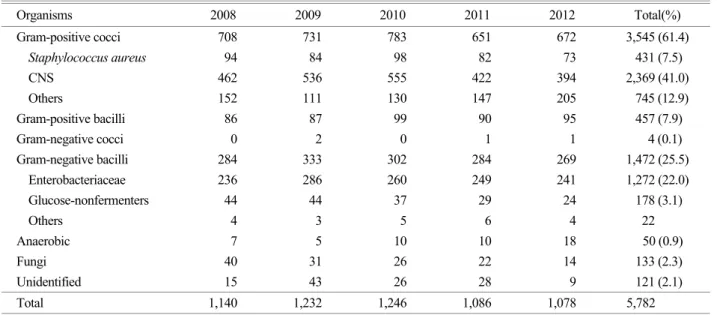
한 환자에서 단일 균종이 분리된 경우가 대부분이었으나 4.3% (247명)에서 여러 균종이 분리되었다. 혈액배양 양 성 환자에서 분리된 단일 균주 중 호기성 그람양성 알균 이 총 3,545예 (61.3%)이었고, 그람음성 막대균이 1,472예 (25.5%), 그람양성 막대균이 457예 (7.9%), 혐기성 세균은 50예 (0.9%), 진균은 133예 (2.3%)이었다 (Table 1).
그람양성 알균은 CNS (59.2%)가 가장 많았고 Staphy-
lococcus aureus (10.8%), Enterococcus faecium (2.6%), Enterococcus faecalis (2.0%), Streptococcus pneumoniae (1.2%)순으로 분리되었다 (Table 2). 그람음성 막대균은 장내 세 균이 1,272예 (22%)였으며 포도당 비발효 그람음성 막
Table 1. Microorganisms isolated from blood culture during 2008~2012
Organisms 2008 2009 2010 2011 2012 Total(%)
Gram-positive cocci 708 731 783 651 672 3,545 (61.4)
Staphylococcus aureus 94 84 98 82 73 431 (7.5)
CNS 462 536 555 422 394 2,369 (41.0)
Others 152 111 130 147 205 745 (12.9)
Gram-positive bacilli 86 87 99 90 95 457 (7.9)
Gram-negative cocci 0 2 0 1 1 4 (0.1)
Gram-negative bacilli 284 333 302 284 269 1,472 (25.5)
Enterobacteriaceae 236 286 260 249 241 1,272 (22.0)
Glucose-nonfermenters 44 44 37 29 24 178 (3.1)
Others 4 3 5 6 4 22
Anaerobic 7 5 10 10 18 50 (0.9)
Fungi 40 31 26 22 14 133 (2.3)
Unidentified 15 43 26 28 9 121 (2.1)
Total 1,140 1,232 1,246 1,086 1,078 5,782
Abbreviation: CNS, coagulase negative staphylococci
대균이 178예 (3.1%) 였다 (Table 1). 장내 세균 중에서는
Escherichia coli가 848예 (65.6%), Klebsiella pneumononiae가 235예 (18.1%), Enterobacter cloacae가 43예 (3.3%),
Proteus spp.가 24예 (1.9%)였다 (Table 3). 포도당 비발효그람음성 막대균 중에서는 Acinetobacter baumannii가 82예 (46.0%), Pseudomonas aeruginosa (29.7%), Stenotrophomonas
maltophillia (5.1%), Burkholderia cepacia (1.1%) 순이었다(Table 4). 진균은 총 133예 (2.3%)에서 분리되었으며
Candida albicans (32.3%), Candida tropicalis (26.3%), Candida glabrata (21.1%) 순으로 분리되었다 (Table 5).분리된 균종의 5년 전체 순위는 CNS (41.0%), E. coli (14.7%), S. aureus (7.5%), S. viridians (4.9%), K. pneumoniae (4.1%), Bacillus spp. (4.7%), Corynebacterium spp. (2.7%),
Micrococcus spp. (1.9%), E. faecium (1.8%), E. faecalis (1.4%), A. baumannii (1.4%), P. aeruginosa (0.9%) 순이었다.Table 2. Species of gram-positive microorganisms isolated from blood culture during 2008~2012
Organisms No. of positive patients (%) Gram-positive cocci
CNS 2,369 (59.2)
Staphylococcus aureus 431 (10.8) Viridans Streptoccoci 284 (7.1)
Micrococcus spp. 110 (2.7)
Other Streptococcus spp. 2 (0.1) Enterococcus faecium 106 (2.6) Enterococcus faecalis 82 (2.0) Other Enterococcus spp. 24 (0.6) Streptococcus pneumoniae 47 (1.2) Streptococcus agalactiae 25 (0.6) Streptococcus equisimilis 49 (1.2) Streptococcus pyogenes 4 (0.1) Streptococcus bovis 2 (0.1) Other gram-positive cocci 10 (0.2)
Subtotal 3,545
Gram-positive bacilli
Bacillus spp. 272 (6.8)
Corynebacterium spp. 159 (4.0)
Other GPR 26 (0.6)
Subtotal 457
Total 4,002
Abbreviations: CNS, coagulase negative staphylococci; GPR, gram-positive rod
Table 3. Species of gram-negative microorganisms except glucose nonfermenting gram-negative bacilli isolated from blood culture during 2008~2012
Organisms No. of positive patients (%)
Gram-negative cocci 4 (0.3)
Enterobacteriaceae
Escherichia coli 848 (65.6)
Klebsiella pneumoniae 235 (18.1)
Enterobacter cloacae 43 (3.3)
Proteus spp. 24 (1.9)
Klebsiella oxytoca 19 (1.5)
Citrobacter freundii 16 (1.2)
Serratia spp. 15 (1.2)
Enterobacter aerogenes 14 (1.1) Other Enterobacter spp. 6 (0.5)
Salmonella typhi 5 (0.4)
Other Salmonella spp. 20 (1.5)
Other Citrobacter spp. 5 (0.4)
Morganella morganii 9 (0.7)
Other Klebsiella spp. 5 (0.4)
Others 8 (0.6)
Subtotal 1,272 (98.4)
Other GNR
Aeromonas hydrophila 11 (0.9)
Pasteurella multocida 1 (0.1)
Subtotal 12 (0.9)
Others 5 (0.4)
Total 1,293 (100)
Table 4. Species of glucose-nonfermenting gram-negative bacilli isolated from blood culture during 2008~2012
Organisms No. of positive patients (%) Acinetobacter baumannii 82 (46.0) Pseudomonas aeruginosa 53 (29.7) Stenotrophomonas maltophilia 9 (5.1)
Burkholderia cepacia 2 (1.1)
Other Acinetobacter spp. 16 (9.0) Sphingomonas paucimobilis 1 (0.6) Other Pseudomonas spp. 5 (3.0)
Others 10 (5.6)
Total 178 (100)
다균성 균혈증
1회 배양을 기준으로 여러 균종이 분리된 경우는 247 예 (4.3%)로 2008년 59예, 2009년 54예, 2010년 35예, 2011 년 45예 그리고 2012년 54예 이었다. 연도별 다균성 균혈 증 비율은 2.4~4.9%였다. 이 중 3종인 경우는 10예, 2종 237예 이었다. 동시에 2종이 분리된 경우를 살펴보면 2종 모두 그람양성 알균이 70예, 2종 모두 그람음성 막대균이 31예, 1종이 그람양성 알균이고 다른 1종이 그람음성 막 대균이 85예 이었다. 2종 모두 진균인 경우는 없었으며, 그 이외가 51예 이었다.
연도별 혈액배양 양성률 및 오염률
5년간 혈액배양이 의뢰된 92,370명의 환자에서 평균 양 성률은 6.3%이었으며 오염률은 3.0%이었다. Propioni-
bacterium spp., Corynebacterium spp., Bacillus spp. 및 CNS를 합한 연도별 분리 빈도는 2.6%에서 3.4%였으며 점차 감소하는 경향을 보였다 (Table 6).
항생제 감수성 검사 결과
S. aureus의 oxacillin에 대한 내성률은 2008년 71%,
2009년 44%, 2010년 63%, 2011년 66%, 2012년 66%로 5년 동안 평균 62%이었다. Trimethoprim-sulfamethoxazole (SXT)에 대한 내성률은 감소하는 경향을 보였다. 또한 vancomycin에 대해서는 내성 균주가 없었다 (Table 7). E.
faecalis는 vancomycin에 대해 2009년에만 내성률이 11%
이었고 모두 감수성이었다. 반면 E. faecium은 vancomycin 및 teicoplanin에 대해 각각 16~37%와 15~37%의 내성 률을 보였다 (Table 8). S. pneumoniae는 vancomycin에 대 한 내성 균주는 없었으나 erythromycin에 대한 내성률은 매우 높았으며 (22~79%) penicillin과 cefotaxime에 대한 내성률은 10% 내외였다 (Table 9). E. coli는 amikacin, piperacillin-tazobactam (TZP)에 대해 6% 이하의 내성률을 보였으며 imipenem에 내성인 균주는 2011년에만 2%였다.
Table 5. Species of fungi isolated from blood culture during 2008~2012
Organisms No. of positive patients (%)
Candida albicans 43 (32.3)
Candida tropicalis 35 (26.3)
Candida glabrata 28 (21.1)
Candida parapsilosis 11 (8.3)
Other Candida spp. 14 (10.5)
Cryptococcus neoformans 2 (1.5)
Total 133 (100)
Table 6. Association between the number of blood culture and single pathogen-positive patients and CNS and BCP isolated from blood culture during 2008~2012
Year Number of blood culture
Positive patients CNS and BCP
No. (%) No. (%)
2008 16,951 1,118 (6.6) 543 (3.2) 2009 18,135 1,232 (6.8) 617 (3.4) 2010 19,237 1,250 (6.5) 650 (3.4) 2011 18,919 1,095 (5.8) 515 (2.7) 2012 19,128 1,087 (5.7) 489 (2.6) Total 92,370 5,782 (6.3) 2,814 (3.0) Abbreviations: CNS, coagulase negative staphylococci; BCP, Bacillus, Corynebacterium and Propionebacterium
Table 7. Antimicrobial susceptibility (%) of Staphylococcus aureus isolated from blood culture during 2008~2012
Year (N)* Percentage of isolates susceptible to
OX SXT VA LNZ HAB RIF CIP GM P CC E TEC
2008 (94) 29 96 100 NT NT NT NT NT 7 41 39 100
2009 (84) 56 99 100 NT NT NT NT NT 7 62 58 100
2010 (98) 37 100 100 NT NT NT NT NT 6 51 50 100
2011 (82) 34 100 100 100 NT 95 55 66 2 40 40 100
2012 (73) 34 97 100 100 NT 96 56 62 7 51 49 100
*Number of isolates tested
Abbreviations: OX, oxacillin; SXT, trimethoprim-sulfamethoxazole; VA, vancomycin; LNZ, linezolid; HAB, haberkacin; RIF, rifampin;
CIP, ciprofloxacin; GM, gentamicin; P, penicillin; CC, clindamycin; E, erythromycin; TEC, teicoplanin; NT, not tested.
Cefotaxime에 대한 내성률은 평균 20%의 내성률을 보였 다 (Table 10). K. pneumoniae는 amikacin과 TZP에는 평균 12% 정도의 내성률을 보였으며 imipenem에 내성인 균주 는 없었다. Cefotaxime에 대한 내성률은 2005년 31%에 비 해 2012년에 17%로 감소하였다 (Table 10). P. aeruginosa 는 amikacin에 대하여 2011년부터 내성률이 증가하고 있으며 ceftazidime에 14%의 내성률을 보였다. 그리고 ciprofloxacin에 대한 내성률은 2008년 13%에서 2012년 50%로 증가하였다. 마찬가지로 imipenem에 대한 내성률 도 2008년 17%에서 2012년 25%로 증가하였다 (Table 11).
A. baumannii는 amikacin에 대하여 P. aeruginosa 보다 훨씬
높은 평균 74%의 내성률을 보였다. 그리고 ceftazidime, ciprofloxacin에 대해서도 P. aeruginosa 보다 높은 70% 이
상의 내성률을 보였다. 또한 imipenem에 대한 내성률은 2009년부터 70%로 증가하여 2012년에는 79%까지 증가하 였다 (Table 12).
고 찰
균혈증의 치료에 있어 혈액배양과 항균제 감수성 검사 결과는 매우 중요하지만 임상의에게 결과가 보고되기 까 지 환자의 증상 및 다른 검사소견을 토대로 경험적인 치 료를 할 수 밖에 없다 (Ahn et al., 2006). 그러나 균혈증의 원인균과 항균제 감수성은 지역과 대상환자에 따라 그 양상이 자주 변하기 때문에 각 병원에서 분리되는 균의 종류와 항균제 감수성 양상을 수시로 임상의에게 알림으 로써 치료 방침을 세우는데 참고할 수 있도록 해야 한다 (Kim et al., 1989).
경기도 지역 650병상 규모의 한 종합병원에서 2008년 부터 2012년까지 혈액배양 양성인 환자 수는 5,782명으 로 5년 평균 혈액배양 양성률은 6.3%였다. 이는 A병원의 5년 (2005-2009) 결과인 10.4% (Son and Shin, 2012), 2010년 9개 병원의 평균 양성률 8.0% (Shin et al., 2011)보다 낮은 결과이다 . 상기 병원들은 대부분 3차의료기관인 대학병원 이므로 규모가 본 병원보다 크며 중환자와 고령의 환자 들이 더 많이 입원하였을 것이며 따라서 혈액배양의 양 성률이 높았을 것이라 생각된다. 총 5,782개의 분리균 중 가장 흔한 균은 CNS였고, E. coli, S. aureus 순으로 흔하게
Table 8. Antimicrobial susceptibility (%) of Enterococcus faecalis and Enterococcus faecium isolated from blood culture during 2008~2012Year (N)*
Percentage of isolates susceptible to
VA GMS QDA IPM AM P CIP TEC TE E CC RIF
E. faecalis 2008 (15) 100 47 0 NT 100 93 73 100 13 0 87 53
2009 (9) 89 78 0 NT 89 78 67 100 44 33 100 33
2010 (18) 100 33 0 NT 100 100 67 100 11 0 NT 44
2011 (18) 100 67 0 NT 100 100 56 100 6 22 NT 39
2012 (22) 100 36 0 NT 100 100 56 100 6 22 NT 32
E. faecium 2008 (27) 63 15 11 NT 4 4 4 63 93 0 96 7
2009 (15) 73 27 80 NT 20 20 7 80 93 0 100 0
2010 (27) 74 37 78 NT 15 15 4 85 85 0 NT 22
2011 (19) 84 37 74 NT 32 26 21 84 63 5 NT 26
2012 (18) 72 44 78 NT 28 28 11 78 83 0 NT 22
*Number of isolates tested
Abbreviations: VA, vancomycin; GMS, gentamicin synergy; QDA, Quinupristin/dalfopristin; IPM, imipenem; AM, ampicillin; P, penicillin; CIP, ciprofloxacin; TEC, teicoplanin; TE, tetracycline; E, erythromycin; CC, clindamycin; RIF, rifampin; NT, not tested.
Table 9. Antimicrobial resistance (%) of Streptococcus pneumoniae isolated from blood culture during 2008~2012
Year (N*) Percentage of isolates resistant to
P E CTX VAN
2008 (10) 10 30 10 0
2009 (11) 9 64 9 0
2010 (14) 14 79 0 0
2011 (3) 0 100 0 0
2012 (9) 11 22 11 0
*Number of isolates tested
Abbreviations: N, number; P, penicillin; E, erythromycin; CTX, cefotaxime; VAN, vancomycin
분리되었다 . 다른 국내보고에서도 분석기간은 서로 달 랐으나 , 분석기간 동안 CNS가 가장 흔히 분리되었고, E.
coli, S. aureus 순으로 분리되어 이들이 균혈증의 주요 원
인균 임을 알 수 있다 (Flagas et al., 2006; Koh et al., 2007;
Table 11. Antimicrobial susceptibility (%) of Pseudomonas aeruginosa isolated from blood culture during 2008~2012
Year (N)* Percentage of isolates susceptible to
IPM AN P/T FEP CAZ TIM TOB CP GM CL
2008 (15) 93 100 93 87 87 87 100 87 87 NT
2009 (16) 69 100 75 75 75 75 100 81 88 NT
2010 (10) 70 100 90 90 80 40 100 50 70 100
2011 (8) 63 88 88 88 88 NT 75 75 75 100
2012 (4) 75 75 100 75 100 NT 100 50 75 100
*Number of isolates tested
Abbreviations: IPM, imipenem; AN, amikacin; P/T, piperacillin/tazobactam CL, colistin; FEP, cefepime; CAZ, ceftazidime; TIM, ticarcillin- clavulanic acid; TOB, tobramycin; CP, ciprofloxacin; GM, gentamicin; NT, not tested.
Table 10. Antimicrobial susceptibility (%) of Escherichia coli and Klebsiella pneumoniae isolated from blood culture during 2008~2012 Year
(N)*
Percentage of isolates susceptible to
ESBL CTX IPM AN ATM FEP CRM TZP TOB GM
E. coli 2008 (152) 20 78 100 99 78 78 79 95 72 75
2009 (186) 22 78 100 99 77 78 77 96 72 80
2010 (183) 14 84 100 99 NT 84 81 96 81 86
2011 (165) 19 78 100 98 NT 79 76 98 74 78
2012 (162) 19 79 100 97 NT 80 79 94 78 82
K. pn† 2008 (48) 21 69 100 90 69 100 63 77 77 85
2009 (56) 16 79 100 88 80 84 71 88 77 82
2010 (47) 13 81 100 96 NT 87 70 94 85 92
2011 (42) 12 88 100 88 NT 88 83 88 86 90
2012 (42) 17 83 100 100 NT 83 74 93 81 83
*Number of isolates tested
†Klebsiella pneumoniae
Abbreviations: ESBL, extended-spectrum β-lactamase; CTX, cefotaxime; IPM, imipenem; AN, amikacin; ATM, aztreonam; FEP, cefepime; CRM, cefuroxime; TZP, piperacillin-tazobactam; TOB, tobramycin; GM, gentamicin; NT, not tested.
Table 12. Antimicrobial susceptibility (%) of Acinetobacter baumannii isolated from blood culture during 2008~2012
Year (N)* Percentage of isolates susceptible to
IPM AN PIP FEP CAZ TIM TOB CIP GM
2008 (16) 69 25 NT 31 25 31 25 38 25
2009 (20) 30 35 NT 25 20 25 35 15 20
2010 (17) 12 18 NT 12 12 NT 12 6 12
2011 (15) 33 24 7 13 13 NT 17 13 13
2012 (14) 21 29 21 21 21 NT 29 29 29
*Number of isolates tested
Abbreviations: IPM, imipenem; AN, amikacin; PIP, piperacillin FEP, cefepime; CAZ, ceftazidime; TIM, ticarcillin-clavulanic acid; TOB, tobramycin; CIP, ciprofloxacin; GM, gentamicin; NT, not tested.
Kim et al., 2009). CNS의 분리율은 국내 및 해외에서도 유 사하게 보고되었다 (Arpi et al., 1994; Kim et al., 2009). CNS 는 과거에는 흔히 오염균으로 간주되었으나, 최근에 면 역저하환자나 인조장치를 삽입한 환자에서 패혈증을 유 발하는 기회감염균으로 알려지면서 (Peter et al., 1982), 혈액배양에서 CNS가 분리되었을 때 이를 어떤 기준으로 해석할지에 대하여는 논란이 많다 (Mirrett et al., 2001;
Weinstein, 2003; Favre et al., 2005).
그람양성 알균 중 두 번째로 흔하게 분리된 S. aureus의 methicillin 내성률도 증가하여 65% 이상이 MRSA이었다.
다른 국내연구에서도 2005년에는 61.5%였던 S. aureus의 methicillin 내성률이 2009년에는 79.8%로 증가함을 보고 하고 있어 (Son and Shin, 2012) methicillin 내성률이 증가 하는 추세라고 사료된다. 아직까지는 vancomycin에 내성 인 S. aureus가 국내에서는 분리된 적은 없으나, 해외뿐 아니라 국내에서도 vancomycin 최소억제농도가 상승되어 있는 S. aureus가 증가하고 있어 앞으로 vancomycin에 내 성인 S. aureus가 출현될 가능성에 대한 우려가 국내에서 도 제기되고 있다 (Chang et al., 2010; Kim, 2011b).
그람음성 장내 세균은 전체 양성환자 중 22%를 차지 하였으며 E. coli, K. pneumoniae 및 E. cloacae 순이었다.
그 중 가장 많이 분리된 E. coli는 시간이 지남에 따라 3세대 cephalosporin 내성률 (ESBL 생성균으로 추정)이
K. pneumoniae 보다 증가하였는데, 이는 최근 ESBL을 생성하는 E. coli가 오히려 K. pneumoniae 보다 증가하였다 는 여러 보고들과 일치하는 결과이다 (Kang et al., 2003;
Ko et al., 2007; Lee et al., 2009b). 아직까지 imipenem에 대 하여 내성인 장내 세균은 드물었으나, 유럽과 미국에서는 carbapenem계 항균제에 내성인 장내 세균에 의한 감염이 문제가 되고 있기 때문에 (Nordmann et al., 2009; Peleg and Hooper, 2010) 이에 대한 지속적인 감시가 필요하다.
포도당 비발효성 그람음성 막대균은 전체 혈액배양 양 성 결과 중 3.1%였으며, A. baumannii (46%), P. aeruginosa (29.7%), Stenotrophomonas maltophilia (9%) 순이었다. 타 병 원에서는 P. aeruginosa 분리율이 가장 높은 것 (Kang and Kim, 2008; Kim et al., 2012)에 비해 A. baumannii 분리율이 매우 높게 나타났다. Kim 등도 A. baumannii (2.6%)가 P.
aeruginosa (2.5%)보다 약간 높다고 발표하고 있어 (Kim
et al., 2011a) 최근 A. baumannii의 분리율이 높아지고 있 음을 알 수 있다. 반면 P. aeruginosa 항균제 감수성 결과 amikacin과 ciprofloxacin, gentamicin 내성률이 증가하고 있 으며 3세대 cephalosporin에 대한 내성은 감소하고 4세대
cephalosporin에 대한 내성은 증가하는 경향을 보였다. 그 리고 imipenem에 대한 내성률도 2008년 7%에서 2012년 25%로 증가하였다. 다제내성 P. aeruginosa 감염이 늘면 서 2010년부터 colistin에 대한 감수성 검사를 부분적으 로 시행하였고, 다른 국내 연구에서도 P. aeruginosa 중 colistin에 대한 감수성이 저하되고 있다고 보고하고 있어 (Lee et al., 2011) 추후 P. aeruginosa 감염증의 항생제 치료 가 매우 어려워질 것으로 사료된다. 다제내성에 의한 문 제가 보다 심각한 A. baumannii의 경우 imipenem 내성률 이 2008년 31%서 2012년에 79%까지 증가하였다. 다른 연구에서도 2000년까지는 imipenem에 대한 A. baumannii 의 내성률이 10% 정도였으나 2010년에는 69%로 상승하 였음을 보고하고 있어 (Kim et al., 2012) A. baumannii에 대 한 carbapenem 계열 항균제 내성 문제가 심각한 수준까 지 진행된 것으로 추정된다. 이는 국내를 비롯한 전세계 적으로 armA와 OXA-23 carbapenemase (class D β-lactamase) 를 생성하는 A. baumannii가 확산되고 있는 것이 주요 원 인이라 추정된다 (Lee et al., 2009a; Mugnier et al., 2010; He et al., 2011; Shin et al., 2012). 한편 다제내성 A. baumannii 는 의료 환경에서 오랫동안 생존하며, 특히 중환자실을 중심으로 감염의 창궐이 자주 보고되고 있으므로 감염환 자 뿐만 아니라 의료환경에 대한 감염감시를 포함한 적 극적이고 철저한 감염관리활동이 요구된다 (Choi et al., 2010; Consales et al., 2011).
혈액배양에서 분리된 균 중 2.3%는 진균이었으며, 이중
Candida spp.가 98%로 대부분을 차지하였다. 그리고 C.albicans (32.3%), C. tropicalis (26.3%), C. glabrata (21.1%)
순으로 분리되었다. 최근 진균혈증의 빈도가 늘고 있다고 해외 및 국내에서 보고되고 있으며 (Falagas et al., 2006;
Kim et al., 2009), C. albicans 이외 균종의 감염도 늘고 있 다 (Kremery and Barnes, 2002). 특히 요즘 전세계적으로 증가 추세에 있는 C. parapsilosis 경우는 병원근무자의 손에서 발견되거나 중심정맥도관유치 등과 같은 시술 후 에 원내 감염이 보고되고 있고, 특히 삽입된 의료기기에 biofilm을 형성하여 항진균제 내성을 보여 치명적인 결과 를 초래할 수 있어 추후 감염관리 차원의 조사 및 대책 이 필요할 것이다 (Son and Shin, 2012). 한편 본 연구에서 혈액배양 오염률이 이상적인 기준 (3% 미만) (Mylotte and Tayara, 2000) 보다 높으므로 철저한 무균 검체 채취에 대 한 교육도 필요할 것으로 사료된다.
결론적으로 5년간 혈액배양 결과 분석에서 흔한 피부
오염균인 CNS를 제외하면, 균혈증 환자에서 가장 많이
분리되는 균은 E. coli와 S. aureus였으며 진균의 분리도 2.3%를 차지하고 있다.
MRSA, VRE, ESBL 생성 장내 세균, imipenem을 포함한 다제내성 P. aeruginosa 및 A. baumannii 등 다양한 내성 균주가 점차 증가 추세를 보여 적절한 항생제의 사용 및 감염관리 대책을 강화할 필요가 있다고 사료된다.
REFERENCES
Ahn GY, Jang SJ, Lee, Jeong OY, Chaulagain BP, Moon DS, Park YJ. Trends of the species and antimicrobial susceptibility of microorganisms isolated from blood cultures of patients.
Korean J Clin Microbiol. 2006. 9: 42-50.
Arpi M, Victor MA, Moller JK, Jonsson V, Hansen MM, Peterslund NA, Bruun B. Changing etiology of bacteremia in patients with hematological malignancies in Denmark. Scand J Infect Dis. 1994. 26: 157-162.
Aronson MD, Bor DH. Blood cultures. Ann Intern Med. 1987.
106: 246-253.
Asensio A, Alvarez-Espejo T, Fernandez-Crehuet J, Ramos A, Vaque-Rafart J, Bishopberger C, Hernandez Navarrete M, Calbo-Torrecillas F, Campayo J, Canton R; Estudio de prevalencia de las Infecciones Nosocomiales en Espana (EPINE) Working Group. Trends in yearly prevalence of third-generation cephalosporin and fluroquinolone resistant Enterobacteriaceae infections and antimicrobial use in Spanish hospitals, Spain, 1999 to 2010. Euro Surveill. 2011. 16: 12-20.
Biedenbach DJ, Moet GJ, Jones RN. Occurrence and antimicrobial resistance pattern comparisons among blood stream infection isolates from the SENTRY Antimicrobial Surveillance Program (1997-2002). Diagn Microbiol Infect Dis. 2004. 50:
59-69.
Chang G, Cha J, Han S, Jang H, Lee K, Yoo J, Yoo J, Kim H, Eun S, Kim B, Park O, Lee Y. Nationwide surveillance study of vancomycin intermediate Staphylococcus aureus strains in Korean hospitals from 2001 to 2006. J Microbiol Biotechnol.
2010. 20: 637-642.
Choi WS, Kim SH, Jeon EG, Son MH, Yoon YK, Kim JY, Kim MJ, Sohn JW, Kim MJ, Park DW. Nosocomial outbreak of carbapenem-resistant Acinetobacter baumannii in intensive care units and successful outbreak control program. J Korean Med Sci. 2010. 25: 999-1004.
Consales G, Gramigni E, Zamidei L, Bettocchi D, De Gaudio AR.
A multidrug-resistant Acinetobacter baumannii outbreak in
intensive care unit antimicrobial organizational strategies. J Crit Care. 2011. 26: 453-459.
Decousser JW, Lamy B, Pina P, Allouch PY; Collége de Bactériologie Virologie Hygiéne Study Group (ColBVH).
Trends in antibiotic susceptibility of bloodstream pathogens in hospitalized patients in France, 1996 to 2007. Diagn Microbiol Infect Dis. 2010. 66: 292-300.
Falagas ME, Kasiakou SK, Nikita D, Morfou P, Georgoulias G, Rafailidis PI. Secular trends of antimicrobial resistance of blood isolates in a newly founded Greek hospitals. BMIC Infect Dis. 2006. 6: 99.
Favre B, Hugonnet S, Correa L, Sax H, Rohner P, Pittet D.
Noscomial bacteremia: clinical significance of a single blood culture positive for coagulase-negative Staphylococcus. Infect Control Hosp Epidemiol. 2005. 26: 697-702.
Fluit AC, Jones ME, Schmitz FJ, Acar J, Gupta R, Verhoef J.
Antimicrobial susceptibility and frequency of occurrence of clinical blood isolates in Europe from the SENTRY anti- microbial surveillance program, 1997 and 1998. Clin Infect Dis. 2000. 30: 454-460.
He C, Xie Y, Fan H, Kang M, Tao C, Zhang R, Hu Y, Chen Z, Wang L. Spread of imipenem-resistant Acinetobacter baumannii of European clone II in Western China. Int J Antimicrob Agents.
2011. 38: 257-260.
Henry M, Gilligan P. Blood culture. In: Isenberg HD, ed. Clinical microbiology procedures handbook. 2nd ed. 2004. ASM press.
Washington D.C. USA.
Kang BK, Lee HJ, Sun JT. The trends of the species and anti- microbial susceptibility of bacteria and fungi isolated from blood cultures (1986-1996). Korean J Clin Pathol. 1998. 18:
57-64.
Kang CI, Kim DM, Yi JY, Park WB, Lee KD, Kim HB, Oh MD, Kim EC, Choe KW. Antimicrobial susceptibility of Escherichia coli and Klebsiella pneumoniae blood isolates over 5 years: Influence of extended-spectrum beta-lactamase- producing organisms. Infect Chemother. 2003. 35: 365-369.
Kang SH, Kim YR. Characteristics of microorganisms isolated from blood cultures at a university hospital located in an island region during 2003~2007. Korean J Clin Microbiol.
2008. 11: 11-17.
Kim HJ, Lee NY, Kim S, Shin JH, Kim MN, Kim EC, Koo SH, Ryoo NH, Kim JS, Cho JH. Characteristics of microorganisms isolated from blood cultures at nine university hospitals in Korea during 2009. Korean J Clin Microbiol. 2011. 14: 48-54.
Kim HS, Sun SP, Cho JH, Kim YH, Nam EH, Ryang DW, Yoo JY.
Antimicrobial susceptibility patterns of various micro- organisms during recent 3 years. Korean J Lab Med. 1989.
89: 487-499.
Kim NH, Hwang JH, Song KH, Choe PG, Park WB, Kim ES, Park SW, Kim HB, Kim NJ, Oh M, Kim EC. Changes in antimicrobial susceptibility of blood isolates in a university hospital in South Korea, 1998-2010. Infect Chemother. 2012.
44: 275-281.
Kim MN. Multidrug-resistant organisms and healthcare associated infections. Hanyang Med Rev. 2011. 31: 141-152.
Kim SY, Lim G, Kim MJ, Sun JT, Lee HJ. Trends in five-year blood cultures of patients at a university hospitals (2003~
2007). Korean J Clin Microbiol. 2009. 12: 163-168.
Ko CS, Sung JY, Koo SH, Kwon GC, Shin SY, Park JW.
Prevalence of extended-spectrum β-lactamases in Escherichia coli and Klebsiella pneumoniae from Daejeon. Korean J Lab Med. 2007. 27: 344-350.
Koh EM, Lee SG, Kim CK, Kim M, Yong D, Lee K, Kim JM, Kim DS, Chong Y. Microorganisms isolated from blood cultures and their antimicrobial susceptibility patterns at a university hospital during 1994-2003. Korean J Lab Med.
2007. 27: 265-275.
Kremery V, Barnes AJ. Non-albicans Candida spp. causing fungaemia: pathogenicity and antifungal resistance. J Hosp Infect. 2002. 50: 243-260.
Lee JY, Song JH, Ko KS. Identification of nonclonal Pseudomonas aeruginosa isolates with reduced colistin susceptibility in Korea. Microb Drug Resist. 2011. 17: 299-304.
Lee K, Kim MN, Choi TY, Cho SE, Lee S, Whang DH, Yong D, Chong Y, Woodford N, Livermore DM, KONSAR group.
Wide dissemination of OXA-type carbapenemase in clinical Acinetobacter spp. isolates from South Korea. Int J Antimicrob Agents. 2009a. 33: 520-524.
Lee SG, Jeong SH, Lee H, Kim CK, Lee Y, Koh E, Chong Y, Lee K.
Spread of CTX-M type extened-spectrum-β-lactamases among bloodstream isolation of Escherichia coli and Klebsiella pneumoniae from a Korean hospital. Diagn Microbiol Infect Dis. 2009b. 63: 76-80.
Mirrett S, Weinstein MP, Reimer LG, Wilson ML, Reller LB.
Relevance of the number of positive bottles in determining clinical significance of coagulase-negative Staphylococcus in blood cultures. J Clin Microbiol. 2001. 39: 3279-3281.
Mugnier PD, Poirel L, Naas T, Nordmann P. Worldwide dissemination of the blaOXA-23 carbapenemase gene of Acinetobacter baumannii. Emerg Infect Dis. 2010. 16: 35-40.
Mylotte JM, Tayara A. Blood culture: clinical aspects and controversies. Eur J Clin Microbiol Infect Dis. 2000. 19: 157 -163.
Nordmann P, Cuzon G, Naas T. The real threat of Klebsiella pneumoniae cabapenemase-producing bacteria. Lancet Infect Dis. 2009. 9: 228-236.
Park Y, Lee Y, Kim M, Choi JY, Yong D, Jeong SH, Kim JM, Lee K, Chong Y. Recent trends of anaerobic bacteria isolated from clinical specimens and clinical characteristics of anaerobic bacteremia. Infect Chemother. 2009. 41: 216-223.
Peleg AY, Hooper DC. Hospital-acquired infections due to gram- negative bacteria. N Engl J Med. 2010. 362: 1804-1813.
Peter G, Locci G, Pulverer G. Adherence and growth of coagulase- negative Staphylococcus on surface of intravenous catheter. J Infec Dis. 1982. 146: 479-482.
Shin JH, Song SA, Kim MN, Lee NY, Kim EC, Kim S, Koo SH, Ryoo NH, Kim JS, Cho JH. Comprehensive analysis of blood culture performed at nine university hospitals in Korea.
Korean J Lab Med. 2011. 31: 101-106.
Shin K, Hwang SY, Hong SB. Molecular characterization and prevalence of 16S ribosomal RNA methylase producing bacteria in amikacin resistant gram-negative bacilli isolated from clinical specimens. J Exp Biomed Sci. 2012. 18: 299 -306.
Son BR, Shin KS. Species and antimicrobial susceptibility of microorganisms isolated from blood culture at a Chungbuk national university hospital during 5 years: 2005-2009.
Chungbuk Medical Journal. 2012. 22: 83-95.
Weinstein MP. Blood culture contamination: persisting problems and partial progress. J Clin Microbiol. 2003. 41: 2275-2278.