Simplex PCR Assay for Detection of blaTEM and gyrA Genes, Antimicrobial Susceptibility Pattern and
Plasmid Profile of Salmonella spp. Isolated from Stool and Raw Meat Samples in Niger State, Nigeria
Dickson A. Musa1, Kolawole H. Aremu2*, Abraham Ajayi3, and Stella I. Smith4
1Department of Biochemistry, IBB University, Lapai, Niger State, Nigeria
2Department of Biochemistry, Osun State University, Osogbo, Osun State, Nigeria
3Department of Microbiology, University of Lagos, Lagos, Nigeria
4Molecular Biology and Biotechnology Department, Nigerian Institute of Medical Research Yaba, Lagos, Nigeria
Received: November 19, 2019 / Revised: January 21, 2020 / Accepted: January 28, 2020
Introduction
Salmonella spp. causes salmonellosis, among other diseases and are also predominant cause of human food- borne outbreaks and diseases in tropical and sub-tropi- cal countries leading to public health threats [1]. In
order to facilitate treatment, recommended therapeutic regimen for Salmonella infections were based on the use of ampicillin, chloramphenicol and trimethoprim/
sulfamethoxazole [2], however there had been the emergence of resistance resulting in great impairment of the efficacy of these antibiotics treatment options [3].
The global trend of resistance to antibacterial agents is alarming and poses grave threat. Consequently, this has prompted investigation into the incidence of antibi- otics resistance in bacteria and underlying mechanisms The global evolution of antibiotic resistance has threatened the efficacy of available treatment options with ravaging impacts observed in developing countries. As a result, investigations into the prevalence of antibiotic resistance and the role of plasmids are crucial. In this study, we investigated the presence and distribution of blaTEM and gyrA genes, plasmid profiles, and the antimicrobial susceptibility pattern of Sal- monella strains isolated from raw meat and stool sources across Niger State, Nigeria. Ninety-eight samples, comprising 72 raw meat and 26 stool samples, were screened for Salmonella spp. The antimicrobial suscep- tibility of Salmonella isolates to 10 commonly used antimicrobial agents was determined using the Kirby- Bauer disc diffusion method. Isolates were further analyzed for plasmids, in addition to PCR amplification of beta-lactamase (blaTEM) and gyrA genes. A total of 31 Salmonella spp. were isolated, with 22 from raw meat (70.97%) and 9 from stool (29.03%). Salmonella spp. with multiple resistance patterns to ceftazidime, cefuroxime, ceftriaxone, erythromycin, ampicillin, cloxacillin, and gentamicin were detected. Ofloxacin and ciprofloxacin were found to be the most effective among the antibiotics tested, with 67.7% and 93.5%
susceptible isolates, respectively. Nine (29.03%) isolates harbored plasmids with molecular sizes ranging between 6557 bp and 23137 bp. PCR amplification of gyrA was detected in 1 (3.23%) of the 31 isolates while 28 isolates (90.32%) were positive for blaTEM. This study shows the incidence of antibiotic resistance in Sal- monella isolates and the possible role of plasmids; it also highlights the prevalence of ampicillin resistance in this local population.
Keywords: Salmonella spp. Antibiotic resistance, polymerase chain reaction, plasmid, resistance genes, Niger State
*Corresponding author Tel: +2348035592157
E-mail: [email protected]
© 2020, The Korean Society for Microbiology and Biotechnology
involved in proliferation of resistance in various environ- ments [4] in addition to the role of plasmid. Numerous ecological studies have shown that increased use of anti- biotic in agriculture and treatment of human infections [5] contribute to the emergence of antibiotic resistance in various bacterial genera [6].
Several literatures have reported the roles of plasmid and resistance genes in antibiotics resistance [7, 8]. Bac- terial antibiotics resistance can be intrinsic or acquired via horizontal gene transfer of genetic mobile elements associated with resistance and mutations causing changes in genetic composition [4]. From earlier studies, resistance to ampicillin and ciprofloxacin has been attributed different genetic determinant including blaTEM [9] and mutations in gyrA genes [10] respectively.
In developing countries, partly due to easy accessibility and economic burden, there is wide spread of antibiotics resistance genes especially to low cost antibiotics in the region. Hence, using molecular technique, it is import- ant to study the distribution of resistance genes for rela- tively high and low cost antibiotics namely ciprofloxacin and ampicillin respectively. In this study, we aim to investigate the antimicrobial susceptibility pattern, plasmid profile and presence of resistance gene in Salmonella strains isolated from raw meat and stool sources across Niger State, Nigeria.
Materials and Methods
This study was conducted with approval of ethics com- mittee of Niger State Hospitals Management Board of Ministry of Health, Niger State (NSHMB No. 2018-08- 009).
Study area and sample collection
This study was conducted across Niger State, Nigeria.
Stool samples were collected from General Hospitals including Lapai, Bida, Minna, Suleja, Kontagora and Wushishi and raw meat samples were collected from
sellers across the state. A total of ninety-eight (98) sam- ples consisting of 26 stool samples collected from sus- pected typhoid fever patients and 72 raw meat samples from raw meat sellers. Table 1 shows distribution of samples across the state. Samples were aseptically col- lected in sterile sample bottles and Ziploc bags and transported to the laboratory at 4℃ for analysis.
Isolation and identification of isolates
Meat (25 g) and stool (5 g) samples were enriched and placed in sterile selenite broth and incubated for 24 h at 37℃. The aliquots were cultured in Salmonella-Sigella agar and incubated overnight. Colourless transparent colonies with black centre dot on Salmonella-Sigella agar were further confirmed as Salmonella spp. using biochemical tests as described by Chessbrough, [11] and Olutiola et al. [12].
Antimicrobial susceptibility of Salmonella isolates Antimicrobial susceptibility of Salmonella isolates was determined by the Kirby-Bauer disc diffusion method. Salmonella isolates were screened for their sus- ceptibility to erythromycin (5 µg), gentamicin (10 µg), cefuroxime (30 µg), ceftazidime (30 µg), ciprofloxacin (5 µg), ceftriaxone (30 µg), cloxacillin (5 µg), ampicillin (10 µg), ofloxacin (5 µg) and augmentin (30 µg). Two to three bacteria colonies were emulsified in sterile physio- logical saline to form a suspension and adjusted to 0.5 McFarland turbidity standard. Using sterile swab sticks bacteria suspensions were applied to the surface of Muller-Hinton agar plates. Afterwards, discs were care- fully layered on the agar and incubated at 37℃ for 24 h.
Results of each isolates were expressed as resistant, intermediate or susceptible to different antibiotics based on recommendation by CLSI [13].
Plasmid extraction of Salmonella isolates
Extraction of plasmid was performed on isolates using TENS-Mini Prep as described by Liu [14]. A 1% agarose
Table 1. Distribution of Samples across Niger State.
Sample Bida Lapai Minna Suleja Kontangora Wushishi Total
Stool 5(2) 5(2) 5(1) 5(2) 1(0) 5(2) 26(09)
Raw meat 12(6) 12(5) 12(3) 12(3) 12(4) 12(1) 72(22)
*Values in “( )” indicate no. of Salmonella spp. identified in each location.
gel was used for plasmid horizontal electrophoresis.
Hind III digest of Lambda phage was used as a standard molecular marker.
DNA extraction
DNA extraction was carried out using the Qiagen QIAmp mini DNA kit (Germany) according to the manu- facturers’ specification.
PCR amplification of resistance genes for blaTEM and gyrA Targeting primers shown in Table 2, a 20 µl PCR reac- tion was carried out. The reaction mixture contained a buffer of 1x hot FirePol Master Mix (Solis BioDyne;
Estonia), dNTPs (200 µM), each primer (20 pmol), hot DNA polymerase (2 unit), magnesium chloride (2 mM), proofreading enzyme and sterile distilled water (final volume 20 µl). Amplification reactions were performed under the following conditions: blaTEM gene, initial dena- turation of 15 min at 95℃, followed by 35 cycles of 30 sec at 95℃, 30 sec at 61℃ and 1 min at 72℃, and one cycle at 72℃ for 10 min. The gyrA gene: initial denaturation of 15 min at 95℃, followed by 35 cycles of 1 min at 95℃, 1 min at 61℃ and 1 min at 72℃, and one cycle 10 min at 72℃ for. The PCR products were separated on a 1.5%
agarose gel at 100 Volts and 100 bp DNA ladder (Solis Biodyne) served as standard molecular weight marker.
Results
Among the 98 samples (72 meat and 26 stool), Salmo- nella spp. were detected in 31 samples (31.6%). The prevalence of Salmonella spp. in meat and stool samples are 30.6% (n = 22/72) and 34.6% (n = 9/26) respectively.
As observed in Table 1, the prevalence rate of Salmonella spp. across the different sample locations are Bida 47.1%
(n = 8/17); Lapai 41.2% (n = 7/17); Minna 23.5% (n = 4/
17), Suleja 29.4% (n = 5/17); Kontangora 30.8% (n = 4/
13); Wushishi 17.6% (n = 3/17).
As shown in Table 3, Salmonella isolates showed high
resistance to augmentin (100%), ceftazidime (100%), ceftriaxone (100%), ampicillin (100%), cloxacillin (96.8%), cefuroxime (90.4%), erythromycin (77.4%), and gentamicin (67.8%). Isolates were highly susceptible to ofloxacin (67.7%) and ciprofloxacin (93.5%).
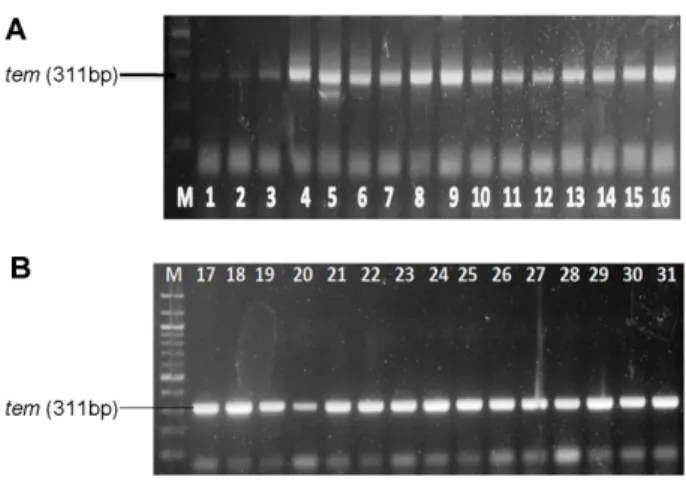
The PCR detection of resistance genes was carried out as observed in Fig. 1, 2. Of the 31 isolates screened for gyrA and blaTEM, 1 isolate (3.23%) (Fig. 1; lane 15) showed presence of gyrA while 28 isolates (90.32%) were positive for blaTEM (Figs. 2A and B; lane 1−11, 13−14, 17−31). In addition, plasmids were detected in 9 (29.03%) of the 28 Salmonella isolates (Fig. 3; lanes 5−6, Table 2. Primer sequence and Amplicon size of Target gene.
Target gene Primer Oligonucleotide sequence (5’-3’) Amplicon size (bp) Reference
blaTEM ASNTF
ASNTR
GCTGGATCTCAACAGCGGTAAG CTGACAACGATCGGAGGACC
311 [15]
gyrA ASNGF
ASNGR
TGGGCAATTTTCGCCAGACGG ACTAGGCAATGACTGG
234 [16]
Table 3. Antibiotic susceptibility pattern of bacteria isolated from stool and raw meat samples (n = 31).
Antibiotic Resistant (n)
Intermediate (n)
Susceptibility (n)
Ceftazidime 31 - -
Cefuroxime 28 1 2
Ciprofloxacin 1 1 29
Gentamicin 21 2 8
Ceftriaxone 31 - -
Erythromycin 24 5 2
Ampicillin 31 - -
Cloxacillin 30 - 1
Ofloxacin 9 1 21
Fig. 1. Agarose gel band of gyrA gene. Lanes M: 100 bp ladder; lane 15: gyrA (234 bp) Positive.
10−11, 14−15, 17−19) that posses blaTEM. Of the 9 Salmonella spp. that harboured plasmids, only one con- tained multiple size plasmids ranging between 6557 bp and 23130 bp (Fig. 3; lane 15).
Discussion
Salmonella spp. are predominant cause of human food-borne outbreaks worldwide [1]. In this study, Salmonella spp. was isolated from meat and stool sam- ples. This agrees with reports of Kumar et al. [17] and Smith et al. [18] that reported the isolation of Salmo- nella spp. from stool and meat samples respectively. The development of antibiotics resistance to readily available treatment options remain a critical public health threat in tropical and subtropical countries [19]. Apart from notable intrinsic resistance, the development of antimi- crobial resistance by microbes through gene transfer and mutation has also been described [20]. In our study, Sal- monella strains showed high resistance to eight (8) anti- biotics. Isolates were 100% resistant to augmentin, ceftazidime and cefriaxone, 96.8% resistant to cloxacil-
lin, 93.5% resistant to ampicillin, 90.4% resistant to cefuroxime, 77.4% resistant to erythromycin and 67.8%
resistant to gentamicin. This concurs with the findings of Adetunji et al. [21], Adabara et al. [22], Hemen et al.
[23] and Omoya et al. [24] who had reported high resis- tance of Salmonella strains to these antibiotics. Also, similar to findings of Cardosso et al. [25] and Adetunji et al. [26], multiple antibiotics resistance was found in Salmonella strains.
Plasmids are major vectors in the global spread of antibiotic resistance genes especially in gram-negative bacteria [8]. In the study, plasmids were detected in 9 (29.03%) Salmonella spp. while multiple size plasmid ranging between 6557 bp and 23130 bp were found in one isolate. Isolates harbouring these plasmids were found to be resistant to ceftazidime, cefuroxime, ampicil- lin, gentamicin, ceftriaxone, erythromycin and cloxacil- lin. Conversely, isolates without detectable plasmid nonetheless exhibit resistance to some antibiotics. This observation infer that bacterial resistance can be attributed to several factors aside from being plasmid- mediated as suggested by Normark et al. [4]. Mean- while, ofloxacin and ciprofloxacin were found to be most susceptible in our study. This is in agreement with the report of Soomro et al. [27] and Tadesse et al. [28] who described ofloxacin and ciprofloxacin respectively, as the drug of choice for the successful treatment of septicaemic salmonellosis in humans.
Furthermore, due to the rapid emergence of resistance to recommended therapeutic regimen (usually ampicil- lin and other third-generation cephalosporins or fluoro- quinolones) for the treatment of Salmonella infections, the choice of antibiotics treatment options have been limited. Salmonella resistance to β-Lactam (ampicillin) has been related to the production of acquired β-Lact- amases [29]. Among these, TEM-1 has been previously reported to mediate the resistance of Salmonella spp. to ampicillin [30]. In our study, blaTEM was detected in 28 (90.32%) Salmonella isolates recovered from stool and meat samples. The high prevalence of blaTEM observed among Salmonella spp. have been previously reported [31]. However, 100% resistance to ampicillin was recorded from the 31 Salmonella isolates. This therefore suggests that ampicillin resistance might be associated to other factors as reported by Michael et al. [30] who described that production of extended-spectrum β-lact- Fig. 2. (A) and (B): Agarose gel band of blaTEM genes. Lanes
M: 100 bp ladder; lane 1-11, 13-14, 17-31 show presence of blaTEM (311 bp).
Fig. 3. Plasmid Profile of Isolates. Lanes 5-6, 10-11, 14-15, 17- 19 show band of plamids.
amases of the TEM, SHV and CTX-M types mediate resistance of Salmonella isolates to ampicillin and other third-generation cephalosporins.
Similarly, fluoroquinolones resistance in Salmonella spp. have been attributed to target gene mutations [32].
Double gyrA mutations have been previously related to ciprofloxacin resistance [32]. In our study, we identified 1 (3.2%) isolate possessed gyrA which concurs with Kaichao et al. [33] who reported low occurrence rate of gyrA double mutations in Salmonella serovars. Notably, the data from antimicrobial susceptibility test in this study indicated more isolates were resistant to ciproflox- acin. Therefore, it suggests that resistant to ciprofloxacin is not only attributable to double gyrA mutation. Thus, other mechanisms like single parC mutation might be implicated as suggested by Yang et al. [32].
In conclusion, the development of antibiotics resis- tance continues to affect readily available treatment options which further burden the management of infec- tious disease in developing countries. Given the findings, we conclude there is an extensive spread of blaTEM while gyrA is rare among Salmonella spp. in Niger State.
According to Khatun et al. [34] and Akinyemi et al. [35]
frequent overuse and misuse are among several factors that contribute to the resistance and spread of resistance determinant. Hence, there is an urgent need for con- certed effort towards ensuring balance and coordination in the use and prescription of antibiotics agents in the environment.
Acknowledgments
The authors would like to acknowledge the valuable contributions of staff at the Molecular Biology and Biotechnology Department, Nigerian Institute of Medical Research, Yaba for their support during this research and AvH Foundation, Germany for the donation of photodocumentation system used in this study.
Conflict of Interest
The authors have no financial conflicts of interest to declare.
References
1. Amini K, Salehi TZ, Nikbakht G, Ranjbar R, Amini J, Ashrafgan- jooei SB. 2010. Molecular detection of invA and spv virulence genes in Salmonella enteritidis isolated from humans and animals in Iran. Afr. J. Microbiol. Res. 4: 2202-2210.
2. Kariuki S, Gordon MA, Feasey N, Parry CM. 2015. Antimicrobial resistance and management of invasive Salmonella disease.
Vaccine 33: 21-29.
3. Butt F, Sultan F. 2011. In vitro activity of azithromycin in Salmo- nella isolates from Pakistan. J. Infect. Dev. Ctries 5: 391-395.
4. Normark BH, Normark S. 2002. Evolution and spread of antibiotic resistance. J. Int. Med. 252: 91-106.
5. Holmes AH, Moore LS, Sundsfjord A, Steinbakk M, Regmi S, Karkey A, et al. 2016. Understanding the mechanisms and drivers of anti- microbial resistance. Lancet 387: 176-187.
6. NethMap. 2008. Consumption of antimicrobial agents and anti- microbial resistance among medically important bacteria in the Netherlands. Bilthoven: RIVM.
7. Harrison E, Brockhurst MA. 2012. Plasmid-mediated horizontal gene transfer is a co-evolutionary process. Trends Microbiol.
20: 262-267.
8. Zhang C-Z, Ding X-M, Lin X-L, Sun R-Y, Lu Y-W, Cai R-M, et al. 2019.
The emergence of chromosomally located blaCTX-M-55 in Salmonella from foodborne animals in hina. Front. Microbiol. 10:
1268.
9. Gebreyes WA, Altier C. 2002. Molecular characterization of multi- drug-resistant Salmonella enteric subsp. enterica serovar Typh- imurium isolates from swine. J. Clin. Microbiol. 40: 2813-2822.
10. Jones ME, Boenink NM, Verhoef J, Köhrer K, Schmitz FJ. 2000.
Multiple mutations conferring ciprofloxacin resistance in Staphy- lococcus aureus demonstrate long-term stability in an antibiotic- free environment. J. Antimicrob. Chemother. 45: 353-356.
11. Cheesbrough M. 2006. District Laboratory Practice in Tropical Countries. 2nd Edn., Cambridge University Press, Cambridge, UK., ISBN-13: 9781139449298.
12. Olutiola PO, Famurewa O, Sonntag HG. 2000. Introduction to General Microbiology: A Practical Approach. 2nd Edition. Bolabay Publications, Ikeja, Nigeria.
13. Clinical and Laboratory Standards Institute (CLSI), 2016. Perfor- mance Standards for Antimicrobial Susceptibility Testing: Eigh- teenth Informational Supplement. CLSI Document M100-S27.
Wayne: CLSL 28: 1.
14. Liu ST. 1981. Rapid procedure for detection and isolation of large and small plasmids. J. Bacteriol. 145: 1365-1373.
15. Carlson SA, Bolton LF, Briggs CE, Hurd HS, Sharma VK, Fedorka- Cray PJ, et al. 1999. Detection of multi-resistant Salmonella typh- imurium DT104 using multiplex and fluorogenic PCR. Molecular Cell. Probes 13: 213-222.
16. Haque A, Haque A, Sarwar Y, Ali A, Bashir S, Tariq A, et al. 2005.
Identification of drug resistance genes in clinical isolates of Salmonella typhi for development of diagnostic multiplex PCR.
Pakistan J. Med. Sci. 4: 402-407.
17. Kumar Y, Sharma A, Sehgal R, Kumar S. 2009. Distribution trends of Salmonella serovars in India (2001-2005). Trans. Res. Soc. of Trop. Med. Hygiene 103: 90-94.
18. Smith SI, Fowora MN, Tiba A, Anejo-Okopi J, Fingesi T, Adamu ME, et al. 2015. Molecular detection of some virulence genes in Salmonella spp. isolated from food samples in Lagos, Nigeria.
Ani. Vet. Sci. 1: 22-27.
19. Aishwarya R, Mariappan S, Uma S. 2017. Detection of blaCTX-M extended spectrum beta-lactamase producing Salmonella enter- ica serotype Typhi in a tertiary care centre. J. Clin. Diagn. Res. 11:
DC21-DC24.
20. DubMandal M. 2005. Experiments on exploration of environ- mental bacteria degrading a pesticide used in agriculture. Thesis, University of Jadavpur, India.
21. Adetunji VO, Odetokun IA. 2012. Antibiogram profiles of Esche- richia coli, Salmonella and Listeria Species isolated along the pro- cessing line of sale of frozen poultry foods. Res. J. Microbiol. 7:
235-241.
22. Adabara NU, Ezugwu BU, Momojimoh A, Madzu A, Hashiimu Z, and Damisa D. 2012. The prevalence and antibiotic susceptibility pattern of Salmonella typhi among patients attending a military hospital in Minna, Nigeria. Adv. Prev. Med. 2012: 875419.
23. Hemen JT, Johnson JT, Ambo EE, Ekam VS, Odey MO, Fila WA.
2012. Multi antibiotic resistance of some gram negative bacterial isolates from poultry litters of selected farms in Benue State. Int.
J. Sci. Technol. 2: 543-545.
24. Omoya FO, Ajayi KO. 2016. Antibiotic resistance pattern of patho- genic bacteria isolated from poultry droppings in Akure, Nigeria.
FUTA J. Res. Sci. 12: 219-227.
25. Cardosso MO, Ribeiro AR, dos Santos LR, de Moraes HLS, Salle CTP. 2006. Antibiotic resistance in Salmonella enteritidis isolated from broiler carcasses. Brazil J. Microbiol. 37: 368-371.
26. Adetunji VO, Isola TO. 2011. Antibiotic resistance of Escherichia coli, Listeria Salmonella isolates from retail raw meat tables in Ibadan municipal abattoir, Nigeria. Afr. J. Biotechnol. 10: 5795- 5799.
27. Soomro AH, Khaskheli M, Bhutto MB, Shah G, Memon A, Dewani P. 2010. Prevalence and antimicrobial resistance of Salmonella serovars isolated from poultry raw meat in Hyderabad, Pakistan.
Turkey J. Vet. Ani. Sci. 35: 455-460.
28. Tadesse G, Habtamu M, Zelalem T, Dadi M. 2019. Salmonella and Shigella among asymptomatic street food vendors in the dire Dawa city, Eastern Ethiopia: Prevalence, antimicrobial suscepti- bility pattern, and associated factors. Environ. Health Insights 13: 1-8.
29. Chen S, Cui S, McDermott PF, Zhao S, White DG, Paulsen I, et al.
2007. Contribution of target gene mutations and efflux to decreased susceptibility of Salmonella enteric serovar typh- imurium to fluoroquinolones and other antimicrobials. Antimicrob.
Agents Chemother. 51: 535-542.
30. Michael GB, Butaye P, Cloeckaert A, Schwarz S. 2006. Genes and mutations conferring antimicrobial resistance in Salmonella: an update. Microbes Infect. 8: 1898-1914.
31. Ammar AM, Abdeen EE, Abo-Shama UH, Fekry E, Kotb EE. 2019.
Molecular characterization of virulence and antibiotic resistance genes among Salmonella serovars isolated from broilers in Egypt. Lett. Appl. Microbiol. 68: 188-195.
32. Yang B, Qu D, Shem J, Xi M, Zhi S, Cui S, et al. 2010. Antimicrobial susceptibility and related genes of Salmonella serovars from retail food in Shaanxi province, Wei Sheng We Xue Bao 50: 788- 796.
33. Kaichao C, Ning D, Edward WC, Sheng C. 2019. Transmission of ciprofloxacin rersistance in Salmonella mediated by a novel type of conjugative helper plasmids. Emerg. Microb. Infect. 8: 857-865.
34. Khatun F, Faruque ASG, Koeck JL, Olliaro P, Millet P, Paris N, et al.
2011. Changing species distribution and antimicrobial suscepti- bility pattern of Shigella over a 29-year period (1980-2008). Epide- miol. Infect. 139: 446-452.
35. Akinyemi KO, Smith SI, Oyefolu AO, Fasure KA, Coker AO. 2007.
Bioline international: trends of multiple drug resistance in Salmo- nella Enterica Serovar Typhi in Lagos, Nigeria. East Central Afr. J.
Surg. 12: 83-88.