탈모 유효 약침액 한약 소재에 대한 동물모델을 이용한 국내 연구보고 고찰
※김규리
1
, 이경란2
, 이재민2
, 류재환1
, 인창식2,
*1경희대학교 동서의학대학원,
2경희대학교 한의과대학 침구경락과학연구센터
[Abstract]
Effect of Herbal Medicines Pharmacopuncture on Hair Growth, a Review of Animal Study Reports Published in Koreae
※Kyu Ri Kim 1 , Gyeong Ran Lee 2 , Jae Min Lee 2 , Jae Hwan Ryu 1 and Chang Shik Yin 2,
*1 Gtaduate School of East-West Medical Science, Kyung Hee University
2 Acupucture and Meridian Science Research Center, College of Korean Medicine, Kyung Hee University
Objectives : The aim of this study was to review the effect of herbal medicine on hair growth in animal models reported in Korean domestic journals.
Methods : Korean core databases were searched with terms alopecia and hair, and animal study reports on hair growth with herbal medicine were reviewed. Animal model, intervention, and hair growth measure data were extracted.
Results : A total of 28 reports were reviewed. C57BL/6 mice with depilation was the most frequent animal models used. Polygoni multiflori radix , Cnidii rhizoma and Biotae Folium were frequently used herbal medicine. Positive effects were reported.
Conclusions : Herbal medicines may be promising resource for pharmacopuncture materials for positive effects on hair growth.
Key words :
Alopecia;
Hair;
Herbal medicine;
Review, Animal model;
Pharmacopuncture
Received : 2014. 01. 22.
Revised : 2014. 02. 28.
Accepted : 2014. 03. 05.
On-line : 2014. 03. 20.
※ This research was supported by Basic Science Research Program through the National Research Foundation of Korea(NRF) funded by the Ministry of Education, Science and Technology (No. 2005- 0049404)
✱ Corresponding author : Acupucture and Meridian Science Research Center, College of Korean Medicine, Kyung Hee University, 26, Kyungheedae-ro, Dongdeamun-gu, Seoul 130-701, Republic of Korea
Tel : +82-2-961-0975 E-mail : [email protected]
This is an Open-Access article distributed under the terms of the Creative Commons Attribution Non-Commercial License (http://creativecommons.org/licenses/by-nc/3.0) which permits unrestricted non-commercial use, distribution, and reproduction in any medium, provided the original work is properly cited.
The Acupuncture is the Journal of Korean Acupuncture & Moxibustion Medicine Society. (http://www.TheAcupuncture.or.kr)
Copyright © 2014 KAMMS. Korean Acupuncture & Moxibustion Medicine Society. All rights reserved.
Database title(abbreviation) URL
Korean Medical Database(KMbase) http://kmbasemedric.or.kr/
Korean Association of Medical Journal Edition(KoreaMed) http://www.koreamed.org Koreanstudies Information Service System(KISS) http://kiss.kstudy.com/
Korea Institute of Science and Technology Information(KISTI) http://socirty.kisti.re.kr/
National Discovery for Science Leaders(NDSL) http://www.ndsl.kr/index.do
Table 1. Resources Search SiteⅠ. 서 론
모발은 보호, 체온조절 등과 같은 본래의 기능 이외에 최 근에는 미적 측면의 기능이 중시됨에 따라 외모의 한 부분 으로서 외향적 이미지를 결정하는 데 중요한 역할을 한다
1)
. 삶의 질이 향상되고 사회적으로 미적 관심도가 높아짐에 따라 탈모관련 시장은 지속적인 성장 추세에 있으며2)
, 탈 모는 심리적인 위축감 등을 초래하여 자신감 상실, 대인관 계 기피증 등으로 이어질 수 있어서 현대인에게 중요한 질 환으로 인식되고 있다3,4)
. 탈모는 유전적 요인 외에 영양의 불균형, 부적절한 관리, 염증, 과도한 스트레스 등 관련된 요인이 다양하고 복합적으로 작용하기 때문에5)
명확한 기 전이 밝혀지지 않았으며 탈모관련 실험모델을 만들기가 어 려워 치료제를 개발하는 데 어려움이 있었다6,7)
. 하지만 최 근에는 모발 성장과 관련된 생화학적ㆍ
분자생물학적 연구 가 활발히 이루어지면서8)
탈모치료 및 모발성장을 촉진하 는 약물이 개발되고 있다.모발의 성장주기는 성장기(anagen)
ㆍ
퇴화기(catagen)ㆍ
휴지기(telogen)의 3단계로 구성되며 각 성장주기별로 다 양한 종류의 cytokine과 성장인자들이 작용한다. 특히 모 낭은 그 형태와 모발의 성장에 영향을 주는 중요한 기능적 단위로 성장주기별로 뚜렷한 형태학적 특징을 보이고 세포 의 증식과 분화가 일어난다9,10)
. 퇴화기 동안에는 모낭의 세포자멸사(apotosis)가 진행되고 휴지기에 들어가면 모낭 의 크기가 줄어드는데11)
, 탈모증은 모낭의 점진적 소형화 로 가늘어진 모발이 관찰되고 휴지기 상태의 모발이 증가 하거나 성장기의 기간이 감소하는 특징을 보인다12,13)
.현재 탈모치료제로는 미국 FDA의 승인을 받은 의약품으 로 도포용 Minoxidil과 경구용 Finasteride가 주로 사용되 고 있으나
14)
, 다양한 부작용 유발이 보고되어 있으며 치료 효과가 일시적인 단점이 있다. 또한 단편적인 약리학적 메 커니즘을 사용하는 등 근본적인 치료에 한계를 보이므로 새로운 치료제 개발을 위한 지속적인 연구가 필요하다15)
. 이에 신약개발을 위한 후보물질의 탐색 및 작용기전에 대한 여러 연구가 진행 중에 있으며, 최근에는 웰빙 산업의 높은 관심도와 세계적으로 활용도가 증가하는 보완대체의 학(complementary and alternative medicine, CAM) 중 안정성 및 신뢰도가 높은 천연물질
16)
및 한약재에서 탈모 예방 및 발모촉진 효능이 있는 성분을 탐색하고자 하는 연 구가 활발하다17,18)
. 모발성장의 효능은 휴지기 상태의 모 발이 성장기로 유도 되도록 하거나 성장기 상태의 모발이 오래 유지되도록 함으로써 평가될 수 있다19)
.본 연구는 동물실험을 대상으로 하고 천연성분, 한약재 를 주재료로 하여 발모 및 육모의 효능 평가를 주제로 하는 논문을 체계적인 절차에 따라 검색한 후 검토 및 분석을 시 행하였다. 그동안의 발모소재 탐색을 위한 연구현황을 살 펴보고 사용된 소재의 빈도 및 측정지표 등을 정리함으로 써 앞으로 발모, 양모 관련 임상에 활용 가능한 약침액 소 재를 탐색하는 연구에 도움이 되도록 하였다.
Ⅱ. 재료 및 방법
1. 검색 방법
관련문헌 검색 사이트는 한국보건의료원에서 제시한 국 내 핵심 데이터베이스 5개
20)
를 이용하였다(Table 1). 각 데 이터베이스의 자료는 2003년부터 2013년에 발표된 국내학 술지를 대상으로 하였으며, 검색어는 ‘alopecia AND hair’로 하되 각 사이트의 검색전략을 이용하였다. 검색 범위는 제목, 초록, 키워드를 모두 포함하는 ‘전체’로 지정하였다.
2. 자료 추출
국내에서 발간되었으며, 탈모치료제 또는 예방 물질로 모발성장의 효능을 관찰한 실험연구를 대상으로 하였다.
자료 추출은 1명의 저자(김)에 의해 수행되었으며, 검색된
N 1 =558, Recoeds identified through database searching (Kmbase=165, KoreaMed=107, KISS=31, KISTI=137, NDSL=118)
N 2 =285, Records screened
N3=29,
Full-text articles assessed for eligibility
273 duplicate articles eliminated
256 records excluded 1) Not experimental study=124 2) Not animal model=102
3) Primary diagnosis was not alopecia=9 4) Not use herbal extracts as intervention=20 5) Not use hair growth measurement=1
Fig. 1. Flow chart for searching strategy논문의 초록을 읽고 검토하되 초록이 누락되어 있거나 내 용이 모호한 경우 원문을 읽고 분석하였다. 자료추출의 선 정기준과 배제기준은 다음과 같다.
1) 선정 기준
①
동물을 대상으로 한 실험연구②
발모 및 탈모예방의 효과가 예상되는 천연추출물, 한약재의 소재를 이용한 경우③
현재 공인 인증 받은 탈모치료제를 대조군으로 이용 하여 그 효능을 비교한 경우④
발모 효능에 주요 지표를 측정한 경우2) 배제기준
①
실험연구가 아닌 경우②
대상이 사람이거나 in vitro인 경우③
대상이 탈모가 주 증상이 아닌 경우④
발모 및 탈모예방의 소재로서 천연추출물, 한약재의 소재가 아닌 경우⑤
발모 효능의 평가가 이루어지지 않은 경우Ⅲ. 결 과
1. 자료추출 결과
5개의 데이터베이스에서 검색된 논문은 총 558편이었으
며, 중복되는 논문을 제외하니 총 285편이었다. 선정기준 과 배제기준을 바탕으로 자료를 추출한 결과 256편의 논 문이 탈락되고 최종 29편의 논문이 선정되었다(Fig. 1).
2. 실험동물에 대한 분석
선정된 논문에서 연구대상으로 삼은 실험동물의 종은 29편 모두 설치류에 속하는 mouse였으며, 그 중 Spargue- Dawley(SD계)를 대상으로 한 논문 1편과 C3H/HeSlc을 대 상으로 한 논문 1편을 제외하고 27편 모두 C57BL/6를 이 용하였다. C57BL/6는 4~7주령 사이가 주로 사용되었으 며, 21주령 이상의 모델은 자발적 원형탈모가 있는 조건이 었다. 수컷만을 사용한 연구는 29편 중 16편으로 암
ㆍ
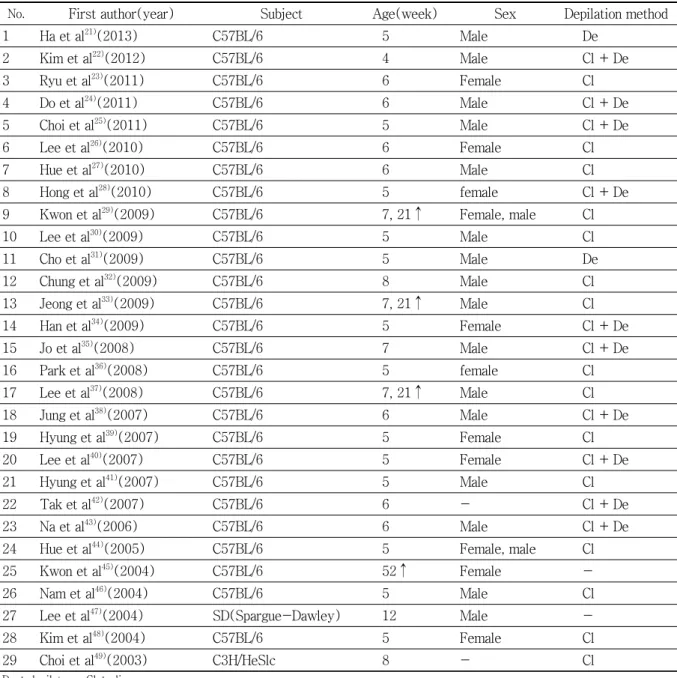
수의 사용 빈도에는 차이가 없었다. 자발적 탈모를 일으킨 모델 이외에는 인위적으로 depilation을 시키는데, 사용된 방법 으로 clipper를 이용한 논문이 15편, depilatory를 이용한 논문은 1편이었으며, 두 가지 방법 모두를 사용한 논문은 10편이었다(Table 2).3. 중재내용 분석
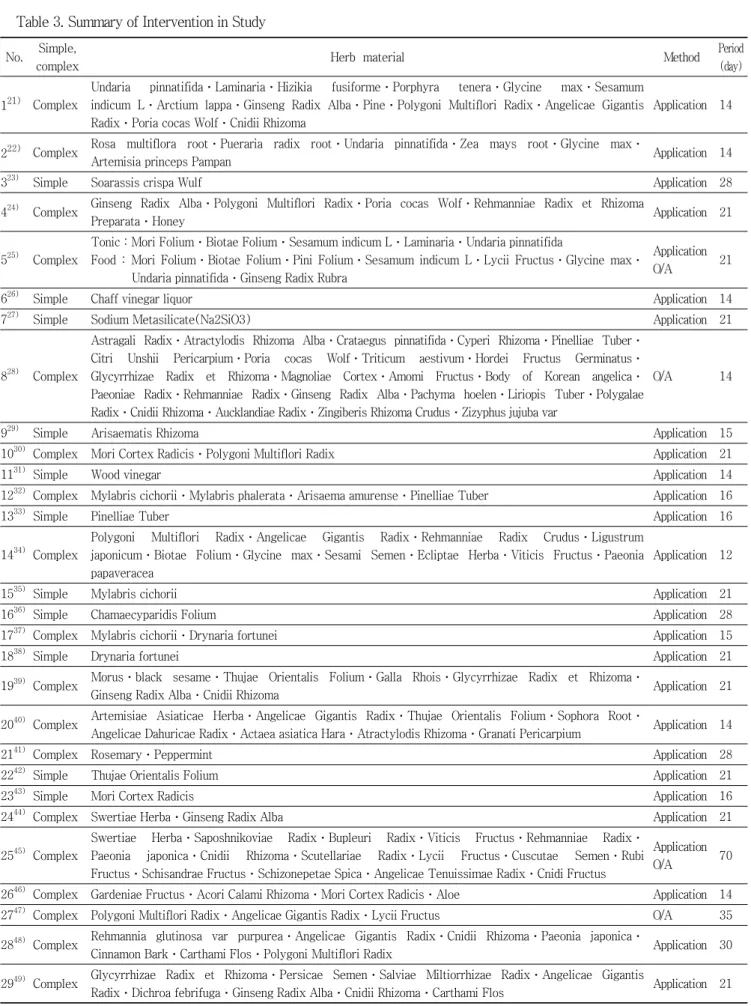
중재내용은 약물의 구성 및 재료, 중재방법, 중재기간을 조사하였다(Table 3).
자발적 원형탈모 증상을 보이거나 휴지기 모낭이 있는 대상모델에게 제공된 천연물질 및 한약재는 단일성분을 이용한 논문이 11편(38 %), 혼합물을 이용한 논문은 18편
No. First author(year) Subject Age(week) Sex Depilation method
1 Ha et al 21) (2013) C57BL/6 5 Male De
2 Kim et al 22) (2012) C57BL/6 4 Male Cl + De
3 Ryu et al 23) (2011) C57BL/6 6 Female Cl
4 Do et al 24) (2011) C57BL/6 6 Male Cl + De
5 Choi et al 25) (2011) C57BL/6 5 Male Cl + De
6 Lee et al 26) (2010) C57BL/6 6 Female Cl
7 Hue et al 27) (2010) C57BL/6 6 Male Cl
8 Hong et al 28) (2010) C57BL/6 5 female Cl + De
9 Kwon et al 29) (2009) C57BL/6 7, 21↑ Female, male Cl
10 Lee et al 30) (2009) C57BL/6 5 Male Cl
11 Cho et al 31) (2009) C57BL/6 5 Male De
12 Chung et al 32) (2009) C57BL/6 8 Male Cl
13 Jeong et al 33) (2009) C57BL/6 7, 21↑ Male Cl
14 Han et al 34) (2009) C57BL/6 5 Female Cl + De
15 Jo et al 35) (2008) C57BL/6 7 Male Cl + De
16 Park et al 36) (2008) C57BL/6 5 female Cl
17 Lee et al 37) (2008) C57BL/6 7, 21↑ Male Cl
18 Jung et al 38) (2007) C57BL/6 6 Male Cl + De
19 Hyung et al 39) (2007) C57BL/6 5 Female Cl
20 Lee et al 40) (2007) C57BL/6 5 Female Cl + De
21 Hyung et al 41) (2007) C57BL/6 5 Male Cl
22 Tak et al 42) (2007) C57BL/6 6 - Cl + De
23 Na et al 43) (2006) C57BL/6 6 Male Cl + De
24 Hue et al 44) (2005) C57BL/6 5 Female, male Cl
25 Kwon et al 45) (2004) C57BL/6 52↑ Female -
26 Nam et al 46) (2004) C57BL/6 5 Male Cl
27 Lee et al 47) (2004) SD(Spargue-Dawley) 12 Male -
28 Kim et al 48) (2004) C57BL/6 5 Female Cl
29 Choi et al 49) (2003) C3H/HeSlc 8 - Cl
De : depilatory. Cl : clipper.
Table 2. Summary of Animal Model in Studies
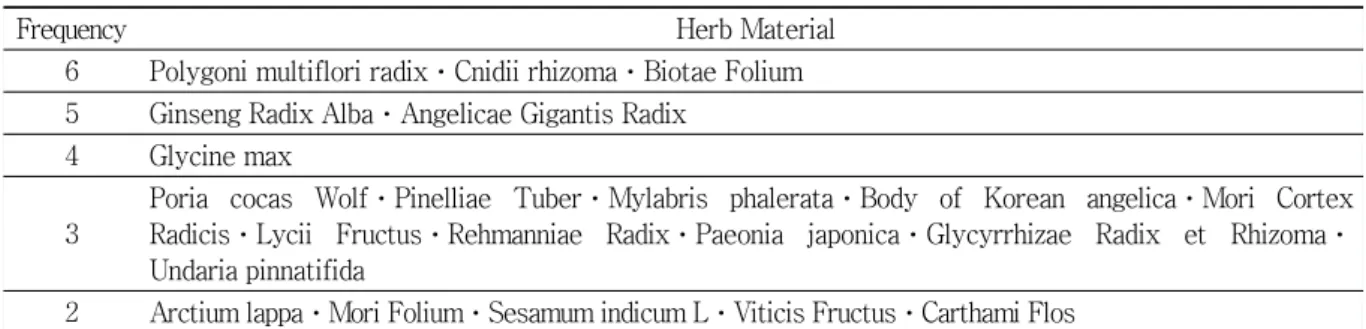
(62 %)으로 분석되었다. 탈모예방 및 발모효능의 소재로 쓰인 천연성분, 한약재의 종류는 총 94가지였다. 사용된 용량이나 일수를 배제하고 물질별 사용 빈도수만을 보면
何首烏ㆍ川芎ㆍ側柏葉
이 6회로 가장 많고 다음으로人蔘ㆍ 當歸
가 5번 등의 순서였다(Table 4).약물의 처치방법으로는 피부에 직접 도포하는 방법을 이 용한 논문이 25편(86 %)으로 가장 많았으며, 경구 투여 법 을 이용한 논문이 2편(7 %), 두 가지 모두 시행한 논문이 2편(7 %)이었다. 중재기간은 짧게는 7일을 제공한 논문에 서부터 42일까지로 범위가 컸으나 대부분 14~28일 동안 관찰을 하였다.
4. 약물효과의 측정 및 결과분석
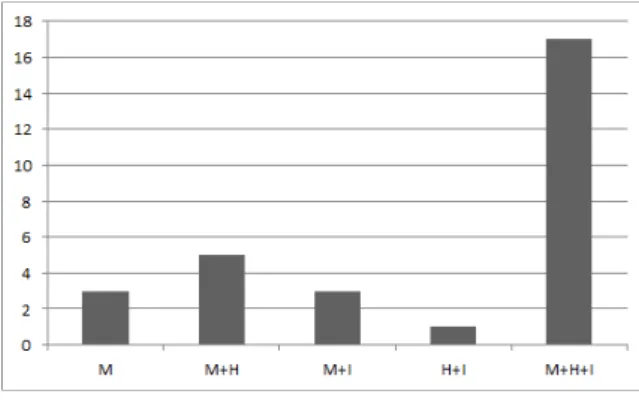
동물모델에 발모를 촉진시키는 약물을 중재로 제공한 후 효과를 평가하는 방법으로는 크게 육안적 관찰(macroscopy), 조직학적 관찰(histological examination), 분자생물학적 관찰법(immunological examination)으로 나뉘었으며 논 문에서 이용된 횟수는 Fig. 2와 같다. 측정 자료는 모발 성 장 패턴의 질적 및 양적 자료로 얻는데, 질적 자료는 모발 성장 양상을 사진 촬영하여 얻은 자료나 조직학적 소견, 탈 모관련 성장인자나 단백질 발현 등이 있으며, 양적 자료로 는 모발의 밀도(n/cm
2
), 모발의 굵기(µm), 모근길이(mm/일),No. Simple,
complex Herb material Method Period
(day)
1 21) Complex
Undaria pinnatifidaㆍLaminariaㆍHizikia fusiformeㆍPorphyra teneraㆍGlycine maxㆍSesamum indicum LㆍArctium lappaㆍGinseng Radix AlbaㆍPineㆍPolygoni Multiflori RadixㆍAngelicae Gigantis RadixㆍPoria cocas WolfㆍCnidii Rhizoma
Application 14
2 22) Complex Rosa multiflora rootㆍPueraria radix rootㆍUndaria pinnatifidaㆍZea mays rootㆍGlycine maxㆍ
Artemisia princeps Pampan Application 14
3 23) Simple Soarassis crispa Wulf Application 28
4 24) Complex Ginseng Radix AlbaㆍPolygoni Multiflori RadixㆍPoria cocas WolfㆍRehmanniae Radix et Rhizoma
PreparataㆍHoney Application 21
5 25) Complex
Tonic : Mori FoliumㆍBiotae FoliumㆍSesamum indicum LㆍLaminariaㆍUndaria pinnatifida
Food : Mori FoliumㆍBiotae FoliumㆍPini FoliumㆍSesamum indicum LㆍLycii FructusㆍGlycine maxㆍ Undaria pinnatifidaㆍGinseng Radix Rubra
Application
O/A 21
6 26) Simple Chaff vinegar liquor Application 14
7 27) Simple Sodium Metasilicate(Na2SiO3) Application 21
8 28) Complex
Astragali RadixㆍAtractylodis Rhizoma AlbaㆍCrataegus pinnatifidaㆍCyperi RhizomaㆍPinelliae Tuberㆍ Citri Unshii PericarpiumㆍPoria cocas WolfㆍTriticum aestivumㆍHordei Fructus Germinatusㆍ Glycyrrhizae Radix et RhizomaㆍMagnoliae CortexㆍAmomi FructusㆍBody of Korean angelicaㆍ Paeoniae RadixㆍRehmanniae RadixㆍGinseng Radix AlbaㆍPachyma hoelenㆍLiriopis TuberㆍPolygalae RadixㆍCnidii RhizomaㆍAucklandiae RadixㆍZingiberis Rhizoma CrudusㆍZizyphus jujuba var
O/A 14
9 29) Simple Arisaematis Rhizoma Application 15
10 30) Complex Mori Cortex RadicisㆍPolygoni Multiflori Radix Application 21
11 31) Simple Wood vinegar Application 14
12 32) Complex Mylabris cichoriiㆍMylabris phalerataㆍArisaema amurenseㆍPinelliae Tuber Application 16
13 33) Simple Pinelliae Tuber Application 16
14 34) Complex
Polygoni Multiflori RadixㆍAngelicae Gigantis RadixㆍRehmanniae Radix CrudusㆍLigustrum japonicumㆍBiotae FoliumㆍGlycine maxㆍSesami SemenㆍEcliptae HerbaㆍViticis FructusㆍPaeonia papaveracea
Application 12
15 35) Simple Mylabris cichorii Application 21
16 36) Simple Chamaecyparidis Folium Application 28
17 37) Complex Mylabris cichoriiㆍDrynaria fortunei Application 15
18 38) Simple Drynaria fortunei Application 21
19 39) Complex Morusㆍblack sesameㆍThujae Orientalis FoliumㆍGalla RhoisㆍGlycyrrhizae Radix et Rhizomaㆍ
Ginseng Radix AlbaㆍCnidii Rhizoma Application 21
20 40) Complex Artemisiae Asiaticae HerbaㆍAngelicae Gigantis RadixㆍThujae Orientalis FoliumㆍSophora Rootㆍ
Angelicae Dahuricae RadixㆍActaea asiatica HaraㆍAtractylodis RhizomaㆍGranati Pericarpium Application 14
21 41) Complex RosemaryㆍPeppermint Application 28
22 42) Simple Thujae Orientalis Folium Application 21
23 43) Simple Mori Cortex Radicis Application 16
24 44) Complex Swertiae HerbaㆍGinseng Radix Alba Application 21
25 45) Complex
Swertiae HerbaㆍSaposhnikoviae RadixㆍBupleuri RadixㆍViticis FructusㆍRehmanniae Radixㆍ Paeonia japonicaㆍCnidii RhizomaㆍScutellariae RadixㆍLycii FructusㆍCuscutae SemenㆍRubi FructusㆍSchisandrae FructusㆍSchizonepetae SpicaㆍAngelicae Tenuissimae RadixㆍCnidi Fructus
Application
O/A 70
26 46) Complex Gardeniae FructusㆍAcori Calami RhizomaㆍMori Cortex RadicisㆍAloe Application 14 27 47) Complex Polygoni Multiflori RadixㆍAngelicae Gigantis RadixㆍLycii Fructus O/A 35 28 48) Complex Rehmannia glutinosa var purpureaㆍAngelicae Gigantis RadixㆍCnidii RhizomaㆍPaeonia japonicaㆍ
Cinnamon BarkㆍCarthami FlosㆍPolygoni Multiflori Radix Application 30
29 49) Complex Glycyrrhizae Radix et RhizomaㆍPersicae SemenㆍSalviae Miltiorrhizae RadixㆍAngelicae Gigantis
RadixㆍDichroa febrifugaㆍGinseng Radix AlbaㆍCnidii RhizomaㆍCarthami Flos Application 21
Table 3. Summary of Intervention in Study
No. Measuring Indicators
1 21) Photographing, HRS, hair density, hair thickness, hair follicle length and thickness, histological observation (longitudinal section), IGF-1, TGF-β1
2 22) Photographing, HRS
3 23) Photographing, HRS, histological observation(transverse section) 4 24) Photographing, hair density, Hair thickness, IGF-1, VEGF 5 25) Photographing, hair density, Hair thickness, IGF-1
6 26) Photographing, histological observation(transverse section), IGF-1, VEGF, KGF, HGF
7 27) Photographing, HRS, histological observation(longitudinal section), ALP, γ-GT, EGF, VEGF, TGF-β1
8 28) Photographing, HRS, histological observation(longitudinal, transverse section), TGF-β1, EGF, IFN-γ, IL-4, IL-10 9 29) Photographing, Histological observation(longitudinal section), TGF-β, IGF, prolactin, placenta lactogen, VEGF,
c-kit, PKC-α, TGF, FGF
10 30) Photographing, HRS, ALP, γ-GT, IGF-1, TGF-β 11 31) Photographing, HRS
12 32) Photographing, histological observation(longitudinal section), VEGF, FGF, c-kit, PKC-α, bFGF, IGF-1, PL1 13 33) Photographing, Histological observation(longitudinal section), TGF-β, IGF, prolactin, placenta lactogen 14 34) Photographing, HRS, histological observation(longitudinal section), EGF, TGF-β1, IL-6, TNF-α, IL-1β 15 35) Photographing
16 36) Photographing, HRS, ALP, γ-GT
17 37) Photographing, histological observation(longitudinal section), VEGF, c-kit, PKC-α, TGF-β, prolactin, placenta lactogen 18 38) Photographing, histological observation(longitudinal section), Skin thickness, Mast cell count, VEGF, PKC-α, SCF 19 39) Photographing, HRS, histological observation(longitudinal section)
20 40) Photographing, HRS, histological observation(longitudinal section), TBF-β1, EGF 21 41) Photographing, HRS, histological observation(longitudinal, transverse section ) 22 42) Photographing, histological observation(longitudinal section), VEGF, PKC-α, SCF 23 43) Photographing, histological observation(longitudinal section)
24 44) Photographing, histological observation(longitudinal section), ALP, γ-GT
25 45) Photographing, histological observation(longitudinal section), substance P, CRF, CRF-R, CRF-BP 26 46) Photographing, HRC, histological observation(longitudinal section), IGF-1, TGF-β
27 47) Histological observation(transverse section), skin total(T+DHT), DHT 28 48) Photographing, HRS
29 49) Photographing
HRS : hair regrowth score. IGF : insulin-like growth factor. TGF : transformation growth factor.
VEGF : vascular endothelial growth factor. KGF : keratinocyte growth factor. HGF : hepatocyte growth factor.
ALP : alkaline phosphatase. GT : glutamyl transpeptidase. EGF : epithelial growth factor. IL : interleukin.
PKC : protein kinase C activator. FGF : fibroblast growth factor. CRF : dorticotropin releasing factor.
DHT : dihydrotestosterone.
Table 5. Summary of the Measuring Indicators and Results
Frequency Herb Material
6 Polygoni multiflori radixㆍCnidii rhizomaㆍBiotae Folium 5 Ginseng Radix AlbaㆍAngelicae Gigantis Radix
4 Glycine max 3
Poria cocas WolfㆍPinelliae TuberㆍMylabris phalerataㆍBody of Korean angelicaㆍMori Cortex RadicisㆍLycii FructusㆍRehmanniae RadixㆍPaeonia japonicaㆍGlycyrrhizae Radix et Rhizomaㆍ Undaria pinnatifida
2 Arctium lappaㆍMori FoliumㆍSesamum indicum LㆍViticis FructusㆍCarthami Flos
Table 4. Frequency of Herbal Materials that Constitute the Intervention for Hair GrowthFig. 2. The number of published studies is analyzed by the observation methods of measuring indicators
M : macroscopy.
H : histological examination.
I : immunological examination.
성장기와 휴지기 모발의 비율(hair regrowth score, HRS) 등이 포함되어 있으며, 구체적인 항목은 Table 5와 같다.
Ⅳ. 고 찰
현대사회에서 탈모는 유전적인 요인 외에 스트레스, 불 규칙한 생활 습관, 약물 남용 및 식생활의 서구화 등 사회 환경적 요인에 의해 발병인구가 증가하면서 점차 중요한 질환으로 인식되고 있다. 현재 우리나라의 탈모 인구는 전 체인구의 12 %이며, 중년 남성뿐 아니라 여성층에서도 발 생하고 있으며 초발 연령도 점점 낮아지고 있어 탈모와 두 피질환 등의 고민은 모든 사람의 관심사로 확대되고 있다
50)
.탈모의 치료로 널리 사용되는 대표적인 의약품은 합성의 약품으로 FDA에서 승인한 Minoxidil과 Finasteride가 있 으나 이들은 몇 가지 부작용이 지속적으로 보고되고 있다.
최근 자연친화적, 천연성을 선호하는 소비자의 심리와 장 기간 사용에도 부작용을 최소화 하되 효과가 있는 제품에 대한 요구에 따라 전통적으로 탈모예방 및 발모 효능이 있 는 것으로 알려진 한약재를 비롯한 천연추출물이 포함된 생산품들이 다수 등장하고 있다. 하지만 대다수의 생산품 은 전문치료제가 아닌 일반치료제로서 경험적으로 관찰된 발모효과에 근거하므로 객관성을 입증하는 데 한계가 있 다. 이를 보완하기 위해 많은 동물 실험이 발모 성분이 있 는 약물의 효과를 입증하기 위해 시행되고 있다
21)
.본 연구에서는 탈모예방 및 모발성장 촉진효과가 예상되 는 약물을 탐색하여 그 효능을 관찰한 논문을 분석한 연구 로, 동물을 대상으로 하여 천연물 및 한약재의 성분을 중
재로 삼고 모발의 성장에 적절한 평가도구를 사용한 논문 29편을 선정하고 실험동물, 중재내용, 발모효과의 평가법, 측정지표 및 주요 결과를 분석하였다.
약물의 효능을 평가하기 위한 연구대상은 모두 mouse였 으며, 2편을 제외한 27편에서 C57BL/6가 이용되었다.
C57BL/6 마우스는 근교계마우스로 유전적인 특성이 잘 알 려져 있고 초기 모발 성장주기가 synchronized되어 있으 며, melanocyte가 모낭에만 한정적으로 존재하므로 melanin 합성이 모발 성장주기와 잘 일치된다. 휴지기의 경우 등판 피부색이 핑크색을 띠고 성장기에는 진회색 및 검은색을 띠어 피부색으로 모발의 성장주기를 판정할 수 있는 장점 이 있어 모발 생리 연구에 널리 이용되고 있다
40)
. 또한 생 후부터 모든 모낭이 모발성장주기의 성장기로 들어가 털이 자라기 시작하였다가 생후 약 3주경 휴지기로 전이된 다음 바로 2차 성장기로 접어들어 6~8주경 다시 모든 모낭이 휴 지기로 전이 되어 약 4주간 이상 지속되므로 실험물질의 효 과를 평가하기 위한 시간적 여유가 주어지므로51)
4~7주령이 연구에 주로 사용된 것으로 보인다.암수의 이용 빈도에는 차이가 없었으며, 탈모증의 실험 모델로는 자발적으로 원형탈모가 있는 모델을 이용한 논문 이 4편이었으며, 인위적인 depilation treatment를 가한 모델이 주로 이용되었다. 탈모를 유발하는 데에 depliation 은 가장 간단한 방법으로 접근성이 쉽고 모델을 재현하기 쉬운 방법이어서 다수 채택하여 연구에 이용된 것으로 보 인다. C57BL/6 정상 생쥐는 생후 4주 전후에 털갈이가 이 루어지고 나서 특별한 자극이 없는 한 휴지기를 유지하다 가 자발적 또는 인위적인 자극에 의하여 성장기의 모발이 유도된다. 인위적 자극에 의하여 털을 성장기로 유도하는 방법으로는 털을 인위적으로 뽑거나 면도를 시행하거나 제 모제와 같은 화학물질의 노출 등이 있다. 본 연구의 29편 논문에서는 물리적 자극에 의한 방법으로 clipper만을 이 용한 논문이 15편으로 가장 많았으며, clipper를 사용한 후 화학적 물질인 depilatory를 이용하여 동물 등의 털을 깨 끗하게 제거한 논문은 10편이었다.
중재약물은 혼합재료의 효능을 알아본 논문이 18편(62 %) 로 문헌적 자료나 임상적으로 효과가 있다고 알려진 단일 약물을 혼합함으로 발모에 시너지 효과를 기대하여 연구한 것으로 생각된다. 중재약물로 쓰인 소재는 총 94가지였으 며, 가장 높은 빈도수를 보이는 재료로는
何首烏ㆍ川芎ㆍ側柏
葉
이었다. 이는 혈압을 낮추고 말초혈관을 확장시키는 효 능이 있어 모근 세포로의 영양공급을 통해 발모를 도울 수 있다는 전통적인 효능에 의해 쓰인 것으로 보인다51)
.何
首烏
는 마디풀과 Polygonum multiflorum THUNB.
의 덩이 뿌리를 건조한 것으로 정을 보충시키고 모발을 검게 하는효능이 있는 약재로 알려져 있으며
8)
,川芎
은 혈관확장, 향균작용, 진정에 효능이 있는 것으로 알려져 있다52)
.側 柏葉
은 전통적으로 동양 의학에서 탈모를 방지하거나 모발 성장 촉진하는 데 사용되어 왔으며, testosterone을 dihydrotestosterone(DHT)로의 전환을 수행하는 5α
- reductase의 억제성분이 포함되어 있다고 알려져 있다40)
.약물의 처치방법으로는 직접 피부에 도포하는 방법을 이 용한 논문이 27편으로 월등히 많았는데, 이는 경구투여보 다 전신적 부작용이 적고 직접 도포함으로써 모낭에 직접 적 자극을 주어 모발성장에 도움을 준다는 보고가 있다
53)
. 본 연구에서는 국내발표 연구 중 탈모 및 양모 관련 한약 소재 연구를 고찰했으며 이는 향후 탈모 및 양모 약침액 관 련 연구와 임상에서 유용한 기초 자료로 활용될 수 있을 것 으로 사료된다.Ⅴ. References
1. Stough D, Stenn K, Haber R et al. Psychological Effect, Pathophysiology and Management of Androgenetic Alopecia in Men. Mayo Clin Proc.
2005 ; 80(10) : 1316-22.
2. Godwin DA, Michniak BB. Influence of Drug Lipophilicity on Terpenes as Transdermal Penetration Enhancers. Drug Dev Ind Pharm. 1999 ; 25(8) : 905-15.
3. Kim JM, Lee IC, Kim BH. The Hair Growth Promoting Effect of Dansam-Samultang by Focusing on the Enzyme Activity and Molecular Biological Obser- vation in C57BL/6 Mice. Kor J Vet Publ Hlth, 2012 ; 36(2) : 89-97.
4. Roy RK, Thakur M, Dixit VK. Hair Growth Promoting Activity of Eclipta Alba in Male Albino Rats. Arch Dermatol Res. 2008 ; 300(7) : 357-64.
5. Rho SS, Park SJ, Hwang SL et al. The Hair Growth Promoting Effect of Asiasari Radix Extract and its Molecular Regulation. J Dermatol Sci. 2005 ; 38(2) : 89-97.
6. Kim YI, Lee MW, Kwon J, Song CH, Lee CH. Ex- perimental Studies on the Factors Related to Hair Loss in Spontaneous Hair Loss C57BL/6N Mice Models. The Korean J Anat. 2005 ; 38(2) : 133-43.
7. Esfandiari A, Kelly AP. The Effects of Tea Polyphenolic
Compounds on Hair Loss Among Rodents. J National Med Assoc. 2005 ; 97(8) : 1165-9.
8. Lee KM, LEe JS, Kim YC. The Effect of Polygoni mulitiflori Radix Water Extracts on Enzyme Activities and Gene Expression Relevant to Hair Growth in C57BL/6 Mice. The Journal of Cosmetological Science. 2010 ; 6(3) : 287-94.
9. Stenn KS, Paus R. Controls of Hair Follicle Cycling.
Physiol Rev. 2001 ; 81(1) : 449-94.
10. Soma T, Ogo M, Suzuki J, Takahasi T, Hibino T.
Analysis of Apoptotic Cell Death in Human Hair Follicles. J Invest Dermatol. 1998 ; 11(6) : 948-54.
11. Burton JL, Marshall A. Hypertrichosis Due to Min- oxidil. Br J Dermatol. 1979 ; 101(5) : 593-95.
12. Olsen EA, Messenger AG, Shapiro J, Bergfeld WF, Hordinsky MK, Robert JL. Evaluation and Treatment of Male and Female Pattern Hair Loss.
J AM Acad Dermatol. 2005 ; 52(2) : 301-11.
13. Hoffmann R. Male Androgenetic Alopecia. Clin Exp Dermatol. 2002 ; 27(5) : 373-82.
14. Libecco JF, Bergfeld WF. Finasteride in the Treat- ment of Alopecia. Expert Opinion Pharmaco
ㄴ
therapy. 2004 ; 5(4) : 933-40.15. Yusur AN, Baier G, Kim JH, Woo HJ. The effects Damsam-Samul-tang on hematopoiesis. J Kor Ori Med. 2002 ; 23(1) : 145-55.
16. Kim JM, Lee IC, Lee TJ, Kim BH. The Promoting Effect of Dansam-Samultang on Hair Growth by Gross and Histological Observation. Journal of Investigative Cosmetology. 2001 ; 7(3) : 257-65.
17. Takahashi T, Kamiya T, Yokoo Y. Proanthocy- anidins from Grape Seeds Promote Proliferation of Mouse Hair Follicle Cells in Vitro and Convert Hair Cycle in Vivo. Acta Derm Venereol. 1998 ; 78(6) : 428
–
32.18. Saraf S, Pathak AK, Dixit VK. Hair Growth Promoting Activity of Tridax procumbens. Fitoterapia. 1991 ; 62(6) : 495
–
98.19. Semalty M, Semalty A, Joshi GP, Rawat MSM. Hair growth and rejuvenation: an overview. Journal of Dermatological Treatment. 2011 ; 22(3) : 123
–
32.20. Kim SY, Park JE, Seo HJ et al. NECA’s guidance for undertaking systematic reviews and meta- analyses for intervention. National Evidence-
based Healthcare Collaborating Agency. 2011.
21. Ha WH, Park DH. Effect of Seaweed Extract on Hair Growth Promotion in Experimental Study of C57BL/6 Mice. Arch Cranopfac Surg. 2013 ; 14(1) : 1-10.
22. Kim JH, Hong SK, Hwang SJ, Son SW, Choi YS.
The Preclinical and Clinical Effects of Herbal Product Containing Rosa mutiflora Roots Extracts as a Main Component on the Hair Growth Promotion. Korean J Medicinal Crop SCi. 2012 ; 20(2) : 108-16.
23. Ryu EM, Shin HJ. Hair growth effect of ethyl acetate and water fractions of Sparassis crispa extracts on hair-removed C57BL/6 mice. The Korean Society for Aesthetics and Cosmetology. 2011 ; 9(4) : 295-304.
24. Do EJ, Hwang MY, Kim SY et al. The Effect of Gyungokgo-gamibang Extract on Hair Growth and Protein Expression in Mice. Kor J Herbology.
2011 ; 26(4) : 9-14.
25. Choi HM, Hwang SJ, Lee JS, Do EJ, Kim MY, Kim MR. Effects of Hair Tonic and Food including Korean Medicinal Herbs on Hair Growth in an Alopecia Model of C57BL/6 Mice. Kor J Herbology. 2011 ; 26(1) : 119-24.
26. Lee SJ, Kim SK, Kwon SY, Reza A, Jang SH, Park SC. Effect of Chaff Vungar Liquor on Promotion of Hair Growth in Alopecia Mice Model C57Bl/6.
The Korean of Society of Medical Crop Science.
2010 : 426-27.
27. Hue JJ, Kang BS, Kim JH et al. Effect of Sodium Silicate on Hair Growth in C57BL/6 Mice. Laboratory Animal Research. 2010 ; 26(1) : 55-62.
28. Hong JA, Song MY, Choi IW, Sohn NW, Chung SH. Effect of Yikgeebohyul-tang(Yìqìbǔxuè-tāng) on Hair Regrowth and Cytokine Changes on Hair- Removed C57BL/6 Mice. J Korean Oriental Med.
2010 ; 31(1) : 138-52.
29. Kwon KS, Lee MW, Jeong IK et al. Experimental Studies on the Hair Growth Activity of Fractions and Extract of Arisaematis Rhizoma in C57BL/6N Mice. Korean J Oriental Physiology and Pathology.
2009 ; 23(3) : 619-30.
30. Lee HS, Hwqng SY. Effects of DCS® Hair Tonic
on Hari growth promotion in ad Alopeciea Model of C57BL/6 Mice. The Korean Society for Aesthetics and Cosmetology. 2009 ; 7(2) : 131-41.
31. Cho YH, Lee JY, Cho JS, Lee GW. Evaluation of Stability in the Purified Wood Vinegar and Its Hair Growth Effect. Journal of Life Science. 2009 ; 19(10) : 1389-95.
32. Chung HS, Cho HY, Lee CH. Experimental Studies on the Hair Growth Activity of Trimix Extracts of Mylabris Phalerata Pall, Arisaematis Rhizoma and Pinelliae Rhizoma Ternata in 57BL/6N mice.
Korean J Oriental Physiology and Pathology.
2009 ; 23(5) : 1116-24.
33. Jeong IK, Jo HY, Kim TH, Kim NS, Jeong HS, Lee CH. Experimental Studies on the Hair Growth Activity of Extracts of Pinelliae Rhizoma in Spontaneous Alopecia Model and Normal C57BL/
6N Mice. Korean J Oriental Physiology and Pathology. 2009 ; 23(1) : 84-92.
34. Han AR, Sohn NW, Chung SH, Kim SS, Song MY.
Study on Saengbal-eum-
Ⅱ
(Shēngfà-yǐn-Ⅱ
) on Hair Regrowth Promotion in C57BL/6 Mice. J Oriental Rehab Med. 2009 ; 19(4) : 95-113.35. Jo HY, Kim TH, Kim H, Jeong HS, Lee CH, Lee KG. EXperimental Studies on the Hair Growth Activity of Mylabris Phalerata Pall. Extracts and Fractions in C57BL/6N Mice. Korean J Oriental Physiology and Pathology. 2008 ; 22(2) : 357-64.
36. Park YO, Kim YC. The Effects of Chamaecyparis Obtusa Oil on the Activities of Enzyme Relevant to Hair Growth. J Kor Soc Cosm. 2008 ; 14(2) : 355-64.
37. Lee MW, Jo HY, Kim TH, Kim NS, Jeong HS, Lee CH. Experimental Studies on the Hair Grwoth Activity of Mixed Extracts of Mylabris Phalerata Pall. and Drynariae Rhizoma in Spontaneous Alopecia Model and Normal C57Bl/6N Mice. Korean J Oriental Physiology and Pathology. 2008 ; 22(4) : 778-90.
38. Jung SY, Jung IK, Kim DK, Jo HY, Jung HS, Lee CH. Experimental Studies on the Hair Growth Activity of Drynariae Rhizoma Extracts in C57BL/6N Mice. Korean J Oriental Physiology and Pathology.
2007 ; 21(2) : 453-61.
39. Hyung SH, Gang SR, Kim YC. Effect of Complex
Oriental Medicine Extract on Hair Growth Promotion in An Alopecia Model of C57BL/6 Mice.
J Kor Soc Cosm. 2007 ; 13(3) : 1366-75.
40. Lee SH, Chung SH, Song MY, Shin HD. Hair Growth Promoting Effect of Saengbal-eum(Shēngfà-yǐn) Application on Hair-Removed C57BL/6 Mouse. J Oriental Rehab Med. 2007 ; 17(2) : 101-21.
41. Hyung SH, Kim YC. Effect of the Mixture Oil of Peppermint and Rosemary on Hair Growth Promotion in An Alopecia Model of C57BL/6 Mice.
J Kor Soc Cosm. 2007 ; 13(3) : 12225-35.
42. Tak MJ, Jung IK, Kim DK, Jung HS, Lee CH.
Influence of Extracts of Biotae Orientalis on the Efficiency of Hair Growth in Hair Removed C57BL/6N Mice. Korean J Oriental Physiology and Pathology. 2007 ; 21(1) : 136-44.
43. Na HU, Lee CH, Lee MW, Kwon J, Jeong HS, Lee KG. Experimental Studies on Hair Growth Effect of Extracts of Cortex Mori Radicis in Hair Removed C57BL/6N Mice. Korean J Oriental Physiology and Pathology. 2006 ; 20(2) : 428-35.
44. Hue JJ, Li L, Lyu SH et al. Effect of Hwanggum- gung, a Natural Product, on Hair Growth Pro- motion in C57BL/6 Mice. Yakhak Hoeji. 2005 ; 49(6) : 518-26.
45. Kwon GJ, Lee CH, LEe MW et al. Morphological Studies on Hair Growth Effect of Samultang- gamibang in Alopecia Areata Mice. Korean J Oriental Physiology and Pathology. 2005 ; 19(3) : 696-704.
46. Nam SY, Mun JH, Yun YW et al. Effect of NDM Hair Tonic on Hair Grwoth Promotion in C57BL6 Mice. Yakhak Hoeji. 2004 ; 48(2) : 122-9.
47. Lee YG, Kim JK. The Biochemical and Histological Studies of the Oriental Medicine Extract on Hair Growth Effect. J Biomed Lab Sci. 2004 ; 10(1) : 49-54.
48. Kim PS, Kim HT, Roh SS, Hwang CY. Effect of DanGuiBoHyulTangGami-Bang on the Alopecia and Hair Growth Stimulation. The Journal of Korean Oriental Medical Ophthalmology and Otolaryngology and Dermatology. 2004 ; 17(3) : 38-60.
49. Choi EY, Park SN, Park SU, Choi SW, Ro BI, Chung MH. Promoting Effect of a Mixture of 8 Herbal Extracts(SPELA 707) on Hair Growth.
Korean J Physiol Pharmacol. 2003 ; 7(2) : 91-6.
50. Lee SW, Ko JM, Lee SY et al. A Case Study of Beevenom Effect on Alopecia Universalis Started from Alopecia Areata. The Journal of Korean Acupuncture and Moxibusion Society. 2008 ; 25(6) : 163-73.
51. Lee SH, Lee HJ, Baek IJ et al. Effect of DREAMMO®
Scalp Lotion on Hair Growth Promotion in an Alopecia Model of C57BL/6 Mice. Lab Anim Res.
2006 ; 22(1) : 91-6.
52. Kim GS, Park GS. Quality Characteristics of Sikhe Prepared with Cnidium officinale Makino Water Extracts. J East Asian Soc Dietary Life. 2012 ; 22(6) : 868-78.
53. Oh HJ, Park HK, Ly SY. An Assessment of Hair Loss Ameliorating Effect of Medicinal Plant Extracts, Amino Acid and Vitamin Complex in Human Subject. Korean Journal of Human Ecology. 2012 ; 21(3) : 587-96.