모르핀 자가투여에서 신문혈 자침효과의 지속 양상
이봉효
*
․박서영*
․이지혜*
․임성철*
․김재수*
․이윤규*
․정태영**
․양재하***
․윤성순***
․이경민*
*
대구한의대학교 한의과대학 침구경락경혈학교실**
대구한의대학교 한의과대학 진단학교실***
대구한의과대학 한의과대학 생리학교실목적 : 기존 연구에서 신문혈 자침은 알코올 및 코카인을 자가섭취하는 동물 모델에서 효과적이라는 점 이 밝혀졌으며, 또한 모르핀 자가섭취를 억제할 수 있음이 밝혀졌다. 이러한 결과를 바탕으로 본 연구에서는 자침의 효과가 얼마나 지속될 수 있는지 알아보았다.
재료 및 방법 : 체중 270~300g의 수컷 SD계 흰쥐를 이용하였다. 먹이섭취 훈련을 통과한 후 오른쪽 경 정맥에 관을 삽입하는 수술을 거쳐, 0.1㎎/㎏의 모르핀을 매일 1시간, 총 3주 동안 자가섭취 하도록 하였다.
모르핀을 일정하게 섭취한 동물에게는 다음날 침술을 시행하였다. 두 번째 실험에서는 GABA
A
및 GABAB
길항제를 자침 30분 전에 투여하여 침술의 효능과 GABA 수용체계 사이의 관계를 검증하였다.
결과 : 모르핀 자가섭취를 억제하는 신문혈 자침의 효과는 매일 비슷하게 나타나지 않았으며, 4일째에는 유의한 효과가 없는 것으로 나타났다. 그러나 5일째와 6일째에는 다시 유의한 효과가 나타나 뒤집어진 U 자 형 곡선을 나타내었다. 또한 GABA 수용체의 길항제들은 자침의 효과가 유의하게 나타났을 때 이를 차단하 는 결과를 보였다.
1)
Duration Pattern of the Effect of Acupuncture at HT 7 in Morphine Self-administration
Lee Bong-hyo * , Park Seo-young * , Lee Ji-hye * , Lim Sung-chul * , Kim Jae-su * , Lee Yun-kyu * , Jung Tae-young ** , Yang Chae-ha *** ,
Yoon Seong-shoon *** and Lee Kyung-min *
*
Dept. of Acupuncture, Moxibustion, Meridian, & Acupoint, College of Oriental Medicine, Daegu Haany University**
Dept. of Diagnostics, College of Oriental Medicine, Daegu Haany University***
Dept. of Physiology, College of Oriental Medicine, Daegu Haany University* This research was supported by a grant from Daegu Haany University Ky․lin Foundation(2008-901-14)
․Acceptance : 2010. 6. 28. ․Adjustment : 2010. 7. 13. ․Adoption : 2010. 7. 19.
․Corresponding author : Lee Kyung-min, Dept. of Acupuncture & Moxibustion, Daegu Oriental Hospital of Daegu Haany University, 165 Sang-dong, Suseong-gu, Daegu, Republic of Korea Tel. 82-53-770-2112 E-mail : [email protected]
Original Article
국문초록
결론 : 모르핀 중독 치료에서 침술의 효과는 항상 비슷하게 발휘되는 것이 아니므로 침 치료는 적어도 1 주일에 2회 이상 받을 필요가 있다. 아울러 보다 심도 있는 연구를 위하여 뇌신경 체계에 대한 연구가 이루 어질 필요가 있는 것으로 사료된다.
주제어 : 침, 신문, 모르핀, 지속, 자가투여, 가바
Ⅰ. Introduction
Morphine, one of the most widely abused drugs in the world, is usually used for the care of a number of pain diseases. However, repeated expo- sure to morphine results in tolerance driving psy- chiatric and physical dependence characterized by withdrawal symptoms
1)
.The mesolimbic dopamine(DA) system is known to be an important pathway for the reinforcement of morphine
2)
. Morphine increases DA release in the nucleus accumbens(NAc) and it causes drugseeking and drug maintenance behaviors3)
. Drugs increasing DA levels when delivered directly into NAc main- tain self-administration and conditioned place preference in animals4)
. These results suggest that DA plays an important role in the morphine ad- diction.Acupuncture, a representative therapy in the oriental medicine, is gaining more and more the population as a useful complementary and alter- native therapy for the treatment of drug abuse in western countries
5,6)
. Most of all, acupuncture is famous for the advance that produce speed and satisfactory results with little side effect. However, such a fine result does not always have the same duration. As well, in spite the duration of effect takes important part in the acupuncture treatment, little has been known about it.HT
7
located on the transverse crease of fore paw in the heart meridian, has shown that could decrease or increase the DA release in the NAc in ethanol-sensitized or withdrawan rats respectively7,8)
. Also, it has demonstrated that suppressed with-drawal signs in ethanol withdrawan rats. In ad- dition, it attenuated cocaine taking behavior in self- administering rats as well as attenuated cocaine- induced sensitization
9-11)
. And HT7
has shown that ameliorated behavioral hyperactivity and DA release in the NAc in rats sensitized to morphine12)
.In the previous study
13)
, Yoon et al. has shown that acupuncture at HT7
could attenuate morphine intake using animal model of self-administration.Also, there are a lot of studies have demonstrated that acupuncture could be effective in the morphine abuse
14-16)
. However, most of them just have revealed the effectiveness of acupuncture, and there is little study that has investigated the duration of effecti- veness. Based on this, it was investigated how long the effect of acupuncture to suppress morphine taking would last.Ⅱ. Materials and methods
1. Animals
Male Sprague-Dawley rats(Daehan Animal, Seoul, Korea) weighing 270~300g at the beginning of the experiment, were used. Rats were housed in home cage of
ad libitum
food and water and a 12h light-dark cycle except the 1st
day of the food training on which animals were kept under over- night schedule. Animals had passed 3days of adaptation period to home cage and experimental environment before the beginning of study. Measures were performed with minimized stress under NIH Guidelines for the Care and Use of Laboratory Ani-mals(NIH publication no. 80-23).
2. Apparatus
Self-administration of food and morphine was carried out in the same operant chambers housed in sound-attenuated wood cubicles(Med Associates, St.
Albans, VT, USA). Chambers have two kinds of lights i.e. the house lights on a wall, and cue lights above the active lever on the opposite wall. The signal of active lever-press was delivered to com- puter installed schedule manager program and the motor equipped with the syringe of morphine solution was operated according to the experiment design.
3. Food training
Animals that adapted to the home cage and experimental environment for 3 days were trained to press the active lever for 45㎎ sucrose pellets (Bio-serve, Frenchtown, NJ, USA) under a daily FR 1 schedule. Rats were required to achieve 100 sucrose pellets within 3h except the first day on which animals tried over night without limitation of time. The house light was turned off and cue light was illuminated across all of the food training.
Food training was performed once a day under food restriction to promote the learning of active lever- press. When animals had succeeded in achievement of 100 sucrose pellets for 3 consecutive days, they were subjected to the next phase of surgery.
4. Surgery
Animals that had passed the food training(100 sucrose pellets within 3h for three consecutive daily tests) were allowed free access to food and water for at least 1 day for surgery. Then, they were anesthetized with sodium pentobarbital(50㎎/㎏, i.p.).
Chronic silastic jugular vein catheters(Dow Corning, Midland, MI, USA; 0.02″ ID×0.037″ OD) coated with tridodecylmethyl ammonium chloride (TDMAC) heparin(Polysciences Inc., Warrington, PA, USA),
were surgically implanted and fixed with mersilene surgical mesh(Ethicon Inc., Somervile, NJ, USA).
The catheters were exteriorized in the back of rats using 22gauge guide cannulae(Palstics One, Roanoke, VA, USA) after skin incision. Silastic tubing and guide cannulae were embedded in dental cement and secured with Prolene surgical mesh. The patency of the catheters during recovery period was main- tained by daily infusion of 0.2㎖ of saline containing heparin.
5. Morphine training
After recovery of at least 1week, animals were trained to self-administer morphine hydrochloride(JEIL Pharmaceutical CO. LTD, DAEGU, Korea) dissolved in saline, and 0.2㎖ of heparin was delivered into the guide cannula of jugular vein immediately before and after daily session to maintain the patency of the catheters. When animals press the active lever, the house light was extinguished and the cue light was illuminated simultaneously for 5sec, and also 0.1㎖ of morphine solution was delivered through intravenous catheters. Five sec of morphine delivery was followed by 10sec of “time-out”(TO) period in which both of house light and cue light were extinguished and no result was produced. If the TO period end, the house light was turned on again.
The responses of inactive lever were recorded pro- ducing no result. Animals were trained to self- administer morphine solution under daily 1h sche- dule except the 1
st
day on which they were exposed during 4h to facilitate lever press for morphine taking. After 3weeks of training, the responses of active lever were checked, and animals who had taken stably(establishment of baseline : variation of active lever responses for 3 consecutive sessions less than 20% of the mean) received test.6. Test
In the 1
st
experiment, animals who had establi- shed the baseline received test for 7 consecutive days. After the establishment of baseline, animalswere divided randomly into following 3 groups.
Rats of HT
7
group(n
=8) were given acupuncture at bilateral HT7
points of heart channel, and LI5
group (n
=10) received at LI5
points of large intestine channel. Rats of control group(n
=10) received the same treatment with acupuncture group without needle stimulation. The anatomical locations of stim- ulated acupoints in rats were determined according to the acupoints in animal acupuncture atlas17)
.In the 2
nd
experiment, animals of HT7
group(n
=6) were given the same acupuncture treatment with HT7
group of 1st
experiment. HT7
+ bicuculline group(n
=6) received acupuncture at HT7
and the selective GABAA
receptor antagonist, bicuculline (Tocris, Ellisville, MO, USA ; 1㎎/㎏) injected intra- venously 30min before acupuncture treatment. HT7
+ SCH 50911 group(
n
=6) received acupuncture at HT7
and the selective GABAB
receptor antagonist, SCH 50911(Tocris, Ellisville, MO, USA ; 2㎎/㎏) injected intravenously 30min before acupuncture treatment. Animals of bicuculline group(n
=6) and SCH 50911 group(n
=6) were given bicuculline and SCH 50911 injection respectively, as well as the same treatment with control group.Acupuncture was given bilaterally immediate be- fore the start of session by oriental medical doctor, and stainless-steel needles(Dongbang Acupuncture INC, Chingdao, China) with a diameter of 0.18㎜
and a length of 8㎜ were inserted vertically into a depth of 2~3㎜ on each acupoints for 1min. The acupuncture stimulation was given by twisting needles bi-directionally at a frequency of twice per sec for a total of 2sec while needles were inserted and withdrawn from acupoints. Animals were given a slight movement restriction for the acupuncture treatment by the other researcher and were given daily handling for 2min during training period to minimize the stress from restriction.
7. Statistical analysis
Schedule manager program(Med Associates, St.
Albans, VT) collected data of lever responses, and SPSS statistics program analyzed data using one-
way analysis of variance(ANOVA) and post hoc test with Tukey for the 1
st
experiment and the least significant difference(LSD) for the 2nd
exper- iment. The statistical significance was regarded with thep
value less than 0.05.Ⅲ. Results
1. The 1 st experiment : effect of acu- puncture
1) Basal level of active lever response in morphine intake
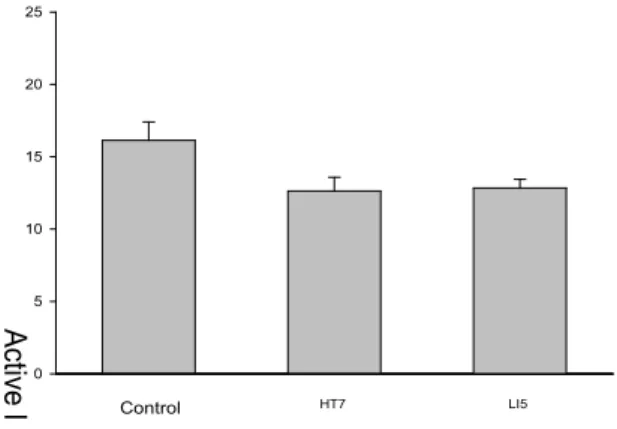
The results of present study show that the basal level of active lever response was 16.13±1.27 for control group, 12.63±0.96 for HT
7
group, 12.84±0.60 for LI5
group. And, statistical analysis has shown that the basal levels of active lever-presses for 3days were similar among the groups and that there was no significant difference between groups(Fig. 1).Control
A ct iv e le ve r r e sp o n se
0 5 10 15 20 25
HT7 LI5
Fig. 1. The basal level of infusion of morphine solution
Results are mean±S.E.M. of infusions. One-way ANOVA and post hoc Tukey test. Rats of HT
7
group(n
=8) were given acupuncture at bilateral HT7
points of heart channel, and LI5
group(n
=10) received at LI5
points of large intestine channel. Rats of control group(n=
10) received the same treatment with acupuncture group without needle stimulation.2) Effect of acupuncture on the active lever response
The results of the present study show that the
active lever response was 15.30±1.47 for control group, 7.50±1.64 for HT
7
group, 11.80±1.47 for LI5
group on the 1
st
test day, and 15.40±1.35 for control group, 8.38±1.51 for HT7
group, 11.90±1.35 for LI5
group on the 2
nd
test day, and 16.60±1.51 for control group, 9.00±1.69 for HT7
group, 12.50±1.51 for LI5
group on the 3
rd
test day, and 17.60±2.15 for control group, 11.00±2.41 for HT7
group, 12.90±2.15 for LI5
group on the 4
th
test day, and 16.80±2.25 for control group, 8.13±2.51 for HT7
group, 12.70±2.25 for LI5
group on the 5
th
test day, and 16.90±1.96 for control group, 8.38±2.19 for HT7
group, 12.20±1.96 for LI5
group on the 6
th
test day, and 15.50±1.30 for control group, 9.25±1.45 for HT7
group, 11.40±1.30 for LI5
group on the 7
th
test day. According to the results of the present study, the effect of acupuncture at HT7
to attenuate morphine taking behavior was not constant and it was more apparent on 1-3 day than behind(** :p
<0.01, * :p
<0.05, HT7
group vs. control group. Fig. 2).3 4 5 6 7
1
A c tiv e le v e r r e s p o n s e
2 4 6 8 10 12 14 16 18
20 Control
HT7 LI5
2
Day
3 4 5 6 7
**
** **
* *
*
Fig. 2. The effect of acupuncture on the active lever response
Results are mean±S.E.M. of responses. One-way ANOVA and post hoc Tukey test. ** : p<0.01, * : p<0.05, HT
7
group vs. control group. Rats of HT7
group(n
=8) were given acupuncture at bilateral HT7
points of heart channel, and LI5
group(n
=10) received at LI5
points of large intestine channel. Rats of control group(n
=10) received the same treatment with acupuncture group without needle stimulation.3) Effect of acupuncture on the inactive lever response
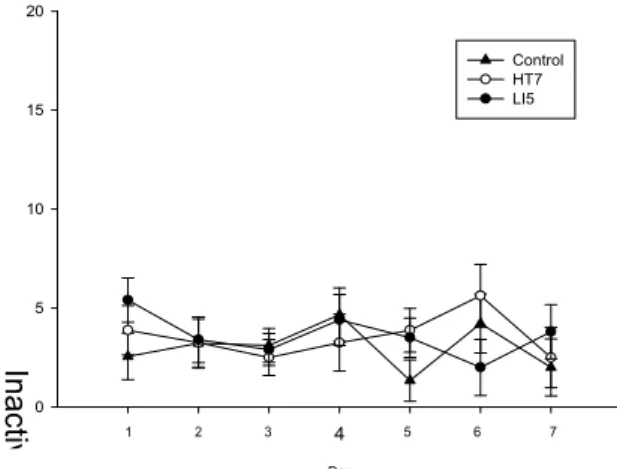
The inactive lever response was 2.56±1.18 for
control group, 3.88±1.25 for HT
7
group, 5.40±1.12 for LI5
group on the 1st
test day, and 3.22±1.22 for control group, 3.25±1.29 for HT7
group, 3.40±1.15 for LI5
group on the 2nd
test day, and 3.11±0.85 for control group, 2.50±0.91 for HT7
group, 2.90±0.81 for LI5
group on the 3rd
test day, and 4.67±1.35 for control group, 3.25±1.44 for HT7
group, 4.40±1.28 for LI5
group on the 4th
test day, and 1.33±1.04 for control group, 3.88±1.11 for HT7
group, 3.50±0.99 for LI5
group on the 5ㅊ test day, and 4.22±1.49 for control group, 5.63±1.58 for HT7
group, 2.00±1.42 for LI5
group on the 6th
test day, and 2.00±1.44 for control group, 2.50±1.53 for HT7
group, 3.80±1.37 for LI5
group on the 7th
test day. There was no significant difference between groups on every treatment day(Fig. 3).4
In a c tiv e le v e r r e s p o n s e
0 5 10 15 20
Control HT7 LI5
Day
1 2 3 5 6 7
Fig. 3. The effect of acupuncture on the inactive lever response
Results are mean±S.E.M. of responses. One-way ANOVA and post hoc Tukey test. Rats of HT
7
group(n
=8) were given acupuncture at bilateral HT7
points of heart channel, and LI5
group(n
=10) received at LI5
points of large intestine channel. Rats of control group(n=
10) received the same treatment with acupuncture group without needle stimulation.4) Effect of acupuncture on morphine intake
The results of the present study show that the percent of active lever compared to basal level was 97.51±7.06% for control group, 50.73±9.07% for HT
7
group, 92.74±6.55% for LI
5
group on the 1st
day, and 95.01±10.49% for control group, 62.66±8.02% for HT7
group, 93.23±5.69% for LI5
group on the 2nd
day, and 102.71±5.96% for control group, 73.40±
8.84% for HT
7
group, 93.71±11.13% for LI5
group on the 3rd
day, and 104.51±10.56% for control group, 84.95±14.42% for HT7
group, 99.66±9.69% for LI5
group on the 4
th
day, and 100.35±8.62% for control group, 65.78±12.10% for HT7
group, 105.12±11.86%for LI
5
group on the 5th
day, and 97.18±7.69% for control group, 65.23±11.69% for HT7
group, 92.64±7.97% for LI
5
group on the 6th
day, and 96.33±4.48%for control group, 70.54±15.86% for HT
7
group, 89.22±6.58% for LI
5
group on the 7th
day. There were significant differences between HT7
group and both of control group and LI5
group. The effect of acupuncture at HT7
to attenuate morphine taking behavior was the best on the 1st
day, and the effect was weak on the 2nd
, 3rd
, 5th
, and the 6th
day.However, the effect was not significant on the 4
th
and 7th
day(** :p
<0.01, * :p
<0.05, HT7
group vs.control group. ## :
p
<0.01, # :p
<0.05, HT7
group vs.LI
5
group. Fig. 4).40 60 80 100
120 Control
HT7 LI5
P e rc e n t c o m p a re d to b a sa l le ve l ( % )
4 3 2
1 5 6 7
Day
**
##
*
*
* *
#
# #
Fig. 4. The effect of acupuncture on morphine taking behavior
Results are mean±S.E.M. of percents compared to basal level. One-way ANOVA and post hoc Tukey test. ** : p<0.01, * : p<0.05, HT
7
group vs. control group ; ## : p<0.01, # : p<0.05, HT7
group vs. LI5
group. Rats of HT7
group(
n
=8) were given acupuncture at bilateral HT7
points of heart channel, and LI5
group(n
=10) received at LI5
points of large intestine channel. Rats of control group(n=
10) received the same treatment with acupuncture group without needle stimulation.2. The 2 nd experiment: neuronal involvement
1) Basal level of active lever response in morphine intake
The basal level of active lever response was 14.72±5.36 for HT
7
, 11.77±1.15 for HT7
+ bicuculline group, 13.77±1.23 for HT7
+ SCH 50911 group, 15.03±1.07 for bicuculline alone group, 14.75±2.44 for SCH 50911 alone group. The basal levels of active leverpresses were similar among the groups and there was no significant difference between groups (Fig. 5).
0 5 10 15 20 25
A c tiv e le v e r r e s p o n s e
H T7
H T7 +b icu cu
llin e H T7
+S C H 50 91 1
bic uc ulli ne
S C H 50 91 1
Fig. 5. The basal level of infusion of morphine solution
Results are mean±S.E.M. of infusions. One-way ANOVA and post hoc LSD test. Rats of HT
7
group(n
=6) were given the same acupuncture treatment with HT7
group of 1st
experiment. HT7
+ bicuculline group(n
=6) received acu- puncture at HT7
and the selective GABAA
receptor antagonist, bicuculline(1㎎/㎏) injected intravenously 30min before acupuncture treatment. HT7
+ SCH 50911 group(n
=6) received acupuncture at HT7
and the selective GABAB
receptor antagonist, SCH 50911(2㎎/㎏) injected intra- venously 30min before acupuncture treatment. Animals of bicuculline group(
n=
6) and SCH 50911 group(n=
6) were given bicuculline and SCH 50911 injection respectively, as well as the same treatment with control group.2) Neuronal involvement in the effect of acupuncture on the active lever
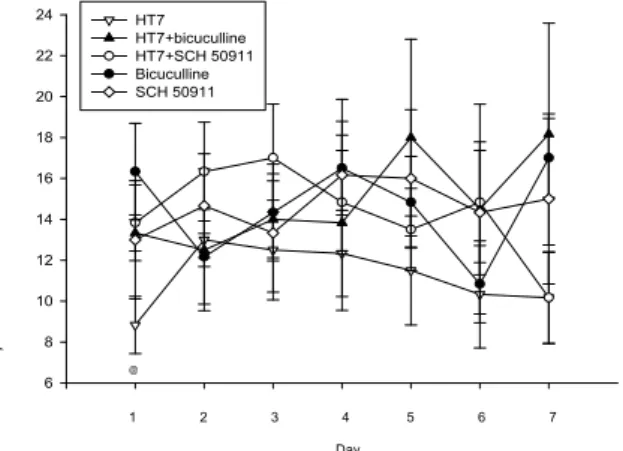
The active lever response was 8.83±1.40 for HT
7
group, 13.33±0.88 for HT
7
+ bicuculline group, 13.83±1.85 for HT
7
+ SCH 50911 group, 16.33±2.36 for bicu- culline alone group, 13.00±2.89 for SCH 50911 alonegroup on the 1
st
test day, and 13.00±3.46 for HT7
group, 12.50±0.81 for HT
7
+ bicuculline group, 16.33±2.42 for HT
7
+ SCH 50911 group, 12.17±2.32 for bic- uculline alone group, 14.67±2.54 for SCH 50911 alone group on the 2nd
test day, and 12.50±2.43 for HT7
group, 14.00±1.88 for HT7
+ bicuculline group, 17.00±2.63 for HT7
+ SCH 50911 group, 14.33±2.36 for bicuculline alone group, 13.33±2.89 for SCH 50911 alone group on the 3rd
test day, and 12.33±2.11 for HT7
group, 13.83±4.28 for HT7
+ bicuculline group, 14.83±2.54 for HT7
+ SCH 50911 group, 16.50±2.29 for bicuculline alone group, 16.17±3.70 for SCH 50911 alone group on the 4th
test day, and 11.50±2.67 for HT7
group, 18.00±4.81 for HT7
+ bicuculline group, 13.50±2.01 for HT7
+ SCH 50911 group, 14.83±2.24 for bicuculline alone group, 16.00±3.36 for SCH 50911 alone group on the 5th
test day, and 10.33±2.62 for HT
7
group, 14.50±5.13 for HT7
+ bicuculline group, 14.83±2.95 for HT7
+ SCH 50911 group, 10.83±1.89 for bicuculline alone group, 14.33±3.04 for SCH 50911 alone group on the 6
th
test day, and 10.17±6 8 10 12 14 16 18 20 22
24 HT7
HT7+bicuculline HT7+SCH 50911 Bicuculline SCH 50911
A c tiv e le v e r r e s p o n s e
@
4 Day 3 2
1 5 6 7
Fig. 6. The effect of acupuncture on the active lever response through GABA receptor system
Results are mean±S.E.M. of responses. One-way ANOVA and post hoc LSD test. @ : p<0.05, HT
7
group vs. bic- uculline group. Rats of HT7
group(n
=6) were given the same acupuncture treatment with HT7
group of 1st
ex- periment. HT7
+ bicuculline group(n
=6) received acupunc- ture at HT7
and the selective GABAA
receptor antagonist, bicuculline(1㎎/㎏) injected intravenously 30min before acu- puncture treatment. HT7
+ SCH 50911 group(n
=6) received acupuncture at HT7
and the selective GABAB
receptor antagonist, SCH 50911(2㎎/㎏) injected intravenously 30min before acupuncture treatment. Animals of bicuculline group (n
=6) and SCH 50911 group(n
=6) were given bicuculline and SCH 50911 injection respectively, as well as the same treatment with control group.2.24 for HT
7
group, 18.17±5.42 for HT7
+ bicuculline group, 10.17±2.23 for HT7
+ SCH 50911 group, 17.00±1.93 for bicuculline alone group, 15.00±4.16 for SCH 50911 alone group on the 7
th
test day. The signi- ficant difference was observed only on the 1st
day between HT7
group and bicuculline group(@ :p
<0.05. Fig. 6).
3) Neuronal involvement in the effect of acupuncture on the inactive lever
The inactive lever response was 3.50±0.89 for HT
7
group, 1.50±1.15 for HT7
+ bicuculline group, 2.00±1.06 for HT7
+ SCH 50911 group, 4.00±1.21 for bicuculline alone group, 5.00±0.97 for SCH 50911 alone group on the 1st
test day, and 3.50±1.12 for HT7
group, 1.00±0.63 for HT7
+ bicuculline group, 3.50±1.45 for HT7
+ SCH 50911 group, 6.17±2.40 for bicuculline alone group, 1.67±0.67 for SCH 50911 alone group on the 2nd
test day, and 2.00±0.68 for HT7
group, 3.33±1.99 for HT7
+ bicuculline group, 3.00±1.03 for HT7
+ SCH 50911 group, 8.50±1.89 for bicuculline alone group, 8.50±3.80 for SCH 50911 alone group on the 3rd
test day, and 2.17±1.17 for HT7
group, 1.33±0.88 for HT7
+ bicuculline group, 2.00±1.44 for HT7
+ SCH 50911 group, 9.33±1.15 for bicuculline alone group, 4.67±1.87 for SCH 50911 alone group on the 4th
test day, and 1.83±1.05 for HT7
group, 1.33±0.80 for HT7
+ bicuculline group, 1.67±1.12 for HT7
+ SCH 50911 group, 5.67±1.05 for bicuculline alone group, 3.50±1.34 for SCH 50911 alone group on the 5th
test day, and 3.50±1.93 for HT7
group, 1.17±0.54 for HT7
+ bicuculline group, 3.33±2.17 for HT7
+ SCH 50911 group, 3.50±0.89 for bicuculline alone group, 3.67±1.76 for SCH 50911 alone group on the 6th
test day, and 2.50±0.72 for HT7
group, 3.67±1.84 for HT7
+ bicuculline group, 2.33±0.80 for HT7
+ SCH 50911 group, 12.50±4.29 for bicuculline alone group, 5.17±1.42 for SCH 50911 alone group on the 7th
test day. The significant differences were HT7
+ bicuculline group vs. SCH 50911 group(+ :p
<0.05) on the 1st
day, HT7
+ bicuc- ulline group vs. bicuculline group(‡:p
<0.05), bic- uculline alone group vs. SCH 50911 alone group(& :p
<0.05) on the 2nd
day, HT7
group vs. bicuculline group(@ :p
<0.05), HT7
group vs. SCH 50911 group($ :p
<0.05) on the 3rd
day, HT7
group vs.bicuculline group(@@ :
p
<0.01), HT7
+ bicuculline group vs. bicuculline group(‡‡‡:p
<0.001), bicucul- line group vs. SCH 50911 group(& :p
<0.05), HT7
+ SCH 50911 group vs. bicuculline group(%% :p
<0.01) on the 4
th
day, HT7
group vs. HT7
+ bic- uculline group(* :p
<0.05), HT7
+ bicuculline group vs. bicuculline group(‡‡:p
<0.01), HT7
+ SCH 50911 group vs. bicuculline group(% :p
<0.05) on the 5th
day, HT7
group vs. bicuculline group(@@ :p
<0.01), HT7
+ bicuculline group vs. bicuculline group(‡:p
<0.05), bicuculline group vs. SCH 50911 group(& :p
<0.05), HT7
+ SCH 50911 group vs. bicuculline group(%% :p
<0.01) on the 7th
day(Fig. 7).0 5 10 15 20
HT7 HT7 + bicuculline HT7 + SCH 50911 Bicuculline SCH 50911
In a c tiv e le v e r r e s p o n s e
+ ‡ ‡ ‡ @@
%%
&
@
‡ $
&
%
‡ ‡ *
@@
‡
&
%%
4 Day 3 2
1 5 6 7
Fig. 7. The effect of acupuncture on the inactive lever response through GABA receptor system
Results are mean±S.E.M. of responses. One-way ANOVA and post hoc LSD test. + : p<0.05, HT
7
+ bicuculline group vs. SCH 50911 group ; ‡: p<0.05, ‡‡: p<0.01, ‡‡‡:p<0.001, HT
7
+ bicuculline group vs. bicuculline group ; & : p<0.05, bicuculline alone group vs. SCH 50911 alone group ;@ :p<0.05, @@ : p<0.01, HT
7
group vs. bicuculline group ;$ : p<0.05, HT
7
group vs. SCH 50911 group ; % : p<0.05,%% : p<0.01, HT
7
+ SCH 50911 group vs. bicuculline group. Rats of HT7
group(n=
6) were given the same acupuncture treatment with HT7
group of 1st
experiment.HT
7
+ bicuculline group(n
=6) received acupuncture at HT7
and the selective GABA
A
receptor antagonist, bicuculline (1㎎/㎏) injected intravenously 30 min before acupuncture treatment. HT7
+ SCH 50911 group(n
=6) received acupun- cture at HT7
and the selective GABAB
receptor anta- gonist, SCH 50911(2㎎/㎏) injected intravenously 30min before acupuncture treatment. Animals of bicuculline group (n
=6) and SCH 50911 group(n
=6) were given bicuculline and SCH 50911 injection respectively, as well as the same treatment with control group.4) Neuronal involvement in the effect of acupuncture on morphine intake
The percent of active lever compared to basal level was 59.95±3.83% for HT
7
group, 116.37±9.29%for HT
7
+ bicuculline group, 98.87±4.53% for HT7
+ SCH 50911 group, 107.07±10.94% for bicuculline group, 85.45±10.56% for SCH 50911 group on the 1st
day, and 84.45±9.92% for HT7
group, 107.88±4.92%for HT
7
+ bicuculline group, 116.23±10.69% for HT7
+ SCH 50911 group, 82.90±14.83% for bicuculline group, 100.60±7.08% for SCH 50911 group on the 2nd
day, and 83.20±5.14% for HT7
group, 117.72±7.22% for HT
7
+ bicuculline group, 121.40±10.22%for HT
7
+ SCH 50911 group, 98.07±17.31% for bicu- culline group, 87.20±8.01% for SCH 50911 group on the 3rd
day, and 87.07±15.51% for HT7
group, 132.92±16.62% for HT
7
+ bicuculline group, 105.43±11.66%for HT
7
+ SCH 50911 group, 114.12±18.86% for bicuculline group, 105.40±12.48% for SCH 50911 group on the 4th
day, and 74.55±9.33% for HT7
group, 143.93±20.04% for HT
7
+ bicuculline group, 98.15±14.00% for HT7
+ SCH 50911 group, 97.62±11.24% for bicuculline group, 105.32±8.90% for SCH 50911 group on the 5
th
day, and 66.13±8.33% for HT7
group, 112.90±24.70% for HT7 + bicuculline group, 103.95±15.86% for HT7
+ SCH 50911 group, 73.58±12.75% for bicuculline group, 93.67±6.17% for SCH 50911 group on the 6th
day, and 68.00±11.96%for HT
7
group, 143.10±24.03% for HT7
+ bicuculline group, 87.72±11.64% for HT7
+ SCH 50911 group, 113.23±10.21% for bicuculline group, 93.65±16.69%for SCH 50911 group on the 7
th
day. There were significant differences between HT7
group and both of control group and LI5
group. The significant differences were HT7
group vs. HT7
+ bicuculline group(*** :p
<0.001), HT7
group vs. HT7
+ SCH 50911 group(## :p
<0.01), HT7
group vs. bicucul- line group(@@ :p
<0.01), HT7
group vs. SCH 50911 group($ :p
<0.05) on the 1st
day, HT7
group vs.HT
7
+ SCH 50911 group(# :p
<0.05) on the 2nd
day, HT7
group vs. HT7
+ bicuculline group(* :p
< 0.05), HT7
group vs. HT7
+ SCH 50911 group(# :p
< 0.05) on the 3rd
day, HT7
group vs. HT7
+ bicucullinegroup(** :
p
<0.01) on the 5th
day, HT7
group vs.HT
7
+ bicuculline group(* :p
<0.05) on the 6th
day, HT7
group vs. HT7
+ bicuculline group(** :p
<0.01) on the 7th
day, and on the 4th
day, there was not any significant difference(Fig. 8).40 60 80 100 120 140
160 HT7
HT7+bicuculline HT7+SCH 50911 Bicuculline SCH 50911
P er ce nt co m pa re d t o b as al le ve l (% )
*** ##
@@
$
#
*
#
**
**
*
4 Day 3 2
1 5 6 7
Fig. 8. The effect of acupuncture on morphine taking behavior through GABA receptor system
Results are mean±S.E.M. of responses. One-way ANOVA and post hoc LSD test. * :
p
<0.05, ** :p
<0.01, *** :p
<0.001, HT7
group vs. HT7
+ bicuculline group ; # :p
<0.05, ## : p<0.01, HT7
group vs. HT7
+ SCH 50911 group ; @@ :p<0.01, HT7
group vs. bicuculline group ; $ : p<0.05, HT7
group vs. SCH 50911 group. Rats of HT7
group(
n
=6) were given the same acupuncture treatment with HT7 group of 1st
experiment. HT7
+ bicuculline group(n
=6) received acupuncture at HT7
and the selective GABAA
receptor antagonist, bicuculline(1㎎/㎏) injected intravenously 30min before acupuncture treatment. HT7
+ SCH 50911 group(n
=6) received acupuncture at HT7
and the selective GABAB
receptor antagonist, SCH 50911(2㎎/㎏) injected intravenously 30min before acupuncture treat- ment. Animals of bicuculline group(
n
=6) and SCH 50911 group(n=
6) were given bicuculline and SCH 50911 injection respectively, as well as the same treatment with control group.Ⅳ. Discussion
Based on the previous study, we anticipated that the effect would hold out until the last test day or may be stronger in the latter part than fore part of the test period and investigated through the 1
st
experiment. The basal level of each group was similar among groups(Fig. 1), and there was no significant difference between groups in the inactive lever through the test(Fig. 3). Therefore, it may besaid that animals had taken morphine solution spontaneously. And, acupuncture at HT
7
decreased morphine taking on the 1st
test day as the result of the previous study has shown13)
. However, the result of the present study has demonstrated that the effect of acupuncture was not constant rather than diminished steadily up to the 4th
day showing the best on the 1st
day(Fig. 4). Although the effect appeared again on the 5th
and 6th
day, it has gone again on the 7th
day. So, the anticipation that acu- puncture might produce similar effectiveness through- out the test period was proved not true. In a similar pattern with the percent compared to the basal level, the active lever press of HT7
group was attenuated more in the fore part than the latter part, and was not significantly reduced compared to control group in the middle part(Fig. 2). It is inter- esting that the effect of acupuncture at HT7
disap- peared on the 4th
day, being weakened steadily. Even if lots of things must be considered, authors pro- pose a hypothesis that it is a kind of ‘tolerance’.The specific acupoint HT
7
of subjects might have experienced the specific stimulation by needle for the first time on the 1st
day. However, the same stimulation with the 1st
day might not be enough to give the same charge to the acupoint HT7
. Another unexpected and interesting thing is that the effect appeared again on the 5th
and 6th
day. So, it is possible that the tolerance of the effect of acupun- cture is not long lasting but short.Although many things still remain to be studied in the changing pattern of the effect of acupuncture, the results of the present study might suggest that acupuncture’s suppression of morphine taking does not appear constantly every day and therefore, it is needed to take acupuncture treatment at least twice per a week changing acupoints or stimulation tech- nique for the treatment of morphine abuse.
In 2
nd
experiment, we investigated the neuronal involvement in the duration of the effect of acu- puncture using GABA receptor antagonists. GABA receptor system has been revealed to be involved in the effects of acupuncture at HT7
in our previous study about alcohol and morphine addiction7,13,18)
. Inthe present study, the selective GABA
A
receptor antagonist, bicuculline inhibited the effect of acu- puncture at HT7
significantly on the 1st
, 3rd
, 5th
, 6th
, 7th
day, and the selective GABAB
receptor antagonist, SCH 50911 inhibited the effect of acupuncture at HT7
significantly on the 1st
, 2nd
, 3rd
day. This result is parallel with the previous study13)
, and expected to be another evidence to account for the invol- vement of GABA receptor system in the effect of acupuncture at HT7
in drug addiction. According to several studies, the ventral tegmental area(VTA) is known to play an important role in morphine addiction19-21)
. So, for the more certain find, the neurochemical and histological study investigating the function of VTA in the effect of acupuncture would be needed.In this study, both antagonists reversed the effect of acupuncture in the front or the rear show- ing the best on the 1
st
day, and there was no re- verse on the 4th
day(Fig. 8). This pattern of reverse is thought to be due to the unique duration pattern of the effect of acupuncture, i.e. the dif- ference of the lasting aspect between HT7
group and both groups of HT7
+ bicuculline and HT7
+ SCH 50911.In other words, both groups of HT
7
+ bicuculline and HT7
+ SCH 50911 did not show ‘overturned-U shape’ while HT7
group did. So, it might be said that the unique lasting pattern of the effect of acu- puncture at HT7
produced this phenomenon.In addition, one more surprising thing is em- bedded in the results of this study. The reverse of the effect of acupuncture by both of bicuculline or SCH 50911 is occurred in the front or the rear, and this pattern is very similar with the aspect of dur- ation of the effect acupuncture at HT
7
. Therefore, it has been found that the regents antagonized the effect of acupuncture only when it was significant, and did not affect when it was not. Eventually, it might be said that the action of regents appeared selectively according to whether acupuncture function or not. From this result, it seems that there is a relation between the function of acupuncture at HT7
and the action of regents.
Ⅴ. Conclusion
As a conclusion, the results of this study suggest that the effect of acupuncture at HT
7
to suppress morphine taking is not constant, and may be weak- ened or disappear after some treatments. Therefore it is needed to take acupuncture treatment at least twice per a week. As well, GABA receptor system is involved in the effect of acupuncture at HT7
and also, there may be a relation between the action of antagonists and the function of acupuncture at HT7
.Ⅵ. References
1. Vanderschuren LJ, De Vries TJ, Wardeh G, Hogenboom FA, Schoffelmeer AN. A single exposure to morphine induces long-lasting be- havioural and neurochemical sensitization in rats. Eur J Neurosci. 2001 ; 14 : 1533-8.
2. Wise RA, Bozarth MA. Action of drug of abuse on brain reward systems; an update with spe- cific attention to opiates, Pharmacol. Biochem.
Behavior. 1982 ; 17: 239-43.
3. Everitt BJ, Dickinson A, Robbins TW. The neuro- psychological basis of addictive behaviour. Brain Res Rev. 2001 ; 36 : 129-38.
4. Spangel R, Weiss F. The dopamine hypothesis of reward: past and current status. Trends Neurosci.
1999 ; 22 : 521-7.
5. Anonymous. Acupuncture, NIH consensus state- ment. JAMA. 1998 ; 280 : 1518-24.
6. Bullock ML, Umen AJ, Culliton PD, Olander RT. Acupuncture treatment of alcoholic recidivism : a pilot study. Alcohol Clin Exp Res. 1987 ; 11(3) : 292-5.
7. Yoon SS, Kwon YK, Kim MR, Shim I, Kim KJ, Lee MH et al. Acupuncture-mediated inhibition of ethanol-induced dopamine release in the rat nucleus accumbens through the GABAB receptor.
Neurosci Lett. 2004 ; 369 : 234-8.
8. Zhao RJ, Yoon SS, Lee BH, Kwon YK, Kim KJ,
Shim I et al. Acupuncture normalizes the release of accumbal dopamine during the withdrawal period and after the ethanol challenge in chronic ethanol-treated rats. Neurosci Lett. 2006 ; 395 : 28-32.
9. Jeon HJ, Lee BH, Lee KM, Kim JS, Lee YK, Lee JH, Jung TY, Yang CH, Yoon SS, Kim H, Choi SH, Han CH, Lim SC. A Synergy Effect of Combination of Acupoints in Cocaine Take. J Korean Acupuncture & Moxibustion Society.
2010 ; 27(2) : 31-41.
10. Lee BH, Kim SH, Lim SC, Kim JS, Lee YK, Lee JH, Jung TY, Yang CH, Yoon SS, Han CH, Lee KM. Suppression of cocaine intake by acupuncture at HT7. J Korean Oriental Med.
2010 ; 31(3) : 17-27.
11. Lee B, Han SM, Shim I. Acupuncture attenuates cocaine-induced expression of behavioral sensiti- zation in rats : possible involvement of the dopaminergic system in the ventral tegmental area. Neurosci Lett. 2009 ; 449(2) : 128-32.
12. Kim MR, Kim SJ, Lyu YS, Kim SH, Lee Y, Kim TH et al. Effect of acupuncture on be- havioral hyperactivity and dopamine release in the nucleus accumbens in rats sensitized to morphine. Neurosci Lett. 2005 ; 387 : 17-21.
13. Yoon SS, Kim H, Choi KH, Lee BH, Lee YK, Lim SC, Choi SH, Hwang M, Kim KJ, Yang CH. Acupuncture suppresses morphine self- administration through the GABA receptors.
Brain Res Bull. 2010 ; 81(6) : 625-30.
14. Lee B, Shim I, Lee H, Yin CS, Park HK, Yang JS, Hahm DH. Morphine-induced locomotor res- ponse and Fos expression in rats are inhibited by acupuncture. Neurol Res. 2010 Feb ; 32 Suppl 1 : 107-10.
15. Liang J, Ping XJ, Li YJ, Ma YY, Wu LZ, Han JS, Cui CL. Morphine-induced conditioned place preference in rats is inhibited by electroacup- uncture at 2 Hz : role of enkephalin in the nucleus accumbens. Neuropharmacology. 2010 Jan ; 58(1) : 233-40. Epub 2009 Jul 14.
16. Jiang YH, Jiang W, Jiang LM, Lin GX, Yang H, Tan Y, Xiong WW. Observation on the effect of acupuncture for preventing and treating the com- plication after Morphine anesthesia and analgesia.
Zhongguo Zhen Jiu. 2010 May ; 30(5) : 403-6.
17. Schone AM. Veterinary acupuncture: ancient art to modern medicine. American Veterinary Publi- cation. 1999.
18. Lee BH, Zhao RJ, Moon JY, Yoon SS, Kim JA, An H et al. Differential involvement of GABA system in mediating behavioral and neuro- chemical effect of acupuncture in ethanol-withdrawn rats. Neurosci Lett. 2008 ; 443 : 213-7.
19. Wu CH, Tao PL, Huang EY. Distribution of neuropeptide FF(NPFF) receptors in correlation with morphine-induced reward in the rat brain.
Peptides. 2010 Jul ; 31(7) : 1374-82. Epub 2010 Apr 8.
20. Madhavan A, He L, Stuber GD, Bonci A, Whistler JL. micro-Opioid receptor endocytosis prevents adaptations in ventral tegmental area GABA trans- mission induced during naloxone-precipitated morphine withdrawal. J Neurosci. 2010 Mar 3 ; 30(9) : 3276-86.
21. Lin X, Wang Q, Ji J, Yu LC. Role of MEK- ERK pathway in morphine-induced conditioned place preference in ventral tegmental area of rats. J Neurosci Res. 2010 May 15 ; 88(7) : 1595-604.