Vo1. 21, No. 2, November, 2012
요골신경 압박마비의 회복
차의과학대학교 분당차병원 정형외과학교실
이승용∙한수홍∙이순철∙이인성∙김진우
─
─ Abstract ──
Convalescence from Saturday Night Palsy
Seung-Yong Rhee M.D., Soo-Hong Han M.D., Soon-Chul Lee M.D., In-Sung Lee M.D., Jin-Woo Kim M.D.
Department of Orthopedic Surgery, CHA Bundang Medical Center, CHA University, Seongnam-si, Korea
Purpose: Saturday night palsy is a transient form of nerve palsy that occurs after a prolonged period of direct pressure on the course of radial nerve by one’s own or spouse’s head. Although commonly encountered, there have been only few studies concerning its convalescence. The purpose of this study is to predict the prognosis of Saturday night palsy based on the causes, time to recovery and degree of recovery.
Materials and Methods: Retrospective study of 20 patients who were diagnosed compression radial nerve palsy was performed. The average age was 36.7 years old and the mean follow-up period was 19.6 months. We investigated sleeping hours as an indirect measure of nerve compression time, recovery of wrist and finger extension, DASH score on the monthly based follow up.
Results: The mean sleeping hours was 5.8 hours and all patients showed full recovery of wrist and fin- gers extension with the mean duration of symptom for 3.2 months. DASH score was an average 1.53 at the last follow up and we found no statistical significance between the time to recovery and the sleeping hours.
Conclusion: Complete natural recovery can be expected in compression radial nerve palsy in this study without correlation with sleeping time. Accurate diagnosis is important in order to avoid unnecessary therapeutic intervention and further study should be accomplished for clarifying the related prognostic factors in larger scale of the cases.
Key Words: Radial nerve, Saturday night palsy, Prognosis.
※통신저자: 한 수 홍
경기도 성남시 분당구 야탑동 351 차의과학대학교 분당차병원 정형외과
Tel: 031-780-5278, Fax: 031-708-3578., E-mail: [email protected]
INTRODUCTION
Sleep or “Saturday night”palsy, although not as common as the palsy associated with trau- matic causes such as humerus fracture, is a well recognized condition affecting patients who sleep on their arm after an alcohol binge1,2. It typical- ly affects the radial nerve, although sciatic, per- oneal and tibial nerves can similarly be affect- ed1,2. It is one kind of compression radial nerve palsy, also known as Honeymooner’s palsy which is a transient form of nerve injury that occurs after a prolonged period of direct pressure on the course of radial nerve by one’s own or spouse’s head. These patients typically present with both sensory and motor involvement within the radial nerve distribution distal to the elbow.
Active extension of the wrist, thumb and fin- gers is impaired and patients may describe decreased or altered sensation with the first dor- sal web space or along the back of the thumb and index finger. Although commonly encoun- tered, and it is known the prognosis of “Satur- day night” palsy is generally good, but there have been only few studies concerning its conva- lescence and the literature concerned with the disease course such as symptom duration and its determinants is scarce. The purpose of this study is to predict the prognosis of Saturday night palsy based on the analysis of regular fol- low up results.
MATERIALS AND METHODS
Twenty patients who had visited outpatient clinic due to extension weakness of wrist and fingers from February 2003 to June 2010 were included. There were 17 male and 3 female patients, and the average age was 36.7 years old(range, 22~60). The mean follow-up period was 19.6 months and diagnosis was made mainly through history and clinical examinations. In 3 patients, EMG/NCV was performed and they showed radial neuropathy around or above
elbow. Wrist brace was applied to every patient to support the wrist without inhibiting the motion of the fingers and the patients were also advised to undertake passive extension exercises of the wrist and fingers. Monthly follow up was performed until patient showed no more improvement in consecutive 2 months.
Coexisting systemic diseases, serial improvements of active wrist/fingers metacarpophalangeal joint extension, DASH score were evaluated. Complete recovery which was defined as functional improvement of such degree that a patient could not feel difference between the two hands in trying to extend the fingers or wrist was investi- gated at the final follow-up.
Statistical analysis was performed with SPSS 9.0 version. Comparison between sleep time and recovery period, DASH score at the last follow up was carried out with the Student t-test.
RESULTS
The symptom developed with sleeping on their arm after alcohol binge in 18 patients and the remaining two patients developed the symptoms after sleeping a while in commuting train. Right arm was affected in 14 patients and left was in 6 patients. The mean sleep time as an indirect measure of compression of nerve was 5.8 hours(range, 1~8 hours). All patients showed complete recovery and the mean recovery time of same extension of wrist and fingers compared to uninjured side was 3.2 months(range, 1~6 months) - recovery within 1 month; 3 cases, within 2 months; 5 cases, within 3 months; 7 cases, over 4 months; 5 cases. The DASH score was an average 1.53 at the last follow up, rang- ing from 0 to 4. The duration of compression, as estimated through sleep time in the alcohol ingestion group was not statistically different from that of the alcohol noningestion group(p=0.11).
No systemic diseases such as diabetes mellitus, giant cell arteritis, polyarteritis nodosa or viral
infections which could adversely affect the ner- vous system were discovered. There was con- comitant alcoholic hepatitis in one case, and one other patient had been affected by rheumatoid arthritis. All the patients complained decreased sensation of the first dorsal web space at the first visit and recovered to same sensation as opposite hand at the final follow up. There was no significant statistical correlation between sleep time and recovery period, DASH score at the last follow up(p>0.05).
Case 1
A 34 year old man observed numbness and weakness of his right hand after awaking from the sleep that had followed a Saturday night binge. He had slept for 8 hours but he didn’t remember the exact position of body and arm during sleep. After 3 days he was referred to our clinic for evaluation of palsy and paresthesia
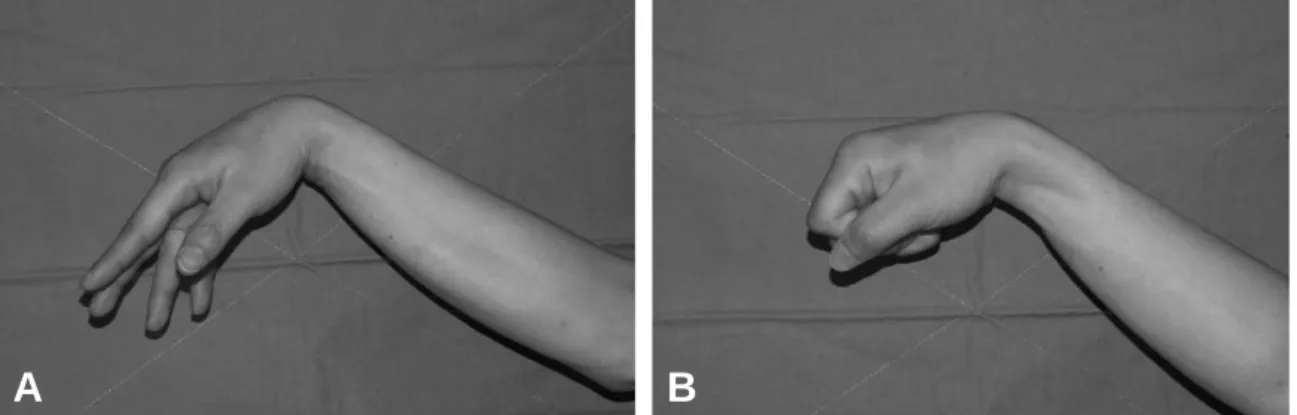
in his wrist and hand. There was no history of trauma, systemic illness, surgery or familial neuropathy. Physical examination revealed weakness of the right hand and wrist, the grip strength scored 25 lbs(26 % of opposite hand) (Fig. 1). Complete recovery of wrist, fingers extension was achieved in 9 weeks after onset of symptoms(Fig. 2). Paresthesia of hand dorsum was also improved at the same time, but full recovery of grip power obtained in 5 months.
DISCUSSION
Sleep or “Saturday night”palsy is a well recog- nized condition which usually means radial nerve compression in the arm resulting from direct pressure against a firm object3. This con- dition arises from prolonged pressure on the radial nerve at the midhumeral level and typi- cally, the extrinsic compression results from
Fig. 1. (A, B) The patient could not extend the wrist and fingers at the first visit.
A B
Fig. 2. (A, B) Active extension of the wrist and fingers was fully recovered in 9 weeks after onset of symptoms.
A B
unphysiological deep sleep with one arm resting against firm edge and causes a local conduction block. It consists of a loss in function of one or more nerves because of stretching or compression due to external force acting through the skin and patients present with a motor deficit such as a wrist, finger and thumb drop. Suspected mechanism of injury in the “Saturday night palsy”is neurapraxia4. This means it is the first degree injury that results from a segmental demyelination without loss of nerve continuity or Wallerian degeneration that may later recover without intervention. The radial nerve is the nerve most vulnerable to compression by exter- nal forces in the upper limb because of its inti- mate relationship to the humerus, against which it is compressed, and its poor supporting epineural tissue at the level of the spiral groove.
In cases of Saturday night palsy the patient is in the deep sleep of the very fatigued, may be debilitated and is often under the influence of alcohol. Noxious stimuli generated by lying in an abnormal position pass unperceived and the subject does not change position.
The main stay of the treatment in these patients is generally physical therapy. This includes splinting, pain management, electrical stimulation and exercises pertaining to the extensor muscles. Sunderland reported seven cases of radial nerve palsy, five of which occurred during sleep with compression noted at the level of the lateral intermuscular septum5. All seven patients experienced complete resolu- tion of paralysis with time. Negrin and Fardin reported that symptoms usually resolve with 6 months6 when it is not associated with other pathology.
Although it is generally known the prognosis is good, there are surprisingly few articles concern- ing the duration of recovery and prognosis based on amount of alcohol intake and duration of nerve compression. Authors tried to find any relation between compression time and prognosis by the indirect application with sleeping time
but there was no significant correlation.
Although radial mononeuritis has been related to alcohol, lead, arsenic, typhoid, and serum sick- ness5,7, all patient in our study denied history of alcohol abuse and no patient had any related systemic problems. Even though the alcohol ingestion is not directly related to the severity of the palsy, rhabdomyolysis could affect the radial nerve in a similar manner, as reported by Maddison et al8. Unfortunately we did not per- form muscle enzyme test. However, no patient in our study was found to have clinical symp- toms or abnormal urinalysis indicative of rhab- domyolysis.
The duration of compression, as estimated through sleep time in the alcohol ingestion group was not statistically different from that of the alcohol noningestion group. There could be a variety of reasons for this finding. First, the time of compression could have no relationship to the time to recovery. Second, the sleep time as reported by the patients may not be accurate, especially after alcohol binge. Third, sleep time may not truly reflect the duration of compres- sion. In this regard, the accurate measurement for the actual compression time should have to be obtained but it is arduously difficult task.
CONCLUSION
Complete natural recovery can be expected in compression radial nerve palsy in this study without correlation with sleeping time. No sys- temic factor was found to be related to symptom duration or the degree of recovery. Duration of compression does not seem to play an important role in terms of full recovery. Accurate diagnosis is important in order to avoid unnecessary ther- apeutic intervention and further study should be accomplished for clarifying the related prognostic factors in larger scale of the cases.
REFERENCES
1) Kornetzky L, Linden D, Berlit P. Bilateral sciatic nerve
“saturday night palsy” J Neurol. 2001; 248: 425.
2) Mitchell SW. Injuries of nerves and their consequences:
(1872). New York: JB Lippincott; 1965.
3) Barton NJ. Radial nerve lesions. Hand. 1973; 5: 200.
4) Lowe JB, 3rd, Sen SK, Mackinnon SE. Current approach to radial nerve paralysis. Plast Reconstr Surg. 2002; 110:
1099.
5) Sunderland SPD, Smith JWMD. Nerves and nerve injuries. Plastic & Reconstructive Surgery. 1969; 44: 601.
6) Negrin P, Fardin P. “Sleep paralysis” of the radial nerve:
Clinical and electromyographical evolution of 10 cases.
Electromyogr Clin Neurophysiol. 1979; 19: 435.
7) Lotem M, Maor P, Fried A. Posterior interosseous nerve palsy. Harefuah. 1971; 81: 377.
8) Maddison P. Acute rhabdomyolysis and brachial plexopa- thy following alcohol ingestion. Muscle Nerve. 2002; 25:
283.