Vol. 18, No. 2 pp. 651-659, 2017
Developing a Customized Sexually Transmitted Infections (STIs) Smartphone Application for Adolescents: An Application of the
Instructional System Design Model
Soo-Kyung Jeong
1, Chi-Young Cha
2*1Department of Nursing, Incheon JEI University
2College of Nursing, Ewha Womans University
청소년 성매개 감염병 교육을 위한 스마트폰 어플리케이션 개발과정
정수경1, 차지영2*
1인천재능대학교 간호학과
2이화여자대학교 간호학과
Abstract Although the need for education on sexually-transmitted-infections (STIs) for adolescents has been increasing, a limited number of adolescents receive STI education. Importantly, the exposure of youth to an STI during their adolescence period can seriously affect their genital health. Smartphones are an innovative medium that can be used to change individual behaviors, especially useful when used to educate adolescents. Therefore, we developed a customized smartphone application for Korean adolescents. The application was based on Dick and Carey's instructional system design model. In this paper, we describe the process for development of the smartphone application, and the strategies we applied to attract adolescents to use the smartphone application. Six experts verified the educational content of the application. The application's easygoing words were chosen to help adolescents understand the topic. Strategies such as cartoon clips, secret chat rooms, buttons changing color from blue to grey, questions and answers, and a repeated-learning function were used to attract Korean adolescents to the application.
The smartphone application developed in this study could be used in schools, youth centers, and hospital centers to improve STI knowledge, STI prevention, and STI coping skills.
요 약 청소년을 위한 성매개 감염병 교육의 필요성이 증가되고 있지만 대부분의 청소년들은 교과과정의 부족한 시간으로 인하여 제대로 된 교육을 받지 못하고 있다. 이 시기의 성매개 감염병 노출은 증상이 없거나 경미하여 청소년들이 성매개 질환에 대한 인지를 못하는 경우가 많아 장기적인 생식기계의 문제를 야기할 수 있다. 스마트폰의 보급과 더불어 청소년들이 정보의 대부분을 스마트폰을 통하여 얻고 있어 스마트폰을 활용한 교육이 청소년에서 효과적이다. 청소년의 성 매개 감염병 지식을 향상시키기 위한 교육의 방법으로 딕 앤 케리의 체계적인 교수 설계 모델을 적용하여 성 매개 감염병 교육 스마트폰 어플리케이션 개발을 하였다. 본 연구는 이 스마트폰 어플리케이션 개발 전략 및 개발 과정을 기술하였다. 이 스마폰 어플리 케이션은 6명의 전문가들과 함께 개발되었으며 교육 내용은 청소년들이 이해하기 쉬운 용어를 사용하였다. 학습능력 향상을 위한 주요 전략으로는 만화로 된 교육내용, 비밀 문의와 질의응답 기능, 버튼 색 변화 및 반복 학습기능 수록 등이다. 본 연구에서 개발된 스마트폰 어플리케이션은 학교, 청소년 관련 기관 및 병원에서 청소년들의 성매개 감염병 지식, 성매개 감염 병 예방 및 성매개 감염병 대처 능력을 향상 시키는데 활용 될 수 있다.
Keywords : Adolescents, Cartoon clips, ISD Model, Smartphone application, STI Education
*Corresponding Author : Chi young Cha (Ewha Womans University) Tel: +82-2-3277-2883 email: [email protected]
Received October 20, 2016 Accepted February 3, 2017
Revised (1st November 22, 2016, 2nd December 5, 2016) Published February 28, 2017
1. Introduction
With the beginning of the Internet era, increasing numbers of education-intervention studies have been based on the use of smart devices like tablet personal computers[1]. According to a survey by the Korean Information Society Development Institute, the percentage of Korean high school students with smartphones increased markedly from 20.3% in 2011 to 90.2% in 2015[2]. Although the number of adolescent smartphone users has increased markedly in South Korea, and the number of smartphone applications for adolescents has increased throughout the Android and Apple markets, few studies described educational smartphone applications. Although negative aspects of smartphone such as decreasing academic performance[3] and possibility for game addiction [4]
have been discussed for adolescents, the benefits of smartphones use have been also reported such as improvement of learning motivations[5–7] and management of health[8–10] among adolescents.
Smartphones have their potential to be an effective educational instrument for Korean adolescents.
In South Korea, due to limited exposure to sexually-transmitted-infection (STI) education, most adolescents obtain limited knowledge on the prevention and management of STIs. Only 10 to 15% of middle and high school students were taught about STIs in South Korea[11]. Moreover, Korean adolescents who learn about STIs were educated for abstinence such as sexual identity, gender role and gender consciousness rather than STI-prevention skills[12]. When Korean adolescents are infected with STIs, they do not know how to cope with the situation. Primarily, STI prevalence during the adolescent period influences genital health more seriously than STIs during adult’
period, due to a still-developing immune system that renders adolescents easily susceptible to STIs.
Therefore, during the adolescent period, education on STI prevention is vital. Insufficient knowledge of STIs could lead adolescents to place themselves in high-risk
situations, creating opportunities for others to be exposed to STIs[13].
Educators delivered diverse educational content on STI knowledge, perceptions of STI vulnerability, proper condom usage, condom-using skills, STI stigma, safe sexual intercourse, and risk factors of STI[14-15].
However, STI education, based on smartphone applications for adolescents was limited in South Korea and some other countries. Smartphones are an innovative medium that can change individual behaviors. Adolescents who are used to using electronic devices would find online education using smartphone applications more accessible and effective than offline education[16]. Education through smartphones can be self-directed learning and adolescents can learn at their own pace, which increases their interest in learning [17]. STI education using smartphone applications could be one of the most effective and growing methods to increase Korean adolescents’ knowledge effectively. Therefore, we introduced a developmental process for a smartphone application as an STI educational tool customized for adolescents to improve STI knowledge and STI-prevention skills as supplemental education material. This paper focuses on the development process of this theory-based and adolescent-customized program. The effect of the developed STI smartphone application which is beyond the scope of this paper was published elsewhere.
2. Theory-Based Development of STI Smartphone Applications
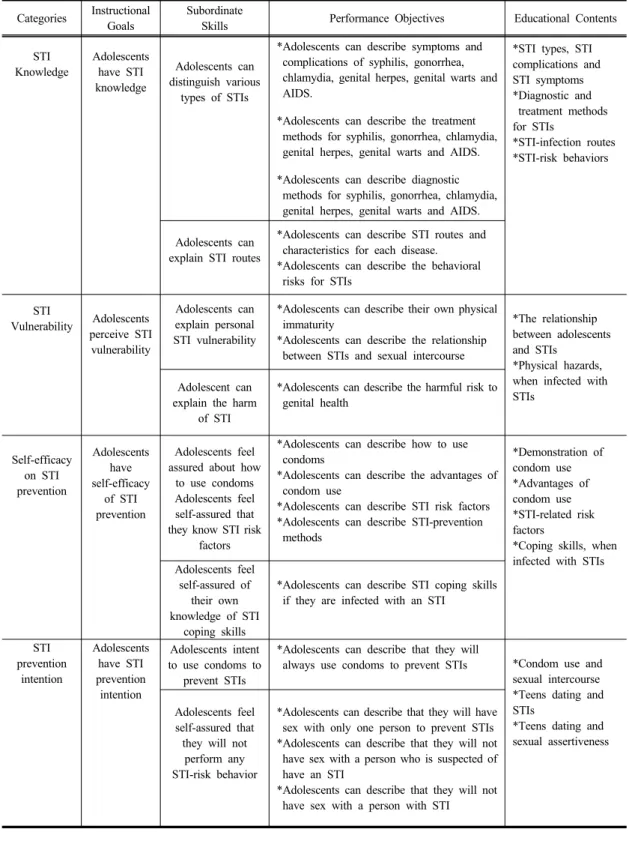
We developed an STI smartphone application to promote the sexual health of adolescents, enabling them to acquire accurate STI knowledge and STI-prevention skills. Dick and Carey’s (2014) instructional-system design (ISD) model provided the framework for this program (see Table 1)[18].
The ISD model indicates the processes and stages
we used to effectively organize all components to obtain goals. The goal was that even adolescents who spend little time studying would be able to reach their study goals[19]. Educators have used this model successfully in developing materials for adolescents in the past. The ISD includes 10 steps: identify instructional goals, conduct instructional analysis, identify learner and contexts, write performance objectives, develop assessment instruments, develop instructional strategy, develop instructional materials, design and conduct formative evaluation, design and conduct summative evaluation, and revise instruction.
The scope of this paper is confined to the development process of smartphone applications rather than evaluating the product. Thus, we describe the first seven steps of the process in this paper.
Throughout the developmental process, six experts reviewed the processes and contexts: two nursing faculty members, one school nurse, two medical doctors in the division of infectious diseases, and one expert in adolescent programs. Additionally, two experts in an information-technology company and one cartoonist supported the development of a customized smartphone application for adolescents.
2.1 Identify Instructional Goals
The first stage determined what learners can achieve after going through the education process[18]. These goals are derived from need assessments. Need assessments are discrepancy analyses between actual status and desired status. For actual STI education status of Korean adolescents, we analyzed six middle and three high school textbooks[20-28]. Systematically, we located some STI educational issues such as over-focused on AIDS, insufficient educational content about STI treatments and symptoms, and STI-prevention skills. To identify desired STI educational content, we analyzed STI content from the School of Sexuality Education Standard[29], sex-education guidelines from other countries[30-33]
and related literature on STI education for adolescents.
Finally, we defined ideal STI content as STI knowledge, STI vulnerability, self-efficacy for STI prevention, and STI-prevention intention. Consequently, based on the discrepancy between STI education problems and desired STI education content, we determined instructional goals for adolescents on STI-prevention intention with a goal to increase adolescents’ knowledge on STI information and STI-prevention skills.
2.2 Conduct Instructional Analysis
During this stage, when learners reached instructional goals, what they should do was determined by stages in a hierarchy[18]. Instructional goals had two steps: first, we determined categories of learning. In the first step, we divided the educational content into four categories: STI knowledge, STI vulnerability, self-efficacy, and STI-prevention intention. In the second step, we determined objectives for each category and developed one instructional goal for each category.
2.3 Analyze Learners and Contexts
In this stage, we analyzed learners’ STI learning experience, preferences, traits and learning situations[18]. For adolescents’ STI learning experience, currently, sex-education is not mandatory in South Korea and approximately 10 to 15% of adolescents get STI education in school[11]. Moreover, in most schools, the teacher does not conduct sex education;
rather an outside lecturer conducts sex education who is a specialist in sexual health[34]. So far, when educators teach STIs, they use PowerPoint Presentation or DVDs. Furthermore, sex education is conducted in one large group of all students gathered in an auditorium or the lecture is broadcast. Considering adolescents’ preferences as modes for education, we selected cartoons, animation, games, and video rather than descriptive education[35-37].
Categories Instructional Goals
Subordinate
Skills Performance Objectives Educational Contents
STI Knowledge
Adolescents have STI knowledge
Adolescents can distinguish various
types of STIs
*Adolescents can describe symptoms and complications of syphilis, gonorrhea, chlamydia, genital herpes, genital warts and AIDS.
*Adolescents can describe the treatment methods for syphilis, gonorrhea, chlamydia, genital herpes, genital warts and AIDS.
*Adolescents can describe diagnostic methods for syphilis, gonorrhea, chlamydia, genital herpes, genital warts and AIDS.
*STI types, STI complications and STI symptoms
*Diagnostic and treatment methods for STIs
*STI-infection routes
*STI-risk behaviors
Adolescents can explain STI routes
*Adolescents can describe STI routes and characteristics for each disease.
*Adolescents can describe the behavioral risks for STIs
STI
Vulnerability Adolescents perceive STI vulnerability
Adolescents can explain personal STI vulnerability
*Adolescents can describe their own physical immaturity
*Adolescents can describe the relationship between STIs and sexual intercourse
*The relationship between adolescents and STIs
*Physical hazards, when infected with Adolescent can STIs
explain the harm of STI
*Adolescents can describe the harmful risk to genital health
Self-efficacy on STI prevention
Adolescents have self-efficacy
of STI prevention
Adolescents feel assured about how
to use condoms Adolescents feel self-assured that they know STI risk
factors
*Adolescents can describe how to use condoms
*Adolescents can describe the advantages of condom use
*Adolescents can describe STI risk factors
*Adolescents can describe STI-prevention methods
*Demonstration of condom use
*Advantages of condom use
*STI-related risk factors
*Coping skills, when infected with STIs Adolescents feel
self-assured of their own knowledge of STI
coping skills
*Adolescents can describe STI coping skills if they are infected with an STI
STI prevention
intention
Adolescents have STI prevention intention
Adolescents intent to use condoms to
prevent STIs
*Adolescents can describe that they will
always use condoms to prevent STIs *Condom use and sexual intercourse
*Teens dating and STIs
*Teens dating and sexual assertiveness Adolescents feel
self-assured that they will not
perform any STI-risk behavior
*Adolescents can describe that they will have sex with only one person to prevent STIs
*Adolescents can describe that they will not have sex with a person who is suspected of have an STI
*Adolescents can describe that they will not have sex with a person with STI
Table 1. Categories, Instructional Goals, Subordinate Skills, Performance Objectives and Educational Contents
Additionally, one expert in this study recommended that because STI education addresses sensitive content, an individual education method could be useful rather than group study. The school nurse advised that instead of descriptive educational media such as videos, pictures, animations, and cartoons were effective to teach adolescents. Thus, we developed an educational method using a smartphone application that included cartoon clips, pictures, and illustrations.
2.4 Write Performance Objectives
When learners complete the education program, they create a detailed action plan about the knowledge they obtained, aligned with performance objectives[18]. We expected STI knowledge, perceptions of STI vulnerability, self-efficacy on STI prevention, and STI-prevention skills to change and improve after students received STI education. We describe each object in detail below. Then, we determined performance objectives. Based on instructional goals and subordinate skills in the four categories, we created performance objectives. Through content verification by the experts, we also translated the terminology of performance objectives into simpler language, allowing adolescents to fully understand the school nurse’s recommendation.
2.5 Develop Assessment Instruments
Assessment instruments determine whether learners achieved their goals[18]. Therefore, we developed an STI-Knowledge instrument, STI-Vulnerability instrument, Self-Efficacy on STI-Prevention instrument, and an STI Prevention-Intention instrument to evaluate whether adolescents achieved instructional goals and objectives.
We constructed the STI Knowledge instrument through experts’ assessment of content validity after modifying Yang’s (1999) instrument[38]. We developed the STI Vulnerability, Self-Efficacy on STI Prevention, and STI Prevention-Intention instruments after experts assessed the content validity and adjusted the number of items and level of difficulty.
Finally, we developed an assessment instrument consisting of 29 items on STI knowledge, four items on STI vulnerability, four items on self-efficacy of STI prevention, and four items on STI-prevention intention.
2.6 Develop Instructional Strategy
In the instructional-strategy stage, the educator determines the educational method that leaners will use to accomplish their final learning goals[18]. We developed the instructional strategy by applying Keller’s (1987) attention, relevance, confidence, and satisfaction model[39]. Keller’s model provides a systematic approach used in teaching and learning conditions in which instructors design the motivational aspect of a learning environment to lead and maintain academic motivation.
The first component is attention. To get adolescents’
attention, we used educational content with cartoons.
The second component is relevance, which means that as learners perceive they can relate to the education content, their academic motivation increases. Therefore, in the educational content, we included current STI prevalence rates of Korean adolescents and adolescents’ compliance rates with STI treatment. The third component is confidence in achieving educational goals. To boost learners’ confidence, we provided indirect experience with using condoms through links with an AIDS-education-center website.
Moreover, learners had the option to learn through the use of smartphones; thus, they were able to go through the topics repeatedly. To increase learners’
satisfaction and achievement, when learners studied all contents, they received stamps so that they could complete the evaluation through the assessment instruments.
2.7 Develop Instructional materials
In this stage, based on the instructional strategy, instructors developed and selected instructional materials[18]. We decided to develop a smartphone application for Korean adolescents’ STI education in
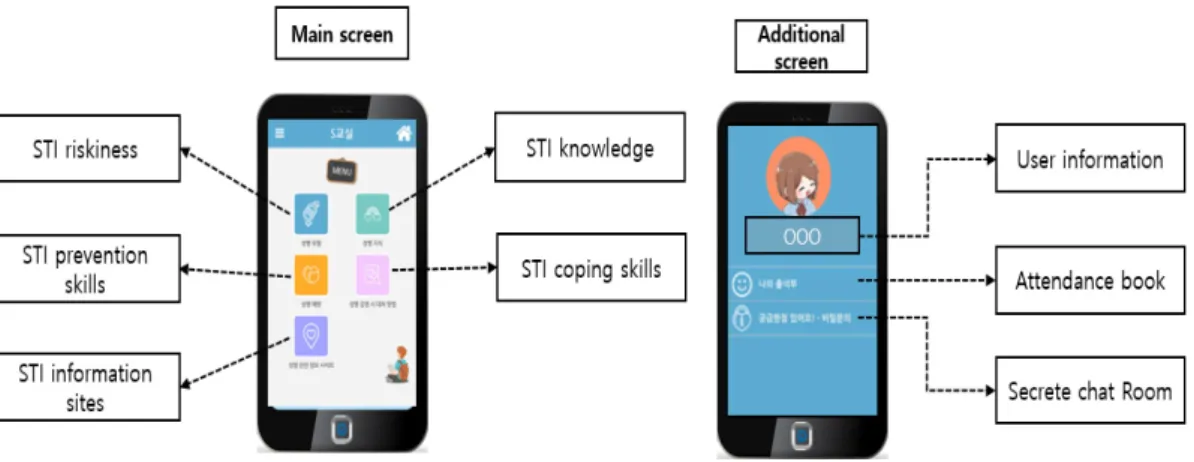
Fig. 1. Construction of the smartphone application
cooperation with an information-technology company.
Additionally, a professional cartoonist helped create the content of the smartphone application. After developing stories about STIs, we remade the stories with a cartoonist and verified this content with experts.
We attended to medical content on STIs that were continuously modified and supplemented through work with two doctors from the Division of Infectious Diseases. The educational content of the smartphone application consisted of four major categories: STI riskiness, STI knowledge, STI-prevention skills, and STI coping skills.
3. Adolescent-Customized STI Smartphone Application
The STI smartphone application described in this study was developed between December 2014 and December 2015, with an adolescent-friendly design and the ability to download freely through Android and Apple shops. We formatted this application to allow adolescents to study STIs in 20 to 30 minutes.
3.1 Constructions of Smartphone Application As a result of following the seven steps of Dick and Carey’s (2014) ISD, we developed five buttons for the main screen: STI riskiness, STI knowledge,
STI-prevention skills, STI coping skills, and STI information (see Figure 1). Also, an additional icon appeared on the upper right side of the main screen linked to an additional screen. The button has the user’s information, attendance book, and a private chat room.
Strategies we used to increase the attention duration of adolescents included use of cartoon clips and a private chat room. First, we developed the information on STI knowledge as cartoon clips (see Figure 2), based on true stories in order to gain viewers’
motivation. Cartoon clips also provided STI-infection routes, STI symptoms, STI diagnosis, and STI treatments. Also, if adolescents had some sexual problems, they could receive counseling from an expert in sexual health. The private chat room is an interactive system that could compensate for the limitation of previous smartphone application educational programs that provide a one-way communication system.
Fig. 2. Sample cartoon clips
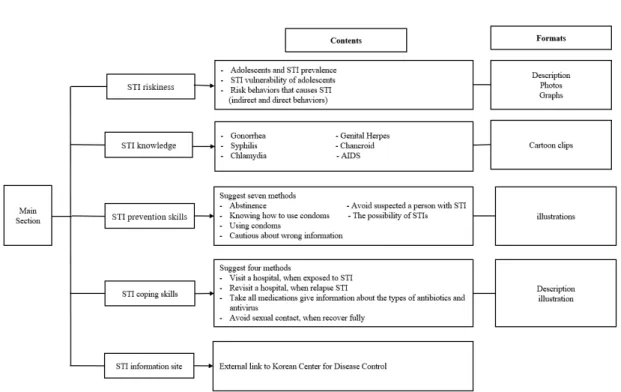
Fig. 3. Structure of smartphone application
3.2 Contents
The STI smartphone application largely comprises four categories: STI riskiness, STI knowledge, STI-prevention skills, and STI-coping skills. The button on the STI information site links to the Korean Center for Disease Control to provide additional information about STIs. The section on STI riskiness provides the prevalence of STIs in adolescents in South Korea, the STI vulnerability of adolescents, and risk behaviors that cause STI. Buttons for STI knowledge includes six types of STIs: gonorrhea, syphilis, chlamydia, genital herpes, chancroid, and AIDS. To increasing self-efficacy for STI prevention, the section on STI-prevention skills provided seven methods to prevent STIs: abstinence, knowing how to use condoms, using condoms, cautions about misinformation, avoiding a person with STI, the possibility of STIs, and a ban on STI-risk behaviors. The section on STI-coping skills provided four methods: first, visit a hospital when exposed to an STI. Second, take medicines when infected with an STI. Third, revisit a
hospital when experiencing a relapse of an STI. Fourth, avoid sexual contacts until you recover fully. Detailed information about the structure appears in Figure 3.
Strategies we used to enhance understanding of the content for the adolescents were color-changing buttons, questions and answers, and a repeated-learning function. The developed STI smartphone application allows adolescents to study STI information in an orderly fashion; thus, if an adolescent finishes studying one section, the color of the buttons changes to grey.
This process assists adolescents to determine their process of studying. As the last step, if adolescents finish all the content, the main screen changes to the questionnaire page, presenting the 41 items and allowing them to get feedback about their score.
4. Conclusion
In this paper, we introduced the steps we took to develop an STI smartphone application based on Dick
and Carey’s (2014) ISD. These steps included identifying instructional goals, conducting instructional analysis, analyzing learners and contexts, writing performance objectives, developing assessment instruments, developing instructional strategies, and developing instructional materials. In addition, we described five strategies that could attract the use of smartphone application for adolescents: cartoon clips, a secret chat room, color-changing icons, questions and answers, and repeated-learning methods. The developed smartphone application for STI education for adolescents could be a versatile tool that could be used in schools, youth centers, and hospital clinics.
References
[1] A. Dunne, J. Mclntosh, & D. Mallory, “Adolescents, sexually transmitted infections, and education using social media: A review of the literature” Journal for Nurse Practitioners, vol. 10, pp. 401-408, 2014.
DOI: https://doi.org/10.1016/j.nurpra.2014.03.020
[2] Korea Information Society Development Institute
“Analysis of Children and adolescents’ media holdings and use form: KISDI STAT Report”, vol. 15-18 Available from:
http://stat.kisdi.re.kr/Library/Library_detail1.aspx?Divisio n=1&seq=840. (accessed 20 August 2016)
[3] M. Samaha, N.S. Hawi, “Relationships among smartphone addiction, stress, academic performance, and satisfaction with life”, Computers in Human Behavior, vol. 57, pp.321-325, 2016.
DOI: https://doi.org/10.1016/j.chb.2015.12.045
[4] K. Olafsson, L. Blinka, “The effect of smartphone use on trends in European adolescents’ excessive Internet use” Behaviour & Information Technology, vol. 35, pp.
68–74, 2016.
DOI: https://doi.org/10.1080/0144929X.2015.1114144 [5] M.J. Cho, J.L. Sim, S.Y. Hwang, “Development of
smartphone educational application for patients with coronary artery disease”, Healthcare Informatics Research, vol. 20, pp.117–124, 2014.
DOI: https://doi.org/10.4258/hir.2014.20.2.117
[6] C.H. Su, C.H. Cheng, “A mobile gamification learning system for improving the learning motivation and achievements” Journal of Computer Assisted Learning, vol. 31, pp. 268–286, 2014.
DOI: https://doi.org/10.1111/jcal.12088
[7] F. Zotti, D. Dalessandr, S. Salgarello, M. Piancino, S.
Bonetti, L. Visconti, C. Paganelli, “Usefulness of an app in improving oral hygiene compliance in adolescent orthodontic patients” The Angle Orthodontist, vol. 86, pp. 101–107, 2016.
DOI: https://doi.org/10.2319/010915-19.1
[8] G.F. Dunton, E. Dzubur, K. Kawabata, B. Yanez, B. Bo, S. Intille, “Development of a smartphone application to measure physical activity using sensor-assisted self-report”, Frontiers in Public Health, vol. 2, Article 12, pp. 1-13, 2014.
DOI: https://doi.org/10.3389/fpubh.2014.00012
[9] L. Hebden, A. Cook, H.P. van der Ploeg, M.
Allman-Farinelli, “Development of smartphone applications for nutrition and physical activity behavior change”, JMIR Research Protocols, vol. 1, no. 2, e9, 2012.
DOI: https://doi.org/10.2196/resprot.2205
[10] G. O’Malley, M. Clarke, A. Burls, S. Murphy, N.
Murphy, I.J. Perry, “A smartphone intervention for adolescent obesity: Study protocol for a randomised controlled non-inferiority trial”, Trials, vol. 15, no. 43.
2014.
DOI: https://doi.org/10.1186/1745-6215-15-43
[11] C.Y. Lee, “Development of management strategy for sexually transmitted infection for Korean adolescents (National report)”, pp. 71-72, Yeonsei University, Seoul City, South Korea, 2016.
[12] D.S. Kim, Y.T. Kim, “A gender perspective on adolescent health and policy issues”, pp. 139-140, Korean Women’s Development Institute, 2012.
[13] S.D. Young, E. Rice, “Online social networking technologies, HIV knowledge, and sexual risk and testing behaviors among homeless youth”, AIDS and behavior, vol. 15, pp. 253–260. 2011.
DOI: https://doi.org/10.1007/s10461-010-9810-0
[14] K.E. Muessig, E.C. Pike, S. Legrand, L.B.
Hightow-Weidman, “Mobile phone applications for the care and prevention of HIV and other sexually transmitted diseases: A review”, Journal of Medical Internet Research, vol. 15, no. 1, 2013.
DOI: https://doi.org/10.2196/jmir.2301
[15] K.A. Phillips, D.H. Epstein, M. Mezghanni, M.
Vahabzadeh, D. Reamer, D. Agage, K.L. Preston,
“Smartphone delivery of mobile HIV risk reduction education”, AIDS Research and Treatment, pp.1-9, 2013.
DOI: https://doi.org/10.1155/2013/231956
[16] C. Kratzke, C. Cox, “Smartphone technology and apps:
Rapidly changing health promotion”, International Electronic Journal of Health Education, vol. 15, pp. 72 –82, 2012.
[17] Ministry of Education and Science Technology.
“Implementation plan of Smart education” [Press release]. Available from:
http://www.moe.go.kr/web/100026/ko/board/view.do
?bbsId=294&pageSize=10¤tPage=375&encode
&boardSeq=34952&mode=view. (accessed 16 August 2015) [18] W. Dick, L. Carey, J.O. Carey, J. O, “The systematic
design of instruction (7th ed.)”. pp. 2-300 Boston, MA:
Pearson, 2014.
[19] I.S. Lee, S.Y. Han, B.N. Lim, “Educational technology
& teaching methods”, pp. 300-310, Seoul City: Korea:
Moonumsa, 2010.
[20] M.H. Cha, S.E. Kim, K.M. Park, H.R. Lee, H.S. Jeong, J.H. Ju, M.H. Choe, M. H, “Middle school health” pp.
108-113, Seoul, Korea: Donghwasa, 2010.
[21] M.R. Han, M.J. Kim, E.Y. Kim, M.H. Park, Y.H. Park, J.H. An, C.E. Hyeon, “Middle school health” pp.
98-101, Seoul, Korea: Deulsaem, 2014.
[22] M.R. Han, E.H. Kwon, G.H. Kim, K.S. Park, J.Y. Lee,
“High school health”, pp. 127-135, Seoul, Korea:
Deulsaem, 2014.
[23] H.J. Jeong, C.Y. Kim, B.Y. Cho, S.B. Lee, E. Bang, J.Y.
Yun, J.H. Lee, “Middle school health”, pp. 118-123, Seoul, Korea: ChunJae Education, 2013.
[24] G.H. Kim, E.Y. Kim, Y.H. Kim, Y.G. Kim, S. Kim, P.H. Noh, E.H. Cho, “Middle school health” pp.69-71, Jellanamdo, Korea: Jellanamdo Office Of Education, 2012.
[25] Y.N. Lee, S.J. Park, I.S. Kwon, Y.H. Kwon, S.H. Park, E.R. Lee, “High school health” pp. 106-109, Seoul, Korea: ChunJae Education, 2014.
[26] O.Y. Woo, S.H. Cho, Y.H. Kim, E.H. Kim, S.Y. Hyeon, G.H. Lee, G. H, “Middle school health”, pp. 122-123, Seoul, Korea: YBM, 2015.
[27] O.Y. Woo, M.U. Gu, K.J. Kim, Y.S. Kim, S.G. Sin, H.Y. Ji, J.S. Hwang, “Middle school health” pp.
139-145, Seoul, Korea: Central Education Research Institute, 2012.
[28] O.Y. Woo, M.K. Kim, J.R. Kim, J.H. Kim, H.J. Kim, S.A. Park, G.Y. Choi, “High school health”. pp.
134-141, Seoul, Korea: Central Education Research Institute, 2015.
[29] Ministry of Education, Standards of sexuality education in school. Seoul, Korea, 2015.
[30] Federal Center for Health Education, “Standards for sexuality education in Europe” Available from:
http://www.oif.ac.at/fileadmin/OEIF/andere_Publikatione n/WHO_BZgA_Standards.pdf. (accessed 13 August 2015).
[31] Future of Sex Education, “National sexuality education standards: Core content and skills, K–12” Available from:
http://www.futureofsexed.org/documents/josh-fose-standa rds-web.pdf. (accessed 09 March 2015)
[32] Healthy Schools London, “London sex and relationships education (SRE) Primary scheme of work & secondary scheme of work” Available from:
http://www.healthyschools.london.gov.uk/sites/default/file s/SRE%20Primary%20Scheme%20of%20work.pdf.
(accessed 15 January 2015)
[33] United Nations Educational, Scientific and Cultural Organization, “International guidelines on sexuality education: An evidence-informed approach to effective sex, relationships and HIV/STI education” Available from:http://www.foxnews.com/projects/pdf/082509_
unesco.pdf. (accessed 09 March 2015).
[34] D.S. Kim, Y.T. Kim, S.E. Choi, “A gender perspective on adolescent health and policy issues” Seoul, Korea:
Korean Women`s Development Institute, 2012.
[35] K. Dalacosta, M. Kamariotaki-Paparrigopoulou, J.A.
Palyvos, N.Spyrellis, “Multimedia application with animated cartoons for teaching science in elementary education” Computers & Education, vol. 52, pp. 741– 748, 2009.
DOI: https://doi.org/10.1016/j.compedu.2008.11.018 [36] J.S. Downs, P.J. Murray, W. Bruine de Bruin, J.
Penrose, C. Palmgren, B. Fischhoff, B, “Interactive video behavioral intervention to reduce adolescent females’ STD risk: A randomized controlled trial” Social Science & Medicine, vol. 59, pp. 1561–1572, 2004.
DOI: https://doi.org/10.1016/j.socscimed.2004.01.032 [37] E. Maticka-Tyndale, J. Wildish, M. ichuru,
“Thirty-month quasi-experimental evaluation follow-up of a national primary school HIV intervention in Kenya”, Sex Education, vol. 10, pp. 113–130, 2010.
DOI: https://doi.org/10.1080/14681811003666481 [38] S.O. Yang, S.S. Kim, G.H. Jeong, S.J. Kim, “Report of
sexual health management for women and children”
Ministry of Health and Welfare.
[39] J. M. Keller “The systematic process of motivational design” Performance & Instruction, vol. 26, no. 9-10, pp. 1–8. Available from:
https://isd-resource-space.wikispaces.com/file/view/Syste matic+Motivational+Design.pdf. (accessed 15 September 2016)
Soo-Kyung Jeoong [Regular member]
•Feb. 2004 : Ewha Womans Univ., MS
•Feb. 2016 : Ewha Womans Univ., PhD
•May 2000 ~ Apr. 2007 : Seoul National University Hospital., RN
•Sep. 2016 ~ current : Incheon JEI Univ., Dept. of Nursing, Part-time lnstructor
<Research Interests>
Pediatric Nursing, Sexual issues in adolescence, Adolescent education
Chi-Young Cha [Regular member]
•Feb. 2000 : Ewha Womans Univ., MS
•Feb. 2010 : Univ. of Washington, PhD
•Mar. 2012 ~ current : Ewha Womans Univ., College. of Nursing, Assistant Professor
<Research Interests>
Healing process, Mobile health, Sociocultural influence on health and illness, Symptom clusters